Showing posts with label refugees. Show all posts

Thursday, June 13, 2019

"When someone tells you who they are, believe them"

One of the many movie lines (almost) that Ronald Reagan used was the one about the most terrifying words in the English language: "'I'm from the government and I'm here to help."

His party loyalists cheered him.

The reality is far from that.  In fact, it is closer to what Maya Angelou said: "When someone tells you who they are, believe them."  Almost always, except when the chief executive is from the GOP, the government is here to help.  Under the GOP Presidents, it seems true that those are some terrifying words.

Back when tRump was merely one of the contenders in the GOP primary, when he launched his blitzkrieg, his supporters cheered him on and some even defended him by saying that the media and his critics were taking tRump literally but never seriously.

But, those of us who adopted the Angelou guideline, took him literally and seriously.  How could we not?  He was so obvious. So transparent in what he said and did.

"When someone tells you who they are, believe them."

And here we are, when the President and his government machinery cruelly turns away the asylum seeking desperate people!
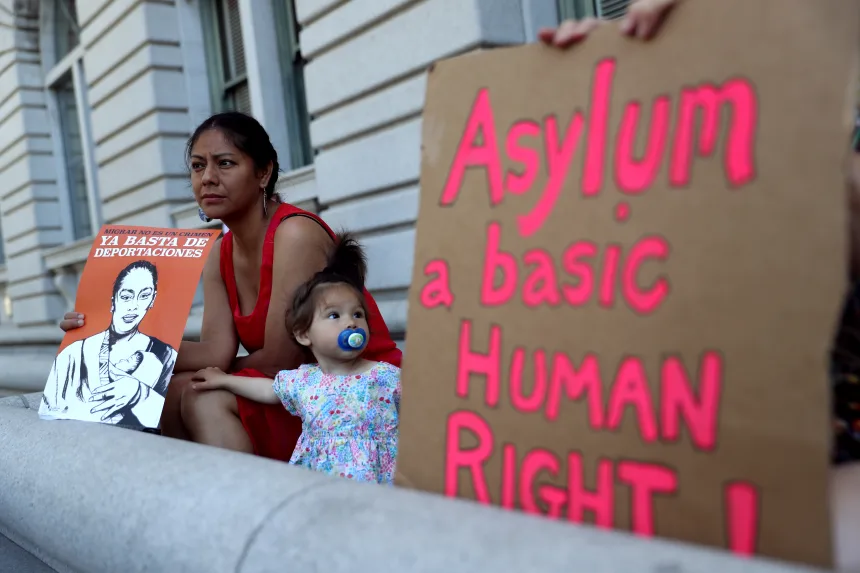
Caption at the source:
A protester holds a sign during a demonstration outside of the James R. Browning United States Courthouse on June 11th, 2019, in San Francisco, California. Dozens of activists staged a demonstration in support of restoring protections for asylum seekers.

tRump proves that reagan was right about the terrifying words in the English language.

The good thing is that the majority of my fellow citizens will not play his cruel games.  We may not be Jesus-loving Christians, but we practice a lot more of Jesus's preaching than they do when they support tRump.

A majority of my fellow Americans are like the jurors in the recently concluded trial in Arizona, where Scott Warren was accused as being a danger to the country all because he is a humanitarian. A Good Samaritan.  He provided water and food to migrants in the harsh desert.  That was his crime.

In the closing argument, the US Attorney--from the government to help us--said this:
He did a bad thing, for which the government wanted to send him to prison for 20 years!

The jury didn't buy that argument.  It ended in a mistrial.

For now, at least, tRump and his terrifying government have been held under check.  My hope is that the reign of terror will end soon.  We will return to the days of a helpful government.

Tuesday, January 29, 2019

If only there were more real Vaishnav people!

It is the anniversary of the assassination of Mohandas Gandhi.  He was shot dead on January 30th in 1948. I am re-posting here a modified version of one my op-ed columns
****************************************

Gandhi, who was born in 1869, led the independence movement that, in 1947, resulted in the creation of two new countries of India and Pakistan and, with that, the end of the British Raj. The struggle for freedom, in which Gandhi passionately urged his followers to observe non-violence even against the colonizer’s brutal force, inspired many others, including Martin Luther King Jr.
Life is full of tragic ironies — Gandhi and King, the champions of peace and nonviolence, fell to bullets aimed at them. Unlike Gandhi, who was assassinated in 1948, King had not lived long enough to live in the promised land of freedom.

Albert Einstein summed it up best for all of us when he wrote about Gandhi that “generations to come, it may well be, will scarce believe that such a man as this one ever in flesh and blood walked upon this Earth.” 

In the contemporary United States, any talk in the public space about peace and nonviolence is rare. Politicians of all stripes want to prove how much tougher they are than the other, out of a fear of being labeled a wimp.  The worst ones are those who successfully dodged the Vietnam War draft but now want to establish their manliness! This has been especially the case since the fateful events on Sept. 11, 2001. At the national level, the “tough” ones smell blood when an opponent does not talk of war. At this rate, even those running for the office of dogcatcher will have to prove their toughness.

Of course, violence is more than merely engaging in war. The political rhetoric, especially over the past four years since trump as a candidate and then as the president (gasp!) seems to have been anything but peaceful and nonviolent. A new day begins with attacks on yet another person or group of people, based on whatever cultural trait is deemed to be the “wrong” one for the moment. Even I, as insignificant as one can be in the political landscape, have been a target for those who are seemingly at ease with offensive words and rhetoric.

While words, unlike sticks and stones, do not break bones, the violence conveyed through words causes plenty of harm. In the noise and confusion of the violent rhetoric that surrounds us in the real and cyber worlds, we seem to have lost a fundamental understanding of what it means to be human.

One of Gandhi’s favorite prayers says it all about being human: It is to “feel the pain of others, help those who are in misery.” Unfortunately, the rhetoric and practice--even among those who claim to be followers of Vishnu--is far from that interpretation of humanity.

When it comes to the terrible humanitarian crises, like the situation in Aleppo, Syria, it is depressing and shocking to see how quickly we closed ourselves off from the “pain of others” and how easily we refuse to “help those who are in misery.” We have refused to budge even when the screens all around us flashed the images of dead toddlers. Or, the images of mothers and children running after being tear-gassed at the border for seeking asylum.

The president's adviser on immigration, whose life is possible only because the US offered asylum to Jews fleeing pogroms in Europe, boasts that “I would be happy if not a single refugee foot ever again touched America’s soil.”

The moral arc of the universe might bend towards justice, but the radius of the arc seems to be getting longer.  Perhaps we shall overcome all our problems, but only over a much longer time than I would like. 


Sunday, April 22, 2018

Shut the front door already!

Remember this?

Source
Or this?

Source

We in the US did not care. 63 million elected a guy who lacks even a drop of empathy.  The fate of Syrian refugees is not what he and his 63 million toadies worry about.  As long as the safety nets are torn apart, the natural environment is destroyed, and non-whites are shoved into the corners where we belong, well, their mission is accomplished.

Of course, the refugees being Muslims makes it all the easier for the 63 million bigots to close the door, even though the Syrians are not dark-skinned as most of us from shithole countries are.  So, more than a year into his monarchy, er, presidency:
In the last years of the Obama administration, the US resettled tens of thousands of Syrian refugees. When Trump took office, that number plummeted — partly because of the 120-day “refugee ban” that prevented nearly any refugees from being brought into the US over the summer of 2017, and partly because of specific scrutiny facing refugees from several countries, including Syria.
The result is that the US is on pace to resettle fewer than 100 Syrian refugees in the fiscal year that ends September 30. And it might not even be that many.
We might not even resettle 100 refugees this year.  Not even a 100 out of the more than 5.5 million Syrians who have fled the country!  
The global refugee crisis is, by some measures, worse than ever. And the Syrian civil war, and the world’s response to it, is a big part of why. Syria accounts for 24 percent of the world’s 22.5 million refugees recognized by the United Nations High Commissioner on Refugees. (Before the war, Syria had about 21 million people, or 0.3 percent of the world’s population.)
But what truly distinguishes the current refugee crisis is that now, more than ever before, refugees are likely to remain displaced for years or even decades, instead of being able to either return home or be permanently resettled in a third country.
The 63 million bigoted bastards "fundamentally don’t believe that there is such a thing as the “global refugee crisis."  Exactly what their religious leader advised them to do, right?!

Source

Sunday, December 24, 2017

Silent Night

About a refugee and migrant camp in Moria, on the Greek island of Lesbos:
If we want to imagine the Nativity, we needn’t go farther than the tent of Alaa Adin from Syria, who left his home just days after he married. Now his wife is pregnant, and when I met them they were living in a tent outside of Moria, because there was no room for them inside.
If we want to see today’s flight to Egypt, we needn’t look far: Nearly every refugee I’ve ever met has a story about escaping in the middle of the night.
If we want to understand a life upended for a census, we need only ask those refugees whose futures are uncertain until their asylum requests are processed, their entire lives now held hostage to bureaucracy.
If we want a miracle, I’d suggest looking at Anwar, who despite crying while recounting the destruction of Mosul, still paused in the middle and offered me a clementine.
As we live through the largest migration in modern history, Christmas invites us to recognize our story in the millions who have been displaced by tyrants, war and poverty and to see their stories in ours.
Pope Francis delivers a message in his address:
Using the example of the holy family to emphasize the “dangers that attend those who have to leave their home behind,” Francis noted that in Bethlehem, Joseph and Mary found a city “that had no room or place for the stranger from afar,” and which “seemed to want to build itself up by turning its back on others.” Instead, the pope said, Jesus “comes to give all of us our document of citizenship.” ...
On Christmas Eve, he recalled the famous appeal of John Paul II to opponents of Communism, that they should “Be not afraid,” “open wide the doors” and have confidence that their cause was just and would prevail.
Francis repurposed the message as an appeal for hospitality to the world’s forsaken. “Christmas is a time for turning the power of fear into the power of charity,” he said.
Peace!

Caption at the source:
A Syrian boy outside his family’s tent near the Moria refugee camp in Lesbos, Greece.

Monday, June 12, 2017

On immigrants and refugees in trumpistan

Soon it will be the longest day of the year in the northern hemisphere.  But then, every day has seemed long like the longest day ever since the disastrous November election.

The president campaigned on various hateful themes, including putting an end to Muslim refugees and to undocumented immigrants. Those themes, and more, won him the few votes that made all the difference in states like Pennsylvania where Hillary Clinton got 2,926,441 votes versus 2,970,733 for trump.  A difference of 44,292 votes.  Clinton's share was 47,46% of the votes cast, and trump's was 48.18%  The winner-take-all electoral votes went to trump.

How are things in trumpistan?
Immigration law is being enforced more aggressively. Out in rural Pennsylvania, in a county Donald Trump carried with 66% of the vote, this is already having a devastating effect on the economy and culture.
That is from an uber-left publication?  Nope; it is an op-ed in the Wall Street Journal!
Beautiful as it is, York Springs is the sort of place people leave after they finish high school. When I moved here in 2012, real estate was cheap and abandoned houses dotted the back roads. The town was aging and dying, though Mexican newcomers were already bringing green shoots. Over the past five years I’ve seen a steady renewal. Townspeople have fixed up many old houses and are raising families.
There has been a little tension, but York Springs in recent years has developed a vibrant, intersectional culture, insofar as that’s possible in such a sparsely populated place.
And then the elections happened.
This stringent enforcement of immigration law is destroying a rich, new rural culture. It’s likely to destroy the economy, too. The orchards generate over $500 million a year, and, one way or another, most of the jobs. But the local growers, many of whom have been operating the family orchards for generations, worry they won’t have enough manpower this fall to harvest the crop.
Sure, a lot of the white folk out here voted for Mr. Trump. Even then, many of them had reservations specifically about his immigration stance. I heard them expressed by Trump supporters in line to vote at the Latimore Township building. Now as we spiral into a local depression that is personal, cultural and economic, a lot of them are going to regret voting for him anyway.
An hour away from York Springs is Lancaster, deep in the Amish country.  This area too was won by trump.  What I didn't know until today is this, which I came across in my Twitter feed:
The ever doubting me did a quick Google search.  It is true.  Like in this news report from a couple of months ago:
Here in Lancaster County, a politically conservative area well known for its Amish community, traditional Christian values run deep. Since the Church World Service opened a Lancaster office 30 years ago, it has been a favored destination for resettling refugees because churches here easily assemble welcome teams whose members see it as a godly duty to care for those in need.
In the last fiscal year, Lancaster County resettled more than 400 refugees from all over the world, with the largest numbers coming from the Congo and Syria.
For once, I hope that the white supremacist British bastard, aka Churchill, was correct when he said that Americans will do the right thing after they exhaust all other possibilities.  After electing trump, there is nothing worse that we can do.  Here is to hoping that better days are ahead.

But, of course, hope alone won't change the world.  So, I did the next best thing that I could: I donated.


Saturday, September 24, 2016

May Peace Be With You

I have sent this across to the editor

The United Nations marks October 2nd as the “International Day of Non-Violence” for a very good reason--it is the birthday of Mohandas Karamchand Gandhi, popularly known as Mahatma Gandhi.

Gandhi, who was born in 1869, led the independence movement that, in 1947, resulted in the creation of two new countries of India and Pakistan and, with that the end of the British Raj as well. The struggle for freedom, in which Gandhi passionately urged his followers to observe non-violence even against the colonizer’s brutal force, inspired many others, including Martin Luther King, Jr.

Life is full of tragic ironies--Gandhi and King, the champions of peace and nonviolence, fell to bullets that were aimed at them. Unlike Gandhi, who was assassinated in 1948, King had not lived long enough to live in the promised land of freedom.

Albert Einstein summed it up best for all of us when he wrote about Gandhi that “generations to come, it may well be, will scarce believe that such a man as this one ever in flesh and blood walked upon this Earth.” On Gandhi’s birthday, it certainly will help us all to be reminded of, as the UN puts it, the human desire for "a culture of peace, tolerance, understanding and non-violence."

In the contemporary United States, any talk in the public space about peace and nonviolence is rare anymore. Politicians of all stripes want to prove how much they are tougher than the other, out of a fear of being labeled a wimp otherwise. This has been especially the case since the fateful events on September 11, 2001. At the national level, the “tough” ones smell blood when an opponent does not talk war. At this rate, even those running for the office of a local dog catcher will have to prove their toughness.

Of course, violence is more than merely about engaging in war. The political rhetoric over the past year seems to have been anything but peaceful and nonviolent. A new day begins with attacks on yet another person or group of people, based on whatever cultural trait is deemed to be the “wrong” one for the moment. So much so that even I, as insignificant as one can be in the political landscape, have been a target for those who are seemingly at ease with offensive words and rhetoric!

While words, unlike sticks and stones, do not break bones, the violence conveyed through words causes plenty of harm. In the noise and confusion of the violent rhetoric that surrounds us in the real and cyber worlds, we seem to have lost a fundamental understanding of what it means to be human,. One of Gandhi’s favorite prayers says it all about being human--it is to “feel the pain of others, help those who are in misery.” However, and unfortunately, the overall rhetoric and practice these days is far from that interpretation of humanity.

When it comes to the terrible humanitarian crises, like the situation in Aleppo, in Syria, it is depressingly shocking how quickly we closed ourselves from the “pain of others” and how easily we refuse to “help those who are in misery.” We have refused to budge even when the screens all around us flashed the images of Aylan Kurdi--the toddler who was dead, face down, on a beach--or the five-year old Omran Daqneesh, whose dust and blood covered face looked dazed and confused.

Meanwhile, all around the world, the number of people displaced from their homes continues to increase. The United Nations estimates that by the end of 2015, the number of people who have been forcibly displaced from their homes numbered 65.3 million. The UN High Commissioner for Refugees, Filippo Grandi, noted that “at sea, a frightening number of refugees and migrants are dying each year; on land, people fleeing war are finding their way blocked by closed borders. Closing borders does not solve the problem.”

As I write this column, peace and nonviolence seem to be evaporating even in Gandhi’s old lands of India and Pakistan. Tension between the two countries is at such high levels that international media and commentators wonder, and worry, whether the neighbors are getting ready for yet another war. As often is the case with these sibling countries, this time too the fight is over Kashmir, but with plenty of nuclear bombs on both sides of the border.

We shall certainly overcome, in the long run. In the meanwhile, on the “International Day of Non-Violence,” like the stereotypical beauty pageant contestant, I too will wish for world peace.

Thursday, August 18, 2016

This, too, shall pass. Unfortunately!

As we were enjoying the tastiest Morrocan sweets and the freshest strawberries, I paused.  "I know I say this a lot, but I want to remind ourselves about the awesome life that we have. With such food in plenty. On a great summer evening."


I am immensely thankful for the life that I have.  If ever I forget how lucky I am, all it takes is one visit to any of my favorite news sites to re-calibrate.

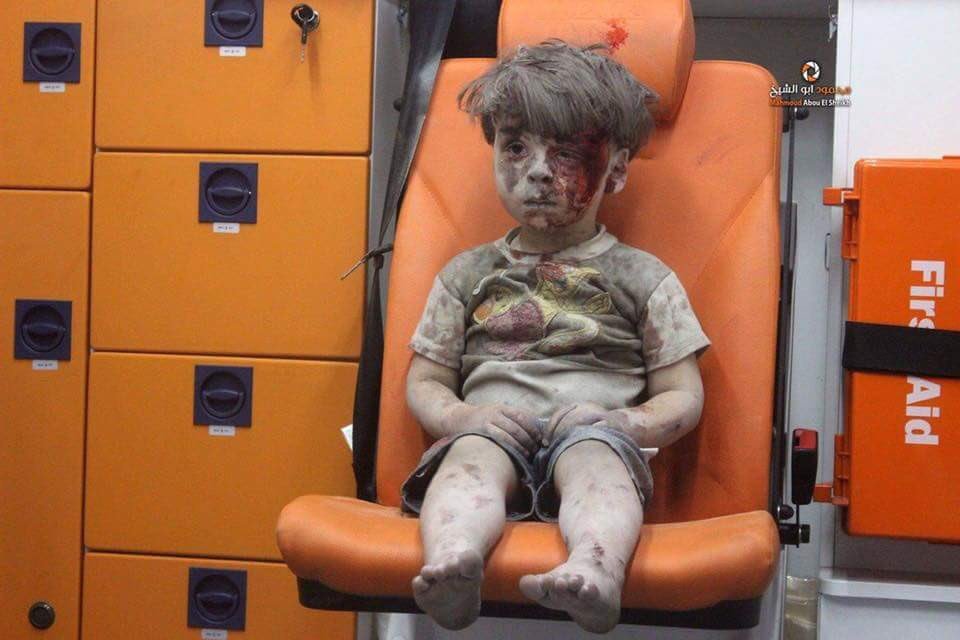
Contrast my life to the life of the kid in this photo:

Source
Even without knowing any backstory, any normal human being with a little empathy would feel terrible for that kid.  A kid with a name and a tragic backstory:
The boy, identified by medical workers as Omran Daqneesh, 5, was pulled from a damaged building after a Syrian government or Russian airstrike in the northern city of Aleppo.
How awful!
Maybe it was his haircut, long and floppy up top; or his rumpled T-shirt showing the Nickelodeon cartoon character CatDog; or his tentative, confused movements in a widely circulated video — gestures familiar to anyone who has loved a child. Or the instant and inescapable question of whether a parent was left alive to give him a hug.
In any event, by Thursday morning, Omran’s image had been broadcast and published around the world
We might share the image and the news. I blog about it. We talk about the kid and the war.  But, the killings continue.  A civil war that has dragged on for years.  Not only have we been witness to the horrors, we do not even want to help those who are fleeing from this hell.

Here in the US, we even have a presidential candidate who proudly vows that his America will not help the refugees--and there are tens of millions of my fellow citizens who even more proudly cheer him and his rhetoric!  We cannot expect any sympathy from that wannabe leader of the free world--after all, he couldn't even stand a crying kid at his rally!

Normal decent humans, unlike that candidate and his followers, will relate to this Syrian kid.
Omran, as he is carried from a damaged building in the dark, could be Everychild. He looks around in confusion, his chubby forearm draped trustingly across the reflective stripe on his rescuer’s back, before he is plopped into the chair at the back of ambulance, lit blindingly white.
He settles into a thousand-yard stare, apparently too stunned to cry. Then he puts a hand to his bloody brow, looks at his palm in surprise, and tries to wipe it on the chair. Then he glances around, as if trying to understand where he is. 
But, it is not as if photographs of kids catalyzed us into humanitarian efforts.  Remember this?

Our lives will continue.  We will have good food. Spend evenings with friends and family.  Go on vacations. Complain about the choppy cellphone signal.  Cry over the sports team that lost.

Meanwhile, adults and kids will continue to die in the brutal civil war:
Cases like Omran’s are a daily sight in eastern Aleppo, several doctors said, but he was lucky in that he made it to a hospital that was still open. ...
A boy lay on the floor, his legs missing. A woman in black put her hand to her mouth in anguish.
Another boy lay on a gurney, soaked in blood, as a clinician worked on him. A few minutes later came another text message: The boy had died. His name was Ibrahim Hadiri, and there was a new photograph of his face, eyes closed. It is not likely to go viral.

Tuesday, May 31, 2016

Remember Aylan Kurdi?

Remember this from nearly a year ago?


Who the fuck cares, right?  I mean, given the more important and urgent issues like how a man's fingers tell us about the size of his penis!  Especially when that was a Muslim male child, who would have only grown up to be a terrorist, right?  We are seriously fucked up in our understanding of what it means to be human! :(

That kid had a name.  Aylan Kurdi.  He had a family who loved and cherished him.  His father, who managed to survive, remembers and laments:
Aylan Kurdi's father has said his son and family "died for nothing" after a string of boat disasters in the Mediterranean that have put 2016 on course to be the deadliest ever year for refugees.
The father continues:
“Refugee children continue to drown every day, the war in Syria has not stopped,” he told Italy's La Repubblica newspaper.
“I see countries who build walls and others that do not want to accept us. My Aylan died for nothing, little has changed.”
I never would have imagined that I would live through a time when the entire world simply stood and watched a humanitarian disaster unfold before our eyes--in real time, thanks to the global electronic coverage.  It is depressing to think about how we simply do not care a shit about this tragedy.

You think yet another photograph of yet another dead child will make any damn difference?

Source

We won't care about the death of this child, too.  We will run marathons, watch ball games, and spend gazillions on entertainment of every possible kind.  Hey, it is a free market where people exercise their preferences.  Our preferences clearly reveal that we don't care a shit when people struggle for their very existence.  Especially the brown people.
The unidentified child died in one of the three big tragedies involving migrant boats last week that left more than 700 people dead, coinciding with an increasing number of people who are attempting the perilous crossing to Europe as the weather improves.
It will be a long summer of tragedies.  Yawn!

Thursday, April 21, 2016

A boat. 500 dead. Yawn!

One of the harsh realities that I have been struggling with from my early teenage years is this--the world treats some lives to be more important than others.

I suppose if we are mere animals deep down, then we would indeed not care about some.  But, if we believe that we are better than a brutal animal behavior, then we will have to resolve within ourselves why some lives matter more than others.

I am not breaking any new ground in this blog with this post.  From the supremacy of the brahmins and whites, to ALS v. Ebola, there are posts in plenty.  I continue to think about them because, well, every day there is something happening to remind me about this lifelong struggle.

Today, it was this:
As many as 500 migrants seeking a better future in Europe may have drowned last week in the Mediterranean Sea between Libya and Italy, U.N. refugee officials said Wednesday.
If true, the toll would make the incident one of the worst tragedies involving refugees and migrants over the last year.
Five hundred died.  We will read about it, or watch it, feel bad for a few minutes, and then we will shrug our shoulders and move on.  If this flashes in our news radars, that is!
The survivors in Kalamata included 37 men, three women and a 3-year-old child. They were from Somalia, Ethiopia, Egypt and Sudan.
Every once in a rare while, we do manage to do the right thing.  Like this story about "one of the girls who was abducted from the Chibok school by Boko Haram in 2014 and managed to escape."  Remember the Boko Haram kidnapping young girls?  At least there are some who cared enough.  Thanks to the efforts of Chris Smith, a representative to Congress from New Jersey, this girl and her friend came to the US.  She is now a college student--she started college in January.

If only we could focus on such profound issues that will educate us on what it means to be human!

Thursday, January 07, 2016

Madaya, the world is insane

In the old Tamil language, is a word "madaya"--to refer to person who behaves crazily.  A slight twist to the pronunciation and it is the name of a town in Syria that I hadn't known about until I read in the news.  One of those instances that reinforces the notion that no-news is good-news.

What about Madaya?  It is "a Syrian town besieged by the army of President Bashar al-Assad."
Civilians in Madaya, near the Lebanese border, say people are beginning to starve to death and children are severely malnourished after weeks with no adequate food.
The 40,000 residents of the town have been under siege for seven months by Syrian government forces and Hezbollah militias.
It is not as if Madaya is in some remote corner of the country.  It is "about 25km (15 miles) north-west of Damascus and 11km from the border with Lebanon."  In case we wonder why they haven't fled like the hundreds of thousands of other Syrians, the town is "surrounded by landmines."
It's not clear why Madaya shot to such prominence, given that other rebel-held areas, such as some of the Damascus suburbs, have been besieged for much longer. Perhaps Madaya was easier to seal off completely. Some blockades are quite porous.
But wounded pro-government fighters recently evacuated from rebel-besieged villages in the north also described people desperately eating grass to survive.
In my job and in my personal life, I try to be as optimistic as possible.  But, the events over the last month have seriously dented my optimism.  After a long, long, time, I begin a new year with nothing but apprehension and worry.  Things are not adding up well.

The town is at 1,400 meters (about 4,500 feet) elevation, which will make it that much more difficult during these winter months:
Conditions have worsened with the onset of winter.
"People here have started eating earth because there's nothing left to eat," Madaya resident Abdel Wahab Ahmed, told the BBC on Thursday. "Grass and leaves have died because of the mounting snow."
Under siege and with winter in an elevation means nothing to eat:
Families are eating leaves, grasses and water flavoured with spices in the town of Madaya, where rice is sold by the gram because a kilogram costs as much as $250 (£170). Some have killed and eaten their pets.
“People are dying in slow motion,” said Louay, a social worker from the town told the Guardian in a phone interview, his voice weakened by months of abject hunger. “We had some flowers growing in pots at home. Yesterday, we picked the petals and ate them, but they were bitter, awful.”
Six months into the siege, the people have practically given up:
“Here, we no longer call on anyone,” said Louay. “We have called for help so many times and nobody has heard us. But we want to ask the officials and decision-makers out there, if you were in this position, and your children were dying from hunger in front of you, what would be your reaction to the world outside that let you down? Don’t forget to ask your readers this question.”
Readers?  In America?  Here in this country where the oxygen in the news has been sucked out by the crazies of Donald Trump, Ben Carson, and the whole line up?  Here in Oregon where the news oxygen has been sucked up by gun-carrying crazy white men who want to "reclaim" as their land that once belonged to the Paiute?

The world is not insane. It is fucked up! :(

Wednesday, September 02, 2015

Shame on us! :(

Maybe I should simply give up on understanding anything that goes on in this world.

Consider, for instance, the war in Syria.  And the refugee crisis:

Source
When the numbers are in hundreds of thousands, we easily forget what every one of those fellow humans mean.  One of those who made it out of the country, but not alive, was this toddler:

Source

The Guardian, from where I grabbed that photograph, reports:
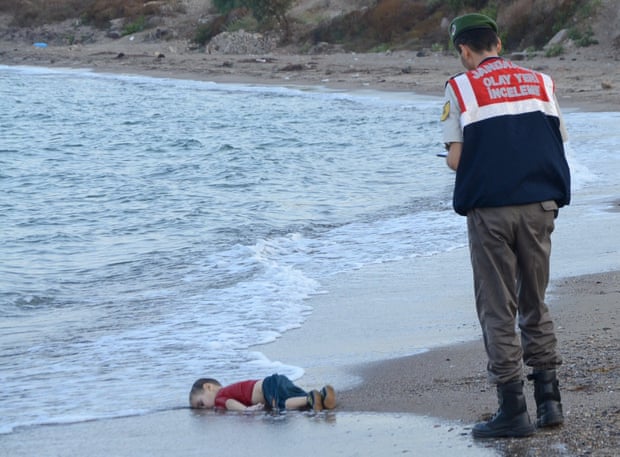
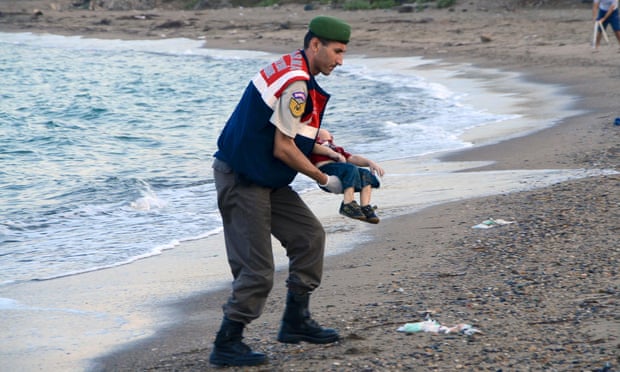
The full horror of the human tragedy unfolding on the shores of Europe was brought home on Wednesday as images of the lifeless body of a young boy – one of at least 12 Syrians who drowned attempting to reach the Greek island of Kos – encapsulated the extraordinary risks refugees are taking to reach the west.
The picture, taken on Wednesday morning, depicted the dark-haired toddler, wearing a bright-red T-shirt and shorts, washed up on a beach, lying face down in the surf not far from Turkey’s fashionable resort town of Bodrum. 
That image haunts me. It should haunt every one of us.
Turkish media identified the boy as three-year-old Aylan Kurdi and reported that his five-year-old brother had also met a similar death. Both had reportedly hailed from the northern Syrian town of Kobani, the site of fierce fighting between Islamic state insurgents and Kurdish forces earlier this year.
 There is something seriously wrong with the world.  A world in which here in the US we are fixated on Donald trump's latest theatrics.  Nicholas Carr writes:
It’s worth asking, though, what kind of democracy is being promoted. Early digital enthusiasts assumed that the web, by freeing the masses from TV news producers and other media gatekeepers, would engender a deeper national conversation. We the people would take control of the discussion. We’d go online to read position papers, seek out diverse viewpoints and engage in spirited policy debates. The body politic would get fit.
It was a pretty thought, but it reflected an idealized view both of human nature and of communication media.
Seriously, is it worth calling ourselves the greatest country that the planet has ever known when we pay immensely more attention to Trump than to a grave humanitarian crisis that resulted in the three-year old dead, face down on the beach?  WTF!
Because it simplifies and speeds up communications, the formulaic quality of social media is well suited to the banter that takes place among friends. Clicking a heart symbol may be the perfect way to judge the worth of an Instagrammed selfie (or even a presidential snapshot). But when applied to political speech, the same constraints can be pernicious, inspiring superficiality rather than depth. Political discourse rarely benefits from templates and routines. It becomes most valuable when it involves careful deliberation, an attention to detail and subtle and open-ended critical thought—the kinds of things that social media tends to frustrate rather than promote.
As the NY Times notes, people have tweeted and Facebooked about that haunting image of the three-year old dead boy.  But, at best, people click "like" and move on to a video of a cat playing the piano.  We seem to have lost even the little bit of a common sense and a shared space where we engaged in deeper conversations.  What is wrong with us?

That was a toddler!  I have no hope that the image will make us collectively think about the four million refugees who are alive ... I give up.

A kid.
A three-year old.

Caption at the source:
 A Turkish police officer carries a young boy who drowned in a failed attempt to sail to the Greek island of Kos. 

Friday, March 05, 2010

One day in the life of .... an Iraqi refugee

We use euphemisms to hide away the real trauma and tragedies in lives all around.  "Displaced persons" is one such sterile euphemism.  The Iraq situation has triggered the displacement of quite few, many of whom have ended up as refugees in Jordan.

How is the daily life of such a refugee in Jordan?  What were some of these refugees doing back in Iraq?  Here is one example--a photo narrative.

Yes, the title of this post is a play on Solzhenitsyn's One Day in the Life of Ivan Denisovich