Showing posts with label america. Show all posts

Tuesday, January 26, 2021

America: A Dane makes idlis, and a Puerto Rican makes pakoras

One day, in my life in California, when I was working as a transportation planner, the secretary buzzed and said that I had a call.

In an unmistakable Indian accent, he introduced himself as Kris, and that he was a professor at the local university.  He called to appreciate my commentary in the newspaper.

In that short phone call, he invited us over for dinner.

It turned out that Kris was an an Americanized name.  He was Venkatakrishna. He and his wife, Kirsten, were much older than me, almost as old as my parents.

Kris was delighted that a younger Indian immigrant was writing commentaries in the paper.  He wanted me to join him at the university as a colleague, and even introduced me to a couple of people to explore if I could at least teach as an adjunct.  Nothing worked out.  He was more disappointed than I was. If memory serves me well, Kris unexpectedly died before my return to academe.

Kris was a strict vegetarian, but not a cook.  Kirsten was a good cook.  She made idlis for him and froze them in packets.  All Kris had to do whenever he wanted to eat idlis was take a packet from the freezer and microwave the idlis.

Kirsten made plenty of other Indian dishes too. Including sambhar for the idlis!  And chicken tikka masala for her sons.  And a whole bunch of Danish delicacies.

Yes, Danish.

The two of them met in Denmark where he had been as a graduate student, and the couple made America their home.

I was reminded of Kris and Kirsten when I read this memoir essay about an Indian father and a Puerto Rican/Italian-American mother.

In 1979, when Loretta and Roop were dating, he’d take her to restaurants in Jackson Heights, in Queens, where many working-class immigrants lived upon arriving in the US. The aromas, colors, tastes and textures that flowed out of storefronts from merchants selling Indian goods intoxicated my mother, and piqued her interest in Indian culture.

Imagine that!  Forty years ago, a young man from India going out with a young Puerto Rican woman.  Perhaps a rare thing even now?

The author continues with anecdotes.  I love this one after the young bride "failed" in her attempt to make a chicken curry with coconut milk:

It was an embarrassing moment for my insecure mother, as the unforgiving wives and girlfriends she had cooked for reveled in her failure. “So, how does it feel to be marrying a foreigner?” one of them said to Roop. “No, we are the foreigners,” he said, referring to himself and the entire dinner party of Indian immigrants, and defending my mother.

That is something!

I hope that President Biden will make more such immigrant stories possible.  After all, these stories are possible only in America.


Monday, September 30, 2019

Yom Kippur is round the corner

Israel's Netanyahu is trying to manipulate politics yet again in order to stay in office and preclude indictment. If he succeeds, then he will try his best to intervene in our politics too because of his conviction that Democrats are not as pro-Israel and anti-Iran as he would like.

Meanwhile, tRump, who is a frenemy of his, has a yuge challenge ahead of him to avoid impeachment and prison time.

Even though I operate under a don't_forget/don't_forgive approach to life, if only these horrible human beings and their sycophants would take at least a few minutes next weekend in order to think about Leonard Bernstein's profound remarks that he gave at Harvard decades ago (emphasis mine):
I have come here tonight to share with you something I learned on this fantastic three-week journey abroad: first, that I have never loved my country so profoundly and caringly as I do now; second, that because of that love I feel more than ever the compulsion and responsibility to re-examine our automatic enemy-concept; and last, that this is a great time to do it, during these 10 days of prayer and reflection.

There is a charming legend about this penitential period: It is said that on Rosh Hashanah, New Year’s Day, the golden Book of Life up there in the sky is inscribed with the name of every single human being, along with his or her destiny for the year: who will live and who will die, who by fire and who by water, who will prosper and who will not. But there are 10 days within which one can change that inscription for the better—by prayer and the practice of good deeds. Charity and faith can avert the evil decree (you see, it’s all just another version of Corinthians, chapter 13). In other words, it’s now or never, because on the 10th day, Yom Kippur, the big book is closed and sealed for the year. Sorry folks, that’s it.So here we are on the eighth night, and I want to make my own public confession of faith, hope, and charity. You see, a couple of years ago I had a bit of a falling-out with my esteemed and well-loved friend Derek Bok. I won’t bore you with the story, but the rumpus was basically about a book written and published at Harvard and blessed with a sizable preface by President Bok. I read and hated this book and became quite exercised about the preface, which didn’t exactly endorse the book, but the presence of which, up front and center, by so distinguished a thinker, gave the book a certain cachet I didn’t think it deserved. Dare I mention its name? Living with Nuclear Weapons—the title alone was discouraging enough. Well, I got real mad and, in a self-righteous huff, stopped further contributions to the Harvard scholarship fund I had established years before. I was wrong to do so; and even though Derek and I have never debated the matter publicly or privately—never even had that lunch we promised each other—nevertheless I have sinned, I re-examine, I re-evaluate, and I hereby return the withheld funds.

There is no enemy; there is the American principle of free debate; fighting against an invented enemy is wasteful; fighting for ourselves and one another is constructive, is sharing—otherwise known as love.Let me leave you with the thought that we all have until Monday night to meditate, rectify, re-assess, and get that celestial inscription changed. Try it, it’s worth it. And, as we say, shana tovah, a good year, and hatimah tovah, a good inscription. Bless you.
So, yes, "shana tovah,"

Friday, August 09, 2019

What makes America great?

Back in February, I blogged about writing to Jill Lepore asking her if she had written such an essay somewhere on what makes America great.  Lepore replied: "I think my answer to that question is in my next book, which is called "This America: The Case for the Nation."

I read her op-ed in the NY Times.  I liked what she was arguing for:
I suppose I could have made the book a part of my summer reading.  But, this is the first summer when I have taken off from any serious work.  After years of M suggesting that I get out of my head, I implemented it.  It feels like I have put down a huge weight that I had been carrying on all these years.  I have no idea how people like Lepore keep going!

But then even when I don't read books, I do read plenty of book reviews.  This essay reviews Lepore's "This America: The Case for the Nation."  Well, it is a twofer that also reviews "This Land Is Our Land: An Immigrant’s Manifesto," whose author is an Indian-American--Suketu Mehta.

I haven't read Mehta's book either; but, I have read his op-ed and have heard him articulate his argument.
So, the review essay is not about books that will be unfamiliar terrain.
Nationalism is currently thriving, she believes, because the discourse of American liberalism is deficient. First, that discourse undervalues the radicality and relevance of the country’s founding ideals; second, the preoccupation with the rights of subgroups is essential, certainly, but politically inadequate; third, and here I put the matter much more crudely than Lepore would, liberals must in some sense do battle for possession of the Stars and Stripes. However gauche or complicit it may seem, they must understand and unapologetically frame their values—which currently have a niche, somewhat subversive emphasis—as our core national values:
This America is a community of belonging and commitment, held together by the strength of our ideas and by the force of our disagreements. A nation founded on universal ideas will never stop fighting over the meaning of its past and the direction of the future…. The nation, as ever, is the fight.
I am struck by the reviewer's blunt statement that "liberals must in some sense do battle for possession of the Stars and Stripes."

"The nation, as ever, is the fight."

Right on, Professor Lepore!

"I claim the right to the United States, for myself and my children and my uncles and cousins, by manifest destiny.”

That was not me, but it is from Mehta.
This land is your land, this land is our land, it belongs to you and me. We’re here, we’re not going back, we’re raising our kids here. It’s our country now…. We’re not letting the bastards take it back.
It’s our America now.
We certainly are not letting the bastards take it back.  No way, Jose!

But, for us liberals and immigrants, the challenge is huge when it comes to fighting for the nation. Fighting for our nation.
If Lepore is right and the nation is indeed the fight, liberals must understand what a fight involves. That is, you can’t fight performatively when the other side is fighting to win: that kind of fight simply won’t go on for very long. You have no option but to fight to win, too. You want to win because you are right and they are wrong; because you have a moral right to power and they don’t; because you are real Americans and they’re not.
Fight on!

Friday, June 28, 2019

Don't go chasing waterfalls

When the context comes up--and it always comes up in any class that I teach--I remind students that they can go to a Walmart and buy whatever they can afford to, or shop online for whatever that they can afford to ... but, no retailer sells at any price something that we often talk about--happiness.

I know that my point won't register on 99.9999 percent of young people.  I am pretty darn confident that a 20-year old me would have internally chuckled at such a comment from an old, bald, and bearded man.  But, every once in a while I make such comments in class because, well, it is my responsibility.

Ok, ok, the 20-year old me was really concerned about such issues.

By then, I had read a few works of literature in order to understand life and happiness.  I was blown away with the simple and powerful opener that Leo Tolstoy had in Anna Karenina: "Happy families are all alike; every unhappy family is unhappy in its own way."  Charles Dickens and Somerset Maugham provided me with plenty to think about.  And so did Alexander Solzhenitsyn.  When helping my parents clean out their old place, I came across my old friend:


All those, in addition to the Tamil literature, and the little bit of Hindu philosophy that I had picked up, gave me insights into life.  And I now distill all those when I make those remarks to students.  Too bad if they don't want to pay attention to this bald old man!

These are also why I have always been puzzled by the American idea of the pursuit of happiness.  How can one pursue happiness?  "To constantly pursue something you can never catch is a form of madness."  I know for certain that I don't pursue it.
In practice, our strategies for finding happiness are usually self-defeating. There’s plenty of empirical evidence to suggest that much of what we do to gain happiness doesn’t pay off. It seems that aiming at happiness is always a misconceived project; happiness comes, as John Stuart Mill insisted, as the unintended outcome of aiming at something else. “The right to the pursuit of happiness,” wrote Aldous Huxley, “is nothing else than the right to disillusionment phrased in another way.”
Yet, we fool ourselves into the pursuit of happiness, and "the pursuit of happiness gave birth to the consumer society."
Thomas Jefferson lived in a world of slavery and pervasive inequality; he knew perfectly well that the world was not as it ought to be. But he believed, rightly, that a world in which people were free to pursue happiness would be one in which liberty would slowly spread, until all could benefit from it. ... But there is an important difference between us and the founding fathers. They saw life, liberty, and the pursuit of happiness as the alternative to despotism and intolerance. We now can see that a society devoted to self-gratification may, in the end, destroy the conditions of its own existence.
It has been a short descent from the idea of "the pursuit of happiness" to Instagram.

Monday, February 11, 2019

The Empire State

Where we are today--whoever "we" are--did not happen as some kind of an accident. The paths can be traced back--the paths from the past that led us to where we are at this time and place.  As the recent blog-post series on Tamil and the United States show, I like to understand these historical paths in a way that I can then relate to my own life. 

Jill Lepore's single-volume history shows that the US being a military, economic, scientific, and cultural powerhouse today did not happen out of sheer luck, nor of any divine plan.  In response, the comment here raises an important question: "What makes America great?" 

While I have provided some thoughts in a rejoinder, the reality is that my decision to live in America was not because I thought it was great or the greatest ever.  I knew enough that the country had its own warts, and the longer I live there, the more I understand the blemishes, which are simply too many.  But, as the imperialist, racist, white supremacist, Rudyard Kipling wrote about his own life:
Each to his choice, and I rejoice
The lot has fallen to me
In a fair ground—in a fair ground—
Yea, Sussex by the sea! 
My decision to live in America, and in Oregon--my own Sussex by the sea--does not mean that I will deny the warts and all, or try to mask them either.  As I noted in my response, I have distaste for jingoism.

Of course, I could easily lead a life without ever examining my Brahmin past, or critiquing America.  But, that is an unexamined life.  Which is also why I followed up on this essay in the NYRB, where the author begins with:
It is hard to give up something you claim you never had. That is the difficulty Americans face with respect to their country’s empire. Since the era of Theodore Roosevelt, politicians, journalists, and even some historians have deployed euphemisms—“expansionism,” “the large policy,” “internationalism,” “global leadership”—to disguise America’s imperial ambitions. According to the exceptionalist creed embraced by both political parties and most of the press, imperialism was a European venture that involved seizing territories, extracting their resources, and dominating their (invariably dark-skinned) populations. Americans, we have been told, do things differently: they bestow self-determination on backward peoples who yearn for it. The refusal to acknowledge that Americans have pursued their own version of empire—with the same self-deceiving hubris as Europeans—makes it hard to see that the US empire might (like the others) have a limited lifespan. All empires eventually end, but maybe an exceptional force for global good could last forever—or so its champions seem to believe.
Yep, face it: America has been, and is, an imperialist force.  Unless there is a serious change in American politics--which is highly unlikely--this imperialism will continue into the future too. If only we would stop maintaining this empire!
“Imperial retreat is not the same as national decline, as many other countries can attest. Indeed, imperial retreat can strengthen the nation-state just as imperial expansion can weaken it.”
So, what makes America great?

Your call!

Friday, February 16, 2018

New Year Friday

Over the years, a number of new experiences have made me a better person.  While it is impossible to prove any counterfactual of what might have been the case had I never left India, I have plenty of evidence that coming to America has been wonderfully enriching.

And by enriching I am not referring to the mere dollars.  Nope. Not even a penny of it.

Take the event of today, for instance.  It is the Chinese new year.  The pappu face me had no idea about the Chinese new year. 

When I was a mustachioed undergraduate student, Chinese new year did not feature in my cultural awareness in any manner.  For that matter, neither did many others, like Hanukkah.  After all, there was no real world context to create that awareness.

My world suddenly became HUGE the moment I came to America.  All of a sudden, I was in a mixed company of people from backgrounds that were all new.  My bearded face began to appreciate the adage that travel makes a wise man better, and a fool worse.  (Ahem, did you catch my arrogance there--I was pretending that I was wise to begin with!)

A Jewish male fellow student, who was from Canada, was the first one to tell me about the significance of Hanukkah.  A female classmate, who was from Taiwan, invited me to the party that she was hosting to celebrate the Chinese new year.  And more.  I started getting wiser.

After graduate school, when I was working in California, our office secretary invited us to join them for the Chinese new year feast.  Ginny and her husband, Citron, were Chinese-Americans, and only a few years younger than my parents.  Of course, I could  barely eat anything in the multi-course dinner at their gathering.

Anne, the wife of a Jewish friend back in California, was from Hong Kong.  She taught me to say happy new year in Cantonese.  And laughed every time I mispronounced it.

Gung Hay Fat Choy!

Saturday, November 11, 2017

What do they eat in Iran?

Consider the following map:

Source
Asia is pretty darn huge, right?  Look at Iran and Kazakhstan alone.  Asia is huge.

No wonder then that the New York Times has a lengthy write-up: Asian-American Cuisine’s Rise, and Triumph.  It is about "America’s long, complicated love affair with Asian cooking":
As a nation we were once beholden to the Old World traditions of early settlers; we now crave ingredients from farther shores. ...
These are American ingredients now, part of a movement in cooking that often gets filed under the melting-pot, free-for-all category of New American cuisine. But it’s more specific than that: This is food borne of a particular diaspora, made by chefs who are “third culture kids,” heirs to both their parents’ culture and the one they were raised in, and thus forced to create their own.
True, right?  What a melting-pot this country is!

The report continues:
Could we call it Asian-American cuisine? The term is problematic, subsuming countries across a vast region with no shared language or single unifying religion. It elides numerous divides: city and countryside, aristocrats and laborers, colonizers and colonized
So, at this point, I should lower the boom.

The "Asian-American" discussed there has no place for Iran. No Kazakhs, No Nepalis.  It is all about the "Asia" that Americans refer to: China, Japan, Korea, the Philippines, Vietnam, and Thailand.  Not even Indonesia!

The American (mis)understanding of the world is unique in many ways.  Reminds me of another map on this theme:

Source

If only we would spend some time and energy understanding the world!  Oh well; hasn't happened before, and ain't gonna happen in trumpistan!!!

Wednesday, September 13, 2017

Yes, Virginia, colonialism exists!

I was an intern in a regional planning agency in Los Angeles, during my graduate school days, thanks to this departed friend.  The internship was one of the many awkward and uncomfortable phases of my life, but that is a different story for another day.

My supervisor was an African-American woman.  Boy was she excited when Clinton beat Bush!  There were two younger women of color who worked in the adjacent cubicles.  Both were full-time employees.  One was from Eritrea.  She was the first person, and the only one ever, from Eritrea with whom I have talked to in real life.

The other woman was from from the Caribbean, she said.  St. Thomas, she added.

My reaction was simple. "St. Thomas?"

Hey, there is only so much one can know.  Life does not teach everything all at once to everybody.  Learning is a lifelong activity.

It was before the days of the world wide web.  Back then, we learnt from each other.  I asked her a whole bunch of questions about St. Thomas.  Including whether they too enjoyed Belafonte's songs.

I thought I had learnt everything important that was to be learnt about St. Thomas.  Of course, wrong I was.  I had no idea all these years that:
One hundred years ago, the islands were called the Danish West Indies. Denmark sold the islands in 1917 to the United States for $25 million.
The Danish West Indies.  One speck of a tiny European country colonizing remote parts of the world, the old country included.

St. Thomas was in the news, but briefly.  Hurricane Irma smashed into the islands there.  Even though the island, along with a few others, is a part of the US, well, the people there aren't "real Americans."  We Americans are the colonizers, and they are the natives who are part of the whole but without any voting rights.

The island has been devastated.
When I finally received a text from my Aunt Cecile on Thursday, she wrote, “The post office is gone.” “What do you mean ‘gone’?” I texted back. She responded with a list: “Grocery stores gone. Schools gone. Hospital gone.” “What do you mean ‘gone’?” I asked again. “Gone,” she texted again. “Demolished. No roof. No walls.”
Imagine the scenario.  A tiny island. No where to run to.  You are stuck.  And now without anything.  Not even food and fresh water.  And you expect your government to come to your rescue, right?

Wrong!

Because, they are not "real Americans."
Virgin Islanders are led by a president who makes clear delineations between “real” Americans and all the rest. True, the people of the Virgin Islands didn’t vote for this current president. The people of the Virgin Islands didn’t vote for any president of our United States of America, because voting in the general election is not a privilege of citizenship that the federal government extends to us. Like the citizens of Puerto Rico, Guam and the other United States territories, we are not yet real Americans.
We Americans do not care when cyclones batter Bangladesh. We don't care even for the Virgin Islands.
No wonder TV networks and even the president’s homeland security adviser, Tom Bossert, can’t seem to get it right.
In a press briefing last Friday, Mr. Bossert appeared to chastise the news media for not covering the government response to Hurricane Irma’s assault on the Virgin Islands. Watching him, I held my breath, wondering if now someone would claim us. But he mentioned the evacuation of American citizens from the Virgin Islands in the same way he talked about the evacuation of American citizens from St. Maarten and St. Martin. I took him to mean: We are evacuating the real Americans from these foreign Caribbean islands.
It is like how post-Katrina, many commentators were referring to the people fleeing Louisiana as "refugees"--because "real Americans" are white and, therefore, the non-whites were like those running away from Eritrea!

I suppose the "real Americans" are very happy with this real-American president!

Monday, August 07, 2017

I scream!

Two decades ago, my parents made their first and only visit to the US.  An incident from that trip that my mother recalled, when we were talking during my visit to India, revealed a lot about my regimented and boring life.  An incident about which I have no recollection till this very day.

So, what happened?  As my mother remembers it, I had almost warned her that everything sugary is inexpensive in America and, therefore, she should pay particular attention to chocolates and ice cream that she ate. Especially ice cream, for which she had an extra fondness.  Apparently I had also explained the logic for the warning: Ice cream is a easy way to gain pounds in no time at all.  On top of that, well, because of diabetes in the family.

What a horrible son, right?

Wait, there is more to the story.

Soon after they returned to India, a routine blood test revealed that she had diabetes!

See, I am a good son, after all! ;)

Ice cream is very American.  In my first "winter" in Los Angeles, I was surprised to see Americans rushing to the ice cream outlets even when it was cold outside.
Kids and adults eat ice cream.
A lot.
While walking.
Sitting.
Standing.
And, of course, while driving too.

Ice cream is so much a part of America, in ways about which I had no idea. Like this one:
When the 18th Amendment outlawed the sale of spirits in 1920, many early American breweries, including Yuengling and Anheuser-Busch, turned to soda and ice cream to stay afloat. By the end of the decade, Americans were consuming more than a million gallons of ice cream per day—and, crucially, associating it with the comfort and diversion formerly assigned to alcohol.
"Ice cream had become inseparable from the American way of life" so much so that the boys fighting for the country abroad had to served with this comfort food that reminded them of home.  Ice cream became a part of the massive military-industrial-complex:
The U.S. Navy spent $1 million in 1945 converting a concrete barge into a floating ice-cream factory to be towed around the Pacific, distributing ice cream to ships incapable of making their own. It held more than 2,000 gallons of ice cream and churned out 10 gallons every seven minutes. Not to be outdone, the U.S. Army constructed miniature ice-cream factories on the front lines and began delivering individual cartons to foxholes. This was in addition to the hundreds of millions of gallons of ice-cream mix they manufactured annually, shipping more than 135 million pounds of dehydrated ice cream in a single year
Of course, for many of us with bloodlines outside Europe, all that intense lactose of ice cream is one big hassle.  At the same time, I too crave for the ice cream experience. And, of course, I too love the comfort food that stirs the memories of childhood days in India.  America offers a product for that too:
Description at the site:
We make this exotic sorbetto simply with ripe Indian mangos, pure sugar and fresh lemon. It’s vegan and free of milk, though your mouth might have trouble believing it at first. Just keep eating it until your mouth admits it was wrong and apologizes.

God bless America! ;)


ps: A "cold" fact that will make this guy happy: Talenti is a subsidiary of Unilever, after the fast-growing upmarket private company was snapped up for an undisclosed amount ;)

Thursday, July 06, 2017

You cannot grow a beard in a moment of passion

Carefully look at the person in this photograph:

Source
Is he:
a. Saudi?
b. Iraqi?
c. Indian?
d. Persian?
e. Afghan?
f. Italian?

Could be any one of those, right?

Now, consider the following photo of the same person without the beard:

Source

Is he:
a. Saudi?
b. Iraqi?
c. Indian?
d. Persian?
e. Afghan?
f. Italian?

Not sure, eh!

Look at the two photos again.  Doesn't the one with the beard seem more like a Muslim and the clean-shaven one more like a non-Muslim?

Doesn't the guy portrayed in the photo below look like a Muslim?

Source
Yep, that is the point.

The first two photos are of the same person--Amit Majmudar.  I have blogged about him before.

So, why do I blog about Majmudar and his photos with and without a beard?

Here's why:
Read that poem at the source that I have linked to.  Better yet, listen to Majmudar read that poem.

Oh, in case you are waiting for the correct answer to the multiple-choice question, yes, Majmudar is an American.  Ok, yes, an Indian-American.

In my previous post, I wrote:
Amit Majmudar is yet another Indian-American who makes me feel like I am nothing but a blabbering idiot who does nothing. Majmudar is a radiologist, novelist, poet, and writes commentaries. And, yes, he is a family man. Seriously, isn't that supposed to be four different people? And, oh, he is yet to turn forty! I hate such people who make a good-for-nothing out of me!!! ;)
Majmudar has more to say about his dual career life:
 Majmudar, whose poetry has appeared in The Best American Poetry 2007 and periodicals like The New Yorker and The Atlantic, won the 2011 Donald Justice Prize. Majmudar was amused when asked to explain why many Indian-American doctors are also writers, prominent examples being Abraham Verghese, Siddhartha Mukherjee, and Atul Gawande. “I don’t know why that is,” he said, “except if you look at the Indians who came over in the sixties and seventies many were doctors like my parents. Medicine is the Majmudar family profession. My sister and I are also doctors. Going forward, I don’t think we will see this split. If someone is interested in writing, he will go into writing, and that will be the end of it.”
May a million writers--bearded or not--bloom!

ps: the title of this post is a G.K. Chesterton quote.

Saturday, July 01, 2017

How can we sing the Lord's song in a strange land?

Back in high school, my friend and classmate, Chandru, had a record player, in which he played for a couple of us who had gone over to his home an LP of a music group called ABBA.  And soon after that, I came to know the music of another group, Boney M.

Those were the days when nobody was ashamed of disco music and were actually joyously singing along.  Among the many Boney M songs was one that began with "By the rivers of Babylon ..."


What I did not know until yesterday--yes, literally yesterday--was that this Boney M song, the opening lines that I was so familiar with, is from "a biblical Psalm – Psalm 137."

It is amazing how ignorant and ill-informed I am.  Every single day, this blog serves me well as a confession booth!

That tidbit is merely the starting point for my ignorance.  The essay begins thus:
On the anniversary of America’s independence, the abolitionist leader Frederick Douglass made a biblical Psalm – Psalm 137 – best known for its opening line, “By the Rivers of Babylon,” a centerpiece of his most famous speech, “What to the Slave Is the Fourth of July?”.
Douglass told the audience at Corinthian Hall in Rochester, New York, on July 5, 1852, that for a free black like himself, being expected to celebrate American independence was akin to the Judean captives being mockingly coerced to perform songs in praise of Jerusalem.
Not only did it inspire the famous abolitionist; this 2,500-year-old Hebrew psalm has long served as an uplifting historical analogy for a variety of oppressed and subjugated groups, including African Americans.
Wait, what?

After that essay, I read the New Yorker and David Remnick also refers to Frederick Douglass, this Psalm, and Douglass' speech.  Seriously, am I the only one who is always stumped by own ignorance?

I decided to read Douglass' speech. Or, at least most of it.

It is powerful. It is moving. It is a must-read.  I imagine that if a James Earl Jones delivered this text, tears will flow down our cheeks listening to the words.

It will be a gross injustice to excerpt even a single sentence from that speech.  With all the apologies, and my ignorance as an excuse, I will wrap up this post with the following lines from Frederick Douglass:
What, to the American slave, is your 4th of July? I answer; a day that reveals to him, more than all other days in the year, the gross injustice and cruelty to which he is the constant victim. To him, your celebration is a sham; your boasted liberty, an unholy license; your national greatness, swelling vanity; your sounds of rejoicing are empty and heartless; your denunciation of tyrants, brass fronted impudence; your shouts of liberty and equality, hollow mockery; your prayers and hymns, your sermons and thanksgivings, with all your religious parade and solemnity, are, to Him, mere bombast, fraud, deception, impiety, and hypocrisy -- a thin veil to cover up crimes which would disgrace a nation of savages.There is not a nation on the earth guilty of practices more shocking and bloody than are the people of the United States, at this very hour. 

Saturday, January 21, 2017

Langston Hughes said it first: Make America (great) again!

e.e. cummings said it best for, and on behalf of, people like me::

"next to of course god america i
love you land of the pilgrims' and so forth oh
say can you see by the dawn's early my
country 'tis of centuries come and go
and are no more what of it we should worry
in every language even deafanddumb
thy sons acclaim your glorious name by gorry
by jingo by gee by gosh by gum
why talk of beauty what could be more beaut-
iful than these heroic happy dead
who rushed like lions to the roaring slaughter
they did not stop to think they died instead
then shall the voice of liberty be mute?"

He spoke. And drank rapidly a glass of water


And here is "Let America be America Again" by Langston Hughes

Let America be America again.
Let it be the dream it used to be.
Let it be the pioneer on the plain
Seeking a home where he himself is free.

(America never was America to me.)

Let America be the dream the dreamers dreamed--
Let it be that great strong land of love
Where never kings connive nor tyrants scheme
That any man be crushed by one above.

(It never was America to me.)

O, let my land be a land where Liberty
Is crowned with no false patriotic wreath,
But opportunity is real, and life is free,
Equality is in the air we breathe.

(There's never been equality for me,
Nor freedom in this "homeland of the free.")

Say, who are you that mumbles in the dark?
And who are you that draws your veil across the stars?

I am the poor white, fooled and pushed apart,
I am the Negro bearing slavery's scars.
I am the red man driven from the land,
I am the immigrant clutching the hope I seek--
And finding only the same old stupid plan
Of dog eat dog, of mighty crush the weak.

I am the young man, full of strength and hope,
Tangled in that ancient endless chain
Of profit, power, gain, of grab the land!
Of grab the gold! Of grab the ways of satisfying need!
Of work the men! Of take the pay!
Of owning everything for one's own greed!

I am the farmer, bondsman to the soil.
I am the worker sold to the machine.
I am the Negro, servant to you all.
I am the people, humble, hungry, mean--
Hungry yet today despite the dream.
Beaten yet today--O, Pioneers!
I am the man who never got ahead,
The poorest worker bartered through the years.

Yet I'm the one who dreamt our basic dream
In the Old World while still a serf of kings,
Who dreamt a dream so strong, so brave, so true,
That even yet its mighty daring sings
In every brick and stone, in every furrow turned
That's made America the land it has become.
O, I'm the man who sailed those early seas
In search of what I meant to be my home--
For I'm the one who left dark Ireland's shore,
And Poland's plain, and England's grassy lea,
And torn from Black Africa's strand I came
To build a "homeland of the free."

The free?

Who said the free? Not me?
Surely not me? The millions on relief today?
The millions shot down when we strike?
The millions who have nothing for our pay?
For all the dreams we've dreamed
And all the songs we've sung
And all the hopes we've held
And all the flags we've hung,
The millions who have nothing for our pay--
Except the dream that's almost dead today.

O, let America be America again--
The land that never has been yet--
And yet must be--the land where every man is free.
The land that's mine--the poor man's, Indian's, Negro's, ME--
Who made America,
Whose sweat and blood, whose faith and pain,
Whose hand at the foundry, whose plow in the rain,
Must bring back our mighty dream again.

Sure, call me any ugly name you choose--
The steel of freedom does not stain.
From those who live like leeches on the people's lives,
We must take back our land again,
America!

O, yes,
I say it plain,
America never was America to me,
And yet I swear this oath--
America will be!

Out of the rack and ruin of our gangster death,
The rape and rot of graft, and stealth, and lies,
We, the people, must redeem
The land, the mines, the plants, the rivers.
The mountains and the endless plain--
All, all the stretch of these great green states--
And make America again!                          

Wednesday, August 03, 2016

Life has never, ever been this good!

A couple of years ago, a 700-page book that very few people read (not me!) was discussed by a whole lot of people (including me, of course!)  I am deeply  impressed with the ability of those who can read that kind of a lengthy work.  I think it is harder for a reader to go through those pages than it is for the author.  Imagine being the editor for such a book; phew!

This time, it is another 700-pager: The Rise and Fall of American Growth.  The book has a subtitle too: The US Standard of Living Since the Civil War.  I wonder why this was not the favorite beach read for millions of Americans, who instead preferred to play Pokémon Go ;)

Anyway, first from the author, Robert J. Gordon, who is a highly respected academic:
Can future innovations match the great inventions of the past? Will artificial intelligence, robots, 3D printing and other offspring of the digital revolution do for economic growth what the second industrial revolution did between 1920 and 1970? The techno-optimist school of economics says yes. I disagree.
The rise in the U.S. standard of living from 1870 to 1970 was a special century -- and won't likely be repeated.
BTW, what a clear statement upfront, right?  I wish more people would write like that!

Gordon adds:
Growth over the next quarter century will resemble the slow pace of 2004–2015, not the faster growth rate of 1994–2004, much less the rapid rate achieved between 1920 and 1970.
700 pages to back up that argument.  That is some serious scholarship, which is what I would expect from a respected academic at one of the elite research universities.  I wish the teaching universities would abandon their pretentious pursuit of intellectual onanism.  But, I digress.

The NYRB has a review essay, whose author, William Nordhaus, too is a highly respected academic.  He too leads off with clarity, (along with a humorous note that "at nearly eight hundred pages it weighs as much as a small dog"):
The message of Rise and Fall is this. For most of human history, economic progress moved at a crawl. According to the economic historian Bradford DeLong, from the first rock tools used by humanoids three million years ago, to the earliest cities ten thousand years ago, through the Middle Ages, to the beginning of the Industrial Revolution around 1800, living standards doubled (with a growth of 0.00002 percent per year). Another doubling took place over the subsequent period to 1870. Then, according to standard calculations, the world economy took off.
Gordon focuses on growth in the United States. Living standards, as measured by GDP per capita or real wages, accelerated after 1870. The growth rate looks like an inverted U. Productivity growth rose from the late nineteenth century and peaked in the 1950s, but has slowed to a crawl since 1970. In designating 1870–1970 as the special century, Gordon emphasizes that the period since 1970 has been less special. He argues that the pace of innovation has slowed since 1970 (a point that will surprise many people), and furthermore that the gains from technological improvement have been shared less broadly (a point that is widely appreciated and true).
Nordhaus highlights a point that Gordon makes in his book:
A consistent theme of this book is that the major inventions and their subsequent complementary innovations increased the quality of life far more than their contributions to market-produced GDP…. But no improvement matches the welfare benefits of the decline in mortality and increase in life expectancy….
Yes, this is something that we far too often forget when we are obsessed with economic growth and whether we have the latest Iphone model.  Our lives have never, ever, been so good with long and healthy lives.

Such optimism comes naturally to the wealthiest guy on the planet, who also reads a whole lot of books in his downtime.  Bill Gates found the book to be "a fantastic read, and well worth the time" and writes:
How do you calculate the value of millions of pages of free information at your fingertips? ... In the future, GDP may not grow as fast as it did in the past—or, for all we know, it may—but that alone doesn’t tell you whether people’s lives are going to get better.
Gates makes an important point:
And I should add that Gordon limits his scope, understandably, to the U.S. But you can’t read his book without thinking about the billions of people around the world for whom a quality of life equal to the America of 1970 would be a vast improvement.
Learning about the speed at which the U.S. was able to spread innovations—from sanitation to electricity—makes me more hopeful about what is possible for the world rather than less hopeful about what is in store for America. 
Indeed.  For hundreds of millions of people around the world, it would be a dream life to live like how the typical white American lived in 1970.  I wish people--especially the Berniacs and Trumpsters--would adopt such a global view.  

I will end it with the optimist's words:
When it comes to choosing a side in the debate between optimism and pessimism, my money is on the incredible forces of technological progress at work every day. Although the book is called The Rise and Fall of American Growth, I am confident that “fall” will not be the final word in America’s story.
If only the ultimate pessimist would read the book, or at least Bill Gates' review!

Source

Saturday, June 18, 2016

Art is not in my DNA :(

I have no clue about art.  It is yet another instance when I am shocked that I can be so clueless about so many things, and have only the smallest idea of a minor aspect of knowledge, and yet I am hired to teach.  Thankfully, people don't really know how much most of us "teachers" don't have a clue about any damn thing!

But, despite the art-challenged ignorance that envelops and defines my existence, I appreciate art in my own way.  Perhaps this is nothing but yet another version of Justice Potter Stewart's comment "I know it when I see it."  Well, that itself is nothing but an iteration of the old adage that beauty is in the eye of the beholder.

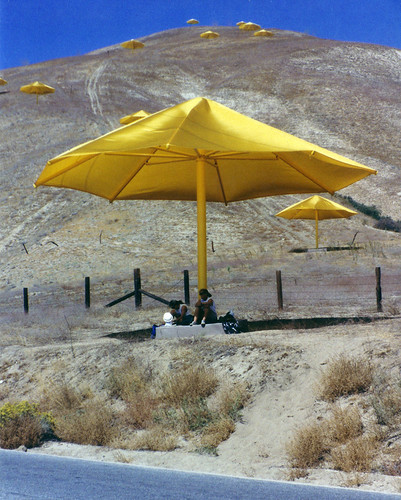
Anyway, I know it when I see the beauty in art!  And I did see and experience one unique piece of art--Christo's umbrellas.

I lived in Bakersfield back then, and remember going up to Gorman to look at the umbrellas up, close, and personal.  And to stand under it because of the bright and hot sun :) ... I should note that the photo here is not mine, but one I found on Flickr--this too is from Gorman, and exactly how I remember it.


The neatest thing about Christo's umbrellas was that the art was an experience.  Because, unlike a painting that might hang in a museum for centuries, Christo's umbrellas were temporary.  I liked that Buddhist sand mandala approach of his to remind ourselves of the temporary lease we have on this planet.  Like how what we experience now cannot be experienced again ever.  It is more than mere "art."  A few days later, the umbrellas were dismantled.  Gone.

Why this post on Christo?  I was getting bored five miles up in the sky--I was flying to Southern California--when I decided to leaf through the in-flight magazine.  An interview with Christo caught my attention.  It was about his latest project.

Source

Only Christo could have imagined such a project:
“The Floating Piers,” a walkway stretching three kilometers, or nearly two miles, that connects two small islands in Lake Iseo, in Italy’s Lombardy region, to each other and to the mainland.
In the interview, Christo talks about how this idea of his had been rejected over the years--nearly forty years--by the governments in Argentina and Japan.  Finally, Italy approved this art installation.  Christo comments :
Art is in the DNA of the Italian people.Italy has a paragraph devoted to art and culture in their constitution. In the US, we have a paragraph about guns.
I don't know if that that comment on the Italian constitution is true.  It does not matter to me; I rarely ever understand art and the artistic mind.  But, damn, I would love to go and experience the "Floating Piers."

Thursday, June 16, 2016

To consume less is not American!

In a commentary that was published back in 2007, I wrote about a strange way of life here in the US, which I referred to as "an American solution to an American problem."  I wrote then:
Well, a few weeks after I came to this country for graduate studies, it was nearing Thanksgiving and the television ad for Alka-Seltzer that I watched then is what I refer to as American solutions to American problems. In this ad, the audio commentary and the pictures presented all the wonderful foods that the viewer would end up eating at Thanksgiving, which then resulted in stomach aches and heartburn. And, presto, Alka-Seltzer to the rescue! My reflexive thought was simple: if the problems came from overeating, then why not simply advise the viewer to eat less? Of course, as I have come to realize, to consume less is not American. (Yes, I, too, am an American!) Instead, the American way is to consume more, and then when problems develop savvy entrepreneurs provide solutions to facilitate further consumption.
I never imagined savvy entrepreneurs devising something that is bizarre, and maybe my visceral reaction is also why I even subconsciously filtered out the news.  But then the friend made sure I read about it :(
A new weight loss device offers a novel approach to cutting calories: draining them from the stomach before they are fully digested.
The AspireAssist system consists of a thin tube implanted in the stomach, connecting to an outside port on the skin of the belly. About 20 minutes after finishing a meal, users connect the port to an external device, which drains some of the recently consumed food into the toilet.
The manufacturer — Aspire Bariatrics based in King of Prussia, Pa. — says its system removes about 30 percent of food stored in the stomach before it ­begins causing weight gain.
People eat and then 20 minutes later they drain the recently consumed food into the toilet.  What the heck?  Weren't we worried about people who engaged in such behaviors?
It undoubtedly sounds gross, and even a bit like assisted bulimia, but this device may be a long-term solution for patients struggling with obesity, characterized as having a body mass index between 35 and 50. “With this device, you only remove about a third of the food, and that’s because the device sits primarily in the upper portion of the stomach,” Kathy Crothall, the CEO and founder of Aspire Bariatrics, told Quartz.
It certainly sounds gross :(

Who ever thought that this gross device will be the way to fight the obesity epidemic in the US!
 The two reports from the Centers for Disease Control and Prevention show that efforts to encourage Americans to lose weight — at least to stop putting on more weight — are having little effect.
Overall, 38 percent of U.S. adults are obese and 17 percent of teenagers are, the two reports find.
 A couple of weeks ago, a student was chatting with me about life, and talked about his weight issues--he was slightly overweight.  He talked about his plans to lose weight, and to win the competition against his mother who had already shed quite a few pounds.  I love my work especially in contexts like this where I get more evidence that teaching is not merely about what goes on in the classroom.  The fact that he was at ease with me to talk about such issues says a lot.

I encouraged him in his summer plans.  I reminded him about the three things that I usually tell anybody who talks with me about weight issues:
It is about calories in versus calories out.
It is about what kind of calories that go in.
It is about when those calories go in.
Seriously, draining the calories from one's stomach?


Thursday, June 09, 2016

Understanding ‘others’ essential in today’s world

(For The Register-Guard: June 8, 2016)

My childhood classmates came from diverse religious backgrounds. This included Farooq and Yasmeen, among others, who were Muslims. Of the teachers, I still recall Yusuf Ali, who was the machine shop instructor. Thanks to India’s diversity, and to life in an industrial setting, we Hindu kids went to school with Muslims and Christians, and even my highly religious and orthodox grandmothers did not worry about “traditional values.”

As a kid, I did not know that there were Muslims in America. When the name of a boxer, Muhammad Ali, appeared in the newspaper, The Hindu, I assumed he was one of our people who had moved to America.

In the grainy black-and-white news photographs more than four decades back, Ali easily looked like one of us — only immensely more handsome. When my brother and I fought, much to our mother’s displeasure, we sometimes imagined that we were boxing like Ali, though neither one of us knew anything about the sport.

As a fresh-off-the-boat student, I made friends for the first time ever with a student, Siddiqui, who was from India’s arch-enemy — Pakistan. Toward the end of my first year of graduate school, when I was getting introduced to life here in America, I was amused by the sight of my classmate John — a white skateboarding dude — practically worshiping a basketball player named Kareem.

Even while the mullahs of Iran were always in the political crosshairs, the Iranian-­Americans in Southern California went freely out and about — and were seemingly one of the more prosperous groups, too. In those early years of my life in America it seemed as though nothing was said or written in public that was against Islam and Muslims.

After such a healthy head start in my life in the old country and then in this adopted home, it shocks me to no end now when I hear or read virulent anti-Muslim remarks, especially from those seeking or holding elected office. The anti-Muslim rhetoric makes a mockery of the noble idea of freedom to practice religion — a freedom that has been a foundational principle of the United States.

While neither Farooq nor Yasmeen lives in the United States, I think of those old schoolmates when very serious people make yet another anti-Muslim comment. I recall how Siddiqui and I shared the foods that we made as struggling graduate students. When we know people and have developed meaningful relationships with the “other,” it becomes difficult to tolerate sweeping statements that condemn hundreds of millions of Muslims because of a minuscule minority that bombs and kills.

Muhammad Ali’s death provides us with yet another context for learning about Islam, and about Muslims in America.

Islam in America is nothing new. Thomas Jefferson owned a copy of the Quran, which provided him with more than a passing familiarity with the religion and its practices.

Researchers estimate that between 15 percent to 30 percent of slaves were Muslims. One of those was Omar Ibn Said, whose life-story has been well documented. Imagine the double whammy of being a slave who was also a Muslim, after having been raised in what is now the West African country of Senegal!

Islam’s holy month of Ramadan, which began on Sunday, is another opportunity to get to know the religion and its faithful. For a month, most of the world’s 1.6 billion Muslims will fast from sunrise until sunset, to remind themselves about the mortals that we humans are and about the fragility of life without food and water. This fasting alone, which humbles the rich and the poor alike, ought to trigger the curiosity of those who harbor only suspicions about the “other.”

One of the challenges in this rapidly globalizing world is for us to understand the “other.” While in centuries past it might have been easier for people to spend an entire life fully within their own respective tribes, we live in a world in which mixing of people and ideas is the norm, not the exception.

It is also clear that the momentum of globalization will not slow down — it will only pick up more speed. This requires all of us to broaden our horizons. To borrow from the late Indian poet Rabindranath Tagore’s “Where the mind is without fear” — a poem Yasmeen, Farooq and I read in school — we need to create a world of freedom that has not been broken into fragments by narrow domestic walls. It is difficult work to create such a heaven right here on Earth, but is an effort worth pursuing.

Wednesday, November 25, 2015

I, too, am America

I could not wait to become a citizen of the United States. I filed the application practically the minute I became eligible and then impatiently waited for the letter that would provide me with the details on the swearing-in ceremony. Finally, that cherished day arrived, during the halcyon days of the year 2000. There were the usual congratulations and wishes from friends and colleagues. One gift was special—a quilt.

A friend, who was a Japanese-American, brought the gift and explained that it was her mother who made the quilt. It had red, white, and blue in the square patches, obviously to reflect the colors of the American flag. But, those colors alone did not make the gift special.

The friend’s mother was one of 120,000 Japanese-Americans who were forced to relocate from their homes to the concentration camps. She was a young child when she was forcibly moved to a camp in Manzanar, California. The quilt was, therefore, very special because she loved the country despite how she and other Japanese-Americans were atrociously and inhumanely treated by her government and fellow-citizens. Her commitment to, love for, and pride about the United States were all there in the quilt that welcomed a new citizen.

I was reminded of that quilt and the Japanese-American friend when viewing the traveling exhibit—Art of Survival: Enduring the Turmoil of Tule Lake–at Eugene’s federal courthouse. The photographs and descriptions were about the conditions of the Japanese-Americans who were forced to live in the concentration camp in Tule Lake, which is in the dry elevations of northern California’s Siskiyou County, immediately to the south of Oregon’s border.

It seems so unreal that the federal government, under the presidency of Franklin Delano Roosevelt who led the country out of the depths of the Great Depression and instituted various programs including Social Security, rounded up its own people and sent them to camps where all their constitutional rights were stripped away. Their only crime was that they looked like the people of the country that attacked Pearl Harbor. The calculation apparently was that because Japan attacked America, Japanese-Americans were suspects.

Years later, the federal government, under the presidencies of Reagan and Bush, formally tendered its apology to Japanese-Americans. Of course, there is no amount that one can ever pay as compensation to those whose lives were so rudely interrupted, and which tremendously affected the rest of their lives after being released from those camps. 

Even though it happened seventy-plus years ago, it was chilling to look at photographs that had signs saying: “Japs Keep Moving, This is a White Man’s Neighborhood.” It was also surreal to view the images at the exhibit, and to think about the horribly simplistic thought that people had made equating Japanese-Americans with the enemy.

It is even more surreal to think that we are employing that same crude thinking in the context of the refugees from Syria and Iraq, and about Muslims in this country. Because the al-Qaeda and ISIS terrorists are Muslims, and because the recent terrorist acts in France and elsewhere are by ISIS, this country is quickly sliding into a dangerously erroneous conclusion that the Muslim refugees from Syria and Iraq are terrorists, and that even American citizens who are Muslims cannot be trusted. It was shocking, to say the least, to hear one presidential contender talk about the need for a database to track Muslims in the country.

I suppose my brown-skinned and bearded appearance, along with an accent that makes it clear that I am not from here, could make some believe that I am a Muslim who needs to be monitored. As the political hysteria gets louder, my worries about my own welfare increase, as was the case in the days and months after 9/11. If that’s how I feel, when I am not a Muslim and when I am not from Iraq or Syria, I would think that Muslim refugees and brown-skinned Muslims in this country are way more worried than I am. And then I think about the Japanese-Americans who were sent to concentration camps for the only reason that Japan had attacked America—what they experienced seems to be of a magnitude that I cannot even imagine.

The quilt from the Japanese-American mother was more than a mere gift. It was a profound statement on her love for America, with its warts and all. It was a patchwork quilt that echoed the African-American poet Langston Hughes’ line, “I, too, Sing America.”

Saturday, December 27, 2014

The globalizing Indians

A few years ago, I authored an oped in which I noted that Indians integrate well into the American way of life, thanks to India's long and rich history of global interactions.  Later, in another op-ed, I pointed to Sri Srinivasan's nomination to the DC Court of Appeals and the unanimous Senate confirmation as further evidence of this integration.

Despite all that, I was shocked--pleasantly, of course--to read that:
Indians, especially in the UK and US, are prevalent in business, academe, the media, medicine and the arts. In 2008, Indians accounted for 38% of doctors in the US, 36% of scientists at NASA, and 34% of employees at Microsoft, 28% at IBM and 17% at Intel.
More than a third of the doctors in the US?
More than a third of NASA's scientists?
More than a third of Microsoft employees?
WTF is the only way to respond to it ;)

Indians integrating well into the economic and social fabric of alien lands is not really new.  In the modern world, India is India, and therefore we refer to Indians, thanks to those who led the struggle for independence from the British Raj, of whom Gandhi was most influential.

Gandhi was a global migrant himself during his years in South Africa, before he returned to India for good a hundred years ago.  If Gandhi hadn't had that experience, history would certainly have been different from how it unfolded.
After one year of a none too successful law practice, Gandhi decided to accept an offer from an Indian businessman in South Africa, Dada Abdulla, to join him as a legal adviser. Unbeknown to him, this was to become an exceedingly lengthy stay, and altogether Gandhi was to stay in South Africa for over twenty years. The Indians who had been living in South Africa were without political rights, and were generally known by the derogatory name of 'coolies'. Gandhi himself came to an awareness of the frightening force and fury of European racism, and how far Indians were from being considered full human beings, when he when thrown out of a first-class railway compartment car, though he held a first-class ticket, at Pietermaritzburg. From this political awakening Gandhi was to emerge as the leader of the Indian community
To stay back in one's own community is the easy thing to do.  But, to venture out requires guts.  To have accomplished what he did, especially in an entirely different country thousands of miles away from where he grew up, Gandhi had guts that we lesser mortals cannot even dream of.  We need to dismiss Gandhi as off-the-charts so that we don't get discouraged comparing our pedestrian existence to his life ;)

Despite the long history of the wandering Indians, it appears that there are a few countries without people of Indian origin.  Perhaps before this century ends, there will be no such country in the listing, eh!

For all we know, the day is not far away when an Indian-American might even be elected as the president of the US of A!  Looking forward to it all.

Thursday, October 24, 2013

America is designed for stalemate. So is the world. The democratic world, that is.

A long time ago, before I discovered op-ed writing, I wrote letters to the editors.  Even a letter published in The Hindu made my father excited enough to cut that piece from the newspaper and mail that across to me. In one letter, I recall making a point about the kingdoms of the past. In the old setting, the defeated king was killed, or exiled, or imprisoned.  The idea was to eliminate the possibility of the "loser" coming back--death of the opponent was, therefore, the best insurance there was, whereas with exile or imprisonment, well, the loser could always stage a comeback.

In democracies, the loser is not banished.  The loser is still alive. The loser is all the time plotting to wage the next battle and win it.  I noted in that letter that the more the loser sticks around, the more we can expect fierce opposition to the government and the party in power.

That must have been more than two decades ago.  Perhaps twenty-five years?  That newspaper cutting is somewhere in my archives--it was, after all, the pre-digital age and tracking down a piece of paper is far more laborious than searching in an electronic database.

On the one hand, I am surprised at myself, and happy with myself, that I had understood democracy that well when I was in the beginning stages of growing a beard, while having a full head of wild hair, and not merely now when I am with a balding head of grey hair that complements a face with white hair..

Where was I?  Oh, yeah, about democracy and intense opposition from the losing side.   On the other hand, it does frustrate me that it means stalemate, more often than not.

Francis Fukuyama, who famously commented that we were on our way to a dull and boring end of history with the triumph of liberal democracy, says we are into vetocracy:
the much-­admired American system of checks and balances can be seen as a “vetocracy” — it empowers a wide variety of political players representing minority positions to block action by the majority and prevent the government from doing anything.
I like the word that he has invented--itself a very Jeffersonian tradition!

Again, it is because the loser just doesn't admit defeat and sits quietly by the sidelines, as is often the case in some of the European democracies.

Fukuyama writes:
the system is designed to empower minorities and block majorities, so the current stalemate is likely to persist for many years. Obama has criticized the House Republicans for trying to relitigate the last election. That’s true, but that’s also what our political system was designed to do.
Exactly!

It is not the design of the system that worries me.  Nope. Not one bit.  It is the quality of the people using the system that gives me nightmares.  When a typical American doesn't know the basics of the governance system we have in place, and yet they passionately and loudly argue in favor of their political preference, I metaphorically shit in my pants that my future rests in their hands.

For instance, one can expect a whole bunch of people to like or dislike the Affordable Care Act, aka as Obamacare.  Disagreements like that are what democracy is all about. Yes, sir.  But, watch this video clip (ht) in which people are definitive about whether they prefer Obamacare of the Affordable Care Act, not knowing that they are both the same.  Watch, and weep that this is democracy as we know it!

Wednesday, July 03, 2013

I like to be in America, okay by me in America

from 1957
Right from when I was a kid—a long time ago in India—I was familiar with the importance of the Fourth of July in the United States because of a family connection: the standing joke at home was that my parents lost their freedom when they got married on the very day that Americans celebrate their independence day.

So, yes, anniversary greetings to my parents.

I left the old country behind years ago.  After gaining American citizenship, the Fourth of July is, of course, way too special for me.  Perhaps it is a typical immigrant emotion after all when I think that my love for this country is special because I consciously weighed the alternatives and worked to come to America. The American citizenship was not an accidental birthright.  Not an ovarian lottery that I won.

Immigrating to America or any other country is so easy now unlike a few generations ago when most of the world’s population stayed at, or close to, the places where they were born and raised.  We humans are now seemingly on the move all the time. We move from one region to another within a country, and migrate across international borders, to strange places where they might speak strange languages and eat strange foods.  The surroundings.are alien to us. Yet, we move.  Because, moving is better than staying put.

Grandfather, during his final year at college
In our family, many, many decades ago, my grandfather too had an opportunity to move away, when he was offered a job in Ceylon (now Sri Lanka) because of his valued metallurgy qualifications from a reputed Indian university.

If grandfather had sailed on that ship, my family’s history would have taken a different turn.  I might not even be blogging this for you to read.

However, he was compelled to reject that offer and stay back in India.

My grandmother and great-aunt always got excited to narrate this story.  Grandfather had no choice but to reject the offer.  Not because the job did not pay enough--the offer was apparently a phenomenal one. But, his mother, who was deeply rooted in the traditions, threatened to commit suicide if he went too far away from her!  Even more, she could not bear the thought of being separated from her son.

Ah, mothers, without whom psychiatrists will be jobless :)

The distance was not all that much either.  Grandfather's hometown, Sengottai, and Ceylon’s capital city, Colombo, are not even 250 miles apart. But, 250 miles in the days before telephone and planes and emails!  Grandfather's mother had justifiable reasons to worry.  He then ended up taking a job that was relatively close by.  A job for which he was tremendously overqualified.  A dutiful family man he was.

The grad student in Los Angeles
In contrast to that, a few decades later, I traveled half way around the world, in order to be here in the US.

A distance of 20,000 kilometers.

The distance did not bother my mother; she cheered me on.

In an interesting coincidence, I left India on its independence day--August 15th.  So, I now have my own addition to the family joke: I gained my independence the very day when they were celebrating in the old country the anniversary of the end of the British Raj and the beginning of self-rule :)

America has been home since the day I landed in Los Angeles, and has been a slow northward migration since.  To quote from the musical, West Side Story, “I like to be in America, okay by me in America.”

Happy Birthday, America!