Showing posts with label oregon. Show all posts

Sunday, February 28, 2021

A year into the pandemic :(

On February 28th,  year ago, we had the first confirmed case of Covid-19 here in Oregon. 

The following is an unedited post from a year ago--from March 1, 2020.

********************************************************************

During the H1N1 scare, when I was visiting India, one of the relatives simply pooh-poohed the global worries by declaring that the virus is not new and that it has always been there.  Having learnt my lessons well, I decided that I would not argue with fools like him.  I smiled.  He then launched into a rant about how the controversy was manufactured by the pharmaceuticals industry.

More than a decade later, as I recall those interactions, I am now amazed at how much conspiracy theories have always been there even in medical contexts.  With every real threat, there are always nutcases that spout crazy theories.  Now it is COVID19.  The most recent Presidential Medal of Freedom honoree said this: “The coronavirus is the common cold, folks”.  He continued on: “It looks like the coronavirus is being weaponized as yet another element to bring down Donald Trump”.
As public health experts warn that the spread of the coronavirus is inevitable and urge Americans to take precautions, the pro-Trump media world has presented the subject as more fodder for partisan debate.
And then there are the rest of us who don't care about crazy conspiracies, but instead focus on the science and the evidence.  We understand the importance of this: "Getting ready for the possibility of major disruptions is not only smart; it’s also our civic duty."

It is a civic duty.  Indeed.
We should prepare, not because we may feel personally at risk, but so that we can help lessen the risk for everyone. We should prepare not because we are facing a doomsday scenario out of our control, but because we can alter every aspect of this risk we face as a society.
That’s right, you should prepare because your neighbors need you to prepare—especially your elderly neighbors, your neighbors who work at hospitals, your neighbors with chronic illnesses, and your neighbors who may not have the means or the time to prepare because of lack of resources or time.
I might be healthy enough that the virus might just about make me sneeze a few times.  But, I could also be spreading the virus through the sneeze. Or by carrying it in my fingers.  We need to play our part to flatten the curve of how it spreads:
Epidemiologists often talk about two important numbers: R0 or how infectious a disease might be, expressed as the number of people that are infected by each person who’s been infected; and the case fatality ratio (CFR): the number of people who die as a result of being infected. For example, an R0 of two means each infected person infects two people on average, while a number less than one means the disease is likely dying out in the population.
The CFR is out of my individual control--that is the task of the government machinery and hospitals and various organizations.  But, I can personally address the R0.
The infectiousness of a virus, for example, depends on how much we encounter one another; how well we quarantine individuals who are ill; how often we wash our hands; whether those treating the ill have proper protective equipment; how healthy we are to begin with—and such factors are all under our control. After active measures were implemented, the R0 for the 2003 SARS epidemic, for example, went from around three, meaning each person infected three others, to 0.04. It was our response to SARS in 2003 that made sure the disease died out from earth, with less than a thousand victims globally.
So, what are the estimates of R0 in the case of COVID19?  It is a wide range at this point, as epidemiologists try to make sense of the data.

Meanwhile, an epidemiologist cautions: “things are going to get shut down. And this virus is probably going to be with us for some time to come. It might become endemic, like measles.”

Who you gonna believe?  This President and the likes of his Presidential Medal of Freedom honoree on Faux News, or public health experts?  Oh, of course, if you are reading this, it means you are not one of the 63 million here in the US.  Good for you for being a responsible citizen!

Sunday, June 30, 2019

Armed and dangerous ... and headed into the shit

A few months ago,  I participated in a march to express my worries over climate change and to urge action.

Very few young people were in the march.  We were a bunch of geezers.

The march went past quite a few apartment buildings where young people were partying.  A couple of them waved out to us from a balcony where they were partying.

Here we were, middle aged and older, marching to make the world a better place for young people, but the youth didn't care enough to protest!

Beer, sex, and Instagram beat climate change protests!

If that's how it is here in liberal, progressive, and green Oregon, then should we be surprised that the US has not done any damn thing about climate change?

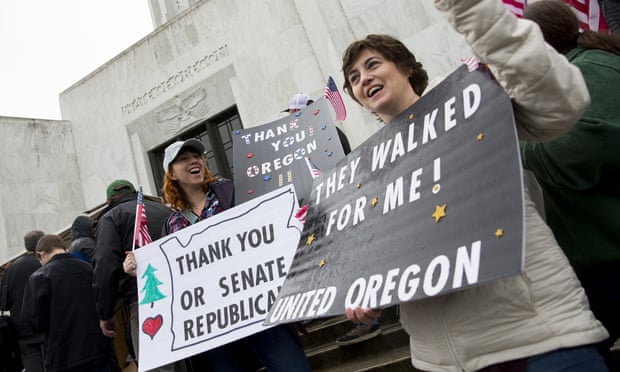
We witnessed yet another regression in this when the fucked up party skipped town, skipped state, and went into hiding in nearby Idaho all because their elected officials did not want to do anything about climate change and were, therefore, opposed to the cap-and-trade bill that was up for vote.
Having killed the climate crisis bill, the Republican senators said they would return to their jobs on Saturday. “Our mission was to kill cap-and-trade,” said senator Herman Baertschiger “And that’s what we did.”

Source

These young people are thanking the Republicans for screwing up their own futures?  How can this be?

When you have guns, everything is possible, it seems.
Joe Lowndes, a political scientist at the University of Oregon who researches rightwing politics, said: “If the Oregon Republican party were a European political party it would be an authoritarian far-right party. It really has that character, that extraordinary truculence,” he said.
During the standoff over climate crisis, Lowndes said, Republicans “were essentially gloating about having an armed wing of the party. That’s when you cut into the structure of constitutional democracy”.
The fucked up party, not only here in Oregon but throughout the country, has become the most powerful far-right country in power anywhere in the democratic world!
the Republican Party lies far from the Conservative Party in Britain and the Christian Democratic Union in Germany — mainstream right-leaning parties — and closer to far-right parties like Alternative for Germany, whose platform contains plainly xenophobic, anti-Muslim statements.
It is frightening to think that this is now the mainstream party!
The difference is that in Europe, far-right populist parties are often an alternative to the mainstream. In the United States, the Republican Party is the mainstream.
“That’s the tragedy of the American two-party system,” Mr. Greven said. In a multiparty government, white working-class populists might have been shunted into a smaller faction, and the Republicans might have continued as a “big tent” conservative party. Instead, the Republican Party has allowed its more extreme elements to dominate. “Nowhere in Europe do you have that phenomenon,” he said.
Will leave it to David Roberts for the last word:
Basically, this is future-of-the-species stuff, getting decided through a spectacle that's barely even able to break into the daily news cycle. And the next time around, there may not even be the pretense of democracy. We are truly headed into the shit. 

Sunday, June 23, 2019

There is no good news

Of course, only bad news makes news.  If it bleeds, it leads.  But still ... the bad news about the natural environment and climate change is not merely because such bad news sells.  It is not fake news either.

The bad news is for real.

So real that it has become surreal even here in Oregon.  The state that the rest of the country and the world imagines is populated only by tree-huggers and hipsters, is unable to move forward with a bill that would modestly address climate change.  We--even those of us who are not hipsters or tree-huggers--are being held hostage by the GOP!

Even when we think we might be able to do something, however small it might be, well, we are stuck going nowhere.

In my old country, the city where my folks live is running out of water.  Polar bears are rummaging for food in urban dumps.  The Sahel is now facing serious climate-change problems.  And then there is plastic.

The official tRump-toady #1--the Vice President--engages in some fantastic political verbal dance about all these:
Mike Pence declined repeated invitations to say the human-induced climate crisis is a threat to US national security.
He doesn't think it is a threat to anybody.  In fact, those of us who are alarmed by it all are the threat, according to him and his party of idiots:
“What I will tell you is that we will always follow the science on that in this administration,” the vice-president said, in answer to CNN State of the Union host Jake Tapper’s first posing of the question.
Tapper responded: “The science says it is.”
“But what we won’t do,” said Pence, “and the Clean Power Plan was all about that, was hamstringing energy in this country, raising the cost of utility rates for working families across this country.”
Tapper interjected: “But is it a threat?”
Pence did not answer the interjection
When the country's executive leaders don't care, and are actively involved in spreading incorrect and misleading narratives, what can one do?
Saving the planet requires not racing to the moon again, or to Mars, but to the White House and up the steps of the Capitol, putting one foot in front of the other.
It is a long, long way to walk one foot in front of another until it is November 2020!

Wednesday, June 19, 2019

Nothing to see here in Oregon. Thanks for not visiting.

I watched In Bruges soon after it was released. A dark comedy that was well done.  The city and the architecture called me.  I figured that if life unfolded well, then I surely will go to Bruges some day.  That continues to be the plan.

As if that was not enough, a couple of years ago, a student was chatting with me about the summer he spent in Europe with his girl friend (who later broke up with him!)  He said they loved Bruges.

However, people in Bruges are not happy that there are millions of people like me who want to go there.  They are getting sick and tired of the tourist mob.
Last week the mayor, Dirk De fauw, elected in October under the slogan “Go with De fauw”, announced that the municipality would no longer advertise or promote day trips to the city. Measures would also be taken to cut back the number of cruise ships able to dock at nearby Zeebrugge from five a day to just two. Cruise companies will also be asked to dock during the week rather than at weekends to help spread the crowds.
“We have to control the influx more if we don’t want Bruges to become a complete Disneyland here,” De fauw told the Flemish TV channel VRT
I can certainly feel his pain; it is no fun when "travellers outnumber residents in Bruges city centre by about three to one."

Bruges is but merely one place where tourists are becoming a pain.  As the world has gotten affluent, domestic and international tourists are everywhere.  I witnessed this in India too. 

The magnitude of tourists is of serious worries to places all around the world.  Overtourism is a real problem for the locals, the natural environment, and for tourists too:
So if we think that you want to get your perfect selfie with, you know, Christ the Redeemer in the background because you're in Rio, you're talking about in some cases literal square meters of space that hundreds, even thousands, of people are flocking to get these photographs, and this has led to really, really crazy phenomena. So you know, for instance, during the California poppy super bloom this year, there were thousands of people descending on literal individual fields in certain small towns. And that's not really something that had occurred 20, 30, 50, 100 years ago.
We are victims of our economic progress.  Here in Oregon, we have come up with an awesome vaccination against tourists: We continue to spin tall tales about how awfully rainy and wet and miserable the conditions are.  This way, we can keep those pesky tourists away and enjoy the landscape all to ourselves ;)

Such gorgeous sights on gorgeous days can never happen in rainy, cloudy, Oregon.
So, head to Bruges instead ;)

Tuesday, April 09, 2019

Into Each Life Some Rain Must Fall

But too much is falling here in Oregon.

The key word there is "some."  Not a whole lot, dammit!

It has been pouring here in the Valley.  The atmospheric river, as the weather folks call it, has been dumping water into the rivers here on land, and everywhere else.

The ground is super-saturated.  True to my father's engineering claim that water is an enemy for the bitumen, roads are rapidly becoming pothole avenues.  A little bit more rain and I will have to trade in my car for a boat.

The river is running brown, full, fast, and furious.  But, comforting it is to get a visual confirmation that my home is well above on a high ground.

April showers these are not; these are April downpours!

April is also poetry month.  Enjoy the poetry that Ella Fitzgerald sings so easily, smoothly, and emotionally.

Into each life some rain must fall 
But too much is falling in mine 
Into each heart some tears must fall 
But some day the sun will shine 

Some folks can lose the blues in their hearts 
But when I think of you another shower starts 
Into each life some rain must fall 
But too much is falling in mine 

Into each life some rain must fall 
But too much, too much is fallin' in mine 
Into each heart some tears must fall 
But some day the sun will shine 

Some folks can lose the blues in their heart 
But when I think of you another shower starts 
Into each life some rain must fall 
But too much is fallin' in mine 

Into each and every life some rain has got to fall 
But too much of that stuff is fallin' into mine 
And into each heart some tears got to fall 
And I know that someday that sun is bound to shine 

Some folks can lose the blues in their heart
But when I think of you another shower starts
Into each life some rain must fall
But too much is fallin' in mine


Tuesday, January 29, 2019

Native Americans. Africans. Mexicans. And now? Chinese!

Since 1492, and since Mayflower, and since the Declaration of Independence and then the Constitution, it has been one chaos after another for non-whites.  As we get more into the Jim Crow era in Jill Lepore's narration of the history of the United States, we will remind ourselves about what she is exploring in this book:
The American experiment rests on three political ideas--"these truths," Thomas Jefferson called them--political equality, natural rights, and the sovereignty of the people. ...
Does American history prove these truths, or does it belie them?
And so far the evidence is ... awful!  The original inhabitants nearly wiped out. People from Africa imported, traded, and held as property.  An empire-building America provoked a war with Mexico and gobbled up the upper-third of its territory.  A horrible Civil War was fought in order to abolish slavery. Women were told that they shall not have rights to participate in politics.

Political equality? Natural rights? Sovereignty of people?

It was time to go after yet another group: Chinese immigrants.

Following the gold rush, "Chinese immigrants began arriving in the United States in large numbers during the 1850s."

Given the track record of white supremacy from 1492, it is easy to predict that the Chinese would have been attacked, killed, imprisoned, and their citizenship questioned, right?

It is incredible how when I was in the 8th or 9th grade, when Mr. Venkatesan taught (he was a horrible teacher anyway!) history, we were somehow led to understand that it was a glorious American political experiment, in which the only blemish was slavery, which too was corrected by Lincoln after the Civil War. And it was happily ever after!

So, people immigrated from China.
Chinese workers began settling in Boise in 1865 and only five years later constituted a third of Idaho's settlers and nearly 60 percent of its miners. In 1870, Chinese immigrants and their children made up nearly 9 percent of the population of California, and one-quarter of the state's wage earners.
Imagine white settlers looking across and seeing hardworking Chinese.   Oregon and California tightly restricted the rights of Chinese. 

Frederick Douglass was consistent in his view of human rights:


Again, this is the Douglass about whom the current president knew nothing!

As I noted in this post back in September, the United States passed a law to exclude the Chinese. To strip them of their citizenship. And the US Supreme Court even upheld this law in 1889! 

Let's ask ourselves, again:
The American experiment rests on three political ideas--"these truths," Thomas Jefferson called them--political equality, natural rights, and the sovereignty of the people. ...
Does American history prove these truths, or does it belie them?

Sunday, November 25, 2018

Into each life some rain must fall

One has to be an Oregonian in order to appreciate the cartoon that rain, er, ran, in our paper:

Source

We had some showers after a long dry spell, with weather stats reminding us that rainfall has been barely a fifth of the normal.

I like the rains.  I often remark, "no rain, no green."  And without the green and the river, well, this will be southern California!

As I kept thinking about the rain, I remembered that way back in high school we studied a poem called "The Comforters."  As my daughter remarked more than once with annoyance, the nerd in me remembers such stuff that we studied decades ago.  Hey, that's the only skill I have--I don't know how to grow crops or change a car tire or even pound a nail!

Hopefully, too much rain is not falling in your life.  If there is something, may this poem ease your mind, in case you live in a place where there is no rain and wind to comfort you, and may you also find comfort in Ella Fitzgerald's song.


The Comforters
By Dora Sigerson Shorter

When I crept over the hill, broken with tears.
When I crouched down on the grass, dumb in despair,
I heard the soft croon of the wind bend to my ears,
I felt the light kiss of the wind touching my hair.

When I stood lone on the height my sorrow did speak,
As I went down the hill, I cried and I cried,
The soft little hands of the rain stroking my cheek,
The kind little feet of the rain ran by my side.

When I went to thy grave, broken with tears,
When I crouched down in the grass, dumb in despair,
I heard the sweet croon of the wind soft in my ears,
I felt the kind lips of the wind touching my hair.

When I stood lone by thy cross, sorrow did speak.
When I went down the long hill, I cried and I cried.
The soft little hands of the rain stroked my pale cheek,
The kind little feet of the rain ran by my side.   


Thursday, September 20, 2018

Stand and ... stare

It was a tad cold on campus because I was in my short-sleeves.  I cursed myself for my sartorial decision.  But then it is not easy to get over the habits of the glorious summer.  Hey, at least I was not in my sandals.

 I stepped outside to admire the cosmic blue sky with white clouds, against the terrestrial green trees and shrubs.  It was magical.  A miracle.

I stood like that for a few minutes.  The clouds were quite some shape-shifters.

I recognized the junior colleague who was walking towards the building.  "How was your summer?" she asked.

Summer?  I am enjoying the sun, the sky, the clouds, the trees.

"What a gorgeous day!"

She nodded.

"What an awesome blue sky with puffy white clouds.  Well, not as puffy as they can be."

Only then it struck her that I was for real.

"Have you tried laying on your back in a lake and looking at the clouds?  You will love it."

I didn't want to tell her that I can't take such risks in lakes when I swim like a rock.

"I remember the taxi driver in Munich telling me to look up before I stepped into the cab.  I did.  He then said in his broken English, "that is our beautiful Bavarian sky."  It was.  But, that is nothing compared to the blue sky with puffy clouds that I have seen in Oregon."

I have shared that Munich story with plenty of people. Even with strangers in strange lands.

Maybe this fascination with blue sky with clouds sounded a tad too odd for her.  "Why, did you not have such skies in the part of India where you are from?"

If only!

Bare traces of clouds.  It always seemed like the sun was beating down on us unfiltered by any damn thing.  If the clouds came, they were not beautifully puffy like here.  And then the dark clouds of the thunderstorms.  But, those dark clouds did not have the blue sky background.  They always looked ominous.  And during the monsoons, well, all one sees is rain.

As one got closer to the hills--the ghats--there was a possibility of blue sky with white clouds.  But then, the sun is only a tad less unbearable, like how it was when I visited Mysore a few summers ago.

I didn't tell her all these.  Nobody has time for my long and winding tales.  I wish more people knew about pole-pole.

"No. Usually it was clear skies.  And hot."

At least we had clear skies when growing up.  Now, kids in big cities in India rarely ever see the clear blue sky; they probably think that the sky is always a dirty white color.

I didn't tell her that either.  Like I said, nobody has time for my stories.  And that too in my strange accent!

"I thought you were waiting for somebody. I had no idea you were here to simply look at the clouds."

Waiting for somebody?  Does she not know that there is nobody who waits for me on campus, and nor do I wait for anyone?  Stand and stare, I do a lot.

Nope, I didn't tell her that either.

"Yep, to look at the clouds, before I go into a meeting."

We both entered the building, and went our separate ways.

Monday, December 25, 2017

The Moais of Oregon

The plan is to submit this for consideration as an op-ed piece.
**************************************

A perfect storm is brewing in the Oregon public policy environment. When that storm makes landfall, Oregon’s higher education system will be devastated beyond recognition.

For years, it has been a struggle to fully fund the state’s public universities. Taxpayer dollars pay for less than ten percent of the research universities’ operations, and the regional universities--like Western Oregon University, where I teach--manage with a quarter of the operating expenses paid for by state allocation.

This is bound to worsen when the next recession hits.

Economies go through a period of growth, followed by stagnation. The Great Recession of 2008 was particularly hard. Since the end of that recession in June 2009, we have had steady growth in the economy over the past nearly nine years. However, growth cannot happen for ever; while any recession is difficult to predict, it will arrive sooner or later.

The coming recession will make state dollars scarce, and public higher educational institutions cannot even dream of balancing their books on the shoulders of students. Students already graduate with debt that many of the old-timers did not have to bear back when the public vigorously supported investing in higher education. To subject students to even higher debts will be outright robbery.

Students from other countries are willing to pay for an American education--they pay much higher fees than our residents do. However, the Trump administration is increasingly making it difficult for them to come here, which does not make any economic sense leave alone the benefits of greater understanding across cultures. And, because Oregonians are having fewer kids than before, the current K-12 student population in Oregon will not translate to increasing numbers of native students at higher educational institutions. All these will further complicate the coming budgetary battles.

Further, over the past couple of years, the political rhetoric in the country has turned intensely anti-intellectual. “We need more welders and less philosophers” has become a mantra. Politicians have virulently attacked various fields of inquiry that they deem wasteful. This means that when the recession hits, voters have already been primed for chopping down public universities.

Tragically, even as public higher education heads to a collapse, we are behaving similar to how the people at Easter Island did. Easter Island is located in the Pacific Ocean, and about 2,000 miles from the Chilean coast. There, as the population faced ecological crises, they--the Rapa Nui--spent more and more resources erecting stone statues--moais--hoping for divine intervention. The gods did not help, and the civilization ultimately collapsed about 400 years ago.

On college campuses, we have been constructing moais in plenty over the years. Athletic stadiums and facilities are our modern day moais, which we continue to build despite the financial urgency. Unfortunately, the massive spending on athletics, including the astronomical salaries for coaches, finds support across the political spectrum, even from the ultra-left faculty on campuses.

Like at Easter Island, these modern day moais too will merely bear witness to the collapse of public higher education in Oregon, unless educators and political leaders begin to prepare for the coming storm keeping in mind the best interests of the state’s future.


Tuesday, November 14, 2017

Twenty years ... and counting

The public's memory is notoriously short.  Which is why politicians get away with anything, for the most part.

Remember the Terry Schiavo tragedy in the public sphere?  It was awful.  Here was a young woman in an irreversible vegetative state for years, and Republican senators in DC adamantly stood against pulling her plug, in order to defend the sanctity of human life.  They were ok with wars and killing, prisons and killing, cops and killing, but no pulling the plug nor aborting fertilized eggs.  Nutcases!

Their leader at that time, Bill Frist, even made his own diagnosis--without having ever met the patient!  I tell ya, the GOP has been home to nothing but nutcases ever since that newt-led revolution in 1994.

Finally, after 15 years in a vegetative state, Schiavo died.  By then I was already an Oregonian.  And had already authored an op-ed on the state's Death With Dignity Act.  I wrote that in late 2002, soon after I moved to Oregon in response to the Bush administration's effort to overturn the Oregon law.  That effort was led by a religious fanatic John Ashcroft, who was the Attorney General.

The nutcase Republicans in DC gave it their best shot, but Oregon's law prevailed.  A couple of weeks ago, it was the law's 20th anniversary.
In Oregon, use of the law has steadily grown. Last year, it happened 133 times. Nearly 1,200 people have died using the law in the last two decades. A vast majority cited loss of autonomy as their main reason.
You remember how horrible it was before the Oregon law passed?  Like this one:
In 1990, a Portland woman, Janet Adkins, traveled to Michigan where Dr. Jack Kevorkian helped her use his lethal injection device in his Volkswagen van. Her death inflamed a national debate.
Kevorkian was later found guilty for his assistance in a number of cases.  He served time too, which is unfortunate. Almost nine years in prison, as an old man himself.  But, boy did he stand up for his beliefs!

I understand that not everybody will be ready to exit the planet as I am.  I love life. This existence is simply fascinating.  I hate the very idea that I will miss out on everything that I cherish.  But, like every saint and sinner who ever existed, I too will die.  A lonely event that will be.  Living like today could be the last day ever makes clear what my priorities are, how I should spend my time, and what I need to plan for.   Which is also why I don't have much in my bucket-list.

Here today, gone tomorrow! You should even think in terms of writing your own obituary.  At the very least, we could all benefit from having the most difficult conversations: Talk to the next of kin and make clear one's end of life choices.  After all, we talk shit all the time.  We have time for sports. We talk endlessly about the shittiest human ever in the White House.  We talk forever about the weather, for heaven's sake.  We definitely have time for this important conversation.

If you want some ideas on how to go about having such a talk with your people, check out the resources here.

In the meanwhile, enjoy the precious gift of life!


Saturday, July 22, 2017

A kumbha mela in Oregon

You recall Bhagwan Shree Rajneesh?  Yes, that fraudster who reinvented himself as Osho.

Back in the early 1980s, he and his fellow criminals bought up a ranch in Oregon and called that Rajneeshpuram.  As if people were hell-bent on confirming PT Barnum's "there's a sucker born every minute," devotees descended on the ashram.  With a matter of months, the place had the largest collection of Rolls Royce cars.

Source
But then the Bhagwan and his minions could not fool everybody.  They then engaged in bioterrorism, were prosecuted, and Rajneesh, who was kicked out of America, went back to India where he lived the rest of his life as Osho.

The police mugshot of Rajneesh.
Source
What has all that got to do with the kumbh mela?

That ranch area is prime viewing spot for the solar eclipse on August 21st!


You see the town of Madras (yes, named after the city in India--long story!)?  The ranch was close by.

Motels and campsites at those Central Oregon locations sold out months in advance.  People are renting out rooms in their homes for quite some rates.  Because, in those dog days of summer, that is a place in the mountain where the probability is very high that no clouds or weather events will spoil one's experience.

Hundreds of thousands of tourists will be flooding Oregon close to that date.  The transportation department has issued an advisory that traffic will be chaotic.  Small towns are worried that they won't have enough toilet facilities--even the portable ones.  Madness!

This is a secular kumbha mela.  People want to be awed by a celestial event over which we humans have no control.  Not even the tiniest of impacts.

When we cannot make sense of events around us, and when we have angst about our own existence, then we turn to the cosmos for answers and comfort.  Or, we turn to religions.  Or, we fall at the feet of fraudsters.  It is all the same to me.  Religions have better, and time-tested, institutional mechanisms to defraud people, unlike Rajneesh whose schemes were blown away.

We can submit to the likes of Rajneesh.  We can be devout our religions.  We can smoke weed.  We can go to religious and secular gatherings.  But, the angst about the meaning of life can be resolved only from within.

As for my own solar eclipse plans?  I live outside the belt of totality.  I don't care.  A colleague, whose home is smack in the zone of totality strongly advised me to get up to one of those places.  "It is a once in a life time event," he said.

I merely smiled.  Because I could not tell him that every breath that we take is a once in a life time event.  Every second that we are alive is a once in a life time event.  If only we cherished every second of our lives as we value the kumbha melas of many types!

I suppose it is because we refuse to understand and appreciate such a life that we seek the fraudsters of the world, who come in many shapes.  Beware!


Tuesday, July 18, 2017

Youthful bravado!

When I was an undergraduate student, a few friends and I planned to spend a couple of days in Ooty and Conoor, which were only a short bus ride away.  When I updated my parents, my father--who was all too familiar with those areas--had only words of caution about youthful bravado.

In those bad old days, inexpensive digital cameras had not even imagined, and the roll-film cameras were too expensive for us regular guys.  But, the brain is an awesome camera that holds plenty of still and moving images.  One of those images that I remember all too well is of a friend and me sitting right at the very edge at Dolphin's Nose.  At the edge.  Which made two other visitors nervous enough to warn us.  But, we sat there anyway.

Youthful bravado, indeed.  And this was by me, who usually lives a boring life!

I would think that the young have always done plenty of stupid things, all through our human story on this planet.  It is there in our genes.  I don't imagine other animals engaging in youthful bravado.  I bet that a young dog tries to stay away from anything that might put its life in danger.  A young lion carefully picks its fights.  Not us humans though.

This youthful bravado becomes even more a problem in these times of digital cameras, GoPro, Instagram, and YouTube, and more.

I am now the father worried about youthful bravado.

Worried I was when the friend and I hiked to the beautiful Tamolitch Falls, also known as Blue Pool.  It was a two-plus mile hike in from the parking place, which was already overflowing.  The hike was a constant flow of humans, and mountain-bikers.  Used to the quiet and lonely walks, I now felt as if I was in the middle of Ranganathan Street!

The pool was spectacular, yes.


But, the youthful bravado on display made a nervous Nellie out of me!

The cliffs seemed about thirty to seventy feet from the water.  We are familiar with the cold temperature of the waters of the McKenzie, and I guessed that the water temperature was maybe about 38 to 40 degrees.  Ice cold.

Youthful bravado.  Every few minutes, I could hear (I couldn't bear to watch) a young man jumping from the cliff down into the water.  A young woman in her bathing suit was swimming for a long time in the middle of the frigid pool.  I was sure I would witness an unfortunate accident.  In an area without cell signal, it would be a long time before rescue arrived.

The friend and I left in a hurry after finishing our lunch.

Today's paper has this news item:
A Texas teenager was seriously injured Monday while attempting to dive from a cliff into Blue Pool.
That teenager was a 17-year old girl.

She is fortunate to be alive, and with only a hip fracture.  Yes, people have also died at that pool.  But look at the timeline of this girl's accident:
Her jump: 12:30 pm
Bystander walks 2 miles to call 911:
First responders arrive: 3:00 pm
Finally, "40 personnel assisted with the rescue mission" help with getting her on to an Army National Guard Blackhawk helicopter at 5:43 pm.
In poor countries, the youthful bravado is held under check because the young people know that there is no concept of taxpayer-funded "search and rescue."  If I had fallen off that edge thirty years ago, well, that would have been the end of me, which is why I was so carefully perched there and not moving even a tad.

I suppose we humans are remarkably stupid animals as much as we are remarkably intelligent creatures!

Saturday, April 15, 2017

Follow the immigrants

This, which I have sent to the editor, builds on a previous blog-post
************************************************************

“Follow the immigrants.” 

That is an easy guideline to understanding the economic geography dynamics in the contemporary United States.

Consider the affluent neighbor that is immediately south of us. The prosperity in California correlates well with the percentage of foreign-born to whom the Golden State is now home. More than a quarter—about 27 percent—of its population was born outside the country. It is no wonder that the Silicon Valley looks more and more like the United Nations.

Consider a contrast to California. West Virginia is an economic laggard, where how one talks about coal—not silicon—is the way elections are won and lost. Here, too, there is a correlation between the economy and the percentage of foreign-born. Barely 1.4 percent of the population in West Virginia was born outside the US. To put it simply, immigrants do not flock to West Virginia.

It is more than a mere correlation, of course. The foreign-born population cannot afford to be jobless and poor, whether they are here legally or illegally, and whether or not they are skilled or unskilled. Hence, immigrants are almost always headed to states where there is potential for work and wages. California offers that promise, and not West Virginia.

In this broad framework, Abigail Cooke, an assistant professor of geography at the University at Buffalo, and Thomas Kemeny, a UB research assistant professor and at the University of Southampton in England, write about their research that was recently published in the journal “Economic Geography.” There is "a strong relationship between greater immigrant diversity and higher productivity—in this case, wages.”

Jobs and incomes are urban-based. "What we found was remarkable. In cities that are unwelcoming to immigrants, as diversity rises, people's wages either don't change, or they go up by only a small amount. In cities that are welcoming to immigrants, as diversity goes up, people's wages go up, and by a lot,” Cooke notes.

It is an interesting feedback cycle. Cities and states where the economies are growing attract immigrants. This influx strengthens the human capital that in turn creates more economic growth and development.

Such dynamics are not merely a contrast between California and West Virginia. In Oregon, the foreign-born account for about 9.8 percent of the population. Even within the state, we can observe differences between, for example, the metropolitan Portland where the economy is based on modern economic activities, versus Coos Bay whose economy was based on natural resources. 

An economy based on resources that were prized in the past—like timber—lags behind one that is driven by the likes of Intel and Nike. This means we will also notice a corresponding significant difference in the percentage of the foreign-born in the Portland area versus in coastal communities.  A diverse immigrant population is naturally attracted to regions for obvious economic reasons--even farming grains, fruits, and flowers, with considerable export potential, will attract immigrants.

However, this unequal economic growth and development across the geography of the country, and within the regions of a state, have had serious implications. 

Richard Florida—an academic and a public intellectual based in Toronto, who has always been enthusiastic about cities, is now worried about a new urban crisis.  Florida writes in a recent essay about the winner-take-all-urbanism “in which the talented and the advantaged cluster and colonize a small, select group of superstar cities, leaving everybody and everywhere else behind. Much more than a crisis of cities, the New Urban Crisis is the central crisis of our time.”

The story is deceptively simple, but a complex one. Modern economic activities are urban-based, and immigrants flock to those urban areas with the greatest economic potential. The reinforcing feedback cycle makes some cities and regions more prosperous than others, and soon we have regions that are seemingly left behind. These left-behind regions, like West Virginia, are also home to less-diverse population.

It has also been clear for a long time that economic advancement does not seem to reach the corners of West Virginia or a Coos Bay here in Oregon. We the people need to try to understand such complexities in a rapidly evolving global economic geography. And, more importantly, we will need political leaders who can articulate constructive policy responses that will not dampen the pace of economic development even while assisting the under-performing regions. 

Or, we can simplistically decide, for instance, that immigrants in a heterogeneous California are the reasons for the lack of economic opportunities in a significantly homogeneous West Virginia.

I would rather that we attracted the immigrants, instead of chasing them away.

Friday, October 28, 2016

Back in the USSR

While liberals adored the hippie-life that Oregon represented, I was equally impressed with the state's Republican leaders that I had read about back in my California days.

There was the famous governor, Tom McCall--thanks to his concern for the environment, we have public access to the awesome beaches, and the first ever legislation that emphasized recycling.  Yep, a Republican.

Or, there was Senator Mark Hatfield, who often voted against his fellow Republicans, and whose principled policy positions might be considered to be dangerously left by today's GOP standards.  Yes, a Republican.

Now, Oregon has become a deep blue state.  It has been three decades since a Republican was voted into the governor's office.  For almost a decade now, both our US senators have been Democrats.  The statewide offices are almost always Democratic.  I worry that we are becoming a one-party state.

It is not that I have problems with our two senators--not at all.  In fact, I have often tweeted supporting their policy positions.  I have no problems with the governors either.  I am concerned that the lack of strong opposition is not always a good thing.  Maybe it is the logic of thesis and antithesis that drives my thinking.  But, hey, that is good enough grounds for being concerned.

Catherine Rampbell's column, therefore, resonates with me.  She writes there that the GOP's implosion, while a good thing as far as purging the crazies out of the party, can also be a bad development because we might not have the healthy debates that we need to have on various policy issues.
Right now a number of bad ideas booming on the left need a credible, coherent, megaphoned rebuttal. These are ideas that may sound nice and perhaps appear helpful. But pursuing many of them would be, at best, irrelevant and ineffective, a waste of time and resources; at worst, they would be actively harmful to the marginalized groups that bleeding-heart liberals claim to champion.
These are proposals such as bringing back Glass-Steagall, a banking law whose repeal actually had nothing to do with the 2008 financial crisis. Its resurrection is perplexingly popular on the left.
Or banning genetically modified organisms.
Or instituting a $15-an-hour minimum wage nationwide, even though that’s higher than the current median wage in four states and three territories.
Or free college for all, including rich people.
Or arbitrary tax carve-outs for items such as tampons (which constitute a giveaway to rich people, too, and ultimately require raising tax rates on everything else, which can disproportionately hurt poor people).  
You might think that none of these can easily happen at DC because even a weakened set of zombie Republicans at the Senate and the House will put up a good fight.  True.
Many of these ideas have little chance of making it into federal law, given current Capitol Hill dynamics. But inspired states and municipalities are going forward with some of them. Additionally, liberal firebrands such as Sen. Bernie Sanders (I-Vt.) have made clear their intention to pressure a President Clinton from the left when and where she would have policymaking power.
If only we had responsible politicians and a responsible citizenry, right?  But, that requires rational voters, and we simply ain't.

Tuesday, September 20, 2016

What have the corporations ever done for us?

I am absolutely pro-labor union.  Yep.

I thought I should make that very clear to my rabid right-wing debaters, if they have not figured it out already ;)

At this point, you perhaps are thinking that this is a set up for something else.  Yep.

I am pro union, if the labor belongs to a category that truly can be screwed over by the short-term profit seeking greedy firms and bosses.  If, for instance, Walmart employees want to organize, I am all for it.  If Foxconn workers wants to join hands in solidarity, I say "go for it."  

But, any public sector employees forming a union, well, that's a different story.  I don't care if the employees are police officers or sanitation workers or university faculty.  The logic is this: Who is "the man" that the union wants to stick it to?  "The man" being considered the oppressor is the taxpayer.  Not some greedy capitalist.  So, the union wants to stick it to the taxpayer?

Of course, the public sector union's leaders will argue that they are really after the greedy capitalist who wants to hoard it all.

Consider this: Here in the dark blue state of Oregon, the public sector unions, "led by teachers," are enthusiastically pushing a ballot measure:
If approved by the voters here in November, Measure 97 would create the biggest tide of new tax revenue in any state in the nation this year as a percentage of the budget, economists said — and one of the biggest anywhere in recent history. Oregon’s general fund would grow by almost a third, or about $3 billion a year, through a 2.5 percent tax on corporate gross receipts.
How would that money be raised?
If the ballot measure passes, not every company will be affected. Out-of-state corporations and those with $25 million or more in revenue would pay the new tax. Smaller businesses would not. That disparity has cut like a knife through the business community.
If only it were that simple to make corporations pay taxes.  I wonder if the unions have heard of gazillion-dollar earning tax lawyers and accountants, like the ones Apple has on its side to keep the taxes far, far away.  The public sector unions create and live in their own alternate universe!

The editorial chief at the newspaper from the state's capital had some awesome lines:
What gets me is proponents’ assumption that corporations simply will accept lower profits in order to pay the tax. At the Salem City Club recently, one advocate went as far as saying companies would transfer their revenue from other states to pay their Oregon taxes.
That’s not the way corporations work, especially ones that are publicly traded on the stock market.
Meanwhile, the state's Legislative Revenue Office ran the numbers because, well, they have to.  It is their job.  What did they find?  Much to the displeasure of the Measure's backers, the office concluded that it would harm the state's economy:
among other effects, Measure 97 would slow private sector job growth and boost the average per-person tax bill by $600 via price increases, with the burden falling mostly on low- and middle-income Oregonians.
Really?  I was going to bet that businesses love paying taxes and will never pass the costs down to consumers.  Oh, how could I have been that stupid! I need to sign up with the comrades the first thing tomorrow ;)


Friday, February 19, 2016

Holding steady in Orygun

It was time.

I had to get it done.

I could not put it off anymore.

I walked into the store that liberals love to hate.  All because of that one thing.

I walked without even casually looking around at anything there.  I was a man on a mission.

I reached.  I stopped.  It was all mine.

I sat down on the seat at the blood pressure measuring machine.  I erased the display and slid my left arm into the designated slot.

I looked up as I hit the "start" button.  Waiting for the pharmacist was a white guy, about 45 or 50 years old.  He had a camo-colored baseball cap that had the letters "NRA" in bold and uppercase.  On his side, was a gun in a holster.

A white guy with a gun in a store.

The machine whirred and whizzed and the tightness on my arm eased.  I shifted my attention to the display, wondering whether the sight of the gun would have caused a spike in the numbers.


Steady Eddie, despite the gun!

I don't care whether or not liberals or conservatives love that store; I am not going there anymore.  This pacifist does not want to witness people parading their guns in public spaces.

If the stereotype holds good, then the gun-carrying white guys won't come to shop at the places where I get edamame and paneer, and I will gladly restrict myself to those stores alone ;)

It is so bizarre that people--almost always white guys--publicly walking around with guns is apparently acceptable, but the sight of a woman wearing a hijab makes this country go ballistic!

America, what a country!


Friday, February 05, 2016

Somewhere over the rainbow ...

A late night email from a co-worker was unprofessional.  But, after years in academe, I am no longer surprised.  In fact, being polite and courteous, and sincerely engaging, are the kinds of behavior that will shock me--apparently, I am rarely ever shocked anymore ;)

The morning came and soon it was time to drive to campus.

It was one of those rainy days when every once in a while the sun tried to peek out from behind the clouds, but failed and then it rained for a while.  As is almost the case, I drove in silence enjoying the scenery.
The gazillion shades of green that I never knew existed until I moved to Oregon.
The rolling grass fields.
Sheep.
Hills.
Horses.
Hawks.
How people could possibly be rude and unprofessional in such settings is simply beyond my wildest imagination!

I noticed the truck ahead in the slow lane indicating to move to the faster lane in which I was approaching.  I slowed down. After seeming to confirm that I had indeed fallen behind, the truck moved over to my lane and as it passed the slow vehicle, the driver flashed his tail-lights in the truck-driving-fashion to thank me.  Here was a truck driver being polite and thankful on the road, while he could have simply gone on.  What  a contrast to the email the night before!

I passed the truck.  Slowly, the northwest sky darkened.  The sun tried to peek from the other direction.  And it started raining.  In a matter of seconds, a huge rainbow appeared on the horizon.  The cosmos was reminding me that life is immensely more than awful emails late in the night.  I was near ecstatic.

After having freshly-brewed coffee in my office, I walked over to the copy room and got my work done.  I hoped that the students would enjoy the task that I had prepared for them.  As I was walking away from the copier, the late night emailer was walking to the machine.

"I'm sorry that I jumped all over you."

I couldn't care.  "I'm used to it by now" I replied as I continued to walk.

I suppose saying "sorry" has become far easier than to behave properly in the first place.  Such is life--it is not always rainbows and green grass and hawks and horses and sheep and drivers saying thanks.  But, I know better:
And I think to myself
What a wonderful world


Saturday, January 30, 2016

A man. A place. A meaning.

A few years ago, the Association of American Geographers recognized Barry Lopez as an "honorary geographer."  It is to recognize "excellence in research, teaching, or writing on geographic topics by non-geographers."  I understand that sentiment--after all, I do not have any formal education, from the undergraduate through the doctorate level, in geography and, yet, have been gainfully employed as a geography instructor for nearly a decade-and-a-half.

Lopez lives in Oregon, not far from my home.  He, too, is a transplant, from across the continent.  A writer of the highest caliber, reflecting on life by observing places, especially the natural environment.  In this recent essay, Lopez writes:
Existential loneliness and a sense that one’s life is inconsequential, both of which are hallmarks of modern civilizations, seem to me to derive in part from our abandoning a belief in the therapeutic dimensions of a relationship with place. A continually refreshed sense of the unplumbable complexity of patterns in the natural world, patterns that are ever present and discernible, and which incorporate the observer, undermine the feeling that one is alone in the world, or meaningless in it. The effort to know a place deeply is, ultimately, an expression of the human desire to belong, to fit somewhere.
The themes of existence, the inconsequential lives that we lead, and attempting to create a meaning through experiencing a place, are all regular features of this blog.  Existential loneliness was also very much a part of Anomalisa that I watched last night with the friend.  Which is perhaps why that paragraph appealed to me.

I am convinced that if we paused to think about our existence we would then realize the crisis within.  I suppose we do our best to avoid thinking about it.  Or, we try to lighten that crisis by making meaning via our affiliations with everything from family and friends to football teams and faiths.  When we strip all those affiliations away, the existential loneliness is all that remains.  Of course, to some extent, these are all age-old questions that humans have been grappling with.

Lopez writes:
The determination to know a particular place, in my experience, is consistently rewarded. And every natural place, to my mind, is open to being known. And somewhere in this process a person begins to sense that they themselves are becoming known, so that when they are absent from that place they know that place misses them. And this reciprocity, to know and be known, reinforces a sense that one is necessary in the world.
Indeed.  Whether it is Pattamadai and Sengottai, or Neyveli, or Calcutta, or ... the deep desire to know about them and understand them has been a wonderful blessing in terms of how much they have helped me know about myself.   I even routinely tell students that, without going into autoethnographic details--understanding the world, understanding the peoples, is a wonderful way to understand our own country and our own place in the grand scheme of things.  

Back to Lopez:
Perhaps the first rule of everything we endeavor to do is to pay attention. Perhaps the second is to be patient. And perhaps a third is to be attentive to what the body knows.
Yes. To pay attention. To observe the place.  To be patient. To be in the here and the now.  I suppose it is not easy to translate those ideas to everyday life!
    

Sunday, November 15, 2015

The Hipsters of Tamil Nadu: Plaid and the Madras Shirt

Perhaps it is my fascination for autoethnography and a quest for the meaning of life that makes me seek the connections between what I read and my own life.  It is my own way of finding my own personal connections to this universe and developing my own interpretation of the old mahavakya à¤¤à¤¤्त्वमसि (You are that.)

Today's piece in this fascinating quest: the plaid shirt.

Back in my first year of graduate school, I bought myself a plaid shirt, with the typical red and black color combination.  When I wore it to class on a Southern California winter day, a classmate--a White American woman--greeted me with "hey lumberjack!"

I had no idea what she was referring to.  Why am I a lumberjack because of the warm and colorful shirt that I was wearing?  Keep in mind that this was well before my immersion into all things Americana and, of course, before I figured out the importance of small talk in this culture.

Over the years I have also come to understand that as one from Madras (Chennai) and Tamil Nadu, maybe I had had the preference for the plaid shirt even back in India thanks to the Madras shirts--though I knew about the expression "Madras shirt" only after living in the US.  I know, I know, this autoethnographic piece is getting to be a ball of woolen yarn; so, will slowly thread the story for you ;)

In 1978, archeologists inspecting an ancient cemetery in China found the 3,000-year old remains of a "6-foot-2, tall, brown hair, and long-nosed" body referred to as the "Cherchen Man."  And, even more interestingly:
When the archeologists discovered this 3,000-year-old body, it was dressed in a “twill tunic and tartan leggings.” Various colors of wool were interwoven. They are the oldest preserved pants in the world and the first example of what we know as plaid. (Which isn't to say this is the first plaid ever made: There are references to the design that pre-date the Cherchen Man; his just happen to be preserved.)
And,
While it's still not entirely clear how persons of Celtic descent ended up in China, the discovery is proof that the Scottish people have been using plaid/tartan as a design for more than 3,000 years.
Imagine that!

Fast forward from the time of the Cherchen Man to the British mercantilism morphing into imperialism.  The Subcontinent, especially in the cotton-growing areas, is way too hot for wool.
The modern day Madras fabric has a plaid or checked and sometimes even striped pattern in generally bright colors. These patterns, especially plaid, first made their appearance about a hundred and fifty years ago and were the result of the tartan craze which started with the visit of King George IV to Scotland in 1822. As was to be expected, this influenced the British in India and tartan started to be incorporated into Madras. The Harris Museum in Preston, Lancashire has two swatches of Madras fabric dating from 1866; one is a tartan and the other very similar to modern day Madras
I recall wearing plenty of checked-patterned shirts when growing up in India, but had no idea then about this rich story of Scottish tartans and the British Raj.

Source
Of course, it was not I who brought the Madras Shirt to the US ;)
It first made its appearance in America in 1718 as a part of a donation made to the Collegiate School of Connecticut by the then Governor of Madras Elihu Yale.
Ahem, by now you know well about my thoughts on Yale--the person--right?
the big breakthrough came allegedly in 1958, when the leading textile importer William Jacobson embarked on a trip from the U.S. to Bombay in the hopes to return with this exotic fabric from India.
What happened?
Upon his arrival, the local textile Commissioner Mr. Swaminathan directed him to Captain C.P.Krishnan Nair the proprietor of Leela Scottish Lace Ltd, a textile exporting company from Chennai ( modern day Madras) who presented Jacobson with a fabric that he fell for right away. It was a Madras plaid fabric with a strong smell of vegetable dyes and sesame oils that was dyed in vivid colors that was originally made for export to South Africa. Mr. Nair was delighted to supply Mr. Jacobson with the Madras fabric at $1 per yard, warning him that the fabric required utmost care when laundering because the color would run out if it wasn’t gently washed in cold water.
The American exporter sold ( 10,000 yards ) of the same fabric to Brooks Brothers who manufactured trousers and jackets (which sold for $50) . 
Wait, this gets more interesting:
However Jacobson failed to fully explain the properties of the fabric and did not issue washing instructions to Brooks Brothers.
Customers were furious when they saw the colors run that ruined their expensive summer apparel. Jacobson was likewise furious and summoned Mr. Nair to the United States where his attorneys threatened to sue Mr. Nair and the Leela Scottish Lace Ltd.
Which is where the marketing genius kicked in:
One of the attorneys arranged an interview for Mr. Nair with the editor of Seventeen Magazine in which he created a story about this miracle Madras fabric from India that was exclusively made for Brooks Brothers in New York. In the following issue, the editor ran a seven-page article about fabric titled “Bleeding Madras — the miracle handwoven fabric from India”. And since pictures say more than 1,000 words, they added beautiful photographs with the caption “guaranteed to bleed”.
Within a days of the magazine hitting the newsstands, Brooks Brothers was flooded with thousands of requests for the Madras items and it became an overnight success. Both, Mr. Jacobson and Mr. Nair made a fortune from the sale and paved the way for future Indian fabric exports of millions of yards of Madras cloth.
In the 1960’s, David Ogivily, one of the leading “Mad Men” of the era, would further a very similar campaign for Hathaway Madras shirts, and all of a sudden customers couldn’t wait to see their Madras shirts fade fast enough.
To borrow the words from another American, "there's a sucker born every minute."

And to bring this to a close, from right here in Oregon, well, there is a town close by that is named Madras.  Why?
According to one version of the story, someone noticed a bolt of Madras pattern cloth and suggested that the town be called “Madras.” Others contend that the name was chosen because of the early settlers’ spiritual affinity with the city in India.
तत्त्वमसि 
Namaste! ;)

Saturday, October 10, 2015

Keep calm ... and toke up!

It was about four in the afternoon when I pulled into the gas station a few days ago.  On the first of this month, if you want me to be precise about the date.  Gawd!  Can I continue with my story now?

So, anyway, I gave my credit card to the gas station attendant.  "Fill up regular, please" I said.  I always, always add that "please" even though filling gas is exactly what the transaction is all about.  He got the pump going and returned the card to me.

"What's with the crowd across the street?" I asked him.

"Oh, it has been there all day long, right from about nine in the morning.  People want their pot" he laughed.

I had forgotten that on October 1st recreational marijuana was becoming legal here in Oregon. But then how does it matter to me when I have never been anywhere near pot and potheads.

"They started lining up well before the store hours" he said with more chuckles.  I suppose he is like me who can be amused very easily.

The amount sold is, ahem, high ;)
Retailers sold more than $11 million of marijuana during Oregon’s first week of legal recreational sales, outpacing the early business done in other states that have legalized pot, according to the Oregon Retailers of Cannabis Association.
Oregon retailers had sales of $3.5 million by the end of opening day, saidCasey Houlihan, executive director of the association, the Statesman Journal in Salem reported. By contrast, Colorado’s first week of sales reached $5 million. In Washington, sales during the first month hit $2 million.
So, what made Oregon's sales so much higher right from the first day?  The same conditions that every other economic activity require:
 One reason Oregon posted stronger early sales was the existing medical marijuana infrastructure. More than 250 medical marijuana dispensaries in Oregon have told the state they will sell to recreational customers. By contrast, Colorado had 24 stores on Day 1. Washington had just four, and a year later still has fewer than Oregon.
Oregon also has a robust supply of marijuana that’s grown to support medical marijuana users and the black market. Companies have invested in massive warehouses in Portland to grow the drug indoors, and Southern Oregon has some of the nation’s best conditions for outdoor cultivation of marijuana.
Growers don’t face strict regulations yet, so the supply can more easily flow into retail stores than it did in Washington and Colorado.
I guess the legalization has begun at the right season--it has started cooling down, the daylight hours are getting shorter, and soon the rains will be here.  All the more convenient, perhaps, to stay indoors and toke up.

Recreational pot is one heck of a job-creation opportunity, argues this lawyer who is also the cho-chair of the legislature's committee overseeing the legalization:
 if we get the new industry right, Oregon could become for marijuana what Napa Valley has become for wine. Our economy would be more robust
Hey, if wine can not only be a huge industry but also spawn wine critics, connoisseurs, and sommeliers, then why not for marijuana, eh.  What a strange world in which we live!

I am so happy with the drug that I live for ;)

Caption at the source:
Co-owner Traci Watson helps a customer at Maritime Cafe in Gladstone
on the first day of legalized recreational pot sales in Oregon, October 1, 2015 in Oregon.