Showing posts sorted by date for query grammar. Sort by relevance Show all posts

Saturday, July 23, 2022

Could I care any less?

English is one hell of a strange language.  So strange that, as far as I know, it is the only one that has a spelling competition because words are not always pronounced the way they are written.  This is not the case in Tamil, for instance.  When you know a language like Tamil or German, as soon as you hear it, you pretty much know how to spell it.  No mystery there.

English is godawful.  When we were young, I read a satirical take on this with the word "ghoti."  Ghoti, a fictional word, is pronounced as "fish" because:

Gh takes the sound "f" as in the word tough

O becomes "i" like in "women"

"Ti" takes on the sound of "sh" like in "station"

Ghoti is, therefore, pronounced as fish!

This godawful language has become the global language!  Whether it is India or Costa Rica, people bash their heads against the hardest surfaces that they can find because there is no logic behind most aspects of this language.

At the Orosi Lodge in Costa Rica, as I was collecting my key from the front desk one afternoon, Connie--one half of the couple who owned the place--said "I have a question for you. About English grammar." I noticed that she was working with a Tica. 

"You know how we say big, bigger, biggest?" Connie asked.  I nodded my head. 

"But, it is beautiful and more beautiful.  It is not beautifuller.  I just know that is the case.  But how do I teach her that it is different for different words?" 

Ah, yes, the pain of learning English as a second language. 

And then there are idioms that people incorrectly use.  Sometimes, like how some of the students did, back when I used to be a professor before my former employer laid me off, people make atrocious mistakes.  One of my favorites was in a student's appreciation for what I did.  In that note, the student had written how much they take people like me "for granite."

Get it?  "For granite" when the student meant "for granted."

The comic strip at the top of this post captures some of those that we encounter in our daily life.  When President W said "nucular"--even I who learnt English as a foreign language know that it is nuclear--it seemed like all of a sudden a good chunk of the country started saying "nucular" as if the emperor cannot be wrong.

If only I couldn't care less!

In life though, I tend to care not about a whole lot.  I wish I could care even less.  Often I ask myself, "what is the outcome that I am aiming for?"  If I don't have a clear answer to that, well, it is off my list. It is no different from the suggestion in this essay to ask oneself "why do I care?"

Caring less doesn’t mean negligence. To care less about inconsequential matters, you need to zero in on what is worth caring for. Consider taking stock of to-do list items and obligations and asking if these responsibilities make your day feel more spacious or more confined, Cohan suggests. Does it nourish your sense of creativity? Is it the best use of your time and talent? Does it make you feel exhausted? Do you want to spend your time and energy on this?

If one doesn't go through such an exercise, then they can easily find themselves in the busy trap.  I bet you know plenty of people who behave that way, and sometimes they try to drag you into that same trap.

Now, if you couldn't care less, you would not have read this post, right?

Wednesday, May 04, 2022

The bike-path grammarian

"There's one more behind us."

It was a loud warning that came from behind.  By now, we are used to all kinds of alerts from bicyclists, old and young.  Some ring a warning bell.  Some just zoom on by catching us by surprise.  A few days ago, an old woman's voice yelled out something like, "please step off the path because there is another bike coming towards me and I have no space."

We literally stepped off the path onto the wet gravelly ground.

She then slowly went past us on a cruiser bike.  Maybe there was no stopping or slowing once she got herself going!

This time, the voice warned us about multiple bikes.  A masked woman passed us, followed by another woman.

I looked behind and there was nobody else.  Why did she yell out "there's one more behind us"?

She should have instead yelled out "one more behind me."  Maybe she also "buys local."  Whom cares, right! ;)


In my early years as a pontificating professor (another alliteration that is also tautological!) in California, it did not take me much time to understand that students in my classes needed to learn how to write at the college level.

I, therefore, did the smartest thing ever: I sought help from the English Department.

I went this route because as much as I emphasized the importance of writing, I was almost always at a loss when it came to explaining to students why something didn't quite feel correct.  There was one particular occasion when a student raised her hand in class and asked for the difference between "affect" and "effect" because I had crossed out her usage of "affect" and written there that she should have used "effect" instead.

I had no clue how to answer that question.  I was stumped.  I told the class that I merely had a feel for it after all the years of working with the language, and that they had to take it up with the writing folks.

From the English Department, Kim loaned me one of her teaching assistants for 30 minutes each week for about six weeks.  One of those was Rebecca.  Once, over lunch when planning for the week's discussion on writing, we talked about books.  To this day, I am pleasantly flummoxed by her response to my question on what book she was reading for fun.  I expected her to respond with an interesting work of fiction.  I certainly did not imagine that the book that she was reading for fun was all about grammar.  Yes, it was about grammar.

I suppose I can confidently state that the biker who yelled about "one more behind us" was not that Rebecca!

Of course, there is more to life than grammar, which is the point of departure for a sacred Hindu prayer.  The first verse is literally about life that is wasted on grammar:

Bhajagovindam bhajagovindam
Govindam bhaja muudhamate
Sampraapte sannihite kaale
Nahi nahi rakshati dukrijnkarane. 
         
Translation:
Worship Govinda, Worship Govinda,
Worship Govinda. Oh fool!
Rules of Grammar will not save you
At the time of your death.

Rules of grammar will not save me from death.  But, they provide order in the chaos that is called life.

Thursday, April 21, 2022

Don't save the planet

There are a few bumper sticker slogans that I enjoy reading.  Like the one that said "Visualize Whirled Peas."  Even funnier was "I Hate Bumper Stickers."

There are bumper sticker slogans that I used as examples of incorrect grammar.  "Eat Local" is my favorite.  I have always felt the urge to take a sharpie and add "ly" to make it a grammatically correct "Eat Locally."

One of the most incorrect and arrogant messages in bumper stickers is "Save The Planet."  Are these people so vain that they think they can save the planet?  A planet that has been around for 4.5 billion years, on which we homo sapiens have existed for a mere 200,000 years.  

Let's do that math here: 200,000 out of 4.5 billion is 0.00004.  We haven't been here for a measurable fraction of time and we think we can save the planet?

COVID-19 has adequately demonstrated that we humans cannot even save ourselves from an invisible virus, which has set us back in so many ways.  If anything, such a humbling experience should lead us to yelling out mayday! "Save Our Souls" should be the bumper sticker.  But then that would draw unnecessary attention from the religious fundamentalists.  Perhaps the bumper sticker ought to be a simple "SOS"--if only people can understand what that message means!

Instead, it is the every day life (and death) issues, starting from how we treat the lakes and the mountains, the ants and the elephants, and fellow humans, ... that Earth Day should be about, which means that we need to think of every single day as Earth Day.

I care for, and worry about, the natural environment--the living and inanimate--because of a deep conviction that the cosmos is not merely about us humans and our own comfortable material existence.  My atheism and a sincere belief that there is nothing for me after this life ends does not mean that I am going to trash this place while I am here either.

The undergraduate years gave me the time and space for me to figure out how I viewed many aspects of life, including religion.  The internal tensions related to religion and the various daily practicalities of life resulted from the years of brainwashing.  I had yet to start any serious reading and thinking about how screwed up other religions might be. 

Graduate school provided me that opportunity too. While I did not take courses on religions, many of the books and articles that I read, and the lectures that I listened to, gave me insights.  One of those was about the relationship between god, nature, and humans.

In the traditional approaches in the various strands of Hindu faith, there is plenty of nature worship.  Mountains are sacred as are rivers and trees.  And, of course, even killing the damn roaches troubled the really faithful ones.  But, apparently not so in the Abrahamic framework in which god rules over man, who rules over nature.  A relationship that is very different from what the faith in the old country told me.  But even the devout Hindus seem to care less about pollution in the holy Ganga.  

I suppose one thing that is common to most believers around the world. irrespective of their religions, is how much they are in favor of polluting the planet!

So, yes, tomorrow is Earth Day.  We will hear, and read, the same old bromides.  I am certain that I will hear somebody say on NPR how important it is to save the planet.  You will hear me laughing!

PS: Three things that we can all do rather painlessly in order to save our souls ourselves: 
1. Reduce consumption
2. Eliminate (or at least reduce) food waste
3. Vote


Friday, November 27, 2020

The Roman Catholic Diocese of Brooklyn v. The Pope

In a 5-4 ruling, the U.S. Supreme Court has temporarily barred New York from enforcing strict attendance limits on places of worship in areas designated coronavirus hot spots.  The case on which it ruled is this: Roman Catholic Diocese of Brooklyn, New York v. Andrew M. Cuomo, Governor of New York.

Let's take a religion roll call first:

Roman Catholic Diocese v. Cuomo, who is Catholic

The five justices who ruled in favor of the Diocese:

  • Amy Coney Barrett--Catholic
  • Brett Kavanaugh--Catholic
  • Neil Gorsuch--Episcopelian (raised Catholic)
  • Justices Samuel Alito--Catholic
  • Clarence Thomas--Catholic

The four justices in the minority:

  • John Roberts--Catholic
  • Stephen Breyer--Jewish
  • Elena Kagan--Jewish
  • Sonia Sotomayor--Catholic

How did Cuomo react?

Cuomo described Wednesday's decision as a political statement. In his daily coronavirus briefing Thursday, he said, "Look, I'm a former altar boy, Catholic, Catholic grammar school, Catholic high school, Jesuits at college. So I fully respect religion and if there's a time in life when we need it, the time is now. But we want to make sure we keep people safe at the same time, and that's the balance we're trying to hit, especially in this holiday season."

So, which Catholic would you believe?

Why not check with the infallible Catholic, the Pope himself?

With some exceptions, governments have made great efforts to put the well-being of their people first, acting decisively to protect health and to save lives. The exceptions have been some governments that shrugged off the painful evidence of mounting deaths, with inevitable, grievous consequences. But most governments acted responsibly, imposing strict measures to contain the outbreak.

Yet some groups protested, refusing to keep their distance, marching against travel restrictions — as if measures that governments must impose for the good of their people constitute some kind of political assault on autonomy or personal freedom! Looking to the common good is much more than the sum of what is good for individuals. It means having a regard for all citizens and seeking to respond effectively to the needs of the least fortunate.

Hmmm ... let's remind ourselves what the Supreme Court's majority opinion noted:

The restrictions at issue here, by effectively barring many from attending religious services, strike at the very heart of the First Amendment's guarantee of religious liberty

The Pope, on the other hand, writes:

It is all too easy for some to take an idea — in this case, for example, personal freedom — and turn it into an ideology, creating a prism through which they judge everything.

I understand that a lawmaker who is Catholic doesn't take orders from the Pope on political issues. That was the very issue that JFK faced as the first serious Catholic candidate, and he made the separation of church and state very clear. 

For contrary to common newspaper usage, I am not the Catholic candidate for president. I am the Democratic Party's candidate for president, who happens also to be a Catholic. I do not speak for my church on public matters, and the church does not speak for me.

Whatever issue may come before me as president — on birth control, divorce, censorship, gambling or any other subject — I will make my decision in accordance with these views, in accordance with what my conscience tells me to be the national interest, and without regard to outside religious pressures or dictates.

I am glad that judges who happen to be Catholic don't take marching orders from the Pope.  But, what about the science of public health that guides the political decisions on restrictions on churches during Covid?  Why is Chief Justice Roberts' view not the majority opinion when he writes: "Only that our Constitution principally entrusts the safety and health of the people to the politically accountable officials of the states to guard and protect."

I suppose the Pope is not infallible even to justices who happen to be Catholic.

Tuesday, March 24, 2020

The incompetent are often blessed with an inappropriate confidence

"I alone can fix it," he said.  And 63 million adults applauded and made him the leader.

He described himself as a "stable genius" and his supporters were thrilled with his reptilian cunning.

He is no physician, and yet he freely advises people, including experts, on what they should do.  During these COVID-19 times, he is practicing what he campaigned on--that he alone can fix it.

We have always known about confident idiots like him.  I blogged about the Dunning-Kruger effect more than 5 years ago--in November 2014.
[In] many areas of life, incompetent people do not recognize—scratch that, cannot recognize—just how incompetent they are, a phenomenon that has come to be known as the Dunning-Kruger effect. Logic itself almost demands this lack of self-insight: For poor performers to recognize their ineptitude would require them to possess the very expertise they lack. To know how skilled or unskilled you are at using the rules of grammar, for instance, you must have a good working knowledge of those rules, an impossibility among the incompetent. Poor performers—and we are all poor performers at some things—fail to see the flaws in their thinking or the answers they lack.
What’s curious is that, in many cases, incompetence does not leave people disoriented, perplexed, or cautious. Instead, the incompetent are often blessed with an inappropriate confidence, buoyed by something that feels to them like knowledge.
"I alone can fix it."

Confident idiots spew bullshit all the time.

It is not an accident that I was drawn to Harry Franfurt's On Bullshit as soon as the tiny book was published.  Which is also why I loved Montaigne's Que sais-je?  Which is also why I developed a course that I offered only once, on intellectual humility.
A couple of years ago, I decided to offer a seminar on this subject.  I titled the course as "Intellectual boldness through intellectual humility."  In that, I essentially channeled my philosophy on education and life--to admit that I don't know.  The key, however, is to rise beyond that "I don't know."
But, 63 million loved the man who claimed to know it all!  And now we are all paying the price for his ignorance and incompetence.

Thursday, September 12, 2019

Solving the world's problems, one tomato at a time!

A few years ago, the university sent me and a couple of others to a conference in Kansas City.  The team leader suggested that we have dinner at a highly recommended restaurant that was a few blocks away.

When we reached the restaurant, I understood why it had those high ratings from a certain group of consumers.  It was one of those "farm to table" places.

"Farm to table" is one of those phrases that I have made fun of, like how I mock the slogan "eat local."  With the latter, I have some serious grammar problems too--they should at least phrase it as "eat locally."

With the "eat local" folks, who buy their meats and veggies and fruits from their locale, whatever the distance radius might be, how local is the eating when even the utensils that they use to cook are not made locally? The recipe is displayed on the iPad, which is not made locally.  You can see where I go with this ...

"Farm to table" is one of those.  Even the food I cook at home is "farm to table"--even though the farm might be far away in Mexico or New Zealand or in California.

A geographer at my old university writes about all these in an essay in which she brings her own life as an environmentalist.  She writes:
The late Anthony Bourdain made the point that “farm-to-table” is a cultural misnomer — all food comes from a farm, and most is served on a table.13 This trend has resulted in the tokenization of the local, environmentally friendly, sustainable meal and put many environmentally minded consumers in a place where their values make them vulnerable to manipulation by corporations that know how to capitalize on said values, but without accountability.
The concept of “local food” has been commodified to the point that it has become meaningless. Restaurants advertise themselves as “farm-to-table” and feature menus highlighting the names of the farms and places where headline ingredients are grown. But the Sysco truck still pulls up to the backdoor, unloading flours, oils, spices, and other ingredients sourced from across the globe.
I have found that if I point out such things that alert one to troubling contradictions, well, it is the quickest way to lose friends ;)

The author refers to a number of such "environmental micro-behaviors."
By fixating on micro-scale actions and lifestyle behaviors, environmentalists have made themselves vulnerable to attacks that characterize environmentalism as both out of touch with society and fixated on concerns that are dwarfed within the broader framework of environmental change.
What, then, should environmentalists do?
Keep in mind that the author is a self-described lifelong environmentalist and runs her daughter's school garden.

So, again, what should environmentalists do?

For many of us who think about the world and its problems, and who try to make meaning of it all in our pursuit of creating a better tomorrow, everything gets more complicated by the day.  And the moment we voice our thoughts on these, the naysayers--almost always from the Republican side of politics--immediately pounce on the contradictions we display in our lives.  Like with Al Gore and his jetting around.

I agree with her point that "micro-behaviors serve as anchors grounding us in a complicated world."
But we need to be careful about representing environmental micro-behaviors as larger and more impactful than they are, or attaching them to larger narratives that obscure the privilege of which they are a by-product. Are we capable of embracing this paradox? Can we contextualize our lifestyles within their broader environmental significance? Can we derive meaning and pleasure from activities that deepen our connectedness with the natural world while recognizing that we environmental moderns are among the most resource-intensive humans who have ever lived? Can we embrace hybridity and complexity without feeling compelled to quantify the carbon footprint of every micro-scale behavior?
In a world that is increasingly individualized, commercialized, and secular, environmentalism and the practices we enact in its name often serve as proxies for religious practices. Perhaps by allowing ourselves these pleasures without demanding that they solve the world’s ills, we can see them for what they are — opportunities for meaning and connection.
Indeed!


Marinara: From the backyard to the table!

Thursday, August 08, 2019

Meet and talk?

I maintain office hours during the academic terms.  Faculty announcing office hours was something new for me when I came to the US for graduate school--I don't recall faculty giving us their office hours when I was an undergraduate student.  Heck, for that matter, we didn't even have syllabi for the courses that we took.  We went to class, doodled, and it was exam time when the term ended.

We faculty are required to maintain office hours--essentially to tell students that we will be available in our offices, waiting for them to talk to us about whatever it is that they want to talk about.  Students do not show up though.  Rarely ever do students walk in during that appointed time.

Increasingly, if they want to contact me, they email.  Almost always, their emails are like text messages to their friends.  No salutation. No grammar. No signing off.

I have often pointed out to students that a great deal can be easily accomplished in a couple of minutes of real-time face-to-face conversation in the real world.  But, I can't seem to convince them about that.

It is the same way with colleagues too. Once, I walked over to a colleague's office two buildings away, and told her that I preferred this to email exchanges.  She was shocked, as if it was the most unnatural thing to to!

Emails have messed us up for good. Yes, there are immense advantages--but, we seem to misuse that tool more than putting it to productive use.
As e-mail was taking over the modern office, researchers in the theory of distributed systems—the subfield in which, as a computer scientist, I specialize—were also studying the trade-offs between synchrony and asynchrony. As it happens, the conclusion they reached was exactly the opposite of the prevailing consensus. They became convinced that synchrony was superior and that spreading communication out over time hindered work rather than enabling it.
The very people who birthed the concept of emails were beginning to see that real-time communication was superior and more productive!
It was in the nineteen-eighties that business thinkers and computer scientists began to diverge in their thinking. People in office settings fixated on the organizational overhead required to organize synchronous collaboration. They believed that eliminating this overhead through asynchronous systems would make collaboration more efficient. Computer scientists, meanwhile, came to the opposite conclusion. Investigating asynchronous communication using a mathematical approach known as algorithm theory, they discovered that spreading out communication with unpredictable delays introduced new complexities that were difficult to reduce. While the business world came to see synchrony as an obstacle to overcome, theorists began to realize that it was fundamental for effective collaboration.
If you want an example, here you go:
As the distributed-system theorists discovered, shifting away from synchronous interaction makes coördination more complex. The dream of replacing the quick phone call with an even quicker e-mail message didn’t come to fruition; instead, what once could have been resolved in a few minutes on the phone now takes a dozen back-and-forth messages to sort out. With larger groups of people, this increased complexity becomes even more notable. Is an unresponsive colleague just delayed, or is she completely checked out? When has consensus been reached in a group e-mail exchange? Are you, the e-mail recipient, required to respond, or can you stay silent without holding up the decision-making process? Was your point properly understood, or do you now need to clarify with a follow-up message? Office workers pondering these puzzles—the real-life analogues of the theory of distributed systems—now dedicate an increasing amount of time to managing a growing number of never-ending interactions.
The next time a very serious person talks about email overload, maybe you can send them the link to that essay?

At work, I have even joked with colleagues that I sometimes intentionally ignore bureaucratic emails--if it is truly important, either I will get another email or the person will walk over to my office.
We must, therefore, develop better systems—ones that will almost certainly involve less ad-hoc messaging and more real-time coördination.
I am all for it!  You know where to find me in the real world ;)

Sunday, April 14, 2019

sanitas per escam!

"About 11 million deaths a year are linked to poor diet around the globe," reports NPR.

Before you allow your bleeding liberal heart to command you to take your credit card and pay for some stereotypical poor people somewhere, read more.
What's driving this? As a planet we don't eat enough healthy foods including whole grains, nuts, seeds, fruits and vegetables. At the same time, we consume too many sugary drinks, too much salt and too much processed meat.
Have you put that credit card back in your wallet?

Btw, I am no grammar expert; but, leading a sentence with "as a planet we don't eat enough ..." sounds awful!  Sounds as bad as "buy local" or "save the earth." ;)

Mexico, in particular, is an interesting case:
The country ranked 57th on the list. On the one hand, people in Mexico consume a lot of whole grain corn tortillas, he says — and whole grains are beneficial. But on the other hand, "Mexico has one of the highest levels of consumption of sugar-sweetened beverages."
So, ok, more confirmation that sugar is bad for us, and it is awful how we are biologically programmed to enjoy it though.  And, yes, we need to eat healthily.

What if all of us, especially the soon-to-be 9 or 10 billion people, decide to eat healthily--you know, the wonderful mix of whole grains, nuts, fruits, and vegetables?
A recent study published in the journal PLOS One by researchers at the University of Guelph found that there would not be enough fruit and vegetables to go around.
Damned if you do, and damned if you don't! ;)

All the more why we need to seriously rethink agricultural production.  Check out this essay in The New Yorker. 

Source

Thursday, January 10, 2019

Tamil becoming modern

Even in the title, David Shulman makes clear that he is writing a biography of Tamil, and not a history.
Old languages like Tamil, given to intense reflection of many centuries, write their own autobiographies, in many media, though we may not know hot to read them.  Sometimes they ask the assistance of a ghostwriter, a biographer, like me.
What a wonderful storyteller he is!  In this biography of Tamil, he educates me on how the grammar evolved, which then made the rich poetic literature happen, and then as the times changed, well, prose also developed.
Modernity is always a relative concept, privileging the more recent over the more distant past and thereby habitually distorting the latter.  It never happens in a single shot.
That applies to the changes in the language as well as to any aspect of life, it seems.

From the Sangam poetry to modern prose is one hell of a journey over nearly 2,000 years.  "Modern literary prose," for which the Tenkasi period played a critical role, is very different from the poetry of the past.  "Nothing can quite prepare us for the expressive power and stylistic range of nineteenth-century Tamil prose works, which 'bespeak a change of consciousness, of conscience'"

In addition to Sanskrit being woven into Tamil, "by the late seventeenth century, two new languages have entered into Tamil-ness from the outside--Persian and Arabic."  The biography of Tamil, it seems, is also about assimilation.  Perhaps this cosmopolitanism that is innate in the language in which we grew also contributes to how easily we move around and assimilate into societies that are completely unlike the Tamil country.

Shulman discusses "the great Muslim poet Umaruppulavar."  Of course, I had no idea about him either.  Even though he was from the part of the Tamil country that was home to my people. He was born in Ettayapuram, the same place that also claims as its own the poet whose verse I have in a tshirt!

Umaruppulavar's opus was:
the best-known literary work of Muslim Tamil, the Cirappuranam, probably the finest large-scale narrative poem in Tamil in the seventeenth-century; this vast work, largely modeled on Kamban, tells the story of Muhammad in a Hijaz that has reimagined as the verdant Tamil land
I had no idea that my ancestral areas in the old Tamil country played such roles in the evolution of the "modern" Tamil.


Tuesday, January 08, 2019

Traditions, when the times they are a-changin'

Consider the following sentence:
Tradition means living while adhering to usage as befits the refined culture of particular people in a particular time and place.
What an awesome definition of tradition, right?

But, there is way more to that sentence.

What happens to the glorious Tamil literature that followed the rules of the sophisticated grammar that involved the mythical Agastya and the real life Nakkirar?  Do the old canons get thrown out?  Will a new grammar have to be created?  What about the tradition?

It is in this context, writes David Shulman, that Peraciriyar (the great teacher) took on the challenge of "defining, defending, and explicating the classical Tamil past."  Centuries have passed since the Sangam literature, and the times they are a-changin' in the 13th century.  Poets are experimenting, and Peraciriyar thinks and writes about marapu:
Tradition means making poetry while adhering to usage (valakku) as befits the refined culture (nakarikam) of particular people in a particular time and place.
Even as I read that sentence, I was struck by how contemporary the issue is.  Shulman adds:
Let's say that actual speech changes over time [...]; does this mean we need a new grammar in each new period?
That question is relevant even today.

Languages and cultures do not stay stagnant.  If they do, perhaps they will perish.  The Tamil of today is vastly different from the Sangam Tamil, from Nammalvar's Tamil, from Peraciriyar's Tamil ... even from Kannadasan's poetry.  What happens to tradition when the times they are a-changin'?
Tradition means living while adhering to usage as befits the refined culture of particular people in a particular time and place.
A verse from Pukalenti's Nalavenpa and Shulman's commentary appeal to me a lot--even though my traditions are far removed from Peraciriyar's:


I, too, think that everyone should see the world as it is.

Saturday, January 05, 2019

Those cunning linguists!

In my early years of teaching, which was back in California, it did not take me much time to understand that students in my classes needed to learn how to write at the college level.  But, I could not spend all my class time teaching them about writing, nor did I have the ability to explain to the class how to write well.

I, therefore, did the smartest thing ever: I sought help from the English Department. As I have noted here, Kim loaned me one of her teaching assistants for 30 minutes each week for about six weeks.  One of those was Rebecca.  Once, over lunch, we talked about books, and to this day I am pleasantly flummoxed by her response to the my question on the book that she was reading.  It was about grammar!  Yes, it was about grammar. No kidding!

David Shulman gives me an idea of why those linguistics folks love to explore grammar.  He writes about the grammar in Tamil, which makes it interesting even for blokes like me.  Shulman then proceeds to write about the beauty of the language by using the example of the word undayirukka (உண்டாயிà®°ுக்கா) which means "to be or become pregnant."


I had no idea about any of these until now!

Of course, Shulman's book is not merely about grammar.  It is a biography of Tamil.

So, about this old language with a rich past and apparently a beautiful grammar too, well, where did it come from?

Shulman writes that "speakers of Dravidian languages were in place in south India, and perhaps also farther north, in the first millennium B.C."  But, it is all a mystery.  "We do not know when Dravidian language first penetrated the subcontinent; there may be a link to the Iron Age cultures of the southern megaliths, or even to the far more ancient world of Neolithic pastoralists."

But, so much is clear: Tamil's grammar paved the way for its poetry.

One of the many examples that Shulman uses in order to convey the richness and beauty of the language is one from the Sangam period.  The anthologies from this period "are broadly sorted into two thematic categories: akam or “the interior,” consisting of love poems, and puram or “the exterior,” a more diverse group, including martial eulogy, public praise, and worldly wisdom."  Here is one (translation by A.K. Ramanujan):


Of course, the akam and puram duality "can only be artificially kept apart."
A seemingly outer being like the beloved, or the god, is so deeply twined into the poet's own in-ness that we soon give up on identifying any out-ness at all.  The Tamil cosmos has no external boundary.
That is profound.

Friday, November 16, 2018

The is the point of this post

It wasn't until I came to the US for graduate school did I know that I was not using "the" when I had to, and was overusing it when I didn't need to.  It ain't easy to learn English as a second language!

It goes back to the Tamil language that was, as we used to say in the old country, my mother tongue.

Even with that usage--"mother tongue"--I recall this hilarious incident from my elementary school days.  Our math teacher--the maths master, as we said then--was a quirky, funny, old man.  Well, he seemed old to us when we were kids and, for all I know, perhaps he was the age I am now!  "PK Master" was how we referred to him.

PK Master would suddenly ask a student something interesting while seemingly looking at another.  And, at the same time tap yet another on the head with a long ruler that he always seemed to have in his hand.  We knew that we always had to be on the alert in his class.  Every once in a while, he would intentionally make a mistake in the problem he would have worked out on the blackboard in order to check whether we were merely copying things down or if we were thinking for ourselves.

One of our old classroom buildings

Where was I?  Yes, the mother tongue. So, one rainy day PK Master was walking around while we were trying to solve the problems he had assigned when he asked one of the girls, Madhulika, what her mother tongue was.

I bet she was petrified as much as any of us were whenever PK Master asked us anything; she blurted out, "it is pink."

It is funny as hell now.  But, if you had been in PK Master's class, you would have blurted out even worse things, I tell ya!

Anyway, English is a funny language to learn, with its rules that make no sense.  One of the rules that apparently I hadn't mastered was about "the."  When to use it and how to use it.

For instance, if one were to think in Tamil a statement "நான் லைப்à®°à®°ிக்கு போà®±ேன் " and then translate that into English, the translation would be "I am going to library."  Note that the translation does not include "the."

We have to systematically learn to add "the" and say in English "I am going to the library."  Once we pick up such bad habits, well, it takes a lot of effort to unlearn the incorrect ways and learn the correct ones.  I wonder why the English teachers back in my school never pointed this out to me; can't blame them when there were forty kids in the class, eh!

As I started re-learning the English language as a graduate student, I spotted this craziness in all kinds of casual contexts too, not merely in grad school work.  One of the instances in which the "the" issue came up was about the Philippines.

My apartment-mate's father was working in the Philippines at that time--with the Asian Development Bank.  He was also a Tamil.  I noticed that the country was "the Philippines" when a bunch of us Tamil folks spoke in English. But, it was "Philippines" if we spoke in Tamil--there was no "the" there.

So, what is "the" deal with the Philippines?  Here is Wikipedia to "the" rescue:
The official name of the Philippines has changed several times in the course of its history. During the Philippine Revolution, the Malolos Congress proclaimed the establishment of the República Filipina or the Philippine Republic. From the period of the Spanish–American War (1898) and the Philippine–American War (1899–1902) until the Commonwealth period (1935–1946), American colonial authorities referred to the country as the Philippine Islands, a translation of the Spanish name.[25] Since the end of World War II, the official name of the country has been the Republic of the Philippines. Philippines has steadily gained currency as the common name since being the name used in Article VI of the 1898 Treaty of Paris, with or without the definite article.[35]
It is not because of the bizarre grammar rules in English, but all because of Spanish?  Oh the crap! ;)

Thursday, October 11, 2018

Temporary inanity

Apparently USA Today published an op-ed bylined by trump (some bootlicking sycophant of his wrote that piece.)  Surprise, surprise that it was full of lies and misleading statements!

While real journalists (not like the faux news and wsj folks) were all up in arms, the President merrily carried on with his loud lying. Say some shit loudly and boldly, and while the sane ones are trying to sort that out, move on to other stuff where you shit loudly and boldly.  That seems to be his MO.

What a contrast to the old-fashioned idea that the loud ones are not necessary the correct ones and, therefore, to be quiet and humble!  We have various expressions from the past, like "empty vessels make noise."

But, this loudly and boldly is not really a new approach.  The explanation comes from centuries before modern communication technologies were even invented!
उच्चैरुच्चरितव्यं यत्किंचिदजानतापि पुरुषेण ।
मूर्खा बहु मन्यन्ते विदुषामपि संशयो भवति ॥
- सुभाषितसुधानिधि
One must talk loudly even when talking about whatever little you know.
Fools will think you are right and the wise may also be put in doubt.
- Subhashitasudhanidhi

I like how the couplet notes that "the wise may also be put in doubt."

While I am far from being one of the wise, I can certainly relate to being put in doubt.

A few years ago, The Atlantic had a regular column about words and grammar.  The editor/columnist, Barbara Walraff  featured an interesting question from a reader who was at a loss for words that could best describe the situation that the reader was in.  All the words in the dictionary didn't work and a word had to be invented.

I was terribly excited when they ran my question (thanks to "googling" myself, I found out that mine even made it to the book--it is there in the collection that Barbara Walraff has put together):
“I wonder if there is a word for what happens when teachers, like me, grade papers at the end of terms: the incorrect information in students’ papers makes me begin to question my own knowledge. For instance, after grading quite a few papers I begin to ask myself if it is effect or affect; does Switzerland really border a sea? Is there a word to describe this acute sense of ‘unlearning’?”
—Sriram Khe, Eugene, Ore.
It really doesn't take much to get me all excited about life!

As if my question featuring there wasn't enough excitement for me, they also mailed me four books autographed by the respective authors!  Hey, I might not have accomplished much in my career, but there has been enough and more excitement to make it more than a pedestrian existence ;)

The structure was that readers sent in their creative solutions to the grammar/word question, and the editor then published the best:
Temporary inanity is what college English teacher Laura Zlogar, of River Falls, Wis., calls the malady. Deborah Carter, of Walkersville, Md., wrote, “I’m a teacher too, and I’ve always thought of this phenomenon as wisdumb.”
Various people suggested factigue, examnesia, and misleducation— also amissgivings (Anutosh Moitra, of Sammamish, Wash.), bogmindling (Eunice Van Loon, of Biloxi, Miss.), contaminotion (Jim Lemon, of Gladesville, of New South Wales, Australia), errattled (Lisa Bergtraum, of New York City), nonsensery overload (C. Bernard Bar-foot, of Alexandria, Va.), numbleminded (Doug and Kay Overbey, of Maryville, Tenn.), and righter’s block (Carol DeMoranville, of Steward, Ill.).
Tom Dorman, of Sedro-Woolley, Wash., had yet another idea, and he knows whereof he speaks. He wrote: “As a high school teacher, I can sympathize. My ninth-graders have recently convinced me that the Norman Conquest took place in 1951, that Samson and Goliath had a torrid affair (don’t tell the school board), and that car pedium means ‘seize your movement.’ Correct tests like this late into the night to meet your grade deadline and you, too, will feel doubt-witted by your students.”
Be confident. Be bold. Say it like you believe you know it well. Let the others sink in their doubt.

Not!

Never!

Saturday, March 31, 2018

Awesome April Fool prank by the White House!

Except, it was not meant as a joke.  They are serious about it.

What are they serious about?

Sexual harassment.

Given the current occupant of the Oval Office, I should clarify that it is not pro-harassment!

The President proclaims April 2018 as "National Sexual Assault Awareness and Prevention Month."

Perhaps you are thinking that The Onion came up with this headline, with all the recent news reports of this President's affairs with a porn actress and a Playboy model.  And then the long list of women who have accused him of harassment.

But, seriously, was this scumbag's character ever saintly?

The guy was well known as a scumbag, of the lowliest kind too, and yet was elected to the White House by 63 million voters, including the Bible-thumping and Jesus-loving Evangelicals!

And, even the statement from the White House is an atrocious piece of writing, as if the madman himself wrote it up while walking around in his bathrobe!  Consider this:
Sexual assault crimes remain tragically common in our society, and offenders too often evade accountability. These heinous crimes are committed indiscriminately: in intimate relationships, in public spaces, and in the workplace.
So, if the problem is that these "heinous crimes are committed indiscriminately," does it mean that there is a more polite, legal way to commit those heinous crimes?  Is that how this scumbag committed his?

And then, well, first read the following:
We must not be afraid to talk about sexual assualt and sexual assult prevention with our loved ones ... our Nation will move closer to ending the grief, fear, and suffering caused by sexual assult.
If students submitted such writing, I would advise them to get help from tutors at the Writing Center.  Don't the staff at the White House run even a simple spell-check before they issue pubic, er, public statements?  "Assualt"?  "Assult"

The error that stumped me the most is this one:
We must encourage victims to report sexual assault and law enforcement to hold offenders accountable, and we must support victims and survivors unremmittingly.
What the hell do they mean by "we must support victims and survivors unremmittingly"?  Again, let me remind you that this is an official statement from the White House!

Of course, grammar issues are the least of the character flaws of the pussygrabber.  This scumbag issuing a proclamation on "Sexual Assault Awareness and Prevention"?  Seriously?!!!


Tuesday, June 06, 2017

The answer is blowing in ... liberal education

It was nearing bed time, but I decided to check my news-feed anyway.  I am glad I did.

I spotted one that referred to Bob Dylan's Nobel lecture.

I pulled up the text that kept my attention focused as I listened to him with the jazzy piano in the background.  It was a delight, as he talked about things that were familiar to me, and to many that were alien to me.  Many that I had no idea about; like this:
John Donne as well, the poet-priest who lived in the time of Shakespeare, wrote these words, "The Sestos and Abydos of her breasts. Not of two lovers, but two loves, the nests."
Sestos? Abydos?

I suppose Dylan knew that there would be blokes like me listening.  Which is why adds there:
I don't know what it means, either. But it sounds good. And you want your songs to sound good.
Dylan then talked about Moby Dick, All Quiet on the Western Front and The Odyssey.
I had principals and sensibilities and an informed view of the world. And I had had that for a while. Learned it all in grammar school. Don Quixote, Ivanhoe, Robinson Crusoe, Gulliver's Travels, Tale of Two Cities, all the rest – typical grammar school reading that gave you a way of looking at life, an understanding of human nature, and a standard to measure things by. I took all that with me when I started composing lyrics. And the themes from those books worked their way into many of my songs, either knowingly or unintentionally.
In grammar school? We don't do those books, or their equivalents, even in college level these days.  If the learning material is more than two screens of scrolling, well, forget it!

I love how Dylan talks about those classics.  Not merely his interpretations, which are wonderful by themselves.  But, more importantly, about how those classics provided him with "an understanding of human nature, and a standard to measure things by."  Which is also what I often I blog about--how short-stories and full-length fiction help me understand the human condition, and how they give me a frame of reference.  And, yes, "either knowingly or unintentionally" those awesome works find their way into my own teaching and writing.

Instead of grounding ourselves on such a broad understanding, which is what liberal education is all about, we increasingly focus on the tricks of the trade.  We train programmers.  We train statisticians, lab technicians, graphic designers, ... We do not educate anymore, it seems.


Sunday, May 03, 2015

Newsflash: buying handmade won't change the economy nor save the world

Sometimes, I worry that maybe the right-wing nutcases (no, not me!) have a point that the education system brainwashes kids in the k-12 system into "one" way of thinking and that this continues in the colleges and universities too.

Today's exhibit: the "feel good" approaches to making the world a better place.  The touchy-feely ways that students (and most faculty, it seems) believe will transform the world into rainbows, unicorns, and pots of gold.

Those are also the issues addressed in this piece on why "that handmade scarf won't save the world."
While buying homemade gifts is a lovely thing to do, thinking of it as a social good is problematic. Like locavorism and “eco consumerism,” it’s part of a troubling trend for neoliberal “all change begins with your personal choices” ideology. This ideology is attractive: Buy something nice, do something good. But it doesn’t work, at least not very well.
Ah, yes.  I have been fighting for a long time the locavorism as the way to the garden of Eden.  While students might not be familiar with the word "locavore" because it is a rather new addition to the dictionary, they are all too familiar with that awfully constructed slogan "buy local,"  I first clarify to them that it is a huge grammar mistake, and that it has to be "buy locally." ;)

So, back to that essay.  The author is like me--ticked off at the misguided approaches to fix the world.  And, on top of that, the uppity-nose looking down on us who think otherwise!  It is not that the author or I want to make the world a worse place; it is just that we want to rationally, critically, think through the touchy-feely approaches.  I want to make sure we don't become "green phonies."

Further, the author points out something that I have argued for long, which the touchy-feely approaches tend to overlook by oversimplifying:
When “buy handmade” is couched as a solution to exploitative labor conditions, it’s easy to forget structural change-making.
It ticks us even more when corporations find a way to make money out of those very touchy-feely things, even more annoying when people fall for those!
Once a mark of poverty, handmade is hot these days. Nothing seems to shout “upper-middle-class values” like hand-carved wooden children’s toys, handmade lavender soap from the farmers’ market, artisan country bread and chunky hand-knit scarves. Etsy, the online marketplace for handmade goods, brought this homespun mania to national attention last month when it went public with a bang, ending its first day of trading at $30, up 87 percent from its I.P.O. of $16. It’s now joined by dozens of other handmade-goods sites, and hundreds of artisan markets across America.
Yep, Etsy is yet another variation of the old PT Barnum quote that there is a sucker born every minute ;)

If only it were simply about the "handmade" nonsense.  Nope, there is more:
“Buying handmade (especially really locally) can greatly reduce your carbon footprint on the world,” reads a post on the popular website Handmadeology.
I had no idea that there is website called Handmadeology.  The internet certainly democratizes idiocy!
There are plenty of good reasons to buy handmade. You’re probably not going to find a squid-shaped dining chair or a crocheted sloth at a big box store, for one. It’s important to support artisans who retain knowledge of traditional art forms. Many handmade items are also higher quality than their mass-produced counterparts. But will buying handmade change the economy or save the world? Not likely.
Exactly.  This is no different from the bottom-line I give students: as consumers, we certainly have the freedom to express our preferences and pay for those options.  But, if we want to make the world a better place via our wallet, then we have a go well beyond a gut-instinct.  It requires a lot of critical thinking to get to the pots of gold.

Plenty of rainbows here in Oregon.
Am continuing to search for the pots of gold, and the unicorn too ;)

Thursday, April 16, 2015

Who cares about what I say or write, when I am a nobody, right?

I have on many occasions referred to a graduate school professor, Martin Krieger, who made a btw-kind of a remark during class discussions, which was profound to me then as it is even today.  Krieger said "it is not what you say, but who you are when you say it."

I am a nobody. So, what I say doesn't register a blip in the radar.

Of course, there are a few friends who read what I write, and pay attention to what I say.  But, otherwise, it is all a waste.  Yet, I say what I have to say and write have to write.  Stupid is as stupid does! ;)

In an email, my debater-friend asked me "Aren’t you going to write 432 posts on Fareed Zakaria’s book – In defence of liberal education ????"  Yes, Fareed Zakaria.  You know, the one who I referred to once as Omar Sharif on intellectual steroids.

But, I had no plans to--I have written enough and nothing has ever happened anyway.

And then I read Nicholas Kristof's column today, for which Zakaria's book is the trigger.  In that Kristof writes, while arguing in favor of liberal education,
John Adams had it right when he wrote to his wife, Abigail, in 1780: “I must study Politicks and War that my sons may have liberty to study Mathematicks and Philosophy. My sons ought to study Mathematicks and Philosophy, Geography, natural History and Naval Architecture, navigation, Commerce and Agriculture, in order to give their Children a right to study Painting, Poetry, Musick, Architecture, Statuary, Tapestry and Porcelaine.”
That was a column that was published today, April 16th. In 2015.

I will now quote from my op-ed, which was published on March 8, 2014:
This tenuous existence of pursuits that are not about vocations per se is such a vivid contrast to the future that John Adams imagined in one his many letters to his beloved Abigail. Adams wrote, “I must study politics and war, so that my sons may have the liberty to study mathematics and philosophy, geography, natural history, and naval architecture, navigation, commerce, and agriculture, in order to give their children a right to study painting, poetry, music, architecture, statuary, tapestry and porcelain.
Other than the fact that I used a version in which the text had been updated to use contemporary grammar, we are saying the same things, using the same logic, and using the same quote.

My op-ed was titled (by the newspaper's editor, which is always the case)
Balancing living a life with making a living in higher education
Kristof's is "Starving for Wisdom."

But then I am a nobody.  Such is life.  Which is something that I learnt way back in graduate school, decades ago.  Thanks to Krieger.

However, I did say something that Kristof did not.  In that op-ed, I noted:
Of course, the higher education industry itself is also at fault. Over the decades (especially during the “false” enrollment gains that resulted from people unable to find jobs in a recessionary environment), campuses spent multiple millions on fancy buildings, and even more millions on sports, as if building monuments and entertaining the population were the mission in higher education. If only they had instead strengthened the implementation of education that would help students learn how to make a living and how to live.
But, is anybody listening? I suppose my friend in the other part of the world will be happy to know that the first of the 432 is done ;)


Friday, February 06, 2015

Does grammar matter at work? Depends!

"They don't told us where it's at" she said.

Grammar depends on the context.

If a teacher had said that, well, you know you never ever want to be in that educational setting.  The ungrammatical sentence didn't come from a teacher.  In fact, not from a student either.  If it had been a student, I would have suffered that obsessive compulsion to correct that person.

It was at a retail establishment.  A place that is not for the white-gloved.

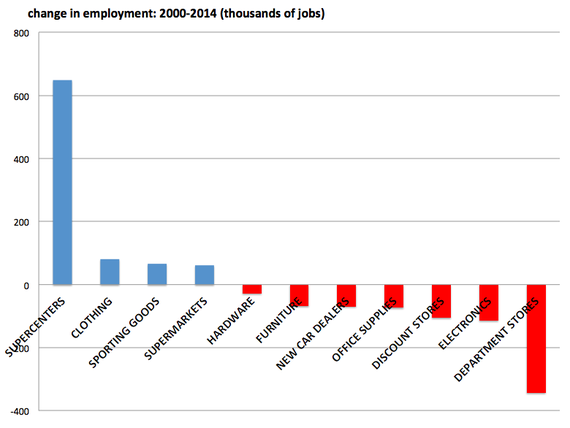
I am happy that there are such places where people have jobs.  Not all of us have the capabilities or the interest to be investment bankers or teachers or politicians.  To quote from Caddyshack, the world needs ditch-diggers too.

But, even those jobs are evaporating.

source

There's something happening here.
You don't need a long explication to see what's going on here. Walmart brought ruthless efficiency to the business of selling stuff in stores, and Amazon brought more ruthless efficiency to the business of selling stuff anywhere, so that today, to be a retail salesperson or cashier—still the two most common jobs in America—is to compete with the convenience of a laptop and a couch (or, even worse, a smartphone search filling a spare moment of boredom). As Radio Shack's story shows, when companies go to war against price and convenience, they tend to lose—first go the jobs, then goes the company. ... There is little reason to think that the most important employment engine of the 20th century will continue to pump through the 21st. The future will be cheap, and it will be convenient, but much of it will lose the personal touch of, well, people.
Even as those jobs are evaporating, the chances are that the ones that remain don't pay well.
Though unemployment has finally dipped below six per cent, real wages for most have barely budged since 2007. Indeed, the whole century so far has been tough: wages haven’t grown much since 2000.
Sometimes, I wonder how people make the proverbial ends meet.  And every time I have such encounters, I can't but think it is crazy for the well-heeled like me to ask for raises and for more benefits.

But, of course, those in my earnings bracket aren't comparing themselves to that ungrammatical retail person but to the investment bankers and CEOs.
corporate America, if not the rest of the economy, has done just fine over the past five years. It’s that all the rewards went into profits and executive salaries, rather than wages.
I don't care about my raise.  But, I am pretty darn certain that executives can easily forego a few dollars in order to ensure that the ungrammatical retail person gets to go home with a few more dollars.  Is it possible?  Yes, at least in one company, apparently:
Aetna’s C.E.O., Mark Bertolini, announced that the company’s lowest-paid workers would get a substantial raise—from twelve to sixteen dollars an hour, in some cases—as well as improved medical coverage. Bertolini didn’t stop there. He said that it was not “fair” for employees of a Fortune 50 company to be struggling to make ends meet. He explicitly linked the decision to the broader debate about inequality, mentioning that he had given copies of Thomas Piketty’s “Capital in the Twenty-first Century” to all his top executives. “Companies are not just money-making machines,” he told me last week. “For the good of the social order, these are the kinds of investments we should be willing to make.”
The lowest paid get raises and executives got copies of Piketty's book.  How fascinating!

Sometimes, an extra effort is needed to make sure that a rising tide will lift not only the yachts but also the rafts and the catamarans--wherever they are floating "at."

Source

Thursday, January 15, 2015

It's tough to make predictions, especially about the future

Yes, that was one of the classics from the one and only Yogi Berra.  If only many important aspects of life can be so easily articulated (even if it fails a formal grammar test.)

For years, I have heard enough and more left-leaning people, especially within academia, beat up on oil companies and their profits.  (Meanwhile, I was beating up on the company that makes the computers that the left-leaning people love to use--for the sheer audacity with which it earns gazillions while portraying a saintly image!)  The evil oil corporations, the story went, did everything possible to increase their profits.  Even launched wars, with the government as their proxies.  The bad oil companies did their best to stifle innovation with the development of the electric car, they argued, because the electric cars will not need oil (gasoline.)

I wonder what they will complain about now, with oil prices tumbling to levels that nobody predicted.  "Peak oil" and the evil corporations together means soon we will be looking at $200 per barrel, they warned us.  The cold, hard, news of today is this:
Brace for $40-a-barrel oil.
So, whatever happened to that framework of the evil oil corporations that want to earn those huge profits?  Why are they now practically giving away gasoline at the pump?

Meanwhile, the company that I love to beat up on is as busy as ever storing its gazillions at tax havens, far away from the taxman and gets a free pass from the left-leaning folks who continue to target the oil companies.  Oh well, a strange world this is!

So, about that oil price.  How come from the experts to the conspiracy nutcases, everybody got it so wrong?  Well, re-read the Yogi Berra quote in the subject line!

Of, if you want an oil-specific quote:
When contemplating the future of oil prices, one should always keep in mind U.S. foreign service officer James Akins’ observation, “Oil experts, economists, and government officials who have attempted in recent years to predict the future demand and the prices of oil have had only marginally better success than those who foretell the advent of earthquakes or the second coming of the Messiah.” Akins wrote that in 1973.
Isn't that a lot more words than the simple Yogism? ;)

Ron Bailey, whose note in Reason is where that quote is from, includes another quote there from a Saudi billionaire who claims that oil will never go back up above $100 a barrel.  Say what?

In a commentary at Project Syndicate, is another interesting question:
should we expect $50 to be the floor or the ceiling of the new trading range for oil?
Say what?  This commentator expects oil prices to go well below $50?  Whatever happened to greedy oil companies and their profits?
economics and history suggest that today’s price should be viewed as a probable ceiling for a much lower trading range, which may stretch all the way down toward $20. 
Are you kidding me?
the marginal cost of US shale oil would become a ceiling for global oil prices, whereas the costs of relatively remote and marginal conventional oilfields in OPEC and Russia would set a floor. As it happens, estimates of shale-oil production costs are mostly around $50, while marginal conventional oilfields generally break even at around $20. Thus, the trading range in the brave new world of competitive oil should be roughly $20 to $50. 
Don't bet your farm on this, as they say.  Why?  I refer you to the Yogi Berra quote in the title.

A couple of years ago, I received a snarky email from a former student.  In the email, she referred to the stepped up production in the US thanks to fracking up the Bakken oil as evidence that I was bullshitting in the class.  (Ok, she didn't use the BS word.)  I wrote back to her that my worry has never been about exhausting the oil supplies or the price, but about the continued and expanded use of carbon as the source of energy and its impacts on global climate.  Even now, though it is awesome to fill up a tank at a remarkably low price, I do worry about the long-term consequences of a delay in energiewende.

Maybe I should not worry about tomorrow and, instead, seek consolation in the Yogism, "It's tough to make predictions, especially about the future."


Monday, November 10, 2014

When ignorance feels like expertise. The confident idiots we are.

Yes, that is the story of me as a faculty in the classroom.

Come to think of it, that is the story of my life.

I suppose if I were to ever write an autobiography (as if I have not shared enough of my life in this blog!) the title of that book will be "A Confident Idiot."  Hey, what are you sniggering at?

Perhaps you are chuckling at how freely I admit to my idiocy.  That, dear reader, is one of the greatest benefits of aging, unlike the pretensions that I had to stage-manage when I was younger.

Turns out that whether we are young or old, we are all confident idiots, writes a Cornell University professor:
For more than 20 years, I have researched people’s understanding of their own expertise—formally known as the study of metacognition, the processes by which human beings evaluate and regulate their knowledge, reasoning, and learning—and the results have been consistently sobering, occasionally comical, and never dull.
The American author and aphorist William Feather once wrote that being educated means “being able to differentiate between what you know and what you don’t.” As it turns out, this simple ideal is extremely hard to achieve. Although what we know is often perceptible to us, even the broad outlines of what we don’t know are all too often completely invisible. To a great degree, we fail to recognize the frequency and scope of our ignorance.
Recall that profound adage about wisdom: not knowing that we don't know is not the mark of a wise one.  To understand deep down that we know very little and that we know that we don't know is one heck of a strong position.  Well, unless you want to be a politician!

Of course, we will assume that the Cornell professor, David Dunning, knows what he is writing about ;)
[In] many areas of life, incompetent people do not recognize—scratch that, cannot recognize—just how incompetent they are, a phenomenon that has come to be known as the Dunning-Kruger effect. Logic itself almost demands this lack of self-insight: For poor performers to recognize their ineptitude would require them to possess the very expertise they lack. To know how skilled or unskilled you are at using the rules of grammar, for instance, you must have a good working knowledge of those rules, an impossibility among the incompetent. Poor performers—and we are all poor performers at some things—fail to see the flaws in their thinking or the answers they lack.
What’s curious is that, in many cases, incompetence does not leave people disoriented, perplexed, or cautious. Instead, the incompetent are often blessed with an inappropriate confidence, buoyed by something that feels to them like knowledge.
That's right--the ones who are incompetent are blessed with inappropriate confidence.  Go figure!  No wonder then that politicians are damn confident people ;)

But, hold your laughter:
Because it’s so easy to judge the idiocy of others, it may be sorely tempting to think this doesn’t apply to you. But the problem of unrecognized ignorance is one that visits us all.
Recall that profound adage about why people in glass houses shouldn't throw stones?  You and I are in our own little glass houses, too!

To quite an extent, it is all because that is how we are wired; the brain is awesome, but that brain is also why we become confident idiots:
An ignorant mind is precisely not a spotless, empty vessel, but one that’s filled with the clutter of irrelevant or misleading life experiences, theories, facts, intuitions, strategies, algorithms, heuristics, metaphors, and hunches that regrettably have the look and feel of useful and accurate knowledge. This clutter is an unfortunate by-product of one of our greatest strengths as a species. We are unbridled pattern recognizers and profligate theorizers. Often, our theories are good enough to get us through the day, or at least to an age when we can procreate. But our genius for creative storytelling, combined with our inability to detect our own ignorance, can sometimes lead to situations that are embarrassing, unfortunate, or downright dangerous—especially in a technologically advanced, complex democratic society that occasionally invests mistaken popular beliefs with immense destructive power (See: crisis, financial; war, Iraq). As the humorist Josh Billings once put it, “It ain’t what you don’t know that gets you into trouble. It’s what you know for sure that just ain’t so.” (Ironically, one thing many people “know” about this quote is that it was first uttered by Mark Twain or Will Rogers—which just ain’t so.)
Thus,
people rely on the cognitive clutter in their minds—whether it’s an ideological reflex, a misapplied theory, or a cradle-born intuition—to answer technical, political, and social questions they have little or no direct expertise in.
Harry Frankfurt had a much simpler way to describe all this: we bullshit!  Frankfurt noted that the ability to bullshit, and the inclination to do so, does not decrease with education but actually increases with it--because of all the new skills we picked up to articulate ideas about which we don't know a damn thing.  While Frankfurt reached that via philosophy, the Cornell professor approaches it via psychology.

So, any suggestions?
For individuals, the trick is to be your own devil’s advocate: to think through how your favored conclusions might be misguided; to ask yourself how you might be wrong, or how things might turn out differently from what you expect. It helps to try practicing what the psychologist Charles Lord calls “considering the opposite.” To do this, I often imagine myself in a future in which I have turned out to be wrong in a decision, and then consider what the likeliest path was that led to my failure. And lastly: Seek advice. Other people may have their own misbeliefs, but a discussion can often be sufficient to rid a serious person of his or her most egregious misconceptions.
Aha, that is no different from what I tell students all the time.  Phew, good to know that I have not been a confident idiot in advocating that method! ;)
The built-in features of our brains, and the life experiences we accumulate, do in fact fill our heads with immense knowledge; what they do not confer is insight into the dimensions of our ignorance. As such, wisdom may not involve facts and formulas so much as the ability to recognize when a limit has been reached. Stumbling through all our cognitive clutter just to recognize a true “I don’t know” may not constitute failure as much as it does an enviable success, a crucial signpost that shows us we are traveling in the right direction toward the truth.
Exactly.  If you don't know, be confident and bold when you say "I don't know."  But then try to know as well.
Source: The New Yorker, of course!