Showing posts with label rogoff. Show all posts

Tuesday, May 13, 2014

Has income inequality increased or decreased? Yes!

When eminent economists at the world's elitist of elite universities disagree, then it all comes down to a simple question: who you gonna believe?

Income inequality is one heck of a hot topic now and even normally the dismal scientists would have had plenty to say about it.  And then came a French dude, with a name that I didn't really know how to pronounce and was going about butchering his last name as I butcher any word that I come across.  At least, thanks to the New Yorker, I know that even Nobel Laureates had some trouble with this:
The economist Paul Krugman burst into an office at the CUNY Graduate Center one recent evening with a pronunciation question. “Is it Pik-etty?” he asked, so that the name rhymed with “rickety.” “Or is it Pikit-tay? And are we going with Tho-mah, or Thom-as?” Three academics stood nearby, clutching wineglasses. They had assembled as part of a welcoming party, but no one knew how to pronounce the name of the guest of honor, the French economist Thomas Piketty. “How about Dr. P.?” Chase Robinson, the interim president of the Graduate Center, suggested.
So, really, how is it to be pronounced?  Tell us, Dr. P.:
“Peek-et-tee,” he said.
That is the only easy thing about the storm that “Peek-et-tee,” has kicked up!

It turns out that there are long lines of reputed economists on either side of the issue.  I have no idea how to make sense of it all.  I am inclined to believe the pro-Piketty crowd, only because my emotions tend to sympathize with that.  After all, there is still that remnant of the commie spirits that flooded my teenage brain.

But, my rational mind wonders why there is that other line, also with economists of the highest calibre.  Take Kenneth Rogoff, for instance. A Harvard economics professor and a former chief economist with the IMF.  Enough cred for you?  Rogoff writes:
Reading Thomas Piketty’s influential new book Capital in the Twenty-First Century, one might conclude that the world has not been this unequal since the days of robber barons and kings. That is odd, because one might conclude from reading another excellent new book, Angus Deaton’s The Great Escape (which I recently reviewed), that the world is more equal than ever
Which view is right?
I say the answer is via another question: who you gonna believe?

If you believe Rogoff, well:
The answer depends on whether one looks only at countries individually or at the world as a whole
Why does that make any difference?
The same machine that has increased inequality in rich countries has leveled the playing field globally for billions. Looking from afar, and giving, say, an Indian the same weight as an American or a Frenchman, the last 30 years have been among the greatest in human history for improving the lot of the poor
Indeed, over the last thirty years we have seen tremendous improvement in extreme poverty.
In 1990, 43% of the population of developing countries lived in extreme poverty (then defined as subsisting on $1 a day); the absolute number was 1.9 billion people. By 2000 the proportion was down to a third. By 2010 it was 21% (or 1.2 billion; the poverty line was then $1.25, the average of the 15 poorest countries’ own poverty lines in 2005 prices, adjusted for differences in purchasing power). The global poverty rate had been cut in half in 20 years.
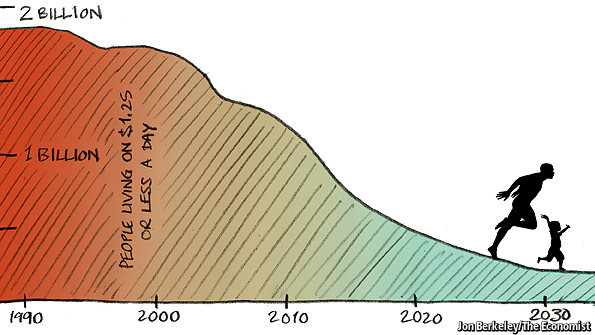
The story of India and China now having a significant middle class also happened over the thirty years.  Which is why Rogoff says the answer depends, and concludes with this:
In accepting Piketty’s premise that inequality matters more than growth, one needs to remember that many developing-country citizens rely on rich-country growth to help them escape poverty. The first problem of the twenty-first century remains to help the dire poor in Africa and elsewhere. By all means, the elite 0.1% should pay much more in taxes, but let us not forget that when it comes to reducing global inequality, the capitalist system has had an impressive three decades.
So, who you gonna believe?

I turned to my favorite when it comes to income distribution issues: Branko Milanovic.  He writes:
When we look at the global population rather than at countries, however, there is a positive side. The unprecedented growth of China and, from the early 1990s, of India, as well as much of the rest of Asia has lifted millions out of poverty. For the first time since the industrial revolution, income inequality among world citizens has fallen.
See, again, from a global perspective, things have never been this good.

Milanovic concludes thus:
What is the role of national inequalities? On a purely arithmetic level, if real growth is given, greater inequality slows poverty reduction and probably the expansion of the middle class. But those who believe in trickle-down economics argue that without greater inequality there would not be strong growth. While this might have been true for China in the past 20 years, it is doubtful that further growth in inequality there will be so benign. China’s Gini – a measure of inequality – at about 44 is already greater than America’s. Can it rise further, deepening regional and urban-rural divides, without slowing the expansion of the middle? India’s inequality, long thought to be in the mid-30s Gini range, may if assessed in terms of income rather than consumption already be as high as 50, practically at the Latin American level.It is therefore growth with redistribution (a familiar development formula from the 1970s) that should be our objective in the years to come, if we want both global poverty and global inequality to continue their downward trend. 
So, who you gonna believe?

Monday, March 12, 2012

Will pay gazillions for linsanity. But, not a dime for CEOs?

I have ranted blogged many times about the ridiculousness in the supersized payouts for athletes, actors, singers and other entertainers (like here).  And pointed out the irony in the ardent supporters of these gazillionaires being vehement critics of corporations and their CEOs.  But, who cares for what Sriram says, right?

But, what about when the eminently qualified Ken Rogoff makes that same point?  Will you listen to him then?  If so, here is what he writes:
What amazes me is the public’s blasé acceptance of the salaries of sports stars, compared to its low regard for superstars in business and finance. Half of all NBA players’ annual salaries exceed $2 million, more than five times the threshold for the top 1% of household incomes in the United States. Because long-time superstars like Kobe Bryant earn upwards of $25 million a year, the average annual NBA salary is more than $5 million. Indeed, Lin’s salary, at $800,000, is the NBA’s “minimum wage” for a second-season player. Presumably, Lin will soon be earning much more, and fans will applaud.
Yet many of these same fans would almost surely argue that CEOs of Fortune 500 companies, whose median compensation is around $10 million, are ridiculously overpaid. 
The US values entertainment way too much for its own good.  But, hey, that is the story within academia too--football and basketball rule, while the liberal arts get flushed down the dirtiest toilet :(

Oh well ...

Tuesday, June 01, 2010

Oil spill, finance mess, and regulation

Ken Rogoff puts it so succinctly (ht):
The parallels between the oil spill and the recent financial crisis are all too painful: the promise of innovation, unfathomable complexity, and lack of transparency (scientists estimate that we know only a very small fraction of what goes on at the oceans’ depths.)  Wealthy and politically powerful lobbies put enormous pressure on even the most robust governance structures.
Well phrased, right?  Rogoff then writes:

If ever there were a wake-up call for Western society to rethink its dependence on ever-accelerating technological innovation for ever-expanding fuel consumption, surely the BP oil spill should be it. Even China, with its “boom now, deal with the environment later” strategy should be taking a hard look at the Gulf of Mexico.
Economics teaches us that when there is huge uncertainty about catastrophic risks, it is dangerous to rely too much on the price mechanism to get incentives right. Unfortunately, economists know much less about how to adapt regulation over time to complex systems with constantly evolving risks, much less how to design regulatory resilient institutions. Until these problems are better understood, we may be doomed to a world of regulation that perpetually overshoots or undershoots its goals.
I am not sure whether regulation will ever be able to get it right.  It is simply the nature of the beast, so to say.  But, here is the question: aren't the global economic crisis and the oil spill posters for it might be better to overshoot through regulation than to undershoot?  After all, Rogoff himself notes:
t is extremely difficult to strike a balance between managing “tail risk” – a very small risk of a very large disaster – and supporting innovation.
Overshooting means precluding that "tail risk" ... a tough call for society.  The recent announcement from Craig Venter is yet another example of how things will only get even more complex ....

Thursday, September 18, 2008

US will need a trillion dollar bail-out

It is true that the US government has very deep pockets. Privately held US government debt was under $4,400bn at the end of 2007, representing less than 32 per cent of gross domestic product. This is roughly half the debt burden carried by most European countries, and an even smaller fraction of Japan’s debt levels. It is also true that despite the increasingly tough stance of US regulators, the financial crisis has probably already added at most $200bn-$300bn to net debt, taking into account the likely losses on nationalising the mortgage giants Freddie Mac and Fannie Mae, the costs of the $29bn March bail-out of investment bank Bear Stearns, the potential fallout from the various junk collateral the Federal Reserve has taken on to its balance sheet in the last few months, and finally, Wednesday’s $85bn bail-out of the insurance giant AIG.
Were the financial crisis to end today, the costs would be painful but manageable, roughly equivalent to the cost of another year in Iraq. Unfortunately, however, the financial crisis is far from over, and it is hard to imagine how the US government is going to succeed in creating a firewall against further contagion without spending five to 10 times more than it has already, that is, an amount closer to $1,000bn to 2,000bn.

When Ken Rogoff writes thus, I can only exclaim OMG!