Showing posts with label coal. Show all posts

Saturday, December 07, 2019

Slow cooking

Judging a post by its title would deceive you into thinking that this is yet another post on sanitas per escam.  It is not.

Instead, it is about CO2 emissions.
CO2 emissions were on course to rise 0.6 percent this year—slower than previous years but still a world away from what is needed to keep global warming in check.
In three peer-reviewed studies, authors attributed the rise to "robust growth" in natural gas and oil, which offset significant falls in coal use in the United States and Europe.
Where does the slow cooking come in then?
The new data shows that natural gas, which is less polluting than coal but still a fossil fuel, has become the biggest driver of emissions growth globally in recent years. ...
“Natural gas may produce fewer carbon emissions than coal, but that just means you cook the planet a bit more slowly,” said Dr. Peters. “And that’s before even getting into the worries about methane leaks” from gas infrastructure.
The fact that we are being slowly cooked, as opposed to a quick broiling, is not comforting, however.

India is key when it comes to further slowing down the cooking:
India, which is trying to lift hundreds of millions of people out of poverty, was perhaps the biggest surprise in the new data. India’s emissions are expected to rise a mere 1.8 percent this year after an 8 percent increase in 2018.
Some of that slowdown, the researchers noted, can be explained by weaker economic growth and an unexpectedly strong monsoon season that allowed the country to generate more electricity from its emissions-free hydroelectric dams and less from its coal plants. But India’s government is also pursuing big plans to promote solar power and electric vehicles, and it remains to be seen whether those policies can help the country constrain future emissions.
But, we need to always keep this in mind:
The carbon footprint of fully industrialized nations remains far higher, however—both in terms of historic emissions and on a per-person basis. America’s per capita oil consumption, for instance, is 16 times greater than India’s.While these wealthier nations are now making a tiny amount of progress on emission reductions, they also relied on fossil fuels to drive their economic growth for more than a century. So these countries have a clear responsibility, as well as a greater financial ability, to cut emissions deeper and faster than emerging economies. They should also help those countries meet as much of their growth as possible with clean energy technologies, by providing low-cost financing, technological know-how, and other forms of support.
Try convincing tRump and his 63 million toadies about this!


Sunday, March 18, 2018

At your service!

On quite a number of occasions, my father has expressed his surprise at how people earn money these days, in contrast to the old days when he was an active participant in the labor economy.  Back then the work products were a lot more tangible.  Farmers grew crops. Miners dug stuff. Workers made widgets.

His favorite way of expressing the change that he and all of us try to understand is "now, everybody is a consultant."

While that is an exaggeration, of course, it is true that even in the old country there has been a tremendous change in the percentage of labor in anything but agriculture, mining, and manufacturing.  There are consultants. Beauty parlors. Investment managers.  And that other comment that father makes: "if they are not consultants, they are all doing software."

If that is the story in the old country, it is even more dramatic here in the US.  However, listening to trump and his 63 million voters, one would believe that everybody is in farming or mining or making widgets in factories.  While facts do not matter to these minions, the rest of us care.
 “goods-producing” jobs like logging, mining, construction and manufacturing accounted for only 20.5 million jobs last month, in a nation with 148 million total positions.
Where do the overwhelming majority work then?  In the service sector.
If you have a mental model in which the only valuable jobs involve making steel or mining coal, it’s easy to lose sight of some of the middle-income jobs that are more common in the 21st-century service economy. Examples include the blackjack dealer in a Las Vegas casino, the nurse at a hospital renowned for its cancer treatments, the audio technician on a movie set, the engineer who advises companies worldwide on the best way to extract oil.
trump and his fellow idiots want to make America great again by trying to bring back those logging, mining, construction, and manufacturing jobs that will only fade more into the future?  What a bunch of morons!  "Fucking morons," to quote the now ousted Secretary of State, Wayne Tracker.

Services make a lot of money for the US.
The biggest is travel, which accounted for $204 billion last year. This is an area that the president should know well. When a Canadian couple stays in a Trump hotel in New York, the money they spend counts as a service export.
The next biggest category is “charges for the use of intellectual property,” a category that includes foreigners who pay to watch movies or music made in the United States, as well as licenses of patents and trademarks.
Other big ones include financial services, insurance, telecommunications and information technology, and a wide range of engineering and other consulting services.
If trump really cared for the average, forgotten, people, he should talk more about the plight of fast food workers than pretending to care about the coal mine workers.

Who am I kidding; the narcissist in the Oval Office cares for nobody but himself!


Friday, July 14, 2017

Rights and wrongs

Way back, when I was a kid who had barely gotten on to the bicycling phase, I complained to my father that our home was far away from where my friends lived.  He said that the industrial township was intentionally designed that way--with lots of open space and trees--in order to make sure that the health impacts from the open-pit (strip) mining would be minimal.

Fast forward a few decades.  We had a thirtieth high school reunion.  After the excitement died down, we middle-aged classmates even talked about our health issues, and our parents' health.  One classmate was convinced that his father's neurological disease was from the daily exposure to toxic chemicals at the fertilizer factory.  His father's health conditions were nightmarish, of an active brain trapped in an immobile body.

My slightly asthmatic hassles were what I brought to the discussion.  I added that my parents and siblings too had--and have--allergy issues that then complicate the nose, throat, lungs functioning.  A friend quickly jumped in at that point, with a forceful comment that most of us who lived there have those very issues and that, yes, the industrial air was the cause.

Of course, establishing the cause-and-effect is not easy, especially when it comes to geographic clusters of ill-health.  But, think about it: Extensive mining, where the topsoil and the layers underneath are stripped generating whatever into the atmosphere.  Then there are the byproducts of the factories.  There is enough and more to hypothesize, right?  I suppose I should be happy that the township was at least well spread out.

It is a strange "development" model that we have put into place over the past two hundred years.  We destroy the natural environment in order to do everything from making smartphones and tshirts and whatever.

The right to pursue happiness is one thing, but don't we have a more fundamental right to clean air, clean water, a clean environment?
The idea of environmental human rights is receiving growing attention worldwide, driven by our global ecological crisis.
I worry that this is coming a tad too late.  A couple of years ago, I went to India's IT capital to meet with a few friends, including this guy.  I was shocked at how warm and dry and brown it was, in contrast to my trip there when I was wrapping up high school.  My father routinely updates me that wells in my grandmother's village have gone dry.  Every visit, I am shocked by how polluted the city is.

I wish we talked more and often about environmental human rights:
The idea of environmental human rights dates back to the environmental movement of the 1960s and 1970s. It follows other, more established conceptions of human rights, such as civil and political rights and economic, social and cultural rights, and often is classified as part of a so-called third generation of “newer” human rights.
Few international agreements explicitly refer to environmental human rights. At the national level, however, more than 100 countries around the world have constitutions that enshrine environmental rights to some degree, including Brazil and Kenya.
Only a handful of U.S. states, including Pennsylvania and Hawaii, have constitutions that explicitly incorporate environmental rights. What is more, these provisions were largely established decades ago and have had uneven success in their enforcement.
With this president and his secretaries for the natural environments (EPA and Interior) we are well on our way to making things even worse.


Wednesday, July 12, 2017

The dirty truth that does not have to be mined

If only more people understood the importance of economic geography in their own lives.  I often tell students in my intro class that if they carried with them the economic geography way of looking at the world, ... but, of course, rare is a student who pays any attention to me.

Most of this current president's campaign lies were on issues that are absolutely economic geography.  China's competition with the US? Yes. Immigration from Mexico and elsewhere?  Yep. Coal? Of course, yes, dammit!

I read two essays on the coal country in eastern Kentucky and West Virginia.  I am guessing this a region that this president won by a huge margin over Hillary Clinton, who spoke the truth about coal jobs not coming back.

Click here to zoom into the map
You know the economics of the region is in shit streets when even Walmart closes down a store.
Rural areas like McDowell County, where Walmart focused its expansion plans in the 1990s, are experiencing accelerating depopulation that is putting a strain on the firm’s boundless ambitions.
Hit hard by the longterm decline in coal mining that is the mainstay of the area, McDowell County has seen a devastating and sustained erosion of its people, from almost 100,000 in 1950 when coal was king, to about 18,000 today.
This president can bullshit all he wants, and 63 million people can vote for him, yes.  But, then there is the real world.

This wasn't even a regular Walmart store, which can seem huge to visitors from most other parts of the world.  This was a supercenter!
“It’s all about jobs,” says Melissa Nester, publisher of the local newspaper, The Welch News, which sells 4,500 copies three times a week and doggedly refuses to have a website. “Dollar stores have picked up some of the trade left by Walmart, but they haven’t created many jobs.”
At its peak, Walmart employed 300 people in the McDowell County supercenter. That was down to about 140 by the end, but it still made it the largest employer in the area.
 The reality of life in a corner of the US that is being rapidly left behind.  These are the "forgotten" people that this president bullshitted to.
After jobs, taxes are the next things to go. The town of Kimball in which the supercenter is located used to receive $145,000 a year in taxes from Walmart, and when that went it had to cut back its workforce and put all remaining staff on a four-day week.
The county government also lost $68,000 in taxes, most of which went to schools, and all its staff were given a 10% pay cut.
It does not take much for economic conditions to quickly spiral down.  Rome was not built in a day, but it did not take long for the decline and fall, right?

Linda McKinney ... "mourns the communal aspect of the supercenter, its quality as a “social hub”."
McKinney rattles off a list of all the community facilities that disappeared from the region in recent years as the population declined and the culture of mega-chains like Walmart took root.
There used to be 28 churches of her United Methodist denomination in the county, now there are six; there were seven bars in Welch, all but one have closed; there were three cinemas, now it’s down to one; there are no community centers left; many of the corner shops have gone. “There’s nothing here,” McKinney says.
A complementing essay at a different publication looks at another aspect of this economic geography: What can a community college do to help people?
As manufacturers shed workers and businesses gravitate to urban areas, they often leave economic devastation in their wake. Thousands of people reliant on a dominant industry, in this case coal, are thrown out of work and their options are few. In the hills and hollows of Eastern Kentucky, communities must also contend with low levels of education, high rates of poverty, weak infrastructure, and an opioid epidemic.
If you are like me, you are thinking this: A community college cannot do much to address such complicated issues.  True,  But, they try their best.
Meanwhile, state and regional leaders wrestle with a pressing challenge: Can they bring decent jobs to an area that lacks the infrastructure, education levels, and geography to support large manufacturers and skilled jobs? In 2014 the average annual wage for a coal miner in Kentucky was $72,000. Nothing has come along since to replace that.
Nothing will come along to replace that $72,000 job.  Of course, that is not the truth that this president and his minions talked about, right?

Keep in mind that there are other jobs.  It is just that those other jobs barely pay minimum wages.
"A lot of what you see in terms of opioid abuse, a decrease in life expectancy, a lot of that is being driven by the hopelessness of seeing jobs, but not good jobs," says Nate Anderson, who spends a lot of time in Kentucky as a senior director at Jobs for the Future, a nonprofit organization that promotes skills training and job opportunities for low-income people. "No one wants to spend their entire life in retail earning next to nothing. They want opportunity and that’s gone."
So, what can be done?

Anything that can be done will have to start at step number one, which will never ever happen.  That first step is this: Political leaders need to start talking the truth to people.  Because that will not happen, and because even partial-truth will only make losers out of candidates, well, ... we are where we are now!

The second best thing to do: Take courses in economic geography and save yourself a whole lot of trouble!

Friday, June 09, 2017

We can't rewind, we've gone too far

It has been a few days since the president theatrically announced that he is pulling the United States out of the Paris agreement on climate change.  I cannot even begin to understand his (ill)logic!

I am increasingly reminded of my younger days in the old country, when politicians would simply lie through their teeth and say whatever they needed to say in order to get the votes.  As a tween and as a teenager, I would read Thuklak and laugh at the idiot politicians, but fully aware that I--like most others--was being screwed.

It is one thing when a local DMK or an ADMK thalaivar entertains the crowd in the nearby maidan with his lies, but it is another when it is the president of the US--words have global implications in trump's case.

If trump wants to continue believing that coal will come back, whatever happened to the brains of the rest of the GOP leaders?  Are they all zombies now?

Here in the real world, the data and the trends have been so clear for so long:
The coal-mining jobs that President Trump thinks were destroyed by government regulation — adopted to combat air pollution and global warming — were actually lost to old-fashioned competition from other American firms and workers. Eastern coal mines lost market share to Western coal, which was cheaper. And natural gas grew at coal’s expense because it had low costs and lower greenhouse gas emissions.
That’s the conclusion of a new study by economist Charles Kolstad of the Stanford Institute for Economic Policy Research ...
Government isn’t killing the coal industry. “Progress is the culprit,” concludes Kolstad’s study.
How much more clearer and simpler should this message be for the GOP idiots to understand?

Source
Technological progress happens.  And we are thankful for it.  Well, unless your livelihood depended on, say, renting video tapes of movies!  Without the technological progress, trump would not have Twitter, and he would, not have become president either back when coal was king!


Monday, May 22, 2017

What's the price of retail jobs?

The pussygrabber ranted on and on about jobs in the coal mines, as if he knew anything about the industry or the people who work.  But, 63 million suckers voted for him anyway!

If only his voters had paid attention to the real world, they would have been worried about an entirely different industry: "The retailing industry employs 15.9m people, accounting for one in nine American jobs."

The retail industry is shedding jobs, and closing stores, are frightening speeds:
 Since January the industry has shed 50,000 jobs, with more lay-offs sure to come. Mr Mathrani reckons that, for shopping centres to match demand, 30% of space should close permanently. In one particularly gloomy scenario, all retail property would shrink by as much. If staff dropped by the same proportion, 4.8m would be at risk of the sack—around half the number of American jobs lost during the financial crisis. Eventually, even more may be laid off, as remaining stores cut costs through automation.
Did you notice that "a" word?  Automation!
The result is that America’s rich landscape of shops now looks like a dangerous glut. Since the start of 2016 Macy’s has announced that it is closing 140 shops. J.C. Penney said in March that it would shut 138. More closures are sure to come. Department stores’ floor space has contracted by 11.5% since 2006, but sales have shrunk more than twice as fast, according to Green Street Advisors, a real-estate research firm (see chart 2). To reach the inflation-adjusted sales productivity of 2006, at least another 800 department stores would need to close, reckons D.J. Busch at Green Street.
In the world of politics, it is coal that translates to diamond when it comes to votes:
This slow melt has so far attracted little attention from politicians, despite jobs in retailing outnumbering those in coal mining, which has caught the political eye, by a factor of 300.
Meanwhile, automation in retailing is taking on another fundamental aspect of the transaction: price.
The right price—the one that will extract the most profit from consumers’ wallets—has become the fixation of a large and growing number of quantitative types, many of them economists who have left academia for Silicon Valley.
Yep, "the right price can change by the day or even by the hour" thanks to automation, which is killing the real world stores:

Guru Hariharan uncapped a dry-erase marker in a conference room at Boomerang’s headquarters in Mountain View, California. He was talking about what had led retailers to this desperate place where it’s necessary to change prices multiple times a day. On a whiteboard, he drew a series of lines representing the rising share of online sales for various kinds of products (books, DVDs, electronics) over time, then marked the years that major brick-and-mortar players (Borders, Blockbuster, Circuit City and RadioShack) went bankrupt. At first the years looked random. But the bankruptcies all clustered within a band where online sales hit between 20 and 25 percent. “In this range, there’s a crushing point,” Hariharan said, clapping his hands together for emphasis. “There’s a bloodbath happening.”
Beyond this crushing point, traditional retailers with both a brick-and-mortar and an online presence feel compelled to compete purely on price. Hariharan talked wistfully of the days when he’d walk into RadioShack and have a salesperson direct him to the exact connector cable he needed. But once retailers enter the crushing zone, expenses like staff, training, and customer support typically are slashed. Profit margins keep falling nonetheless—why go to the store at all if no one there can help you?—and a death spiral ensues. (RadioShack traced just this path before filing for bankruptcy in 2015.)

Yet, the pussygrabber always talks about those few thousand coal mining jobs?

Saturday, April 22, 2017

Carrying coal to Newcastle

In my classes, I often remind students that for all practical purposes, it is the last two hundred years that have made a huge difference in the human condition, and that the rest of this century will undergo transformations that will be of a scale even grander than that of the past two centuries.

All those pretty much began with the way we started using coal to power the transformative ideas.  This coal-based transformation of the world, the Industrial Revolution, began in England.  The same place where history was made this past Friday:
Friday was the first full day since the height of the Industrial Revolution that Britain did not burn coal to generate electricity, a development that officials and climate change activists celebrated as a watershed moment.
The accomplishment became official just before 11 p.m., when the 24-hour period ended.
...
Now on a path to phase out coal-fired power generation altogether by 2025, Britain, also the home of the first steam engine, is currently closing coal plants and stepping up generation from cleaner natural gas and renewables, like wind and solar.
“Symbolically, this is a milestone,” said Sean Kemp, a spokesman for National Grid, Britain’s power grid operator. “A kind of end of an era.”
I wish the coalman-in-chief in the White House and his 63 million toadies will get to at least hear about this, which their only news source--Faux Noose--will not cover, I am sure.
“The first day without coal in Britain since the Industrial Revolution marks a watershed in the energy transition,” Hannah Martin, head of energy at Greenpeace U.K., told The Guardian. “The direction of travel is that both in the U.K. and globally we are already moving towards a low carbon economy.”
If not for the fucked up GOP, we would have moved a lot more towards a low carbon economy!

Not that the world of business is any better either.  Which should worry us when business schools rarely, if at all, include sustainability in their curriculum.
Even if we stop or reduce greenhouse gas emissions, global temperatures will continue to rise for 100 or more years due to carbon dioxide emissions already in the atmosphere. Today’s business students who will be tomorrow’s business leaders are guaranteed to face sustainability challenges.
Tell that to the businessman-in-chief, when he is not busy grabbing pussies!


Monday, August 29, 2016

Ducking climate change

(Have sent a version of this to the editor)

An old high school friend, who is a practicing pathologist in India, visited with me in mid-August, just as the temperature started its sharp climb during the dog days of summer. I joked that she brought with her the Indian conditions. Talk about the weather soon morphed into discussing climate change.

My friend, like many hundreds of millions in India, is intensely familiar with the recent unusual meteorological happenings there. Last December, for instance, the city of Chennai--home to both our parents--received rainfall amounts that vastly exceeded all kinds of records and the city was flooded. (I addressed this in a column that was published on January 6, 2016.)

In late spring, more than a quarter of India’s 1.2 billion population struggled with drought and water shortage. The conditions worsened in the summer, when the country recorded unbearably hot temperatures, and the heatwave turned out to be a killer as much as the heatwave of 2015 was. Then, when the monsoon arrived after all the heat and dust, it poured and flooded. In Kaziranga National Park in India’s northeast, more than twenty rhinos, which had been making quite a recovery after near extinction, were killed in the monsoon floods.

Most scientists and lay people alike in India are in agreement that these extreme weather episodes, year after year, are a result of climatic conditions that are getting weirder and not predictable as they might have been in the past.

Here in the US too, it is not a mere accident that record-setting rain fell in Louisiana, for instance. Only months before, we witnessed Houston deluged by rains. When records are being shattered in places across the world, across different parameters of heat, rain, drought, and cold, then surely these are not isolated events but a part of a larger story.

When it comes to that larger story of global climate change, it is not a case of what happens in Vegas stays in Vegas. Instead, the cumulative effects of Vegas and everywhere else means that all of us anywhere on the planet are feeling the effects. The more extreme the resulting weather events, the more will be the destruction of life and property as well.

My friend and I got to talking about what can be done. “Look at all the lights here” she remarked. Homes were aglow in my neighborhood from the light inside and from the street lamps. Artificial light is so much in abundance in the US that we are worried about light pollution that prevents most Americans from sighting even our own home galaxy—the Milky Way. “Twinkle, twinkle, little star” is an abstract idea for many urban kids who rarely see get to see stars in the sky during their everyday lives.

It is quite a contrast in her country. "In India, a large population doesn’t even have electricity in their homes. Turning the lights off won’t help fight climate change" she said.

Developing countries like India have an immense problem to solve. When 300 million people in India lack basic electric light, leave alone air conditioners and refrigerators, the magnitude of the problem is easy to imagine. Even among those who are connected to the electricity grid, the power consumption per person is barely a fifth of the global average. The fulfillment of the dreams of the people will require a whole lot of energy. However, the use of coal and other carbon sources will further accelerate the climate weirding.

While India’s emissions are very low on a per-capita basis—about a tenth of US per capita emissions—it is already the third largest total emitter of carbon dioxide. As India’s economic engines rev up, if it follows the same fossil-fuel path that was traveled most recently by China, and by the developed countries including the US earlier on, then the explosive growth of carbon use will mean “game over”, and we might as well party like there will be no tomorrow.

Thus, as we move into the future, it is India—more than any other developed or developing country—that will practically determine our collective global fates with its decisions on clean and carbon-free energy sources.

It was an unbearably warm evening the day before my friend left. We walked up to the Willamette River and soaked our feet in the cool waters. About thirty young and old ducks floated and quacked all around us. Climate change could prevent future generations from enjoying such blissful nature. Here is to hoping that the natural world of tomorrow will be as good as, or even better than, the wonderful world that we inherited.


Monday, April 04, 2016

All was lost for want of ... water

I worry that I blog on way too many topics.  I worry because while I am a polymath wannabe, I am at best a dilettante.  There is, therefore, the nagging worry that it is only a matter of time before the world sniffs out this fake.  

But then, every once in a while something happens just enough to boost my ego.  It happened today too, which means I can rest easy for a while ;)

What happened today?  I read this in my favorite newspaper from the old country:
The Ganga that has nourished the Indian civilisation for centuries has recorded a historically low inflow in its lower reaches this year, going by the evidence on the ground. The inflow at the Farakka barrage in West Bengal nearly halved, compared with the quantum of water available in the last two years. The NTPC’s plant beside the barrage had to shut operations from March 10.
An NTPC plant shutting down?
Readings showed that the water level in the canal connecting the river to the plant was going down rapidly. Water is used to produce steam to run the turbines and for cooling vital equipment of coal-fired power stations.
By next day, authorities were forced to suspend generation at the 2,300-megawatt plant in Farakka town causing shortages in India's power grid. Next, the vast township on the river, where more than 1,000 families of plant workers live, ran out of water. Thousands of bottles of packaged drinking water were distributed to residents, and fire engines rushed to the river to extract water for cooking and cleaning.
Unprecedented.

What's the connection between a coal-fired power plant and water?  As the Union of Concerned Scientists put it in the context of the US:
Coal-fired power plants, which produce almost half of the country’s electricity, have significant impacts on water quantity and quality in the United States. Water is used to extract, wash, and sometimes transport the coal; to cool the steam used to make electricity in the power plant; and to control pollution from the plant.  The acts of mining and burning coal, as well as dealing with the waste, also can have major effects on water quality.
A lot of water is needed.  When there was no water, the NTPC's coal fired plant had to close down.

So, back to me.  After all, the blog posts are always about me ;)  Why do I feel like I am not that much a fake after all?

Back in April 2009--yes, seven years ago--the newspaper  published an op-ed of mine, in which I wrote about the importance of water in energy production.  I wrote there that water is a lot more to be worried about than CO2:
This is but another incentive for us to explore alternative energy sources that do not impose additional demands on water, which will then also mean lesser reliance on coal. Water-constrained countries such as China, India and Israel ought to encourage innovation on this urgent issue.
At the same time, we here in the United States have a wonderful opportunity to use our research and development infrastructure to develop feasible and economical approaches that will ease the pressure on water resources, and thereby help the world.
After all, to borrow a water metaphor, we sink or sail together!
Of course, my worry that I am a fake is a waste of my time; after all, nobody cares about what I think anyway! ;)

Saturday, June 06, 2015

King coal's final battle will be in ... India?

First, some good news about coal, before we get into bad news ;)
The biggest surprise is the slowdown in consumption in China, which burns half the world’s coal. Last year’s fall in demand no longer looks like a blip. In the first four months of 2015 it fell 8% year-on-year (and imports dropped by a stonking 38%). Environmental worries are spurring China to increase energy efficiency and boost its use of natural gas and renewables, particularly wind power.
Now, before you run out into the street rejoicing that coal is dead, that same report ends with this:
Coal may be unpopular, but it is not doomed. Its share of world primary-energy use is falling from a peak of 30% in 2010, but only to a likely 25% in 2035, according to BP’s annual energy forecast. For poor countries which prize growth over greenery, coal seems indispensable: cheap, abundant and reliable. India in particular is betting heavily on it.
India is betting on coal. Big time.

Ok, you sat up.  Good.

Think about the complex web of industries whose business is to manufacture equipment to use coal. If China is thinking twice about coal, then what would you do?
Just because momentum is shifting away from coal in China does not mean that the country is no longer part of the global coal boom. A glut in coal power equipment among Chinese manufacturers has led to China becoming a leading exporter — buoyed by state-affiliated banks and export-credits — with important implications for India’s power sector portfolio.
Yes, the coal train gets routed to India.
Over 60 per cent of India’s coal power equipment ordered by private developers in the past decade has come from Chinese vendors, commonly with the financial backing of Chinese state banks, amounting to over 100 GW of coal power installed or in the pipeline involving Chinese firms.
 With the world worried about coal, and with even China deeply concerned about using coal, you might wonder why India is betting so much on coal.  It is simple:
People living without electricity don’t just want to see in the dark, they want to live in light as others do.
And how many such people live in India without electricity?  More than the entire population of the United States!  If you want a taste of such a life, go completely off the grid for an entire day: nothing that involves electricity.  Nah, don't try that--I am worried you will go insane.  Instead, try to understand the coal situation in India before you get all high and mighty about banning coal and about divestment--especially when your money comes from selling fossil fuels!

So, back to India ... 
 If the coal power sector overcomes the current procedural and judicial barriers, growth could proceed quickly, aided by inexpensive imports from China. China and India’s coal power sectors are intertwined. How it plays out will have important climate impactions.
The world will increasingly note India's coal consumption.  In the fall, as scientists, reporters, and activists, gear up for the climate conference in Paris, expect to read and hear quite a bit about India's coal consumption.  
To many western environmentalists, who are determined to see a binding global deal to reduce greenhouse gas emissions at the UN climate change conference in Paris later this year, India’s rising coal use is anathema. However, across a broad range of Delhi politicians and policymakers there is near unanimity. There is, they say, simply no possibility that at this stage in its development India will agree to any form of emissions cap, let alone a cut.
When 400 million-plus people have no electricity, and when environment-friendly alternatives like solar and wind simply cannot be scaled up to meet that kind of a demand with the current technological capabilities, India will turn to coal a lot more.  Especially when coal prices start plunging, thanks to countries like Australia having placed their bets on China buying coal.   
[Navroz] Dubash, a lead author of the IPCC’s reports, is personally in no doubt as to the need to reduce global emissions. ... In India, he added, the number of people who consume as much energy as anyone deemed to be above the official poverty line in the developed world is, at most, a few tens of millions. Everyone else consumes less. “From a global perspective, you have to give India carbon headroom.”
Which means:
“By 2030, coal use is projected … to be 2.5-three times current levels,” the report says. Even with stringent policy action to increase the deployment of renewables and increase energy efficiency, “coal use is projected by all but one study to be more than two times current levels”.
With the result:
The consequence is that if, as the projections suggest, India’s emissions grow between two and three times by 2030, “India could be the second largest global emitter within the next decade.” Its projected output – between 4bn and 5.7bn tonnes of carbon dioxide each year – will surpass that of the US, which in 2011 was 5.3bn tonnes and falling, and be smaller only than China’s.
This projected emissions from India will be a big reason why there will be a lot of emphasis on the country that by 2028 will have a population that will exceed China's.  India's politicians and analysts are gearing up for the conference:
Nitin Desai is a retired UN diplomat, who organised the 1992 Earth Summit in Rio de Janeiro and later represented the UN secretary-general at international climate conferences. He is now a member of a small expert panel advising Modi in the lead-up to Paris. “In a country with blackouts and so many people without access to electricity, can I really manage without developing more coal?” he asked. “Why should we be accountable? The pressure should be on the countries whose per capita emissions are much higher. If you try to force India to adopt emissions targets, you will fail.”
Let's face it--the only way we can avoid the coal train wreck is if the developed, richer, countries--beginning with the US--make developing cheaper and scalable alternatives as important as, if not more important than, the mission to send humans to the moon and bring them back.  If we don't--and it looks like we don't care a shit about the urgency of developing alternatives--then we have to accept dramatic increases in coal consumption, and in GHG emissions, in India--even if it chokes the life out of people there :(

Caption at the source:
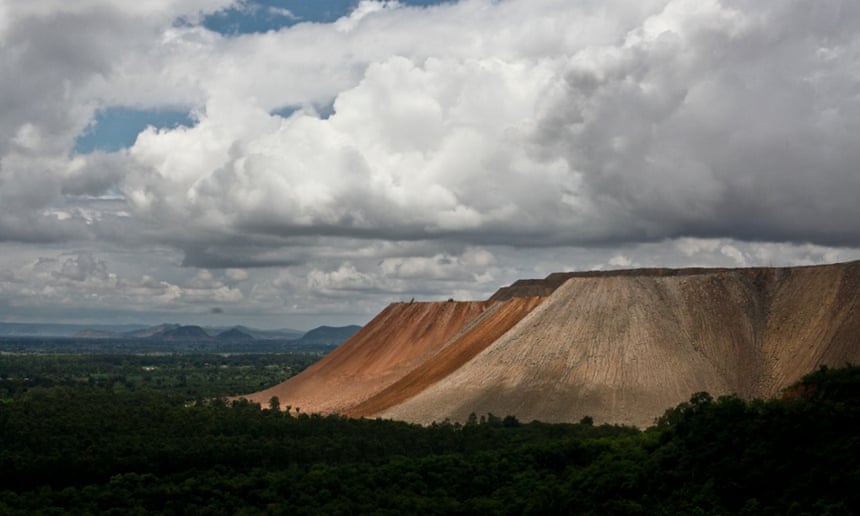
Mining overburden in the Singrauli coalfield. Photograph: Greenpeace/Sudhanshu Malhotra 

Friday, June 05, 2015

Drill, baby, drill. Who the frack cares!

One event and so many different headlines!


Who you gonna believe?

I wonder if it always was like this, or whether such contentious interpretations day in and day out are a modern phenomenon.  Even for a junkie like me, this is simply head-spinning.  Perhaps all the more why many simply decide to shut themselves off from this cacophony and instead rely on their favorite news sources.  You know, like the Faux News people!

What was the event that triggered all these headlines? In a weighty tome that can put anybody to sleep, the US EPA found "no signs of “widespread, systemic” drinking water pollution from hydraulic fracturing."

But, we are talking about energy and politics.  Not really science.  Which means:
it’s widely believed the Obama administration is deferential to natural gas fracking companies because the industry is more environmentally friendly than Big Coal but also robust enough to help drive much-needed economic growth. That attitude is shared by other members of the president’s part
Fight coal, but then a wink-wink towards natural gas.

Except, even the fighting coal is not really happening, notes the Pulitzer-winning writer at my favorite magazine:


So, where do all these  leave us?  Do the President and his people have any real energy policy at all? Kolbert writes, "the White House’s energy policies remain a muddle."  Great!  Can anything be done?
the Administration is undermining its own best efforts. But such a muddle is probably the best we can expect until and unless American voters demand something more coherent.
Ah! American voters demanding something coherent?  Good luck on that!

All these mean that after November 2016, we will most likely end up with a President and a Congress that will be a lot more fossil-fuel friendly than the friendly environment that currently exists.  Meanwhile, there is a climate conference coming up in December:


Good luck on that, rest of the world!

Saturday, January 31, 2015

Nuke coal: Poverty, electricity, and the environment

The few days that I spent in Tanzania were eye-opening in many ways, including how energy-starved people were.  There was no electricity grid network in the village small town--the house where we stayed had its own generator--and women were hunched over smoke as they cooked.  It was no surprise, therefore, that upper-respiratory infections were high in the community.


Poverty and low energy consumption are highly correlated.  But, even worse is how expensive the energy that the poor consume is--the out-of-pocket expenses and the price they pay in terms of health problems.

If only electricity can be generated and delivered to them, right?  Inexpensive at that.  I wonder what that least expensive route is!  Of course, we know that answer, don't we?
While the United States is just now finding ways to try to keep coal a viable part of its power system, the rest of the world is riding even greater technological advances to a brighter future for the dark fuel.
Yep, coal.
the world today faces two contradictory and interrelated challenges: While billions of poor people in the developing world need a lot more energy to pull them out of poverty and drive economic development, improve life expectancies, and bolster human health, the world also faces a looming and possibly existential threat from climate change—caused in large part by greenhouse gas emissions that are the bitter harvest of the world’s reliance on coal and other dirty fossil fuels over the past several centuries.
Yep, all I have to do is picture that Tanzanian community for a real example of the interrelated issues those sentences highlight.
As history shows, without energy there is no economic growth. From 1000 to 1820, global growth averaged about 0.2 percent a year. Since then, growth has been 10 times higher. Modern prosperity, in other words, is built upon the vast amounts of chemical energy first unleashed by coal.
Wait, is that some empty rhetoric based on the old stories of Industrial Revolution in England and the US, or do we have any contemporary ones too?
And there has been no better student of this lesson than China. It has  relied on smoldering coal to achieve a nearly four-decade economic metamorphosis—
lifting more than 600 million people out of poverty, even as it housed them in polluted cities—that has transformed a once-backward agrarian state into the world’s second-largest economy.
But, don't economists say there is no free lunch?  So, any price to pay for that economic miracle?
Meanwhile, this economic miracle has created a large, relatively wealthy Chinese middle class that has brought an ecological consciousness to the Middle Kingdom. Environmental nightmares, especially the choking air pollution fundamentally caused by the country’s overwhelming reliance on coal, have in recent years sparked huge protests by people questioning the legitimacy of the unelected leadership in Beijing.
Damn!  No free lunch, after all.
For the developing world, as India’s struggles show, simply getting power at all is a huge challenge. Globally, for the 1.3 billion people who lack electricity of any sort, shunning a gleaming, new, reliable coal-fired power plant on climate-change grounds is almost an impossible luxury. 
So, let's recap.  There are poor people on this planet.  Their poverty and various aspects of life are interrelated and to untangle them all will require energy.  Coal provides energy at low prices, but then it also generates a whole lot of smog and godawful health issues.  Anything else at this point?

Of course, global climate change, for which burning coal is one awful contributor.  So, can we do anything as we now add climate change to all that interrelated set of issues?  I suppose that will require turning away from coal.  I wonder what the International Energy Agency has to say about this.
The International Energy Agency and the Nuclear Energy Agency suggest in a report released Thursday that nuclear will have such a significant role to play in climate strategy that nuclear power generation capacity will have to double by 2050 in order for the world to meet the international 2°C (3.6°F) warming goal.
With fossil fuels growing as sources of electricity across the globe, the IEA sees nuclear power as a stable source of low-carbon power helping to take polluting coal-fired plants offline.
No kidding!  Nuclear power.  I am sure that will, oh wait, there was that first paragraph:
Since the 2011 Fukushima Daiichi nuclear accident in Japan chilled global attitudes toward nuclear power, the world has been slowly reconciling its discomfort with nuclear and the idea that it may have a role to play in reducing greenhouse gas emissions to tackle climate change.
Ok, let's recap. There are poor people on this planet.  Their poverty and various aspects of life are interrelated and to untangle them all will require energy.  Coal provides energy at low prices, but then it also generates a whole lot of smog and godawful health issues.  And coal is making things worse for the global climate.  Nuclear power is more expensive, but is a low-carbon alternative.  But then something like the catastrophe at Fukushima Daiichi can make people's lives godawful.
Globally, nuclear energy is already making a comeback with 72 nuclear reactors now under construction worldwide, mainly in Asia.“This marked the greatest number of reactors being built in 25 years,” IEA Executive Director Maria van der Hoeven said in a statement. “Nuclear energy also remains the second-largest source of low-carbon electricity worldwide. And, indeed, if we are to meet our collective climate goals, nuclear energy is critical.”
You and I, dear reader, don't have to worry about all these, right?  Because, you and I are in comfortable homes, and comfortable temperatures maintained by air-conditioning or heating.  Ours, for all purposes, is merely an intellectual discussion at this point, as we sip wine or coffee: let's talk about coal and nuclear energy.  We are the modern versions of Marie Antoinette!  But, for the global poor, and those who are not poor but are energy-starved, these are real life hassles that they worry about.  

So, at the end of it all, what do you want to tell those poor folks in Tanzania, and Nigeria, and India, and Bangladesh, and ...?

I, for one, have no answer :(

Father, uber-happy, during our visit to Neyveli in 2002
(Lignite is a low-energy coal. Yep, lots of electricity generated there)

Thursday, July 17, 2014

A requiem for coal. Rejoice!

Two summers ago, I authored an op-ed on the issue of exporting coal from Montana and Wyoming via ports here in Oregon.  In arguing my case opposing the idea, I wrote:
 [Coal's] obsolescence is well under way. We need to start thinking about coal the way we think about wood as a source of fuel. Three centuries ago, wood was by far the dominant source of energy, but we don't harvest trees in order to export them as firewood, do we?
The coal exporters were motivated by the combination of falling domestic demand and China's endless demand for coal, especially the low-sulfur carbon.

The export terminal/port idea is far from dead here in Oregon.  But for the public opposition and politicians sympathetic to the opposition, the terminals would have started operating a long time ago.  However, the case for export terminals now has gotten weaker, and I am doubly excited because the logic for my opposition is also justified and validated.  Here is the Wall Street Journal:
China's once insatiable appetite for coal is cooling, raising questions about mining companies' big bets on new projects.
Beijing's figures on coal imports and domestic production this year indicate sharply weaker demand, which experts say stems from slowing growth in the world's No. 2 economy. Longer term, factors including new policies to curb air pollution by limiting coal use are likely to keep growth in coal consumption far below the double-digit increases of the past.
Ta-da!

To be a commentator is one thing.  It is awesome when it turns out that I was right all along.  Unlike those pundits who earn gazillions of dollars for being wrong all the time ;)

As the WSJ notes, Australia and Indonesia--China's leading coal suppliers--have to quickly rethink their bets on projects.  If that is the case for those two countries far away from us, then what is the story with the American coal export to China?  No different:
The mud-colored air that blankets Chinese cities these days is bad for the people who live there. It may prove unhealthy for U.S. coal producers, too.
Intense opposition on the U.S. West Coast, over climate change, rail congestion and damage to Native American fisheries, already is blocking new export terminals designed to ship coal across the Pacific Ocean. Now, China -- which consumes almost as much coal as the rest of the world combined -- is accelerating a planned switch to cleaner fuels, including a possible cap on carbon emissions and limits on new coal-fired plants.
Even if such changes don’t occur as fast as environmentalists might hope, Chinese President Xi Jinping plans to scrap the economic strategy that spawned coal-eating steel plants in every province.
When demand falls, well, prices fall.  "[Even] if you could sell the quantity, you’re not going to get nearly the same price as in the past."  The love-affair fizzles:
China's boom gave the international coal market a new hope. Miners expanded thermal-coal capacity to 10% more than what is needed this year, according to Wood Mackenzie. A changing China now means coal will remain unloved.
I tell ya, if only the world would listen to me! ;)

Friday, February 08, 2013

Holy carbon! US exports coal and Europe imports it!!!

A chart that I would never have imagined would be the case:
Wow!
In the United States, natural gas is now frequently less expensive than coal for power, so demand for the hard, black fuel has plummeted. Ships are steaming the coal around the world instead. U.S. coal exports to Europe were up 26 percent in the first nine months of 2012 over the same period in 2011. Exports to China have increased, too.
But, ... but, ... aren't Europeans supposed to be, ahem, greener than thou?  
Green-friendly Europe has a dirty secret: It is burning a lot more coal.  Europe’s use of the fossil fuel spiked last year after a long decline, powered by a surge of cheap U.S. coal on global markets and by the unintended consequences of ambitious climate policies that capped emissions and reduced reliance on nuclear energy.
So, Germany shuttered its nuclear program after the Fukushima incident, and now burns more coal instead.  The truth is always dizzying!

How much have things changed in Germany?  Like so, in a community not far from the Polish border:
Last year, the power plant consumed 88,000 tons of lignite a day and generated more electricity than it had since 1981, according to Vattenfall, the Swedish company that runs it. That record is even more impressive given that in 1981, Communist East German officials didn’t have to contend with labor laws or environmental regulations and could run the mines almost every day of the year.   
The expansion of lignite mining has stunned some people who live in its path. One community under threat is the tiny hamlet of Atter­wasch, a cluster of 250 people on the edge of a proposed expansion of the Jaenschwalde mine. They might have to leave their homes, as well as their church, whose chapel was built in 1294.   
“This church survived the Thirty Years’ War [in the 1600s], two world wars and socialism,” said Mathias Berndt, the senior pastor at the church, which is festooned with anti-coal-mining protest banners. “Now a free country is coming and saying, ‘Good for you, but now you have to move.’ ”
Germans are in love with coal now.  And that too one of the dirtier varieties--lignite.  It was their expertise with lignite that led the West Germany of those old times to provide technical assistance in the town in India where I grew up.

The burning of coal is understandable when poor countries do it--they simply cannot afford to use way more expensive resources, especially when they have to import it.  "Moving away from fossil fuels could be devastating for some of the world's poorest countries."  But, Germany? The Netherlands?

Why is Germany so much anti-nuclear energy, even to the extent of burning more coal?  For that matter, it is a shame that an anti-nuclear energy stance has come to be typical of the liberal left. Why so?  Ashutosh Jogalekar discusses the following five reasons in detail over at the Scientific American:
  1. Ignorance: This simple reason remains remarkably pervasive. I am not trying to sound preachy or elitist here but reading two or three books would greatly benefit people who have a gut reaction against nuclear energy.
  2. Bad psychological connections: There are two bad connections in the minds of many liberals, both of which are rather unjustified and contribute to their dislike of nuclear power. One is the connection between nuclear power and nuclear weapons.  ... Another flawed connection is between environmentalism and the boycott of nuclear power. Unfortunately die-hard environmentalists are mainly responsible for reinforcing this connection. Their decades-long opposition to nuclear energy started with some reasonable premises, but then mainly descended into irrational, uninformed and exaggerated polemic.
  3. Waste: ... Many people think that this is the single greatest threat from nuclear power, that we will all be inhabiting vast atomic wastelands if we allow nuclear power to flourish. ... It’s not a trivial issue, but many of the problems have to do with inefficiency and increased proliferation threats from burying valuable plutonium-containing nuclear waste.
  4. Damn them Republicans: There is actually a third connection- that between nuclear weapons and belligerent right wing political leaders that drives liberals’ disdain for all things nuclear. If the erroneous connection between power and weapons takes hold in your mind, then it is not too difficult to perceive a connection between nuclear energy and right wing excesses.
  5. Fear of the unknown: This is again related to the first point. Fear of the unknown has unfortunately driven negative liberal reactions to many other promising technologies, including vaccines and GMOs. 
An argument in favor of rationally approaching the global energy issue, and the energy needs of the developing countries in particular, is not new to this blog.  Especially when Europe is importing coal like there is no tomorrow!

BTW, the US is flush with coal because fracking has made natural gas available in plenty, and at low prices.  And Europe is grabbing that coal.  Why doesn't Europe also use natural gas then?
One big part of the problem, experts and officials say, is Europe’s cap-and-trade system, which aims to reduce European Union-wide industrial greenhouse gas emissions by 20 percent by 2020. The system is the centerpiece of Europe’s green policies. But the program, which charges industries for permits to emit greenhouse gases, no longer serves as a major disincentive to pollute. Industrial production fell dramatically during the economic crisis, so overall greenhouse gas emissions remain well underneath the cap, and they are still falling. The price per ton of carbon emissions is barely more than a tenth of its 2008 peak. Energy companies, who must plan decades in advance, have shied away from investing in gas-fired power plants because they are not profitable in comparison to coal.
Yep, carbon is way too cheap now!  Burn, baby, burn!

Friday, February 01, 2013

The coal chart that should scare us towards exploring renewable energy

I am not any environmental activist by any means.  I understand that life is about tradeoff and that the natural environment is one of the many factors that we have to consider.

But, I do worry that all is not well with the manner in which the global economy has been pursuing a growth strategy in which many, many, goods--from inexpensive plastic bottles to iPhones--are manufactured in China, at a huge cost.  The cost being environmental.  I suspect that such a global economic approach will depend on how China responds, and the response--or lack thereof--will have implications for internal political stability as well.

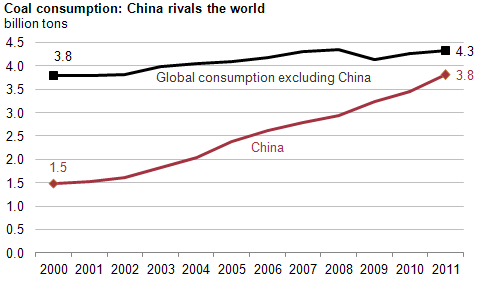
China's economic engine is fueled by coal, the consumption of which is simply astounding, as this chart, which was all over the news and the blogs yesterday, shows:
Source: EIA
As this note in the Scientific American adds:
In fact, according to EIA, the 325-million-ton increase in Chinese coal consumption in 2011 accounted for 87 percent of the entire world's growth for the year, which was estimated at 374 million tons. Since 2000, China has accounted for 82 percent of the world's coal demand growth, with a 2.3-billion-ton surge, the agency said.
A scary, scary, chart, indeed!

But, China consumes so much coal for a very good reason--it is one heck of a cheap source of energy.  Well, cheap because nobody has to explicitly pay for the downside to burning carbon, as is the case when we burn gasoline or natural gas too.

It is coal that has helped the rapid transformation in China--especially in the rural hinterland:
Xu Youwang has been a farmer all his life. The 56-year-old says he can remember a day when all he owned were sheep. He and his neighbours all live in mud-brick houses.
But now he has a washing machine, a TV - and big dreams. "If I had the money I'd buy a car, an apartment, a fridge and a computer," he said.
Farmer Xu expects his life to only get better. And that is the challenge for China's leaders - balancing the aspirations of people like him with more sustainable economic growth
For now, at least, the country's reliance on coal and the pollution that comes with it shows little sign of ending.
Of course, China has been actively exploring alternatives to coal--there are more nuclear power plants planned and under construction there than anywhere else on the planet:
Source: The Economist
Like any other rational person, I too worry about the downsides of nuclear power.  But, hey, that is what I mean as tradeoff!  An environmental activist who opposes coal and nuclear power then has to provide for alternatives, right?

China has been exploring hydropower too as an alternative-but, remember all the environmental controversies over the Three Gorges Dam?  Tradeoff is not easy.  Never easy.

China is pushing for more hydro projects, which will not only have environmental issues, but will also catalyze more geopolitical hand-wringing:
In a major concern for India and Bangladesh, China has approved construction of three new hydropower dams on the Brahmaputra river.

The move comes after a two-year halt amid concerns shown by India and environmental groups about reduced water flow downstream.

The three new dams have been approved by the Chinese State Council Cabinet under a new energy development plan for 2015.
Bloomberg reports that China is pushing for more solar power, too!
China plans to increase its goal for solar-power installations in 2015 by 67 percent to reduce reliance on fossil fuels blamed for greenhouse gases and as smog in Beijing reached record hazardous levels this month.
The world’s biggest emitter of carbon-dioxide plans to raise the solar target to 35 gigawatts by 2015 from 21 gigawatts set last year, boosting demand for manufactures that suffer from slowing sales in Europe, Shi Dinghuan, the counselor of China’s State Council and the president of Chinese Renewable Energy Society, said today by phone.
“We’ve got more pressure to save energy and reduce emissions as smog worsens due to pollution,” he said.
All these make very, very clear that we--the world--cannot have our cake and eat it too: if we, especially in the US and in the rich countries, want cheap stuff that fills up our closets and garages, then we have to accept the carbon usage in China.  If we, especially in the US, refuse to impose a carbon tax on ourselves and, thereby, set an example for the rest of the world, then we have no choice but to accept the carbon usage in China.

We can always fool ourselves by claiming that CO2 emissions in the US have fallen way down to the lowest level since 1994--we have simply exported away the pollution, exactly as Lawrence Summers wanted us to back when he was the Chief Economist at the World Bank :(

Thursday, August 02, 2012

Worried about CO2 emissions? Story got more interesting today

One of the more surprising headlines of the day:
U.S. CO2 Emissions Fall to Lowest First-Quarter Level in 20 Years
Huh?

Really?

Apparently so:
Carbon dioxide (CO2) emissions from energy use in the first quarter of this year fell to their lowest level in the U.S. in 20 years, as demand shifted to natural gas-fired generation from coal-fired electricity due to record low gas prices, the energy department said.
Energy-related carbon emissions fell 8 percent from the same period a year ago to 1.134 billion metric tons (1.25 billion tons), according to the latest monthly energy review by the Energy Information Administration (EIA) - the energy department's statistics arm.
If only the "doubting Thomas" commenter, jayjames,  who didn't believe my arguments about coal plants closing and natural gas price decreasing actually knew what he/she was talking about!

If the news about CO2 emissions here in the US was a surprise, perhaps only a tad lower was this:
Earth sucking up increasing amounts of carbon dioxide
Huh?

Really?

Apparently so:
The Earth's ability to soak up man-made carbon dioxide emissions is a crucial yet poorly understood process with profound implications for climate change.
Among the questions that have vexed climate scientists is whether the planet can keep pace with humanity's production of greenhouse gases. The loss of this natural damper would carry dire consequences for global warming.
A study published in Thursday's edition of the journal Nature concludes that these reservoirs are continuing to increase their uptake of carbon — and show no sign of diminishing.
In an accounting of the global "carbon budget," researchers calculated that Earth's oceans, plants and soils had almost doubled their uptake of carbon each year for the last half-century. In 1960, these carbon sinks absorbed around 2.4 billion metric tons of carbon; in 2010, that figure had grown to around 5 billion metric tons.
Head spinning, you say?  Wait, there is more.
A second paper, published earlier in the week by the journal Nature Geoscience, provides insight into how the disposal service in the ocean is actually working. The surprising finding is that a handful of relatively concentrated spots in the Southern Ocean account for a high proportion, roughly 20 percent, of the entire oceanic carbon uptake.
So, can they keep absorbing at the same rates?
The obvious concern the paper raises is that climate change could disturb the existing pattern of winds and currents and shut down the hot spots, making the entire ocean less efficient as an absorber of carbon dioxide.
In principle, of course, things could go the other way too, with climate change perhaps creating more such hot spots and increasing the efficiency of the disposal service. But we know from the geological record that past jumps in the earth’s temperature have tended to raise the amount of carbon dioxide in the air, which then reinforced the warming trend. So that’s a pretty good reason to think that things will unfold the same way as a result of human-caused warming.
These reports about CO2, against the backdrop of the blackouts in India where the monsoon has failed as well, reminded me about this op-ed by the editor of Scientific American, in which he noted:
The most frightening prospect that Mr. Lenton has found is the vulnerability of the Indian monsoon. More than a billion people depend on this weather pattern each year for the rain it brings to crops. The monsoon, though, is being affected by two conflicting forces: the buildup of carbon dioxide in the atmosphere is adding energy to the monsoons, making them more powerful. On the other hand, soot from fires and coal plants acts to blocks the sun’s energy, weakening the monsoons.
This opposition creates potential instability and the possibility that the atmospheric dynamics that bring the monsoons could change suddenly. Mr. Lenton’s analysis shows this could occur in a remarkably short time. The monsoons could be here one year, then gone the next year. 
Here today and gone tomorrow is not a bottom-line that is conducive to any long-term planning, is it?  The level of uncertainty that CO2 introduces ought to worry most of us outside the maniacal GOP!