Showing posts sorted by relevance for query master manipulator. Sort by date Show all posts

Monday, September 08, 2008

Thomas Friedman: Master Manipulator of Metaphors

Maybe I should copyright "Master Manipulator of Metaphors" :-)
Gregg Easterbrook starts his review of Friedman's latest multi-million dollar generator, er, book, with:
Buzz. BUZZZZZZZZZ. There are so many buzz phrases in Thomas Friedman's new book that it practically vibrates in your hand. Code Green. Day-trading for electrons. Green is the new red, white, and blue. Subprime planet. Petrodictatotrships. The Common Era, Friedman tells us, should be supplanted by the Energy Climate Era; the year is 1ECE.

So, Easterbrook was expecting something other than buzz phrases? As always, Easterbrook does a wonderful job. I liked his jab: "The cynical view is that his embrace of max-PC alarums about global warming is Friedman's bid to make everyone forget he pounded the table in favor of an American invasion of Iraq." Good point, man!

And then Easterbrook writes,
He presents many examples of higher world resource demand, noting that even if
America cuts back, reductions here will be swamped by increases elsewhere: "The
biggest downside [of globalization] is that in raising standards of living,
globalization is making possible much higher levels of production and
consumption by many more people." Yet if resource trends and climate change are
driven by rising population and rising affluence, which of these, precisely, do
you propose to ban?
More troubles for Friedman:
his factual assertions are impossible to weigh, since Hot, Flat, and Crowded
contains no footnotes or source notes. Friedman asserts, for instance: "In fact,
the American pet food industry spends more each year on R&D than the
American utilities industry does." Good luck figuring out the "in fact" part.
And then:
Friedman's book-talk schedule for the first month alone of Hot, Flat, and Crowded promotion requires jet aircraft trips that, the calculator at Terra Pass estimates, will generate about 3 tons of carbon dioxide—the same as driving a Hummer for almost half a year. Friedman counsels, "[P]ersonally lead as environmentally sustainable a life as you can" but himself lives in a 11,400-square-foot mansion, whose carbon footprint may be visible from orbit. Rather than address this straight on, he squirms to paint his lifestyle green ... Friedman can't bring himself to admit he is lord of a manor and racing through more resources in his daily life than 10,000 rural Africans.
I do agree with Easterbrook on this point:
First, the author. Few who reach the top of any occupation have remained so hard-working, intellectually curious, and professionally conscientious. Despite considerable personal means, Friedman is in constant transcontinental motion, including to not-glamorous parts of the world, and constantly exposes himself to criticism by speaking at colleges.

BTW, before you jump into any conclusion that I am a global warming denier: no, I am not.
Also, youcan save yourself the few dollars by not buying Friedman's book. Instead, you can read a much better version of Friedman's argument, which was a neat, short, and to-the-point essay in Foreign Policy. Easterbrook also refers to this essay. I have used it in my classes too. It is in such essays that Friedman shines. And I like his metaphor of "First Law of Petropolitics."

Sunday, June 28, 2009

The United Printing Press, er, States of America :-(

Every once in a while, the master manipulator of metaphors, Thomas Friedman, comes up with something really, really good. Like this from his column:

Sometimes, I worry, though, that what oil money is to Russia, our ability to print money is to America. Look at the billions we just printed to bail out two dinosaurs: General Motors and Chrysler.

Lately, there has been way too much talk about minting dollars and too little about minting our next Thomas Edison, Bob Noyce, Steve Jobs, Bill Gates, Vint Cerf, Jerry Yang, Marc Andreessen, Sergey Brin, Bill Joy and Larry Page. Adding to that list is the only stimulus that matters. Otherwise, we’re just Russia with a printing press.
Hey, give credit where it is due, eh!

Saturday, November 01, 2008

The youth are screwed

When Thomas Friedman doesn't write as the master manipulator of metaphors, he makes a lot of sense and clearly articulates his argument. Such as this one:

Since the last debate, John McCain and Barack Obama have unveiled broad ideas about how to restore the nation’s financial health. But they continue to suggest that this will be largely pain-free. McCain says giving everyone a tax cut will save the day; Obama tells us only the rich will have to pay to help us out of this hole. Neither is true.

We are all going to have to pay, because this meltdown comes in the context of what has been “perhaps the greatest wealth transfer since the Bolshevik Revolution in Russia in 1917,” says Michael Mandelbaum, author of “Democracy’s Good Name.” “It is not a wealth transfer from rich to poor that the Bush administration will be remembered for. It is a wealth transfer from the future to the present.”

Never has one generation spent so much of its children’s wealth in such a short period of time with so little to show for it as in the Bush years. Under George W. Bush, America has foisted onto future generations a huge financial burden to finance our current tax cuts, wars and now bailouts. Just paying off those debts will require significant sacrifices. But when you add the destruction of wealth that has taken place in the last two months in the markets, and the need for more bailouts, you understand why this is not going to be a painless recovery.

The Bush team leaves us with another debt — one to Mother Nature. We have added tons more CO2 into the atmosphere these last eight years, without any mitigation effort.


Well, my intro class students know really well the argument about burdens being shifted to future generations--even they have started referring to how much their futures are screwed :-( They have pretty much adopted as their slogan "we are screwed". I am to be blamed though, as their blog posts make it clear.

Friday, September 05, 2008

The world is curved. No, it is flat. How about spiky?

Not too long ago, Thomas Friedman--the master manipulator of metaphors--asserted that the world is flat. The book earned him quite a few million dollars, I am sure, and then he went on to talk and write about a green revolution--about green energy--apparently oblivious that the green revolution is a phrase that is already under use. Now, thanks to Friedman the popularizer of metaphors, people are going to the forget the importance of improving agricultural productivity in poorer countries--the green revolution--which ought to be the #1 global priority.

One of the best critiques of Friedman's metaphor came from Edward Leamer, an economist at UCLA. He had a fantastic prologue to the book review:
When the Journal of Economic Literature asked me to write a review of The World
is Flat, by Thomas Friedman, I responded with enthusiasm, knowing it wouldn’t
take much effort on my part. As soon as I received a copy of the book, I shipped it overnight by UPS to India to have the work done. I was promised a one-day turn-around for a fee of $100. Here is what I received by e-mail the next day: “This book is truly marvelous. It will surely change the course of human history.” That struck me as possibly accurate but a bit too short and too generic to make the JEL happy, and I decided, with great disappointment, to do the work myself.

A few months after Friedman's book was published, in October 2005, Richard Florida wrote in the Atlantic that the world is spiky. In discussing that, Florida threw in more metaphors--valleys, hills, playing fields, ....

I suppose people decided that we have played around with metaphors enough. Enter David Smick and his book, The World is Curved. A Q/A with the author at that website has this:
The title The World Is Curved is sure to draw comparisons with Tom Friedman’s book The World Is Flat. Why did you select the title? Why is the world now curved? Was it ever flat?
Friedman brilliantly presents the first installment of the globalization story, concentrating on the revolutionizing (flattening) of the global supply chain. But there is a second installment—the financial side of the story where the world is not flat; the world is curved. You can’t see over the horizon. Sight lines are limited. As during the subprime mortgage crisis, we are forced to travel down an endless, dangerously twisting and turning road of volatility with steep valleys and risky mountainous climbs. We can’t see financial risk ahead. A small village in Arctic Norway can see its
entire financial future destroyed because its financial managers invested heavily in a Citigroup product called a collateralized debt obligation.

Can somebody please pass a law that playing with metaphors to explain global economic geography will result in a forced Peace Corps volunteer service in Moldova for two years?

As always, it is the first one who gains the attention and money--something that Friedman knows really well. Even if he is not always right in his analysis, he is definitely a trendsetter. I am pretty sure, and unfortunately for Florida and Smick, that people will not pick up the world is curved or spiked metaphors.

Bonus if you read until here. Matt Welch wrote a fine commentary on Friedman's punditry through metaphors and cliche.

Sunday, September 15, 2013

Beware of pundits. Especially in the New York Times op-ed pages.

Once upon a time, before the dawn of everything-is-on-the-web era, for a while I was a subscriber to the New York Times.  The Times, the Wall Street Journal, and the local paper--the Bakersfield Californian. Sometimes the Los Angeles Times too!  All at the same time.  It was always quite a haul of paper to the local recycling collection bins.

Then, not only did the web happen, everything was for free too.  It was down to the local paper alone.  

Given the three hour time zone difference, it was also fun to read the following day's east coast papers as pre-bedtime reading, and blog about them.  I was, of course, keen on the op-eds and columns there, with the exception of the crazy William Kristol experiment that the Times did.  Come to think of it, those Kristol months was also perhaps the beginning of the end of my daily habit of reading the Times.

The Times erecting a paywall, therefore, didn't bother me one bit.  By then I had pretty much stopped reading that paper, and there was nothing I was missing anyway.  Every once in a while, our local paper reprints a Times column by Thomas Friedman or Nicholas Kristof or Paul Krugman and I am all the more relieved that I am staying away from the paper.

The rare occasion that I read a Friedman piece, I am amazed that he gets to say such remarkably stupid things on an international stage and get paid gazillions for it.  I suppose there is a sucker born every minute.  Over the years, the guy has become nothing but a master manipulator of metaphors and cliches.  I guess punditry means that the more one is incorrect and inane, the more airtime and money they get!

A couple of days ago, I came across a Kristof column urging the US to actively intervene in Syria, with our military might.  It didn't surprise me that he too has gone off the deep end of punditry!

The Onion, which is in many ways America's Finest News Source, described the New York Times quite well:
New York Times, daily newsletter of the American Association of Retired Persons (AARP). Founded in 1851, the New York Times newsletter is an indispensable source of information for AARP members, with articles tailored specifically for persons 55 and older, as well as news and views from columnists such as Frank Rich, Thomas Friedman, and Maureen Dowd, who provide an elder perspective on issues of the day. 
Of course, it is not merely the political pundits whose celebrity status increases with yet another incorrect pronouncement.  Ronald Bailey quotes the late Julian Simon:
“How often does a prophet have to be wrong before we no longer believe that he or she is a true prophet?”
That was in the context of the famous debate between Simon, the optimist, and Paul Ehrlich, the doomsday prophet whose predictions about famines, deaths, shortages, and price hikes never came to pass. Not only did all those predicted horrors fail to happen, our collective prosperity continues to increase, with more food than ever and all kinds of fancy goods being manufactured with resources that never seem to be in shortage at all.

Yet, society seems to favor the wrong pundits, more often than not.  Even when time and again the huge errors of the pundits are difficult to ignore.  My guess is that it is all ideological and preferential.  The liberal left, for instance, continue to echo the views of a Ehrlich or a Kristof because these pundits are theirs, while the conservative right celebrates the punditry of a Kristol because he is theirs.  All are nothing but the variations of the old political bottom-line of "he may be a sonofabitch, but he is our sonofabitch."

Oh well.

I know, I know--I am preaching to the choir.  You, the reader, know better.  Which is why you read this pundit's daily rants--after all, he comes from the land that gave the English language the word "pundit" ;)

Sunday, July 17, 2011

Cartoon of the day: Tom Friedman

A wonderful caricature of the master manipulator of metaphors :)


As I noted a couple of days ago, it has been a while since I looked for anything by Friedman, and I think it will be better for my health if I stayed away from his writings for a while :)

Tuesday, July 13, 2010

David Brooks needs a break. A long one, preferably.

If Brooks is going to churn out columns like this one on the princes and the grinds, and he gets paid for it, I suppose we are all living proof that there's a sucker is born every minute!

There is nothing new or substantive there.  I stand corrected: it has a whole bunch of metaphors, all in one column enough to claim the title of the master manipulator of metaphors from another NY Times columnist.  Let us list the metaphors in this Brooks column, shall we?
  • Prince
  • Grind
  • Conversational ping pong
  • Cockroach up his arm
  • Social butterflies
  • Social polish
  • Sitting on mountains of cash
And the winning one is the final sentence all by itself:
the real issue is how we are going to light a fire under the country’s loners, its contrarians and its narrow, ambitious outsiders.
WTF!  seriously, they get lengthy profiles for writing stuff like this?  Hey, George Orwell, can you stage a miracle of sorts and straighten these people out?

The best one though is this comment (#112) in response to Brooks' column:
Mr. Brooks, you are continuing your argument for the benefits of a liberal arts education founded in the classics. Your grinds are merely technicians, trained to do one thing very well. The princes you describe, on the other hand, use their more well-rounded education to charm legislators and siphon money out of taxpayers when the grand temples to their Odyssean egos come crashing down. Remember Odysseus killed all of his wife's maids even though they were powerless to stop the suitors. Those maids were really grinds. So much for the ethical justifications for reading in the classics. It is not what we read that matters, but how critically we read anything.

Wednesday, August 11, 2010

It is the new economic geography, stupid. Or not?

Looks like Paul Krugman has started throwing punches in every street battle.  Krugman is now doing an Obama of trying to be everywhere.  Chill it, Prof!

First it was his rather shrill attack on Paul Ryan, by using metaphors to describe the person.  Whatever happened to the academic in Krugman to focus on the arguments and not on the person?   Maybe Krugman has been listening too much to the master manipulator of metaphors whose office is just down the hall from his? :)  Megan McArdle has articulated well what I have in mind:
there are legitimate concerns about whether the roadmap would actually reduce the deficit.  Of course there are legitimate concerns; I share them.  (For that matter, I have legitimate concerns about pretty much every policy proposal ever invented.)  But I am not the person who titled his column "The Flim-Flam Man" and turned the raising of legitimate concerns into the side-show of an all-out attack on Paul Ryan's credibility and ethics, while treating an estimate from the Tax Policy Center as a fact rather than one possible model. 

If you think that this is all rather beside the point, then bring it up with Krugman, who not only did multiple follow-up posts on Ryan's alleged dishonest campaign to prevent his tax program from getting scored, but also seems to have been so tickled by his column title that he threw in a bonus Diana Krall video**.

Nor, in my experience, do such attacks help get one's legitimate concerns addressed.  Rather the opposite, in fact; they tend to entrench the opposition, who for some reason often fear that they will not get a fair hearing.
And now, Krugman is ticked off at a FT opinion piece that opens with a direct hit at Krugman:
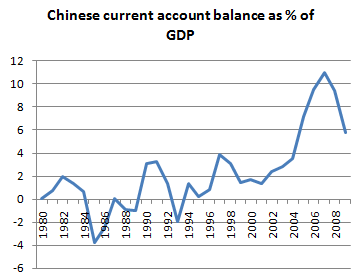
China’s exchange rate continues to be blamed for global economic imbalances, with the economist Paul Krugman one of Beijing’s staunchest critics. Even after China announced a change in its currency policy in June, Mr Krugman argued that it did not “address the real issue, which is that China has been promoting its exports at the rest of the world’s expense”. Yet, arguably, it is the Nobel Prize-winning ideas that Mr Krugman developed three decades ago, not currency manipulation, that have led to China’s unparalleled growth.
At least this time Krugman is not resorting to name calling--no "flimflam man" :) and points out that:
surpluses, and the currency manipulation, are neither intimately related to Chinese growth nor necessary for that growth to continue.

Friday, May 02, 2014

The (Chinese) gods must be crazy!


As a graduate student, I never said no to any fellow Indian student asking me whether I wanted to go to the Hindu temple.  Not because I was a faithful believer, but because it was at a scenic spot, and the drive was scenic as well.  And, of course, there was good food.

Not only the temple priest, but the sculptors were also imported from India.  Of course, it was not new.  That's how these things are done.  But, if Hindus could cross the seas, which was traditionally prohibited, and could thus settle down in lands far, far away, then how much are traditions, well, traditions?

In the tradition, worshiping god is not in the abstract manner but by praying to idols and paintings.  One needs to only look at abandoned temples in order to theorize that a worshiped god no longer exists in that very idol that was worshiped for years, even centuries.  The same idol when under the care of the government's archaeology department becomes a mere artful sculpture that attracts mostly only foreign tourists.


Non-believing foreigners go to visit the god-less idols in abandoned temples.  What if non-believing foreigners created images of gods for the believers to worship?

Sounds intriguing?  The Hindu reports:
Mr. Zhao’s shop, the Zhejiang Yiwu Yijie Crafts company, displays from its walls images one would not expect to find in officially atheist China: on one corner is a collection of beautifully rendered images of the god Krishna as a child. There are, on the shop’s walls, framed photographs of half a dozen gods and goddesses from the Hindu pantheon: images of Ganesha, Hanuman and Saraswathi on a lotus.
From this small shop in Yiwu, these images will find their way to homes and offices – and possibly even places of worship – across India.
More than a hundred Indian companies buy Mr. Zhao’s products, supplying and distributing them across India – often without making their customers aware of the fact that the images that adorn their prayer rooms were all put together by Chinese workers in a factory in Zhejiang province.
"Without making their customers aware."  Caveat emptor, indeed!

If the customer is informed about this, will the god become any less a god to the faithful who worships the image?  

A few years ago, Thomas "master manipulator of metaphors" Friedman noted that practically every statue of Virgin of Gualalupe that was sold in Mexico was manufactured in China.  Maybe I ought to watch out for his pointless pontificating on Ganesha from Guangzhou.

Anyway, The Hindu adds:
There are at least three other companies that have factories producing images and statues of gods and goddesses for the Indian market. Most of the factories are located in Cangnan, a county close to Wenzhou – a thriving port city in Zhejiang that is famous for being a centre of entrepreneurship. Some of the companies have listed annual sales of 10 million Yuan (Rs. 10 crore); they also render a range of Christian images for export.
Zhang Daofeng, who runs a factory in Cangnan, said his company’s “Indian gods series”, which included posters, three-dimensional images and statues, were being sold across India.
Mr. Zhang was one of the earliest producers of images of Hindu gods. Today, he estimates, there are between 30 and 40 companies in China doing the same, even as they struggle to stay competitive as wages across China rise year after year. “Many of the new factories offer poor quality, but the Indian customers are very price sensitive so business is down,” he said.
Of course, the faithful shall also be bargain-hunters!  The god-crazy India combined with the price-shopping behavior means:
“It’s still easier to order from China,” one trader said. “Everything is produced in bulk, and the trade is very organised. Where am I going to find such factories in India?”
How interesting that a country with 800 million Hindus have outsourced a good chunk of their god production to godless China!

The gods must be crazy!

Saturday, October 30, 2010

Americans do the right thing--after trying Republicans and everything else

Every once in a rare while Maureen Dowd writes something that is worth quoting; in her latest column, Dowd writes about President Obama:
In 2008, the message was him. The promise was him. And that’s why 2010 is a referendum on him. 
That is a neat way to summarize the dynamics of this election.  Which is also why it is bloody dangerous to have personality-driven politics and leaders.  Bill Clinton's re-election was not about Clinton the person at all--not with all that baggage he carried around.  But, during the campaign season, the stock that Obama sold was himself, and now as President he has a tougher problem making a repeat sale.

Meanwhile, Nicholas Kristof, who seems to have taken time off from the gruesome stories that otherwise he forces us to recognize, wants us to give Obama a break:
go ahead and hold Mr. Obama’s feet to the fire. He deserves to be held accountable. But let’s not allow economic malaise to cloud our judgment and magnify America’s problems in ways that become self-fulfilling.
I am not so sure about this argument. 

The problem is that the alternative, in terms of Republican leadership, is an even more pathetic joke.  If the GOP takes over the house, Kevin McCarthy will become number 3?  I remember him from my days in Bakersfield, and a few days ago I watched him on C-Span and the guy is as lacking as ever.  At least Bill Thomas, whose retirement paved the way for McCarthy, was a really sharp guy and, unfortunately, even more ruthless!

So, to some extent, I am with Paul Krugman who is worried about a Republican Congress:
This is going to be terrible. In fact, future historians will probably look back at the 2010 election as a catastrophe for America, one that condemned the nation to years of political chaos and economic weakness.
However, I wish, for the nth time, that Krugman would be less shrill and less hyperbolic, and engaged more like the economist he is; did he really have to write "Be afraid. Be very afraid" ...?


David Brooks lays out what Obama's problem is going to be if (when?) Republicans take over the House (and Senate?):
[If] Obama is to rebound, he is going to have to suppress his natural competitive instincts. If he gets caught up in the Beltway fight club, the Republicans will emerge as the party of limited government and he’ll emerge as the spokesman for big government — surely a losing proposition.
Thomas "master manipulator of metaphors" Friedman, too, has something sensible, for a change, when he writes on why this election matters, as he looks at it from India while talking with some of his favorites (does Friedman talk to the 400 million poor there, I wonder!):

It looks, said Srivastava, as if “what is happening in America is a loss of self-confidence. We don’t want America to lose self-confidence. Who else is there to take over America’s moral leadership? American’s leadership was never because you had more arms. It was because of ideas, imagination, and meritocracy.” If America turns away from its core values, he added, “there is nobody else to take that leadership. Do we want China as the world’s moral leader? No. We desperately want America to succeed.”
This isn’t just so American values triumph. With a rising China on one side and a crumbling Pakistan on the other, India’s newfound friendship with America has taken on strategic importance. “It is very worrying to live in a world that no longer has the balance of power we’ve had for 60 years,” said Shekhar Gupta, editor of The Indian Express newspaper. “That is why everyone is concerned about America.”
Well, we--in the US and in the entire world--will find out real soon.

My long term bets are always on the good ol' US of A.  As Winston Churchill said, “You can always count on Americans to do the right thing - after they've tried everything else.”  And with a Republican victory in the midterms, we would have exhausted everything, and we will start doing the right thing.

Monday, January 26, 2009

Meanwhile, the Israel-Palestinain two-state issue

Thomas Friedman makes a lot of sense when he is not being a master manipulator of metaphors.  The fewer the metaphors, the more powerful and succinct his argument.
Consider this for instance, from his column:

We’re getting perilously close to closing the window on a two-state solution, because the two chief window-closers — Hamas in Gaza and the fanatical Jewish settlers in the West Bank — have been in the driver’s seats. Hamas is busy making a two-state solution inconceivable, while the settlers have steadily worked to make it impossible.

If Hamas continues to obtain and use longer- and longer-range rockets, there is no way any Israeli government can or will tolerate independent Palestinian control of the West Bank, because a rocket from there can easily close the Tel Aviv airport and shut down Israel’s economy.

And if the Jewish settlers continue with their “natural growth” to devour the West Bank, it will also be effectively off the table. No Israeli government has mustered the will to take down even the “illegal,” unauthorized settlements, despite promises to the U.S. to do so, so it’s getting hard to see how the “legal” settlements will ever be removed. What is needed from Israel’s Feb. 10 elections is a centrist, national unity government that can resist the blackmail of the settlers, and the rightist parties that protect them, to still implement a two-state solution.

And, in case you want to see for yourself what Friedman is referring to, well, here is a Sixty Minutes take on it:


Hey, good luck to you, George Mitchell, on getting that prized job as the Middle East Envoy!