Showing posts with label stockmarket collapse. Show all posts

Friday, August 05, 2011

The second dip cometh? A Republican Recession?

So, the stock market sank faster than I can in water (yes, despite numerous attempts to learn, I can't even float, leave alone swim!)
The stock market plunged by more than 4 percent yesterday in its worst day in more than two years and investors flooded safe-haven investment alternatives, driven by escalating fears the wobbly global economy may stumble into a new recession.
While one swallow doesn't make a summer, the high probability of an economic catastrophe has always been talked and written about, even in this blog. And I am not even an economist or a banker!  So, it is not as if we are merely looking at this one day stock market event.

First, a recap of the nightmarish situation:

A Month of Awful News
June was a very weak month for the U.S. economy, and our data from July so far isn't looking good. Some quick highlights:
These would all be very bad signs in a healthy economy. In a weak recovery -- a time when business activity should be above average -- they're even worse. Although we appeared to climbing out of the abyss in early 2011, it no longer looks like we're even treading water. In fact, we may be drowning again.
Robert Reich is furious, and he is darn right:

Republicans repeatedly assured the nation that once the debt-limit deal was done – capping spending, cutting the budget deficit, and getting “90 percent” of what they wanted — the economy would bounce back.
 Just the opposite seems to be happening.
Call it the Republican’s double-dip recession.
Wall Street investors aren’t ideologues. They don’t obsess about budget deficits ten years from now, or the size of the government. One day doesn’t make a trend, but a giant sell-off like this is motivated by hard, cold realities.
Dr. Doom is on a spree of what essentially is "I told you so" ... like this one:
QE3 started in Japan & Switzerland via fx action &/or monetary easing. Fed will eventually get to QE3 but it will be too little too late
Oh, how I wish I had no interest in public policy issues at all; life will be so much without worries!

Friday, June 04, 2010

The US economy in a mess, but dollar surges ...

A long time ago, our high school English included a play called "The Refund" ... at least, I think that is what the title was (I am simply excited I can remember this much given that 30 years have passed since I exited the best high school I could have had.)  In that play, a character runs into his schoolmate who says he made a lot of money trading in currencies, and this oaf has no idea what is going on.  The successful guy then tells him that if he does not know even that, then he ought to go back to high school and get his tuition and fees refunded!  (Hey, anybody reading this, any chance that I might locate this play on the Web?)

I sympathize with that dolt in the play who could not understand how people can make money from currencies.  I mean, look at this: the American economy has been awful for quite some time now.  The stock-market wants to sink down to where the BP well is spewing like an undersea volcano.  Unemployment continues to be way too high.  The wars in Iraq and Afghanistan suck money, life, and any sense of hope. 

And, guess what?  The dollar is appreciating.  Money is rushing into America.  Bernanke, et al, have no pressure to raise interest rates.  It is almost like we have entered a bizarro world!

It just so happens that the US might suck, but the rest of the world seem to be suckier.  I tell you, am ready for my refund :)

Thursday, November 12, 2009

Wednesday, March 11, 2009

Don't get carried away by Tuesday's "Bull Market"

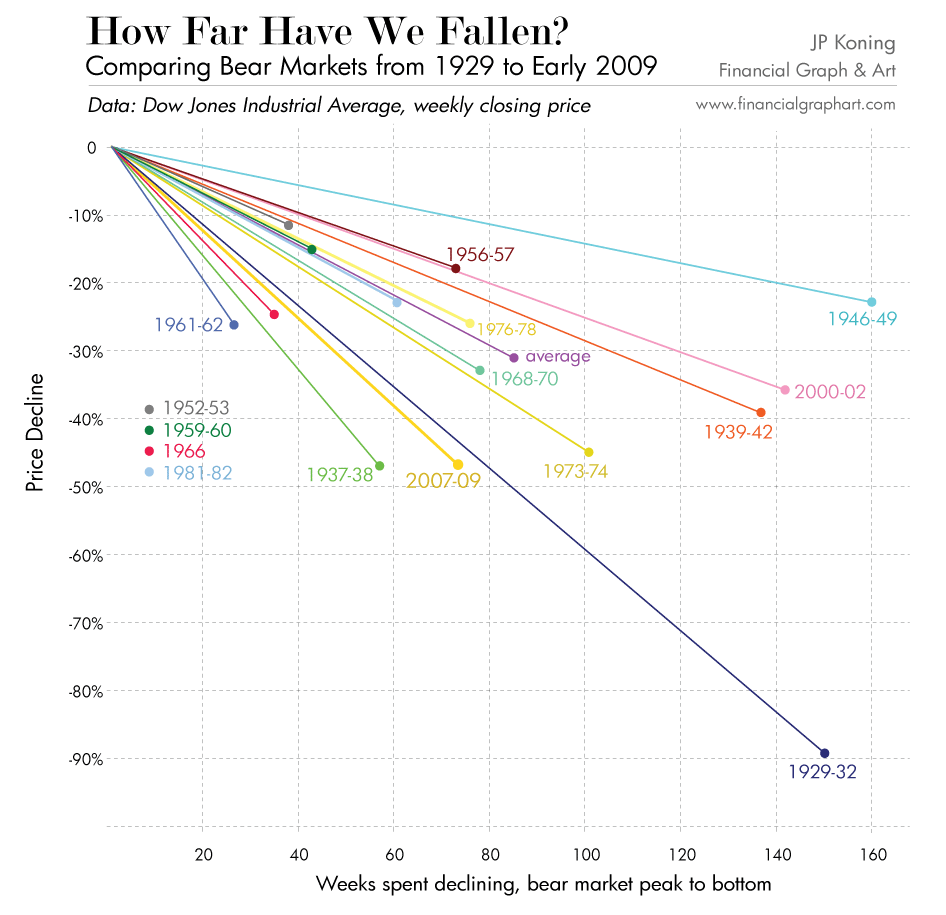
Yes, it was a relief that there was some good news, particularly about Citibank's health, which then led to a huge stock market rally. But, don't get overly bullish--such ups and downs are common in such chaotic conditions, as this wonderful graphic from dshort shows:

Tuesday, October 21, 2008

Marx is back

A great follow-up to the blog entry on how ideologues don't just die nor fade away.
This might seem like a believe it or not report ....
Marx is back
Hasan Suroor
LONDON: With capitalism in crisis, Karl Marx has become fashionable again in the West. Das Kapital, his seminal work, is set to become a best-seller in Europe.
In his native Germany, copies of Das Kapital are reported to be “flying off the shelves” as failed bankers and free-market economists try to make sense of the global economic meltdown.
Jorn Schutrumpf, head of the Berlin publishing house Dietz, is reported as having said that the sales of the works of Marx, and Friedrich Engels, have trebled. “Marx is fashionable again…We have a new generation of readers who are rattled by the financial crisis and have to recognise that neo-liberalism has turned out to be a false dream,” he told The Times.
A dramatic rise has been reported in the number of visitors to Marx’s birthplace in Trier. And film-maker Alexander Kluge is planning to turn Das Kapital into a movie.
Western leaders who once sneered at Marx’s dense tome, breezily dismissing it as a “doorstop,” have been seen flaunting Das Kapital in recent weeks. French President Nicolas Sarkozi has been spotted “flicking through” it, German Finance Minister Peer Steinbruck has said nice things about it, and even the Pope has praised the book for its “great analytical” quality.
Archbishop of Canterbury Rowan Williams recalled Marx’s analysis of capitalism , saying: “Marx long ago observed the way in which unbridled capitalism became a kind of mythology, ascribing reality, power and agency to things that had no life in themselves.”
Free-market cheerleaders such as The Times and The Daily Telegraph have become interested in Marx. There has been a wave of soul-searching analyses of whether he was right, after all.

Friday, October 10, 2008

Hot investment tips

Received this in an email:

If you had purchased $1,000 of AIG stock one year ago, you would have been left with $42 now.
With Lehman, you would have $6.60 left.
With Fannie or Freddie, you would have less than $5 left.
But if you had purchased $1,000 worth of beer one year ago, drank all of the beer, then turned in the cans for the aluminum recycling REFUND, you would have had $214.

You now know where to invest

Thursday, October 09, 2008

The recession train has left the station

This latest update from Nouriel "Dr. Doom" Roubini is one hell of a jaw-dropper. I have copied/pasted in its in entirety. What is his bottom line? we are screwed! According to him, the question is not whether it will be a world-wide shallow recession, but whether it will be a Japanese style decade-long recession, and with severe deflation to boot. OMG!

So, over to Roubini:

Nouriel Roubini: The world is at severe risk of a global systemic financial meltdown and a severe global depression


The U.S. and advanced economies’ financial systems are now headed towards a
near-term systemic financial meltdown
as day after day stock markets are in free fall, money markets have shut down while their spreads are skyrocketing, and credit spreads are surging through the roof. There is now the beginning of a generalized run on the banking system of these economies; a collapse of the shadow banking system, i.e. those non-banks (broker dealers, non-bank mortgage lenders, SIV and conduits, hedge funds, money market funds, private equity firms) that, like banks, borrow short and liquid, are highly leveraged and lend and invest long and illiquid, and are thus at risk of a run on their short-term liabilities; and now a roll-off of the short term liabilities of the corporate sectors that may lead to widespread bankruptcies of solvent but illiquid financial and non-financial firms.

On the real economic side, all the advanced economies representing 55% of global GDP (U.S., Eurozone, UK, other smaller European countries, Canada, Japan, Australia, New Zealand, Japan) entered a recession even before the massive financial shocks that started in the late summer made the liquidity and credit crunch even more virulent and will thus cause an even more severe recession than the one that started in the spring. So we have a severe recession, a severe financial crisis and a severe banking crisis in advanced economies.

There was no decoupling among advanced economies and there is no decoupling but rather recoupling of the emerging market economies with the severe crisis of the advanced economies. By the third quarter of this year global economic growth will be in negative territory signaling a global recession. The recoupling of emerging markets was initially limited to stock markets that fell even more than those of advanced economies as foreign investors pulled out of these markets; but then it spread to credit markets and money markets and currency markets bringing to the surface the vulnerabilities of many financial systems and corporate sectors that had experienced credit booms and that had borrowed short and in foreign currencies. Countries with large current account deficits and/or large fiscal deficits and with large short-term foreign currency liabilities and borrowings have been the most fragile. But even the better performing ones – like the BRICs club of Brazil, Russia, India and China – are now at risk of a hard landing. Trade and financial and currency and confidence channels are now leading to a massive slowdown of growth in emerging markets with many of them now at risk not only of a recession but also of a severe financial crisis.

The crisis was caused by the largest leveraged asset bubble and credit bubble in the history of humanity where excessive leveraging and bubbles were not limited to housing in the U.S. but also to housing in many other countries and excessive borrowing by financial institutions and some segments of the corporate sector and of the public sector in many and different economies: an housing bubble, a mortgage bubble, an equity bubble, a bond bubble, a credit bubble, a commodity bubble, a private equity bubble, a hedge funds bubble are all now bursting at once in the biggest real sector and financial sector deleveraging since the Great Depression.

At this point the recession train has left the station; the financial and banking crisis train has left the station. The delusion that the U.S. and advanced economies contraction would be short and shallow – a V-shaped six month recession – has been replaced by the certainty that this will be a long and protracted U-shaped recession that may last at least two years in the U.S. and close to two years in most of the rest of the world. And given the rising risk of a global systemic financial meltdown, the probability that the outcome could become a decade long L-shaped recession – like the one experienced by Japan after the bursting of its real estate and equity bubble – cannot be ruled out.

And in a world where there is a glut and excess capacity of goods while aggregate demand is falling, soon enough we will start to worry about deflation, debt deflation, liquidity traps and what monetary policy makers should do to fight deflation when policy rates get dangerously close to zero.

At this point the risk of an imminent stock market crash – like the one-day collapse of 20% plus in U.S. stock prices in 1987 – cannot be ruled out as the financial system is breaking down, panic and lack of confidence in any counterparty is sharply rising and the investors have totally lost faith in the ability of policy authorities to control this meltdown.

This disconnect between more and more aggressive policy actions and easings, and greater and greater strains in the financial market is scary. When Bear Stearns’ creditors were bailed out to the tune of $30 bn in March, the rally in equity, money and credit markets lasted eight weeks; when in July the U.S. Treasury announced legislation to bail out the mortgage giants Fannie and Freddie, the rally lasted four weeks; when the actual $200 billion rescue of these firms was undertaken and their $6 trillion liabilities taken over by the U.S. government, the rally lasted one day, and by the next day the panic had moved to Lehman’s collapse; when AIG was bailed out to the tune of $85 billion, the market did not even rally for a day and instead fell 5%. Next
when the $700 billion U.S. rescue package was passed by the U.S. Senate and House, markets fell another 7% in two days as there was no confidence in this flawed plan and the authorities.
Next, as authorities in the U.S. and abroad took even more radical policy actions between October 6th and October 9th (payment of interest on reserves, doubling of the liquidity support of banks, extension of credit to the seized corporate sector, guarantees of bank deposits, plans to
recapitalize banks, coordinated monetary policy easing, etc.), the stock markets and the credit markets and the money markets fell further and further and at accelerated rates day after day all week, including another 7% fall in U.S. equities today.

When in markets that are clearly way oversold, even the most radical policy actions don’t provide rallies or relief to market participants. You know that you are one step away from a market crash and a systemic financial sector and corporate sector collapse. A vicious circle of
deleveraging, asset collapses, margin calls, and cascading falls in asset prices well below falling fundamentals, and panic is now underway.

At this point severe damage is done and one cannot rule out a systemic collapse and a global depression. It will take a significant change in leadership of economic policy and very radical, coordinated policy actions among all advanced and emerging market economies to avoid this economic and financial disaster. Urgent and immediate necessary actions that need to be done globally (with some variants across countries depending on the severity of the problem and the overall resources available to the sovereigns) include:

  • another rapid round of policy rate cuts of the order of at least 150 basis points on average globally;
  • a temporary blanket guarantee of all deposits while a triage between insolvent financial institutions that need to be shut down and distressed but solvent institutions that need to be partially nationalized with injections of public capital is made;
  • a rapid reduction of the debt burden of insolvent households preceded by a temporary freeze on all foreclosures;
  • massive and unlimited provision of liquidity to solvent financial institutions;
  • public provision of credit to the solvent parts of the corporate sector to avoid a short-term debt refinancing crisis for solvent but illiquid corporations and small businesses;
  • a massive direct government fiscal stimulus packages that includes public works, infrastructure spending, unemployment benefits, tax rebates to lower income households and provision of grants to strapped and crunched state and local government;
  • a rapid resolution of the banking problems via triage, public recapitalization of financial institutions and reduction of the debt burden of distressed households and borrowers;
  • an agreement between lender and creditor countries running current account surpluses and borrowing, and debtor countries running current account deficits to maintain an orderly financing of deficits and a recycling of the surpluses of creditors to avoid a disorderly adjustment of such imbalances.

At this point anything short of these radical and coordinated actions may lead to a market crash, a global systemic financial meltdown and to a global depression. The time to act is now as all the policy officials of the world are meeting this weekend in Washington at the IMF and World Bank annual meetings.


Wednesday, October 08, 2008

On the market "going south"

It turns out that there are lots of geography lessons, even in the reporting of the current economic crisis.

Over the last few days, stock markets all over the world have been on a losing trend and every other television reporter and commentator keeps referring to this as the market going “south.” And, without fail, I feel myself wanting to yell at the reporter to stop using “south” in this context.

My objection is not simply because “south” is one of the four cardinal directions along with east, west, and north. And my objection is not because the market indicators cannot move sideways—east or west—but can only go up or down, or remain unchanged.

I have trouble with the usage of “south” in the context of bad news because we keep reinforcing the notion, perhaps unintentionally, that “south” is bad and, therefore, “north” is good.

We don’t realize how much such connotations of north and south is ingrained in us until we begin to examine it. Pretty much every region in the world has its own version of the “northern superiority” over its southern neighbor.

Every once in a while I ask my freshman students whether there is any geographic pattern when it comes to the location of rich and advanced countries on a world map. Before long, the majority opinion is always that it is in the north that rich countries are located whereas all the poorer countries are in the south. When I push them for possible explanations, they can’t seem to resist the temptation that a northern location is just better.

After a few minutes of waiting for students to start questioning this framework, I present them with the first of my exhibits to challenge this assumption. When I ask them about Australia and New Zealand, I typically start seeing those light bulbs going on in them. They know that these countries way south of us are no economic basket-cases by any measure. We slowly then begin to reshape our assumptions about any innate virtues of the “north.”

And when I ask them where the richest and advanced countries of the day were located about a thousand or three thousand years ago, they begin to articulate an understanding that a northern location or a southern location does not necessarily make permanent a country’s economic fate. Being in the south is, therefore, no curse either. “Going south” then doesn’t carry the same connotations anymore.

Students get an opportunity to follow-up on this if ever they wander into my office and look up at the world map on the wall. It is a wonderful teaching and learning moment when I see in their eyes a little bit of confusion as they try to figure out why the map looks strange. It takes them only a few seconds to realize that it is an upside down map of the world—one that I purchased when we visited New Zealand.

Well, for all I know, maybe they leave the room feeling that they have just exited the Bizarro World of comics, where up is down, and left is right!

Perhaps it is the geographer in me that makes me write about this. Or, maybe because I grew up in a country that is located to the south of North America and Western Europe. In any case, the unfortunate aspect is that in characterizing misfortunes as “going south” we end up reinforcing an incorrect idea that somehow south is inferior.

I am not sure whether the television audience systematically, and strictly, treats “south” as a metaphor for a certain trend line and nothing else. (I hope I have not messed up with professional grammarians by referring to metaphors!)

Metaphors are powerful tools, particularly in rhetoric. Politicians use metaphors almost all the time because of the deep emotional response they can trigger. Some of the greatest orators, like Martin Luther King Jr. used metaphors that wonderfully blended together and helped convince the populace about the issues and ideas, and energized them into action. Most of us lesser mortals though tend to abuse metaphors.

So, while acknowledging that the economic indicators are “down”, here is to hoping that they will go “up” really soon and fast.

The market meltdown and your 401K

Don't look. Seriously, don't look. I have no idea what's going on with any of my equity investments, because that is not short term money that I need to keep my eye on.
If you look you will get upset, and you will be tempted to do something stupid. I can't guarantee that the market won't drop further and you won't regret having held on. But as a general rule, selling into a massive liquidity crisis is a pretty bad idea. Selling in a panic because your assets just dropped 30% is almost certainly a bad idea.
The good news is that while the stock market can take a long time to recover, it historically doesn't actually go down for more than a couple of years.
Yeah, that's not very good news. But unless you're planning to retire right now, my advice remains the same: don't look.

Sage advice from Megan McArdle

Tuesday, October 07, 2008

Lemmings, not bears, on Wall Street?

Sure it is a bear market. But, how do we know the market is not over-correcting? What if the better metaphor is lemmings jumping off a cliff? Well, that was my thought after looking at the Economist cover earlier today. And then I read this piece in the NY Times; here is an excerpt:
the market has become a case study in the psychology of crowds, many experts say. In normal times, it runs on a healthy mix of fear and greed. But fear now seems to rule, with investors often exhibiting a Wall Street version of the fight-or-flight mechanism — they are selling first, and asking questions later.
“What’s happening is people are crawling into a bunker and pulling an iron sheet over their heads because they think the sky is falling,” said William Ackman, a prominent hedge fund manager in New York.
And that bunker is getting very crowded, so much so that some analysts are starting to suggest the markets are showing signs of “capitulation” — another term of art to describe what happens when even the bullish holdouts, the unflagging optimists, throw up their hands and join the stampede out of the market.

Wednesday, September 17, 2008

An economic martial law in the US?

George W. Bush and Dick Cheney have not, as far as anyone can tell, been steering the ship. According to The Wall Street Journal, Bush was briefed on the rescue after it was in play. And even then, he was only "briefed." There's been no effort on the part of the White House to even advance the idea that Bush is an engaged participant who's actively signing off on these actions, possibly because suggesting his involvement in a crisis of this complexity would cause the stock market to run and hide in a corner.
Congress, too, has been cut totally out of the loop. The AIG bailout -- in fact, all of the bailouts -- have been conceived entirely without their involvement. Indeed, the Federal Reserve and the Treasury Department have been acting, over the course of this crisis, as if they are the sum total of the government. And that may be the correct approach: Neither the president nor the legislative branch possess the expertise or speed to be involved in the real-time crisis management that Bernanke and Paulson are trying to manage. They could, presumably, reverse decisions after the fact or change the contours of the law, but for now, the ship is being steered by the Chairman of the Federal Reserve, the Treasury Secretary, and an informal working group of Wall Street CEOs and banking powerhouses. And the government, as we normally think of it, has basically accepted their temporary authority. You've heard of martial law? We're currently in a state of market law.

That was EzraKlein Archive The American Prospect via Brad DeLong.

I am not at all ok with the idea that we are under some kind of an economic martial law. Paulson and Bernanke are the economic martial law administrators? There is something in this analysis that bothers me, but I can't quite figure out what exactly that is. Anyway, DeLong responds to that with the following comment:

This is how things have been since 1979--when Carter appointed Volcker to head the Fed, Volcker decided he was going to stop inflation no matter what the cost and would dare anyone else to try to block him, and congress and the president decided that challenging the Fed meant taking responsibility for inflation and thus blame if anything went wrong. Congress and the president occasionally show up to pass tax cuts--and twice, in 1990 and 1993, to take action to try to balance the budget. But otherwise the technocrats at the Fed and the Treasury run things.
This is the Age of Central Bankers.

Certainly not the Age of Aquarius!
But, aren't we granting too much of "war powers", so to say, to Paulson and Bernanke? Of course, they will not misuse it unlike the president who misused the war powers that Congress gave. But, are we putting too much of faith in Paulson, Bernanke, et al? Very troubling. Somehow this does not resonate well with how democractic societies are supposed to respond.
BTW, if we think that Paulson and Bernanke can steer the ship, how come the same people then distrust any form of "management" of the economy? The bottom line seems to be that government should let businesses rake in all the profits--legal and illegal--and not do anything about it. But, the same government ought to steer the economic ship when those same businesses run into icebergs. Aaaaaah!!!