Showing posts with label renewables. Show all posts

Wednesday, August 31, 2016

Here comes the Sun

Unlike this post from a couple of days ago, this post is about good news.  And perhaps a constructive follow-up to this one?

What news do I bring to you?
The installed price of solar energy has declined significantly in recent years as policy and market forces have driven more and more solar installations.
You see, I wasn't kidding about the good news and cheer that even General Malaise can occasionally bring ;)

Notice something in the chart below?


To me, the key there is the sharply reducing cost of utility-scale solar power.  We can do bits and pieces with solar panels on our roof tops, but if the utilities are able to get into the act, then that will be a game-changer.  Which is where the best news of all is:
Perhaps the most interesting piece of data to come out in the latest Lawrence Berkeley National Lab reports is the trend in the price of solar power purchase agreements or PPAs. These prices reflect the price paid for long-term contracts for the bulk purchase of solar electricity. The latest data show that the 2015 solar PPA price fell below $50 per megawatt-hour (or 5 cents per kilowatt-hour) in 4 of the 5 regions analyzed. In the power industry, the rule of thumb for the average market price of electricity is about $30 to $40 per megawatt-hour—so solar is poised to match the price of conventional power generation if prices continue to decline.
The market is reacting already and "will certainly be interesting to see what kind of market dynamic develops as solar approaches the tipping point."

That tipping point is also news from Chile:
Solar power just sold for the lowest price ever, in Chile.
The Spanish developer Solarpack Corp. Tecnologica won contracts to sell power from a 120-megawatt solar plant for $29.10 a megawatt-hour at an energy auction this week.
That’s the lowest price on record for electricity from sunshine, surpassing a deal in Dubai in May. It’s the cheapest to date for any kind of renewable energy, and was almost half the price of coal power sold in the same event. According to Solarpack General Director Inigo Malo de Molina, it’s one of the lowest rates ever for any kind of electricity, anywhere.
Again, note that this is the market that is responding.

Now, about the "bits and pieces with solar panels on our roof tops" that I mentioned earlier in the post, the economies of scale might be different with solar:
somewhat counterintuitively, there are no clear economies of scale in utility-scale solar. Bigger plants, represented by bigger circles in the chart, don’t seem to be producing cheaper power. The authors speculate that this is in part due to the increased regulatory and land-use hassles that come with plants over a certain size, which cancel out any savings. (Interestingly, there are economies of scale on the small-solar side. It seems solar power gets cheaper up to the 5 MW to 20 MW range, and then levels out.
Of course, we have a long way to go.  But, it seems like we are on the right path.


Tuesday, March 24, 2015

In energy, too, it’s the water ... again!

About this time six years ago--ok, ok, April 7, 2009, if you want me to be specific--my newspaper column was titled "In energy, too, it's the water."  I noted there:
instead of urging countries, particularly India and China, to stop using coal, perhaps we ought to focus on how to a large extent it is all about water. Many parts of India, China and other countries have low levels per capita of available water. For instance, while the United State has about 1,600 cubic meters of water per person, the average in China is about 400 cubic meters, and even less in India. This immensely valuable resource can be put to better uses than in coal-fired power plants.
This is but another incentive for us to explore alternative energy sources that do not impose additional demands on water, which will then also mean lesser reliance on coal. Water-constrained countries such as China, India and Israel ought to encourage innovation on this urgent issue.
But, hey, when was the last time anybody ever listened to me, right?  

Today, I read this about a town in Texas:
Last week Georgetown, Texas, a town of about 50,000 about 30 miles north of Austin (and the home of Nolan Ryan) announced that the utility that it owns, Georgetown Utility Systems, would soon get 100 percent of the electricity it provides from renewables.
What is the connection to my column from six years ago?  "because it will save on electricity costs and decrease our water usage.”
creating electricity from fossil fuels doesn’t simply require lots of natural gas and coal. It requires a huge amount of water. “Production of electrical power results in one of the largest uses of water in the United States and worldwide,” the U.S. Geological Survey notes in this infographic. At power plants, water is heated to make steam and huge amounts of water are needed to cool the equipment. Producing the fuel that powers these plants—mining coal and fracking natural gas—also consumes a huge amount of water.
But creating electricity from wind turbines and photovoltaic panels requires virtually no water. 
Ahem, is it ok to say "I told you so?"

BTW, such developments via the marketplace are yet another reason why I am not a big fan of the rah-rah fanaticism about fossil fuel divestment.  Other than a few nutcases who continue to believe in coal and petroleum, most of the corporate world is fully aware of the issues, and put their money where their mouth is--after all, that bottom-line is always their guide!  (A post for another day.) 

But then, at the end of it all, nobody listens to me. I don't get no respect.  The story of my life; what a Cassandra Curse! ;)  


Friday, February 01, 2013

The coal chart that should scare us towards exploring renewable energy

I am not any environmental activist by any means.  I understand that life is about tradeoff and that the natural environment is one of the many factors that we have to consider.

But, I do worry that all is not well with the manner in which the global economy has been pursuing a growth strategy in which many, many, goods--from inexpensive plastic bottles to iPhones--are manufactured in China, at a huge cost.  The cost being environmental.  I suspect that such a global economic approach will depend on how China responds, and the response--or lack thereof--will have implications for internal political stability as well.

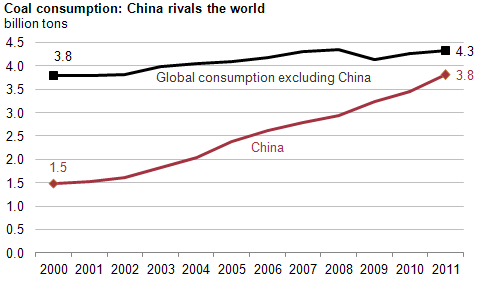
China's economic engine is fueled by coal, the consumption of which is simply astounding, as this chart, which was all over the news and the blogs yesterday, shows:
Source: EIA
As this note in the Scientific American adds:
In fact, according to EIA, the 325-million-ton increase in Chinese coal consumption in 2011 accounted for 87 percent of the entire world's growth for the year, which was estimated at 374 million tons. Since 2000, China has accounted for 82 percent of the world's coal demand growth, with a 2.3-billion-ton surge, the agency said.
A scary, scary, chart, indeed!

But, China consumes so much coal for a very good reason--it is one heck of a cheap source of energy.  Well, cheap because nobody has to explicitly pay for the downside to burning carbon, as is the case when we burn gasoline or natural gas too.

It is coal that has helped the rapid transformation in China--especially in the rural hinterland:
Xu Youwang has been a farmer all his life. The 56-year-old says he can remember a day when all he owned were sheep. He and his neighbours all live in mud-brick houses.
But now he has a washing machine, a TV - and big dreams. "If I had the money I'd buy a car, an apartment, a fridge and a computer," he said.
Farmer Xu expects his life to only get better. And that is the challenge for China's leaders - balancing the aspirations of people like him with more sustainable economic growth
For now, at least, the country's reliance on coal and the pollution that comes with it shows little sign of ending.
Of course, China has been actively exploring alternatives to coal--there are more nuclear power plants planned and under construction there than anywhere else on the planet:
Source: The Economist
Like any other rational person, I too worry about the downsides of nuclear power.  But, hey, that is what I mean as tradeoff!  An environmental activist who opposes coal and nuclear power then has to provide for alternatives, right?

China has been exploring hydropower too as an alternative-but, remember all the environmental controversies over the Three Gorges Dam?  Tradeoff is not easy.  Never easy.

China is pushing for more hydro projects, which will not only have environmental issues, but will also catalyze more geopolitical hand-wringing:
In a major concern for India and Bangladesh, China has approved construction of three new hydropower dams on the Brahmaputra river.

The move comes after a two-year halt amid concerns shown by India and environmental groups about reduced water flow downstream.

The three new dams have been approved by the Chinese State Council Cabinet under a new energy development plan for 2015.
Bloomberg reports that China is pushing for more solar power, too!
China plans to increase its goal for solar-power installations in 2015 by 67 percent to reduce reliance on fossil fuels blamed for greenhouse gases and as smog in Beijing reached record hazardous levels this month.
The world’s biggest emitter of carbon-dioxide plans to raise the solar target to 35 gigawatts by 2015 from 21 gigawatts set last year, boosting demand for manufactures that suffer from slowing sales in Europe, Shi Dinghuan, the counselor of China’s State Council and the president of Chinese Renewable Energy Society, said today by phone.
“We’ve got more pressure to save energy and reduce emissions as smog worsens due to pollution,” he said.
All these make very, very clear that we--the world--cannot have our cake and eat it too: if we, especially in the US and in the rich countries, want cheap stuff that fills up our closets and garages, then we have to accept the carbon usage in China.  If we, especially in the US, refuse to impose a carbon tax on ourselves and, thereby, set an example for the rest of the world, then we have no choice but to accept the carbon usage in China.

We can always fool ourselves by claiming that CO2 emissions in the US have fallen way down to the lowest level since 1994--we have simply exported away the pollution, exactly as Lawrence Summers wanted us to back when he was the Chief Economist at the World Bank :(