The guy who believes he was appointed to ruin the EPA and not run the EPA is pissed off that people are talking about c****** c***** when Hurricane Irma is knocking on America's doors, after flattening quite a few doors in the Caribbean.
The head of the Environmental Protection Agency (EPA) said that talk
about how climate change has played into hurricanes like Irma and Harvey
is “misplaced.” Scott Pruitt, who has expressed skepticism on the degree to which human activity causes global warming, told CNN that the country’s focus should be squarely on the immediate effects of the hurricanes for the time being.
“Here's
the issue,” Pruitt told CNN late Thursday as Irma was heading toward
Florida. “To have any kind of focus on the cause and effect of the
storm; versus helping people, or actually facing the effect of the
storm, is misplaced.”
I cannot begin to understand why there is such a sustained denial of c****** c*****. It seems like we can even remove quite a few words from George Carlin's list, but we need to add c****** c*****.
"People are pretty certain of where they stand on climate change," reports David Koniksy of Indiana University's School of Public and Environmental Affairs. "Extreme weather does not move the needle much."
Does not move the needle!
"One reason may be that people do not yet closely attribute many
common types of extreme weather to climate change," the researchers
conclude. "Perhaps (over time) these linkages will strengthen in the
public's mind."
Perhaps?
I bet that the 63 million who voted for the denier-in-chief are blaming god, and not c****** c*****, as Irma knocks Florida around, and will thank him (neither god nor the president can be female!)
One of the many, many, many problems that trump has created for me is this: The fascist sucks up so much of my time and energy that I have very little left for the world outside. I used to have plenty of time for the rest of the world; now, despite being on furlough, I barely have time to keep up with his shit! And boy does he shit by the truckload every single day!!!
I don't even have the time anymore to talk about the old country. Well, ok, that is also because I have given up on that old land. But, it is not as if I don't keep up with the news about the Subcontinent. For one, talking to my father every other day means that I have an idea of life there, however skewed that reporting might be.
As I have blogged before, one of the regular features of our conversations is about water. Yep, water. About the water shortage in Chennai. About groundwater depletion in Sengottai. And, of course, the monsoon.
We might be far removed from the village and farming life of our ancestors, but we father and son always worry about water, and the rains.
Therefore, the monsoon floods in different parts of India, too, have been regular topics. "Remember the old news reels before the movies that you kids made fun of? "பீகாரில் வெள்ளம்" (Floods in Bihar) in that grave newscaster voice?" he remarked. Because, well, there have been floods in Bihar. And in Assam. And ...
We humans are messed up; we do not understand how integral water is to our existence on this planet. Despite scientists searching for water in the universe as signs of life, we fail to truly understand the preciousness of water. We continue to abuse and mis-manage this life-giving resource.
But, hey, we humans are nothing but pesky irritants on this planet. The more we try to mess with the planet, the more our own very lives will be threatened--either as water shortage, or as floods.
This summer, more than a thousand have died in the floods in South Asia; "while flooding in the Houston area has grabbed more attention, aid officials say a catastrophe is unfolding in South Asia"
“This
is the severest flooding in a number of years,” Francis Markus, a
spokesman for the International Federation of Red Cross and Red Crescent
Societies, said by phone from Kathmandu, Nepal’s capital. ... Asked
how the situation in Nepal compared with that in Houston, Mr. Markus
said, “We hope people won’t overlook the desperate needs of the people
here because of the disasters closer home.” India has also suffered immensely. Floods have swept across the states of Assam, Bihar, Odisha, West Bengal and other areas.
It is not over yet.
And the rain keeps coming. On
Tuesday, Mumbai, the sprawling financial capital, was soaked to the
bone. Nearly all day, the rain drummed down. As people scurried up the
sidewalks, the wind tore umbrellas out concof their hands. The
sky seemed to fall lower and lower, pressing down on the building tops,
cutting visibility to a few blocks, then a few yards. By midafternoon,
it was so dark it felt like nightfall.
And, yes, like with Hurricane Harvey, climate change likely played a role:
"This is not normal," Reaz Ahmed, the director-general of Bangladesh's Department of Disaster Management, told CNN. "Floods this year were bigger and more intense than the previous years." Climate change appears to be intensifying the region's monsoon rains.
Climate change? News to me!
Unchecked urban development
has also left many communities in the region without proper drainage
systems, which only compounds the problem when a natural disaster
strikes. "A lot of the urbanization ... has happened in a largely
unplanned matter," Abhas Jha, the World Bank sector manager for
Transport, Urban and Disaster Risk Management for East Asia and the
Pacific, told CNN
It is one thing if my blog-posts and op-eds echoing such logic are ignored; after all, I am but a lowly academic at a podunk university. But, it is a shame that real experts continue to be attacked by the fascist and his adopted party. What a fuck up!
Caption at the source: Flood-affected people sleeping by a highway toll plaza in the Indian state of Bihar last week.
In November-December of 2015, record rain fell in Chennai. After visiting the city during the winter break, I wrote in an op-ed:
While scientists are cautious when postulating the cause-and-effect
relationship, the role of climate change has not been ruled out. ...
Of course, the natural disaster was
amplified by mismanagement of the land and water. Homes and high-rise
buildings had been constructed at a frenzied pace in what were
previously water-drainage areas, marshlands and lake beds. Thus, the
floodwaters speeding along the natural contours of the land ended up in
basement garages and ground floor units.
It feels like deja vu all over again, when I follow the horrific updates from Houston.
David Leonhardt writes in the (not failing) NY Times:
Obviously,
some extreme weather events are unrelated to climate change. But a
growing number appear to be related, including many involving torrential
rain, thanks to the warmer seas and air.
“The
heaviest rainfall events have become heavier and more frequent, and the
amount of rain falling on the heaviest rain days has also increased,”
as the National Climate Assessment, a federal report, found. “The mechanism driving these changes,” the report explained, is hotter air stemming from “human-caused warming.”
Leonhardt adds this:
In Houston’s particular case,
a lack of zoning laws has led to an explosion of building, which
further worsens flooding. The city added 24 percent more pavement
between 1996 and 2011, according to
Samuel Brody of Texas A&M, and Houston wasn’t exactly light on
pavement in 1996. Pavement, unlike soil, fails to absorb water.
Add up the evidence, and it overwhelmingly suggests that human activity has helped create the ferocity of Harvey.
There is a simple thermodynamic relationship known as the Clausius-Clapeyron equation
that tells us there is a roughly 3% increase in average atmospheric
moisture content for each 0.5C of warming. Sea surface temperatures in
the area where Harvey intensified were 0.5-1C warmer than current-day
average temperatures, which translates to 1-1.5C warmer than “average”
temperatures a few decades ago. That means 3-5% more moisture in the
atmosphere.
That large amount of moisture creates the potential for much greater
rainfalls and greater flooding. The combination of coastal flooding and
heavy rainfall is responsible for the devastating flooding that Houston is experiencing.
Mann continues about the stalling, which has made Harvey pour water from the skies. This stalling is not only with hurricanes and cyclones though:
More tenuous, but possibly relevant still, is the fact that very
persistent, nearly “stationary” summer weather patterns of this sort,
where weather anomalies (both high-pressure dry hot regions and
low-pressure stormy/rainy regions) stay locked in place for many days at
a time, appears to be favoured by human-caused climate change. We
recently published a paper in the academic journal Scientific Reports on this phenomenon.
Hot days are hotter than ever and stay hot for a lot longer. Wet days are wetter than ever and stay wet for a lot longer.
In another op-ed, after the devastating cyclone that tore through Chennai, I wrote in January 2017:
Such extremes are consistent with climate weirding. ...
Climate scientists warn that we have to
prepare for more and more extreme events that result from climate
weirding. The Intergovernmental Panel on Climate Change noted that “a
changing climate leads to changes in the frequency, intensity, spatial
extent, duration and timing of extreme weather and climate events, and
can result in unprecedented extreme weather and climate events.”
Of course, it is not merely about the
rains. Heat waves, too, for instance, are increasing in both frequency
and intensity. Unlike wind and rains, heat waves are not action-made for
cameras — heat waves produce no images and videos that go viral. But
heat waves kill more people than rains and cold spells do.
In that op-ed, I suggested that we Americans look at ourselves in the mirror:
We in the United States need to stop
denying the human cause in the global climatic changes in this
industrial era. As a country with an affluence that is the envy of the
rest of the world, we need to assume leadership in addressing global
weirding.
These will be enormous challenges during a Trump presidency and with a Republican-controlled Congress.
The 63 million who voted for trump and his climate-change-denying minions can now add Houston to the growing list for why they stand accused.
As a way to stress the importance of the courses that I teach, I often tell students that they have enormous power to influence the outcomes through two roles that they have: Consumer and voter. I then follow up with how people talk about the voting aspect, but that they vastly underestimate the decisions that we make every single day as consumers. When we buy a tshirt that was manufactured in Bangladesh, it is a political act too, I tell them.
If only they and the rest of the world listened to me!
Take the food that we eat, for instance. I have blogged in plenty about how much beef is an environmental disaster. (Like here, for example.) Beef and chicken consumers are essentially saying, "fuck it, I don't care about climate change." Because, if they did care, then it will be difficult to justify their actions.
Every small thing, however mundane and a daily boring thing it is that we do, is a political statement. It is just that we don't think of it that way.
Gidon Eshel talks about in the video that I have embedded here. But, hey, maybe not everybody wants to spend 45 minutes on that talk ;) He says:
“When you make a choice between any two competing ingredients or any two
competing meals,” Eshel said in a December lecture (on “Rethinking the
American Diet”), “you are making a whole cascade of important choices
that you may or may not be aware of. For example, in that choice you
determine…the nature of rural communities” in terms of structure, land
use, and population density; the quantity of greenhouse gases emitted
“on your behalf” for food production; the biodiversity of rangelands;
the likelihood of species extinctions; and the health of waterways and
coastal ocean fisheries, where massive die-offs are one consequence of
agricultural pollution. “You even get to take sides in things that we
don’t often associate with food choices, like societal strife,” he said,
citing the example of a water-rights dispute pitting alfalfa farmers
against a Native American tribe in Oregon’s Klamath basin.
You see how even the food that we eat is a statement on various people and natural elements all around?
If I had been asked to guess how much of the agricultural land is used to grow all things healthy, like apples and oranges and nuts and tomatoes, I would never, ever, have guessed anywhere near the neighborhood. My number would have been like trump's factoids that he grabs from his asshole! The reality is shocking:
all the lettuce, tomatoes, fruits, and nuts people eat (including apples, citrus, and almonds) are grown in less than one-half of 1 percent of the agricultural lands: “a minuscule fraction of the total”
What the what? One-half of one percent of the ag lands in this country? That's it? Oh my!
So, what is Eshel's bottom-line?
When making their dietary choices, Eshel said in summing up his
research, individuals “get to tip the scale of environmental, social,
and political contests,” as well as improve their personal health.
Eating healthy foods that use less land, therefore, “is one of the
callings of our time….”
Imagine explaining all these to the 63 million who voted for the asshole-in-chief!
A few years ago, when a local organization filed a lawsuit against the federal government and the fossil fuel industry under the public trust doctrine, I didn't think that anything will be accomplished. But, much to my surprise, the courts are siding with them. Their claim, on behalf of a few named children plaintiffs, and on behalf of all children, is that the public trust doctrine "requires our government to protect and maintain survival resources for future generations."
The Oregon approach is now not the only one. I didn't know, until I read this, that February 7th, the court heard "Juliana, et al v. United States of America, et al — a case a group of kids, young adults and environmentalists brought in 2015 against the U.S. government." It is not the merits of the case that this post is about; there is no way I am going to pretend that I know the law. I firmly believe in Charles Dickens's description that the law is an ass!
What caught my attention is this:
The lead attorney for U.S. manufacturers and oil and gas companies on a climate change lawsuit didn't know the answer to a measurement fact when asked in court two weeks ago, court papers show.
And what was that measurement fact?
Frank Volpe said he didn't know whether carbon dioxide levels had reached 400 parts per million, a measurement of atmospheric concentration.
A simple measurement fact. About CO2 in the atmosphere. The lead attorney defending the industry said he didn't know.
Of course Volpe knows. Volpe is "representing the American Petroleum Institute, American Fuel & Petrochemical Manufacturers and National Association of Manufacturers in the case." Of course the industry knows. They just do not want to admit that they know.
The judge didn't let him off the hook:
Asked by Judge Thomas Coffin whether the groups he represents “acknowledge that the CO2 levels in the atmosphere are currently at 400 ppm,” Volpe did not answer.
“Do you deny that, or do you not know?” Coffin asked, according to a transcript.
“I would say that as we said in our answer, we don't know,” Volpe said.
“You don't know,” Coffin replied. Volpe said that determination would be up to an expert witness.
If we watched such an exchange on Saturday Night Live, we might laugh our asses off. But, this is for real, in a real courtroom.
The judge tried again.
“So as we sit here today, do you have an expert witness that the intervenors intend to call that you can identify that will opine that the CO2 levels are not 400 ppm, but are something other than that and, if so, what?” he asked.
“I don't know, your honor,” Volpe responded.
How screwed up are the fossil fuel industry and their attorneys!
Neither Volpe nor C. Marie Eckert, another attorney for the trade groups, responded to requests for comment about their clients' views on carbon dioxide concentrations.
Why would they!
You ask scientists the same question, and they will give you the answer even when they are piss-drunk at the unholy 3:00 am when this president starts tweeting.
The National Oceanic and Atmospheric Administration tracks CO2 levels measured at Mauna Loa Observatory, Hawaii. The monthly averages for January this year and last were both greater than 400 ppm, according to the agency.
Reached by phone and asked of the possibility that CO2 levels aren't at 400, a spokesman for the agency laughed.
63 million Americans have voted for a man who denies climate change, and who has appointed to the EPA a man who would rather dismantle the EPA. How messed up are these 63 million voters? What a disaster!
It took a while for me to synchronize my personal approach to knowledge with my how I engage with teaching and learning in the classroom. You know, my commitment to a public-intellectual way of scholarship into the classroom. (I have blogged in plenty about that, like here.)
Thus, in my intro class, I took to them a one-pager, from this recent proposal from a bunch of Republicans who want to tax carbon as the way to deal with climate change. I wanted students to understand that the academic ideas that we talk about in class has real world applications in various public policy issues like climate change.
Of course, as with most things that I do, there was a structure to the class discussions. It was clear that students had never been presented such an idea before. The part about the tax revenue being returned to people as a dividend-check really grabbed their attention.
And then one student said, "but, this cannot work when Trump does not even think that climate change is real."
And that is only the beginning. The first step is to stop denying climate change. To recognize and understand that it is for real.
The second step is to acknowledge that this climate change is being caused by human actions. This will be a huge step for most Republicans to take. A yuge step.
And then to recognize and understand the role that carbon plays in this process.
And finally to get into a constructive discussion on what to do about carbon.
Now, ask yourself, do you think all these can ever happen with a president and his minions dealing with "alternative facts"? With 63 million assholes--like this powerful guy--voting for the orange asshole?
(As you can imagine, an edited version of this is what I have sent the editor!)
A year ago, after visiting India in December 2015, I wrote about the record-setting rains and floods in the city of Chennai, where my parents and sister live. Almost 14 inches of rain fell within a matter of 24 hours, and that was merely one of the rain spells. With all the reservoirs full, authorities had to open up the gates, which then flooded the city.
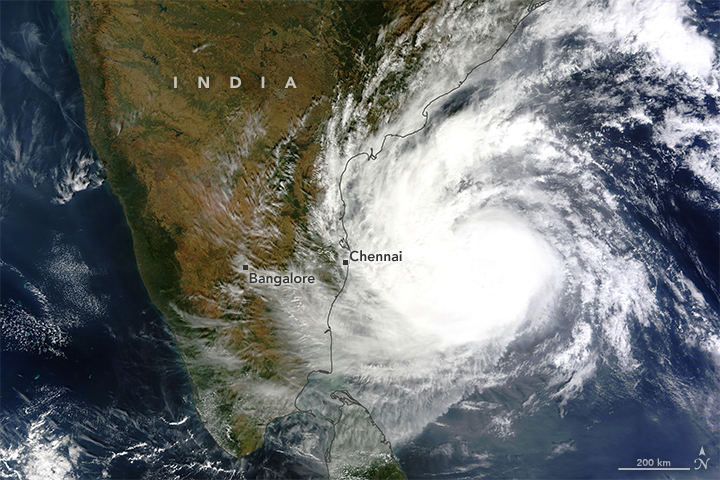
A year later, the same city but another extreme event. A “super cyclone” changed course and aimed straight towards the city. It is an irony that the cyclone was named Vardah, which means red rose. A beauty of a red rose it was not. In a couple of hours, the winds had toppled about a quarter of the trees in the city. Transformers blew up, utility poles cracked and fell, and power and communication systems were knocked out. Some of the more than eight million people in the area were without power and water for more than a week.
Because of the cyclone, the airport was closed. I was already en route, and was held back in Dubai for a day. The night that I landed in Chennai, the city was pitch dark at most places—no electricity. Fallen tree branches—and entire trees too—made the drive home from the airport eerie. Like practically everybody else in the city, my parents were also sitting by the candle light and waving a plastic fan about themselves in order to keep themselves cool and to shoo away the mosquitoes that couldn’t care about the cyclone.
The following morning, I walked about the city. This was as close as I have been to a landscape that can be described as a war zone. Entire trees uprooted. Buildings with facades blown off. Walls destroyed. And a strange silence in contrast to the high noise levels that otherwise typically assault my senses.
The rain and floods of December 2015, and the super-cyclone of December 2016, will now be followed by drought. Yes, water shortage. The state of Tamil Nadu, for which Chennai is the capital, is reeling from a monsoon that failed—the second worst in over 150 years. “The latest spell of rain due to Cyclone Vardah has only brought down the State’s deficit from 66 per cent to 61 per cent, says S. Balachandran, Director in the Meteorological Department.” If not for the moisture that the cyclone brought with it, the city and the state would be in an even worse situation.
Such extremes are consistent with climate weirding. I way prefer the phrase “global weirding” because it helps avoid unnecessary debates with deniers who want to contest global warming. The same deniers also typically point to changes in weather in order to raise pointless questions about global climate changes. Finally, global weirding helps me understand the kinds of extreme weather stories that have become all too common.
Extreme events are beyond the predictability that humans have lived by. The monsoons, for example, have wild swings these days. When it rains, it seems to pour all at once. Or, it rains when it should not. And, like this past season, the rains are deficient. This is especially a disaster for developing countries like India where a significant percentage of the population relies on intensive agriculture. The drought in Tamil Nadu has already resulted in a few farmers worried about their misfortunes committing suicide.
Climate scientists warn that we have to prepare for more and more extreme events that result from climate weirding. The Intergovernmental Panel on Climate Change (IPCC) noted that “a changing climate leads to changes in the frequency, intensity, spatial extent, duration and timing of extreme weather and climate events, and can result in unprecedented extreme weather and climate events.”
Of course, it is not merely about the rains. Heat waves, for instance, are increasing in both frequency and intensity. Unlike wind and rains, heat waves are not action made for cameras. Thus, unlike with a cyclone, for instance, there are no images and videos that go viral when it comes to heat waves. But, heat waves kill more people than rains and cold spells do. It is then not difficult to understand that heat waves during water-deficit situations can become disasters in tropical areas like India.
We in the United States need to stop denying the human cause in the global climatic changes in this industrial era. As a country with an affluence that is the envy of the rest of the world, we need to assume leadership in addressing global weirding. These will be enormous challenges during the demagogue's presidency and with the Grand Old Minions controlling Congress. But, we have overcome challenges in the past; here, too, I hope that we will eventually do the right thing.
The demagogue and the millions who voted for him continue to spin whatever stories that suit them. But, the laws of physics are the laws of physics, and--unlike the brainless Republicans--are not affected by moronic and misleading tweets from the demagogue.
One of the many, many lessons from this election is that despite all the benefits that we people enjoy from the progress in scientific understanding, a great many are clueless about the scientific method. The laws work " regardless of political or social prejudices, and they are indisputably true."
But the most basic scientific concept that is clearly and disturbingly
missing from today's social and political discourse is the concept that
some questions have correct and clear answers.
The scientific method is not how one feels and does not work by name-calling. It is not faith-based either. It is the scientific method that leads scientists to conclude:
2016 will go down as the warmest year globally since record-keeping
began, with preliminary reports indicating that 2016 was 1.3 degrees
Celsius above pre-industrial times.
And one of the consequences?
As temperatures rise, we’re also learning more about how these rising temperatures affect our weather – and extreme weather events, in particular. With the help of new and evolving climate research, we’re detecting a
stronger link between warming and changing weather patterns.
Yep, extreme weather events. When it rains it floods creating records. Droughts are record-setting. People old enough to have experienced a sense of predictability are now our living witnesses on how how unpredictable meteorological events have become.
While the demagogue and most of the people who voted for him continue to dismiss climate change and its human cause, the effects of climate change are already being felt all over the world. Especially in poor countries that do not have the resources to adapt to the rapid changes. Like in Madagascar:
Southern
Africa’s drought and food crisis have gone largely unnoticed around the
world. The situation has been particularly severe in Madagascar, a
lovely island nation known for deserted sandy beaches and playful
long-tailed primates called lemurs. But
the southern part of the island doesn’t look anything like the animated
movie “Madagascar”: Families are slowly starving because rains and
crops have failed for the last few years. They are reduced to eating
cactus and even rocks or ashes. The United Nations estimates that nearly
one million people in Madagascar alone need emergency food assistance.
And the understanding through the scientific method is this:
New research, just published
in the bulletin of the American Meteorological Society, concludes that
human-caused climate change exacerbated El Niño’s intensity and
significantly reduced rainfall in parts of Ethiopia and southern Africa. The
researchers calculated that human contributions to global warming
reduced water runoff in southern Africa by 48 percent and concluded that
these human contributions “have contributed to substantial food
crises.”
Of course, all these are nothing but hoax manufactured by the Chinese!
"If I respect the person, then I am almost always open to listening to their ideas--even if they are different," a student remarked during discussions.
Now that explains why nobody listens to me! ;)
The student's observation is profound--am not sure if she realizes how insightful that is. I hope she does not let go of that bottom-line; it will serve her well in life.
I am so convinced because, after all, I have my own experiences to confirm that. Once, a stranger emailed me after reading an op-ed of mine, in which he wrote that he always reads my opinions because of my integrity. The craziest thing is that he and I do not know each other and, yet, in his estimate from afar and based on my writings, I am a man of integrity.
I, too, behave the same way--I love to interact with people who are genuine and for whom I have respect. Why would I want to waste my remaining time with people for whom I have no respect at all?
These begin to matter a lot on issues that bear enormous weight on society. On the world. Like with climate change. Most people who are suspicious of claims about climate change, or the human triggers behind it, are also some of the more religious people in this country. Most scientists, on the other hand, are not that much into religious beliefs. So, we now have a problem: How could we convince them about the urgency?
This is not that much different from how public health issues--like small pox and polio--were tackled in developing countries. Remember? People, especially in villages, were not quite sold on the vaccination idea. The campaign then sought out people in the communities whose words had some weight on others. The village elders, the religious leaders, the school teachers, ... and when those people spoke to the community, the campaign was an easier sell.
people can accept unwelcome truths much more readily if they come from within, rather than from outside, their community/family/group.
The NY Times profiled Katharine Hayhoe, who is a climate scientist as Texas Tech University, as one of those highly respected insiders:
Dr. Hayhoe has come to prominence in part because she is just so darned nice. It would be too easy to chalk that up to her Canadian background — she says it does help explain her commitment to finding consensus — and she has found that she gets her science across more effectively if she can connect with people personally. In a nation seemingly addicted to argument as a blood sport, she conciliates. On a topic so contentious that most participants snarl, she smiles. She is an evangelical Christian, and she does not flinch from using the language of faith and stewardship to discuss the fate of the planet.
She reminds us about something important:
While some climate warriors treat those who are not inclined to believe them as dupes or fools, she wants to talk. “If you begin a conversation with, ‘You’re an idiot,’ that’s the end of the conversation, too,” she said
Something similar is what another student remarked during the discussions. Students hate it when they are treated like stupids.
Some people seem to intuit all these. Some are like me--we learn it the hard way, after a few early years of arrogance. It took me a while to understand and appreciate intellectual humility. I wish I had understood that when way younger.
So, why the strange title for this post when it is intellectual humility that I wanted to reach? It is straight out of that NY Times piece:
“I don’t believe in climate change,” she said. Belief doesn’t come into it; scientific verification does.
“Gravity doesn’t care whether you believe in it or not,” she said, “but if you step off a cliff, you’re going to go down.”
Facts and scientific verification have nothing to do with "belief." But, facts and science alone cannot win the day.
Oh, the coolest thing of all? I had tweeted the "belief" thing earlier:
There are those who believe that global warming is a hoax created by the Chinese government, and their fearless leader wants to be the leader of the free world.
We live in strange times where facts are for losers! We started going down that road when a previous leader of the free world trusted nothing but his instincts, not realizing that he was like "a blind man in a room full of deaf people,"
2016 will be the year that carbon dioxide officially passed the symbolic 400 ppm mark, never to return below it in our lifetimes, according to scientists.
Perhaps never to return below 400 in our lifetimes. I am sure it is a hoax being propagated by the Chinese government that works hand in glove with climate scientists all around the world.
So, how do we know about this 400 ppm?
September is usually the month when carbon dioxide is at its lowest
after a summer of plants growing and sucking it up in the northern
hemisphere. As fall wears on, those plants lose their leaves, which in
turn decompose, releasing the stored carbon dioxide back into the
atmosphere. At Mauna Loa Observatory, the world’s marquee site for
monitoring carbon dioxide, there are signs that the process has begun
but levels have remained above 400 ppm.
Visit your favorite glaciers that you have listed in your bucket-list, thanks to the gorgeous photos that you have seen, before the Chinese government starts melting them away!
Washington voters will decide in November whether to introduce a carbon
tax on fossil fuels and electricity from coal and natural gas, with the
goal of slowing global warming while reducing taxes on sales and
manufacturing and keeping total tax revenue flat overall.
A deep blue state. Environmentally conscientious--even fanatical--electorate. So, the measure has big time support and will win easily, right?
Sierra Club has adopted a Do Not Support position concerning Initiative 732, rather than Support, Neutral, or Oppose.
How about that? It is not a stand of "Support, Neutral, or Oppose" but "Do Not Support." Talk about linguistic jiu-jitsu. And you thought Bill Clinton's dancing around the word "is" was unique?
The resistance comes not just from the usual opponents on the right,
but even more strikingly from the left. The reason: Many
environmentalists see climate change as an opportunity to remake the
economic order. They want to use carbon taxes to fund renewable energy
and green technology and bolster the incomes of workers and communities
they say are most hurt by climate change. Whatever the merits of these
goals, the effect is to equate climate policy with bigger government,
which makes it harder to achieve broad-based support.
Seriously? Environmentalists oppose it because of their larger social engineering agenda?
But the main reason is that I-732 sends its revenue back to
taxpayers, whereas environmentalists would like the revenue for other
priorities. The Washington Environmental Council, which doesn’t support
I-732, says revenue from any climate initiative should be plowed into
the “clean energy economy…infrastructure for clean, abundant water and
healthy forests” and assistance for “the most vulnerable workers and
communities.”
So, party on, folks! Make sure your party is on high ground so that you don't have to deal with the rising water levels.
The installed price of solar energy has declined significantly in
recent years as policy and market forces have driven more and more solar
installations.
You see, I wasn't kidding about the good news and cheer that even General Malaise can occasionally bring ;)
Notice something in the chart below?
To me, the key there is the sharply reducing cost of utility-scale solar power. We can do bits and pieces with solar panels on our roof tops, but if the utilities are able to get into the act, then that will be a game-changer. Which is where the best news of all is:
Perhaps the most interesting piece of data to come out in the latest
Lawrence Berkeley National Lab reports is the trend in the price of
solar power purchase agreements or PPAs. These prices reflect the price
paid for long-term contracts for the bulk purchase of solar electricity.
The latest data show that the 2015 solar PPA price fell below $50 per
megawatt-hour (or 5 cents per kilowatt-hour) in 4 of the 5 regions
analyzed. In the power industry, the rule of thumb for the average
market price of electricity is about $30 to $40 per megawatt-hour—so
solar is poised to match the price of conventional power generation if
prices continue to decline.
The market is reacting already and "will certainly be interesting to see what kind of market dynamic develops as solar approaches the tipping point."
Solar power just sold for the lowest price ever, in Chile.
The Spanish developer Solarpack Corp. Tecnologica won contracts to sell power from a 120-megawatt solar plant for $29.10 a megawatt-hour at an energy auction this week.
That’s the lowest price on record for electricity from sunshine, surpassing a deal in Dubai
in May. It’s the cheapest to date for any kind of renewable energy, and
was almost half the price of coal power sold in the same event.
According to Solarpack General Director Inigo Malo de Molina, it’s one
of the lowest rates ever for any kind of electricity, anywhere.
Again, note that this is the market that is responding.
Now, about the "bits and pieces with solar panels on our roof tops" that I mentioned earlier in the post, the economies of scale might be different with solar:
somewhat counterintuitively, there are no clear economies of scale in
utility-scale solar. Bigger plants, represented by bigger circles in the
chart, don’t seem to be producing cheaper power. The authors speculate
that this is in part due to the increased regulatory and land-use
hassles that come with plants over a certain size, which cancel out any
savings. (Interestingly, there are economies of scale on the
small-solar side. It seems solar power gets cheaper up to the 5 MW to 20
MW range, and then levels out.
Of course, we have a long way to go. But, it seems like we are on the right path.
(Have sent a version of this to the editor) An old high school friend, who is a practicing pathologist in India, visited with me in mid-August, just as the temperature started its sharp climb during the dog days of summer. I joked that she brought with her the Indian conditions. Talk about the weather soon morphed into discussing climate change.
My friend, like many hundreds of millions in India, is intensely familiar with the recent unusual meteorological happenings there. Last December, for instance, the city of Chennai--home to both our parents--received rainfall amounts that vastly exceeded all kinds of records and the city was flooded. (I addressed this in a column that was published on January 6, 2016.)
In late spring, more than a quarter of India’s 1.2 billion population struggled with drought and water shortage. The conditions worsened in the summer, when the country recorded unbearably hot temperatures, and the heatwave turned out to be a killer as much as the heatwave of 2015 was. Then, when the monsoon arrived after all the heat and dust, it poured and flooded. In Kaziranga National Park in India’s northeast, more than twenty rhinos, which had been making quite a recovery after near extinction, were killed in the monsoon floods.
Most scientists and lay people alike in India are in agreement that these extreme weather episodes, year after year, are a result of climatic conditions that are getting weirder and not predictable as they might have been in the past.
Here in the US too, it is not a mere accident that record-setting rain fell in Louisiana, for instance. Only months before, we witnessed Houston deluged by rains. When records are being shattered in places across the world, across different parameters of heat, rain, drought, and cold, then surely these are not isolated events but a part of a larger story.
When it comes to that larger story of global climate change, it is not a case of what happens in Vegas stays in Vegas. Instead, the cumulative effects of Vegas and everywhere else means that all of us anywhere on the planet are feeling the effects. The more extreme the resulting weather events, the more will be the destruction of life and property as well.
My friend and I got to talking about what can be done. “Look at all the lights here” she remarked. Homes were aglow in my neighborhood from the light inside and from the street lamps. Artificial light is so much in abundance in the US that we are worried about light pollution that prevents most Americans from sighting even our own home galaxy—the Milky Way. “Twinkle, twinkle, little star” is an abstract idea for many urban kids who rarely see get to see stars in the sky during their everyday lives.
It is quite a contrast in her country. "In India, a large population doesn’t even have electricity in their homes. Turning the lights off won’t help fight climate change" she said.
Developing countries like India have an immense problem to solve. When 300 million people in India lack basic electric light, leave alone air conditioners and refrigerators, the magnitude of the problem is easy to imagine. Even among those who are connected to the electricity grid, the power consumption per person is barely a fifth of the global average. The fulfillment of the dreams of the people will require a whole lot of energy. However, the use of coal and other carbon sources will further accelerate the climate weirding.
While India’s emissions are very low on a per-capita basis—about a tenth of US per capita emissions—it is already the third largest total emitter of carbon dioxide. As India’s economic engines rev up, if it follows the same fossil-fuel path that was traveled most recently by China, and by the developed countries including the US earlier on, then the explosive growth of carbon use will mean “game over”, and we might as well party like there will be no tomorrow.
Thus, as we move into the future, it is India—more than any other developed or developing country—that will practically determine our collective global fates with its decisions on clean and carbon-free energy sources.
It was an unbearably warm evening the day before my friend left. We walked up to the Willamette River and soaked our feet in the cool waters. About thirty young and old ducks floated and quacked all around us. Climate change could prevent future generations from enjoying such blissful nature. Here is to hoping that the natural world of tomorrow will be as good as, or even better than, the wonderful world that we inherited.
The dog days of summer, and the dog days of the presidential election season have coincided. One party does not care about the daily warmth nor the long-term climate change:
The platform approved by a voice vote yesterday evening doesn’t
explicitly question the science behind climate change. But it calls for
reduced funding for renewable energy and international adaptation
programs, and it seeks an end to the global agreement reached in Paris
late year to cut greenhouse gas emissions worldwide.
...
“We oppose any carbon tax,”
Meanwhile, "based on the findings of 450 scientists from 62 countries" the "new “State of the Climate”
report by the American Meteorological Society and the National Oceanic
and Atmospheric Administration’s National Centers for Environmental
Information" informs us that::
Last year officially surpassed 2014 as the warmest year ever noted on record.
Rising
oceans, accumulating atmospheric greenhouse gasses, and escalating
temperatures on both sea and land all reached new record highs in
2015 — surpassing landmarks set a year prior.
I am sure the GOP and its loyal members merely let out a collective yawn over this latest hoax!
The record warmth, month after month, and year after year, is apparently making true what were mere theoretical scenarios. Like how pathogens buried in the cold, cold permafrost might find it to be a hospitable place for them:
The ongoing anthrax outbreak in Siberia
is offering us a preview: What was once considered a future theoretical
possibility — a re-animated deadly bacterium emerging from the
permafrost — is now a reality.
"Ongoing"??? And I thought I keep up with the news! Let me tell you first about that:
Eight people are confirmed as infected with anthrax, a rare but
deadly bacterial disease. It is believed to have spread from reindeer.
More
than 2,300 reindeer have died in the outbreak, in the Yamalo-Nenets
region of Siberia. Reindeer-herding families have been moved out.
A heatwave has fuelled the disease.
Temperatures in the danger zone - now under quarantine - have soared to 35C.
Russia has sent troops trained for biological warfare to help deal with the emergency.
Anthrax? The first time I ever heard about it was in the days after 9/11. Until then, I had no idea about something called Anthrax. And now, they are coming up from the deep freeze?
Officials believe that the heat melted permafrost and exposed an
infected reindeer carcass in the Siberian tundra, AFP news agency
reports.
The last outbreak in the region was in 1941.
Crap!
So, back to the climate scientists and their theoretical scenarios.
Scientists have been warning for years
that melting permafrost might release ancient pathogens, frozen for
millennia or longer in northern soils. Over the last decade or so,
bacteria have been discovered alive in Alaskan permafrost at temperatures as low as minus-40 degrees Celsius, and in permafrost layers as old as three million years
in Siberia. Although the vast majority of known bacteria are harmless,
we don’t yet know what’s buried up there, or how dangerous it might be
to humans.
And
it’s clear that, for now, weather conditions in Siberia are far outside
their normal range. Last month, parts of Siberia near where the anthrax
outbreak is occurring were as much as 18 degrees Fahrenheit (10 degrees
Celsius) warmer than normal, averaged over the entire month. That’s
like New York City suddenly adopting the climate of Tucson, Arizona, for
the whole month of July. To say the Arctic climate is off the charts
this year is an understatement.
What the what?
So, if we continue to set records for warmest month and warmest year, then ...?
“This is uncharted territory in the human experience, and especially the ecosystem is likely to respond in abrupt ways”
Anything else?
Permafrost-borne
diseases are only one threat of climate change, and scientists warn that
further abrupt changes are possible (if not likely) unless greenhouse
gas emissions are quickly reduced. At this point, humanity has a
decision to make — which is good news in the sense that a different
course is still possible. But as with this week’s anthrax outbreak, if
we continue to lock in future warming, we won’t be able to say we
weren’t warned of the consequences.
I don't care whether or not Einstein really said or wrote somewhere that insanity is doing the same thing over and over again and expecting different results. It makes a lot of sense. Yet, humans often tend to do the same bloody things over again, believing things will work out differently.
I wonder if Einstein ever considered in his thought experiments the possibility that humans do the same thing again not because they expect different results, but because they completely deny the results. Such denial would never occurred to his logical mind, perhaps. Einstein versus the climate change deniers would have been one interesting discussion.
Yet, that is what is unfolding in plain sight. People are gladly doing the same things. Like this, in in South Florida:
Its very existence depends on the continued allure of the beaches,
waterways and natural environment. Yet, by 2050, an estimated $15
billion to $36 billion of Florida’s coastal property will be threatened
by sea-level rise, according to a report last year from the Risky
Business Project, a Bloomberg Philanthropies effort that quantifies
economic risks from climate change.
In South Florida, sea-level rise and climate change are already
having an effect on available drinking water, roads and sewer lines in
low-lying areas, and storm and flood insurance rates.
If problems are showing up in every day life even now, then Einstein's logic will tell us that people won't develop the land and sell multi-million dollar homes, right? Welcome to the insanity:
there’s an emerging industry eager to find a way to help people stay
in that paradise, a place born of real estate speculation and rebirthed
cyclically out of natural disasters like hurricanes and man-made
disasters like real estate bubbles.
Developers have started marketing storm-resistant homes and resilient
buildings, like a high-rise in downtown Miami designed to withstand
300-mph winds. In Miami Beach, the city is beginning to implement
building codes that require new construction and city infrastructure to
be elevated. Fort Lauderdale is considering raising the height limits on
sea walls.
“Sea level is rising, and we have to plan for the next 50 to 100
years. You have to, for the purposes of marketing, build for the future.
You have to build for the future, even if the code may not allow it.”
Seriously?
Meanwhile, whatever the deniers might want to believe, the data trend is worsening.
The last station on Earth without a 400 parts per million (ppm) reading has reached it.
Where was that, you ask? In Antarctica. Far, far, away from South Florida and China and India and humanity.
In the remote reaches of Antarctica, the South Pole Observatory carbon
dioxide observing station cleared 400 ppm on May 23, according to an
announcement from the National Oceanic and Atmospheric Administration on
Wednesday. That’s the first time it’s passed that level in 4 million
years (no, that’s not a typo).
So, those of us who are not into insanity, nor into denial, will worry about trends like this:
“The increase of carbon dioxide is everywhere, even as far away as you can get from civilization,” Pieter Tans,
a carbon-monitoring scientist at the Environmental Science Research
Laboratory, said. “If you emit carbon dioxide in New York, some fraction
of it will be in the South Pole next year.”
It’s possible the South Pole Observatory could see readings dip below 400 ppm, but new research published earlier this week shows that the planet as a whole has likely crossed the 400 ppm threshold permanently (at least in our lifetimes). Passing
the 400 ppm milestone in is a symbolic but nonetheless important
reminder that human activities continue to reshape our planet in
profound ways
And, one of the results will be, yes, rising sea levels in South Florida too.
Guess who is in favor of building higher sea walls even when denying the very climate change? Yes, it is the fascist, who is worried about his wealth!