Showing posts sorted by relevance for query economics. Sort by date Show all posts

Monday, August 17, 2009

American economics profession failed the US

Like many people, in academe and otherwise, I am most interested in how the economics profession, theory, and education will change as a result of this Great Recession. My hypothesis is that economics education, starting from the ECON 101 classes, will barely change at all. After all, academia is notoriously slow-paced when it comes to any change.

But, shouldn't economists acknowledge that they goofed up. Big time? Shouldn't the American Economics Association issue a mea culpa of sorts?
Here is Richard Posner on this topic:
In modeling the business cycle, economists not only ignored, because difficult to accommodate in their mathematical models, vital institutional detail (such as the rise of the "shadow banking industry," which is what mainly collapsed last September)--often indeed ignoring money itself, on the ground that it doesn't really affect the "real" (that is, the nonfinancial) economy. They also ignored key concepts in Keynes's analysis of the business cycle, such as hoarding and uncertainty and business confidence ("animal spirits") and worker resistance to nominal (as distinct from real) wage reductions in depressions. Lessons of economic history were ignored, too, leading to a belief that there would never be another depression, let alone a collapse of the banking industry. Even when the collapse occurred, in September, many macroeconomists denied that it would lead to anything worse than a mild recession; the measures that the government has taken to recover from what has turned into a depression owe little to post-Keynesian economic thinking; and the economists cannot agree on what further, if anything, should be done, and which of the government's recovery measures has worked or will work.

Besley and Hennessy's letter, when first published, was described in some quarters as a letter of "apology" by English economists. It was not that; nor is the August 10 letter--the latter is a denunciation of mainstream economics.

The notion of a profession's apologizing for its failure in a letter to the monarch is charming, however. It would be an apology to the nation, personified in its monarch. The English monarch does not exercise political power, but does personify the nation, and it is easier to write a letter to a person than to a nation.

The English economics profession failed the United Kingdom; the American economics profession failed the United States. Not that the profession should be equated to its macroeconomic and financial divisions. The study of business cycles is only a small part of modern economics. Other areas of economics bear significantly on the study of business cycles, such as labor economics, without being implicated in the failures of response to the current crisis. But the control of the business cycle had until the present crisis been regarded as a principal triumph of modern economics and justification for regarding economics as the queen of the social sciences. We have no monarch; the President is not a personification of the nation but rather the head of the national government; there is no one to write the letter of apology to. No matter. The urgent need is for the part of the profession that concerns itself with business cycles to acknowledge its inadequacies and reorient its training and research.

Monday, February 16, 2009

Economics is a ponzi scheme :-)

As an academic discipline, economics is at its lowest point now.  It is simply hilarious to see "Nobel" prize winning economists disagree with each other in blogs and opeds.  Simply soap-opera style to see words like "hysterical" and "freshman" and "econ101" being used to make fun of the other's arguments ..... aaah, I am so glad that economics is in such a disarray.  May I have a moment of schadenfreude?  
Yes, I read the Economist, WSJ, and mouth off economic jargon.  But, I have never believed that economics is a science, which is what "mainstream" economists wanted us to believe.  And they always were uber-confident with their mathematical models--always built on assumptions--and the results of those models.  With all those, it is simply ridiculous that they can't quite figure out how we got into this mess, and whether a stimulus will do any good, and how much good could it ever do--says a lot about the true state of the discipline.  Maybe the field of economics now itself has been built up as one big ponzi scheme :-)

Gregory Clark describes it thus:
The debate about the bank bailout, and the stimulus package, has all revolved around issues that are entirely at the level of Econ 1.  What is the multiplier from government spending?  Does government spending crowd out private spending?  How quickly can you increase government spending? If you got a A in college in Econ 1 you are an expert in this debate: fully an equal of Summers and Geithner.     

The bailout debate has also been conducted in terms that would be quite familiar to economists in the 1920s and 1930s.  There has essentially been no advance in our knowledge in 80 years.

It has seen people like Brad De Long accuse distinguished macro-economists like Eugene Fama and John Cochrane of the University of Chicago of at least one "elementary, freshman mistake."

It has seen Treasury Secretary Timothy Geithner, guided by Larry Summers, one of the most respected economists of our time, produce a bailout plan for the US financial system stunning in its faltering vagueness.

Bizarrely, suddenly everyone is interested in economics, but most academic economists are ill-equipped to address these issues. 

Recently a group of economists affiliated with the Cato Institute ran an ad in the New York Times opposing the Obama's stimulus plan.  As chair of my department I tried to arrange a public debate between one of the signatories and a proponent of fiscal stimulus -- thinking that would be a timely and lively session.  But the signatory, a fully accredited university macroeconomist, declined the opportunity for public defense of his position on the grounds that "all I know on this issue I got from Greg Mankiw's blog -- I really am not equipped to debate this with anyone."

Monday, February 09, 2009

"Faith-based" economics?

In expressing his frustration with the inability of economists to give a single bottom-line, President Truman asked for a one-handed economist. President Obama sarcastically noted that these days everybody think they are economists.

As I have noted earlier, it is all because while economists pretend that their field of study is as scientific as is physics, the reality is that economics is nothing but a game of intelligent estimates. Best guesses, that come out of critical thinking and evidence. That is all.

So, it was quite fun to read the following in the Economist:
Economics (parts of it, at least) is broken, and mathematicians, sociologists, psychologists, and a bevy of other armchair -ologists are trying to fix it. At the Times, Anatole Kaletsky describes just a few of the ongoing attempts to bring knowledge from other disciplines into the dismal science. He mentions work done by students of aerodynamics and behavioural scientists, among others. But the most intriguing idea in the piece is that while it's possible our ideas are failing to accurately describe the economy, it could also be the case that the economy is failing because it's built on our inaccurate ideas:

[R]ational investors can find it very profitable to act on false premises - for example that credit will always be available without limit - if these false ideas become so widely accepted that they change the way the economy actually functions, at least for a time...

[T]he challenge that existing economic orthodoxy may find most disconcerting is Imperfect Knowledge Economics (IKE), the name of a path-breaking recent book by Roman Frydman and Michael Goldberg, two American economists. Building on ideas of Edmund Phelps, one of the few Nobel Laureate economists who rejected the consensus view on rational expectations, IKE uses similar tools to conventional economics to generate radically different results. It insists that the future is inherently unknowable and therefore that there is always a multitude of plausible models of the way the economy works.

Which model is right may well depend upon which model is the current dominant paradigm. This is quite headache-inducing. It suggests that economics may be plagued by observer effects; by investigating one aspect of a system and solidifying knowledge about it into widely held principles, we reinforce those principles, which proceed to work until they don't.

This is the inherent risk in studying a complex system constructed on the aggregated decisions of billions of creatures who base their actions on the actions of everyone else. The science contributes to feedback, which biases the science. Ideally, some brilliant individual will discover a way around this hurdle. In any case, the first lesson economists may learn in the wake of the crisis is that they actually know much less than they think they do. Or rather, they know what they know, only so long as other people continue to know it.

Friday, March 27, 2009

Paul Krugman's Nobel Prize, and Economic Geography

Though it seems like eons ago, it was just a couple of months ago that Krugman was awarded the Nobel. The day of the announcement (October 13, 2008), I wrote the following to my department colleagues:
hey, this is exciting.
am all the more excited because most of the courses i teach are either directly or indirectly about economic geography .... and krugman was one of the first neoclassical economists to systematically talk about a "new economic geography"
in his book Geography and Trade, krugman writes, "About a year ago I more or less suddenly realized that I have spent my whole professional life as an international economist thinking and writing about economic geography, without being aware of it"
it will be neat if neoclassical economics alters its course thanks to the 1-2-3 punch from Amartya Sen, Joseph Stiglitz, and Paul Krugman. but, maybe that is asking for too much, eh!
Thus, I was looking forward to the special session on Krugman and economic geography that I noticed in the program for the annual meeting of the premier professional organization for geographers--the Association of American Geographers.
But, the session did not live up to its billing. So, after thinking about it for a day or so, I emailed the following to the session organizer, with a copy to Professor Ron Martin:
Dear Professor Maskell:

I was delighted when I noticed in the program a session devoted to Paul Krugman's Nobel Prize for his work in economic geography.

As a member of the geography department in a teaching university, one of the reasons I look forward to the AAG is for the continuing education benefits from attending sessions. Particularly when the demands of teaching require me to spread my intellectual interests across a range of courses. However, for the most part, the session on Paul Krugman did not advance the discussion more than how the Economist summarized it in 1999--almost exactly to the day of the session, ten years ago.

After my comments, I have copied/pasted the article from the Economist, and the word "geographers" is highlighted throughout because of the keyword search I had employed. I remembered that piece because (a) it came at a time that Krugman was rapidly transitioning into a public role, and (b) I have used that many times over the ten years, including in a book review in Professional Geographer.

I found it equally puzzling that the geographer mentioned in that article, Professor Ron Martin, was not one of the panelists. Well, there could have been any number of logistical reasons behind it. But, puzzling nonetheless. Anyway, my thanks to Professor Martin for his observations towards the end of the session when it was opened up to comments from the floor.

Well, even if I did not find the session at a level I initially expected, my thanks to you for organizing this session. I hope that this session will be the beginning of a series of conversations on forging a truly new economic geography that marries the best ideas and methods of economists and geographers.

************
"Knowing your place"
Economist; 03/13/99, Vol. 350 Issue 8110, p92-92, 1p

Economists say they have rediscovered geography. Geographers are interested to hear it. They didn't know they had been away

THE leading light of the "new economic geography" is Paul Krugman, professor of economics at MIT. These days he is widely known for his popular books and magazine columns, where his speciality is to explain economics in straightforward terms while pouring scorn on rival experts such as Lester Thurow and Robert Reich. Mr Krugman is a brilliant writer of economics for non-specialists. Annoyingly, he is at least as good at the real thing. The "new economic geography" has lately been a chief interest, developing as it does from his earlier research in "new trade theory".

It is too soon to say whether this new area of work, like its predecessor, will become a major field of research in its own right. But it is not too early for geographers to be very annoyed that economists are roaming blithely across their land.

In a new paper, Ron Martin, from the geography department at the University of Cambridge, surveys the "new economic geography" with the critical eye of an actual geographer-and makes some interesting points. As will become clear, much of what he has to say applies not just to new economic geography but also to much else of what economic theorists spend their time on these days.

Mr Martin explains that the two main branches of new economic geography-one of them concerned with clusters of activity, the other with regional growth disparities-raise questions that are entirely familiar to geographers.

On clusters, economists start with the idea that centripetal and centrifugal forces are in opposition when firms choose where to locate. The agglomerating forces are "externalities" such as the ability to tap into an established local market for appropriate labour and intermediate goods. The dispersing forces are the costs of congestion, and the bidding-up of prices for land and labour. In models of clustering, transport costs and labour mobility usually have a central role: if transport is cheap and labour is mobile, agglomeration will tend to outweigh dispersal (and the converse).

According to Mr Martin, these and other models "generate a dull sense of deja vu . . . Geographers were busy analysing industrial location in these terms back in the 1960s and 1970s."

Much the same goes for the other sort of models-the kind concerned with convergence (or lack of it) in regional incomes. Again, according to Mr Martin, the economists arrived late for the meeting. Their starting point was the comparatively recent finding that incomes among regions converge more slowly than the standard neoclassical model of growth would predict. (This model embodies diminishing returns, meaning that as you invest more, you get a smaller return-so poor regions should catch up.) New economic geographers are examining the reasons for this slow convergence. Again, Mr Martin observes that their work "merely revives" ideas proposed more than 30 years ago in proper geography.

He goes further. The geographers have not only been there and done that, they have given it up as a fruitless enterprise and moved on. The real problem with new economic geography, they believe, is its obsession with mathematical modelling. The economists sometimes argue that geography came to a halt way back because the mathematical tools of the day were not up to the job. Imperfect competiton features prominently, for instance, and clever maths is needed to deal with it. Now those tools are available-their use in economics pioneered by specialists in industrial organisation and trade-so economists can breathe new vigour back into the lifeless body of geography.

No, not quite, says Mr Martin. It wasn't mathematical backwardness that led geographers away from this approach but the conviction that to rely too heavily on maths was a dead end. Geographers realised that "formal mathematical models impose severe limits on our understanding. Geographers became more interested in real economic landscapes, with all their complex histories and local contexts and particularities . . ."

A specific complaint is that an economist may be happy to use the same model to explain clusters at completely different scales-at the international level, at the scale of core versus periphery within a single economy, among urban concentrations and even within city neighbourhoods. (Yes, that is just like an economist.) Geographers insist that profoundly different processes are at work at different scales. So modern geography is interested in a more "discursive" approach, piling on detail and colour, in "close explication of locally specific and contingent factors", in building models from the bottom up, not from the top down.

Mr Krugman's response is robust. The geographers are often simply anti-model, anti-quantitative, anti-clarity, he has written. The geographical literature uses terms likes post-Fordism-even Derrida gets a look in-and Mr Krugman finds that very off-putting. (So does this column, it must be said.) Mr Krugman's general defence of maths in economics, and his strictures on using it properly, seem right: economic statements are based on models, he has argued, whether you acknowledge their existence or not. Better to know the model you are using, if only to understand its limitations, than to kid yourself you have moved to a deeper, model-free plane. Quite so.

Yet who can deny, as the geographers complain, that at the frontier of research, abstract economic modelling and the real world have moved dispiritingly far apart? A meeting of minds ought to be possible: a middle ground between bottom-up and top-down. One day, maybe, but tempers will have to cool first.

The article by Mr Martin is "The New `Geographical' Turn in Economics", Cambridge Journal of Economics, January 1999. Among Mr Krugman's many writings on the subject are "Development, Geography and Economic Theory" (MIT Press, 1995).

Sunday, October 03, 2010

Quote of the day, on Larry Summers and economists

Summers is unquestionably brilliant, as all who have dealt with him, including myself, quickly realize. And yet rarely has one individual embodied so much of what is wrong with economics, with academe, and indeed with the American economy. For the past two years, I have immersed myself in those worlds in order to make a film, Inside Job, that takes a sweeping look at the financial crisis. And I found Summers everywhere I turned.
Oooooh .... "burn," as my students say :)

The author, Charles Ferguson (director of the new documentary Inside Job and the 2007 documentary No End in Sight: The American Occupation of Iraq) argues that Summers is not the only one, but perhaps the most important among those at an unholy intersection:
Summers's career is the result of an extraordinary and underappreciated scandal in American society: the convergence of academic economics, Wall Street, and political power.
He makes it sound almost as if these modern day academic economists peddling to political and financial powers are the very "economic planners" that those in favor of deregulation and free markets critique.  Another instance of hating somebody so much because of the intense love within? muahahaha

Now, for a mighty blow to the profession:
Over the past 30 years, the economics profession—in economics departments, and in business, public policy, and law schools—has become so compromised by conflicts of interest that it now functions almost as a support group for financial services and other industries whose profits depend heavily on government policy. The route to the 2008 financial crisis, and the economic problems that still plague us, runs straight through the economics discipline. And it's due not just to ideology; it's also about straightforward, old-fashioned money.
All right!  Am enjoying this intellectual assault. I am sure there will be plenty of responses at different places.  All in time for the Prize in memory of Nobel. 

Whoever said that intellectual life is a bore.  When it comes to ideas, there is always a battle or two beginning. 

The only problem: these are not mere intellectual discourses in a seminar room, but have profound and mostly disastrous results as policies. 

Tuesday, February 23, 2010

Paul Krugman will be at the AAG annual meeting

A neat essay in the New Yorker on how Paul Krugman the economist found politics as well ...
I am all the more looking forward to his talk at the upcoming annual meeting of the AAG, on April 16th.  I would assume that it will be an overcrowded hall for this event :)

Given that I deal mostly with economic geography, I was waiting for that dimension of Krugman's to unfold in the essay, and it is pretty neat:

Later on, Krugman became interested in economic geography, in the related question of why there were regional specialties—why, in the United States, for instance, were cars produced in Detroit, carpets in Dalton, Georgia, jewelry in Providence, and chips in Silicon Valley? Again, the answer turned out to be history and accident. Once an industry started up in one place, for whatever reason (the carpet industry in Dalton appears to have its origin in a local teen-ager who in 1895 made a tufted bedspread as a wedding present), local workers became trained in its methods, skilled workers from elsewhere moved there, and related businesses sprang up close by. Then, as more skilled labor became available, the industry could grow and benefit from economies of scale. Soon, as long as it didn’t cost too much to transport the industry’s products, the advantages of the place would be such that it would be impractical for someone to open up a similar business anywhere else. Many economists found the idea that economic geography could be so arbitrary “deeply disturbing and troubling,” Krugman wrote, but he found it exciting.
Again, as in his trade theory, it was not so much his idea that was significant as the translation of the idea into mathematical language. “I explained this basic idea”—of economic geography—“to a non-economist friend,” Krugman wrote, “who replied in some dismay, ‘Isn’t that pretty obvious?’ And of course it is.” Yet, because it had not been well modelled, the idea had been disregarded by economists for years. Krugman began to realize that in the previous few decades economic knowledge that had not been translated into models had been effectively lost, because economists didn’t know what to do with it.

At the AAG meetings last year, they devoted a session to Krugman receiving the Nobel Prize and what this meant for economic geography.  But, they made quite a mess of it. 

Of course, as one who still enjoys a little bit of freedom of expression, despite the best (worst?) efforts of some of my faculty colleagues to silence me, I did share my feelings with the session's organizer :)  Even though this posting is already too long, here is that email I sent in March 2009:
I was delighted when I noticed in the program a session devoted to Paul Krugman's Nobel Prize for his work in economic geography. 

As a member of the geography department in a teaching university, one of the reasons I look forward to the AAG is for the continuing education benefits from attending sessions.  Particularly when the demands of teaching require me to spread my intellectual interests across a range of courses.  However, for the most part, the session on Paul Krugman did not advance the discussion more than how the Economist summarized it in 1999--almost exactly to the day of the session, ten years ago. 

After my comments, I have copied/pasted the article from the Economist, and the word "geographers" is highlighted throughout because of the keyword search I had employed.  I remembered that piece because (a) it came at a time that Krugman was rapidly transitioning into a public role, and (b) I have used that many times over the ten years, including in a book review in Professional Geographer.

I found it equally puzzling that the geographer mentioned in that article, Professor Ron Martin, was not one of the panelists.  Well, there could have been any number of logistical reasons behind it.  But, puzzling nonetheless.  Anyway, my thanks to Professor Martin for his observations towards the end of the session when it was opened up to comments from the floor.

Well, even if I did not find the session at a level I initially expected, my thanks to you for organizing this session.  I hope that this session will be the beginning of a series of conversations on forging a truly new economic geography that marries the best ideas and methods of economists and geographers.

************
"Knowing your place"
Economist; 03/13/99, Vol. 350 Issue 8110, p92-92, 1p
Economists say they have rediscovered geography. Geographers are interested to hear it. They didn't know they had been away
THE leading light of the "new economic geography" is Paul Krugman, professor of economics at MIT. These days he is widely known for his popular books and magazine columns, where his speciality is to explain economics in straightforward terms while pouring scorn on rival experts such as Lester Thurow and Robert Reich. Mr Krugman is a brilliant writer of economics for non-specialists. Annoyingly, he is at least as good at the real thing. The "new economic geography" has lately been a chief interest, developing as it does from his earlier research in "new trade theory".
It is too soon to say whether this new area of work, like its predecessor, will become a major field of research in its own right. But it is not too early for geographers to be very annoyed that economists are roaming blithely across their land.
In a new paper, Ron Martin, from the geography department at the University of Cambridge, surveys the "new economic geography" with the critical eye of an actual geographer-and makes some interesting points. As will become clear, much of what he has to say applies not just to new economic geography but also to much else of what economic theorists spend their time on these days.
Mr Martin explains that the two main branches of new economic geography-one of them concerned with clusters of activity, the other with regional growth disparities-raise questions that are entirely familiar to geographers.
On clusters, economists start with the idea that centripetal and centrifugal forces are in opposition when firms choose where to locate. The agglomerating forces are "externalities" such as the ability to tap into an established local market for appropriate labour and intermediate goods. The dispersing forces are the costs of congestion, and the bidding-up of prices for land and labour. In models of clustering, transport costs and labour mobility usually have a central role: if transport is cheap and labour is mobile, agglomeration will tend to outweigh dispersal (and the converse).
According to Mr Martin, these and other models "generate a dull sense of deja vu . . . Geographers were busy analysing industrial location in these terms back in the 1960s and 1970s."
Much the same goes for the other sort of models-the kind concerned with convergence (or lack of it) in regional incomes. Again, according to Mr Martin, the economists arrived late for the meeting. Their starting point was the comparatively recent finding that incomes among regions converge more slowly than the standard neoclassical model of growth would predict. (This model embodies diminishing returns, meaning that as you invest more, you get a smaller return-so poor regions should catch up.) New economic geographers are examining the reasons for this slow convergence. Again, Mr Martin observes that their work "merely revives" ideas proposed more than 30 years ago in proper geography.
He goes further. The geographers have not only been there and done that, they have given it up as a fruitless enterprise and moved on. The real problem with new economic geography, they believe, is its obsession with mathematical modelling. The economists sometimes argue that geography came to a halt way back because the mathematical tools of the day were not up to the job. Imperfect competiton features prominently, for instance, and clever maths is needed to deal with it. Now those tools are available-their use in economics pioneered by specialists in industrial organisation and trade-so economists can breathe new vigour back into the lifeless body of geography.
No, not quite, says Mr Martin. It wasn't mathematical backwardness that led geographers away from this approach but the conviction that to rely too heavily on maths was a dead end. Geographers realised that "formal mathematical models impose severe limits on our understanding. Geographers became more interested in real economic landscapes, with all their complex histories and local contexts and particularities . . ."
A specific complaint is that an economist may be happy to use the same model to explain clusters at completely different scales-at the international level, at the scale of core versus periphery within a single economy, among urban concentrations and even within city neighbourhoods. (Yes, that is just like an economist.) Geographers insist that profoundly different processes are at work at different scales. So modern geography is interested in a more "discursive" approach, piling on detail and colour, in "close explication of locally specific and contingent factors", in building models from the bottom up, not from the top down.
Mr Krugman's response is robust. The geographers are often simply anti-model, anti-quantitative, anti-clarity, he has written. The geographical literature uses terms likes post-Fordism-even Derrida gets a look in-and Mr Krugman finds that very off-putting. (So does this column, it must be said.) Mr Krugman's general defence of maths in economics, and his strictures on using it properly, seem right: economic statements are based on models, he has argued, whether you acknowledge their existence or not. Better to know the model you are using, if only to understand its limitations, than to kid yourself you have moved to a deeper, model-free plane. Quite so.
Yet who can deny, as the geographers complain, that at the frontier of research, abstract economic modelling and the real world have moved dispiritingly far apart? A meeting of minds ought to be possible: a middle ground between bottom-up and top-down. One day, maybe, but tempers will have to cool first.
The article by Mr Martin is "The New `Geographical' Turn in Economics", Cambridge Journal of Economics, January 1999. Among Mr Krugman's many writings on the subject are "Development, Geography and Economic Theory" (MIT Press, 1995).

Thursday, November 11, 2010

Is economics a science? Do we need to ask? :)

Economics aspires to be a science. But in this it does not succeed. Neither does finance. This despite the fact that there is an annual, optimistically named Nobel Prize in “Economic Sciences.”
Financial crises keep happening—the list is long. Could they be avoided if economics and finance were science?
Thus begins Alex Pollock's essay, which, I hope, will trigger responses from academic economists so that people like me can have fun watching the fireworks :)

Ever since the onset of the Great Recession, the "scientific" nature of economics has been seriously doubted, and for all the good reasons, as even noted in this ill-informed blog.  So, more the discussions on this, the better for our own understanding.

Pollock writes:
To forecast and, moreover, control the financial future correctly is literally impossible. This is because of the exceptionally complex and very rapid recursiveness of financial markets and the resultant Uncertainty. This “Uncertainty,” with a capital “U,” means, remembering the classic definition of economist Frank Knight, that you not only do not know the odds of events, but you cannot know the odds.
In case you thought it was some left-wing publication where this essay appeared, NOT!  Pollock is with the American Enterprise Institute.

Wednesday, September 11, 2013

It is mumbo jumbo. It is science. It is, wait for it, Economics!

Way back in graduate school, which is when I started picking up a little bit of economic jargon so that I can pass of as an informed person at a social gathering, and as an expert in a freshman class, I was full of questions.  Or, full of it, as some prefer to characterize me, even now!

I recall asking a graduate student, who was also from India and who was working on the doctoral thesis, a question, and the response was intriguing then as it continues to be even now--"oh, that is a macro question."  As in macroeconomics.

If I as a reasonably curious and intelligent person could not understand what I thought was a simple issue, and if a soon-to-be-Ph.D. was not informed about it to explain to me, then there was something seriously wrong.  It simply was not adding up well.  It was one of those instances when economics seemed like mumbo-jumbo.

At least Ben Bernanke talks about the American and global macro-economy in ways that lesser mortals like me can at least pretend to know what it is going on. With Alan Greenspan, it was not even mumbo-jumbo, but gobbledygook!  Which is all the more why economists like Paul Krugman and Joseph Stiglitz appeal to me and gazillion others--we are even able to disagree with them only because they talk and write in ways that we can understand.  Recently, Krugman even commented on the need to clearly articulate ideas and arguments:
What every economist, and for that matter every writer on any subject, needs to realize is that unless you are a powerful person and people are looking for clues about what you’ll do next, nobody has to read what you write — and lecturing them about what they’re missing doesn’t help. You have to provide the hook, the pitch, whatever you want to call it, that pulls them in. It’s part of the job.
Exactly!  It is a damn challenging task, however, to write well.  And even if well-written, macroeconomic issues ... well, consider the following, from an op-ed by Raghuram Rajan, in his new capacity as India's central banker:
An increase in gold imports placed further pressure on the current-account balance. Newly rich consumers in rural areas increasingly put their savings into gold, a familiar store of value, while wealthy urban consumers, worried about inflation, also turned to buying gold. Ironically, had they bought Apple shares, rather than a commodity (no matter how fungible, liquid, and investible it is), their purchases would have been treated as a foreign investment rather than as imports that add to the external deficit.
I bet that the first half of that paragraph is easy to swallow.  It just slides down without any effort.  The rich and the poor alike, whether they live in cities or villages of India, view gold as a safe investment.

And then you reach his observation that the macroeconomic accounting of rupees and dollars changes if Indians had bought Apple shares instead of gold.

That's when I throw a flag and rule that economics is not a science.  Economics is more like some version of a gentleman's agreement on how to think about something.  There are many instances where it feels like they simply made up the rules as they went along.  It is like questioning the offside rule in soccer or the ineligible receiver rule in American football.  That is how it is and you don't ask questions.

I don't care if all my observations here are nothing but bullshit--this is my space for my opinions.  That is how it is and you don't ask questions. :)

Tuesday, July 02, 2013

We care about fellow-Americans and not about Indians or Ethiopians because ...?

One of the serious essays that I read after the Costa Rica trip was this essay by Greg Mankiw, in which he lays out his defense of the one-percent.  I am surprised not with his wanting to defend the one-percent--after all, he has always been in the Bush and Romney camps--but with the approach that he took.  Mankiw seemed to offering a kind of unsophisticated moral and political philosophy interpretation that might be expected only from half-baked pseudo-intellectuals like this blogger!

I wouldn't be as harsh as Jonathan Chait, but I am on his side when he writes:
Mankiw — perhaps admirably, or at least bravely — ventures completely outside his area of expertise, economics, into moral philosophy. The result is — well, there’s no other way to put it. It’s an embarrassing piece of ignorant tripe.
Yet, I admire Mankiw for admitting, for acknowledging, that debates and discussions on income distribution in society cannot be simply resolved via econometrics:
fundamentally normative conclusions cannot rest on positive economics alone. 
If only economists would make this clear to the public every single time they convey their research findings.  If only they would stop claiming that economics is a science that can help in public policy decisionmaking! If only Mankiw himself would recite it every time.

And, yes to Mankiw when he makes clear up front:
At the outset, it is worth noting that addressing the issue of rising inequality necessarily involves not just economics but also a healthy dose of political philosophy. We economists  must recognize not only the limits of what we know about inequality’s causes, but also the limits  on the ability of our discipline to prescribe policy responses. Economists who discuss policy  responses to increasing inequality are often playing the role of amateur political philosopher (and, 3 admittedly, I will do so in this essay). Given the topic, that is perhaps inevitable. But it is useful to keep in mind when we are writing as economists and when we are venturing beyond the boundaries of our professional expertise. 
Give the man his due, I say, for stating that loudly and clearly.  We can then at least agree that income distribution discussions come down to how much we are able to persuade the audience.  Can we convince them that our way of thinking about it is correct?  Econometrics is only as good or as bad a tool as simple rhetoric can be.  Yes, I am channeling D. McKloskey here.

Anyway, in that essay, Mankiw writes:
Some of the largest income disparities are observed between nations. If a national system of taxes and transfers is designed to move resources from Palm Beach, Florida, to Detroit, Michigan, shouldn’t a similar  international system move resources from the United States and Western Europe to sub-Saharan  Africa? Many economists do support increased foreign aid, but as far as I know, no one has  proposed marginal tax rates on rich nations as high as the marginal tax rates imposed on rich  individuals. Our reluctance to apply utilitarianism at the global level should give us pause when  applying it at the national level.
Exactly. We are ok with California and New York sending in more dollars to DC in taxes than they get back from Congress.  Alabama or Mississippi are examples at the other end--they get more from DC than they remit as taxes.  Such national-level redistribution is considered acceptable, but not if we extend the courtesy to Ethiopia.  Even though Ethiopians are immensely poorer than the poorest in Alabama.

The tribal behaviors of the past, when humans helped out only their group are understandable.  But, we now live in a world in which people effortlessly seem to take on new identities.  I am an American citizen who came from elsewhere.  This entire country is full of such narratives; if not first-hand, then one only needs to go back a few generations to find out where the people came from--with the exception of the Native Americans, who are now a minority in their original lands.  Yet, we so easily defend not caring about the rest of the world even when we are ok with massive internal income distribution, to individuals and geographic areas alike.

It is so arbitrary a line that we draw, a political boundary. We then defend it with words and with guns. We then even claim that Indians and Chinese are taking away "our" jobs, as if "we" are the only ones entitled to those jobs and incomes.  But, really, do "they" not bleed when pricked? If tickled, do they not laugh?  If poisoned, do they not die?

So, yes, income inequality and redistributing incomes and wealth really does come down to our own versions of moral philosophy and how we justify them.

We use our own yardsticks to continue to define and re-define the tribes to which we belong and we want to make clear the us-versus-them distinctions.  Income inequality is merely one such example in which we demonstrate this tribalism.

We humans are a very strange life form on this planet.

Monday, November 10, 2008

World War II was NOT a fiscal stimulus!!!

Paul Krugman has a timely column for one reason: the right, which never liked the characterization of FDR as one of the greatest presidents, and who have always sought to dismantle many of FDR-initiated programs, is now all the more in a hysteria over another FDR-style government intervention in the economy.

What really caught my attention in the op-ed was Krugman's honesty in assessing FDR's record. Particularly, this sentence: "What saved the economy, and the New Deal, was the enormous public works project known as World War II, which finally provided a fiscal stimulus adequate to the economy’s needs."

When I was at Calstate, one course that I taught was "Economy and Society", which was to convey economic ideas to the teacher-prep majors. I would routinely ask them something like, "hey, it looks like WWII was good for the economy. so, does it mean that whenever we fall into an economic rut, we ought to just start a large-scale war?"

It always got them thinking, and they would start providing all kinds of responses. Until somebody pointed out that there was severe rationing. and then somebody else would point out the enormous loss of life and property we suffered, and the world suffered.

In other words, I wish Krugman hadn't written that sentence, or phrased it that way. It was not the fiscal stimulus of WWII, but it was literally blood all over the place that re-started the economy. I mean, everybody on the planet knows that Krugman is a progressive liberal, and there is no way he meant to minimize the loss of life and property. But, it is also the unfortunate aspect of economics that loss of lives--in millions--becomes a mere economic footnote, and not the main story. The main story in economics is always only economic growth.

I have a love-hate relationship with economics. Which is why I systematically stayed away from a PhD in economics itself, but did read up on it .... and continue to ....

Saturday, November 01, 2008

Economics not a dismal science, just an useless science :-)

On a few posts, I have made snide remarks about economics. In one entry, I was just short of rolling all over floor laughing at the notion that economics is science! But, I am, after all, not an economist, which means that my remarks are, well, worthless.
So, let us turn to a real expert, James Galbraith, shall we? Here are two of the questions that were posed to him, along with his reponses:

But there are at least 15,000 professional economists in this country, and you’re saying only two or three of them foresaw the mortgage crisis?
Ten or 12 would be closer than two or three.

What does that say about the field of economics, which claims to be a science?
It’s an enormous blot on the reputation of the profession. There are thousands of economists. Most of them teach. And most of them teach a theoretical framework that has been shown to be fundamentally useless.

Monday, September 12, 2016

Leftover women on bare branches

One of the ideas that I get across to students when discussing the two-hundred year transformation is this: We may equally think of the transformation as a history of women.  The past two hundred years has changed, almost overnight, women's roles for the better, and many of the global challenges of today relate to societies (read men!) that are unable to come to terms with this new woman.

Nowhere has the transformation been anywhere as rapid as have been the changes in China.  Not too long ago, we were reading about foot-binding practices in China, and seemingly with a snap of a finger, women have become independent and powerful.  The "traditional" idea of the barefoot and pregnant woman in the kitchen has given way to educated women who are challenging the old ways.  One of the most traditional institutions--marriage--and, therefore, having children, is rapidly falling apart there:
Fewer Chinese people are getting married, a shift with profound implications for China’s economic and social life. The decline in marriages means a decline in the number of babies, and potentially less spending on homes, appliances and other family-related purchases — the kind of spending China needs to drive economic growth.
"Fewer Chinese people are getting married" masks the real story, which should be told as "fewer Chinese women are getting married"
Specialists in economics, demography and sociology say some of those women are delaying marriage to build careers and establish financial footing, resulting in a more empowered female population that no longer views marriage as the only route to security.
“Because they are highly educated, they hold well-paid jobs, they lose the financial incentive to get married,” says Zhang Xiaobo, a professor of economics at Peking University’s National School of Development.
Ever since graduate school, I have understood that education is one heck of a contraceptive.  Typically, the more educated a woman is, the fewer children she has; the fertility story is the same whether it is the First Lady in the White House or women in SmallTown, India.

The higher the percentage of educated women in society, then one of my favorite topics kicks in as well: save the males.  Increasingly men come across as “not mature or irresponsible.”
China still faces yawning gaps in wages and employment between men and women, according to surveys. But women made up more than half of undergraduate students in 2014, compared with about 46 percent a decade earlier, and accounted for nearly half of graduate students, government figures show.
Cheng Guping, a 30-year-old from Hangzhou in eastern China who works at a start-up and is pursuing a doctorate in economics, is one of those women. She cited her professional and educational obligations as the reason she and a recent boyfriend broke up. “I felt that our level of affection wasn’t enough yet,” she said. “I want to see how far I can go on my own.”
Of course, parents who grew up with the older ideas are having a tough time with the new woman; unmarried women referred to as ‘sheng nu’--leftover women.
By government definition, a "leftover woman" refers to any unmarried female above the age of 27.
There is a government definition for this? Yuk!
"Marriage in China is extremely patriarchal and women need to see that being single is something to be celebrated, not to be ashamed of," she says.
"But I believe that this trend of women who choose to be single and independent is going to increase and this is the beginning."
This is the beginning, yes.  The beginnings of the end of men, if they continue to be “not mature or irresponsible."  Good for women, I say!


Friday, January 22, 2016

Stop the presses. Faculty are political!

Students have no idea how they make me feel great via their comments in class or in their papers.  One noted in her paper that she did not care for the ideas when they were expressed by "an extremely conservative" professor but is apparently receptive to those same ideas when she hears them from me.  Another found that in my blog I criticize Obama and Faux News.

These two comments are not anything new.  Years ago, one student wrote in a long letter of appreciation that she really didn't know about my politics even after having known me throughout her undergraduate years.  Which is exactly how it ought to be; my political philosophy ought to be irrelevant and immaterial to students.  Right?

It is one thing when biologists have political preferences; after all, mitochondria are not influenced by political views.  But, in the humanities, the social sciences, business, and a gazillion other things that universities offer, well, it is pretty much all politics.  Rare will be a business faculty with uber-left leanings, and perhaps rarer will be a sociologist with ultra-right political views. Yet, we pretend that our "research" is all objective.  Ha!
In October Russell Roberts, a research fellow at Stanford University’s Hoover Institution, tweeted that if told an economist’s view on one issue, he could confidently predict his or her position on any number of other questions.
The people rose in protest with tweets, blog-posts, and position papers!
As Mr Roberts suggested, economists tend to fall into rival camps defined by distinct beliefs. Anthony Randazzo of the Reason Foundation, a libertarian think-tank, and Jonathan Haidt of New York University recently asked a group of academic economists both moral questions (is it fairer to divide resources equally, or according to effort?) and questions about economics. They found a high correlation between the economists’ views on ethics and on economics. The correlation was not limited to matters of debate—how much governments should intervene to reduce inequality, say—but also encompassed more empirical questions, such as how fiscal austerity affects economies on the ropes. Another study found that, in supposedly empirical research, right-leaning economists discerned more economically damaging effects from increases in taxes than left-leaning ones.
That is worrying.
Seriously?  They needed to do research on this?  It shows what pretentious lives economists lead believing that their thinking is not political and is only--and nothing but--scientific!
 even if economics is not uniquely ideological, its biases are often more salient than those within chemistry. Economists advise politicians on all manner of important decisions. A reputation for impartiality could improve both perceptions of the field and the quality of economic policy.
For Brutus is an honourable man;
So are they all, all honourable men

Saturday, April 20, 2019

A new social contract for progressive capitalism

I searched my blog for the earliest post that included the label "Stiglitz."  I am not at all surprised that it was way back in 2008, not long after I re-started the blog.

In that post, I wrote, "It will be neat if neoclassical economics alters its course thanks to Amartya Sen, Joseph Stiglitz, and Paul Krugman. but, maybe that is asking for too much, eh!"

In my understanding, mainstream academic economics--and its political variation--did not significantly change in the more than ten years since then.  Even the nasty Great Recession did not force a sharp re-thinking in economics and politics!

There is a reason that I have keenly followed these three: They are not merely economists of repute, but also phenomenal thinkers.  And, they also write in a manner that makes even blokes like me understand the weight of their arguments.

Stiglitz has, forever it seems, yelling about the need to redo the social contract, so that it would reflect the conditions in which we live now.  There are a number of posts where I have quoted him, among many others, on the need for a new social contract.  Like in this post from three years ago.

It is also instructive to think about the comment there: "Stiglitz is in the same camp as Krugman and therefore I have to take many a gulp before I write this comment - lest Trumpesque unparliamentary language creeps in :)"  That comment is reflective of the intense political opposition that existed, and continues to exist.

In his latest opinion essay in The NY Times, Stiglitz writes:
We are now in a vicious cycle: Greater economic inequality is leading, in our money-driven political system, to more political inequality, with weaker rules and deregulation causing still more economic inequality.
If we don’t change course matters will likely grow worse, as machines (artificial intelligence and robots) replace an increasing fraction of routine labor, including many of the jobs of the several million Americans making their living by driving.
Even a casual reader of this blog knows well how much I have worried about these very issues, and which is why I have been yelling from my corner about the need for a new social contract.  A contract that would not dampen the innovative and creative forces in the marketplace, but would also provide a lot more support to the people and places that get left behind.

Stiglitz calls for a new social contract, through Progressive Capitalism.  A political economic structure that will be different from what we now have:
Most important, our exploitive capitalism has shaped who we are as individuals and as a society. The rampant dishonesty we’ve seen from Wells Fargo and Volkswagen or from members of the Sackler family as they promoted drugs they knew were addictive — this is what is to be expected in a society that lauds the pursuit of profits as leading, to quote Adam Smith, “as if by an invisible hand,” to the well-being of society, with no regard to whether those profits derive from exploitation or wealth creation.
This was the fork-in-the-road that we faced in the elections of 2016.  No thanks to two old white men, 63 million forced the country to take the wrong route despite all the flashing red lights warning us of danger ahead.  Let's see what we do in 2020.

Tuesday, April 23, 2019

Blogging, public intellectuals, and faculty

Of course I am talking about myself; this is my blog!

A few years ago a student exclaimed in class that he was reading my blog and realized that he need not ever come to my classes; instead he could get everything that I might have to say in the class right from the blog itself.

Whenever students discover this, I tell them that my blog serves multiple purposes for me, of which one is that this blog serves as my own notes that I can refer to if/when needed.  And, of course, it also serves the curiosities of anybody who is interested in the content here.

Over the years, I have wondered why faculty do not operate in such modes, within and outside the classroom.  And why faculty do not go to classes and treat students as members of the public with whom they have to intellectually interact. 

Tyler Cowen, who is one heck of a prolific, accomplished, polymath of a professor across the continent, and whom I have cited many times here, says:
What’s a university and what is not? Those distinctions are crumbling. If we’re not a university, maybe no one else will be either. There’s a lot of content on the web. A lot of it’s free. That will be increasingly important. I think it’s already the case on a given day. More people read economics blogs than are taking "Principles of Economics" classes in the United States, so why aren’t the blogs already a kind of university? They’ve sort of won that competitive battle in some way.
The people who read the blogs want to read them. A lot of people in "Principles" class, they’re not paying attention, they don’t want to learn, they feel they have to, so blogs are in some ways doing a better job of educating.
While Cowen uses the example of economics, the same can be said about any subject.  People want to know about any number of topics but somehow we have convinced ourselves that the old buildings with ivies crawling on them is the only way to meet that desire to know.  In fact, it increasingly works the other way around--those who come to the universities are some of those who are least interested in learning and are in college only to pick up a diploma.

Cowen has moved beyond blogging itself--to a "university" that offers a whole bunch of videos.  The interviewer signs off with this:
Maybe the biggest impact of upstarts like Marginal Revolution University will be that traditional colleges will feel more like, well, like blogging. Maybe the line between the formality of college education and the informal materials found online throughout one’s life will blur, and maybe those distinctions will just matter less and less. Authority may sound less like a lecture from a podium and more like a Facebook post.
But, are the faculty, who are busily writing books that nobody ever reads, thinking about such important questions as "What’s a university and what is not?"

Source

You read until here?  Check this out.

Wednesday, April 15, 2015

If only economists understood that it is wicked problems all around :(

The commie leanings during my early years were primarily why I ditched electrical engineering.  Of course, I ditched most of the commie thoughts even before I applied for a student visa to come to the US, and over the years have come to even delight at the nonsense spouted by "socialists."

Engineering, however, gave a false sense of confidence about solving the pressing problems.  I simply believed that qualified minds had to approach the problems like how engineers tackled problems and, bingo, the world will become a better place.  Come to think of it, that is what the commie thinking also told me ;)

And then came the reading list in the first year of graduate school.  Through that I came to realize that an engineering approach to solving problems will not work for the social issues that I wanted to not only study but solve.  Because, of the "wicked problems."

If you have never come across the phrase 'wicked problems" before, hey, it isn't your fault--you had better things to do than go to graduate school and doodle around like I did ;)  Ok, seriously, there is a fair chance you have not come across that phrase before, but the moment you read up about it, you will fall in love with that idea.  Soon, the world will look like it has nothing but wicked problems.

So, what the hell is a wicked problem, you ask?  Instead of directing you to the papers by Churchman, Webber, and Rittel, I will give you the Wikipedia overview:
[A] problem that is difficult or impossible to solve because of incomplete, contradictory, and changing requirements that are often difficult to recognize. The use of term "wicked" here has come to denote resistance to resolution, rather than evil. Moreover, because of complex interdependencies, the effort to solve one aspect of a wicked problem may reveal or create other problems.
You see right away plenty of examples, right?

Now, if only economists understood that most of what they study is also nothing but wicked problems.  Instead, they believe that economics is a science--like physics--and, therefore, they can solve the problems like how we can approach scientific problems.  Thus, it is no surprise to me when I read this:
Ten years ago, a survey published in the Journal of Economic Perspectives found that 77 percent of the doctoral candidates in the leading American economics programs agreed or strongly agreed with the statement "economics is the most scientific of the social sciences."
In the intervening decade, a massive economic crisis rocked the global economy, and most economists never saw it coming. Nevertheless, little has changed: A new paper from the same publication reveals how economists continue to believe that their science is superior to all other social sciences
Yep, as the joke goes, economists have correctly predicted eight of the last six recessions! ;)

The author--Moisés Naím--notes:
The world is still living with the effects of the most recent economic crisis, and the inability of economists to offer solutions with a significant degree of agreement shows how urgently their discipline needs to be disrupted by an injection of new ideas, methods, and assumptions about human behavior.
Yep, remember that old joke about President Truman calling for a one-handed economist?

Naím concludes his piece with this:
Ten years ago, I suggested that economists would “be well advised to trade in their intellectual haughtiness for a more humble disposition.” That's advice that has yet to be heeded.
Makes it quite a wicked problem for economists!


Thursday, July 09, 2009

Save the males, part two :-)

In August of last year, I blogged that we needed to worry about the males.
Now, two significant developments--one from economics and the other from science. (No, economics is NOT a science!)

In the world of economics, in this Great Recession, it turns out that males have been losing jobs, and finding it difficult to get employed again, than what has been the female experience thus far. So much so that apparently one economist has termed this the "mancession"--"a recession that hurts men much more than women, and we are allegedly in the worst mancession in recent history"

The huge loss in manufacturing has a significant gender implication. On the other hand, services like teaching holding steady to a large extent has kinds of gender implication.

Amidst this kind of an update from economists, comes a completely surprising, though not that unexpected, news from the world of medicine--reports, which are yet to be confirmed through independent studies, that scientists have been able to create human sperm without any help from a male! To which the BBC has assembled a bunch of funny and serious responses; here is my favorite:

The Daily Telegraph's Rowan Pelling says men are redundant but worth keeping for menial tasks.

"Yet I feel compelled - and not just as the mother of two small boys - to make a spirited defence of the weaker sex. Where would I be without my husband to read 80 pages of a car manual, in French, to find out how the back windscreen-wiper works? Who would tug the dried lumps of excrement from our cat's backside? Who would explain the rules of cricket to an American? Who would clear a blocked drain of unspeakable clotted matter? Who would take hours to demonstrate the dreadnought manoeuvres at the Battle of Jutland, armed only with salt cellars and jam jars? Without men, there would be no one to read Joseph Conrad or Norman Mailer, to remove spiders from the bath, or (important one, this) to tell women they're pretty."
So, if unemployed men had so far been lining up to donate at sperm banks, the prospects are getting dimmer, eh!

Thursday, September 25, 2008

Nasty comments and learning experiences

First a dietitian propounding on economics, now a geography teacher. SJ editors, staff and apparently college teachers haven't a clue what economics/labor economics is about. ...
Western must be scraping the bottom of the barrel for teachers.

That was a comment to my opinion piece in the Statesman Journal (Sep 25th).
That comment is an example of how NOT to engage in debates and discussions. Such comments are wonderful learning experiences though :-) I often tell my students that in discussions we ought to stay focused on the issues, and should not launch into ad hominem arguments. I can use this as yet another example, I suppose.

So, what was the opinion that attracted such comments? Here it is:

State officials deserve better salaries
I support higher compensation for the governor, legislators, judges and other senior state officials.
The world and the state have significantly changed since Oregon's Constitution was adopted 150 years ago. The dominant economic activities then, for instance, were related to natural resources — farming, fishing, forestry — which also were seasonal. Citizens interested in politics and governance could then set aside time from their professions (if they could afford to, of course).
The issues also were less complicated than they are now. For one, they did not have to be concerned about the problems of most of the population — women and nonwhites, who did not have voting rights until much later. That itself would make the agenda for any government very light indeed.
Further, the much simpler economy meant that it was a limited range of issues that needed any discussion at all. An example will illustrate the point. There was no need
for discussions on a "bottle bill" in the 1870s because, well, there were no soda cans or bottles littered on the beaches and along the highways. Wait, there were no highways then!
In contrast to those simpler "Little House on the Prairie" times, we have a sophisticated economy, and the organization of our economic and personal lives is much more complex than it was even 50 years ago.
So much so that even the successful "bottle bill," which was a landmark legislation hailed all over the world, now needs updating to reflect the contemporary situation.
In a democracy, working on the "bottle bill" and a whole bunch of other issues requires qualified people in all the branches of our government. However, we can't expect, nor require, the legislators, judges or the governor to essentially do this on their time and money, which is what, in effect, low compensation levels imply.
Yes, we need to fix inefficiencies in our government, but the solutions for leaner and more productive government will not automatically happen as a result of low salaries. In fact, it will require higher salaries to attract talented people who can then work toward this important goal.
If compensation is the overriding issue, then perhaps we should watch out for loony proposals to outsource our government (including the governor and legislators) to India, where a few thousand well-qualified Indians will be willing to work for Oregon's minimum wage!
Obviously, higher salaries do not guarantee a better government. We only need to look across at the business world, which is filled with examples such as Enron, whose leaders were highly compensated but failed miserably. But, unlike in the corporate world, we people have the ultimate power after all — the votes to elect or not re-elect officials.
Finally, let us also remember two golden rules. One, the warning that, in a democracy, we get the government we deserve. And second, the marketplace axiom that we get what we pay for.
An outcome when these two rules work together can be disastrous for good government in the 21st century.

Saturday, October 17, 2020

Want to talk about Sully Prudhomme?

Six years ago, I argued in my talk that academe that has been taken over by hyperspecialization, because of which we have failed to contribute to big and contemporary questions for which the public is eagerly looking for answers.

Hyperspecialization has its place, no doubt, even though it leads researchers to inventions and discoveries that are fraught with ethical concerns.  But, that level of hyperspecialization is required in the natural sciences, and not in the social sciences and the humanities.

I could re-run that argument practically every time the "Nobel" Prize in economics is announced.  But, who cares about what I think; let's hear from a real expert--Branko Milanovic.

I have blogged a lot quoting Milanovic.  A consummate scholar, with a phenomenal level of expertise in income and wealth inequality.   A decade ago, Milanovic crunched a whole lot of data and gave us this simple and clear bottom-line: "an astounding 60 percent of a person’s income is determined merely by where she was born (and an additional 20 percent is dictated by how rich her parents were)"

Isn't that a perfect example of big and contemporary issues that the public wants to understand?  Especially here in America where we are told that you, too, can pull yourself up by your bootstraps and become a wealthy individual, we need such a reality check.  You can certainly hang on to your bootstraps, but it will certainly help to be aware it is rigged game in which 80 percent is pre-determined.

Milanovic had a few thoughts after the economics "Nobel" was announced.  He writes (well, tweeted):

when we ignore this biggest issue of all, we are --as indeed we seem to be-- in the world of Nobel in literature. At the time when Tolstoy, Joyce and Proust were publishing, the Nobel prize went to… Sully Prudhomme. Yes, Sully Prudhomme (check it out).

Sully Prudhomme?  I have never even heard this name before. So, yes, I checked it out.  Strange!

In a threaded series of tweets, Milanovic writes:

The point I want to make is this: Economics is a social science. Its aim is to make us understand the world and make people’s lives (materially) richer. The work that should be singled out is the work that does that—in a big way.

Yep.

Tuesday, August 11, 2020

Dosais for breakfast in the People's House in 2021

I am absolutely delighted that Kamala Harris is Joe Biden's running mate.

A year ago, as the Democratic wannabes were positioning themselves, and when it seemed like Haris was a formidable front runner, The New Yorker profiled this daughter of immigrants--Jamaican father and Indian (Tamil) mother.


Harris' mother was from Chennai.
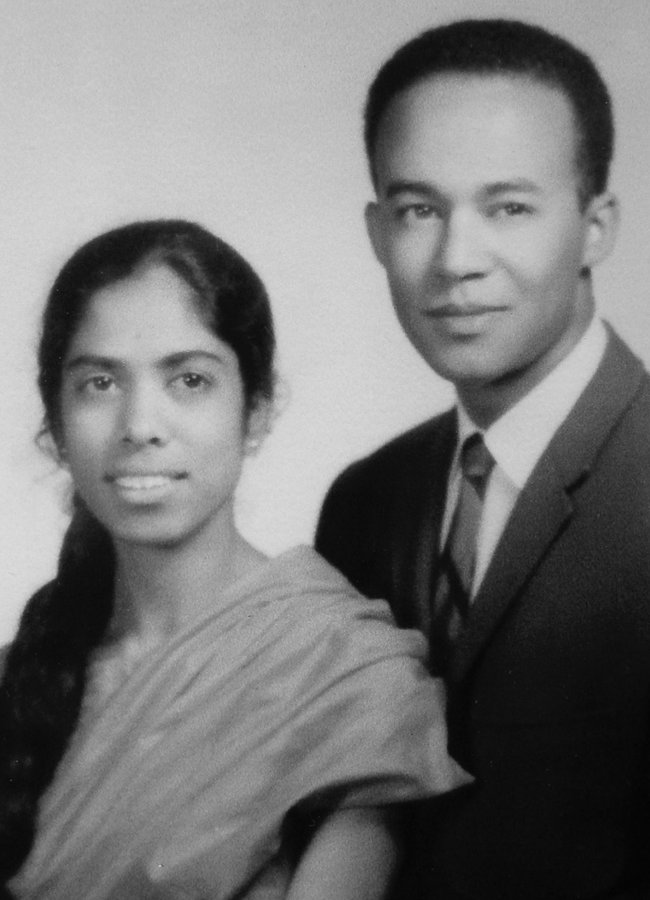
Harris’s mother, Shyamala Gopalan, the Brahman daughter of a diplomat from Chennai, graduated from the University of Delhi at nineteen, and, avoiding an arranged marriage, went to Berkeley to study nutrition and endocrinology. There, she met another graduate student, Donald Harris, from Jamaica, who was pursuing a Ph.D. in economics. The student civil-rights movement, centered on the Berkeley campus, gave the two young immigrants a shared context. “They both identified as people of color and people who were oppressed by a white-male-dominated world,” Meena Harris, Kamala’s niece, told me. “Their fields were science and economics—there were not many Indian women or black men.” They were married while still in graduate school, and Kamala was born in 1964; another daughter, Maya, came two years after that.
A wonderful immigrant story.  Only in America can a brown-skinned woman come to study advanced science, marry another brown-skinned immigrant doing advanced studies in economics, and have a daughter who grows up to be the attorney general of the biggest state, and then its senator, and now a VP candidate.  This itself gives me so much hope for the country that I adopted as mine.

It is awesome that she embraced the Black identity of hers right from when she was young, which is why she chose to study at Howard.
In her late teens, Harris fell in with a group of friends who were bound for historically black colleges. “We all went to private school, we all were educated, we all were very much parented, but we knew kids that weren’t,” Derreck Johnson, a restaurateur in Oakland, told me. He attended the same Catholic school as Maya, before going to Fisk University, and remains close to the family. “The idea of the struggle was embedded in us from our mothers, who told their stories,” he said. Kamala went to Howard and returned to San Francisco for law school. By then, Maya, who had given birth to Meena at seventeen, was in college, so Kamala and her mother often took Meena for overnights and weekends. The matriarchy was intact.
Kamala is not a Tamil word though.  As is the case with most Brahmin names, it is from the Sanskrit, and it means lotus.

This lively, warm, and absolutely human video of Kamala Harris and Mindy Kaling (also with Tamil roots) will remind you of the kind of empathetic and joyful leadership that we used to take for granted.  It is time to make America great again ... and this time with dosai ;)