Showing posts with label wisdom. Show all posts

Tuesday, June 13, 2017

Do unto others ...

Over the years, I have read plenty of trashy, potboiler, fiction.  I have also read a number of serious works of literature. The past few summers even included syllabi that I carefully constructed (FYI: The 2016, and 2015 lists)

Over the years, the potboiler fiction and cheap movies have pretty much disappeared from my radar.  As I have often remarked in this blog, reading great works of literature, and watching movies that are about the human condition, help me with trying to understand the "other," which is pretty much everybody other than me.  In the process, I begin to understand myself too.

I have also blogged often that my intuitive, personal-observation-based, view is that despite the fact that we are more educated than ever before, we are reading less of literature. I routinely poll  students in my classes about a few classics that I expect to appeal to young readers in particular (like Fahrenheit 451) and the response is always discouraging.  For that matter, even my faculty colleagues seem to be unfamiliar and uninterested in some of the great works.  Yet,  these very faculty can be all high and mighty defending the value of the humanities.  WTF, right?
Many humanists have difficulty in presenting their case because they are used to speaking one way among themselves and another way to outsiders. To the public at large, they still make statements about the value of great books, of the noblest things said by the most brilliant minds and of the need to know the Western heritage. Among themselves, such talk is, at best, hopelessly dated. Perhaps one reason literary scholars make an unconvincing case to outsiders is that they do not believe it themselves.
Students often come to college without having any grasp of what reading great works entails. Their AP and other exams test knowledge of facts about literature, not actually understanding it. Classes teach them to hunt for symbols, to judge writers according to current values, or to treat masterpieces as mere documents of their times. The first method makes reading into a form of puzzle solving, the second allows us to compliment ourselves on our advanced views, and the third misses the point that great literature speaks outside the context of its origin. Tolstoy is not great because he tells us about czarist Russia or the Napoleonic wars.
How unfortunate!
Here’s an alternative approach: Why not approach great literature as a source of wisdom that cannot be obtained, or obtained so well, elsewhere?
Exactly!  This is exactly what I have been talking about, and practicing, for years now.
And great writers present ethical questions with a richness and depth that make other treatments look schematic and simplistic.Moreover, great literature, experienced and taught the right way, involves practice in empathy. When we read a great novel, we identify with the heroine. We put ourselves in her place, feel her difficulties from within, regret her bad choices. Momentarily, they become our bad choices. Even when we do not like her, we may wince, suffer, put the book down for a while. The process of identification, feeling and examination of feeling may happen not just once but, in the course of a long novel, thousands of times. No set of doctrines is as important for ethical behavior as this constant practice in ethical thought or that direct sensation, felt over and over again, of being in the other person’s place.
The most important lesson novels teach is not a fact or a message but the skill of empathy and of seeing the world from other points of view. Practiced often enough, that skill can become a habit.
Seriously, isn't it tragic that these are not self-evident, and that the president of Northwestern University and his faculty colleague there have to write a commentary to remind higher education professionals about these?

Empathy does not come easily to us.  We need to learn about it, and experience it over and over.  We learn and experience empathy through the profound works of literature.  I still remember feeling devastated after reading A farewell to arms.  As I noted in a post:
Felt so empty inside when it ended that I had to wait out a couple of days before blogging this.
Hemingway simply sucked everything out of me with the anti-war story where the American protagonist signs up to serve in the medical corps of the Italian army in order to fight the good war, ends up deserting that only to have the military come after him because of his AWOL status as an officer, flees to neutral Switzerland with his British "wife" who is pregnant ... and then Hemingway lets the wife die after a difficult birth of a stillborn child. That is simply too cruel!
Empathy, dear reader, for this fictional character leads to empathy for the real ones in the real world.
What could be more important, for ethical and social understanding, than the ability to grasp what it is like to be someone from a different culture, period, social class, gender, religion or personality type? And one learns why even those broad categories won’t do, because one senses what it is like to be a particular other person. And that, too, is an important lesson: no one experiences the world in quite the same way as anyone else.
If we could more easily put ourselves in the position of others and put on a set of glasses to see the world in their way, we might very well, when those glasses are off, still not share their beliefs. But we will at least understand people better, negotiate with them more effectively, or guess what measures are likely to work. Just as important, we will have enlarged our sense of what it is to be human. No longer imprisoned in our own culture and moment, or mistaking our local and current values for only possible ones, we will recognize our beliefs as one of many possibilities -- not as something inevitable, but as a choice.

Indeed.


Saturday, June 10, 2017

Smart fools and confident idiots

Way back in November 2014, well before trump even announced his candidacy, I blogged about a Cornell professor's research on "confident idiots":
What’s curious is that, in many cases, incompetence does not leave people disoriented, perplexed, or cautious. Instead, the incompetent are often blessed with an inappropriate confidence, buoyed by something that feels to them like knowledge.
As much as this alone goes a long way towards explaining trump and his enablers, in the big picture and in specifics like coal, this post is not about those assholes.

We are quite a few people, other than those assholes, who should be able to do something, right?  Furthermore, with a claim to the intellectual and cultural high ground--which is why trump constantly snarls at us "elites"--we should be able to do better, right?

Not only do we lack the ability, we are further contributing to the education of young people who will lack the ability to make the world a better place:
Our overemphasis on narrow academic skills—the kinds that get you high grades in school—can be a bad thing for several reasons. You end up with people who are good at taking tests and fiddling with phones and computers, and those are good skills but they are not tantamount to the skills we need to make the world a better place.
My high scores and ability to do math and science did not impress me one bit.  I was not sure how I could make the world a better place through that route.  I quit engineering--mentally even during my final year of high school itself, and for good when I came to the US for graduate studies--with a hope that I would get on to the path that would help me become a better person and also help the world a tiiiiiiiiny bit better.

A few terms ago, a student--Bill--remarked something similar when he argued that, for instance, scientists and technologists working in various government and university research that was aimed at destruction to life and property are not engaged in any value-neutral effort.  His hypothesis was that maybe these experts were not asking themselves whether they were using their smarts to make the world a better place.  "I wonder if they take courses in the humanities" he asked.

The older I get, the more I am discouraged by expertise that is devoid of an understanding of humanity.  I care less and less about the SAT and GRE scores and fancy degrees, if the person cannot seem to understand and empathize with the human condition.
What I argue is that intelligence that’s not modulated and moderated by creativity, common sense and wisdom is not such a positive thing to have. What it leads to is people who are very good at advancing themselves, often at other people’s expense. We may not just be selecting the wrong people, we may be developing an incomplete set of skills—and we need to look at things that will make the world a better place.
I am not sure about the "other people’s expense"; otherwise, I am in agreement there.
You know, it’s easy to think of smart people but it’s really hard to think of wise people. I think a reason is that we don’t try to develop wisdom in our schools. And we don’t test for it, so there’s no incentive for schools to pay attention.
And we now have a president who is the antithesis of wisdom!
Not only do we not encourage creativity, common sense and wisdom, I think a lot of us don’t even value them anymore.
Therein lies the problem--a lot of us don't even care about these anymore.  We have met the enemy and ... it is us :(


Tuesday, January 17, 2017

Nero to succeed Marcus Aurelius!

I know I have been harsh on Barack Obama the President.  As President, Obama always came across to me as a souped up combination of Jimmy Carter and George H.W. Bush.  He seemed to lack the inner drive to go out there and strike deals.  Sometimes,  I even think that this personality trait of his has also contributed to Democrats getting cleaned out not only from the White House and Congress, but--and more importantly--at the state level in the legislatures and governors offices all over the country.

As a person, Obama has been a model human being at the White House.  Like how Carter was, and continues to be after his presidency.  Kids all over the world can--and should--look up to the likes of Obama and Carter and tell themselves, "I want to grow up to be like them."

I am equally proud of the remarkable level of intelligence that Obama has always demonstrated.  An intelligence that is not abrasive nor audacious, but humble.  Kids all over the world can--and should--look up to him and tell themselves, "I want to grow up to be smart like him."

A reader, as much as he is a writer and an orator:
During his eight years in the White House — in a noisy era of information overload, extreme partisanship and knee-jerk reactions — books were a sustaining source of ideas and inspiration, and gave him a renewed appreciation for the complexities and ambiguities of the human condition.
Yes, the complexities and ambiguities of the human condition.

What a contrast to the incoming president who has not for a nanosecond demonstrated anything about "the complexities and ambiguities"; in fact, he has taken to a whole new level the previous Republican president who made it clear that he did not do nuances and that he viewed the world as us-versus-them.

For Obama:
reading gave him the ability to occasionally “slow down and get perspective” and “the ability to get in somebody else’s shoes.”
To get into somebody else's shoes is what empathy is all about.

Not even the incoming president's fanatical bootlickers will think of their Dear Leader as capable of empathy!

Obama reads widely, including fiction:
He points out, for instance, that the fiction of Junot Díaz and Jhumpa Lahiri speaks “to a very particular contemporary immigration experience,” but at the same time tell stories about “longing for this better place but also feeling displaced” — a theme central to much of American literature, and not unlike books by Philip Roth and Saul Bellow that are “steeped with this sense of being an outsider, longing to get in, not sure what you’re giving up.”
In contrast, can you imagine the demagogue having anything substantive to say about Diaz or Lahiri?!  As one reader phrased it in his comments to the NY Times piece:
Like Blunder Woman Sarah Palin, Trumpty Drumpty always struggles to name a single book he's ever read.
Oh, I owe to another commenter at the NY Times the title for this post.

Friday, February 07, 2014

The wisdom of working out--the body and the senses

It has now been two days of snow falling steadily.  So unusual that this robin did not care about me, and was more worried about the snow and the cold.

you see the bird?
I have not stirred out of the neighborhood since I reached home almost forty-eight hours ago. Fearing such a house-arrest, I made sure I picked up the absolutely needed grocery items back on Wednesday.  You don't have to be an eager-beaver Boy Scout to be prepared!  Thanks to that, I can sit out another two days or more. Heck, I have enough coffee to last me a week. And then there is tea--genuine Darjeeling tea, thanks to Ramesh. So, the weather gods can keep sending snow this way, but I will outlast this modern day Vienna siege! ;)

But, I do miss walking around.

Walking for three miles. Or four. Or five.

And hiking.

If only I had the winter gear to venture out in the snow!

In the latest issue of National Geographic, Garrison Keillor remarks that "Winter is miserable only for people who don’t know what to wear."  Aha!  I will be prepared then before the next winter arrives.

I suppose the body is used to the endorphins that walking and hiking generate. It is an endorphin withdrawal that I am suffering from, to some extent. It is not that I am a fitness maniac either. I fully understand that physical health is merely one component of an existence in which the happiness endorphins come from different places.  Furthermore, there is this wisdom from the old country:
शरीर पोषणार्थि सन् यु आत्मानं दिदृक्षति ।
ग्राहं दारुधिया धृत्वा नदीं तुर्तुं स गच्छति ॥
-विवेकचूडामणि

Some people are interested in nurturing their body well assuming that it make their soul also happy.
Such people are kidding themselves; trying to cross a river on a crocodile taking that to be a log.
- Vivekachudamani
This atheist does not care about the soul, but does understand that there is immensely more to life than a fixation on the physical appearance and health.

Stuck at home, am eating more than I probably should.  If this is my behavior when seven inches of snow fall over two days, I should be thankful then that I don't live where it is feet of snow over the winter months!

Eat I did, like this one:

Melted cheese with chives, and salsa .. the halves combine to make me one with everything ;)

Of course, I don't live to eat, but eat to live. Eat healthily and colorfully to live ;)

I know enough not to fall victim to eating.  Again, from the old country:
शब्दादिभिः पंचभिरेव पंचपंचत्वमापुः स्वगुणेन बद्धाः ।
कुरंग मातंग पतंग मीन भृंगा नरः पंचभिरंचितः किम् ॥
- विवेकचूडामणि

The five senses are sound, touch, sight, taste and smell. Animals that are slaves of any one of them often pay the price by their life. A deer follows the sound (of its calf) and becomes a prey. An elephant is enslaved by its vulnerability of touch behind the head. A moth is driven to the flame by its sight. A fish is baited by its longing for taste. A bee loses its life when it gets trapped in the lotus which attracted it by smell. What can now be told of a man who is driven by all the five senses?
- Vivekachudamani
The sound of silence of the falling snow is a wonderful background to think about life, even through such everyday activities.

Thinking is one awesome workout.

The best.

My favorite!

Tuesday, July 09, 2013

How many books should one read to gain wisdom?

Of a couple of faculty colleagues with whom I was friends, at least for a while, one, who retired a few years ago, loved engaging me in arguments and debates, especially when we were in agreement, which was almost all the time.

Once, when we were discussing and walking, she asked me, for the gazillionth time, how old I was.  And she  stopped walking when I told her. (Stalker ladies, I ain't telling you how old I am!)  And then, she gave me what I thought was one of the best compliments that I have ever received--she thought I was way wise for my age.

We often construct images of people we interact with, based on whatever little we know.  She, too, had thus estimated my age at a good decade-plus more than what I was based on what she knew about me and my way of thinking.

In developing such an image, she had also imagined that I read a great number of books, all the time.  I corrected that, too.  The reality is that I rarely ever read full-length books anymore.

She was initially convinced that I was playing the fool. Why play one when I am one, right?

The scientist that she was, she then quizzed me a lot over the next few conversations and finally convinced herself that I really don't read a great deal of books.

I then let her in on what I thought was an open secret: that most modern books in the humanities and the social sciences aren't entirely new thoughts developed by the authors.  Instead, the gist of their arguments in the full-length books can often be found in much shorter, and easier to read, essays they would have authored in publications--academic or general.  That condensed form works very well for me.

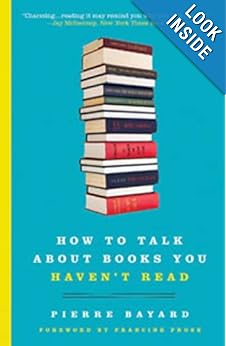
As a follow-up, when it was her birthday time, I gifted her this book:


I hadn't read that book either, which amused her to to a great deal!

But, her prodding made me inquire about my own approach to understanding the world.

The only satisfying explanation is this: the constant reading of articles and news reports is reinforced by that old Hindu philosophical approach that understanding the world is a lot more intuitive than analytical.

Recently, when another friend asked me whether I had read a certain book--fiction, in this case--I told her that I find contemporary full-length fiction to be unappealing.  When I am in the mood for it, I go back to the classics.  I re-read any one of the books I have read in the past.  When I read Fathers and Sons a second time after nearly twenty-five years, the insights I gained from it were phenomenal.  Or, the time I re-read Catch 22 or Fahrenheit 451.

Which is why when I came across the following Vladimir Nabokov quote, I immediately resonated with it:
Curiously enough, one cannot read a book: one can only reread it. A good reader, a major reader, an active and creative reader is a rereader. And I shall tell you why. When we read a book for the first time the very process of laboriously moving our eyes from left to right, line after line, page after page, this complicated physical work upon the book, the very process of learning in terms of space and time what the book is about, this stands between us and artistic appreciation. When we look at a painting we do not have to move our eyes in a special way even if, as in a book, the picture contains elements of depth and development. The element of time does not really enter in a first contact with a painting. In reading a book, we must have time to acquaint ourselves with it. We have no physical organ (as we have the eye in regard to a painting) that takes in the whole picture and then can enjoy its details. But at a second, or third, or fourth reading we do, in a sense, behave towards a book as we do towards a painting. However, let us not confuse the physical eye, that monstrous masterpiece of evolution, with the mind, an even more monstrous achievement. A book, no matter what it is—a work of fiction or a work of science (the boundary line between the two is not as clear as is generally believed)—a book of fiction appeals first of all to the mind. The mind, the brain, the top of the tingling spine, is, or should be, the only instrument used upon a book.
But then, how do we know we have read enough books and that our time might be better spent re-reading them?  That answer is intuitive, my dear reader ;)

Keep in mind that "knowledge comes, but wisdom lingers."  I am furiously at work to get past the "wise guy" wisecrack to a real one, though, I am increasingly convinced that even now I could easily open up an ashram here and babble a few things and earn a lot more money.  As I recently joked with a friend, the answers to all questions are right at my blog already ;)

After I re-read the sentences up until here, (see, I already put Nabokov to use!) I wonder what the point is!

Will end it with this:
We are not provided with wisdom, we must discover it for ourselves, after a journey through the wilderness which no one else can take for us, and effort which no one can spare us.- Marcel Proust 

Monday, June 06, 2011

No money, no respect? Even from family?

The verse I have borrowed from this blog reminds us that things now are not all that different from a long time ago.  Am not sure whether this is a good thing or otherwise!
यावद्वित्तोपार्जनसक्तः
    तावन्निजपरिवारो रक्तः ।
पश्चाज्जर्जरभूते देहे
    वार्तां कोऽपि न पृच्छति गेहे ॥
- भजगोविन्द स्तोत्र

As long as you are earning money,
your family loves you.
When you stop earning and the body becomes weak,
no one in the house want to hear about you.
- Bhajagovinda Stotra
As a kid growing up in a fairly traditional/religious family, I recall memorizing the "Bhajagovindam" verses that were rendered as music by the late MS Subbulakshmi.  But, I don't recall reading along with a translation of what those Sanskrit words meant.  So, it was more a rote memorization of 1,200 year old verses by Adi Shankara!

There was a great uncle, "RM"--a mixed-bag like all of us--who was at ease in quoting many of these ancient words of wisdom.  Well, he could quote and recite--from an understanding, not mere memorization--verses from Sanskrit, Tamil, and English.  Dad too does that to quite an extent.  I suppose there has been quite a generational shift since then.  Yet again, I am reminded of Tennyson's "knowledge comes, wisdom lingers."