Showing posts with label malthus. Show all posts

Wednesday, September 07, 2016

Racing to a ten

Major Buzzkill tries to do optimism.  But, it is hard.  Deep down, there are worries all the time.  He blames it all on his very optimistic and cheerful grandmother whose night time prayer included a subliminal worry that she might not wake up from her sleep! ;)

Over the years, the Major has made fun of Malthus and the neo-Malthusians.  He has happily pointed out to students that the world human population was less than a billion when Malthus thought we were all going to die soon, while the reality of today is that 7.4 billion people have too much food and obesity is our big worry!  It is all a part of the 200-year transformation, the Major proudly enlightens them.

But, Major Buzzkill, who loves telling students "you're screwed!" does not tell students is that deep, deep, deep down there is always a worry about the future population numbers.

This worry deepens every time he visits India.  Except between late night and early in the morning, it is crowded everywhere, and seems to get more crowded every year.  In contrast, the Major is getting more and more used to the plenty of open space under the big sky here.  It is a struggle within to reconcile the intellectual understanding of population growth and resources with his own personal preferences?

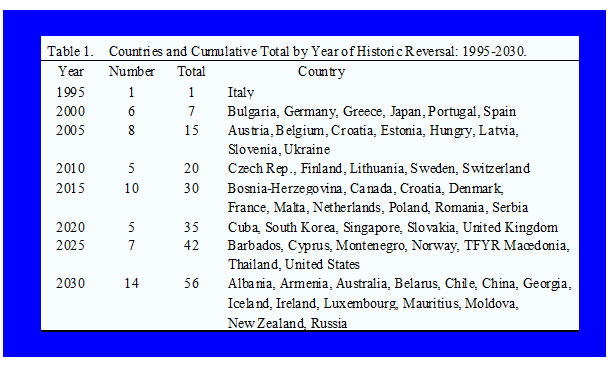
The intellectual Major Buzzkill gleefully points out the historic reversal that is unfolding across the world--the elderly in the country outnumbering the kids there.  As the following chart shows, Italy led the way in 1995,, and now it is a growing list:
Source

Imagine that: 56 countries having more older folks than kids!

The trend into the future tells quite a story:
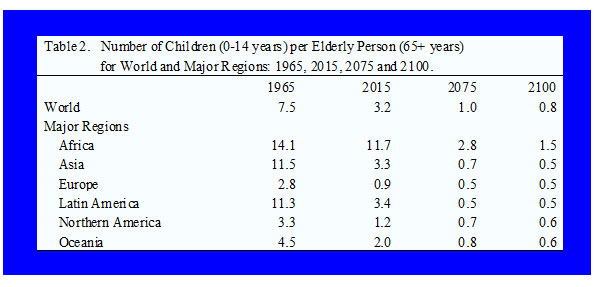

Looks incredible, right?  It is almost as if this is from Ripley's Believe it or not.  The future will be the tyranny of the old.  Instead of the parents changing the kids' diapers, it will be middle-aged women (almost always they are the caregivers) or perhaps robots changing the diapers of the elderly.  What a transformation through the 19th, 20th, and 21st centuries!

Major Buzzkill is no Malthusian.  But, deep, deep, deep down he worries that a few countries, like his old country, might struggle to keep up with the total population and the elderly population.

Source

Adding the population of the US to India in another three decades.  Despite his best plans, largely because of his dull and boring highly regimented lifestyle, this might happen within Major Buzzkill's lifetime and he will get to witness it.  I wonder what Major Buzzkill will have to say about this in 2040, if not in 2050.

Wednesday, November 02, 2011

Thank heavens it is not seven billion Kim Kardashians!


BTW, all the other cartoons I came across--on this topic of the world population at seven billion--were  Maulthusian.  Pretty much variations of the theme of imbalance between the demand (from the seven billion) and food, or resource, availability.  Like the one below:


Is it because a Malthusian framework appeals to us a lot more than otherwise?  Are humans somehow wired to be pessimistic that way?  Is it because since the proto-human times we have been worried about our individual and collective abilities to survive?

It is an unfortunate irony that not a single cartoon pointed out that if we should be worried about the resource issue, it is not the actual number of people that drives consumption.  Consumption--and overconsumption--comes from affluence.  If only a cartoonist had transformed into an image the following words:

the populations that are rising fastest contribute very little to climate change. The poorest half of the world produces 7% of carbon emissions. The richest 7% produces half the carbon.

Monday, February 28, 2011

Nine billion by 2050: Can we feed 'em all?

That is the focus of the special report that the Economist has.  But, first, I need to highlight the dry humor that I have come to expect in any report from this newspaper:
For years some of the most popular television programmes in English-speaking countries have been cooking shows. That may point to a healthy interest in food, but then again it may not. The historian Livy thought the Roman empire started to decay when cooks acquired celebrity status.
Well, but on to serious discussions then ...

It is one tough question.  Even this ill-informed blogger has often commented about the world's rather lackadaisical approach to the food issue, and the recent spikes in food prices.  But then when even my students don't listen to what I have to say, why should the world!
the fact that agriculture has experienced two big price spikes in under four years suggests that something serious is rattling the world’s food chain. ...
An era of cheap food has come to an end. A combination of factors—rising demand in India and China, a dietary shift away from cereals towards meat and vegetables, the increasing use of maize as a fuel, and developments outside agriculture, such as the fall in the dollar—have brought to a close a period starting in the early 1970s in which the real price of staple crops (rice, wheat and maize) fell year after year.
There are a couple of things happening: First, in the developed world, the fluctuations in raw grain prices do not affect us that much because the prices we pay for food are dependent more on costs of preparation, packaging, etc.  But, in a poor country, the population depends on that raw staple, which they meticulously cook and consume.  They feel the price hikes, and find it awfully difficult.  And we have the arrogance to blame them for wanting more food!

Second, we have come to believe that India and China and many other countries have become our competitors and, therefore, we have started discounting the magnitude of global poverty.  The reality is far from the truth.

So, where do we go from here?
it is not surprising that the food crisis has produced contradictory accounts of the main problem and radically different proposals for solving it. One group is concerned mainly about feeding the world’s growing population. It argues that high and volatile prices will make the job harder and that more needs to be done to boost supplies through the spread of modern farming, plant research and food processing in poor countries. For those in this group—food companies, plant breeders and international development agencies—the Green Revolution was a stunning success and needs to be followed by a second one now.
The alternative view is sceptical of, or even downright hostile to, the modern food business. This group, influential among non-governmental organisations and some consumers, concentrates more on the food problems of richer countries, such as concerns about animal welfare and obesity. It argues that modern agriculture produces food that is tasteless, nutritionally inadequate and environmentally disastrous. It thinks the Green Revolution has been a failure, or at least that it has done more environmental damage and brought fewer benefits than anyone expected.
So, what is the bottom line?
although the concerns of the critics of modern agriculture may be understandable, the reaction against intensive farming is a luxury of the rich. Traditional and organic farming could feed Europeans and Americans well. It cannot feed the world.
I have been preaching this same bottom line for years in my classes.  But then, to some extent, it is not kosher to make such statements anymore given the irrational penchant for locavore and organic eating, which, we forget, is a luxury that only the rich countries can afford.  It is like how one student a few years ago remarked in a class about the simple pleasures of boating--she loves to take her paddle boat to the river and spend hours floating by.  But, to the youth of her age in a poor country, that boating--on a rudimentary catamaran, for instance--will be the daily chore, for hours on, in a fishermen community that barely subsists.

I leave it to the Economist for the last words ...
There are plenty of reasons to worry about food: uncertain politics, volatile prices, hunger amid plenty. Yet when all is said and done, the world is at the start of a new agricultural revolution that could, for the first time ever, feed all mankind adequately. The genomes of most major crops have been sequenced and the benefits of that are starting to appear. Countries from Brazil to Vietnam have shown that, given the right technology, sensible policies and a bit of luck, they can transform themselves from basket cases to bread baskets. That, surely, is cause for optimism.
Here is to hoping that we, across the planet, will start doing the right things.

Sunday, March 14, 2010

Dickens' Scrooge was a caricature of Malthus. Awesome!

[It] is the height of arrogance for us in the rich world to downplay the importance of our own environmental footprint because future generations of poor people might one day have the temerity to get as rich and destructive as us. How dare we?
I could not have phrased this any better!  I am concerned--worried is more appropriate--about climate change, yes.  But, this whole idea of pointing the fingers at the rapidly growing poorer economies, while we in the rich countries continue to binge is simply not ok and, in fact, comes across as a twisted approach to keeping the poor, well, poor!!!

Anyway, that quote is from Fred Pearce's essay, (ht) where he adds:
Some green activists need to take a long hard look at themselves. We all like to think of ourselves as progressives. But Robert Malthus, the man who first warned 200 years ago that population growth would produce demographic armageddon, was in his time a favourite of capitalist mill owners. He opposed Victorian charities because he said they were only making matters worse for the poor, encouraging them to breed. He said the workhouses were too lenient. Progressives of the day hated him. Charles Dickens attacked him in several books: when Oliver Twist asked for more gruel in the workhouse, for instance, that was a satire on a newly introduced get-tough law on workhouses, known popularly as Malthus’s Law. In Hard Times, the headmaster obsessed with facts, Thomas Gradgrind, had a son called Malthus. In A Christmas Carol, Ebenezer Scrooge was also widely seen at the time as a caricature of Malthus.
Malthus, it should be remembered, spent many years teaching British colonial administrators before they went out to run the empire. They adopted his ideas that famine and disease were the result of overbreeding, so the victims should be allowed to die. It was Malthusian thinking that led to the huge and unnecessary death toll in the Irish potato famine.
We must not follow the lure of Malthus, and blame the world’s poor for the environmental damaged caused overwhelmingly by us: the rich. The truth is that the population bomb is being defused round the world. But the consumption bomb is still primed and ever more dangerous.

Monday, July 06, 2009

Will we be able to feed 9.5 billion people?

The Aspen Ideas Festival is over. You nor I went to that one means that apparently we did not have ideas that anybody wanted to listen to, or we did not have the money to listen to those with ideas! Oh well ....

James Fallows was one of those that the attendees wanted to listen to, and has blogged about a session he moderated; it was on "Feeding the World's Billions." Fallows writes:
Sample alarming fact: if the world population eventually tops out at 9.5 billion, 50% more than now, total food production will probably have to grow by 200%, as people eat higher up the food chain and demand more and more meat. The challenge, as several panelists put it, was to produce three times as much food on no more than the current amount of agricultural land. (About why it won't just work to cut down all remaining forests to grow food, see here.)

Sample specific solution-possibilities, or at least interesting facts: Average yields in U.S. farms are roughly three times as high as the overall average for Mexico, India, and Brazil. If those countries got to even two-thirds of the US level, it would make a huge difference in closing the "grain gap." Also: a huge share of the world's food output is wasted -- in the developing world because it rots and spoils before it can get to market, and in the US to a significant degree because of restaurant waste. Thus easy opportunities for gain.
I am sure the neo-Malthusians will be all over this one in no time at all ....