"Can you explain to me what's going on in Kashmir between India and China?"
I told him what I know.
I could have told him more.
Like the stories from more than three decades ago, of a Kashmiri Muslim sister and brother who, by coming to graduate school, were fleeing their native land.
Compared to the present, those were Kashmir's good days!
I am confident that those siblings have read Agha Shahid Ali's "Postcard from Kashmir." I can easily imagine that they relate to every word in it.
Postcard from Kashmir
By Agha Shahid Ali
Kashmir shrinks into my mailbox,
my home a neat four by six inches.
I always loved neatness. Now I hold
the half-inch Himalayas in my hand.
This is home. And this the closest
I'll ever be to home. When I return,
the colors won't be so brilliant,
the Jhelum's waters so clean,
so ultramarine. My love
so overexposed.
And my memory will be a little
out of focus, it in
a giant negative, black
and white, still undeveloped.
Showing posts with label kashmir. Show all posts
Showing posts with label kashmir. Show all posts
Tuesday, July 07, 2020

Thursday, October 31, 2019
The end of Jammu and Kashmir
Jammu and Kashmir ceases to be state in India. The mOdi government's fiat takes effect.
Three months in and conditions are not looking better. Especially for kids:
What is the rest of the world doing?
Nothing.
Back in Kashmir:

India on Thursday formally implemented legislation approved by Parliament in early August that removes Indian-controlled Kashmir’s semi-autonomous status and begins direct federal rule of the disputed area amid a harsh security lockdown and widespread public disenchantment.As my old country newspaper put it, "The bifurcation of Jammu & Kashmir into two Union Territories came into effect at midnight on October 30."
The legislation divides the former state of Jammu-Kashmir into two federally governed territories.
Three months in and conditions are not looking better. Especially for kids:
At least 1.5 million Kashmiri students remain out of school. Virtually all private schools are closed, and most government schools are shut — one of the clearest signs of the fear that has gripped Kashmir since the Indian government locked down the disputed territory and separatist militants began carrying out attacks to disrupt its control.How terrible!
This generation of Kashmiri children has been among the hardest hit. They have known nothing but conflict. For the past 10 years, huge protests and clashes keep erupting. Many young people have seen friends killed, maimed or hauled off by security forces. Their schools are constantly closing, sometimes for months at a time.What did the kids do to deserve this, right?
What is the rest of the world doing?
Nothing.
The world’s apathy — and the apathy of many Indians — is only perpetuating a climate of fear, silence and repression the region hasn’t witnessed in decades.And that merely emboldens the fanatical Hindu nationalists.
More of us need to speak up. The world must hear the deafening silence from Kashmir. Looking the other way for strategic relations is not an option. Kashmir and her children are waiting for justice.But, what can one do? My government is far more interested in a mafia hit on Ukraine in order to get anything on a political opponent. And, it was the President who lit the proverbial match with his irresponsible remark (not that he ever makes any responsible remark!)
Back in Kashmir:
The children, meanwhile, are desperate to get out of the house and go back to school. They want to see their friends. They want to learn new things. They know their futures depend on it.This is a fucked up world!
“You should either burn my books and my uniform or send me to school,” Reyan, the fourth grader, grumbled to his father on a recent day as they sat in their house in Baramulla, a town in northern Kashmir.
His father, Pervaiz Ahmad Sofi, a forestry professor, threw open a window and pointed toward a group of soldiers in riot gear, stationed just outside their house, guarding a highway.
“Now tell me, do you still want to go to school?” he said. Reyan looked down and walked away, back to the TV.
Friday, August 09, 2019
A Himalayan Blunder!
It is not that I have forgotten Kashmir after blogging this post. Not.At.All. It continues to preoccupy me so much that I have two different threads going on Twitter. (One and two.)
Ten years ago--yep, in 2009--I quoted from an article:
Here we are in 2019. In the ten years since, mOdi not only became India's Prime Minister, but also recently won a landslide majority and secured a second term, which gave him enough political capital to revoke Kashmir's special status in the federal structure.
Soon after mOdi became the Prime Minister, when the nationalists decided to spend a fortune on a colossal statue, I wrapped up that post with:
I wrote in a work email to a colleague who wondered if a lack of response from me was because I was in India: "I am very much here in the US, and following with a heavy heart the unfolding of events in Kashmir, and the tragic mass shootings."
It is like the line from Brokeback Mountain: "I wish I knew how to quit you."
I am not at all surprised that most of India's Hindus support this mOdi move to annex Jammu and Kashmir in one sweep. Most of the extended family, the old school mates, and even the "worldly" former commenter at this blog, are mOdi supporters, like how many among my neighbors are tRump voters. It is strange that I find myself in such company!
Pankaj Mishra, who wrote extensively about India's militarization of Kashmir in his younger years, connects the political dots between Brexit and this Kashmir situation (and tRump too.) Drunk on power, they blithely smash up fragile constitutional arrangements, Mishra writes.
I wish I were still in touch with an old graduate school acquaintance, who was from Kashmir. "G.P.". Unless I want to forget, I suppose I never forget people and their names. She was a couple of years ahead of me in the doctoral program. Her brother then came to the US for his graduate schooling in engineering. Even then--three decades ago--they talked about how they could not live and prosper in Kashmir and slowly the extended family was emigrating away from Kashmir. Perhaps they also often utter the same line: "I wish I knew how to quit you."
Ten years ago--yep, in 2009--I quoted from an article:
the use of religion for political ends has substantially increased during the last few decades. Such a development has serious implications for a secular state and society. Retrieving the secular character of the public sphere is therefore imperative; otherwise its religious character is likely to impinge upon the functions of the state.To which I added this as an example of how this affects the functions of the state: "The rabidly open anti-Muslim rhetoric of the chief minister of Gujarat, Narendra Modi, who oversaw the worst communal violence."
Here we are in 2019. In the ten years since, mOdi not only became India's Prime Minister, but also recently won a landslide majority and secured a second term, which gave him enough political capital to revoke Kashmir's special status in the federal structure.
Soon after mOdi became the Prime Minister, when the nationalists decided to spend a fortune on a colossal statue, I wrapped up that post with:
Maybe I should simply give up on my old country and avoid the heartaches altogether. Oh well, easier said than done!It is easier said than done!
I wrote in a work email to a colleague who wondered if a lack of response from me was because I was in India: "I am very much here in the US, and following with a heavy heart the unfolding of events in Kashmir, and the tragic mass shootings."
It is like the line from Brokeback Mountain: "I wish I knew how to quit you."
I am not at all surprised that most of India's Hindus support this mOdi move to annex Jammu and Kashmir in one sweep. Most of the extended family, the old school mates, and even the "worldly" former commenter at this blog, are mOdi supporters, like how many among my neighbors are tRump voters. It is strange that I find myself in such company!
Pankaj Mishra, who wrote extensively about India's militarization of Kashmir in his younger years, connects the political dots between Brexit and this Kashmir situation (and tRump too.) Drunk on power, they blithely smash up fragile constitutional arrangements, Mishra writes.
I wish I were still in touch with an old graduate school acquaintance, who was from Kashmir. "G.P.". Unless I want to forget, I suppose I never forget people and their names. She was a couple of years ahead of me in the doctoral program. Her brother then came to the US for his graduate schooling in engineering. Even then--three decades ago--they talked about how they could not live and prosper in Kashmir and slowly the extended family was emigrating away from Kashmir. Perhaps they also often utter the same line: "I wish I knew how to quit you."
Monday, August 05, 2019
The blowing up of Kashmir
I am no Indologist. Am not an international relations expert. I am not located in India. Heck, I am not even an Indian!
Yet, sitting at home only a few hundred meters from the Willamette River, I knew immediately that tRump had committed a huge geopolitical blunder when he volunteered to mediate in the India-Pakistan conflict during a press conference with the visiting Pakistani Prime Minister, Imran Khan.
After tweeting about, I followed up with this:
After a relaxing summer weekend, earlier in the morning, I read this:
With a caveat that I am no expert, I worry about the following two possibilities:
Peace is doomed in the Subcontinent!
Yet, sitting at home only a few hundred meters from the Willamette River, I knew immediately that tRump had committed a huge geopolitical blunder when he volunteered to mediate in the India-Pakistan conflict during a press conference with the visiting Pakistani Prime Minister, Imran Khan.
After tweeting about, I followed up with this:
That was two weeks ao.So ... why would #tRump commit such an enforced error, with enormous geopolitical implications between #India and #Pakistan over #Kashmir?— Am.Dr.Khe (@congoboy) July 23, 2019
Here's why:@EdwardGLuce: https://t.co/SCKDRZvHdW
After a relaxing summer weekend, earlier in the morning, I read this:
The Indian government said on Monday that it was revoking a constitutional provision that had for decades given a unique degree of autonomy to Kashmir, a disputed mountainous region along the India-Pakistan border.The government that won re-election by a huge margin by playing up the Kashmir and Pakistan cards takes the Kashmir issue to a whole new level right in time for its independence day political theatre!
The India-Pakistan tensions over Kashmir date all the way back to their respective creations from the British Raj, back in 1947:
Kashmir agreed to become part of India only under certain conditions that guaranteed its autonomy, which were protected by Article 370. India and Pakistan then fought several wars over the area and today most of Kashmir is administered by India, with a smaller slice controlled by Pakistan, which like Kashmir is majority Muslim.Of course, the Pakistan government wasted no time in responding:
The Pakistani Foreign Ministry condemned the Indian announcement as a violation of United Nations resolutions, saying in a statement on Monday that “Pakistan will exercise all possible options to counter the illegal steps.”
Imran Khan started calling up his allies.
When speaking to Turkey's President Recep Tayyip Erdogan, Khan said that "India's illegal actions to modify the special status of the Indian Occupied Kashmir would have serious implications for the regional peace and security"tRrump couldn't care. He reaffirmed on August 2 that he was happy to intervene." Of course, he always doubles down!
The Pakistani military, the ultimate arbiter of the country's foreign policy (and its nuclear arsenal), didn't mince words: "Kashmir runs in blood of every Pakistani. Indigenous freedom struggle of Kashmiris shall succeed [God willing]," said Major General Asif Ghafoor, a military spokesman.
What next?
With a caveat that I am no expert, I worry about the following two possibilities:
- There will be tremendous pressure on Imran Khan to not merely fight back with words but also with weapons. This is an attempt by the mOdi government to lure Pakistan into lobbing the first bomb across the border, which will then give the justification for the Indian government to launch a full-fledged military attack.
- Either with the support of Pakistan's notorious ISI, or on their own, militants will strike in India, especially timing with the independence day political celebrations. These militant strikes will the justification for the mOdi government to clamp down on internal security--perhaps even an "emergency"--while launching a military assault on Pakistan.
Peace is doomed in the Subcontinent!
Saturday, July 16, 2016
This wasted land, Kashmir
For a while now, I have not blogged anything that is focused on India. Of course, I refer to my experiences in the old country because of the autoethnographic approach in my way of understanding the world. But, it has been a long, long, while since I commented on anything that is going on in India.
All because--and this will not agree well with Indians, and with Ramesh in particular--I have given up on India :(
Like how a family simply gives up after years of riding the roller coaster of emotions as the relative continues to go down a destructive path, I decided a few months ago that for my own sanity I needed to disengage from the internal happenings in the old country that is so dear to me.
Like how a family simply gives up after years of riding the roller coaster of emotions as the relative continues to go down a destructive path, I decided a few months ago that for my own sanity I needed to disengage from the internal happenings in the old country that is so dear to me.
But then, it is not as if we can completely shut ourselves off. We might get updates about the relative through the grapevine. An occasional sighting somewhere. Or the news of something that happened. It is an unfortunate development that compels me to blog about the old country. The news reports from Kashmir.
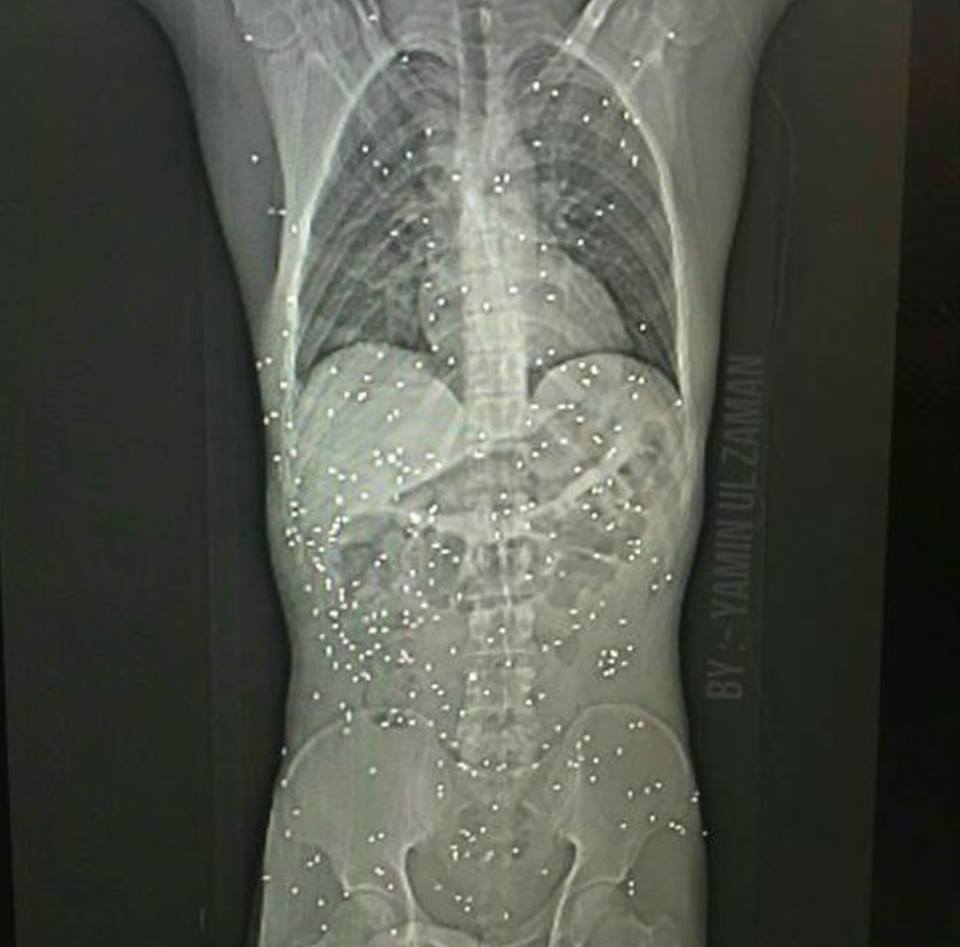
One image, among many, brought me to tears. Literally. I paused to clear my eyes before I continued to read on. It was this photograph:
 |
| Source |
That is an x-ray of a boy who was one of the many Kashmiris who were pummeled by India's military with pellet guns. The sparkling rhinestones in the x-ray are the tiny iron balls, the ball bearings, that got lodged in him. Count them!
The tiny iron balls have also blinded--yes, blinded--so many that eye surgeons have been rushed to Kashmir to treat them, most of whom will not get their eyesight back. (The number of reports of people--including kids pelleted--is why I am convinced that the x-ray image is real.) Those with the tiny iron balls in their eyes include this Kashmiri:
 |
| Source |
When a democratic government uses such cruel violence against its own people, pacifists like me lose all hope.
I found it particularly awful to look at the following photograph of India's military shooting at Kashmiris, after aiming at the target--humans:
 |
| Source |
It reminded me of a notably violent incident from the decades of the white supremacists' political control of the Subcontinent: The afternoon at Jallianwalla Bagh a hundred years ago, when civilians who had gathered at the park for a political rally were mercilessly gunned down, was one of the darkest of the darkest of the many dark moments of the British Raj,
The Indian government behaves as if it is a nineteenth century European colonizer, controlling the natives. The Indian government in New Delhi has merely replaced the Queen's Viceroy! If the natives rebel, they shall be put down with brute force.
If only a referendum had been held decades ago, soon after the departure of the white supremacists. Instead, we have witnessed India's occupation of Kashmir and the wars with Pakistan, we bear witness to the violence that continues on, and Kashmir is the most militarized region in the world.
The government violence in Kashmir, and the lone-wolf violence in Nice have crushed me inside. I will return to blogging after a couple of days.
Wednesday, September 02, 2015
When two elephants fight, it is the grass that suffers
It is that season again.
No, not autumn, but the crazy season when India and Pakistan violate their ceasefire agreement and use gunpowder to match the amped up rhetoric. Compared to these two siblings, even the two Koreas seem to be getting along much better!
Let us count the number of years since 1947 when they gained their independence from the white supremacist colonial masters: sixty-eight. A human born in 1947 will now be coasting along in retirement, while these two countries continue to behave worse than middle-school boys during recess!
The situation is so crazy that their mutual neighbor, China, is urging them to, you know, talk.. China, of all countries! Yep, the same China that every single day seems to want to make the neighboring countries across its waters nervous and jittery.
No, not autumn, but the crazy season when India and Pakistan violate their ceasefire agreement and use gunpowder to match the amped up rhetoric. Compared to these two siblings, even the two Koreas seem to be getting along much better!
 |
| Source |
The situation is so crazy that their mutual neighbor, China, is urging them to, you know, talk.. China, of all countries! Yep, the same China that every single day seems to want to make the neighboring countries across its waters nervous and jittery.
China on Tuesday advised India and Pakistan to exercise restraint on the border, and try to resolve differences through dialogue and mutual consultation.Of course, there is another reason for China to interject--it is getting ready for the grand parade and celebrations in Beijing "honoring the 70th anniversary of the end of World War II." Pakistan is sending its president, while India will be represented by a second-tier federal cabinet minister. Guess which country China favors? ;)
The stakes are high for China, which has committed to invest $46 billion in infrastructure and power development in Pakistan, and build an economic corridor which will link it to the Arabian Sea through the Gwadar port. New Delhi has reasons to worry about China's quest to obtain access to the Arabian sea, which touches the west of India.India and Pakistan are engaged in a "dialogue of the deaf," this op-ed notes:
The China funded economic corridor will also pass through Pakistan Occupied Kashmir, which India considers as its own territory.
Lurking under this neighborly rage are stereotypes that refuse to fade. India thinks Pakistan is an aging terrorism addict that keeps hitting up the world for loose change so it can get its next fix. Pakistan thinks India is an old uncle who has come into some money late in life but still doesn’t know how to dress. India says Pakistan is the pesky kid who is always picking a fight in the neighborhood. Pakistan says India is the real bully — and if you don’t believe it, go ask the other kids on the block: Bangladesh, Sri Lanka, Nepal. Still don’t believe it? Go ask the Kashmiris. India says no one should ask the Kashmiris anything because Pakistan has poisoned their minds.The net result is a tragic bottom-line: "Three generations have lived either with war or the imminent threat of war." Nothing else to show for these 68 years!
Are these two nuclear powers talking to each other, or are they two teenagers playing a game of dare?What a waste of time, resources, and lives! If only the leaders and the people of both the countries had instead spent their precious resources on human development. If only!
Maybe it’s time India and Pakistan did away with the pretense that they want peace. Hundreds of miles of barbed wires on the border, countless searchlights and mile-long visa forms haven’t made us feel secure about each other.
Sunday, February 24, 2013
A year of transition ahead in South Asia. Will peace prevail?
Combining ideas from a few past posts, this is a "meta-post" on the year ahead in the Indian Subcontinent:
Beginning with this spring, it will be quite an eventful year in South Asia, to say the least. General elections in Pakistan are scheduled to be held in March. In Afghanistan, before this year ends, US troops will be drawn down to slightly more than 30,000, and presidential elections are set for April 2014. Sometime by May of 2014, at the latest, India has to complete its general elections, given that its parliament’s term expires by then.
Beginning with this spring, it will be quite an eventful year in South Asia, to say the least. General elections in Pakistan are scheduled to be held in March. In Afghanistan, before this year ends, US troops will be drawn down to slightly more than 30,000, and presidential elections are set for April 2014. Sometime by May of 2014, at the latest, India has to complete its general elections, given that its parliament’s term expires by then.
Will all these transitions be peaceful?
Many a pundit—this word itself having its origin in India—have had eggs on their faces when trying to predict the future. Thus, one can’t definitively answer that question and can only think through some of the major issues that could work against peace in that part of the world.
Bombs have been routinely bursting in Pakistan. As of writing this, more than eighty were killed in the last major incident in the southwestern part of the country, in the city of Quetta. In these nearly two months of 2013, more than 400 have been killed by bombs. A particularly worrisome aspect of these bombings is that they indicate worsening sectarian conflict, with militant Sunni outfits intent on cleansing the areas of the Shia. As if this internal violence weren't enough, bombs have been regularly raining from the US operated drones, above the frontier areas between Pakistan and Afghanistan.
The militaries of India and Pakistan have had some tense situations at their borders, over the past couple of months. In January, three Pakistani soldiers were killed by the Indian forces, and two Indian soldiers also died. One of the dead Indian soldiers was found beheaded and the other had been mutilated. Earlier this month, another Pakistani soldier was shot dead by the Indian forces. These are symptoms of the tense, hands‐on‐the‐trigger, situation that exist at the Indo‐Pak border and in Kashmir.
All is not well within India’s borders south of Kashmir too. On February 21st, two blasts rocked the Indian city of Hyderabad, which has been rapidly growing as another information‐technology (IT) center, along with Bangalore and Chennai. Three college students were among the 17 killed, with more than a hundred others injured. It is suspected that the Indian Mujahideen carried out these blasts in response to the hanging of a terrorist convicted in the attack on India’s parliament in 2001.
Meanwhile, politicians are amping up their campaigns to project themselves in front of others to become the next prime minister of India. One leading candidate is Narendra Modi, who brings along with him a huge baggage of anti‐Islam and pro‐Hindu activities. There is enough worry that the Indian electorate, tired of corruption and weak governance, could elect Modi, despite the dark shadows of his rhetoric that invokes memories of the old national socialists and fascists of Europe.
Because of Modi’s role in the riots in the state of Gujarat, in 2002, the US has over the years refused to extend a visa for him to visit this country. Recently, the US assistant secretary, Robert Blake, stated that the US policy on Modi remains unchanged. "There is no question of changing or revising or softening. We may revise depending on the Indian justice system completing cases against him," he said. I am glad that the US continues to maintain this position even though the European Union has softened its stance against Modi sensing his ascent.
Across the Khyber Pass, in Afghanistan, nothing seems settled. If everything goes on schedule, then presidential elections will be held in April 2014. The last elections, in 2009, were a big farce, thanks to the extensive fraud committed by President Hamid Karzai and his allies. How “clean” the elections will be this time around is anybody’s guess.
It is quite possible that all these geopolitical issues could sort out by themselves and a year from now South Asia could be calmer and more peaceful than it has been in recent years. On the other hand, it is clear that it will merely take a proverbial match to strike a huge fire, given the explosive elements in place.
With our preoccupation over Israel and Iran, and to some extent over North Korea, we don’t seem to be paying enough attention to the Afghanistan‐Pakistan‐India issues. Perhaps we are keen on bringing the troops back home with the hope that later we don’t even have to open an atlas to locate those parts of the world. But, bringing the troops home, which we should have done a long time ago, doesn’t mean that we can afford to overlook the region. We will hope and wish for a peaceful year in South Asia, with our eyes and ears wide open.
Friday, November 04, 2011
India opens up with Pakistan--East and West

The report in the WSJ, from where I got the chart, adds:
There is huge room for growth in trade. In the year ended March 31, India exported $2.33 billion of goods to Pakistan. In the same period, Pakistan sold goods valued at $332.5 million in India, according to Indian government statistics.
By comparison, two-way trade between India and China, New Delhi's largest trading partner, is valued at more than $60 billion annually.
What a different story this would have been had these two countries not been caught up with the Kashmir issue and literally battled over it!
Meanwhile, Bangladesh-- the old East Pakistan--and India are finally getting around to the land and border issues that have confounded mapmakers; the hassle of enclaves:
In a healthy sign:EVER since Bangladesh achieved its independence in 1971, struggles over territory and terrorism, rather than the exchange of goods and goodwill, have dominated its relations with its mega-neighbour. Forty years on, both countries appear to be nearing an agreement to solve the insoluble—by swapping territory.The planned exchange of parcels of each other’s territory is concentrated around some 200 enclaves. These are like islands of Indian and Bangladeshi territory surrounded completely by the other country’s land, clustered on either side of Bangladesh’s border with the district of Cooch Behar, in the Indian state of West Bengal. Surreally, these include about two dozen counter-enclaves (enclaves within enclaves), as well as the world’s only counter-counter enclave—a patch of Bangladesh that is surrounded by Indian territory…itself surrounded by Bangladeshi territory.
Now, if only the Kashmir issue can be resolved!For the people of the two tiny Bangladesh enclaves, history recently took a new turn. The iron gates of the Indian corridor connecting them with the mainland will now remain open round the clock.On October 19, Bangladesh Prime Minister Sheikh Hasina declared the Tin Bigha Corridor formally open for 24 hours, heralding the end of nearly 64 years of captivity for its inhabitants. The right to unrestricted movement through the corridor was virtually open from September 8 when the two countries signed an agreement during Prime Minister Manmohan Singh's visit to Bangladesh.Whatever the reasons, it took nearly four decades to see the full implementation of a historic agreement signed between Indira Gandhi and Sheikh Mujibur Rahman in 1974 — three years after Bangladesh emerged on the world map dividing Pakistan with active Indian assistance.
Friday, October 21, 2011
Pakistan+Afghanistan+US+Kashmir+India = Aaaaaahhh!
Hillary Clinton is blunt with Pakistan:
So far, it does seem like Obama and his team are doing well with the AfPak situation. Their next moves will be crucial.
Where do we go from here then? Obviously, the same-old same-old cannot continue. What might be a different approach?
Well, it won't be easy to execute. That much is for sure. I cannot imagine that converting the Line of Control in Kashmir into permanent borders going well in India, even if such ideas were in the back-channels negotiations. The current government is already on shaky grounds, and the fanatical BJP is already smelling blood. In this grand bargain, the authors suggest that the US would:
Yeah, right! The BJP will win the voters way too easily by campaigning that the Congress is a nothing but a CIA stooge.
We are now into the eleventh year of the war in Afghanistan :(

you cannot keep snakes in your backyard and expect they will only bite the neighbours
So far, it does seem like Obama and his team are doing well with the AfPak situation. Their next moves will be crucial.
Pointing out that the coalition forces and the Afghans had increased pressure on the Taliban on the Afghan side of the Pak-Afghan border, she said: “Across the border, we look to Pakistan to take strong steps to deny Afghan insurgents safe havens and to encourage the Taliban to enter negotiations in good faith.''
Where do we go from here then? Obviously, the same-old same-old cannot continue. What might be a different approach?
With U.S. relations in Pakistan at a low point and the two countries' strategic disagreement over priorities in Afghanistan on full display, it is time to review U.S. strategic options. One that deserves a close look is a grand bargain: give Pakistan what it wants in Afghanistan - but on two conditions: Pakistan assumes responsibility for preventing terrorism out of Afghanistan, and Pakistan agrees to settle Kashmir along the present geographic lines. This is not a panacea, nor would it be easy to execute.
Well, it won't be easy to execute. That much is for sure. I cannot imagine that converting the Line of Control in Kashmir into permanent borders going well in India, even if such ideas were in the back-channels negotiations. The current government is already on shaky grounds, and the fanatical BJP is already smelling blood. In this grand bargain, the authors suggest that the US would:
give India advance notice of this announcement. U.S. support for a settlement along the Line of Control would in all likelihood pull additional international support in that direction
Yeah, right! The BJP will win the voters way too easily by campaigning that the Congress is a nothing but a CIA stooge.
We are now into the eleventh year of the war in Afghanistan :(
Caption at the source:
A soldier prays near a tank on Dec. 10, 2001, on the hills overlooking Tora Bora, Afghanistan.
A soldier prays near a tank on Dec. 10, 2001, on the hills overlooking Tora Bora, Afghanistan.
Sunday, October 31, 2010
Just give up on Kashmir. End the intifada
Earlier today, when I was jumping from one hyperlink to another, I came across a link to this decade-old paper, which is in the context of the Balkan crisis. Forget that context and merely read the following sentences:
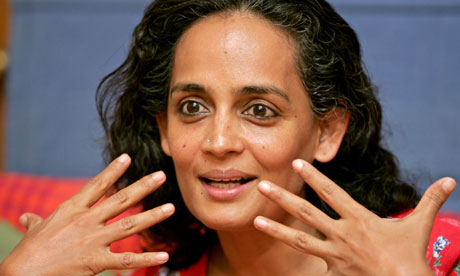 I am with Arundhati Roy (such agreement doesn't happen often!) when she says that Kashmir has never been an integral part of India and maybe Indians should just let go of that territory. I, too, have expressed such sentiments in this blog. I would extend the same logic to Nagaland, Mizoram, ...
The difference though is that as a nobody, and an American nobody, my words don't invite the Indian government's attention as do Roy's. The latest news of a mob gathering outside her home doesn't bode well either.
An unpleasant truth often overlooked is that although war is a great evil, it does have a great virtue: it can resolve political conflicts and lead to peace. This can happen when all belligerents become exhausted or when one wins decisively. Either way the key is that the fighting must continue until a resolution is reached. War brings peace only after passing a culminating phase of violence. Hopes of military success must fade for accommodation to become more attractive than further combat.Isn't this what the Kashmir issue, too, has been for sixty-plus years? The cease-fire and the "line of control" in place has merely perpetuated the war, instead of ushering in a sense of peace.
Since the establishment of the United Nations and the enshrinement of great-power politics in its Security Council, however, wars among lesser powers have rarely been allowed to run their natural course. Instead, they have typically been interrupted early on, before they could burn themselves out and establish the preconditions for a lasting settlement. Cease-fires and armistices have frequently been imposed under the aegis of the Security Council in order to halt fighting.
The difference though is that as a nobody, and an American nobody, my words don't invite the Indian government's attention as do Roy's. The latest news of a mob gathering outside her home doesn't bode well either.
Monday, September 13, 2010
Has India lost it on Kashmir? The intifada rages on ...
Looks like even the Israel-Palestine issue might be settled before peace returns to Kashmir.
If I were an athlete preparing to compete in the upcoming Commonwealth Games in New Delhi, I would rather stay home, consistent with the advice from some of the countries. With Kashmir exploding, Maoists threatening the inland, and Islamic militants always eager to blow themselves up, it might just about be safer to stay home. (editor: don't forget the threat of Dengue Fever too)
 Kashmir is an unresolved issue all the way from 1947, and now we have youth who have known nothing but protests and massive Indian military and paramilitary presence.
Such a tense situation means, and to no real surprise, that the news of Quran burning in America became another rallying cry in Kashmir. And, as protesters often do throughout the world, the American flag and an effigy of the President were burnt. Like Obama or the American government had anything to do with the nutcase pastor of a flock of forty.
According to the BBC:
As eager beaver teenagers, my friends and I debated about Kashmir and my views haven't changed much: I don't understand why a territory and its peoples ought to be subjugated under military force if they don't want to be in the union. But, even then I was in the minority--the rest couldn't let go of Kashmir.
Perhaps India's approach to the Kashmir situation would have been different if Jawaharlal Nehru had been from, say, Bihar or Andhra, as opposed to hailing from Kashmir? (Yes, Nehru was born in Allahabad, but was one of the Kashmiri Pandit families.)
Well, one can't re-write history. But, at this moment, it certainly looks like the Indian government and politics have completely lost any control of how the rest of the Kashmir story will be written. Let us hope that a lot more lives will not be lost, and not a lot more property will be damaged.
If I were an athlete preparing to compete in the upcoming Commonwealth Games in New Delhi, I would rather stay home, consistent with the advice from some of the countries. With Kashmir exploding, Maoists threatening the inland, and Islamic militants always eager to blow themselves up, it might just about be safer to stay home. (editor: don't forget the threat of Dengue Fever too)
Such a tense situation means, and to no real surprise, that the news of Quran burning in America became another rallying cry in Kashmir. And, as protesters often do throughout the world, the American flag and an effigy of the President were burnt. Like Obama or the American government had anything to do with the nutcase pastor of a flock of forty.
According to the BBC:
One might wonder why the Protestant-run school had to be burnt ... But, a mob does what a mob does.In Monday's protests, thousands of people defied curfews and took to the streets, chanting anti-India and anti-US slogans and burning effigies of US President Barack Obama, our correspondent says.An angry mob set fire to several government buildings and a Protestant-run school, as well as attacking a police station, he adds.
Police fired live ammunition to break up the demonstrations, and confirmed that 18 civilians had been killed.
Several of the deaths were reported to have occurred in Budgam district, with others reported in the village of Tangmarg, where the school was burned.
One of those killed was a student aged 12 or 13, our correspondent says.
As eager beaver teenagers, my friends and I debated about Kashmir and my views haven't changed much: I don't understand why a territory and its peoples ought to be subjugated under military force if they don't want to be in the union. But, even then I was in the minority--the rest couldn't let go of Kashmir.
Perhaps India's approach to the Kashmir situation would have been different if Jawaharlal Nehru had been from, say, Bihar or Andhra, as opposed to hailing from Kashmir? (Yes, Nehru was born in Allahabad, but was one of the Kashmiri Pandit families.)
Well, one can't re-write history. But, at this moment, it certainly looks like the Indian government and politics have completely lost any control of how the rest of the Kashmir story will be written. Let us hope that a lot more lives will not be lost, and not a lot more property will be damaged.
Sunday, August 29, 2010
A new MIA: Muslims in America, that is
I didn't know this about Feisal Rauf--the man behind the Park51 project, which has become one insane controversy:
Media Matters notes that Feisal Rauf "has a long history of condemning terrorism, promoting pluralism, and arguing that the true meaning of Islam involves democracy, religious freedom and women's rights" and thanks that information-rich page I now know that, among other things,:
In one of Khan's bio-sketches, there is a quote from Rumi, the great Persian Sufi poet:
 I have had wonderful friends who were/are Muslims--one was even briefly a roommate back in graduate school. The talented plumber, Samad, who was a jack of all trades, is a Muslim and was my parents' trusted assistant. The only music performance that I ever attended in the fabled Music Academy in
Madras Chennai, before leaving for the US decades ago, was to listen to Amjad Ali Khan playing the sarod. Creating the fantastic mats in the village of Pattamadai, where my dad grew up, is almost exclusively by Muslims. These are a few of the personal connections to Muslims and Islam. It simply jars me when the Park51 critics lump all these people with the insanely radical Islamists. Crap!
Update:
Glenn Greenwald writes:
When a memorial service was held for murdered Wall Street Journal reporter Daniel Pearl, Rauf declared: "I am a Jew." When the scandal of Abu Ghraib broke, Rauf was among those asked to appear in an apology advert that was broadcast on Arabic television.A Jewish reporter dies after crazy militant Islamist radicals slit his throat and even air a video of that, which is why Rauf's declaration in the tradition of JFK's "Ich bin ein Berliner" is immensely admirable, and echoing Pearl's own last words, "I am Jewish." He said:
"Hear O Israel, the Lord our God, the Lord is one, not only today I am a Jew, I have always been one."What a contrast to this is the opposition to the Park51 project from Abraham Foxman, the head of the Anti-Defamation League!
Media Matters notes that Feisal Rauf "has a long history of condemning terrorism, promoting pluralism, and arguing that the true meaning of Islam involves democracy, religious freedom and women's rights" and thanks that information-rich page I now know that, among other things,:
Bush administration sent Rauf on State Department trip in 2007. In an August 10 press briefing, Assistant Secretary of State P.J. Crowley addressed the State Department travel program in which Rauf is participating, noting that its purpose is to promote "religious tolerance" and provide Muslim countries with a "moderate perspective" of being "Muslim in the United States." Crowley noted:Rauf's wife has an Indian connection--Daisy Khan was born in Kashmir, and immigrated to the US when she was 15. I can't track down how she got her first name of "Daisy" ... Am not sure if that was the name her parents gave her at birth, or whether she adopted it to Americanize her name ...
For Imam Feisal, this will be his third trip under this program. In 2007, he visited Bahrain, Morocco, the UAE and Qatar. And earlier this year in January, he also visited Egypt. So we have a long-term relationship with him. His work on tolerance and religious diversity is well-known and he brings a moderate perspective to foreign audiences on what it's like to be a practicing Muslim in the United States. And our discussions with him about taking this trip preceded the current debate in New York over the center.
In one of Khan's bio-sketches, there is a quote from Rumi, the great Persian Sufi poet:
"I looked for God. I went to a temple, and I didn't find him there. Then I went to a church, and I didn't find him there. And then I went to a mosque, and I didn't find him there. And then finally I looked in my heart, and there he was."
Update:
Glenn Greenwald writes:
One of the most under-reported political stories is the increasingly vehement, nationwide movement -- far from Ground Zero -- to oppose new mosques and Islamic community centers. These ugly campaigns are found across the country, in every region, and extend far beyond the warped extremists who are doing things such as sponsoring "Burn a Quran Day." And now, from CBS News last night, we have this:It is the same Tennessee town that Aasif Mandvi reported about:
Fire at Tenn. Mosque Building Site Ruled Arson
Federal officials are investigating a fire that started overnight at the site of a new Islamic center in a Nashville suburb.
Ben Goodwin of the Rutherford County Sheriff's Department confirmed to CBS Affiliate WTVF that the fire, which burned construction equipment at the future site of the Islamic Center of Murfreesboro, is being ruled as arson. . . .
| The Daily Show With Jon Stewart | Mon - Thurs 11p / 10c | |||
| Tennessee No Evil | ||||
| ||||
Sunday, August 15, 2010
Photo of the day: India's Independence Day

The moment of birth, 63 years ago, was characterized as the "tryst with destiny" by Jawaharlal Nehru.
In that historic speech, Nehru remembered, and reminded everybody, the siblings who now became citizens of another country, Pakistan:
We think also of our brothers and sisters who have been cut off from us by political boundaries and who unhappily cannot share at present in the freedom that has come. They are of us and will remain of us whatever may happen, and we shall be sharers in their good and ill fortune alike.For India and Pakistan, it has been two very different tales right from their births. I often wonder what the story might have been had there been no partition. Or, what if Kashmir had become a separate country, like Nepal. And, later on, what if the states had not been created based on the prevailing majority languages spoken.
Such counterfactual questions aside, it is quite an achievement, indeed, that the country has been largely successful with its experiment in democracy--except for that brief period of darkness that was the "Emergency" imposed by the then prime minister, Indira Gandhi.
I have my own version of Salman Rushdie
 's marking of the I-Day in his life; it was on a August 15th that I left India for the United States decades ago in order to pursue graduate studies at USC. It is also, in a way, my own independence day :)
Thursday, August 12, 2010
More on the Kashmiri Intifada

Anyway, peace in Kashmir looks so difficult from so far away. The photo on the left is from the NY Times story: "Aabid Nabi, right, sat next to his brother Fida Nabi, who was shot in the head during a protest, in a hospital in Srinagar. Mr. Nabi later died from his injury."
“What we are seeing today is the complete rebound effect of 20 years of oppression,” said Mirwaiz Umer Farooq, the chief cleric at Srinagar’s main mosque and a moderate separatist leader. Kashmiris, he said, are “angry, humiliated and willing to face death.”This is certainly looking more and more like the Gaza situation where a generation has known nothing but internal unrest, and a sense of hopelessness.
This summer there have been nearly 900 clashes between protesters and security forces, which have left more than 50 civilians dead, most of them from gunshot wounds. While more than 1,200 soldiers have been wounded by rock-throwing crowds, not one has been killed in the unrest, leading to questions about why Indian security forces are using deadly force against unarmed civilians — and why there is so little international outcry.
Over at the BBC, Soutik Biswas echoes nearly identical sentiments:
Things are looking grimmer than ever before. It's a summer that could turn out to be another defining point in the valley's tortured history. A whole generation of children of the conflict - Kashmiri writer Basharat Peer evocatively calls it their "war of adolescence" - who grew up in the days of militancy and violence in the early 1990s are driving the protests today. (Seven out of 10 Kashmiris are below 25.) Growing up in the shadow of the gun and what they say is "perpetual humiliation" by the security forces, they are angry, alienated and distrustful of the state. As prominent opposition leader Mehbooba Mufti tells me when I visit her at her heavily secured home overlooking the stunning Dal lake: "If these young men are not given something to look forward to, God help Kashmir." The valley, most residents say, is in the early stages of an intifada.Biswas ends his report on a tough emotional note, which conveys the urgency of the Kashmir issue:
One mother emptied a cupboard and a suitcase full of of her 14 yr-old boy's belongings for me. Wamiq Farooq had gone to play in the neighbourhood when a tear gas shell fired by the troops exploded on his head. Doctors tried to revive him for an hour at the hospital before declaring him dead.
Now, sitting on a brown rug in a modest family home, his mother brings out Wamiq's red tie, red belt, white cap, fraying blue uniform, half a dozen school trophies, report cards, school certificates and then his pithy death certificate. "He is sure to be a face in the crowd," writes his school principal on one certificate praising Wamiq, the Tom and Jerry cartoons and science-loving teenaged son of a street vendor father. Then she slowly puts back Wamiq - his life and death - back into the suitcase and the cupboard and tells me, her eyes welling up: "I never understood why Kashmiri people demand freedom. After Wamiq's death, I do. I want freedom too. So that my children can return home unharmed and in peace."
Tuesday, August 10, 2010
Rains and mudslides, chaos and destruction
In Pakistan, Kashmir, China ...
The following photo from BBC tells the horror story in China after a huge landslide:

The following photo from BBC tells the horror story in China after a huge landslide:
The image on the left is from July 2008. The photo on the right was taken on Sunday following the disaster. The areas within the yellow lines show the path of the mud slick.To make things worse, more rains/storm on the way ...
Sunday, August 01, 2010
The intifada in Kashmir

The caption for the photo on the left reads:
A man throws a policeman's bamboo shield on a burning government vehicle after protesters set it on fire in Pampore, near Srinagar on Sunday.
According to the same news report, At least eight people were killed in fresh round of violence in Kashmir, taking the death toll in the past 36 hours to 12.
A commentary from across the border, in Pakistan, naturally takes on a completely pro-Pakistani slant, along with anti-Indian and anti-American rhetoric:
India continues to treat the Kashmiri people as if they were not human beings and as if they have no rights. It refuses to acknowledge the uprising to be a home grown insurgency. Instead, it finds it easy to blame it all on groups that it says Pakistan sponsors.
There are even more fascinatingly rhetorical and inflammatory sentences in that commentary. But then that is what most commentators do anyway--we have quite a few of such shrill ideological voices spouting rhetoric in the television and newspaper outlets here in America. Stupid ideologues all over this planet!
If only India's Vallabhai Patel and Jawaharlal Nehru hadn't arm-twisted the Kashmiri maharajah, and quite a few other territories into joining the union. I suppose this is the one of the rare situations when I agree with Arundhati Roy, who refers to these and other acts as India's acts of territory grabbing and imperialism.

Sunday, July 18, 2010
Kashmir and the Indo-Pak situation
I received an interesting email in response to my earlier posts on Kashmir and the darkening clouds over India and Pakistan; excerpt:
BTW, here is more info about Newsy
I just saw your post on the Indian-Pakistan peace talk and its lack of any concrete compromises or solutions. Many are disappointed by the continued disagreements and tension between India and Pakistan. I think you will find the following video interesting and relevant to this discussion:Here is the video that the email refers to:
http://www.newsy.com/videos/tension-lingers-after-india- pakistan-talks-end
The video gives some background to this recent talk and also shows a number of different opinions on the talk's original purposes, the aims of both India and Pakistan during the talk, and whether or not it is likely that these two countries will find some sort of compromise in the future. I hope you will consider embedding this video to your site.Newsy.com videos analyze and synthesize news coverage from multiple sources. Its unique method of showing how different media cover the news helps viewers better understand complex stories.
BTW, here is more info about Newsy
More on Kashmir, and the dark clouds of war
While the web has made it possible to follow events from thousands of miles away, it is equally possible to be misled because of that very distance. Which is why I feel better--even when discussing awful developments--when I find that I am not the only one worried about, in this case, Kashmir. Here is Tariq Ali writing in the London Review of Books:
I was shocked at the topic itself, not to speak of the comments that were made. This in a country where two prime ministers had been assassinated not by people with Islamic faith--Indira Gandhi was felled by bullets from her bodyguards who were Sikh, and Rajiv Gandhi was brutally exploded by a Sri Lankan Tamil suicide bomber. Of course, Mohandas "Mahatma" Gandhi was killed by a Hindu zealot.
Ok, these were before 9/11. But, all contemporary terrorists being Muslims is contradicted by, for instance, the Maoist rebels who seem to strike and kill at ease, which has the government responding by deploying paramilitary forces in large numbers. And, of course, the communal terror launched by the BJP and Shiv Sena .... Or, how about Gujarat's Modi coordinating the violence that killed and terrorized Muslims in the state in which he was elected chief minister to protect and serve those very people?
That TV show was no exception. Maybe one needs such an outsider's perspective to see through all these ...
Very depressing all the developments in Kashmir have been ... Ali concludes:
Successive Pakistani governments continue to capitalize on the Kashmir issue, and the explicit and implicit anti-Muslim tendencies in India--and they screw the country and the people in the process. I mean, this is a no-win for anybody involved. Bloody hell all around.
I wonder if I might never get to see Kashmir's famous Dal Lake that I thought I would visit some day--it was in the textbook for the "social studies" class a long time ago (what was that teacher's name? I can kind of picture her even now! Was it Sitalakshmi Ramaswamy?) that I came across a photo of Dal Lake. And then there were so many Hindi movie song/dance sequences from that lake and the state itself. My graduate school mate, Gazala, who was from Srinagar, added to my interests with her descriptions of Dal Lake ...
Here is one of my favorite Hindi film songs--this one is from "Kashmir Ki Kali" (lyrics translation here)
An ugly anti-Muslim chauvinism accompanies India’s violence. It has been open season on Muslims since 9/11, when the liberation struggle in Kashmir was conveniently subsumed under the war on terrorI second his view that in India it has been open season on Muslims. I was too shocked to make any comment when watching a television show during one of my trips there. It was on NDTV, I think, and seemed to be an Indian version of the American talk-fest among pundits, with audience participation. The question they were discussing? "All Muslims are not terrorists, but all terrorists are Muslims."
I was shocked at the topic itself, not to speak of the comments that were made. This in a country where two prime ministers had been assassinated not by people with Islamic faith--Indira Gandhi was felled by bullets from her bodyguards who were Sikh, and Rajiv Gandhi was brutally exploded by a Sri Lankan Tamil suicide bomber. Of course, Mohandas "Mahatma" Gandhi was killed by a Hindu zealot.
Ok, these were before 9/11. But, all contemporary terrorists being Muslims is contradicted by, for instance, the Maoist rebels who seem to strike and kill at ease, which has the government responding by deploying paramilitary forces in large numbers. And, of course, the communal terror launched by the BJP and Shiv Sena .... Or, how about Gujarat's Modi coordinating the violence that killed and terrorized Muslims in the state in which he was elected chief minister to protect and serve those very people?
That TV show was no exception. Maybe one needs such an outsider's perspective to see through all these ...
Very depressing all the developments in Kashmir have been ... Ali concludes:
Now a new generation of Kashmiri youth is on the march. They fight, like the young Palestinians, with stones. Many have lost their fear of death and will not surrender. Ignored by politicians at home, abandoned by Pakistan, they are developing the independence of spirit that comes with isolation and it will not be easily quelled. It’s unlikely, however, that the prime minister of India and his colleagues will pay any attention to them. And just to show who’s master, the Indian army flag-marched through the streets of Srinagar on 7 July in an awesome show of strength.I have problems with many of Tariq Ali's takes on the world ... but, in this case, I agree with him.
Successive Pakistani governments continue to capitalize on the Kashmir issue, and the explicit and implicit anti-Muslim tendencies in India--and they screw the country and the people in the process. I mean, this is a no-win for anybody involved. Bloody hell all around.
In the immortal words of Rodney King, why can't we all get along?
I wonder if I might never get to see Kashmir's famous Dal Lake that I thought I would visit some day--it was in the textbook for the "social studies" class a long time ago (what was that teacher's name? I can kind of picture her even now! Was it Sitalakshmi Ramaswamy?) that I came across a photo of Dal Lake. And then there were so many Hindi movie song/dance sequences from that lake and the state itself. My graduate school mate, Gazala, who was from Srinagar, added to my interests with her descriptions of Dal Lake ...
Here is one of my favorite Hindi film songs--this one is from "Kashmir Ki Kali" (lyrics translation here)
Friday, July 16, 2010
The dark clouds of war over India-Pakistan

Against that background, the foreign ministers of India and Pakistan were to hold talks ...
Here a a few reports:
The day prior to the meeting, India's Home Secretary (a civil service position, not to be confused with the American "Secretary") flatly stated that Pakistan's ISI was directly behind the Bombay (Mumbai) terrorism:
"It was not just a peripheral role," the Indian Express newspaper quoted Pillai as saying. "They (ISI) were literally controlling and coordinating it from the beginning till the end."
Like that will go well with the Pakistani government, eh! Not that this statement was the clincher, but the talks failed. Spectacularly.
The Pakistani minister was not pleased with the Indian contingent:
Pakistan from the start had been insisting on a sustained dialogue and picking up from where the composite dialogue was suspended by India, but New Delhi's contention was that since the process was called off because of the Mumbai terror attack, it cannot be restarted without some action in unravelling the conspiracy and bringing the culprits to book by Islamabad.
Commenting on the way the Indians conducted the negotiations, the Minister said the Indian side appeared ill-prepared with Mr. Krishna having to time and again consult New Delhi.
Pointing out that he had entered the dialogue well prepared and with the full mandate of the Pakistani leadership, Mr. Qureshi pondered aloud why his counterpart — who is supposed to preside over Indian diplomacy — needed to consult New Delhi ever so often.India's minister disagrees:
External Affairs Minister S.M. Krishna said here that India did not think it was prudent at this stage to accept the Pakistani offer of timelines because of the complexity of the issues involved. “We told them terrorism is the biggest problem in normalising relations. Unless this is met, everything else will be futile. In diplomatic parleys, we don't go by a timeline unless it is absolutely necessary. The question of timeline was not feasible.''
The Minister dismissed suggestions that the Indian delegation was not flexible and ill-prepared. “I am not going to score debating points. The fact of the matter is we did discuss many issues of concern…. The mandate was very clear. As External Affairs Minister, I confined myself to the mandate. I am quite satisfied,'' he observed.
Sensing a political opening, the out-of-power the crazy nutcase Hindu religious fundamentalist party, the BJP, calls for suspending talks altogether:
“The time has come for India to call off the dialogue,” she said. There was no need for India to keep putting up with insults heaped upon its representatives.
At the party headquarters here, spokesperson Ravi Shankar Prasad said Mr. Qureshi seemed to have lost his cool because Home Secretary G.K. Pillai mentioned about the Inter-Services Intelligence of Pakistan in a comment he had made. This showed the ISI was the “real boss” in Pakistan, he said.
At some point, the game of chicken could lead to one completely losing it. I hope that dangerous day does not come. ever.
But, worry we should.
Tuesday, June 29, 2010
Sticks and stones do break bones

A youth attempts to throw a teargas shell back at the police during protests against the alleged killing of a young boy
So, where did this happen?
The Palestinian territories?
Lebanon?
Iran?
Naaah ... this is from India. Yes, India. supposedly the land where every young person is busy taking customer calls from around the world!
All is not well in India, and this is one of those many areas where the Indian government has been dealing through brute police/army force, many times going over the line into abuse of power.
Anyway this itself is from Kashmir--a few miles away from the capital city of Srinagar.
Kashmir has been an issue, unfortunately, ever since the creation of India and Pakistan, and this was back in 1947! Sopore itself has been bubbling ever since the nasty series of tragic events. One of my graduate school colleagues--who was a Muslim--was from Srinagar. I wonder if she ever returned to Kashmir even for brief visits; I would doubt that ...
What is the latest situation in Sopore?
With street battles spreading in the valley, Chief Minister Omar Abdullah on Tuesday sent a high level team to Baramulla district to help local administration take measures for restoring peace in the violence hit North Kashmir towns.
"Street battle"--that says it all. Here is one angle on the internal issues, the use of armed forces, and the neighboring countries:
The blockade in Manipur has been in place for almost two months and people are suffering unimaginable hardship even as the governments. The Naxal issue has gained criticality in the aftermath of a proactive policy adopted by Home Minister P Chidambaram.
The Army is already playing an active role in both Kashmir and the North East and now it may be called upon to contain the Naxal menace also. In the midst of this turmoil the Army, which is the sole savior and sentinel of the nation''s integrity, is facing a grave challenge from a number of forces that are trying to weaken its intrinsic fabric.
Whether this is part of a grand design or the machination of different powers and lobbies who have their own axes to grind, cannot be ascertained, but what is very obvious is that the cumulative effect is quite alarming.
The increasing involvement of the Army in quelling social and political dissent in the country provides the first and most critical chink in its armour. Interestingly, the divisive ideologies of Islamic Jihad and Maoism that the country has to contend with are direct imports from its two neighbours, China and Pakistan.
Subscribe to:
Posts (Atom)