Showing posts with label syria. Show all posts

Tuesday, June 25, 2019

Shame on us! :(

Earlier today,  I sat in silence after looking at the photograph below and the story behind it:

Source
A father and daughter. Migrants. Drowned. Dead. At the border.
The man and his 23-month-old daughter lay face down in shallow water along the bank of the Rio Grande, his black shirt hiked up to his chest with the girl tucked inside. Her arm was draped around his neck suggesting she clung to him in her final moments. 
The searing photograph of the sad discovery of their bodies on Monday, captured by journalist Julia Le Duc and published by Mexican newspaper La Jornada, highlights the perils faced by mostly Central American migrants fleeing violence and poverty and hoping for asylum in the United States.
We are bloody messed up. Way fucked up!
Óscar Alberto Martínez Ramírez, frustrated because the family from El Salvador was unable to present themselves to U.S. authorities and request asylum, swam across the river on Sunday with his daughter, Valeria. 
He set her on the U.S. bank of the river and started back for his wife, Tania Vanessa Ávalos, but seeing him move away the girl threw herself into the waters. Martínez returned and was able to grab Valeria, but the current swept them both away.  
Even as I read the news, I was reminded of the little Syrian boy who was lying dead face down in the water:

Source

We are fucked up. Way fucked up!

Sunday, April 22, 2018

Shut the front door already!

Remember this?

Source
Or this?

Source

We in the US did not care. 63 million elected a guy who lacks even a drop of empathy.  The fate of Syrian refugees is not what he and his 63 million toadies worry about.  As long as the safety nets are torn apart, the natural environment is destroyed, and non-whites are shoved into the corners where we belong, well, their mission is accomplished.

Of course, the refugees being Muslims makes it all the easier for the 63 million bigots to close the door, even though the Syrians are not dark-skinned as most of us from shithole countries are.  So, more than a year into his monarchy, er, presidency:
In the last years of the Obama administration, the US resettled tens of thousands of Syrian refugees. When Trump took office, that number plummeted — partly because of the 120-day “refugee ban” that prevented nearly any refugees from being brought into the US over the summer of 2017, and partly because of specific scrutiny facing refugees from several countries, including Syria.
The result is that the US is on pace to resettle fewer than 100 Syrian refugees in the fiscal year that ends September 30. And it might not even be that many.
We might not even resettle 100 refugees this year.  Not even a 100 out of the more than 5.5 million Syrians who have fled the country!  
The global refugee crisis is, by some measures, worse than ever. And the Syrian civil war, and the world’s response to it, is a big part of why. Syria accounts for 24 percent of the world’s 22.5 million refugees recognized by the United Nations High Commissioner on Refugees. (Before the war, Syria had about 21 million people, or 0.3 percent of the world’s population.)
But what truly distinguishes the current refugee crisis is that now, more than ever before, refugees are likely to remain displaced for years or even decades, instead of being able to either return home or be permanently resettled in a third country.
The 63 million bigoted bastards "fundamentally don’t believe that there is such a thing as the “global refugee crisis."  Exactly what their religious leader advised them to do, right?!

Source

Thursday, October 27, 2016

Where does the neighborhood end?

Usually when I call my parents, thanks to life on opposite sides of the world, I end up calling them when they have just about wrapped up a hot breakfast, and when they are contemplating what to prepare for lunch.  Usually.

Not that one day.  Their lunch prep was on hold.

The preparations had to wait because the neighbor had died and they did not want to get the kitchen operations going until the body was taken away.  Whatever be the religious reasons, there is a basic humanitarian reason for such a delay, which you may have already figured out.  Indian cooking releases a gazillion mouth-watering aromas (or, strong odors, if you don't care for them) and such an act while the neighbor's family is sitting with the dead person is simply an awfully discourteous behavior.

In the old days, in my grandmothers' villages, one of the reasons for a quick disposal of the body was to also make sure that the neighbors were not put to a great inconvenience--after all, when tragedy strikes in our life, it is not a tragedy for everybody, right?

Which is what I want to get to in this post.  Where does that neighborhood boundary end?

Tragedies happen every minute of every day all around the world.  But, that does not stop us from cooking delicious meals, traveling, having sex, ... whatever.  While it is a wonderful survival mechanism to make sure that we don't involved with the tragedies all around, my objective in this post is a much simpler one: For us to be reminded that there are real people all around with real problems that are far more compelling than our problems with the overcast skies and crappy cellphone coverage.

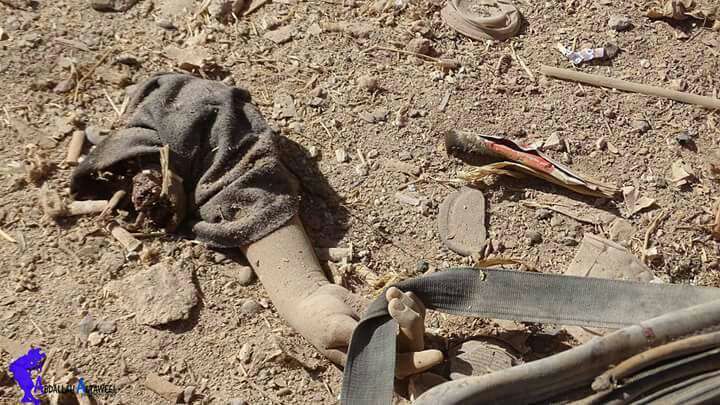
One of those tragedies was this image that appeared in my Twitter feed:


The tweet noted:
it's a kid arm holding to his bag after today's bombing
Yet another tragic day in Syria :(

I started following that Twitter feed after reading a Nick Kristof column, in which he had included details about a kid and her mother in Aleppo.  Now, thanks to that, I am reminded every day that life is not normal in Syria.  The image of a kid's severed arm lying on the ground with the fingers wrapped around a school bag is, sadly, only the latest of the horrific images that we have seen over the past couple of years.

Later, news reports provided a complete picture related to that image:
A school compound in a rebel-held part of northern Syria was repeatedly hit by airstrikes on Wednesday in an assault that monitoring groups and rescuers said had left dozens of people dead, including many children.
Unicef, the United Nations Children’s Fund, said the assault in Idlib Province may have been the deadliest on a school since the Syrian war began more than five years ago.
Twenty-two children and six teachers were killed in the strikes, Unicef said. 
Neither my parents nor I stop our lunch and dinner preparations in order to honor and respect the dead in Aleppo. Or in Mosul. Or in wherever.  Because ... they aren't our neighbors?!

Friday, September 30, 2016

The war criminals

When history is written a few years from now, you and I will be found guilty as well--for having merely stood by and watched as Syria collapsed into a brutal civil war; for having done nothing when civilians were slaughtered; for having turned away those who were fleeing from the chaos and destruction.

I never imagined that something like Syria would unfold in real time, and that we would do nothing other than talk tough about imposing sanctions!

Throughout all these, while ill-informed pundits and politicians have said and written a lot, how many commentaries have you read that were authored by philosophers?  If ever we needed somebody to tell us what is right and wrong, and what the moral imperative is, I can't think of a better and more urgent example than Syria and--yet--practically nothing from philosophers in the public space.

The lack of public engagement by philosophers is atrocious.  But, easy to understand; After all, philosophers decided that they, too, needed to have their own academic discipline and talk only amongst themselves and by using arcane words that only they would understand.  Unlike Socrates, these modern philosophers have essentially told the public to go f*k themselves!
This institutionalization of philosophy made it into a discipline that could be seriously pursued only in an academic setting. This fact represents one of the enduring failures of contemporary philosophy.
So, how was philosophy before the philosophers were institutionalized?
Before its migration to the university, philosophy had never had a central home. Philosophers could be found anywhere — serving as diplomats, living off pensions, grinding lenses, as well as within a university.
And what happened after the philosophers were institutionalized?
Against the inclinations of Socrates, philosophers became experts like other disciplinary specialists. This occurred even as they taught their students the virtues of Socratic wisdom, which highlights the role of the philosopher as the non-expert, the questioner, the gadfly.
Philosophy, then, as the French thinker Bruno Latour would have it, was “purified” — separated from society in the process of modernization.
What a tragic irony, right, that thanks to such "purification" philosophers have pretty much nothing to contribute to the discussions on one of the most urgent humanitarian crisis of our times!

I am not sure if I am supposed to laugh or cry that we are not discussing such matters.

Meanwhile, even as Rome burns, the Republican Party's Nero esteemed candidate has a three a.m. wake up moment and tweets about the sex tape of a former beauty contest winner.  To which a GOP Congresswoman responds with "That's the kind of president we need."  I have no idea how there could be even two people to vote for this candidate!

Shame on all of us!

Thursday, August 18, 2016

This, too, shall pass. Unfortunately!

As we were enjoying the tastiest Morrocan sweets and the freshest strawberries, I paused.  "I know I say this a lot, but I want to remind ourselves about the awesome life that we have. With such food in plenty. On a great summer evening."


I am immensely thankful for the life that I have.  If ever I forget how lucky I am, all it takes is one visit to any of my favorite news sites to re-calibrate.

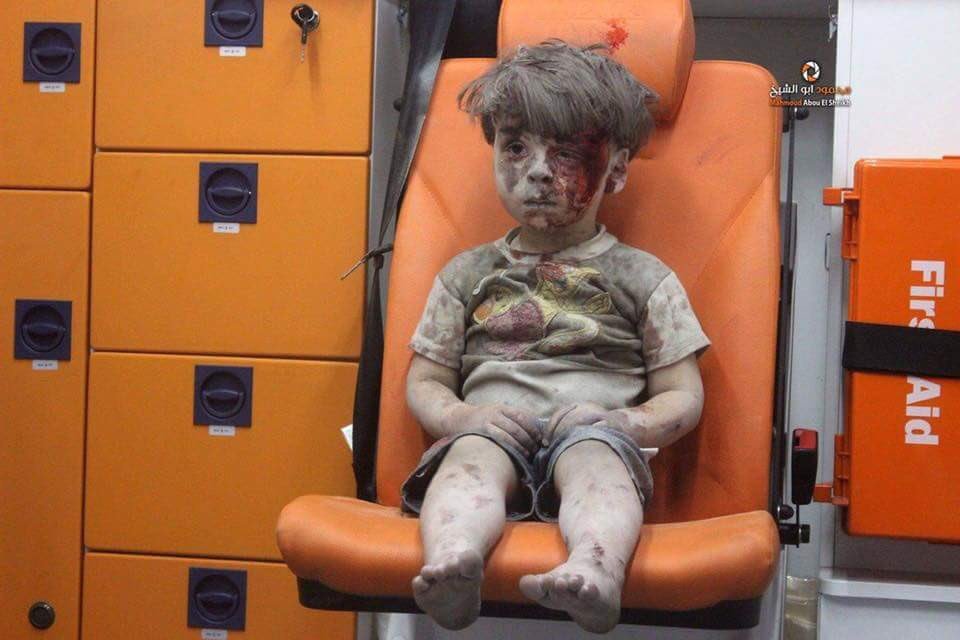
Contrast my life to the life of the kid in this photo:

Source
Even without knowing any backstory, any normal human being with a little empathy would feel terrible for that kid.  A kid with a name and a tragic backstory:
The boy, identified by medical workers as Omran Daqneesh, 5, was pulled from a damaged building after a Syrian government or Russian airstrike in the northern city of Aleppo.
How awful!
Maybe it was his haircut, long and floppy up top; or his rumpled T-shirt showing the Nickelodeon cartoon character CatDog; or his tentative, confused movements in a widely circulated video — gestures familiar to anyone who has loved a child. Or the instant and inescapable question of whether a parent was left alive to give him a hug.
In any event, by Thursday morning, Omran’s image had been broadcast and published around the world
We might share the image and the news. I blog about it. We talk about the kid and the war.  But, the killings continue.  A civil war that has dragged on for years.  Not only have we been witness to the horrors, we do not even want to help those who are fleeing from this hell.

Here in the US, we even have a presidential candidate who proudly vows that his America will not help the refugees--and there are tens of millions of my fellow citizens who even more proudly cheer him and his rhetoric!  We cannot expect any sympathy from that wannabe leader of the free world--after all, he couldn't even stand a crying kid at his rally!

Normal decent humans, unlike that candidate and his followers, will relate to this Syrian kid.
Omran, as he is carried from a damaged building in the dark, could be Everychild. He looks around in confusion, his chubby forearm draped trustingly across the reflective stripe on his rescuer’s back, before he is plopped into the chair at the back of ambulance, lit blindingly white.
He settles into a thousand-yard stare, apparently too stunned to cry. Then he puts a hand to his bloody brow, looks at his palm in surprise, and tries to wipe it on the chair. Then he glances around, as if trying to understand where he is. 
But, it is not as if photographs of kids catalyzed us into humanitarian efforts.  Remember this?

Our lives will continue.  We will have good food. Spend evenings with friends and family.  Go on vacations. Complain about the choppy cellphone signal.  Cry over the sports team that lost.

Meanwhile, adults and kids will continue to die in the brutal civil war:
Cases like Omran’s are a daily sight in eastern Aleppo, several doctors said, but he was lucky in that he made it to a hospital that was still open. ...
A boy lay on the floor, his legs missing. A woman in black put her hand to her mouth in anguish.
Another boy lay on a gurney, soaked in blood, as a clinician worked on him. A few minutes later came another text message: The boy had died. His name was Ibrahim Hadiri, and there was a new photograph of his face, eyes closed. It is not likely to go viral.

Wednesday, August 10, 2016

Water, water everywhere ...and it is all good?

Everyday something or the other completely amazes me.  It could be nature, my own stupidity, or an impressive achievement.  No, the achievement is not an Olympic gold medal--after all, you know well what I think about that expensive mass entertainment ;)

A human achievement that amazed me?
Israel now gets 55 percent of its domestic water from desalination, and that has helped to turn one of the world’s driest countries into the unlikeliest of water giants.
In the old days, we used to joke that with enough money, water will run uphill.  Without money and water running uphill, Southern California will be one heck of a desert by now.  Instead of being bone dry, it now gets water from all directions, with water running uphill at many places thanks to the power of electricity and pumping, which cannot happen without money.

Now, money and ingenuity turns salty sea water into a potable variety.
Just a few years ago, in the depths of its worst drought in at least 900 years, Israel was running out of water. Now it has a surplus. That remarkable turnaround was accomplished through national campaigns to conserve and reuse Israel’s meager water resources, but the biggest impact came from a new wave of desalination plants.
Boggles my mind!  Aren't you also impressed?  What a turnaround in a decade!
In 2008, Israel teetered on the edge of catastrophe. A decade-long drought had scorched the Fertile Crescent, and Israel’s largest source of freshwater, the Sea of Galilee, had dropped to within inches of the “black line” at which irreversible salt infiltration would flood the lake and ruin it forever. Water restrictions were imposed, and many farmers lost a year’s crops.
It was the same drought that catalyzed the instability in Syria.
 “The drought lasted for years, and no one said anything against the government. Then, in 2011, we had had enough. There was a revolution.” That February the Arab Spring uprisings swept the Middle East. In Syria, protests grew, crackdowns escalated and the country erupted with 40 years of pent-up fury.
Israel managed its meager resources well.
The turnaround started in 2007, when low-flow toilets and showerheads were installed nationwide and the national water authority built innovative water treatment systems that recapture 86 percent of the water that goes down the drain and use it for irrigation — vastly more than the second-most-efficient country in the world, Spain, which recycles 19 percent.
Pause for a second and re-read that.  Israel recaptures about 86 percent of the water that goes down the drain, and the next best effort comes from Spain, which recycles 19 percent.  It is one hell of a gap between 19 and 86, right?  Think about India and China and everywhere else, and about all the water that is wasted.

If all that does not impress you enough, consider this:
Water produced by desalination costs just a third of what it did in the 1990s. ... Israeli households pay about US$30 a month for their water — similar to households in most U.S. cities, and far less than Las Vegas (US$47) or Los Angeles (US$58).
As the article notes, this level of a sophisticated desalination technology is a game changer.  If only our collective efforts would be directed towards such important aspects of life, instead of on Olympics and Facebook and ...

Thursday, January 07, 2016

Madaya, the world is insane

In the old Tamil language, is a word "madaya"--to refer to person who behaves crazily.  A slight twist to the pronunciation and it is the name of a town in Syria that I hadn't known about until I read in the news.  One of those instances that reinforces the notion that no-news is good-news.

What about Madaya?  It is "a Syrian town besieged by the army of President Bashar al-Assad."
Civilians in Madaya, near the Lebanese border, say people are beginning to starve to death and children are severely malnourished after weeks with no adequate food.
The 40,000 residents of the town have been under siege for seven months by Syrian government forces and Hezbollah militias.
It is not as if Madaya is in some remote corner of the country.  It is "about 25km (15 miles) north-west of Damascus and 11km from the border with Lebanon."  In case we wonder why they haven't fled like the hundreds of thousands of other Syrians, the town is "surrounded by landmines."
It's not clear why Madaya shot to such prominence, given that other rebel-held areas, such as some of the Damascus suburbs, have been besieged for much longer. Perhaps Madaya was easier to seal off completely. Some blockades are quite porous.
But wounded pro-government fighters recently evacuated from rebel-besieged villages in the north also described people desperately eating grass to survive.
In my job and in my personal life, I try to be as optimistic as possible.  But, the events over the last month have seriously dented my optimism.  After a long, long, time, I begin a new year with nothing but apprehension and worry.  Things are not adding up well.

The town is at 1,400 meters (about 4,500 feet) elevation, which will make it that much more difficult during these winter months:
Conditions have worsened with the onset of winter.
"People here have started eating earth because there's nothing left to eat," Madaya resident Abdel Wahab Ahmed, told the BBC on Thursday. "Grass and leaves have died because of the mounting snow."
Under siege and with winter in an elevation means nothing to eat:
Families are eating leaves, grasses and water flavoured with spices in the town of Madaya, where rice is sold by the gram because a kilogram costs as much as $250 (£170). Some have killed and eaten their pets.
“People are dying in slow motion,” said Louay, a social worker from the town told the Guardian in a phone interview, his voice weakened by months of abject hunger. “We had some flowers growing in pots at home. Yesterday, we picked the petals and ate them, but they were bitter, awful.”
Six months into the siege, the people have practically given up:
“Here, we no longer call on anyone,” said Louay. “We have called for help so many times and nobody has heard us. But we want to ask the officials and decision-makers out there, if you were in this position, and your children were dying from hunger in front of you, what would be your reaction to the world outside that let you down? Don’t forget to ask your readers this question.”
Readers?  In America?  Here in this country where the oxygen in the news has been sucked out by the crazies of Donald Trump, Ben Carson, and the whole line up?  Here in Oregon where the news oxygen has been sucked up by gun-carrying crazy white men who want to "reclaim" as their land that once belonged to the Paiute?

The world is not insane. It is fucked up! :(

Monday, November 16, 2015

If you prick us, do we not bleed?

It is easy to dish out philosophical advice and comfort to others upon whom the cosmos might have showered misfortunes.  When a death happens but in a different home, we trot out all the platitudes.  The believers might even say things like "your loved one is now with god" or "god's will hath no why."

In the old country, there is an expression: தனக்கு பட்டால் தான் தெரியும், which translates to something like "you will truly understand it only when it happens to you."  When, for instance, a death happens in our own home--even if it is the death of beloved dog--we cry and sob just like how the neighbor did and we forget all those philosophical platitudes that we dished out to the neighbor.

It is one thing when such events happen at a personal, individual level, but, another when an entire country is going through an upheaval that I cannot even begin to imagine in my wildest imaginations.  I am referring to Syria here.  When the war and the killings unfolded in Syria, all those over the past few years apparently mattered less to us compared to when the horrific killings happened in our own home, in Paris:
Monuments around the world lit up in the colors of the French flag; presidential speeches touted the need to defend “shared values;” Facebook offered users a one-click option to overlay their profile pictures with the French tricolor, a service not offered for the Lebanese flag. On Friday the social media giant even activated Safety Check, a feature usually reserved for natural disasters that lets people alert loved ones that they are unhurt; they had not activated it the day before for Beirut.
“When my people died, no country bothered to light up its landmarks in the colors of their flag,” Elie Fares, a Lebanese doctor, wrote on his blog. “When my people died, they did not send the world into mourning. Their death was but an irrelevant fleck along the international news cycle, something that happens in those parts of the world.”
The implication, numerous Lebanese commentators complained, was that Arab lives mattered less
That was after a double suicide attack in Beirut only a day before the Paris tragedy.  A city that was finally becoming calm and peaceful after years of unrest, and despite all the chaos next door in Syria that was pushing out refugees into Lebanon.
“Imagine if what happened in Paris last night would happen there on a daily basis for five years,” said Nour Kabbach, who fled the heavy bombardment of her home city of Aleppo, Syria, several years ago and now works in humanitarian aid in Beirut.
“Now imagine all that happening without global sympathy for innocent lost lives, with no special media updates by the minute, and without the support of every world leader condemning the violence,” she wrote on Facebook.
I want to be very clear here, before some troll thinks that I am minimizing the tragedy in Paris--I am not, and these two posts make that very clear.

"All of these tragedies are "an attack on all of humanity," writes this commentator, who points out how the media even reported the events very differently:
Although the terrorist group behind the attacks in Paris and Beirut was the same, the Western media narrative has been vastly different. In Paris, ISIS attacked the city's progressive youth, massacring dozens enjoying their night out at a concert, a soccer game and a restaurant. In Beirut, ISIS struck a "Hezbollah stronghold" in the "southern suburbs of Beirut," a poor, majority Shia area often characterized as a bastion of terrorism in the region. The attack was portrayed as little more than strategic punishment for Hezbollah's ongoing involvement in the Syrian civil war and support of Syrian President Bashar al-Assad's regime.
As much as we are shocked and sad about the Paris attacks, don't we need to think about other places too where the same ISIS has made daily life a hell on earth?  Shouldn't what we feel for Paris and France be the same as what we feel for Aleppo and Syria?  For Beirut and Lebanon?  For Baghdad and Iraq?  for ...

It seems like we have forgotten this part that Shakespeare wrote:
If you prick us, do we not bleed?
if you tickle us, do we not laugh?
if you poison us, do we not die? 
But want to remember only the lines that come after that:
and if you wrong us, shall we not revenge?
If we are like you in the rest, we will resemble you in that.

Caption at the source:
The relatives of one of the victims of the twin suicide attacks in Beirut mourned
during a funeral procession in the city's Burj al-Barajneh neighborhood.

Wednesday, September 02, 2015

Shame on us! :(

Maybe I should simply give up on understanding anything that goes on in this world.

Consider, for instance, the war in Syria.  And the refugee crisis:

Source
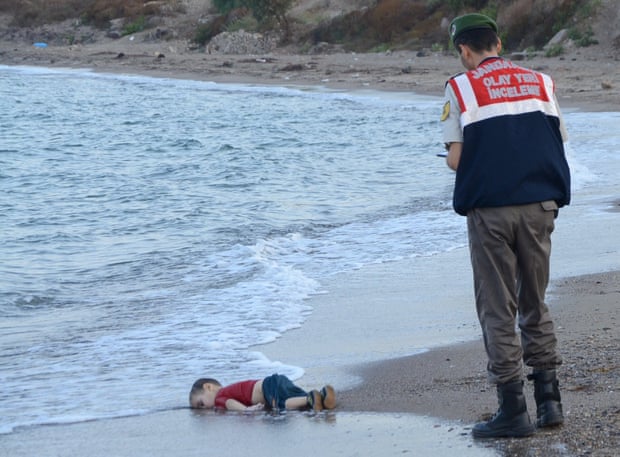
When the numbers are in hundreds of thousands, we easily forget what every one of those fellow humans mean.  One of those who made it out of the country, but not alive, was this toddler:

Source

The Guardian, from where I grabbed that photograph, reports:
The full horror of the human tragedy unfolding on the shores of Europe was brought home on Wednesday as images of the lifeless body of a young boy – one of at least 12 Syrians who drowned attempting to reach the Greek island of Kos – encapsulated the extraordinary risks refugees are taking to reach the west.
The picture, taken on Wednesday morning, depicted the dark-haired toddler, wearing a bright-red T-shirt and shorts, washed up on a beach, lying face down in the surf not far from Turkey’s fashionable resort town of Bodrum. 
That image haunts me. It should haunt every one of us.
Turkish media identified the boy as three-year-old Aylan Kurdi and reported that his five-year-old brother had also met a similar death. Both had reportedly hailed from the northern Syrian town of Kobani, the site of fierce fighting between Islamic state insurgents and Kurdish forces earlier this year.
 There is something seriously wrong with the world.  A world in which here in the US we are fixated on Donald trump's latest theatrics.  Nicholas Carr writes:
It’s worth asking, though, what kind of democracy is being promoted. Early digital enthusiasts assumed that the web, by freeing the masses from TV news producers and other media gatekeepers, would engender a deeper national conversation. We the people would take control of the discussion. We’d go online to read position papers, seek out diverse viewpoints and engage in spirited policy debates. The body politic would get fit.
It was a pretty thought, but it reflected an idealized view both of human nature and of communication media.
Seriously, is it worth calling ourselves the greatest country that the planet has ever known when we pay immensely more attention to Trump than to a grave humanitarian crisis that resulted in the three-year old dead, face down on the beach?  WTF!
Because it simplifies and speeds up communications, the formulaic quality of social media is well suited to the banter that takes place among friends. Clicking a heart symbol may be the perfect way to judge the worth of an Instagrammed selfie (or even a presidential snapshot). But when applied to political speech, the same constraints can be pernicious, inspiring superficiality rather than depth. Political discourse rarely benefits from templates and routines. It becomes most valuable when it involves careful deliberation, an attention to detail and subtle and open-ended critical thought—the kinds of things that social media tends to frustrate rather than promote.
As the NY Times notes, people have tweeted and Facebooked about that haunting image of the three-year old dead boy.  But, at best, people click "like" and move on to a video of a cat playing the piano.  We seem to have lost even the little bit of a common sense and a shared space where we engaged in deeper conversations.  What is wrong with us?

That was a toddler!  I have no hope that the image will make us collectively think about the four million refugees who are alive ... I give up.

A kid.
A three-year old.

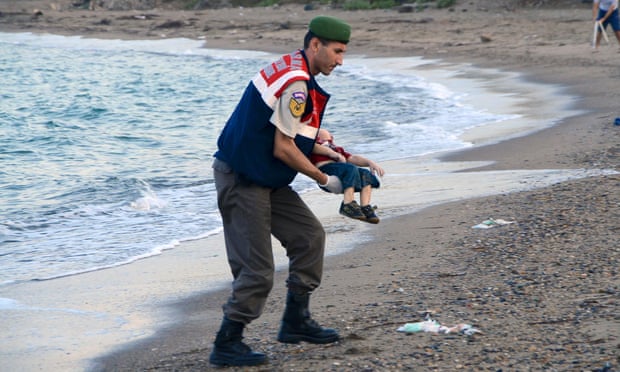
Caption at the source:
 A Turkish police officer carries a young boy who drowned in a failed attempt to sail to the Greek island of Kos. 

Sunday, September 14, 2014

Don't know much about geography. Don't know much about, well, everything.

The Onion made fun of bloggers like me:
So, of course, here I am returning to my blog after a break of, gasp, two days!

BTW, if there is nobody to read a blogger's post, then does the blog post make that philosophical noise in the forest? ;)

Anyway, two months ago, I remarked on how much even the attention-paying few realize that yesterday's news becomes quickly forgotten:
We live in a world in which yesterday's news is not merely yesterday's news but feels like something that might have happened back in the Jurassic Age! 
Apparently, I was not the only one to think along those lines, though it does almost always feel that way in my world.  In today's paper, I read this commentary, where the author writes that "even dedicated news junkies are bound to tune things out" because of the sheer volume of events:
A look back at this year shows just how fickle the public’s attention can be. Several stories have peaked in the news, but no two have commanded the same peaks of attention at the same time.
Google Trends tracks how often people search for keywords — including those related to major events — all over the world. Back in March, the conflict in Ukraine grabbed the world’s attention, but it was largely forgotten when Malaysia Airlines Flight 370 disappeared.
It wasn’t that the action in Ukraine or its global importance diminished, as we would see later in the year. Audiences and news organizations simply switched head space and resources to the other story.
Two stories could not claim the same peak of attention at the same time.
Then, in July, the fighting in Gaza ramped up along with its audience. But just as it was heading for a Google Trends peak as high as those of Ukraine and MH370, something else happened: the downing of another Malaysia Airlines jet in Ukraine. With two big stories developing simultaneously — the plane was shot down on the same day Israel launched its ground invasion of Gaza — neither managed the heights of attention of Ukraine and MH370 earlier in the year.
Within weeks, however, attention shifted again. An outbreak of ebola in West Africa wiped almost everything else off the map. In August, there was another change. Ebola dropped well off its peak, as the crisis in Ferguson, Mo., began to capture eyes from around the world.
Then, as the Islamic State has advanced farther across Syria and Iraq and has committed horrific crimes, it has pulled readers and viewers away from ebola and other stories. Of course, none of this has any impact on whether the deaths from ebola are mounting (they are) or concern from public health officials is growing (it is).
Forget the "average" person.  What about the experts?  No, I am not referring to Thomas Friedman.  And, no, by experts I am not pointing to where John McCain drools.  I am referring to real experts like, well, me.  Hahaha!  Ok, seriously, what do the experts think?  Here is Dan Drezner, who has now started moonlighting at the Washington Post, opining that nobody knows anything:
Let me be blunt:  I didn’t expect a lot of this to go down in this fashion. After all, I’ve been relatively upbeat about global economic governance, and I was hopeful that as the developed economies recovered, so would their ability to tamp down geopolitical tensions.  Oops.
It has been one awful year. Just when it seemed like we were all settling into more peaceful and friendly ways, kaboom!

Drezner ends it with an important piece of advice:
when the world seems like an uncertain place and you’re looking for some guru to help explain what the world will look like in 2015, please remember:  Nobody. Knows. Anything.
If that is the case, then is it even worth following the news?

YES, DAMMIT!  Don't ever take your eyes off the world news.  Otherwise, the McCains and the Friedmans of the world will screw us even more than they have.

Ok, I exaggerated.  Ignore the world news.  Ignore the Onion.  READ THIS BLOG! ;)


Wednesday, September 04, 2013

Syria, the Arab Spring, and the Ottoman Empire

As tempted as I have felt to rant write about Syria, I resisted that urge, but I seem to have crossed my own "red line"!

The following is a repeat post from two years ago, with minor edits:

The “Arab Spring” is the final unraveling of the Ottoman Empire.

It is now three years since the self-immolation of a Tunisian street merchant—a horrific act that captured the imaginations of millions and launched the widespread movement in the Middle East to remove authoritarian governments, in favor of democracy.

Almost all the countries included in the ongoing Arab Spring were once part of the powerful and expansive Ottoman Empire, whose prominence was marked by the conquest of Constantinople in 1453.  The city became Istanbul and the empire’s capital too.  It was no surprise, therefore, that soon Suleiman and his forces were knocking on Vienna’s doors. 

Source

As empires always do, the Ottoman Empire, also, started its decline after a successful run, and the descent accelerated in the 19th century.  Again, as it happens with empires, the decline was marked by its territories being taken over by other powers.  Tunisia was one of those, as were the other Arab Spring countries of Algeria, Libya, Egypt, Syria, Morocco, and Yemen.  The Pasha was replaced by European colonial powers.  The First World War, whose conclusion we mark with Armistice Day and Veterans Day, had an additional effect of removing the remnants of the Ottoman Empire. 

The final untangling from the Ottoman ties began with the breakup of Yugoslavia in 1991.  The Balkans, too, were once a part of the Ottoman Empire, and Yugoslavia was held together by authoritarian governments, until the death of President Tito and, later, the collapse of the Soviet Bloc.  When the authoritarian structures were gone, for the first time people in Yugoslavia had an opportunity to establish their own political identities.  Unfortunately, it turned out to be violent and bloody, and triggered external intervention from the US and its NATO allies.

The collapse of the Soviet Union created new countries that were also former Ottoman territories—Armenia and Azerbaijan.  These had been swallowed by the Russian Czars and, after the Bolshevik Revolution, became a part of the USSR. 

When all that dust settled, more or less, the decade that followed began with the events of September 11, 2001.  

One of the grand plans that preoccupied Osama bin Laden’s maniacal approach was the creation of an Islamic state that would continue where the Ottoman Empire had ended.  His logic was that the US was propping up the governments in Saudi Arabia, Egypt and Libya, to name a few, and that weakening the US would make possible the supra-Islamic state. 

In this decade, fortunately, the Arab Spring is the exact opposite of what bin Laden had envisioned.  The peoples of the former territories of the Ottoman Empire are protesting against their rulers not because they want to re-create an Islamic empire.  When the Tunisian street merchant set himself on fire, it was because he was fed up with having to deal with the corrupt rulers—all the way down to the local police.  Egyptians similarly were tired of Hosni Mubarak and his cronies looting away the wealth, while the youth were jobless with highly insecure futures. 

Dictators and authoritarian governments have been the norm since the end of the Ottoman Empire, and even after the people in the Arab Spring countries had witnessed the departure of the European colonizers.  Tunisia, for instance, was a French colony until 1956, but independence did not usher in freedom and democracy. 

The correlation between the Arab Spring and the Ottoman Empire is also reflected in the case of Saudi Arabia, which has not experienced mass protests—Saudi Arabia was not a part of the Ottoman Empire.

The Arab Spring is a reminder, in a way, that our contemporary lives are intricately connected with events from the past—something that historians often remind us about but is easily forgotten by most of the rest of us. 

The continued linkage with the past means that even as we keep one eye on the Arab Spring, the other remains fixed on at least one byproduct of the end of the British Empire that the world worries about--Pakistan.  

Empires strike back, even from their graves!

Sunday, August 18, 2013

Beirut was Paris. Once. Not too long ago!

In what seems like eons ago, I fell in love with a country that I have never been to.  No, not that one, but Lebanon.  Regularly the country pops up in my life, even if only in the form of falafels!

So, there I was finally continuing with that stalled James Bond series with the goal of eventually getting to Skyfall, and watching The man with the golden gun, when Bond's quest takes him first to, yes, Beirut.  Lebanon and Beirut, yet again!


Of course, this was just before the nasty civil war began in Lebanon.  Beirut was one international, cosmopolitan city.  It was the Paris away from Paris.

And then everything changed.

The war. The background tensions between the US and USSR. Then the Shia revolution in Iran and the rise of Hezbollah. Now with the raging violence in Syria that is next door, not to forget the ever present tension with Israel, what a nasty turn of events over the forty years since Bond went there looking for the golden bullet.  (Yes, that is the ornament in the belly-dancer's innie!)

So, can Beirut ever become Paris again?

Restoration has also taken place in downtown Beirut. Most of the area has been rebuilt; stone buildings that delightfully blend Parisian and Ottoman styles have been lovingly restored. But the area feels antiseptic and fake, as though it had been built yesterday as an imitation of Beirut’s past. It wasn’t; the city center simply sustained such heavy damage during the civil war that all the old buildings had to be completely resurfaced. These buildings are so clean that they seem unreal, especially compared with the rest of the city, which is chaotic and wild, like most Middle Eastern and Mediterranean cities. Downtown Beirut seems more pristine than the most pristine parts of Paris; you get the impression of a Levantine Disneyland.

Then there’s a large area, immediately northwest of downtown, that the war razed entirely. It has been rebuilt from scratch as something called the Souks of Beirut—an open-air mall with a hint of traditional style to remind the visitor of Middle Eastern bazaars. The shops, which tend to be too expensive not only for most Lebanese citizens but for middle-class Americans like me, cater to wealthy Gulf Arabs on vacation. The development certainly looks better than the rubble field it replaced, but most Beirutis feel a bit alienated by it. And it sucked half the merchants out of downtown: Beirut’s economy can sustain only so many high-end restaurants and stores. There’s such a thing as rebuilding too quickly.
Seems like a good news/bad news combination.

So, can Beirut become a glorious city once again?  Only if the Assad government falls quickly, the author notes, which resonates well with me too:
Beirut’s economy is in worse shape than I’ve ever seen it. Tourism is one of the city’s primary industries, but tumbleweeds blow through the hotel lobbies. Governments all over the world are issuing terrifying travel warnings about the city. The last two summer tourism seasons were busts; this summer will make three in a row. Restaurants and nightclubs are closing because they don’t have enough foreign customers and the locals don’t have enough money.
Still, the city looks wonderful. The amount of reconstruction is simply astounding. Some of it looks like Miami, true, but it’s all superior to anything built in Beirut between the end of World War II—when an abundance of cheap materials and a cratering of aesthetic standards ruined architecture all over the world—and the end of the civil war. The city made this progress despite Syria’s military occupation, despite Hezbollah’s war against Israel, despite the invasion of Beirut in 2008, despite the global economic downturn that has dragged on for years, and despite the civil war burning next door in Syria.
A city that could come so far while enduring all those trials should do even better with the Syrian boot off its neck. Whenever Assad’s regime is overthrown or reformed—and that seems to happen to all such nasty regimes in due time—Beirut, whether it’s the Paris of the Middle East or not, might once again become a great city.
Maybe, once again James Bond's adventures will take him to Beirut.

And, perhaps, one day I will finally get to Lebanon.

Wednesday, May 01, 2013

Bombs and missiles are ok in Syria, but gas is not ok? WTF!

Last night, even as my eyes were half-closing, and with my right arm tiring quickly holding the New Yorker thanks to the tennis-elbow issue that I am dealing with, I simply had to, had to, finish reading the absolutely depressing narrative on the people in Aleppo burying their dead.

If it was depressing to read, I cannot imagine how awful it was for the reporter to be there.  And even more awful for the Syrians who live in Aleppo.  And way more awful for those whose friends and family are dead. What a terrible situation there!

The entire essay is bloody depressing.  Within that insanity, one of the most insane was this: there is a bridge that divides the rebel area from the regime's.  People use it even as there is fighting all around because, well, they have to keep going with their lives.  And then this happens:
In several places, to evade government snipers, you must run.  Nearly every day, the snipers kill people--but, if you reach the bridge, chances are that the soldiers on the other side will let you in.
The snipers shoot commuters in order to bait rebel fighters and would-be rescuers.  Often, it is women and children who are shot. 
Even Catch-22 didn't include such levels of insanity.

It is now more than two years of fighting.  The UN has registered and processed more than 1.2 million refugees.  As one can imagine, a lot more are internally displaced.

So, when all these are happening, why should the use of gases be some kind of a red line that Assad's government cannot cross?  The 1.2 million refugees don't matter? The 75,000 dead is within our tolerance limits?  The regime's use of aircraft and missiles against its own people is normal?

This artificial notion of gas used against Syrians as some kind of a barometer on whether or not we should act is just bizarre.  Stupid, actually!

It is a long corridor of geopolitical instability from Kashmir all the way to the Mediterranean.  We need to draw a red line around the thousands of miles of this corridor.  And there isn't enough red ink for that!

All I can do in such contexts is rely on the old masters; here is Hemingway in A Farewell to Arms
"There is nothing as bad as war. ... When people realize how bad it is they cannot do anything to stop it because they go crazy.  There are some people who never realize. There are people who are afraid of their officers. It is with them the war is made"

"I know it is bad but we must finish it."

"It doesn't finish.  There is no finish to a war."

"Yes there is."

Passini shook his head.

"War is not won by victory. ... We think. We read. We are not peasants.  We are mechanics.  But even the peasants know better than to believe in a war.  Everybody hates this war."

Friday, June 10, 2011

The brutality in Syria and a 15-year old :(

This news video blocks out the image because it is apparently too gruesome...

The results of a 15-year old boy who was tortured by the Syrian regime because he participated in anti-government protests ...

Whatever leads one to torture another is beyond my wildest possible imagination, and that too a 15-year old?  Cutting the genitals off? :( :(

Sunday, May 22, 2011

Summer of our discontent ahead? Become comfortably numb!

Shakespeare wrote:
Now is the winter of our discontent
Made glorious summer by this sun of York
The spring of our discontent continues with temperatures rising, both literally and metaphorically.  Look at the sampling of news reports:
 Pakistan: Taliban attacks a naval base, and
At least 10 militants attacked the base with guns and grenades about 11 p.m. Sunday, leading to several explosions and an hours-long gun battle with Pakistani forces that killed four naval officials
Well, there is a lot more violence in Pakistan than that alone.
Such incidents then lead to the inevitable question: are the Pakistani nukes safe?
Worry, worry, worry.

Afghanistan: Taliban increasingly uses military uniforms when striking
Taliban insurgents expanded their summer offensive on Sunday by storming a government building in eastern Afghanistan and killing six people during a protracted battle that required support from U.S military forces in the area.
The assault by insurgents wearing military uniforms came one day after a suicide bomber hit Kabul's largest military hospital and killed six in the Afghan capital.
Worry, worry, worry.

Syria: Assad is on a murderous spree to put down the revolution
Syrian security forces opened fire on a funeral procession for slain antigovernment protesters yesterday, pushing the number of people reported killed in a two-month uprising to more than 900 and making it one of the deadliest of the Arab Spring.
Worry, worry, worry.
 And then there are ongoing issues in Egypt, Israel/Palestine, ...

Worry, worry, worry.

Stateside, unemployment + deficit/debt + gas prices = more discontent

Worry, worry, worry.

WTF happened, right?

Well, some of these are merely in Act I, and others are in Act II, and we are a long way before the plays come to their respective endings.  So, for now, become comfortably numb:

Friday, April 29, 2011

The worrisome headlines of the day

All from Al-Jazeera:
Libyan fighters stray across Tunisian border: me worry?
Syria target hit by Israel was 'nuclear site': confirmation of that 2007 mystery
Death toll mounts on Syria's 'day of rage': 62 dead on Friday alone
Morocco steps up security after cafe blast: 14 dead in a cafe blast
Thai-Cambodia ceasefire breaks down: day eight of border fighting
and, the most worrisome of all ...
UK's Prince William weds Kate Middleton: ...
ok, it is just me annoyed at all the brouhaha over the public excitement over a prince marrying.  A global celebration of royal fornication to produce heirs, preferably male, in order to continue with the screwed-up monarchy.

Wednesday, July 01, 2009

About Iran and the US: a view from India

India's newspapers are yet to shrink in size--unlike America's papers that have reduced width, fewer pages, and significantly lesser readership. Thus, they are able to have lengthy opinion pieces even in the weekday editions.

Today's Hindu has one mighty long piece on Iran, and it certainly has a strong viewpoint that might surprise the typical American reader: the author, a former diplomat, opines that the Grand Ayatollah and Ahmedinajad have come out stronger, and that the UK, the US, and Obama, are now in a much weakened position with respect to Iran. Here is an excerpt:

Paradoxically, the Obama administration will now deal with a Khamenei who is at the peak of his political power. As for President Mahmoud Ahmedinejad, he will now be negotiating from a position of strength. Arguably, it helps when your adversary is strong so that he can take tough decisions, but in this case the analogy may not hold.

Also, the regional milieu can only work to Iran’s advantage. Turkey distanced itself from the European opinion. Azerbaijan, Turkmenistan, Afghanistan and Pakistan greeted Mr. Ahmedinejad’s victory. Moscow followed suit. Beijing has never before expressed such staunch solidarity with the Iranian regime. Neither Syria nor Hezbollah and Hamas showed any inclination to disengage from Iran. True, Syria’s ties with Saudi Arabia improved in the last six months and Damascus welcomes the Obama administration’s recent overtures. But far from adopting the Saudi or U.S. agenda toward Tehran, Syrian Foreign Minister Walid al-Moallem openly criticised the legitimacy of the street protests in Tehran.

He warned last Sunday when the Tehran streets were witnessing unrest: “Anyone betting on the fall of the Iranian regime will be a loser. The [1979] Islamic revolution is a reality, deeply-rooted in Iran, and the international community [read U.S.] must live with that.” Mr. Moallem called for the “establishment of a dialogue between Iran and the United States based on mutual respect and non-interference in Iran’s affairs.” ....

All things taken into account, therefore, there has been a goof-up of major proportions in Washington. The Obama magic suddenly wore off when he sounded like George W. Bush in disregarding convention and courtesy, contrary to the abundant promise in the Cairo speech. It is inconceivable that the Obama administration harboured the notion that the commotion in Tehran’s middle-class districts would weaken the Iranian regime or make it diffident and dilute its resolve while the critical negotiations on the nuclear and other issues regarding the situation around Iran commenced.

Mr. Ahmedinejad left hardly anything to interpretation when he stated in Tehran on Saturday: “Without doubt, Iran’s new government will have a more decisive and firmer approach towards the West. This time the Iranian nation’s reply will be harsh and more decisive” and will aim at making the West regret its “meddlesome stance.”

Tuesday, May 12, 2009

So, the Middle East is going nuclear?

First, in order to counter Israel's nuclear bomb, the anti-Israel Arab world was keen on developing an "Islamic bomb". As India too got quite "explosive", Bhutto (Benazir's father) famously commented:"There's a Hindu bomb, a Jewish bomb and a Christian bomb," Bhutto once wrote. "There must be an Islamic bomb."

As Iraq got into that, Israel launched a brilliant attack that destroyed Iraq's key facilities. Much later, Pakistan detonated its nuclear devices to tell the world that it has arrived. A few months ago, something happened in Syria that nobody still talks about. But, speculation is that Israel wiped out some kind of a nuclear ambition that Syria had.

Yesterday (I think it was) as I was driving, I head on NPR that France was selling Saudi Arabia civilian nuclear power generating technology. Because, the Saudis want to prepare themselves for a world without petroleum--when they are sitting on the world's largest reserves that they can tap into for practically no cost at all.
I was not happy with all this talk about selling nuclear tech to the crazy guys in the Middle East. Because these are not democratic countries. We have no idea who the next ruler will be, and what kind of crazy things he will want to pursue.
And then I read this:
We are witnessing the beginning of a Middle East nuclear arms race. Iran's rivals do not want Tehran to gain the military, political, and diplomatic advantage that nuclear weapons convey. They are beginning the decades-long process of developing technologies to match Iran's capabilities. All of this is legal, by the way, under the Nuclear Non-Proliferation Treaty. In fact, nuclear weapon states are obliged to sell non-weapon states nuclear technology for peaceful purposes. It is one of the two grand bargains in the treaty. And it could spell our doom.

Not all Middle East powers may see civilian nuclear programs as a hedge against Iran. But recent history is instructive. The burgeoning interest in nuclear energy perfectly coincided with a set of events in the summer of 2006. At that time Western efforts to rein in Iran's enrichment program began to fail. The United States was becoming further mired in the wars in Iraq and Afghanistan and appeared unable to stop an Iran now freed of its main regional rivals. Iran's leaders expanded their military influence through aid to Hezbollah in the Israeli-Lebanese war. Referring to the changing atmosphere in 2006, Jordan's King Abdullah II observed, "The rules have changed on the nuclear subject throughout the whole region." My translation: "After this summer, everybody's going for nuclear programs." Given the context, the connection to Iran's growing strength and spinning centrifuges is clear.

Now, instead of persuading Jordan and others to refrain from setting off a proliferation cascade in the Middle East, the United States is joining the Chinese, French, and Russian salesmen eagerly peddling the tools to do it.

At its core, this is a deeply flawed method for preventing proliferation. It continues the Bush approach of dealing with problems state by state, dividing them into good guys and bad guys, rewarding friends with nuclear treats and trying to deny them to enemies.

It does not work.
Great! after we are done with the wars in Afghanistan and Iraq, next decade will be all about uncontrolled chain reactions in the Middle East. Thanks. Now I can sleep well! Dr. Strangelove, any pills for me? :-)

Monday, March 30, 2009

The Nazi Swastika: In Eugene and in Lebanon

About a year ago, in an op-ed in the Register Guard, I wrote about seeing a Nazi swatika on a lamp-post by the river/bike path. I was shocked to see that. Of course, I called the city personnel right away, and it was wiped clean.

I was reminded of that when I read this piece by Christopher Hitchens. Hitchens is simply an amazing scholar/journalist/intellectual. Not many of his kind around, unfortunately. He is no arm-chair academic mouthing off from the comforts of the ivy-covered college buildings, but ventures out to the problem areas, like Lebanon (near Israel, not the one here in Oregon!) that he writes about here. He does something though that I know I would not have had the guts to do; Hitchens writes:

Well, call me old-fashioned if you will, but I have always taken the view that swastika symbols exist for one purpose only—to be defaced. Telling my two companions to hold on for a second, I flourish my trusty felt-tip and begin to write some offensive words on the offending poster. I say “begin” because I have barely gotten to the letter k in a well-known transitive verb when I am grabbed by my shirt collar by a venomous little thug, his face glittering with hysterical malice. With his other hand, he is speed-dialing for backup on his cell phone. As always with episodes of violence, things seem to slow down and quicken up at the same time: the eruption of mayhem in broad daylight happening with the speed of lightning yet somehow held in freeze-frame. It becomes evident, as the backup arrives, that this gang wants to take me away.

I am as determined as I can be that I am not going to be stuffed into the trunk of some car and borne off to a private dungeon (as has happened to friends of mine in Beirut in the past). With my two staunch comrades I approach a policeman whose indifference seems well-nigh perfect. We hail a cab and start to get in, but one of our assailants gets in also, and the driver seems to know intimidation only too well when he sees it. We retreat to a stretch of sidewalk outside a Costa café, and suddenly I am sprawled on the ground, having been hit from behind, and someone is putting the leather into my legs and flanks. At this point the crowd in the café begins to shout at the hoodlums, which unnerves them long enough for us to stop another cab and pull away. My shirt is spattered with blood, but I’m in no pain yet: the nastiest moment is just ahead of me. As the taxi accelerates, a face looms at the open window and a fist crashes through and connects with my cheekbone. The blow isn’t so hard, but the contorted, glaring, fanatical face is a horror show, a vision from hell. It’s like looking down a wobbling gun barrel, or into the eyes of a torturer. I can see it still.