Tuesday, January 31, 2012

Monday, January 30, 2012
Three times the excitement: three girls in half-saris :)
A few years ago, I asked my sister and her daughter a very simple question: "Do girls wear half-saris anymore?"
I would never have imagined the response I got: I was laughed out. The niece just couldn't stop laughing, and commented that my memories of India were stuck in some prehistoric times.
Even after that unintentionally funny episode, I find it hard to imagine Tamil Nadu's teenage girls not wearing half-saris. It will be like the French (men, too) without the capris. Or, the US without, oh wait, bad example :)
Back in my high school days, my girl classmates had a choice between wearing half-saris or churidars. I am pretty confident about this, my selective amnesia notwithstanding. I suppose I have always had a soft corner for the half-saris :)
Whenever we went to grandma's homes, of course, the young women in those small towns wore the traditional half-saris. No question of churidars. Thirty years later, churidars have invaded even the remotest villages of Tamil Nadu.
Thus, I had given up this whole half-sari thing after I became the punchline myself.
And then it happened.
 I was wandering about one evening here in Chennai, when I saw a couple of boys wearing the traditional white dhotis, but with backpacks across their shoulders. Pretty interesting juxtaposition, I thought.
Two other boys, wearing shorts, were a couple of steps behind, and it seemed like the four were a group. They were talking and playing, while walking.
I observe my own sense of whether or not it will be kosher to take photos of people in public places. Even though being out in common areas means that we give up privacy, I feel odd taking photos of strangers like this. Especially when they are not adults.
So, I stood at the road's edge and let them pass me. I then clicked from behind; after all, my interest was only in this interplay between tradition and modernity.
 Well, as I watched them pass, I saw three girls only a few steps behind those boys, and these girls were wearing half-sari school uniforms.
How exciting!
(Though, the school could have gone for some other better color combination!)
Again, I let the girls pass me, and then I quickly clicked.
Only later when I reviewed that shot did I notice the young girl in a pinafore uniform, and the dhoti-clad boy also in the same frame. Makes it all the more an excitingly complex set of images.
Anyway, the half-sari is alive, after all!
Should I update my niece? :)
I would never have imagined the response I got: I was laughed out. The niece just couldn't stop laughing, and commented that my memories of India were stuck in some prehistoric times.
Even after that unintentionally funny episode, I find it hard to imagine Tamil Nadu's teenage girls not wearing half-saris. It will be like the French (men, too) without the capris. Or, the US without, oh wait, bad example :)
Back in my high school days, my girl classmates had a choice between wearing half-saris or churidars. I am pretty confident about this, my selective amnesia notwithstanding. I suppose I have always had a soft corner for the half-saris :)
Whenever we went to grandma's homes, of course, the young women in those small towns wore the traditional half-saris. No question of churidars. Thirty years later, churidars have invaded even the remotest villages of Tamil Nadu.
Thus, I had given up this whole half-sari thing after I became the punchline myself.
And then it happened.

Two other boys, wearing shorts, were a couple of steps behind, and it seemed like the four were a group. They were talking and playing, while walking.
I observe my own sense of whether or not it will be kosher to take photos of people in public places. Even though being out in common areas means that we give up privacy, I feel odd taking photos of strangers like this. Especially when they are not adults.
So, I stood at the road's edge and let them pass me. I then clicked from behind; after all, my interest was only in this interplay between tradition and modernity.

How exciting!
(Though, the school could have gone for some other better color combination!)
Again, I let the girls pass me, and then I quickly clicked.
Only later when I reviewed that shot did I notice the young girl in a pinafore uniform, and the dhoti-clad boy also in the same frame. Makes it all the more an excitingly complex set of images.
Anyway, the half-sari is alive, after all!
Should I update my niece? :)
Sunday, January 29, 2012
The exacting price of democracy in India: Mullaperiyar and Kudankulam
Mark Twain famously observed that water in America’s west was for fighting and that whiskey was for drinking. Here in the southern part of India, while Twain’s whiskey might not be applicable, fights, though, are in plenty!
A significant fight is over a dam that is located in the border areas of two southern states—Kerala and Tamil Nadu. The Mullaperiyar Dam is in Kerala, and provides much needed water for irrigation in neighboring areas in Tamil Nadu too, especially during the drier months.
The dam itself is more than a hundred years old, and there are concerns over its structural safety. Kerala, whose towns and villages lie downstream from the dam, is worried that the hundred year old dam might not be up to contemporary standards. Public policy in contexts like this dam is about first evaluating costs and benefits, and a political decision later. However, the feuding politicians in both the states seem to be operating only with votes on their minds. But then, aren’t such intentions fundamental requirements to be a politician?
The dam(n) water conflict is more than mere war of words. Largely goaded by the histrionics of politicians, protesters in the border areas of Kerala and Tamil Nadu severely affected trade and commerce as well. The region around the dam is known for its cardamom production and, India is the dominant global exporter of cardamom, with Guatemala a distant second. Yes, Guatemala, which is half way around the planet from this dam! The Economic Times reported that “the inferior quality of Guatemalan cardamom” cannot compete with the spice from India. As one can imagine, the suspension of cardamom auctions for two weeks quickly amounted to losses that have been estimated at more than 1,000 million rupees (about $20 million.) Thankfully, trade resumed after a two week standoff, preventing further losses.
Even as the war of words has abated over the dam conflict, another project continues to be a huge headache for the government at the federal level, and for the state of Tamil Nadu. This is over a nuclear power generation plant located at Kudankulam. India faces severe energy shortages, and has been pushing nuclear power for electricity generation. The Kudankulam project has a capacity of 2,000 megawatts, and the first phase was scheduled to be commissioned in December 2011.
With the construction work practically completed, and with various pre-operation tests underway, quite suddenly extensive protests have been launched against the facility. Here too, as in the case of the Mullaperiyar Dam, rhetoric has preceded reasoning. It appears that there was little to no protests right from the project planning stages, and all the way through the ten years of construction, for which work began in September 2001. It is rather ironic that opposition has been vigorous only when the power plant is a metaphorical switch throw away.
Commentaries and reports suggest that two factors are largely behind why protests have come at such a late stage of the nuclear power plant construction. The first was, understandably, the dramatic and eye-arresting catastrophic developments at Japan’s Fukushima Daiichi nuclear power plant, after the devastating earthquake and tsunami in March 2011. However, politicians and activists, more than experts themselves, seem to be ever ready to offer rhetorical doomsday scenarios of the Kudankulam reactor completely failing. The second reason for the protests is quite conspiratorial: that foreign money is funding the protests. Recently, a federal minister stated that "some organisations involved in the protests against the Kudankulam Nuclear Power Plant had received funds to the tune of over Rs. 55 crore from “foreign sources.”"
The Mullaperiyar and Kudankulam problems are representative of the resource challenges that India faces. China, too, faces similar issues, but non-democratic politics in China means that rarely ever do such protests ever happen. Even if they do, the authorities quickly put them out. India, however, continues to struggle with these challenges through the ballot box, for which it deserves enormous sympathy and support.
But then, sometimes I wonder whether Mark Twain was cynical, or humorous, or being a realist, when he said “Only a government that is rich and safe can afford to be a democracy, for democracy is the most expensive and nefarious kind of government ever.”
A significant fight is over a dam that is located in the border areas of two southern states—Kerala and Tamil Nadu. The Mullaperiyar Dam is in Kerala, and provides much needed water for irrigation in neighboring areas in Tamil Nadu too, especially during the drier months.
The dam itself is more than a hundred years old, and there are concerns over its structural safety. Kerala, whose towns and villages lie downstream from the dam, is worried that the hundred year old dam might not be up to contemporary standards. Public policy in contexts like this dam is about first evaluating costs and benefits, and a political decision later. However, the feuding politicians in both the states seem to be operating only with votes on their minds. But then, aren’t such intentions fundamental requirements to be a politician?
The dam(n) water conflict is more than mere war of words. Largely goaded by the histrionics of politicians, protesters in the border areas of Kerala and Tamil Nadu severely affected trade and commerce as well. The region around the dam is known for its cardamom production and, India is the dominant global exporter of cardamom, with Guatemala a distant second. Yes, Guatemala, which is half way around the planet from this dam! The Economic Times reported that “the inferior quality of Guatemalan cardamom” cannot compete with the spice from India. As one can imagine, the suspension of cardamom auctions for two weeks quickly amounted to losses that have been estimated at more than 1,000 million rupees (about $20 million.) Thankfully, trade resumed after a two week standoff, preventing further losses.
Even as the war of words has abated over the dam conflict, another project continues to be a huge headache for the government at the federal level, and for the state of Tamil Nadu. This is over a nuclear power generation plant located at Kudankulam. India faces severe energy shortages, and has been pushing nuclear power for electricity generation. The Kudankulam project has a capacity of 2,000 megawatts, and the first phase was scheduled to be commissioned in December 2011.
With the construction work practically completed, and with various pre-operation tests underway, quite suddenly extensive protests have been launched against the facility. Here too, as in the case of the Mullaperiyar Dam, rhetoric has preceded reasoning. It appears that there was little to no protests right from the project planning stages, and all the way through the ten years of construction, for which work began in September 2001. It is rather ironic that opposition has been vigorous only when the power plant is a metaphorical switch throw away.
Commentaries and reports suggest that two factors are largely behind why protests have come at such a late stage of the nuclear power plant construction. The first was, understandably, the dramatic and eye-arresting catastrophic developments at Japan’s Fukushima Daiichi nuclear power plant, after the devastating earthquake and tsunami in March 2011. However, politicians and activists, more than experts themselves, seem to be ever ready to offer rhetorical doomsday scenarios of the Kudankulam reactor completely failing. The second reason for the protests is quite conspiratorial: that foreign money is funding the protests. Recently, a federal minister stated that "some organisations involved in the protests against the Kudankulam Nuclear Power Plant had received funds to the tune of over Rs. 55 crore from “foreign sources.”"
The Mullaperiyar and Kudankulam problems are representative of the resource challenges that India faces. China, too, faces similar issues, but non-democratic politics in China means that rarely ever do such protests ever happen. Even if they do, the authorities quickly put them out. India, however, continues to struggle with these challenges through the ballot box, for which it deserves enormous sympathy and support.
But then, sometimes I wonder whether Mark Twain was cynical, or humorous, or being a realist, when he said “Only a government that is rich and safe can afford to be a democracy, for democracy is the most expensive and nefarious kind of government ever.”
Turmoil from India to Israel. Will there be peace in 2012?
The New York Review of Books and Pankaj Mishra together add up to a delightful combination for essays. In his latest one, Mishra writes about Anna Hazare's protest movement by presenting it against the backdrop of the economic reality that has severely disappointed India's majority:
I am worried though that there is an increasing level of intolerance in India. As I see it, the corruption itself is less worrisome compared to a rapidly growing support for restricting the freedom for expression. A tiny group of Muslims vocalize their protests, and then a tiny group of Hindus voice theirs. The government wants to censor online speech. My father worries that my blog posts and opinion pieces will not be welcomed by the Indian government; such is the level of "free speech" in India.
I wonder where this is all headed. One kind of turmoil in India and a completely different kind across the border in Pakistan, which shares borders with two other countries in much higher levels of turmoil: Afghanistan and Iran. From Iran, it is a stone's throw away from Iraq, Syria, Israel ... 2012 is not looking good.
[Under Manmohan Singh] growth in India has remained wildly uneven—and deeply compromised by corporate influence on political processes. A U.S. diplomatic cable released this year by Wikileaks shows a senior Hindu nationalist politician admitting that virtually all economic growth of recent years has been concentrated in the four southern states, two western states (Gujarat and Maharashtra) and “within 100km of Delhi.” In another cable about Pranab Mukherjee, the finance minister being groomed to be India’s next PM, Hillary Clinton is revealingly blunt: “To which industrial or business groups is Mukherjee beholden?”There is simply nothing in Mishra's essay that strikes a discordant note in my ear. My own take on Anna Hazare and the Indian economic conditions have pretty much been along the same lines too.
During Singh’s reign as prime minister, India has also witnessed a strong backlash against globalization among the poor. The most striking instance is the militant Communist movement representing landless peasants and indigenous forest peoples in Central India—these are Indians fighting their dispossession by mining companies that are backed by the Indian government. Early last year, India’s Supreme Court censured the government for creating an informal militia against Communist militants. Claiming that “the poor are being pushed to the wall,” the court blamed increasing violence in the country on “predatory forms of capitalism, supported by the state.”
Since then Singh has also lost his main constituency: the beneficiaries, both real and potential, of “rising” India. Periodicals such as Foreign Affairs, The Economist, and The Financial Times that in 2005 hailed India as a “roaring capitalist success story” now wonder if India is descending into a Latin-American-style oligarchy. In recent months the global recession has also begun to affect the Indian economy. Inflation is running into double digits. Industrial production has declined; at one point, the rupee had fallen nearly 20 percent again the dollar; and foreign capital—the mainstay of India’s remarkable growth in the last decade—flows steadily out of the country. As though sensing the prevailing winds, India’s biggest companies are putting the bulk of their investments abroad.
I am worried though that there is an increasing level of intolerance in India. As I see it, the corruption itself is less worrisome compared to a rapidly growing support for restricting the freedom for expression. A tiny group of Muslims vocalize their protests, and then a tiny group of Hindus voice theirs. The government wants to censor online speech. My father worries that my blog posts and opinion pieces will not be welcomed by the Indian government; such is the level of "free speech" in India.
I wonder where this is all headed. One kind of turmoil in India and a completely different kind across the border in Pakistan, which shares borders with two other countries in much higher levels of turmoil: Afghanistan and Iran. From Iran, it is a stone's throw away from Iraq, Syria, Israel ... 2012 is not looking good.
Saturday, January 28, 2012
A young woman asked me for directions in Chennai. And I knew the place :)

But, most of the non-helmeted women, unlike the woman in this photo, protect their faces from the dust and the smoke in a very exciting way: they wrap the scarf (dupatta) around their heads in such a manner that only their eyes are exposed. When I see them, I am reminded of photographs of Arab men and women in the sandy deserts.
When I walk around with my camera, none ever passes by. When I am without a camera, these "dupatta scooterists" are everywhere!
I was walking to the store the other day when I saw a "dupatta scooterist." Of course, no camera! I was walking by the side of the road, directionally against the flow of traffic, and I sensed this scooter coming towards me.
I moved further off the road, worried that I might be run over.
The scooter stopped next to me.
She slowly undid her dupatta. Perhaps a college student, I thought to myself, when I saw her face.
I have gotten to a stage in life that when a young woman looks at me or seems to wave at me, I know for sure I am merely in her line of sight and there is a young, handsome man behind me. So, when she stopped, I moved to the side a tad more.
"Hi" she said.
Now I was on alert. Is this a cousin or a niece that I am supposed to recognize? Is my selective amnesia that bad?
"Yes?"
"Where is Dhandapani Street?"
Finally, all the walking around paid off. "This is Dhandapani Street" I replied. I was proud of myself, that I know this much!
"Oh. My friend is at a hair salon somewhere here."
I know the place really well--I mean, we are talking about right around the corner from where my parents live.
"Skip this upcoming left" I told her. "Then soon after the second left, you will see two hair places."
I should know; only a couple of weeks ago, I got my hair trimmed there. I was so worried when the hairdresser took out a shaving blade. "No shave" I hurriedly told him. Turned out that the blade was for the post-haircut cleanup :)
"My friend said it is opposite to Hotel Ilakkiya" the scooter girl added.
"Yes, it is right there."
She thanked me and we went our ways.
All I could think was, "dammit, I didn't have my camera." Well, maybe another time.
Friday, January 27, 2012
I remember now: Saha was my boss at Adyar Gate Hotel
A month ago, after a meeting, Gowri suggested to a few of us that we go have dinner. Sudha and I thought it was a great suggestion.
It was only the three of us, and Gowri drove us to Park Sheraton. As we walked in, I told them how that hotel was my employer for a grand total of three weeks, twenty-six years ago.
Of course, back then it had a different name: Adyar Park. By the time I spotted the advertisement for a management-level maintenance engineer position, I was already unemployed for more than four or five months. I had quit my job at Calcutta, and had had enough with loafing around and going to interviews.
The worst decision I ever made was to take up an interview offer in Rajasthan, during the peak of the summer months. The idea was to collect the first class train fare from them, travel by second class, and use the difference for more travels. Well, stupid is as stupid does!
When I told Sudha and Gowri about having worked at Adyar Park as a maintenance engineer, I am sure it sounded impossible to believe, when by now they are used to thinking about me as a geographer. What a wandering life I have had in more ways than one!
As I was telling them about this, I tried my best to recall my boss' name. I knew it was not any uncommon last name, by which I addressed him. Try as I did, my memory simply failed me.
That was a month ago. A couple of days ago, thanks to the cricket match in the television and conversational background, it came back to me: my Adyar Park boss' last name was the same as the wicketkeeper's: Saha.
Mr. Saha had spent quite a few years as an engineer in the commercial shipping industry and, if I recall correctly, Adyar Park was his first assignment on land. One of his first orders/advice to me was this: do not ever run through the hotel, unless it is an emergency of the utmost urgency. He said we had to walk in a way that did not cause any concern in the guests' minds. It made sense after he said that.
As managers, Saha and I could eat with other managers in the special lunch room. That was a decadent experience. Some days we ate at the regular lunch room too. I quickly connected with a technician, Dominic. He was a lot of fun, and I am sure privately he wondered why I was his boss!
After a couple of weeks, I told Mr. Saha that I was not cut out for a job at Adyar Park. He understood. I completed the week, and was off the hotel for good. Until a month ago, that is.
In a few days, I will be there again, this time with Gowri and Mahadevan.
I wonder now whatever happened to Mr. Saha.
It was only the three of us, and Gowri drove us to Park Sheraton. As we walked in, I told them how that hotel was my employer for a grand total of three weeks, twenty-six years ago.
Of course, back then it had a different name: Adyar Park. By the time I spotted the advertisement for a management-level maintenance engineer position, I was already unemployed for more than four or five months. I had quit my job at Calcutta, and had had enough with loafing around and going to interviews.
The worst decision I ever made was to take up an interview offer in Rajasthan, during the peak of the summer months. The idea was to collect the first class train fare from them, travel by second class, and use the difference for more travels. Well, stupid is as stupid does!
When I told Sudha and Gowri about having worked at Adyar Park as a maintenance engineer, I am sure it sounded impossible to believe, when by now they are used to thinking about me as a geographer. What a wandering life I have had in more ways than one!
As I was telling them about this, I tried my best to recall my boss' name. I knew it was not any uncommon last name, by which I addressed him. Try as I did, my memory simply failed me.
That was a month ago. A couple of days ago, thanks to the cricket match in the television and conversational background, it came back to me: my Adyar Park boss' last name was the same as the wicketkeeper's: Saha.
Mr. Saha had spent quite a few years as an engineer in the commercial shipping industry and, if I recall correctly, Adyar Park was his first assignment on land. One of his first orders/advice to me was this: do not ever run through the hotel, unless it is an emergency of the utmost urgency. He said we had to walk in a way that did not cause any concern in the guests' minds. It made sense after he said that.
As managers, Saha and I could eat with other managers in the special lunch room. That was a decadent experience. Some days we ate at the regular lunch room too. I quickly connected with a technician, Dominic. He was a lot of fun, and I am sure privately he wondered why I was his boss!
After a couple of weeks, I told Mr. Saha that I was not cut out for a job at Adyar Park. He understood. I completed the week, and was off the hotel for good. Until a month ago, that is.
In a few days, I will be there again, this time with Gowri and Mahadevan.
I wonder now whatever happened to Mr. Saha.
The Inquisition ignited the modern police state
One of the best habits I got into a very long time ago was to read Lingua Franca. The magazine began about the time I was growing up as a graduate student. It was something like an inside-baseball version of intellectual discussions. From Lingua Franca, which didn't last long, I transitioned to a life of a daily dose of aldaily.com.
Today, aldaily.com serves me this essay about how all our awful waterboarding and torture and censorship and everything else have their origins in the Inquisition. But then,
Every once in a while, I ask students in my classes about the Spanish Inquisition. Simple questions like if they know what it was about. The approximate time when it happened. And then I share with them the Mel Brooks version of the history of the world in which he presents the Inquisition :)
Today, aldaily.com serves me this essay about how all our awful waterboarding and torture and censorship and everything else have their origins in the Inquisition. But then,
[Why] did the Inquisition come into being when it did? Intolerance, hatred and suspicion of one group by another had always existed. Throughout history, these realities had led to persecution and violence. But the ability to sustain a persecution – to give it staying power by giving it an institutional life – did not appear until the Middle Ages. Until then, the tools to stoke and manage those embers of hatred did not exist. Once the tools do exist, inquisitions become a fact of life. They are not confined to religion; they are political as well. The targets can be large or small. An inquisition impulse can quietly take root in the very systems of government and civil society that order our lives.Yeah, why, and how?
The tools are these: there needs to be a system of law, and the means to administer it with a certain amount of uniformity. Techniques must be developed for conducting interrogations and extracting information. Procedures must exist for record-keeping, and for retrieving information after records have been compiled and stored. An administrative mechanism – a bureaucracy – is required, along with a cadre of trained people to staff it. There must be an ability to send messages across significant distances, and also an ability to restrict the communications of others – in a word, censorship.What an institutional support, eh that took intolerance to awful depths!
The Inquisition was built on all of these capabilities. The new universities brought order to canon law, defining heresy with precision and therefore defining who was “inside” and who was “outside”. The Church bureaucracy became professional; papal chanceries turned out perhaps 300 letters in 1200 and 50,000 a century later. Inquisitors learned how to organise their documents and make them searchable; a person’s testimony to one tribunal could be known to another tribunal decades later. Interrogation manuals, like the famous Practica written by Bernard Gui, were drawn up to instruct inquisitors on how to question the accused – the tricks to use, the psychology to employ. The resemblance to the modern manuals for military personnel and intelligence operatives is hard to miss. As a supplement to interrogation, torture became systematic – subject to rules, perhaps, but rules that proved elastic, as they always do.
Every once in a while, I ask students in my classes about the Spanish Inquisition. Simple questions like if they know what it was about. The approximate time when it happened. And then I share with them the Mel Brooks version of the history of the world in which he presents the Inquisition :)
Thursday, January 26, 2012
Photo of the day: the world's oldest locomotive

Caption at the source:AGE NO BAR: The EIR 21 steam locomotive being cheered during the heritage run to mark the Republic Day, in Chennai on Thursday. Photo: S.R. Raghunathan
The paper notes:
The 157-year-old steam engine, the world's oldest locomotive, remained true to form during a heritage run organised by Southern Railway here to mark the Republic Day on Thursday.
Should China lose for the US to win?
I cannot even remember the last time I watched the President's State of the Union address. All the fake applause, and the monarchical settings just don't agree with me. So, I know for sure that I would not have watched Obama's address, but would have read about it.
And that is what I did even while here on the other side of the planet from the US.
The first time I read anything about the SOTU was at a Facebook status message; my "cousin-in-law" (yes, I invented this relationship!) had a note that read:
I concede that this is election year, when rhetoric heats up beyond the stratosphere. But, come on. Really? This is the argument the professor-in-chief wants to provide?
But, the Economist's correspondent has more to say, and that is about the very sentence that PO'ed my "cousin-in-law"
I agree with everything there, except that final sentence. I want Obama to stick around only because the emerging set of alternatives are incredibly worse than him.

Greg Mankiw, too, didn't like them:
In Foreign Policy, Gideon Rachman (an Economist alum) writes about the end of the win-win world:

And that is what I did even while here on the other side of the planet from the US.
The first time I read anything about the SOTU was at a Facebook status message; my "cousin-in-law" (yes, I invented this relationship!) had a note that read:
"Lets not allow other countries to win the fight for the future"...really?? I did not expect this BS from BO.And then I read a few more, and was particularly attracted to this blog post by an Economist correspondent:
Perhaps more distressing, he implied in several places that the reason to become more like China was that only by doing so could America defeat China, and others, at economics. Consider the line:He is bloody pissed, isn't he? I think he is damn right to comment that way.
Our workers are the most productive on Earth, and if the playing field is level, I promise you – America will always win.Leaving others, one is forced to conclude, to lose—not once, not occasionally, but always. And what is likely to be the outcome of unending defeat? Destitution? Are we to hope that other countries are left with no gainful employment opportunities at all? If that means dreadful poverty, then Mr Obama ought to be dragged before an international tribunal. But maybe it's not so bad, in which case we have to wonder why it's so damned important to "win" whatever contest it is we're having. Is the implication that it's possible to get by all right, to not be poor, without having lots of demanding manufacturing jobs? That doesn't sound so bad, actually; are we sure America doesn't want to sign up for that? Of course, if this is the nature of economic activity, and if America is determined to defeat other countries, it's worth asking whether it wouldn't make sense to deliberately sabotage other places, or bomb them; after all, it's hard to lose to a country whose people are dead.
I concede that this is election year, when rhetoric heats up beyond the stratosphere. But, come on. Really? This is the argument the professor-in-chief wants to provide?
But, the Economist's correspondent has more to say, and that is about the very sentence that PO'ed my "cousin-in-law"
Later, the president added:Ouch, ouch, ouch!
Don’t let other countries win the race for the future.The context, innocuously enough, was in calling for greater support for American research and development efforts. But the language of this statement is either daft or ghastly, depending on how charitably one is willing to read it. Is Mr Obama so dense as to miss that when America invents things other countries benefit, and vice versa? If a German discovers a cure for cancer, shouldn't we be ecstatic about that, rather than angry? Indeed, shouldn't we be quite happy and interested in ensuring that Germans and Britons and Indians have the capability and opportunity to develop fantastic new technologies? In the more nefarious reading, Mr Obama seems to accept that only relative standing really matters. A sick, poor world in which America always triumphs is preferable in all cases to one in which America maybe doesn't "win" the race to discover every last little thing that's out there to be discovered. And hell, one has to ask again whether the easiest way to prevent other countries from winning the race for the future isn't simply to blow up their labs.
... People who live outside of America are people just like Americans, and we should all rejoice in their rising prosperity, the more so when it occurs through additions to the stock of human knowledge that will benefit people everywhere. If an American president can't communicate that simple idea to his citizenry, out of fear that he'll be drummed out of office on a wave of nationalistic outrage, then he doesn't deserve to be president and his country doesn't deserve to win a damned thing, least of all the right to call itself "exceptional", a beacon of hope and freedom. A zero-sum world is a world without hope, and if Mr Obama is convinced that's what we're in then I don't see much need for him to stick around.
I agree with everything there, except that final sentence. I want Obama to stick around only because the emerging set of alternatives are incredibly worse than him.
Greg Mankiw, too, didn't like them:
I was disappointed, and even a bit surprised, that the President adopted the xenophobic approach to outsourcing and international trade. Usually, on issues of international trade, the President plays the role of grown-up and leaves it up to Congress to gin up populist ire. That is true of both parties. Recall that President Clinton pushed NAFTA through.But, Obama is not the only zero-sum game guy in town.
In Foreign Policy, Gideon Rachman (an Economist alum) writes about the end of the win-win world:
In my book Zero-Sum Future, written in 2009, I attempted to predict how the global economic crisis would change international politics. As the rather bleak title implied, I argued that relations between the major powers were likely to become increasingly tense and conflict-ridden. In a worsening economic climate, it would be harder for the big economies to see their relationships as mutually beneficial -- as a win-win. Instead, they would increasingly judge their relationships in zero-sum terms. What was good for China would be seen as bad for America. What was good for Germany would be bad for Italy, Spain, and Greece.Rachman seems to be analyzing the Euro Zone chaos, in which the northerners have to bail out the southerners, as somehow an example of the end of win-win. But, the Euro common currency and its related macroeconomic problems now is very different a situation from, say, the US-China trade issue that Obama views as a zero-sum game. Reading Rachman, I am, like, WTF! Rachman is all confused about the win-win or win-lose of globalization, depending on one's interpretation, and the international geopolitics in which he sees a non-zero-sum situation. The only place where he seems to make sense is when he writes:
Now, as the paperback edition of my book comes out, the prediction is being borne out -- which is gratifying as an author, although slightly worrying as a member of the human race. The rise of zero-sum logic is the common thread, tying together seemingly disparate strands in international politics: the crisis inside the European Union, deteriorating U.S.-Chinese relations, and the deadlock in global governance.
[WTO officials] dread the prospect of being asked to adjudicate a U.S.-Chinese dispute over currency -- fearing that any such case would be so politically charged that it could blow apart the world trading system.Oh well ...
Wednesday, January 25, 2012
Why a sababtical? To be a stranger!
I thought this advice for a sabbatical was neat. But, Freeman Dyson does it better, of course (ht):
As my friend the physicist Leo Szilard said (number nine in his list of ten commandments): “Do your work for six years; but in the seventh, go into solitude or among strangers, so that the memory of your friends does not hinder you from being what you have become.”Ok!
People look to the US, again. And, "China is rising, but it is not catching up"
The Foreign Policy interview with Nouriel Roubini and Ian Bremmer re-affirms my own views, like this one :)
FP: Ian, what's the biggest winner of the coming year?Daniel Drezer excerpts the following from this study:
IB: United States.
FP: Really?
IB: Oh, absolutely. First of all, it's all a relative game. If you're concerned about the euro, the dollar looks really good, and that gives us a lot more flexibility in this country. I'm a believer in American entrepreneurship. I'm also a believer in quality of life, and when things start falling apart, people look to the U.S. more.
The widespread misperception that China is catching up to the United States stems from a number of analytical flaws, the most common of which is the tendency to draw conclusions about the U.S.-China power balance from data that compare China only to its former self. For example, many studies note that the growth rates of China’s per capita income, value added in hightechnology industries, and military spending exceed those of the United States and then conclude that China is catching up. This focus on growth rates, however, obscures China’s decline relative to the United States in all of these categories. China’s growth rates are high because its starting point was low. China is rising, but it is not catching up.The challenge will be to figure out how to make the US' economic might more inclusive than it is now.
Tuesday, January 24, 2012
How smart is your elementary school teacher?
One taboo subject on campus, perhaps on any university campus: anything to do with comparing intellectual abilities of students across majors. We are expected to pretend that all students are equally capable. (Plus, of course, pretentious faculty, even at teaching universities like mine, walking around as if they are geniuses!)
And then comes the GPA issue. We are suddenly faced with a situation where we find plenty of students with perfect or near-perfect GPAs in some majors, and far-from-perfect GPAs in others. But, of course, academia being nothing but politics anymore where honest discussions are not allowed, we never openly engage in discussions.
So, we whisper in hallways, and might complain to colleagues we trust. In my case, not having a colleague to trust makes it all the easier to blog about all these :)
In my second year as a graduate student, when I was a teaching assistant, one undergraduate student, who was in my discussion section, referred to the very course that I was TAing for as a "mickey mouse" course and that she had no problems earning high grades in many similar university courses. I was amazed at such an honest and open admission from a student. (BTW, she was a contender, that year, to be in the "Royal Court" at the Rose Parade.)
What a terrible contrast it has been since I became a faculty, only to discover that most faculty, unlike that student, do not want to engage in honest and open discussions.
Worse, they are ready to throw out idiots like me who cling on to seemingly antiquated notions that education and university are about honest pursuits of truths!
It will be awesome if, for instance, a faculty meeting were devoted to the following graph (ht):

Fat chance!
And then comes the GPA issue. We are suddenly faced with a situation where we find plenty of students with perfect or near-perfect GPAs in some majors, and far-from-perfect GPAs in others. But, of course, academia being nothing but politics anymore where honest discussions are not allowed, we never openly engage in discussions.
So, we whisper in hallways, and might complain to colleagues we trust. In my case, not having a colleague to trust makes it all the easier to blog about all these :)
In my second year as a graduate student, when I was a teaching assistant, one undergraduate student, who was in my discussion section, referred to the very course that I was TAing for as a "mickey mouse" course and that she had no problems earning high grades in many similar university courses. I was amazed at such an honest and open admission from a student. (BTW, she was a contender, that year, to be in the "Royal Court" at the Rose Parade.)
What a terrible contrast it has been since I became a faculty, only to discover that most faculty, unlike that student, do not want to engage in honest and open discussions.
Worse, they are ready to throw out idiots like me who cling on to seemingly antiquated notions that education and university are about honest pursuits of truths!
It will be awesome if, for instance, a faculty meeting were devoted to the following graph (ht):
Fat chance!
Monday, January 23, 2012
There are places I remember ... or, stairway to heaven?
A standard argument in urban economics/geography is that residential use of land is a residual use--only if commercial use of it is not viable. Similarly, if money is to be made, then homes in an area can be bought, demolished, and the land will be converted to commercial uses.
My parents lived through this textbook explanation of urban land use.
For twenty-five years, they made themselves home and it looked like this before they moved out:

And that stairway to home has become the stairway to a store :)

The coconut trees are long gone. No retailer wants coconuts to drop on customer's heads or cars!
Am mighty glad, however, that the trees by the road, which have grown even more, have not been cut down, but have been only pruned.
But, I don't seem to have any particular emotions attached to this old house.
It was Madras when I was a visitor from Coimbatore, and it was Madras when I was a visitor from the US. It has been years since the city became Chennai. Having always been a visitor to Chennai, I feel a lot more nostalgic about Neyveli and Sengottai, which stir a lot more memories of "home," than I do about the city where my parents and sister live.
Home is what we individually make of the spaces where we live, and where we create memories.
Which is why we do not talk about homes in economic geography. They are only houses. It is only the housing market.
For now, as I type this post, home is far, far away, in Eugene.

My parents lived through this textbook explanation of urban land use.
For twenty-five years, they made themselves home and it looked like this before they moved out:

And that stairway to home has become the stairway to a store :)

The coconut trees are long gone. No retailer wants coconuts to drop on customer's heads or cars!
Am mighty glad, however, that the trees by the road, which have grown even more, have not been cut down, but have been only pruned.
But, I don't seem to have any particular emotions attached to this old house.
It was Madras when I was a visitor from Coimbatore, and it was Madras when I was a visitor from the US. It has been years since the city became Chennai. Having always been a visitor to Chennai, I feel a lot more nostalgic about Neyveli and Sengottai, which stir a lot more memories of "home," than I do about the city where my parents and sister live.
Home is what we individually make of the spaces where we live, and where we create memories.
Which is why we do not talk about homes in economic geography. They are only houses. It is only the housing market.
For now, as I type this post, home is far, far away, in Eugene.


Comment of the day: On Hemingway, Franco, and war
If ever I need evidence for how the world is full of crazies, I need not go very far. I have to merely look at myself in the mirror :)
No, seriously, the following is a comment that somebody had left, in response to my post a while ago about Hemingway's A farewell to Arms:
Ps: Google helped me out with translating BORRACHO PAYASO. The translator is quite funny as well. Because I had copied and pasted into the translator the comments, which are in uppercase, the translation in English was also in uppercase: DRUNK CLOWN :)
No, seriously, the following is a comment that somebody had left, in response to my post a while ago about Hemingway's A farewell to Arms:
Hemingway:Ahem, it is absolutely my f*g business! And will continue to be my f*g business :)
BORRACHO PAYASO.
OUR LAST CIVIL WAR NEVER WAS OF YOUR FUCKING BUSSINESS, AS NEITHER FOR AT LEAST ALL OF THOSE NUNS AND PRIESTS KILLERS CALLED BRIGADAS INTERNACIONALE AND ALSO THE JEWISH LINCONL BRIGADE.
VIVA FRANCO FOREVER.
Ps: Google helped me out with translating BORRACHO PAYASO. The translator is quite funny as well. Because I had copied and pasted into the translator the comments, which are in uppercase, the translation in English was also in uppercase: DRUNK CLOWN :)
Cartoon of the day: Newt Gingrich's open marriage :)
Sunday, January 22, 2012
Hyundai and Foxconn buses. Near Chennai, not in China

Right from the first minute of the drive, I engaged him in conversations--in Tamil, of course--about Kanchipuram and other topics.
The first question I had for him was whether the name on the vehicle, "S," was his. "No, sir, it is my son's." Which is also when he told me his name was "L."
I would never have guessed that he was a father of a kid; he seemed way too young for fatherhood. I suppose this is better than the Tony Randall route to becoming a father at an age when quite a few would have become great-grandfathers!
"L" drove me from one old temple to another. As we were driving, I spotted two large white buses with "Hyundai" written on them. A number of companies--multinationals and Indian alike--run their own buses to transport employees. Thus, it was not the bus itself that caught my attention, but the fact that these two buses were in Kanchipuram. Perhaps a few employees were on a tour? Or, perhaps visiting Hyundai managers were on a sightseeing trip?
"What is the Hyundai bus doing here?" I asked "L."
When he didn't reply, I thought he probably didn't hear me. I asked him again.
"I don't know what is written on the bus, sir. I don't know to read much."
"Oh ... how many years did you go to school?"
He answered with three fingers for three years. The manner in which he responded makes me wonder whether that was an exaggeration--perhaps he is barely literate and that is it?
Later, on my bus ride back to Chennai, I spotted two white buses with the words Foxconn. While I am all too familiar with Hyundai, Ford and the automobile industry in Chennai (hmmm ... my sabbatical work!) I had no idea that Foxconn has operations in India, and that too in Chennai.
Back in Oregon, I routinely require students to read this essay about Foxconn. It always shocks most of them. It troubles them that a workplace has nets around the buildings in order to minimize employee suicides. I am hoping that Foxconn employees in India get a better deal--after all, at least on the books there are labor laws that Foxconn has to follow, which is a step above China's situation.
Drag racing at the beach. Not in Miami, but in Chennai?
So, there I was walking along the beach enjoying the pleasant afternoon sun and breeze, after quite some time at the art exhibit, when the sounds of screeching vehicle brakes jolted me into the world around me.
The culprit was a white BMW X1. With boom-boom music to boot.
And then a black BMW X1 sidled up next to it.
Two expensive cars, on a road by the beach, and with young adults as drivers. The drivers could have been anywhere between in their late teens to early twenties.
The drivers talked with each other. And then as they both revved up their engines, I wondered if they were drag racing. In Chennai's Besant Nagar beach. When everything else was quiet by the homes that looked far from Indian.

Yep. It was a drag race, all right!
Must be some rich kids, I thought to myself. I wondered if I would have done that, if I were rich. Nah! I am way too boring a personality, who delights in eating oatmeal for breakfast :)
A few minutes later, they were back, and then turned into left into the street and stopped.
Again, engines revved, and off they went. Thankfully, they didn't return.
But, another drag race took over: two bikes. Boy were they loud. A driver alone on one, and the other bike had a second on the back seat. Even scarier? Only the solo-driving guy had his helmet on. What the hell is wrong with people these days? Or, am I beginning to turn into a Andy Rooney? :)
I didn't have to worry about the (b)rash youth anymore--a police constable stood in the middle of the road and started reading a newspaper. I suppose the rich kids didn't want to test their machines or the police!
I slowly walked towards the inviting waters. To my left was a father and a son sharing a good moment in their lives, while the mother stood back watching them through her purdah.

On my right was a father with his daughter, who was making it loud and clear, through her yells and screams, how much she was enjoying the waves. The mother in her churidar was happily clicking away.

I could sense a feeling of loneliness getting into my system along with the refreshingly clean salty air. I walked away that feeling, which is when I spotted another lonely soul by a boat. We are all in the same metaphorical boat, I told him silently. Some day, the drag-racing youngsters, too, will understand this.

The culprit was a white BMW X1. With boom-boom music to boot.
And then a black BMW X1 sidled up next to it.
Two expensive cars, on a road by the beach, and with young adults as drivers. The drivers could have been anywhere between in their late teens to early twenties.
The drivers talked with each other. And then as they both revved up their engines, I wondered if they were drag racing. In Chennai's Besant Nagar beach. When everything else was quiet by the homes that looked far from Indian.

Yep. It was a drag race, all right!
Must be some rich kids, I thought to myself. I wondered if I would have done that, if I were rich. Nah! I am way too boring a personality, who delights in eating oatmeal for breakfast :)
A few minutes later, they were back, and then turned into left into the street and stopped.
Again, engines revved, and off they went. Thankfully, they didn't return.
But, another drag race took over: two bikes. Boy were they loud. A driver alone on one, and the other bike had a second on the back seat. Even scarier? Only the solo-driving guy had his helmet on. What the hell is wrong with people these days? Or, am I beginning to turn into a Andy Rooney? :)
I didn't have to worry about the (b)rash youth anymore--a police constable stood in the middle of the road and started reading a newspaper. I suppose the rich kids didn't want to test their machines or the police!
I slowly walked towards the inviting waters. To my left was a father and a son sharing a good moment in their lives, while the mother stood back watching them through her purdah.

On my right was a father with his daughter, who was making it loud and clear, through her yells and screams, how much she was enjoying the waves. The mother in her churidar was happily clicking away.

I could sense a feeling of loneliness getting into my system along with the refreshingly clean salty air. I walked away that feeling, which is when I spotted another lonely soul by a boat. We are all in the same metaphorical boat, I told him silently. Some day, the drag-racing youngsters, too, will understand this.

Saturday, January 21, 2012
College is not a trade school. Higher education as an investment "risk"
Whether it is in India or in the US, higher education sells, seemingly at rates faster than how tulips sold in the manic Dutch and European markets nearly 500 years ago.
Students (and their parents) operate with a skewed understanding of what higher education is about. In economic terms alone,
Students (and their parents) operate with a skewed understanding of what higher education is about. In economic terms alone,
colleges are not employment agencies. Plus, the labor market rapidly changes; few schools are prepared to perfectly match students with open positions. If they did, colleges would admit students (to the school or to majors) based on the supply and demand of available jobs. Instead, students undertake a great deal of risk that their investment will pay off with increased income, but there is no guarantee. Unfortunately, even as the student loan bubble continues to inflate, too few students (and their parents) appear to grasp the magnitude of risk that they are undertaking when they enroll in college.So, what ought to be done?
The gutting of the traditional liberal arts is a tragedy:While we can keep arguing whether college is worth it, the people who really need to answer that question are the ones who are ponying up the dough at the cash register. We owe it to them to provide the best information so that they can make an informed decision. They need a clearer definition of the assumed risk of enrolling in college. They have to wrestle with the notion that a future graduate may have to pay $300 a month for 30 years after graduation, regardless of where that student goes after graduation.Of course, a good college education does provide intrinsic rewards beyond a future paycheck such as an enlightened mind and a love of learning, but at the moment those benefits do not characterize the intentions of most students. Hence, we need mechanisms to reduce (what Austrian economists call) the malinvestments in higher education. The sooner this happens, the less pain will be involved and the quicker we can shift our intellectual energy from running in place to moving forward.
As the former president of St. John's College in Santa Fe, John Agresto, argues in his essay, "The Liberal Arts Bubble," were it not for the continued infusion of government subsidies and the influx of foreign students, the bubble might already have burst. Agresto points out that the liberal arts, once the backbone of the higher education system, has fallen into a precipitous decline.Yep, we have become expensive trade schools :(
"What was once normative -- that Jake or Suzie would go off to college and study some history, some literature, learn a second language, and perhaps major in philosophy or classics -- has not been the case for years," Agresto writes. By 2008, the number of bachelor's degrees had risen to 1.5 million Americans, but few of these degrees were in the traditional liberal arts. Barely 2 percent of BAs were awarded in history and only 3.5 percent in English literature. Agresto points out that more than a third of undergraduate degress are now earned in business, health professions and education. Colleges have become trade schools by another name -- but far more expensive ones than their for-profit counterparts.
Is India secular in the public sphere? Does it have a "religious" government?
Recently, I traveled in Tamil Nadu government buses. These are buses funded and operated by the government. Yet, on one bus I saw a decal of a Shiva Lingam. Another bus had a cross. A third one had a figure representing another Hindu god, Muruga.
We are not talking about the bus driver wearing any religious symbols--that pertains to the individual, and we generally do not worry about what a single person says. Of course, if the driver were to discriminate against passengers of other faiths, for instance, then we worry.
The decals were on taxpayer property!
Such acts in the public sphere are all too common in India.
I was flummoxed to read in the newspaper that the Madhya Pradesh government was going ahead with its mass "surya namaskar" while conveniently pretending that there are no religious undertones, despite protests from minorities. An editorial in the paper that dad subscribes to had this to say:
Even as that was unfolding, there was another controversy--about Salman Rushdie's visit to India, in order to attend the Jaipur Literary Festival.
A few--by no means any majority--Muslim leaders, who continue to be upset with Rushdie for this Satanic Verses, wanted the government to prevent him from entering India. But, the federal law minister pointed out that Rushdie, who apparently went through the process that I chose not to, has the paperwork that recognizes him as a "person of Indian origin" and, therefore, doesn't need a visa to visit India. Rushdie can, legally, come and go as it pleases him.
The protesters won--Rushdie stayed away from the literary event.
A few writers, upset at the manner in which Rushdie was treated, decided to read a little bit from, yes, Satanic Verses, which is banned in India. A book, authored by a person who was born in India and recognized around the world as a talented writer, is banned in India, which proclaims itself as a democracy.
Anyway, does reading from the book mean it is an illegal activity? Can those people be hauled off to jail?
An op-ed author writes:
We are not talking about the bus driver wearing any religious symbols--that pertains to the individual, and we generally do not worry about what a single person says. Of course, if the driver were to discriminate against passengers of other faiths, for instance, then we worry.
The decals were on taxpayer property!
Such acts in the public sphere are all too common in India.
I was flummoxed to read in the newspaper that the Madhya Pradesh government was going ahead with its mass "surya namaskar" while conveniently pretending that there are no religious undertones, despite protests from minorities. An editorial in the paper that dad subscribes to had this to say:
The ostensible purpose of these camps, which saw heavy participation by schools, colleges, and other organisations — many of them privately run and obviously feeling compelled to go along — was to get into the record books. Yet questions do arise when the entire State Cabinet led by Chief Minister Shivraj Singh Chauhan makes a fetish of performing a particular asana that is known to cause unease among Muslims, including secular sections otherwise supportive of yoga. The surya namaskar carries with it a suggestion of sun worship, which is anathema to orthodox Muslims. ... Ahead of the surya namaskar mobilisation this year, the government secured presidential assent for a draconian law against cow slaughter, which was followed by reports of attacks on Muslims. Clearly, a stint in power and more than a decade of coalitional leadership have not changed the BJP, whose single preoccupation is Hindu sectarian politics. Matters have been made worse by the Congress' emulation of the BJP's communal politics — in reverse.The editorial concluded that politics was making it increasingly difficult for India to shed its communal baggage.
Even as that was unfolding, there was another controversy--about Salman Rushdie's visit to India, in order to attend the Jaipur Literary Festival.
A few--by no means any majority--Muslim leaders, who continue to be upset with Rushdie for this Satanic Verses, wanted the government to prevent him from entering India. But, the federal law minister pointed out that Rushdie, who apparently went through the process that I chose not to, has the paperwork that recognizes him as a "person of Indian origin" and, therefore, doesn't need a visa to visit India. Rushdie can, legally, come and go as it pleases him.
The protesters won--Rushdie stayed away from the literary event.
A few writers, upset at the manner in which Rushdie was treated, decided to read a little bit from, yes, Satanic Verses, which is banned in India. A book, authored by a person who was born in India and recognized around the world as a talented writer, is banned in India, which proclaims itself as a democracy.
Anyway, does reading from the book mean it is an illegal activity? Can those people be hauled off to jail?
Crazy, isn't it?Q.What then does this mean for Amitava Kumar, Hari Kunzru and the other writers who read passages from “The Satanic Verses”?A.I would say that as a writer you must have not any fear of cases and other things. We must not have any fear.Q.Could festival organizers be held liable for their readings?A.When a case is filed, it’s in the investigation it would be known whether they were responsible or not. As far as I am concerned, as a civil liberties person, no law has been broken. As far as I am concerned, nobody has committed an offense. As far as the organizers being worried, I do think that they do have a right to be worried. I don’t think there is any reason for them to worry.
An op-ed author writes:
I liked the argument that the op-ed author makes, and the evidence he provides for how the state has made god a big time government activity, with large budgetary allocations too. And "god" as in budgets for every flavor of god:Salman Rushdie's censoring-out from the ongoing literary festival in Jaipur will be remembered as a milestone that marked the slow motion disintegration of India's secular state. Islamist clerics first pressured the state to stop Mr. Rushdie from entering India; on realising he could not stop, he was scared off with a dubious assassination threat. Fear is an effective censor. ...The betrayal of secular India in Jaipur, though, is just part of a far wider treason: one that doesn't have to do with Muslim clerics alone, but a state that has turned god into a public-sector undertaking.
I am pretty sure that his concluding sentences will not draw accolades from those who have a political fortune to make:Few Indians understand the extent to which the state underwrites the practice of their faith. The case of the Maha Kumbh Mela, held every 12 years at Haridwar, Allahabad, Ujjain and Nashik, is a case in point. The 2001 Mela in Allahabad, activist John Dayal has noted in a stinging essay, involved state spending of over Rs.1.2 billion ...There are no publicly available figures on precisely how much the government will spend on other infrastructure — but it is instructive to note that an encephalitis epidemic that has claimed over 500 children's lives this winter drew a Central aid of just Rs.0.28 billion.The State's subsidies to the Kumbh Mela, sadly, aren't an exception. Muslims wishing to make the Haj pilgrimage receive state support; so, too, do Sikhs travelling to Gurdwaras of historic importance in Pakistan. Hindus receive identical kinds of largesse, in larger amounts. The state helps underwrite dozens of pilgrimages, from Amarnath to Kailash Mansarovar. Early in the last decade, higher education funds were committed to teaching pseudo-sciences like astrology; in 2001, the Gujarat government even began paying salaries to temple priests.In 2006, the Delhi government provided a rare official acknowledgment that public funds are routinely spent on promoting god.
Dr. Nanda ably demonstrated the real costs of India's failure to secularise: among them, the perpetuation of caste and gender inequities, the stunting of reason and critical facilities needed for economic and social progress; the corrosive growth of religious nationalism.Will India ever be able to secularize its public sphere?
India cannot undo this harm until god and god's will are ejected from our public life.
Oddest question at Kanchipuram: "What is your gothram, sir?"
 The driver warned me that I would not be able to go inside the Varadaraja Perumal Temple because it would be closed during lunch time, from noon until four.
I was awfully tempted to ask him whether god has lunch and takes a siesta as well; but, am glad I resisted that urge to wisecrack that way in a town of a thousand temples :)
A thousand-year old structure, with a great deal of history and art. A century or two older than the the Leaning Tower of Pisa, for instance, which is one heck of a tourist attraction. (Yes, been there, done that!) The tower at this temple hasn't leaned in any way over all these years.
To the inquisitive tourist that I am, there is a lot to see in Kanchipuram and I had to pick and choose.
There was no skipping this temple, though.

I was almost through the doorway when a thirty-something looking brahmin came rushing.
He pointed to my camera, and then pointed up to the sign that said there was a five rupee fee to use the camera within the temple grounds.
"Where do I pay for the ticket?" I asked him.
The brahmin, clad in a traditional dhoti and bare-chested with the namam on his forehead, said he would get the ticket for me.
"No problems. Just show me where the office is" I cautiously replied. I know I have become one paranoid American tourist. But, that is better than to cry later!
"I can help you. I can even open those closed gates and you can take photos there" the brahmin said.
"No, thanks. I will get the camera ticket and look around on my own."
"Why are you so afraid? I only want to help you."
I laughed. "Well, things are that way these days" I said, and gave him a five rupee coin.
"You be here, and I will bring you the ticket."
Of course, there was no way I was going to trust this guy--I walked right behind him. From behind a tree materialized a guy with a receipt book and the brahmin traded the coin for a receipt, which he handed to me.
Now, we were standing very close to each other and there was no breeze. I smelled alcohol breath on him. Yes, alcohol. At about 1:45 in the afternoon. In a place religious Hindus consider to be one of the holiest of holy temples. As Shakespeare wrote, "So are they all; all honorable men."
"What is your name, sir?"
"Sriram."
"You are from ....?"
"From Madras. But, been in America for a very long time."
"I see. What is your gothram, sir?"
I laughed big time. "I gave up on those things decades ago."
Meanwhile, another "guide," who was wearing a pair of pants and a shirt that was tucked in, walked up to us. He had been siting a few feet away, beside a White European-looking woman. I wasn't sure if he was coming up to try to rescue me, or to assist the brahmin into trapping me. Am I paranoid about people, or what!
The brahmin looked at him and said, in Tamil, "he is Sriram from Madras. He has been abroad. And seems to doubt me."
With a chuckle that "guide" replied, "maybe he will trust you if you are a real iyengar."
I walked away, but always watching out for the alcohol-smelling iyengar who wanted to know my gothram.

Friday, January 20, 2012
A Neyveli artist in Chennai's Besant Nagar. No, it is not me!
In a corner of the day's supplemental pages of the newspaper that dad buys daily, I saw a note about an arts exhibit. For three days. Across from the beach.
Always looking out for activities like this, I was excited enough to decide that I would go there the first day itself!
It was a great call.
The address said "1, Elliots Beach Road." I hailed an auto. After winding through a few side-streets after a long ride, I suddenly heard the driver ask me for the address.
"Number 1" I replied. And added, "is this Elliots Beach Road?"
"No, sir, Elliots Beach Road is after I make this right turn."
He turned and I could see the beach on the left. I looked to the right, and there it was: a huge banner that said "Paalam."
"Right here" I told the auto driver, and paid.
It was much smaller than what I had anticipated. But, it was a wonderful setting.
Across from the beach. Under some gorgeous trees. With an arty and small amphitheater.
Way cool. It didn't matter that I am severely art-challenged!
I checked at the reception desk whether it would be ok for me to take photos. No problems.
I scanned the inner set of art work, near the amphitheater:

As I stood there trying to make sense of this surreal experience of art in Chennai, by the beach, on a glorious afternoon, a guy came up to me with a tray of paper cups full of tea.
"Some tea?" he asked.
"No, thanks."
I walked around, and stood under another tree:

Artists certainly seem to know how to hang out in some awesome places. The conferences I go to are held in climate-controlled semi-dark rooms where people talk while pointing at crappy PowerPoint slides!
I retraced me path, and was delighted to see a flapping paper that had the artist's name and hometown: he was from Neyveli. Yay!!!

I couldn't locate the artist. But, I was not too keen on inquiring either.
I figured it was time to visit the beach. In one section, I spotted a lone man sitting facing the waters. I imagined that he was the artist from Neyveli and that is why he was not to be found in the art exhibit.

Always looking out for activities like this, I was excited enough to decide that I would go there the first day itself!
It was a great call.
The address said "1, Elliots Beach Road." I hailed an auto. After winding through a few side-streets after a long ride, I suddenly heard the driver ask me for the address.
"Number 1" I replied. And added, "is this Elliots Beach Road?"
"No, sir, Elliots Beach Road is after I make this right turn."
He turned and I could see the beach on the left. I looked to the right, and there it was: a huge banner that said "Paalam."
"Right here" I told the auto driver, and paid.
It was much smaller than what I had anticipated. But, it was a wonderful setting.
Across from the beach. Under some gorgeous trees. With an arty and small amphitheater.
Way cool. It didn't matter that I am severely art-challenged!
I checked at the reception desk whether it would be ok for me to take photos. No problems.
I scanned the inner set of art work, near the amphitheater:

As I stood there trying to make sense of this surreal experience of art in Chennai, by the beach, on a glorious afternoon, a guy came up to me with a tray of paper cups full of tea.
"Some tea?" he asked.
"No, thanks."
I walked around, and stood under another tree:

Artists certainly seem to know how to hang out in some awesome places. The conferences I go to are held in climate-controlled semi-dark rooms where people talk while pointing at crappy PowerPoint slides!
I retraced me path, and was delighted to see a flapping paper that had the artist's name and hometown: he was from Neyveli. Yay!!!

I couldn't locate the artist. But, I was not too keen on inquiring either.
I figured it was time to visit the beach. In one section, I spotted a lone man sitting facing the waters. I imagined that he was the artist from Neyveli and that is why he was not to be found in the art exhibit.

On seeing a Chinese guy in Kanchipuram!
After visiting Mahabalipuram for the first time in my life, I was all the more convinced that I ought to visit the old temple structures in Kanchipuram. Which is what I did.
As one who doesn't care for any religion-based explanations for where everything came from and what happens after we die, my interest in this old town with a gazillion temples is in its history, art, and architecture.
 Thus, I was especially interested in two old temples that are now under the care of the government's archeology folks: Kaliasanathar Temple, and Vaikuntha Perumal Temple.
The two have been decommissioned, so to say, to borrow from the modern technological vocabulary. Believers no longer go to these because the main and ancillary idols have been uninstalled. Non-patronage, therefore, creates maintenance problems different from those resulting from huge numbers showing up. As the driver who took me there remarked, "only foreigners come here, sir."
Anyway, one of these days, the nerd in me will read up and get a clearer idea of when this was built with respect to the Shore Temple at Mahabalipuram.
Why is this important? Because ...
... Even to the art-challenged me, it was evident that the sculpture styles are so similar at this temple, at Kailasanathar Temple, and Shore Temple. It was, therefore, a wonderful pleasure, when the archeology department employee, who doubled up as a guide for an informal fee, pointed out the following on the wall:

The guide said it shows the Pallava king on the left celebrating, and the Shore Temple on the right.
I asked him which king it was, but he pretended that he didn't hear me. When students pretend they didn't hear me in the classroom, I repeat the question all over again; here, I chose not to :)
The carvings and frescoes will, I am sure, have recorded a lot about the major events during those years. There are quite a few inscriptions in the old Tamil script. I am not sure how much have of those treasures have been appropriately documented and studied.
As I tried to keep up with the guide's show-and-tell, I realized how difficult it was for me to absorb them all. I wished he would slow down. To take his time in sharing with me whatever he knew.
Meanwhile, another foreigner came in. The driver was right on the money!
So, we backtracked a tad for her to catch-up with whatever I had seen by then.
Poor woman; she struggled even more than me because (a) the guide's accent made it very difficult, and (b) she was unfamiliar with the content.
Anyway, after a while, we were now two tourists trying to keep up with this guide. I asked her where she was visiting from. "Perth." And then after a very slight pause, "Australia."
I was reminded that Australian tourists--and from Perth, to boot--marked my own vacation beginnings. And then my brother's visit. I wonder where else, and how many more, Aussies are going to pop up over the rest of the travels here.
The guide then stopped and dramatically pointed at something. We also looked.
"A Chinese man came to the Pallava court" said the guide.

See the Chinese guy on the left side of this panel? How awesome! 1,300-plus years ago, a guy from China comes all the way to this southern part of south India and becomes a part of the history.
It was a small world even back then, and it is rapidly getting smaller and smaller and smaller ...
As one who doesn't care for any religion-based explanations for where everything came from and what happens after we die, my interest in this old town with a gazillion temples is in its history, art, and architecture.

The two have been decommissioned, so to say, to borrow from the modern technological vocabulary. Believers no longer go to these because the main and ancillary idols have been uninstalled. Non-patronage, therefore, creates maintenance problems different from those resulting from huge numbers showing up. As the driver who took me there remarked, "only foreigners come here, sir."
Anyway, one of these days, the nerd in me will read up and get a clearer idea of when this was built with respect to the Shore Temple at Mahabalipuram.
Why is this important? Because ...
... Even to the art-challenged me, it was evident that the sculpture styles are so similar at this temple, at Kailasanathar Temple, and Shore Temple. It was, therefore, a wonderful pleasure, when the archeology department employee, who doubled up as a guide for an informal fee, pointed out the following on the wall:

The guide said it shows the Pallava king on the left celebrating, and the Shore Temple on the right.
I asked him which king it was, but he pretended that he didn't hear me. When students pretend they didn't hear me in the classroom, I repeat the question all over again; here, I chose not to :)
The carvings and frescoes will, I am sure, have recorded a lot about the major events during those years. There are quite a few inscriptions in the old Tamil script. I am not sure how much have of those treasures have been appropriately documented and studied.
As I tried to keep up with the guide's show-and-tell, I realized how difficult it was for me to absorb them all. I wished he would slow down. To take his time in sharing with me whatever he knew.
Meanwhile, another foreigner came in. The driver was right on the money!
So, we backtracked a tad for her to catch-up with whatever I had seen by then.
Poor woman; she struggled even more than me because (a) the guide's accent made it very difficult, and (b) she was unfamiliar with the content.
Anyway, after a while, we were now two tourists trying to keep up with this guide. I asked her where she was visiting from. "Perth." And then after a very slight pause, "Australia."
I was reminded that Australian tourists--and from Perth, to boot--marked my own vacation beginnings. And then my brother's visit. I wonder where else, and how many more, Aussies are going to pop up over the rest of the travels here.
The guide then stopped and dramatically pointed at something. We also looked.
"A Chinese man came to the Pallava court" said the guide.

See the Chinese guy on the left side of this panel? How awesome! 1,300-plus years ago, a guy from China comes all the way to this southern part of south India and becomes a part of the history.
It was a small world even back then, and it is rapidly getting smaller and smaller and smaller ...
Tuesday, January 17, 2012
Image of the day: Wikipedia Blackout

Wikipedia's statement here
CNN explains (?) the two
Here's how Google explains SOPA/PIPA
Has Zuckerberg figured out ideas on how to monetize this, too? :)
A London cabbie in Chennai? Believe it, or not!
Dad arranged for a call-taxi for me. By 2:40, I was all ready for the cab, which was scheduled for 3:00.
2:50, and I got a tad antsy that the cab might be late. Dad called them, and updated me.
I was pleasantly stunned when the call taxi arrived at 3:00 sharp. Another measure of India's economic progress.
As I got in, dad gave the driver details for the destination. After all, I am always a visitor in Chennai and don't know anything about the city other than a handful of landmarks.
I closed the door and put my seat belt on.
The car started its jumpy drive over the gravelly road when the driver asked me, "are you from America?"
I am impressed every time when this happens. There are plenty of guys around in this city who are dressed no differently from me--shorts or jeans and tee-shirts. Yet, drivers and vendors figure out from my behavior that I am from the US.
This time, I wanted to know how and why he asked me that question.
"Only people from America wear seat belts here in Chennai" he said.
Yes, he spoke to me in English. Not any choppy sentences either.
I normally stay away from conversations with autorickshaw drivers. But, with taxi drivers, I am ready to chat, as I am with taxi drivers in any part of the world that I have been to thus far. We ended up talking all the way to my destination.
"So, will the Democrats win this time?"
I laughed away the question because I didn't know if he wanted them to win or lose.
"Last time, when Obama won, I felt as if I won" he continued. "Even now I get emails from his campaign website. The site doesn't care if the supporters' email addresses say co.uk or co.in. I even get the fundraising emails"
The guy's English was pretty good, and his behavior was different from the typical taxi drivers I had encountered.
Turns out that he has been driving in Chennai for less than a year now, after having been a London cabbie for a few years. That's right--London as in the UK!
"I came back because I didn't like the life there."
"So, are you from Chennai, or you chose to come to this place, after having grown up elsewhere in India?" I asked him.
"From Chennai. Triplicane. I went to Hindu High School."
I am mostly inclined to believe that he was in the UK, driving a taxi. Of course, it is always probable that he was taking me for a ride, figuratively as well. But, even if he was lying, well, he was one good actor in the Shakespearean world stage in which we are all actors with our own entrances and exits, eh!
2:50, and I got a tad antsy that the cab might be late. Dad called them, and updated me.
I was pleasantly stunned when the call taxi arrived at 3:00 sharp. Another measure of India's economic progress.
As I got in, dad gave the driver details for the destination. After all, I am always a visitor in Chennai and don't know anything about the city other than a handful of landmarks.
I closed the door and put my seat belt on.
The car started its jumpy drive over the gravelly road when the driver asked me, "are you from America?"
I am impressed every time when this happens. There are plenty of guys around in this city who are dressed no differently from me--shorts or jeans and tee-shirts. Yet, drivers and vendors figure out from my behavior that I am from the US.
This time, I wanted to know how and why he asked me that question.
"Only people from America wear seat belts here in Chennai" he said.
Yes, he spoke to me in English. Not any choppy sentences either.
I normally stay away from conversations with autorickshaw drivers. But, with taxi drivers, I am ready to chat, as I am with taxi drivers in any part of the world that I have been to thus far. We ended up talking all the way to my destination.
"So, will the Democrats win this time?"
I laughed away the question because I didn't know if he wanted them to win or lose.
"Last time, when Obama won, I felt as if I won" he continued. "Even now I get emails from his campaign website. The site doesn't care if the supporters' email addresses say co.uk or co.in. I even get the fundraising emails"
The guy's English was pretty good, and his behavior was different from the typical taxi drivers I had encountered.
Turns out that he has been driving in Chennai for less than a year now, after having been a London cabbie for a few years. That's right--London as in the UK!
"I came back because I didn't like the life there."
"So, are you from Chennai, or you chose to come to this place, after having grown up elsewhere in India?" I asked him.
"From Chennai. Triplicane. I went to Hindu High School."
I am mostly inclined to believe that he was in the UK, driving a taxi. Of course, it is always probable that he was taking me for a ride, figuratively as well. But, even if he was lying, well, he was one good actor in the Shakespearean world stage in which we are all actors with our own entrances and exits, eh!
Saturday, January 14, 2012
What sells at the Chennai Book Fair? Ahem, ...
Back home, I am a huge fan of C-Span's BookTV. I have spent one too many hours at home watching and listening to authors talk about their books. I have even spent the mornings of the first Sundays of many months watching the extended three-hour sessions with writers.
A couple of years ago, when I was in Chennai for a few days, I was starved for intellectual activity. I scanned the paper every single day for any interesting and non-religious talks. It was so disappointing and frustrating not to have anything to attend.
Then, one day I spotted a book-review, I think, that excited me. The book was a compilation of selected Tamil poems--from the Sangam period to modern times--that had been translated into English.
One of the authors was a faculty member at IIT Madras. I emailed her inquiring whether there would be any book-reading like how it is done in the US.
She replied almost right away. "Thank you so much. We are having a launch for The Rapids on August 21st at 6 (Landmark, Apex Plaza). Please do come if you are around."
I was excited. But, disappointed too--the event was to be held a couple of days after I was to leave for the US! An O Henry irony in real life :(
Largely because of that experience, I went to the book fair with zero expectations. Furthermore, as with all things in India, I have come to learn not to question anything, and not to expect anything. I just have to take it the way it comes. India is simply incomprehensible anymore.
 At the book fair, it seemed like four kinds of books dominated over everything else: religious/spiritual books, various exams- and competencies-related texts, left of center books, and books from local newspaper/magazine publishers.
The left-of-center books, with Marxist language, looked and felt so old. Looking at copies of Mao's dictates in Tamil was quite surreal.
The libertarian streak in me scanned for anything that might challenge the role of government. I did not see anything along those lines.
Oh well!
Of the Tamil books I spotted, if it were 30 years ago, I would have purchased the complete collections of short stories by Pudhumaipithan. I leafed through the table copy, but that was it. There was once a time and a place for that in my life. That moment has passed.
After I put that down, a thirty-something woman picked it up and started scanning it. I was glad.
And then at another booth, she again picked up a book that I put down. Now, I was not glad. When I saw her again at a third booth, well, I skipped a couple of booths and continued on without any worries. Maybe America has made me paranoid about such things!
As I later told mom, the best thing about the book fair's content was this: the two main preoccupations of the people here were missing at the fair. And the two that were, thankfully, missing? Cricket and movies.
So, if you are in Chennai and, if not for any other reason but to get a place where nobody bugs you about cricket or movies, at least for a couple of hours, head to the book fair :)
While you are there, pick up tee shirts at a booth that sells wonderfully attractive ones that are unique--they have creatively designed Tamil phrases on them. They look great. Want to check them out before you go?
A couple of years ago, when I was in Chennai for a few days, I was starved for intellectual activity. I scanned the paper every single day for any interesting and non-religious talks. It was so disappointing and frustrating not to have anything to attend.
Then, one day I spotted a book-review, I think, that excited me. The book was a compilation of selected Tamil poems--from the Sangam period to modern times--that had been translated into English.
One of the authors was a faculty member at IIT Madras. I emailed her inquiring whether there would be any book-reading like how it is done in the US.
She replied almost right away. "Thank you so much. We are having a launch for The Rapids on August 21st at 6 (Landmark, Apex Plaza). Please do come if you are around."
I was excited. But, disappointed too--the event was to be held a couple of days after I was to leave for the US! An O Henry irony in real life :(
Largely because of that experience, I went to the book fair with zero expectations. Furthermore, as with all things in India, I have come to learn not to question anything, and not to expect anything. I just have to take it the way it comes. India is simply incomprehensible anymore.

The left-of-center books, with Marxist language, looked and felt so old. Looking at copies of Mao's dictates in Tamil was quite surreal.
The libertarian streak in me scanned for anything that might challenge the role of government. I did not see anything along those lines.
Oh well!
Of the Tamil books I spotted, if it were 30 years ago, I would have purchased the complete collections of short stories by Pudhumaipithan. I leafed through the table copy, but that was it. There was once a time and a place for that in my life. That moment has passed.
After I put that down, a thirty-something woman picked it up and started scanning it. I was glad.
And then at another booth, she again picked up a book that I put down. Now, I was not glad. When I saw her again at a third booth, well, I skipped a couple of booths and continued on without any worries. Maybe America has made me paranoid about such things!
As I later told mom, the best thing about the book fair's content was this: the two main preoccupations of the people here were missing at the fair. And the two that were, thankfully, missing? Cricket and movies.
So, if you are in Chennai and, if not for any other reason but to get a place where nobody bugs you about cricket or movies, at least for a couple of hours, head to the book fair :)
While you are there, pick up tee shirts at a booth that sells wonderfully attractive ones that are unique--they have creatively designed Tamil phrases on them. They look great. Want to check them out before you go?
I watched Nouriel Roubini on TV. Bad idea!
Flicking the channels in this part of the world where I have no idea about the lineup seems to be a version of Forrest Gump's "life's like a box of chocolates. you never gonna know what you're gonna get." :)
Earlier this afternoon, I got Nouriel Roubini.
In his unique voice and tone, Roubini delivered yet another variation of the same message that he has been delivering for, well, forever it seems like--it will get worse before it gets better.
While Roubini was being his usual Dr. Doom self, the ticker at the bottom quoted Joseph Stiglitz that the US economy might be shaky all the way through 2013.
Whatever happened to the two-handed economists that President Harry Truman complained about?
With the downgrading of quite a few Euro Zone countries' bond ratings, there is not much optimism on the economic front. So, ...
 I decided that I needed to inflict more painful news on myself.
Off I went to another predictably bad news giver: Glenn Greenwald, who is really, really ticked off with the systematic killings of Iranian nuclear personnel.
I agree with Greenwald that it is terrorism; but, then, when have I not been able to agree with his analysis!
On the Iranian front, Google News brings this to my attention--a news item that quotes the Wall Street Journal:
Meanwhile, my parents wanted an update on the cricket scores; more bad news, but, thankfully, not for me because I don't follow the game anymore and couldn't care about any outcomes there. I suppose that is my good news for the day!
Imagine Nouriel Roubini forecasting the road ahead for India's cricket team :)
Earlier this afternoon, I got Nouriel Roubini.
In his unique voice and tone, Roubini delivered yet another variation of the same message that he has been delivering for, well, forever it seems like--it will get worse before it gets better.
While Roubini was being his usual Dr. Doom self, the ticker at the bottom quoted Joseph Stiglitz that the US economy might be shaky all the way through 2013.
Whatever happened to the two-handed economists that President Harry Truman complained about?
With the downgrading of quite a few Euro Zone countries' bond ratings, there is not much optimism on the economic front. So, ...
Off I went to another predictably bad news giver: Glenn Greenwald, who is really, really ticked off with the systematic killings of Iranian nuclear personnel.
I agree with Greenwald that it is terrorism; but, then, when have I not been able to agree with his analysis!
On the Iranian front, Google News brings this to my attention--a news item that quotes the Wall Street Journal:
All right then, maybe the Mayan prophecy about 2012 will become true, after all, eh!
"The US military is preparing for a number of possible responses to an Israeli strike, including assaults by pro-Iranian Shiite militias in Iraq against the US Embassy in Baghdad," the paper quoted a US official as saying.
According to the report, Washington has moved a second aircraft carrier to the Persian Gulf area and has stationed 15,000 troops in Kuwait as means to create deterrence in the region.
Meanwhile, my parents wanted an update on the cricket scores; more bad news, but, thankfully, not for me because I don't follow the game anymore and couldn't care about any outcomes there. I suppose that is my good news for the day!
Imagine Nouriel Roubini forecasting the road ahead for India's cricket team :)
Friday, January 13, 2012
Book fairs: 26 years ago in Calcutta versus now in Chennai
Twenty-six years ago, when I was gainfully employed and living in Calcutta as a freshly minted engineer, I went to the book fair there. (I think it was during that time, and not during my second work-related stay there, which was for a week much later that year.)
1986 feels so old now. The world was very different then, and the book fair reflected that old world. One of the booksellers was the USSR's Mir Publishers. Thanks to the Soviet government underwriting the costs of publication, and the propaganda goals, the books at Mir's booth were bloody inexpensive.
I picked up a bunch from them--those were the only books that I bought at the fair. I think it was then that I purchased Dostoevsky's "The Brothers Karamazov," which is one of the few books that I thought were ever worth retaining and are safely at home in Eugene. I have not re-read them after the initial reading, but that doesn't matter.
And, of course, I bought a copy of "The Communist Manifesto." After all, those were the last days of my own commie leanings. Yes, this copy, too, is safe in Eugene :)
Anyway, true to the stereotype, Calcutta's population showed up in huge numbers at the fair. I had plenty of rasagollas and pani puri and then I walked back to the tiny room I had. (I wonder where the fair was held then for me to have walked back!)
It is now 2012. A vastly different world, and an equally vastly different me. As I figured out what I wanted to do in life, I shed my pink colors, well before the wall tumbled down. Having made myself at home in the arch enemy of the old Soviets, I spent hours in the US, in front of CNN on television, watching the wall come down, and then the USSR disintegrate.
Now, I am more of an outsider and observer when in India.
It is the book fair in Chennai, which is no longer Madras. Calcutta, too, has undergone a name change. The USSR is, of course, long gone and, therefore, there was no booth of Mir's at the Chennai fair.
Unlike the old me 26 years ago, I was not in search of anything too literary and philosophical. Not because I have lost interest in them; they are very much alive. But, I was not planning on picking up anything that serious in the Tamil language.
 However, there was one publication for which I was on the alert: a collection of Madan's "Ananda Vikatan" cartoons from the old days.
Sure enough, there was a Ananda Vikatan booth.
I zoomed into the humor section, and there they were: collections of Madan's cartoons, in three volumes. I picked them up, paid, and exited.
What a contrast over the 26 years: the old me at the book fair was excited with Dostoevsky and the current me is thrilled with Madan's cartoons at a book fair!
1986 feels so old now. The world was very different then, and the book fair reflected that old world. One of the booksellers was the USSR's Mir Publishers. Thanks to the Soviet government underwriting the costs of publication, and the propaganda goals, the books at Mir's booth were bloody inexpensive.
I picked up a bunch from them--those were the only books that I bought at the fair. I think it was then that I purchased Dostoevsky's "The Brothers Karamazov," which is one of the few books that I thought were ever worth retaining and are safely at home in Eugene. I have not re-read them after the initial reading, but that doesn't matter.
And, of course, I bought a copy of "The Communist Manifesto." After all, those were the last days of my own commie leanings. Yes, this copy, too, is safe in Eugene :)
Anyway, true to the stereotype, Calcutta's population showed up in huge numbers at the fair. I had plenty of rasagollas and pani puri and then I walked back to the tiny room I had. (I wonder where the fair was held then for me to have walked back!)
It is now 2012. A vastly different world, and an equally vastly different me. As I figured out what I wanted to do in life, I shed my pink colors, well before the wall tumbled down. Having made myself at home in the arch enemy of the old Soviets, I spent hours in the US, in front of CNN on television, watching the wall come down, and then the USSR disintegrate.
Now, I am more of an outsider and observer when in India.
It is the book fair in Chennai, which is no longer Madras. Calcutta, too, has undergone a name change. The USSR is, of course, long gone and, therefore, there was no booth of Mir's at the Chennai fair.
Unlike the old me 26 years ago, I was not in search of anything too literary and philosophical. Not because I have lost interest in them; they are very much alive. But, I was not planning on picking up anything that serious in the Tamil language.
 However, there was one publication for which I was on the alert: a collection of Madan's "Ananda Vikatan" cartoons from the old days.
Sure enough, there was a Ananda Vikatan booth.
I zoomed into the humor section, and there they were: collections of Madan's cartoons, in three volumes. I picked them up, paid, and exited.
What a contrast over the 26 years: the old me at the book fair was excited with Dostoevsky and the current me is thrilled with Madan's cartoons at a book fair!
Thursday, January 12, 2012
Notes from the reunion: How green was my valley!
Ok, Neyveli is no valley.
But, boy was it greener than I had ever known and imagined!
Even back when I was a school-going kid, yes, there were lots and lots of trees. The yard at our home had a whole bunch of mango and tamarind trees, and a few others. The walk, and later the bicycle ride, to school was along tree-lined roads.

Thirty years later, the town and the school were immensely greener. I mean, incredibly greener.
When we were in school, the yard, where I stand in the photo, was quite bare with only a couple of trees.
(There was no statue then! I wish they hadn't installed it.)
When we drove past the house which was once our home, the building was quite lost in the thick vegetation. All the homes on that entire road were way, way greener. It was great!
 As we continued driving, I was struck even more by the phenomenal greenery all around.
Doesn't this photo clearly convey a sense of how green the place is? With a house (where a former classmate lived) snugly amidst a number of trees of different types?
The greenery is wonderfully contrasted by the bright color of the soil.
I remember well how the Tanzanian soil color reminded me of Neyveli's, and now I am convinced that my mind was not playing any tricks; the similarity is for real.
 Not only were there many more banyan trees in Neyveli than I had imagined, many of them were also huge.
Huge!
Like this one, which was way smaller when we were in high school.
Over the hundreds of sunny and warm days in the tree's lifetime, I suppose thousands of people have sought shade and chatted and played and fought under this tree, which, if it could talk, would have fantastically rich stories to tell.
There were many more like this wherever we went.
 After we left town in the evening, through the night and the following day, Cyclone Thane blew through the area and the rain fell hard and fast.
Reports were that many trees were down, which then brought down power lines too.
A classmate, "K," who works and lives there, updated us with plenty of photos--like the one on the left. Fallen trees across the roads.
Homes in the town, which is a significant source of electricity for the entire state, were apparently without power for a couple of days.
 With their multiple supports, most banyan trees are well grounded. "K" added a note to this photo that only a few branches had broken off this tree.
People come and go. Cyclones blow past. The firmly rooted banyan trees stand witness to all things good and bad.
Here is to hoping for a lot more good than bad!
But, boy was it greener than I had ever known and imagined!
Even back when I was a school-going kid, yes, there were lots and lots of trees. The yard at our home had a whole bunch of mango and tamarind trees, and a few others. The walk, and later the bicycle ride, to school was along tree-lined roads.
Thirty years later, the town and the school were immensely greener. I mean, incredibly greener.
When we were in school, the yard, where I stand in the photo, was quite bare with only a couple of trees.
(There was no statue then! I wish they hadn't installed it.)
When we drove past the house which was once our home, the building was quite lost in the thick vegetation. All the homes on that entire road were way, way greener. It was great!

Doesn't this photo clearly convey a sense of how green the place is? With a house (where a former classmate lived) snugly amidst a number of trees of different types?
The greenery is wonderfully contrasted by the bright color of the soil.
I remember well how the Tanzanian soil color reminded me of Neyveli's, and now I am convinced that my mind was not playing any tricks; the similarity is for real.

Huge!
Like this one, which was way smaller when we were in high school.
Over the hundreds of sunny and warm days in the tree's lifetime, I suppose thousands of people have sought shade and chatted and played and fought under this tree, which, if it could talk, would have fantastically rich stories to tell.
There were many more like this wherever we went.

Reports were that many trees were down, which then brought down power lines too.
A classmate, "K," who works and lives there, updated us with plenty of photos--like the one on the left. Fallen trees across the roads.
Homes in the town, which is a significant source of electricity for the entire state, were apparently without power for a couple of days.
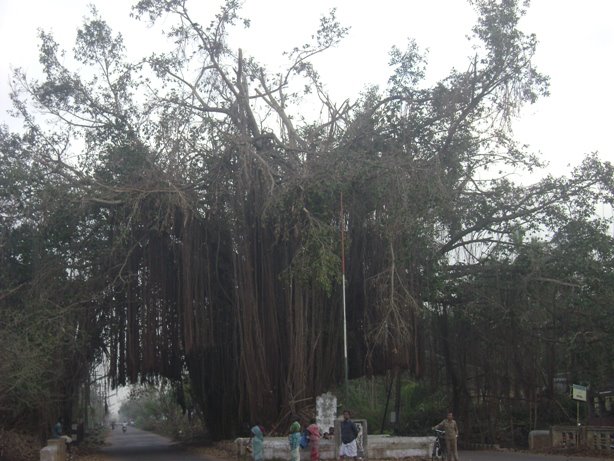
People come and go. Cyclones blow past. The firmly rooted banyan trees stand witness to all things good and bad.
Here is to hoping for a lot more good than bad!
Subscribe to:
Posts (Atom)