Showing posts with label demographics. Show all posts

Saturday, November 17, 2018

Getting older

I often punctuate my comments in the introductory course that I teach with statements like, "if, like me, you pause to think about all these, you will be amazed at how much everything has changed in a very short period of time."  It boggles my mind.  Based on these changes, I tell them that we have no idea what further changes await.

I don't think many people pause to think about all the changes.  They are so busy rushing around that they have no idea about it all.

As they rush around, people don't even realize that they have long lives ahead of them, for which they are unprepared.

A decade ago, researchers proclaimed that half of the babies born in wealthy countries in this new millennium will live to 100 years, or even more.  They will live through this entire century!

Most of the students in my introductory course are in this category.  Many of them, unless they get into some really bad habits, will perhaps celebrate the new year as the Big Apple descends on December 31, 2099.

I tell them to pause to think about these.  Of course, nobody listens to me!

Japan is already struggling with these changes.   Japan’s prime minister, Shinzo Abe, talks of “designing the 100-year-life society”.  Good luck with that!

To deal with the 100-year life society, Japan needs to "persuade current workers to labour longer, encourage more women to enter the workforce and let in more immigrants."  More immigrants because women there are having very few kids, which is rapidly escalating into an acute labor shortage: "Japan’s population is declining by almost 400,000 a year and there are a stunning 1.6 vacancies for every jobseeker."

If only we paused to think about what all these mean here in our own countries.  But, of course, we don't.  When was the last time you heard an American politician discussing such urgent and complex issues related to demographics and aging?
By 2035, there will be 78.0 million people 65 years and older compared to 76.7 million (previously 76.4 million) under the age of 18


To deal with these changes will require the US also to "persuade current workers to labour longer, encourage more women to enter the workforce and let in more immigrants."  But, we already have high participation of women in the workforce, compared to Japan.  And we are forever increasing the age at which seniors can tap into the benefits.  And, of course, under trump, we are making sure that we won't let in more immigrants.

Iceberg alert.  Never mind; full steam ahead!

Wednesday, August 09, 2017

The tyranny of the old

"Old soldiers never die, they just fade away," said Douglas MacArthur.  To which maybe it is time we added a twist: The old are neither dying nor fading away that easily!

I have complained enough about the choke-hold that older people have on everything going on in the world.  I have called them names, like tyrannosaurus elderex!  Of course, I have screamed at the senior citizens in my profession to retire already.  For whatever reasons, we do not engage in honest conversations on senior citizens who don't want to call it quits.

Remember the political campaigns here in the US just a year ago?  How could you forget, right?  Now think about the three of them who were yelling every single day: Hillary Clinton, Bernie Sanders, and donald trump.  Who was the spring chicken there?!

This country has slipped into a gerontocracy even as we were all watching.
The highest levels of American politics bear an uncomfortable resemblance to a gerontocracy. From the Senate to the presidency to — perhaps most strikingly — the Supreme Court, top positions are held more and more by people in their 70s or above.
What happened, right?
In the body as a whole, 23 senators are at least 70. Seven are 80 or older.
Keep in mind that there are only 100 senators.  Which means, 23 percent is at least 70 years old.  Whatever happened to graceful retirement and encouraging a new and younger set of people taking over?
We should address these matters without rancor or cruelty, but also without euphemism or undue reticence.
These matters are hard to talk about in American politics because they are hard to talk about in our own lives. I see my mortality etched on my father’s face, as my daughters see it in mine. Mortality and bodily fragility are two great constants of human life. How we handle those constraints provides a small but important test of American democracy.
And that is the crucial point: Whether it is in our personal lives, or in the context of our public officials, we do not engage in open and honest conversations regarding aging and mortality.  As long as we do not address these issues, well, expect the drooling and fragile tyrannosaurus elderex to get more and more powerful.

Saturday, August 27, 2016

Good news for a change. Nah, I am kidding!

One of my favorite ideas that I try to convey to students in the introductory class is this: Everything economic that we can think of is a mere 200 year story, which means that we humans are not mentally ready for the kinds of changes that keep coming our way.  We are not biologically wired for such a pace.

I suppose it might be difficult for a 20-year old to really, really appreciate what I tell them.  If I were a 20-year old, I might not even taken classes that I offer ;)

Consider the simple aspect of having children.  Even a hundred years ago, people did not give much thought to having children.  People had kids, was a simple fact.  If they didn't, it was either because they were biologically incapable--and cultures had lots of awful words to ridicule them--or they had opted for a life without sex.  But, life has changed, and changed rapidly.  Now people choose to have no kids, or only one child, or maybe two.  

The pace of such dramatic changes leads us to being completely unprepared as "the largest youth population in human history is coming of age in a steady, unstoppable wave."
societies across the Middle East, Africa, and South Asia are experiencing youth booms of staggering proportions: More than half of Egypt’s labor force is younger than age 30. Half of Nigeria’s population of 167 million is between the ages of 15 and 34. In Afghanistan, Angola, Chad, East Timor, Niger, Somalia, and Uganda, more than two-thirds of the population is under the age of 25.
How well these young people transition to adulthood — and how well their governments integrate them economically, politically, and socially — will influence whether their countries thrive or implode. Surging populations of young people will have the power to drive political and social norms, influence what modes of governance will be adopted and the role women will play in society, and embrace or discredit extremist idesituatiologies.
Idle young men, in particular, filled with testosterone, can easily slip into various kinds of anti-social and destructive activities--more so if they do not have war or sex as outlets for the testosterone.  
As we ponder our path forward, we should consider that the developing world’s youth boom coincides with four interrelated global trends: an information revolution, the largest movement of refugees and displaced people in recorded history, growing urbanization that will concentrate youth in cities, and a rise in terrorism and extremist ideologies. Together these trends will spread not just people but, more importantly, their ideas at an unprecedented rate. They will raise and dash expectations pushing and pulling young people toward and away from their hometowns and homelands, toward and away from their desired futures. They will make young people around the globe aware of how others are living, the divisions within their societies, and how those they identify with are treated by governments, security forces, and other groups. This knowledge can inspire or anger. It can commit people to elevating their families and communities — or make them lash out against them.
I tell ya, Major Buzzkill General Malaise is always ready to brighten your day ;)

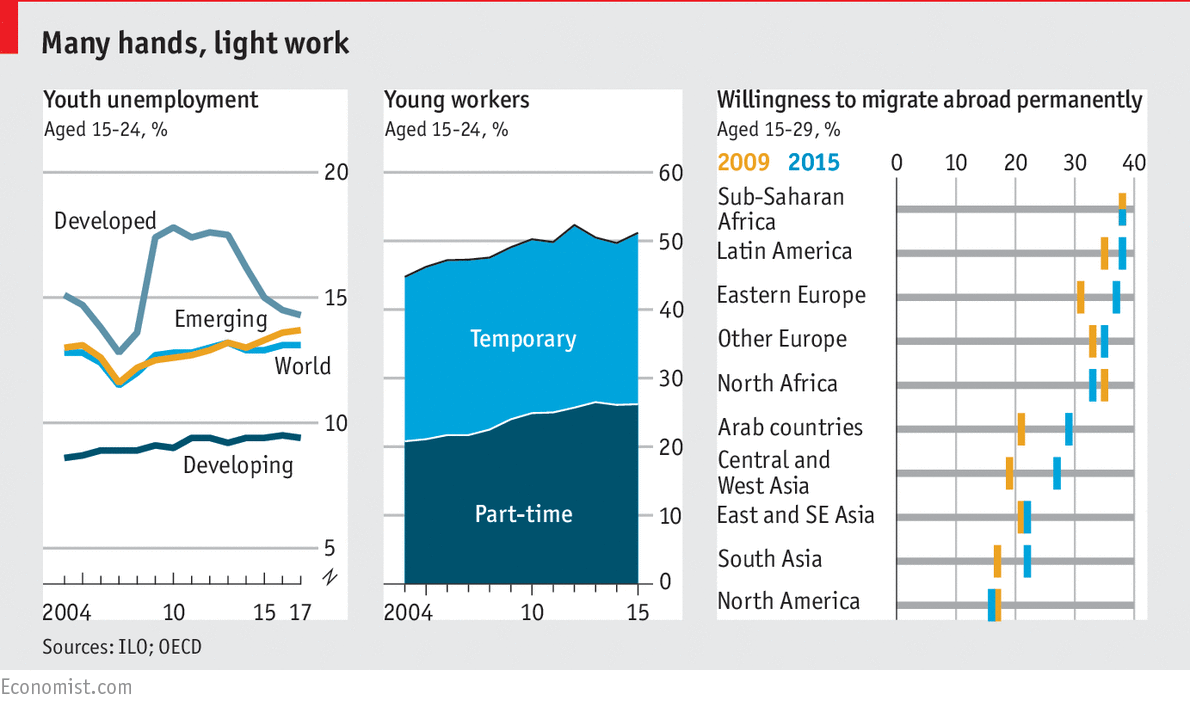
This situation sets up the probability for more migration:
As poor countries prosper and their young become more educated, they are more likely to migrate. It explains in part why India has the largest diaspora in the world: In 2015, 16 million Indians were living outside India, double the number in 2000.
The youth will be highly motivated to move if employment prospects are dim in their home countries:


"Given the bleak future faced by many, it is little surprise that 40% of 15-29-year-olds in Africa, eastern Europe and Latin America would countenance a permanent move abroad."
I hope the political leaders are paying attention.  Oh, wait, of course they don't pay attention.  Which means, I get yet another opportunity to utter a favorite phrase of mine: we are screwed! ;)

Monday, April 25, 2016

My university and Europe

The university where I work invited interested faculty members to self-nominate themselves to serve on the Strategic Planning Committee.  Given my interests in higher education, and given that the directions that the university sets through this committee will be in place until I retire or am fired, I nominated myself and provided evidence of my track record in thinking above and beyond mere courses and the small little bubbles in which most discussions are trapped.

Of course, I was not selected to be on that committee.  What do I know about higher education!

In a brief thank-you email after receiving the notification that also included the list of faculty named to serve on the committee, I added a sentence that I hoped would make them all think about the committee's composition:
BTW, it seems kind of odd that faculty membership does not include any "people of color" as they say ;)
It was not diversity for the sake of diversity that I pointing out, but was instead about the need to think of the demographic reality.  Strategic Planning is about consciously developing specific action items for the future.  The demographic future of the country is in beige, the 2042 that even comedians joke about.  Oregon is notorious for not knowing how to deal with diversity, whether based on the superficial skin or on religion.   Especially Islam.

Everybody is talking and writing about Islam and the Arab world and Muslims.  The more one delves into the news, the more we realize we don't know anything about Islam, the Arab world, and Muslims.  Robert Kaplan writes that "Europe was essentially defined by Islam. And Islam is redefining it now."
The cultural purity that Europe craves in the face of the Muslim-refugee influx is simply impossible in a world of increasing human interactions.
“The West,” if it does have a meaning beyond geography, manifests a spirit of ever more inclusive liberalism. Just as in the 19th century there was no going back to feudalism, there is no going back now to nationalism, not without courting disaster.
In his short essay, Kaplan makes extensive reference to Edward Said's Orientalism.  Naturally.  Said had plenty of profound observations on the distorted--and intentional at that--understanding that the "West" has about Islam and the Arabs.
The scholar Edward Said took this point further, writing in his book Orientalism in 1978 that Islam had defined Europe culturally, by showing Europe what it was against. Europe’s very identity, in other words, was built in significant measure on a sense of superiority to the Muslim Arab world on its periphery. Imperialism proved the ultimate expression of this evolution
In a lengthy essay after his book was published, Said wrote--keep in mind that this was in 1980:
 If you were to ask an average literate Westerner to name an Arab or Islamic writer, or a musician, or an intellectual, you might get a name like Kahlil Gibran in response, but nothing else. In other words, whole swatches of Islamic history, culture and society simply do not exist except in the truncated, tightly packaged forms made current by the media. As Herbert Schiller has said, TV’s images tend to present reality in too immediate and fragmentary a form for either historical or human continuity to appear. Islam therefore is equivalent to an undifferentiated mob of scimitar-waving oil suppliers, or it is reduced to the utterances of one or another Islamic leader who at the moment happens to be a convenient foreign scapegoat.        
If that is the case with the average literate Westerner then do we need to even wonder why there are plenty of Americans today who eagerly embrace the anti-Muslim and anti-Arab rhetoric from Donald Trump and Ted Cruz!

Even at the university, the numbers of students from Saudi Arabia and their families have not been strategically used as opportunities to truly understand "them."  Instead, it seems that my university, like many others, merely continues to treat the foreigners as revenue sources, which is not that different from the "scimitar-waving oil suppliers" caricature that Said was upset about.

At this rate, it seems like it will be a close race between my exit from the university and the ultimate exit itself ;)

Saturday, December 27, 2014

The Indianizing Indians

Slowly things are changing in this part of India.  It is Indianizing.

A few days ago,
before the mysterious fever with aches and pains like I have never had in my life--which miraculously disappeared in 24 hours--and before
the horrible experience of traveler's diarrhea--my first in all these years of traveling in the US and different countries, including India,
I walked around the uber-congested shopping areas of the infamous Ranganathan Street.  In the heart of traditional Chennai.

Source

I was shocked to hear languages and dialects that I am sure were not from the Dravidian south, nor were there any Hindi words.  I couldn't pick up any Bengali sing-song either.  In the heart of traditional Chennai!

Even more shocking was to see people who were clearly not from the Dravidian south, nor from the Hindi Belt.  From the northeastern parts.  Walking around casually in the heart of traditional Chennai!

Another day, my brother and I were in an autorickshaw when the driver pulled into a fuelling station--an LPG fuelling station.  As the driver pushed his vehicle along in the long line, another auto driver attempted to cut in. The station attendant came charging and let out yells--in Hindi!  The guy obviously was from another part of India, and was working here in the traditional Chennai, and hadn't learnt the local language to yell in Tamil!  Hilarious it was.  And one more evidence of the India that is slowly changing and mixing.  I call it Indianizing.

People from other parts of India moving to Chennai is easy to understand.  It is a combination of demographics and economics: economic growth rates are not enough in areas with high fertility rates, whereas Chennai and the Dravidian south are experiencing economic growth while the fertility rates have fallen well below replacement levels.


My ground-level observations match up with this report:
Internal migrants in India are expected to touch 400 million in the 2011 census, over half the global figure of 740 million and almost twice as many as China's estimated 221 million.
A third of the country's population are internal migrants.  What a phenomenal change from even two generations ago!
According to the report, internal migrants faced discrimination as 'outsiders', which excluded them from access to legal rights, public services and social protection programmes accorded to residents. This is despite the migrants providing cheap labour and typically doing the most dirty, dangerous and degrading jobs that locals do not want to do. Far from being a burden on society, migrants' cheap labour provides a subsidy and contributes to the national GDP, stated the report. Moreover, remittances from migrants lead to increased expenditure on health and education helping human capital formation.
To be viewed, discriminated, as "outsiders" is not an unusual experience for migrants--internal or international.  Change from the old is not easy for us humans to handle.  But, as this migrant will attest, we migrants are a hardy bunch.  I am sure even the Hindi-yelling LPG gas station attendant will survive and prosper--even in the heart of traditional Chennai!


Saturday, July 12, 2014

On this accidental life

Every once in a while, in the introductory course in which demographics is one of the topics we address, I assign students the task of talking with their parents and grandparents about why they chose to have the family size they had.  "If they had three kids, ask them why they decided against two or four, for instance" I would tell them.  Of course, the written essay about the family demographics will be situated in the context of academic discussions.

When we regroup and discuss the assignment, I can always expect a student or two to talk about how they were "an accident," as in an unplanned pregnancy.

What we almost always overlook is this: every one of us--yes, you and me included--is an accident.  We are “children of chance.”
The time traveler, however, does not need to kill his grandfather to wipe himself out of existence, for as we said children conceived at different times would be in fact different children. All he has to do is distract his grandfather long enough to alter the timing of the conception of his grandfather’s child, and poof! He vanishes. Given that men produce about 1,500 sperm per second and that the particular sperm that succeeded in fertilizing the egg from which our time traveler’s parent came was in competition with about 400 million released on average during sex, I should think a loud thud on Gram and Gramps’s bedroom door at just the right moment should do the trick.
In the generations prior that had sex in order for us to be here at this time, one teeny weeny deviation from that intercourse, or if one of the other sperm among the 400 million had reached the egg first, the rest would have been history.  I might not even have been created and, thus,I might not exist.  How bizarre is that!  Without those series of accidents, there is no possibility for that favorite articulation of cogito ergo sum.
It also sets up a sequence of events in which an entirely different set of people end up being born. Unlike most actions whose remote consequences diminish to zero, like the furthermost ripples of a pond after a pebble has been thrown into it, altering when children are conceived or to whom they are conceived has repercussions that steadily increase over time. The consequences of a different set of marriages, births, accidents, road gridlocks, crimes, FIFA World Cup winners, businesses, books, inventions and scientific discoveries increase exponentially the further we progress along time’s arrow.
Given such a tenuous existence that was created out of a freakish ultra-low probability accident, it is depressing how much we go about making lives unpleasant--we fight, we kill, we enslave, and we even attempt to wipe out of existence "different" people.

With no such everyday realization that we are "children of chance," it is no wonder that we are far, far away from peace on earth!

Wednesday, July 24, 2013

The postman always rings twice? Not with wedding invites!

"Only one wedding invitation this year so far" my father complained.  "Usually, every year we get so many wedding invitations that I would get concerned about being forced to skip some.  And, only one this year.  Every day I look at the mailbox hoping there would be an invitation" he added.

I wasn't sure if it was one of those conversations in which I merely had to listen. After all, it is not always that people look for responses to everything they say.  Sometimes, they merely want to express a thought.  An emotion. Nothing more to it.

It took me a long time to figure that out. Well, it was the daughter who explained that concept a few years ago when she was an undergraduate student.  Whereas I thought that as the father I had to act on whatever she said, it turned out to be otherwise. Apparently, all I had to to was to listen. Life became easier after that!

Now, with father, hey, we are both men too. Men don't emote--we are doers. Or so, I thought.  The nerd in me kicked in.

"I know what you mean.  It is all the demographic changes. Over the years, our people in South India have been having fewer and fewer kids, and now it is showing up.  Further, the kids are delaying getting married, and sometimes choose not to get married.  Thus, unlike the old days, you no longer have a bunch of weddings every season. Invitations to weddings will be rare anymore."

And then for a good measure, I added, "the trend is that you can expect more second marriages anymore."  I was referring to the post-divorce second marriage, of course, which is a case of hope triumphing over experience!

That killed the topic and father moved on to something else.

I am guessing that I was merely supposed to listen and say "aha."

It is not that I was citing incorrect data.  When people--even those within India--think about population, they often work with images of the old India. The old India where men and women married when fertile and couples had anything between two and five children. But, those were old stories.  In a matter of two generations, the story has been completely re-written.

Among us three siblings, my brother is the big family man with two children!  One kid seems to be the new normal, and there are quite a few without kids. Without kids because they chose not to get married, or after marriage they don't have children for whatever reason.

Our minds haven't adjusted to this new reality and, thus, father hasn't revised his expectations for wedding invites.

The map below says it all--TFR is the average number of children that a woman has in her childbearing years.


Tamil Nadu, where my people hail from, has fertility rates that are lower than the rates here in the US.  Americans, who are long used to images of too many babies in India, might find it a shocking revelation that we in the US have, on an average, more children than women do In Tamil Nadu, or in Kerala, or in Karnataka, or in .... These are not states with small populations either.  As this Wikipedia entry helpfully points out, Kerala's population makes it a Canada-equivalent. Tamil Nadu is like Turkey. With its low fertility rate, Karnataka is really like Italy!

Thus, wedding invitations have become rare.

Weddings are, of course, not merely about weddings. They are occasions for reunions. Meeting with friends and families. I know that is what father is referring to. He misses those opportunities to say hello, and more, to people. He was expressing that emotion. I should have done what my daughter advised me a long time and merely said "aha."  Well, stupid is as stupid does!

Saturday, November 24, 2012

Liberalizing immigration will not lead to the Camp of the Saints

Russell Peters has a funny routine about the mixing of different groups and the coming "beige-ification" of the planet--that eventually we the global population will be a mix of Indian and Chinese genes with the rest, because these two populations account for a third of the world.

There is a serious demographic argument underlying that joke--the different rates of population growth across the geographic areas, especially across countries.  With Europe and Japan rapidly depopulating, whether or not to allow foreigners into the borders will take on a more urgent tone.  In relatively immigration-friendly countries like the US and the UK, it also means that we are at important crossroads where the tightening or relaxing of immigration policies could have long lasting economic implications.

In the absence of tight border controls against migration, people would move around a lot more than they do now because of the immense economic incentives:
An individual worker, however talented, cannot hope to replicate the fertile environment of a rich economy all on his own. But transplanting a worker into rich soil can supercharge his productivity. A Mexican worker earns more in the United States than in Mexico because he can produce more, thanks to the quality of US technology and institutions.
This is, after all, another way of presenting Warren Buffett's argument on winning the "ovarian lottery" and that he couldn't have produced all the wealth that he did if he had been born in some country that is much poorer than the US. 

What could happen in a hypothetical scenario where half of the developing world’s workforce moved to to the rich world?
If migration closes a quarter of the migrants’ productivity gap with the rich world, their average income would rise by $7,000. That would be enough to raise global output by 30%, or about $21 trillion. Other studies find even bigger effects. A 2007 paper by Paul Klein, now at Simon Fraser University, and Gustavo Ventura, now at Arizona State University, reckons that full labour mobility could raise global output by up to 122%. Such gains swamp the benefits of eliminating remaining barriers to trade, which amount to just 1.8-2.8% of GDP, reckons Mr Mukand.
Yes, a strictly theoretical argument it is, because there is no way that such a large-scale movement of people will ever be allowed, despite the healthy track record that we have about the successes: from the US, the UK, Canada, Australia, the Persian Gulf countries, Singapore, ...

There is, of course, a gut-level economic opposition to an inflow of labor--from the worry that it will depress wages.  That it could lead to a Grapes of Wrath scenario of labor undercutting each other's wages as they search for productive employment. But, more often than not, our guts mislead us:
In a recent paper on western Europe Francesco D’Amuri of the Italian central bank and Giovanni Peri of the University of California, Davis find that immigration encourages natives to take more complex work. Such “job upgrades” are responsible for a 0.6% increase in native wages for each doubling in immigrant labour-force share. Where immigration disadvantages subsets of the population, Gordon Hanson of the University of California, San Diego reckons that charging an entry fee to migrants or their employers could help pay for training or benefits for those who lose out.
There is then the social opposition to immigration: people coming in from other cultures will mess up the "native" culture.  The controversial novel, The Camp of the Saints, captured this very well, though, when I read it a few years ago, there were many instances when I had to force myself to read through despite the atrocious attitudes towards the brown skin.  People might couch the same worries in more polite and politically-correct ways, but the non-economic reasons might perhaps be even weightier than the "they will take my jobs" argument.  It is considerably easier to present the logic and evidence on economic issues than it is to educate people to get rid of their biases against peoples of other cultures.  

As the GOP found out from the recently concluded elections, demographics is destiny.  It is yet another case of political contradictions: the Democrats will all their unions are stereotypically against more labor coming into the country, and yet they are the party overwhelmingly preferred by the non-Whites, including the immigrant population.  The GOP, which talks way more economic liberalization, is increasingly hostile to reforming immigration policies because of the worry deep down that immigrants and their children vote Democratic.

The rich countries have very little time left to figure out how they want to deal with immigration.  It is a demographic race against the clock. 

Sunday, December 05, 2010

200-year economic history of 200 countries in 4 minutes

I have used many of Hans Rosling's videos in my classes, ever since I watched the first TED talk of his.  While most of the students are, well, students who are indifferent to anything (even my awful puns!) there are always a few who are blown away by his explanations.
I am sure I will use the following next term (and after too?) ... ht

Monday, February 01, 2010

What a depressing news headline :(

Huge Deficits May Alter U.S. Politics and Global Power

That is the headline over at the NY Times.

My question is this: why the use of "may" and not "will", eh?
American deficits will not return to what are widely considered sustainable levels over the next 10 years. In fact, in 2019 and 2020 — years after Mr. Obama has left the political scene, even if he serves two terms — they start rising again sharply, to more than 5 percent of gross domestic product. His budget draws a picture of a nation that like many American homeowners simply cannot get above water.
For Mr. Obama and his successors, the effect of those projections is clear: Unless miraculous growth, or miraculous political compromises, creates some unforeseen change over the next decade, there is virtually no room for new domestic initiatives for Mr. Obama or his successors. Beyond that lies the possibility that the United States could begin to suffer the same disease that has afflicted Japan over the past decade. As debt grew more rapidly than income, that country’s influence around the world eroded.
Again, where from does the NY Times get an optimism to use "may" instead of "will", you ask?  Well, it is at the tail end:
“Much may depend on whether we put in place the financial reforms that can rebuild a functional financial system,” Mr. Galbraith said, to finance growth in the private sector — the kind of growth that ultimately saved Mr. Clinton from his own deficit projections.
His greatest hope, Mr. Galbraith said, was Stein’s law, named for Herbert Stein, chairman of the Council of Economic Advisers under Presidents Richard M. Nixon and Gerald R. Ford.
Stein’s law has been recited in many different versions. But all have a common theme: If a trend cannot continue, it will stop.

I suppose we can expect the dollar to continue to slide down.  Meanwhile, the demographic dynamics of the Euro zone and Japan mean that those economies will slowly lose their influence and so will their currencies.  The Russian demographics are no different.  So, it will all come down to a showdown between China and the US.

And, it does not appear that the Chinese politburo is as stupid as the Soviets were.  Which means chances are pretty good that China will stare us down?  Hmmmm.....

Perhaps I should return to using the line I discontinued, when talking with students: "you are screwed!"