Showing posts with label economics. Show all posts

Saturday, October 17, 2020

Want to talk about Sully Prudhomme?

Six years ago, I argued in my talk that academe that has been taken over by hyperspecialization, because of which we have failed to contribute to big and contemporary questions for which the public is eagerly looking for answers.

Hyperspecialization has its place, no doubt, even though it leads researchers to inventions and discoveries that are fraught with ethical concerns.  But, that level of hyperspecialization is required in the natural sciences, and not in the social sciences and the humanities.

I could re-run that argument practically every time the "Nobel" Prize in economics is announced.  But, who cares about what I think; let's hear from a real expert--Branko Milanovic.

I have blogged a lot quoting Milanovic.  A consummate scholar, with a phenomenal level of expertise in income and wealth inequality.   A decade ago, Milanovic crunched a whole lot of data and gave us this simple and clear bottom-line: "an astounding 60 percent of a person’s income is determined merely by where she was born (and an additional 20 percent is dictated by how rich her parents were)"

Isn't that a perfect example of big and contemporary issues that the public wants to understand?  Especially here in America where we are told that you, too, can pull yourself up by your bootstraps and become a wealthy individual, we need such a reality check.  You can certainly hang on to your bootstraps, but it will certainly help to be aware it is rigged game in which 80 percent is pre-determined.

Milanovic had a few thoughts after the economics "Nobel" was announced.  He writes (well, tweeted):

when we ignore this biggest issue of all, we are --as indeed we seem to be-- in the world of Nobel in literature. At the time when Tolstoy, Joyce and Proust were publishing, the Nobel prize went to… Sully Prudhomme. Yes, Sully Prudhomme (check it out).

Sully Prudhomme?  I have never even heard this name before. So, yes, I checked it out.  Strange!

In a threaded series of tweets, Milanovic writes:

The point I want to make is this: Economics is a social science. Its aim is to make us understand the world and make people’s lives (materially) richer. The work that should be singled out is the work that does that—in a big way.

Yep.

Tuesday, July 21, 2020

What if we don't reconstruct an "efficient" economy?

I have ranted, sometimes nearly hysterically, against the primacy of efficiency.  As I wrote in this post a while ago, even as an undergrad, and definitely in graduate school, I had an intuitive understanding that there was something wrong with the pursuit of efficiency.  After all, if I had worshiped efficiency, I would have then stayed in engineering, which is about making "things" less inefficient.

Years have gone by.  Heck, it has been decades.  I have only become even more of a efficiency-hater.  Especially in the world of higher education, for which I often quote Leon Botstein:
No matter the outcome of such a conversation, a very important point is that we must make clear that the university will never be an efficient institution. A university is, by definition, inefficient. If one wants a great university, one has to put up with “wasted” time, unproductivity, seeming leisure.
However, whether it is in higher education, or by individuals who want to manically multitask, there is a huge worship at the feet of efficiency.  If only people would understand that efficiency is more satan than god!

The COVID-19 life is a context in which we could engage in discussions on efficiency.  Right?
Efficiency means getting the most “bang for your buck”, the most benefit for every pound spent. Any other course of action is wasteful, surely? But eliminating waste implies eliminating excess capacity, and we now see the consequences of that in health systems worldwide. Our obsession with efficiency, if it means failing to plan for a pandemic or a climate emergency, will cost lives.
Our priority should be resilience, not efficiency. We need to build resilient systems and economies that are explicitly designed to withstand worst-case scenarios – and have a fighting chance of coping with unforeseen disasters too.
Am reminded of an old joke about an auditor who viewed fire engines that the company had as wasted investment because they were rarely used!

If only we would use the coronavirus conditions to rethink efficiency!

Should we focus our energy on rebuilding an economy that was governed by the rules before COVID-19 brought activities to a halt?
What if, instead of going back to work full-time, we decided to work less, buy less, make less, and not fight to raise GDP at any cost?
What if?

Seriously, what if?  Why not think about prosperity without growth?
“Reversing consumerism’s financial and cultural dominance in public and private life is set to be one of the twenty-first century’s most gripping psychological dramas.”
What good is all the wealth when, for instance, four months into a lock down of sorts, and six months since the virus went, ahem, viral, we in the US are yet to develop enough testing capacity and PPE?  Does it not mean that all that wealth is inefficient, when we should have instead invested in "wasteful" resilience?

I suppose I will have lots more time to "waste" on such matters after I am laid off!

Tuesday, May 21, 2019

The naked truth

I have always been impressed with people who seem free and liberated enough that they color their hair in purple and blue and whatever else; or wear outrageously colorful clothing; or couldn't care about how they look when they are clothed or not.  Nudity in the public terrifies me, and I bet am not alone.

I am, therefore, all the more impressed that an academic at Cambridge, with graduate degrees from Oxford, sometimes presents self in the nude in order to convey the point.  In the nude in the public.  Or, in the nude in videos that the entire world can watch whenever.  And, oh, this a female academic.

I won't embed any unclothed image of Victoria Bateman's in this blog, even though it is not at all difficult to track them down.  Bateman herself provides plenty even at her Twitter stream.

Why the public nudity sometimes?  For one, she is pissed off that women are "invisible" to economists and economic historians.  And, she is one hell of a strong feminist.
I think “my body, my choice” should be at the heart of feminism. It shouldn’t just apply to birth-control rights.
Bateman's forceful and well thought out arguments remind me of Camille Paglia.  But, I don't want to digress.

Bateman has come out with her latest book, which is about how women made the West rich.
The Industrial Revolution was a new technological wave. Women were crucial for sowing the seeds of that wave. They created the incentives for technological change, the savings, the skills base, and the entrepreneurship. But when that feeds through to the economy, women don’t get paid back in return.
And so we see quite a sizable decline in women’s participation in the labor force throughout the Industrial Revolution. By the late 19th century, we have the roots of the idea of the male breadwinner model. That then becomes the middle-class ideal, and we then get the cult of domesticity.
Which leads us situations like this today:
There was an International Labour Organization (ILO) report out last year that showed that globally 75% of unpaid care is provided by women. They estimated it’s the equivalent of 2 billion women working full time, for nothing. The ILO says the way in which unpaid care is seen as women’s responsibility is one of the big impediments to women entering the workplace and being able to achieve equality within the workplace.
Now, don't for a second be tempted into thinking that Bateman comes from a privileged background and, hence, the OxBridge and feminism and nudity and all that.  Nope.  Bateman's parents didn't complete high school.
[Her dad,] inspired by Thatcherite entrepreneurialism, went into business for himself, again in ductwork, and her mom helped out with the administrative side while working other odd jobs and raising Bateman and her two younger sisters. Customers often couldn’t pay Bateman’s father, and the business soon went under. When Bateman was 11 and home sick, she’d go with her mom to clients’ homes begging for them to pay what they owed, sometimes blocking their driveways to help persuade them. At home, however, the family was on the flip side of that ugly equation, several men armed with bats demanding that her parents pay what they owed.
When Bateman was 14, her parents split, and her mom raised the girls as a single mother.
A tough life.  A blue-collar background just like Paglia's.

A woman who has accomplished a lot. "Bateman is embraced and appreciated by colleagues and students alike for her approachability, her down-to-earth sensibility, and her sense of humor."
Her dad, now in his 70s, still works in duct fitting, traveling about in his van. Her mom was in a bad car accident 10 years ago and is on disability. One of her sisters went to night school and has pulled together a career for herself, but the other still struggles mightily.
But, even this uber-confident feminist academic sometimes feels the bad moments ... what does she do? "I play the Ella Fitzgerald song “They all laughed.”

Whether we are clothed or in the nude, men or women, academics or duct workers, we all find comfort in Ella Fitzgerald ... and Louis Armstrong.  

Saturday, April 20, 2019

A new social contract for progressive capitalism

I searched my blog for the earliest post that included the label "Stiglitz."  I am not at all surprised that it was way back in 2008, not long after I re-started the blog.

In that post, I wrote, "It will be neat if neoclassical economics alters its course thanks to Amartya Sen, Joseph Stiglitz, and Paul Krugman. but, maybe that is asking for too much, eh!"

In my understanding, mainstream academic economics--and its political variation--did not significantly change in the more than ten years since then.  Even the nasty Great Recession did not force a sharp re-thinking in economics and politics!

There is a reason that I have keenly followed these three: They are not merely economists of repute, but also phenomenal thinkers.  And, they also write in a manner that makes even blokes like me understand the weight of their arguments.

Stiglitz has, forever it seems, yelling about the need to redo the social contract, so that it would reflect the conditions in which we live now.  There are a number of posts where I have quoted him, among many others, on the need for a new social contract.  Like in this post from three years ago.

It is also instructive to think about the comment there: "Stiglitz is in the same camp as Krugman and therefore I have to take many a gulp before I write this comment - lest Trumpesque unparliamentary language creeps in :)"  That comment is reflective of the intense political opposition that existed, and continues to exist.

In his latest opinion essay in The NY Times, Stiglitz writes:
We are now in a vicious cycle: Greater economic inequality is leading, in our money-driven political system, to more political inequality, with weaker rules and deregulation causing still more economic inequality.
If we don’t change course matters will likely grow worse, as machines (artificial intelligence and robots) replace an increasing fraction of routine labor, including many of the jobs of the several million Americans making their living by driving.
Even a casual reader of this blog knows well how much I have worried about these very issues, and which is why I have been yelling from my corner about the need for a new social contract.  A contract that would not dampen the innovative and creative forces in the marketplace, but would also provide a lot more support to the people and places that get left behind.

Stiglitz calls for a new social contract, through Progressive Capitalism.  A political economic structure that will be different from what we now have:
Most important, our exploitive capitalism has shaped who we are as individuals and as a society. The rampant dishonesty we’ve seen from Wells Fargo and Volkswagen or from members of the Sackler family as they promoted drugs they knew were addictive — this is what is to be expected in a society that lauds the pursuit of profits as leading, to quote Adam Smith, “as if by an invisible hand,” to the well-being of society, with no regard to whether those profits derive from exploitation or wealth creation.
This was the fork-in-the-road that we faced in the elections of 2016.  No thanks to two old white men, 63 million forced the country to take the wrong route despite all the flashing red lights warning us of danger ahead.  Let's see what we do in 2020.

Wednesday, June 13, 2018

Party like there's no tomorrow

The Queen of the United Kingdom and the other Commonwealth realms famously asked a bunch of eminent academics at the London School of Economics why nobody noticed the Great Recession before it arrived.

A simple question that all of us regular people have.  Of course, all the economists do was hem and haw and look the other way.  After all, as the joke goes, economists have correctly predicted 7 of the past 4 recessions!

Predicting the next recession is not easy.  It is impossible.  But, hey, I am not an economist; so, it is not like my reputation is on the line or anything ;)  But, I wonder if we are getting closer and closer to the next one.

Four years after the Queen asked that question, she got an answer:
Sujit Kapadia from the Bank's financial services committee gave the Queen three reasons why the crisis happened - one of which was that it was rare event which made it difficult to predict.
He added: "People thought markets were efficient, people thought regulation wasn't necessary. Because the economy was stable there was this growing complacency,"
"Thirdly, people didn't realise just how interconnected the system had become."
The Queen replied: "I suppose, in money terms, it is very difficult to foresee. But people had got a bit lax. Have they?"
The system is even more interconnected compared to a decade ago.  We have in power at the Oval Office, in the Senate, and in the House, maniacs who believe that regulation is unnecessary.  And, we the people have become a tad too complacent. They don't add up well, do they?
Rapid technological advances are propelling the U.S. economy into a new paradigm, unemployment is the lowest in decades, corporate debt is rising, inflation is dormant and the expansion is one of the longest on record, even if growth isn’t that hot.
Much of that growth is being driven by consumer spending fueled not by rising income, but by borrowing more and running down savings, which have slumped to historically low levels.
Sound like the U.S. economy today? Yes, it does. It’s also the U.S. economy of July 2000
Yep, American consumers are at it again. Spending the money that we don't have, confident that the boom times will continue forever.

So, for how long can consumers can carry on spending, while saving practically nothing at all?
“The toxic mix of rising interest rates, falling savings, low or falling incomes and high levels of corporate debt is a train crash waiting to happen,” said Ann Pettifor, director at Policy Research in Macroeconomics in London. 
Any other perspectives?
The historically low household savings rate has caught the eye of Bernstein, which is now at least partially reconsidering its positive economic outlook for 2018.
 "A big financial shock — which is a plausible scenario for 2018 — not only would damage the consumption forecast but could end the expansion itself," Philipp Carlsson-Szlezak, an economist at Bernstein, wrote in a client note. "For 2018 it remains a core cyclical recession scenario in our coverage."
Always keep in mind that the day before the stock market crash of 1929, an eminent economist of the day, Irving Fisher, made the worst prediction ever:

Source

Monday, April 16, 2018

We don't know shit!

When people ask me what economic geography is about, one of the examples I give them is what I refer to as a big-picture question.  And that is: Why are some countries rich and some poor?

People always get excited about this example.  Their response is typically along the lines of "wow, I had no idea that geography includes such topics.  I would love to take your classes."

What I don't tell them is this: Don't ask me for the answer on why some countries are rich and some are poor because, well, nobody knows!

We can fairly easily explain why a country is poor.  That is not what I mean.  But, how to place a country on a path of sustained economic and social growth?  This continues to be a mystery, as it was to me when I began graduate school more than three decades ago.

The Economist addresses this metaphorical elephant in the room:
Economists have precious few hard facts about growth. They know that sustained growth in GDP per person only started in the 18th century. They know that countries can become rich only by growing steadily over long periods. They know that in some fundamental way growth is about using new technologies to become more productive and to uncover new ideas. Beyond that, almost everything is contested.
That's what I don't tell people when they ask me about economic geography.  We don't know shit!

But, this is too important a question for us to ignore. The fact that we don't know shit does not mean that we give up.  Why?
A clearer understanding of how growth happens, and why growth-boosting institutions sometimes wither or fail to take root, could raise the living standards of billions of people. The economics of growth should therefore be central to the discipline, even though the questions it poses are objectively hard, and the answers rest more in history and politics than in elegant mathematics.
Note that dig about "elegant mathematics"?  One of the reasons that I chose to go far away from from the economics folks is because of their worship of the math and statistical models, which really don't give any credible answer.  Yet, that is how the academics play their game.

The Economist wraps it up with a valuable advice:
Until they can give better answers in this area, economists should speak with greater humility about how this structural reform or that tax change might affect long-term growth. They have not earned the right to confidence.
Like I said, we need to admit that we don't know shit.

But then, Que sais-je?!

Friday, December 08, 2017

Eat, drink, and be merry, for tomorrow we die

When we were kids, my parents meticulously kept accounts of household expenses.  I know it well because even we tiny ones were involved with the accounting.  We helped count up the coins and helped them remember the expenditure items.

Thus, we were all intensely aware that there was no free money lying around. Often, the parents borrowed from the rainy-day-fund.  We became intensely aware that the rainy-day-fund was being depleted.

Those were the hard cold days before credit cards.  So, there was no concept of spending money and then worrying about paying that later.  If we didn't have it, well, we couldn't spend it either.  It was, therefore, no surprise that, for instance, we did not have a fridge at home, nor a "scooter" leave alone a car.

Every once in a rare while, we would be allowed to get "hotel food"--those tasty puri/potato or masala-dosai or, yes, ice cream!  I did not know of a phrase called "eating out."  Well, with mother making awesome foods and snacks and sweets, why would we want to eat out anyway, eh!

It is a different world now.  It seems like everybody eats out.  I simply do not understand how that can be possible.  Do people have unlimited expense accounts?

Turns out that "adults tend to underestimate how much they spend on eating out by more than twice what they’re actually spending."  Yep, they have no idea how much they are wasting, er, spending.  A few years ago, I remarked in class that back in my undergraduate days, we would split a cup of tea from the corner stall--we could not afford even that cheapest tea.  We took for granted that students would have to live on tight budgets.  And, I continued on with the contrast of students walking around with mochas and lattes, which easily add up to quite a few dollars per month.  People blow their budgets on eating and drinking out.
This phenomenon matters because around the world, people are eating out more than at any point in modern human history. According to most estimates, it constitutes as much (or more) than 45 percent of food expenditures in the United States.
More importantly, studies have shown that those earning less tend to spend a greater proportion of their disposable incomes on eating out.
It is insane!

On top of that, I should also note here my grandmother's observation: While mothers and grandmothers prepare healthy foods for their families, the "hotel" people do not care.  One grandmother loved remarking, "and you never know where their hands went before they cooked."

Grandmother was not way off:
while eating out doesn’t necessarily need to be unhealthy, people often aren’t aware what’s in the prepared meals we’re buying from restaurants, markets and cafeterias.
The solution is simple, I think.  Don't eat out often. Live within your budget.  Make your own damn meals and coffee, instead of wasting time on Instagram!  Right?

Nope.  This is America.  Nobody will listen to General Malaise!
The Greek philosopher Plato once said, “The first and best victory is to conquer self.”
But in a culture that implores people to “let loose” and “live a little,” self-control shouldn’t be equated with self-punishment. I like to point to a maxim of celebrated chef Julia Child: “You must have discipline to have fun.”
Apparently all I have is discipline and no fun.  As a cousin once told me, "live a little!" I am left with only one alternative: As an American, I will blame my parents for instilling in me such a fun-killing discipline ;)

Monday, July 24, 2017

No country for young people

When I got to graduate school, I felt overwhelmed listening to other graduate students talk about their research topics.  One of them--also from my part of the old country--was working on her dissertation on population economics.  Until I ditched engineering and came to graduate school, I had always been under the impression that economics was about money.  And that was it.  And she was talking about population.  One of the many foundational instances when I realized that I am nothing but a fake, whose fakery will soon be exposed.

Now, when I routinely discuss demographics in economic geography, I suppose some of the students--those paying attention--also begin to appreciate the important role that population change plays in our lives.  One of my favorites is to tell them that the longer we older people live, the less they will have.  If the class mood is right, I joke that they should not take it upon themselves to push us old folks off the cliffs ;)

With this president at the helm, and with his minions also not concerned about facts, I worry that we are not thinking about the world of a few years from now.  Take 2020, for instance.  Yes, that is when we will have the next presidential election.  But, from a demographic perspective, it will be a "yuge" deal for the world: For the first time in human history, there will be more people in the world over age 65 than under age 5.  Let me repeat that sentence for you: For the first time in human history, there will be more people in the world over age 65 than under age 5.  Get it?

Source
Historic!  In 2030, the number of 65-plus on this planet will be--are you sitting down for this?--one billion people.  Imagine that--one billion 65-plus, including me!

That is worldwide.  In the old days, the lucky grandparents barely lived into their sixties.  Not anymore.  And not into the future.  Think of the economic implications.  Yes, the money aspect.  And think about one of the major issues--heath. You think this president is thinking about all those?  Of course not!  Imagine if we had a president and a bunch of leaders who were responsible and ethical and talked about such issues with substance.

We need such substantive discussions.  Consider the healthcare quagmire in which the Geriatrics Only Party has trapped itself.  And then think about the following chart:

Source
Thirty years ago, I came to understand that experts were weighing in on how the changing demographics will affect everything.  Since then, the data have gotten better, and the quality of statistical models have become even better.  Most politicians also know about these trends; unfortunately for us, they choose not to talk about it and, instead, want us to chase some imaginary rabbits!

Source
Aren't you all the happier with my plan? ;)


Monday, March 06, 2017

Hey, wanna balance the budget?

I have often commented that government budgets are nothing but a reflection of our priorities and, therefore, our moral decisions.  But then, well, nobody cares for my comments anyway!

That kind of a bottom-line on budgets as priorities is easily conveyed through a wonderful "game" that Brookings has put together.  In this game, the player is asked to figure out ways in which the federal debt can be decreased.  For this, the player has to first identify three goals as the targets while working on balancing the budget.  I chose the following: Climate change, social safety net, and investing for the future.  Within each, the game offers specific policy proposals to choose from, the resulting action adding to or decreasing the debt.

Those three reflect my priorities.  It will not be any surprise to anybody who has known me even for a couple of years that I went with a carbon tax; increase in social security payroll tax; and enacting immigration reform.

It is all about the priorities.  Budgeting and economics require us to make clear upfront the question that a graduate school professor talked to us about in his guest lecture: What do you want to maximize?

Answering that question is not the same as answering 2+2 = 5.  What we try to maximize depends on our preferences, which means I am making moral decisions--like how enacting immigration reform is to me not merely a budgetary issue but also a statement on what it means to be human and to respond to the trials and tribulations of the undocumented and their children.

Even after this step, it is not as if economics is a science. Far from it.
Economics provides the illusion of science, the veneer of mathematical certainty.
 It is a big-time guessing game, in which the experts do provide all the ceteris paribus caveats and the degree of confidence that they have.  However, when talking with people in the real world, they simplify the message and let people believe that it is all science.
We economists should be more humble and honest about the reliability and precision of statistical analysis.
Indeed!

So, go ahead, play that budget game.  Think for yourself, instead of outsourcing "thinking" to an economist or--worse--to this president!

Saturday, February 25, 2017

This nadu is my land, this nadu is your land ;)

Right from when I was a kid, I have always believed that there is something in people in India that makes us feel it is normal to go far away from the places where we were born and raised.  Maybe the stories of my grandfather were the reason; back in the early 1930s, he went from his home in the southern tip of the peninsular India all the way to Varanasi (Benares) for his undergraduate education.  Given the transport and communication technologies of the day, that kind of a decision is almost unimaginable these days.

Or, maybe because of the stories that I heard about my father, who went all the way from the southern tip of the peninsular India all the way up to a back-of-beyond place in Bihar in order to work at a project that was modeled after the Tennessee Valley Authority (TVA.)  Those days, travel from his mother's home to his work consumed five days, which meant that ten days of a month-long vacation were spent merely on traveling!

By the time I was a pre-teen, I had been made aware of the far corners of the world to which people from India had spread.

Such a "will travel" attitude means that soon people of Indian origin pop up in areas all around.  Sometimes, that leads to tragedies too--like in the case of an Indian engineer who was shot dead by a white terrorist.

If we don't get killed, and if we are allowed to do what we like doing, then, hey, a Sendhil Mullainathan happens.

To people like me, who come from a certain part of India, that name immediately tells us that he is one of us.  It is a Tamil name.  

For a few years, I have been following Mullainathan's work to the extent that I can understand.  He has been engaging with the public, too.  Good for him, and good for us.  A chair professor at Harvard, he writes in the NY Times about trump not having an economic adviser:
The Council of Economic Advisers performs a function, and provides a perspective, that businesspeople do not.
By way of background, it is useful to understand how the council, which does not, at the moment, have a chairman, actually operates. In effect, it is an in-house economic consultancy for the White House. The staff produces economic analysis on nearly every issue the president faces.
trump is clear that he knows it all.  He doesn't need any stinking economist to tell him about the economy.  How many economists are as rich as he and some of his cabinet members are, right?  If you are so smart, how come you ain't rich, you stupid economics professor?

Mullainathan addresses this difference between business and economics:
This is a much broader responsibility than you might imagine. For example, suppose a reduction in the size of the Army was being considered. The effect on national security would be a major concern, but even this policy has economic consequences. What would the reduced job opportunities do to people who have made the military their profession? What would happen to the economies of the towns that surround Army bases? What would the fiscal consequences be, such as the cost of early retirement or severance packages that might need to be paid as part of a downsizing? It is the council’s job to marshal the best analysis and evidence to answer these questions.
Ah, those elite professors at liberal universities that keep conservatives away from campuses.  trump and his minions know better.

Chances are that despite the best efforts of the white supremacist party aka the GOP, a smart, good-looking, person of Indian origin might even make it all the way to the Oval Office; just wait for it ;)

Sunday, October 23, 2016

This heavy post won't fly!

Every day, I seem to have some interesting memory-recall instances.  Why should today be any exception, right?

Even as I glanced at the headline, I thought to myself, "I have discussed this somewhere."  The headline was this: An American airline wins the right to weigh passengers on its Samoan route.

I spent a couple of minutes thinking about where it was ... and then it came to me.  It was the blog that this lazy business-focused guy has stopped working on.  I tracked down his post and my own comment as well.

The other day, I told students in one class that understanding the world, which is what learning is about, is to a large extent nothing but conversations--with those around us, with authors of texts that we read, with speakers we watch, and--heck--even with Socrates.  So, along those lines, I suppose this post is a continuation of the conversation from three years ago ;)

First a recap of the issues for those who are jumping into the conversation without any idea of what happened: "Samoa Air in 2013 became the first airline to charge passengers by weight."  That was what the retired businessman had blogged about in joy.  Since then, Hawaiian Airlines came to the same idea of weighing the Samoan passengers:
The problem for Hawaiian Airlines began when the carrier discovered it was burning through more fuel than anticipated on its route between Honolulu and the small Pacific island territory of American Samoa, according to reporting by the Associated Press. The airline ruled out explanations like strong winds and decided to conduct a voluntary survey among its passengers on the route. The results were clear: passengers and their carry-on luggage were, on average, 30 pounds (14 kilograms) heavier than expected.
So Hawaiian Airlines instituted a new policy. People flying between Honolulu and American Samoa would no longer be able to select their seats before arriving at the airport. Instead, they would be assigned seats when they checked in so that the carrier could distribute their weight evenly around the plane.
Now, if Samoans weighed only as much as the sports-maniac did, then nothing to worry about.  But, Samoans "have among the highest rates of obesity in the world."

Three years ago, my comment was this:
Hmmm ... you should be happy that you are not in the US--by now, a lawyer would have sued for a pound of flesh from you. Oh wait, you don't have a pound on you!!!
Well ... in a way, yes, this Hawaiian Airlines decision did not go unnoticed.  The people complained that:
Hawaiian’s decision is discriminatory because it applies only to that one route, most of whose passengers are Samoan or of Samoan descent.
How do you think that the U.S. Department of Transportation ruled on this?  I will leave it to you infer that from the headline of the article ;)

One of the comments in response to the article is interesting:
As a small person who has been subsidizing large people on airline flights forever, all I can say is get over it. You've had it lucky for years. A truly just and equitable system would be to charge everyone by total weight (body plus luggage). We seem to accept that principle for freight. Well, that's what we all are, human freight.
We are human freight?  It is one heck of a strange world in which we live.  Am reminded of the Brazil minister's response to the notorious memo authored by Larry Summers back when he was the World Bank's chief economist: " reasoning is perfectly logical but totally insane."  Hey, that's another memory recall; how about that! ;)

Friday, January 22, 2016

Stop the presses. Faculty are political!

Students have no idea how they make me feel great via their comments in class or in their papers.  One noted in her paper that she did not care for the ideas when they were expressed by "an extremely conservative" professor but is apparently receptive to those same ideas when she hears them from me.  Another found that in my blog I criticize Obama and Faux News.

These two comments are not anything new.  Years ago, one student wrote in a long letter of appreciation that she really didn't know about my politics even after having known me throughout her undergraduate years.  Which is exactly how it ought to be; my political philosophy ought to be irrelevant and immaterial to students.  Right?

It is one thing when biologists have political preferences; after all, mitochondria are not influenced by political views.  But, in the humanities, the social sciences, business, and a gazillion other things that universities offer, well, it is pretty much all politics.  Rare will be a business faculty with uber-left leanings, and perhaps rarer will be a sociologist with ultra-right political views. Yet, we pretend that our "research" is all objective.  Ha!
In October Russell Roberts, a research fellow at Stanford University’s Hoover Institution, tweeted that if told an economist’s view on one issue, he could confidently predict his or her position on any number of other questions.
The people rose in protest with tweets, blog-posts, and position papers!
As Mr Roberts suggested, economists tend to fall into rival camps defined by distinct beliefs. Anthony Randazzo of the Reason Foundation, a libertarian think-tank, and Jonathan Haidt of New York University recently asked a group of academic economists both moral questions (is it fairer to divide resources equally, or according to effort?) and questions about economics. They found a high correlation between the economists’ views on ethics and on economics. The correlation was not limited to matters of debate—how much governments should intervene to reduce inequality, say—but also encompassed more empirical questions, such as how fiscal austerity affects economies on the ropes. Another study found that, in supposedly empirical research, right-leaning economists discerned more economically damaging effects from increases in taxes than left-leaning ones.
That is worrying.
Seriously?  They needed to do research on this?  It shows what pretentious lives economists lead believing that their thinking is not political and is only--and nothing but--scientific!
 even if economics is not uniquely ideological, its biases are often more salient than those within chemistry. Economists advise politicians on all manner of important decisions. A reputation for impartiality could improve both perceptions of the field and the quality of economic policy.
For Brutus is an honourable man;
So are they all, all honourable men

Wednesday, April 15, 2015

If only economists understood that it is wicked problems all around :(

The commie leanings during my early years were primarily why I ditched electrical engineering.  Of course, I ditched most of the commie thoughts even before I applied for a student visa to come to the US, and over the years have come to even delight at the nonsense spouted by "socialists."

Engineering, however, gave a false sense of confidence about solving the pressing problems.  I simply believed that qualified minds had to approach the problems like how engineers tackled problems and, bingo, the world will become a better place.  Come to think of it, that is what the commie thinking also told me ;)

And then came the reading list in the first year of graduate school.  Through that I came to realize that an engineering approach to solving problems will not work for the social issues that I wanted to not only study but solve.  Because, of the "wicked problems."

If you have never come across the phrase 'wicked problems" before, hey, it isn't your fault--you had better things to do than go to graduate school and doodle around like I did ;)  Ok, seriously, there is a fair chance you have not come across that phrase before, but the moment you read up about it, you will fall in love with that idea.  Soon, the world will look like it has nothing but wicked problems.

So, what the hell is a wicked problem, you ask?  Instead of directing you to the papers by Churchman, Webber, and Rittel, I will give you the Wikipedia overview:
[A] problem that is difficult or impossible to solve because of incomplete, contradictory, and changing requirements that are often difficult to recognize. The use of term "wicked" here has come to denote resistance to resolution, rather than evil. Moreover, because of complex interdependencies, the effort to solve one aspect of a wicked problem may reveal or create other problems.
You see right away plenty of examples, right?

Now, if only economists understood that most of what they study is also nothing but wicked problems.  Instead, they believe that economics is a science--like physics--and, therefore, they can solve the problems like how we can approach scientific problems.  Thus, it is no surprise to me when I read this:
Ten years ago, a survey published in the Journal of Economic Perspectives found that 77 percent of the doctoral candidates in the leading American economics programs agreed or strongly agreed with the statement "economics is the most scientific of the social sciences."
In the intervening decade, a massive economic crisis rocked the global economy, and most economists never saw it coming. Nevertheless, little has changed: A new paper from the same publication reveals how economists continue to believe that their science is superior to all other social sciences
Yep, as the joke goes, economists have correctly predicted eight of the last six recessions! ;)

The author--Moisés Naím--notes:
The world is still living with the effects of the most recent economic crisis, and the inability of economists to offer solutions with a significant degree of agreement shows how urgently their discipline needs to be disrupted by an injection of new ideas, methods, and assumptions about human behavior.
Yep, remember that old joke about President Truman calling for a one-handed economist?

Naím concludes his piece with this:
Ten years ago, I suggested that economists would “be well advised to trade in their intellectual haughtiness for a more humble disposition.” That's advice that has yet to be heeded.
Makes it quite a wicked problem for economists!


Tuesday, May 13, 2014

Has income inequality increased or decreased? Yes!

When eminent economists at the world's elitist of elite universities disagree, then it all comes down to a simple question: who you gonna believe?

Income inequality is one heck of a hot topic now and even normally the dismal scientists would have had plenty to say about it.  And then came a French dude, with a name that I didn't really know how to pronounce and was going about butchering his last name as I butcher any word that I come across.  At least, thanks to the New Yorker, I know that even Nobel Laureates had some trouble with this:
The economist Paul Krugman burst into an office at the CUNY Graduate Center one recent evening with a pronunciation question. “Is it Pik-etty?” he asked, so that the name rhymed with “rickety.” “Or is it Pikit-tay? And are we going with Tho-mah, or Thom-as?” Three academics stood nearby, clutching wineglasses. They had assembled as part of a welcoming party, but no one knew how to pronounce the name of the guest of honor, the French economist Thomas Piketty. “How about Dr. P.?” Chase Robinson, the interim president of the Graduate Center, suggested.
So, really, how is it to be pronounced?  Tell us, Dr. P.:
“Peek-et-tee,” he said.
That is the only easy thing about the storm that “Peek-et-tee,” has kicked up!

It turns out that there are long lines of reputed economists on either side of the issue.  I have no idea how to make sense of it all.  I am inclined to believe the pro-Piketty crowd, only because my emotions tend to sympathize with that.  After all, there is still that remnant of the commie spirits that flooded my teenage brain.

But, my rational mind wonders why there is that other line, also with economists of the highest calibre.  Take Kenneth Rogoff, for instance. A Harvard economics professor and a former chief economist with the IMF.  Enough cred for you?  Rogoff writes:
Reading Thomas Piketty’s influential new book Capital in the Twenty-First Century, one might conclude that the world has not been this unequal since the days of robber barons and kings. That is odd, because one might conclude from reading another excellent new book, Angus Deaton’s The Great Escape (which I recently reviewed), that the world is more equal than ever
Which view is right?
I say the answer is via another question: who you gonna believe?

If you believe Rogoff, well:
The answer depends on whether one looks only at countries individually or at the world as a whole
Why does that make any difference?
The same machine that has increased inequality in rich countries has leveled the playing field globally for billions. Looking from afar, and giving, say, an Indian the same weight as an American or a Frenchman, the last 30 years have been among the greatest in human history for improving the lot of the poor
Indeed, over the last thirty years we have seen tremendous improvement in extreme poverty.
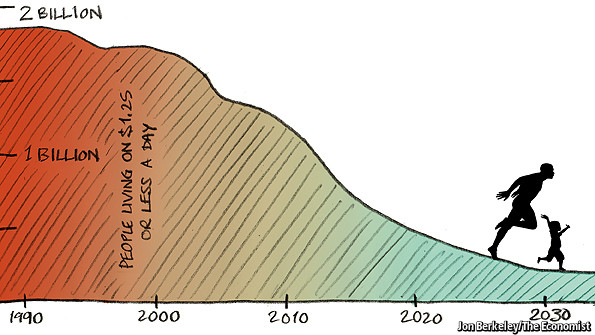
In 1990, 43% of the population of developing countries lived in extreme poverty (then defined as subsisting on $1 a day); the absolute number was 1.9 billion people. By 2000 the proportion was down to a third. By 2010 it was 21% (or 1.2 billion; the poverty line was then $1.25, the average of the 15 poorest countries’ own poverty lines in 2005 prices, adjusted for differences in purchasing power). The global poverty rate had been cut in half in 20 years.
The story of India and China now having a significant middle class also happened over the thirty years.  Which is why Rogoff says the answer depends, and concludes with this:
In accepting Piketty’s premise that inequality matters more than growth, one needs to remember that many developing-country citizens rely on rich-country growth to help them escape poverty. The first problem of the twenty-first century remains to help the dire poor in Africa and elsewhere. By all means, the elite 0.1% should pay much more in taxes, but let us not forget that when it comes to reducing global inequality, the capitalist system has had an impressive three decades.
So, who you gonna believe?

I turned to my favorite when it comes to income distribution issues: Branko Milanovic.  He writes:
When we look at the global population rather than at countries, however, there is a positive side. The unprecedented growth of China and, from the early 1990s, of India, as well as much of the rest of Asia has lifted millions out of poverty. For the first time since the industrial revolution, income inequality among world citizens has fallen.
See, again, from a global perspective, things have never been this good.

Milanovic concludes thus:
What is the role of national inequalities? On a purely arithmetic level, if real growth is given, greater inequality slows poverty reduction and probably the expansion of the middle class. But those who believe in trickle-down economics argue that without greater inequality there would not be strong growth. While this might have been true for China in the past 20 years, it is doubtful that further growth in inequality there will be so benign. China’s Gini – a measure of inequality – at about 44 is already greater than America’s. Can it rise further, deepening regional and urban-rural divides, without slowing the expansion of the middle? India’s inequality, long thought to be in the mid-30s Gini range, may if assessed in terms of income rather than consumption already be as high as 50, practically at the Latin American level.It is therefore growth with redistribution (a familiar development formula from the 1970s) that should be our objective in the years to come, if we want both global poverty and global inequality to continue their downward trend. 
So, who you gonna believe?

Tuesday, November 12, 2013

The market for boobs. The market is for boobs.

The first time I read about the Tulip mania, I simply could not believe that people could have bid up on Tulips. I mean, Tulips! A flower!

If people could have bid up on Tulip bulbs, well, I figured that people are capable of bidding on any damn thing.  As long as people feel that the price is right and that they are coming out ahead.  It is one heck of a strange economic system that I will never truly, emotionally understand, though I can pretend to intellectually grasp the idea.

It is one thing to put a price tag on goods in the market.  But, do we really want to find out what the best price is that will work as incentives for mothers of newborns to breastfeed?  The longer I live, the less I will understand anything, I fear!
New mothers are to be offered up to £200 in shopping vouchers to encourage them to breastfeed their babies.
Seriously?  British mothers don't understand that concept on their own?  I am willing to bet all the tulips that new mothers have a whole range of reasons, perfectly rational reasons, for why well-informed new mothers choose not to breastfeed even when they biologically can.

Btw, how did they arrive at 200 pounds?  Why not 100?  Or 2,000?  Aaaaah, I should stayed back in engineering and earned my millions and retired like how my super-wealthy friend is in retirement now!

How will this incentive scheme be implemented?
Midwives and health visitors will be asked to verify whether the women are breastfeeding.
Sounds like this is from the Onion, right?  If only it were a joke!

XX Factor's take appeals to me:
What is almost never discussed in these exhortations to breast-feed is how hard it can be on mothers, particularly without social support. At the beginning, you are waking up several times a night to feed, and you’re exhausted and drained. If you don’t have a lot of help with your children—perhaps you are a single mother—and you have to go back to work, you might want those extra hours of rest more than you want £200. You might be able to be a better parent to your other kids with that extra sleep and energy, or you know, just a happier person.
...
I just don’t see how breast-feeding is so important we should consider spending government money to bribe women to do it.
As if this is not enough to make me wonder about incentives and price, I am reminded of the news from a few days ago about breast milk bought online here in the US having salmonella and E.Coli.  Which raises a whole number of questions: buy and sell breast milk? And online at that?
Three quarters of the purchased human milk was contaminated with gram-negative bacteria that can pose serious health risks in babies, the researchers found. Three of the samples were contaminated with salmonella. E. Coli was also detected in some samples, an indicator of fecal contamination. 
I certainly would not have imagined "fecal contamination" and "breast milk" in the same sentence.  I tell ya, it is one heck of a brave new world!
As of now, the sale of human milk via the Internet is almost entirely unregulated. Based on the postings on the milk-sharing sites, the sellers are mostly mothers who have a freezer full of expressed milk and aren't sure what to do with it, Keim said. The buyers are mostly women who have had trouble producing enough milk -- or any milk -- and were determined to feed their babies breast milk.
So, will we develop regulations on this?  Will there develop a black-market for breast milk?  Dark alley transactions?

Source

Maybe I am simply getting old.  Maybe this is how my grandmothers felt when they faced the changes during their times.  As much as I wonder how all these are also part of "progress," I am sure the generations that went before us had their own pangs over "progress."

The intellectual me understands these developments. The emotional me, on the other hand, finds all these just bizarre.

The world was way simpler, and fun-filled, when I was a single-digit-aged kid in PK Master's maths class!

Wednesday, September 11, 2013

It is mumbo jumbo. It is science. It is, wait for it, Economics!

Way back in graduate school, which is when I started picking up a little bit of economic jargon so that I can pass of as an informed person at a social gathering, and as an expert in a freshman class, I was full of questions.  Or, full of it, as some prefer to characterize me, even now!

I recall asking a graduate student, who was also from India and who was working on the doctoral thesis, a question, and the response was intriguing then as it continues to be even now--"oh, that is a macro question."  As in macroeconomics.

If I as a reasonably curious and intelligent person could not understand what I thought was a simple issue, and if a soon-to-be-Ph.D. was not informed about it to explain to me, then there was something seriously wrong.  It simply was not adding up well.  It was one of those instances when economics seemed like mumbo-jumbo.

At least Ben Bernanke talks about the American and global macro-economy in ways that lesser mortals like me can at least pretend to know what it is going on. With Alan Greenspan, it was not even mumbo-jumbo, but gobbledygook!  Which is all the more why economists like Paul Krugman and Joseph Stiglitz appeal to me and gazillion others--we are even able to disagree with them only because they talk and write in ways that we can understand.  Recently, Krugman even commented on the need to clearly articulate ideas and arguments:
What every economist, and for that matter every writer on any subject, needs to realize is that unless you are a powerful person and people are looking for clues about what you’ll do next, nobody has to read what you write — and lecturing them about what they’re missing doesn’t help. You have to provide the hook, the pitch, whatever you want to call it, that pulls them in. It’s part of the job.
Exactly!  It is a damn challenging task, however, to write well.  And even if well-written, macroeconomic issues ... well, consider the following, from an op-ed by Raghuram Rajan, in his new capacity as India's central banker:
An increase in gold imports placed further pressure on the current-account balance. Newly rich consumers in rural areas increasingly put their savings into gold, a familiar store of value, while wealthy urban consumers, worried about inflation, also turned to buying gold. Ironically, had they bought Apple shares, rather than a commodity (no matter how fungible, liquid, and investible it is), their purchases would have been treated as a foreign investment rather than as imports that add to the external deficit.
I bet that the first half of that paragraph is easy to swallow.  It just slides down without any effort.  The rich and the poor alike, whether they live in cities or villages of India, view gold as a safe investment.

And then you reach his observation that the macroeconomic accounting of rupees and dollars changes if Indians had bought Apple shares instead of gold.

That's when I throw a flag and rule that economics is not a science.  Economics is more like some version of a gentleman's agreement on how to think about something.  There are many instances where it feels like they simply made up the rules as they went along.  It is like questioning the offside rule in soccer or the ineligible receiver rule in American football.  That is how it is and you don't ask questions.

I don't care if all my observations here are nothing but bullshit--this is my space for my opinions.  That is how it is and you don't ask questions. :)

Sunday, August 25, 2013

Doing nothing versus ... doing Bullshit Jobs?

Sometimes, I joke in my classes that the worst invention ever was one that goes back nearly 12,000 years--settled agriculture.  Until then, we humans were no different from other mammals in that we hunted and gathered to feed ourselves, and over the rest of the hours of the day, we played, fought, mated, and scratched ourselves.  And we slept. A lot!

Some stupid humans proposed that we simply stay put, raise some animals, grow some crops, and our problems began.  From that moment on, we were destined to reach the point where we are now.  Growing crops and raising animals meant that we could no longer simply hunt and gather when we felt the hunger pangs, but now had to start planning towards the next meal.  We had to start worrying about the crop going bad, or the animals dying on us.  It was only a matter of time before we played less, mated even less, and slept a whole lot less!

I tell ya, the invention of settled agriculture was the original sin!

Of course, it is all tongue-in-cheek.  I am mighty happy that we have a far better understanding of who we are and where we are in this universe.  Ignorance is no bliss for me.

The process that began 12,000 years ago has led us to the world today in which we do not hunt and gather our food--well, with a few exceptions, that life is impossible for us anymore.  Instead, we work in order to get paid, which we then use to buy the food and more.  The question then is how much do we want to work.  Not much work is needed for mere survival, and a lot more is needed if we want to lead a materially prosperous life.

Quo vadis?

In answering that question, we begin to interpret the options very differently.

David Graeber, a professor of anthropology at the London School of Economics, writes that we are no way near the utopia of a "15-hour work week" because:
Given the choice between less hours and more toys and pleasures, we’ve collectively chosen the latter. This presents a nice morality tale, but even a moment’s reflection shows it can’t really be true. Yes, we have witnessed the creation of an endless variety of new jobs and industries since the ‘20s, but very few have anything to do with the production and distribution of sushi, iPhones, or fancy sneakers.
So what are these new jobs, precisely? A recent report comparing employment in the US between 1910 and 2000 gives us a clear picture (and I note, one pretty much exactly echoed in the UK). Over the course of the last century, the number of workers employed as domestic servants, in industry, and in the farm sector has collapsed dramatically. At the same time, “professional, managerial, clerical, sales, and service workers” tripled, growing “from one-quarter to three-quarters of total employment.” In other words, productive jobs have, just as predicted, been largely automated away (even if you count industrial workers globally, including the toiling masses in India and China, such workers are still not nearly so large a percentage of the world population as they used to be).
But rather than allowing a massive reduction of working hours to free the world’s population to pursue their own projects, pleasures, visions, and ideas, we have seen the ballooning not even so much of the “service” sector as of the administrative sector, up to and including the creation of whole new industries like financial services or telemarketing, or the unprecedented expansion of sectors like corporate law, academic and health administration, human resources, and public relations. And these numbers do not even reflect on all those people whose job is to provide administrative, technical, or security support for these industries, or for that matter the whole host of ancillary industries (dog-washers, all-night pizza deliverymen) that only exist because everyone else is spending so much of their time working in all the other ones.
These are what I propose to call “bullshit jobs.”
A progression from hunting/gathering to settled agriculture to "bullshit jobs."

While I like the way Graeber phrases it as "bullshit jobs," I don't really agree with his explanation that this is all some capitalist conspiracy:
There’s a lot of questions one could ask here, starting with, what does it say about our society that it seems to generate an extremely limited demand for talented poet-musicians, but an apparently infinite demand for specialists in corporate law? (Answer: if 1% of the population controls most of the disposable wealth, what we call “the market” reflects what they think is useful or important, not anybody else.) But even more, it shows that most people in these jobs are ultimately aware of it. In fact, I’m not sure I’ve ever met a corporate lawyer who didn’t think their job was bullshit. The same goes for almost all the new industries outlined above. There is a whole class of salaried professionals that, should you meet them at parties and admit that you do something that might be considered interesting (an anthropologist, for example), will want to avoid even discussing their line of work entirely. Give them a few drinks, and they will launch into tirades about how pointless and stupid their job really is.
...
If someone had designed a work regime perfectly suited to maintaining the power of finance capital, it’s hard to see how they could have done a better job. Real, productive workers are relentlessly squeezed and exploited. The remainder are divided between a terrorised stratum of the, universally reviled, unemployed and a larger stratum who are basically paid to do nothing, in positions designed to make them identify with the perspectives and sensibilities of the ruling class (managers, administrators, etc) – and particularly its financial avatars – but, at the same time, foster a simmering resentment against anyone whose work has clear and undeniable social value. Clearly, the system was never consciously designed. It emerged from almost a century of trial and error. But it is the only explanation for why, despite our technological capacities, we are not all working 3-4 hour days.
Ryan Avent at the Economist counters with this as the point of departure:
 The place to start is to recognise that, romance aside, many of the industrial jobs that have been automated away were incredibly tedious and unpleasant for those doing them.
Indeed!  Can you imagine a job day after day of doing the same thing, like tightening the nuts and bolts of a part, day after day, year after year?  Isn't it better to liberate humans from that kind of awful work?

Avent continues:
One question is why today's workers aren't rewarded with high wages for their suffering. And one possible answer is that, well, they are. Real wages for today's clerical workers are far higher than they were for manufacturing workers a century ago, and the work, for all its tedium, probably isn't nearly as unpleasant. Administrative workers get to sit down in climate-controlled offices, tweeting and playing fantasy football on their desktop when time allows. If firms had to pay more to get a body in the deskchair, they would.
Technology continues to improve, however. Just as robots became ever better at various manual tasks over the past century—and were therefore able to replace human labour in a growing array of jobs, beginning with the most routine—computer control systems are able to handle ever more of the work done by human administrative workers. Jobs from truck driver to legal aid to medical diagnostician to customer service technician will soon be threatened by machines. Starting with the most routine tasks. Human labour will not be eliminated entirely from these sectors. Jobs that require a particularly high level of task flexibility, or creativity, or empathy may continue to employ people (for a while). Yet most office jobs will eventually go the way of the dodo.
And at that point advanced economies may find it necessary to address what is really the central complaint in Mr Graeber's essay. The issue is not that jobs used to have meaning and now they don't; most jobs in most periods have undoubtedly been staffed by people who would prefer to be doing something else. The issue is that too little of the recent gains from technological advance and economic growth have gone toward giving people the time and resources to enjoy their lives outside work. 
I like the way Avent ends his argument:
there is a decent chance that "bullshit" administrative jobs are merely a halfway house between "bullshit" industrial jobs and no jobs at all. Not because of the conniving of rich interests, but because machines inevitably outmatch humans at handling bullshit without complaining
So, there is hope, yet, that a future of not doing anything but to merely watch the day go by is not that far away.

But, wait, what if we end up in a Wall-E world? ;)

Saturday, August 17, 2013

Not putting the money where the mouth is: Ecuador's oil in Yasuni!

I love the natural environment as much as any regular person might.  A hike in the woods, the sight of a waterfall, the spray from the ocean waves, the gentle breeze, and, of course, my regular walk by the Willamette River, well, I would not want to trade these away.  To live where I live with so many natural wonders is a wonderful salary by itself.


At the same time, as I have often noted in this blog, I am not ready to tell less economically developed countries how they ought to deal with their natural resources.  That is where, I suppose, I begin to part ways from the typical American environmentalist.

Living in the USA, we have all the energy we need and all the material comforts--and more--that one might look for.  It is, therefore, easy to look at the vast majority of the countries across the planet and find fault with them for not doing more to protect the natural environment.

If they really mean it, then those advocating for the environment ought be willing to pay for it.  After all, if a much poorer country wants to tap into its natural resource, the objective there is economic growth.  Not using those resources means giving up on that potential economic benefits.  Those interested could then pay the country a comparable amount in order to conserve those natural resources.  Right?

Talk, is of course, cheap.  Thus, we engage in all kinds of rhetoric.  But, when it comes down to it, most environmentalists are like the rest of us who not only don't like to let go of what we have but also would love to have more.  Hence my lame joke that I rarely meet an environmentalist who doesn't want a pay raise!

The recent news item about Ecuador's government abandoning its idea to protect a bio-diverse habitat is a case in point:
OPEC-member Ecuador, where the rights of nature are recognized in the constitution, plans to develop crude deposits in an Amazon area declared a biosphere reserve by the United Nations as existing fields age and economic growth slows.
President Rafael Correa will ask the country’s congress to allow drilling in the Ishpingo-Tambococha-Tiputini oil fields in eastern Ecuador’s Yasuni National Park, he said yesterday in a speech broadcast on public television station ECTV. The area’s estimated oil reserves could be worth more than $18 billion, Correa said.
The decision reverses a policy to preserve nature in an area eight times bigger than Los Angeles, estimated by Correa to hold 920 million barrels of crude, or about 20 percent of Ecuador’s reserves. The proposal to develop the area comes as economic growth is forecast to slow for a third year.
While Correa and politics might be corrupt like any other country, one cannot blame the guy for the decision when economic growth is slowing down in a country with a per capita income that is barely a fifth of the US average--after adjusting for purchasing power parity.

Ecuador did try, of course, to sell the idea of the rest of the world paying the country to protect the area.
[In] 2007, Ecuador President Rafael Correa came up with a innovative proposal. He’d ask wealthy countries and donors to pay Ecuador $3.6 billion to leave that oil untouched.
It’d be an elegant way to help tackle climate change, he explained. The carbon would stay out of the atmosphere. Ecuador’s Yasuní National Park, one of the most biologically diverse spots on Earth, would remain unharmed. And Ecuador would be compensated for the billions in foregone oil revenue. (The three oil fields in Yasuní make up about one-fifth of Ecuador’s oil reserves.)
The problem? Those wealthy donors never materialized. Spain chipped in a couple million. So did the Andean Development Bank and the Inter-American Development Bank. The U.N. and other private individuals raised some funds. But in the end, Ecuador only raised $13 million, a far cry from the $3.6 billion Correa had sought.
If you were the president of Ecuador, wouldn't you also have taken this decision?
“Let no one be fooled, the fundamental reason this failed is because the world is hypocritical.”
“It was not charity that we sought from the international community, but co-responsibility in the face of climate change,” he said. His plan would have prevented the emission of about 400m metric tons of carbon dioxide, it was estimated. “The world has failed us.”
A big question then for the rest of the world is the same one from 2007:
“If we can’t justify saving a place that has more species per square kilometer than any other place on the planet,” Swing asked, “what are we going to decide to keep?”
We cannot expect the people of Ecuador alone to pay the price, can we?

Of course, later on we will target the oil companies for extracting oil for there and selling it, while conveniently forgetting that we really did not want to pay up!
Last year, in a paper in the Journal of Political Economy, Northwestern’s BÃ¥rd Harstad argued that paying poorer countries to keep their fossil fuel resources unexploited could be one of the most cost-effective ways of tackling climate change. The big hitch, as always, is where the money will actually come from.
I will refrain from uttering the cliche about cake and eating!


Thursday, February 07, 2013

The real crisis here and elsewhere is all about "trust"

I am unable to even recall the last time I gave students an in-class exam, and that too in the closed-book, closed-notes format.  For a while now, it has been nothing but take-home exams.

Last Tuesday, before returning the graded test papers to students, I told them that while they and I will not be happy with the low grades that a few test responses earned, I am delighted that there was nothing in their responses to suggest anything remotely resembling unprofessional conduct.  Nothing indicated that they might have outsourced the test-taking, for instance.  That meant that I can continue to trust that the class will play by the rules.  Further, it means that I can continue to administer the take-home format, confident that students will play by the rules.

"Our entire economic system and democracy are based on the trust we will all play by the rules" I told them.  I gave a couple of examples. When we go to a restaurant, we trust the people there to prepare the dishes hygienically.  When we drop the kids off at daycare, we trust that they will take good care of the children.

"It becomes a pain, and adds to the costs, when people do not play by the rules.  We have to spend on systems that will monitor how we work, and then punish those who abuse the trust we have in them" I added before handing back the test papers.

While students in my classroom play by the rules, even when it means getting a low or a failing grade in the test, the "real world" is, however, filled with abuse--in the economic and political system--that makes us want to distrust any of them.

When a President tells us we will invade a country far away because of a massive stockpile of weapons of mass destruction there, we trust that President, only to find out later that there was nothing there after all and that it was all made up.  When banks play roulette with the money we have invested in them and fool around with the critical Libor, which, influences the price for savings and loans, our trust in them quickly vaporizes.

We trust the colleges to do the right things, and a Penn State scandal sends us fleeing for shelter.  We run to the churches only to find that there have been abuses there too.  We trust the police to protect and serve us and we find that they, too, can go rogue.  Millions of people invested their time and money on a Lance Armstrong because they trusted his words about his post-cancer life that was a phenomenon; unfortunately, fooled, again.

Perhaps this is all because of the culture of consumption in the rich countries, one might suggest.  But, the poorer countries seem to be in even worse conditions.  There, reaching out to the law and order officials, for instance, could only worsen the problem; there is, therefore, no case of trusting that there are institutions to protect and serve.  One cannot even trust that the milk is nothing but milk.

A few years ago, I got an email from a stranger in response to one of my op-eds.  That stranger wrote that he pays attention to my op-eds, even if he disagreed, because he trusted my integrity.  It was quite a revelation to me that a faceless stranger would seek in my opinions a measure of trust.

It is understandable that the stranger felt that way.  The Great Recession was triggered by a banking scandal that was nothing but an abuse of the trust we have in them.  The political disasters of the wars, which continues now in the form of drones too, are nothing but abuse of trust.  The higher education crisis has resulted from years of insiders abusing the trust that the public had placed on us running the show.  The list is simply endless.

At least, my classroom is a safe haven.  In that I trust.

Tuesday, November 27, 2012

Ban the word "incentivise" and stop the monetization of everything

Right from my graduate school days, I have maintained a love-hate relationship with economics and the logic of markets in every aspect of our lives.  My roommate, Avu, who was also from Tamil Nadu, was at USC pursuing a doctoral degree in marketing and was a convert to the Milton Friedman and Hayek way of reducing everything to an utilitarian framework and a bottom-line of the price one is willing to pay.  While I enjoyed the intellectual argument, and often agreed with him, I knew well that it wasn't my religion. 

In my own studies, I opted to work with a professor who was clearly way more in favor of market forces than a couple of others were.  Even to this day, I am puzzled, and profoundly thankful, that he agreed to guide me along in the doctoral process even when it was clear to him that my philosophical preferences were elsewhere.

It is not that I hate the market.  I am no rabid socialist.  I understand what a wonderful tool that is in order to achieve a certain set of outcomes.  But, the logic of supply, demand, and price has its limits, and I detest any limitless application of those into every sphere of our lives.

Not aware of my bounded admiration for the market, faculty colleagues and students erroneously conclude that I am a right-wing free market enthusiast.  Don't judge a book by its cover, they say, and I seem to have one unattractive cover :)

My political position as a Libertarian-Democrat reflects this admiration from a distance of the market and economics.

Which is why I empathize with the sentiments expressed by Michael Sandel (ht):
Today, we often confuse market reasoning for moral reasoning. We fall into thinking that economic efficiency—getting goods to those with the greatest willingness and ability to pay for them—defines the common good. But this is a mistake.
I urge students not to simply mouth the rhetoric from what they have been told about the market or the state or religion, but to instead learn and think about other interpretations as well.  And that is what Dierdre McCloskey notes, while critiquing Sandel's work:
Over the front door of the late-medieval city hall in the Dutch city of Gouda is the motto of the first modern economy, the first large society in which commerce and innovation instead of state regulation and social status were honored. It says, Audite et alteram partem—Listen even to the other side. It's good advice for a society of the bourgeoisie, and for a classroom for students of philosophy. 
I wonder if before I die I will ever settle this love-hate relationship one way or the other.  My guess is that I will carry these mixed feelings with me until the very end, which apparently happens at the eleventh hour :)