Showing posts with label Pakistan. Show all posts

Tuesday, August 25, 2020

A virus loses the battle in Africa

Throughout my childhood years, a sudden onset of high-temperature fever was a constant in my life.  One moment I would be playing like any other kid, and the next I would be down with a scalding temperature.

One story that I have heard my mother narrate often was about how I was delirious and calling out the gods Krishna and Rama during one of those fevers when I was a kid.  She panicked that I was well on my way out of earth.

The one that I always remember is when I worried that I wouldn't be able to sit for the Class X exams, because I came down with one such sudden fever.  In the old country's system, missing the all-important end of year exams at the 10th or 12th grade would mess up one's life.  The doctor had a simple treatment protocol: Rest, and do not do any exam preparation.  As one who never cared to spend time prepping for exams, I found the doctor's recommendation to be useless ;)

The fever weakened me a great deal though.  So, for one exam, my father escorted me to the hall and sat outside ready--in case he had to rush me to the hospital.

All through those years of sudden fevers, one of the questions I was always asked was whether I experienced any pain in my legs.  If ever I said yes to that, the expression on my parents' faces conveyed well their worries. It was all because of a fear of polio.

I was fortunate that none of those episodes had anything to do with the poliovirus.

Two years ago, I blogged that most of the world is polio-free, except three countries: Afghanistan, Pakistan, and Nigeria.

Now we are down to one.

The remaining two are in South Asia, which means that the entire continent of Africa is now free of polio.

It is celebration time.

It took quite an effort in Nigeria where public health workers literally lost their lives in their efforts to vaccinate their kids.  The virus did not kill them; they were murdered by assassins who had been brainwashed into thinking that the polio drops were contaminated medicine!

Now, Africa has gotten rid of the damn virus.
Delivering polio vaccines to every child in the African region and wiping out the wild virus is no small feat, and the human resources, skills and experience gained in the process leave behind a legacy in how to tackle diseases and reach the poorest and most marginalised communities with lifesaving services. Leadership from all levels of government across party lines, a historic public-private partnership which raised billions, millions of health workers reaching children across the region - from conflict zones to remote areas only accessible by motorbike or helicopter - and a culture of continual improvement were all critical to overcoming challenges and bottlenecks. 
If the world is committed to doing the right thing, then we can move the proverbial mountains!
Polio and COVID-19 both demonstrate that the best ways to break the chains of disease transmission are working together in solidarity, accelerating the science and continually cooperating to solve problems on the ground and improve service delivery.
It is such an effort that will be needed to fight the coronavirus.  Unfortunately, tRump and his fellow sociopaths are running ruining the government.

For now, we will forget the sociopaths and just celebrate the victory in Africa.

Monday, May 21, 2018

And then there were three ...

Pakistan, Afghanistan, and Nigeria.

Pakistan and Afghanistan are neighbors. Why Nigeria, which is far away?

One word puts them in a special group: Polio.
“We are closer than we have ever been before to wiping out this virus. The next few months will tell us if we may be able to finish the job this year as this is the time when the virus is circulating"
Many of us here in the US and elsewhere suffer from the craziness that trump and his minions have been.   We have a president who openly questions whether vaccines are good!  Bill Gates says that the idiot-in-chief asked him about it--"he asked me if vaccines weren’t a bad thing because he was considering a commission to look into ill-effects of vaccines."  And what was Gates' response?  Gates said he told Trump, “that’s a dead end, that would be a bad thing, don’t do that.”  Had trump been the president back in the day, the US government might not have done anything regarding polio, small pox, ...

Thankfully, trump has come about during the end stage of the fight against polio.  Pakistan is inching towards zero.  One of those instances in real life when we begin to appreciate the mathematical idea of "tends to zero" but not yet zero. Perhaps the country might have wiped out the virus if the US had not recruited a Pakistani doctor to help find Osama bin Laden by having him carry out a fake vaccination campaign.

As we get closer and closer to eradicating polio, we need to pause and think about one of the most remarkable aspects of the vaccine: Jonas Salk did not patent the polio vaccine that he created.  He chose not to patent it.

Actually is is only two--Pakistan and Afghanistan. Because, Nigeria has not recorded a case of polio for 20 months since 2016.
If the country can make it to three years, plus a few extra months as an epidemiological cushion, it will be certified polio-free, which will also mean that the entire continent of Africa is clear of the disease. 
Imagine that; the African continent could be officially polio free in a year.  The entire continent.

Against such a backdrop, we have our eyes set on the November elections.  But, 2018 will be far more historic than a Democratic takeover of Congress if there are no new polio cases in 2019.  A big fucking deal, as Joe Biden once remarked!

Monday, January 30, 2017

Speak. Don’t be without a voice.

Remember Khizr Khan?  The Pakistani-American who spoke at the Democratic convention?  And he was later savagely attacked by the man who was elected to the White House by Republicans?

Yes, that Khizr Khan.

The New Yorker has an interview with him.  By Robin Wright, whose writings on global affairs are always phenomenally educational.  The executive order by the POTUS is the context.  You know which one that is:
executive order banning the entry of Syrian refugees indefinitely and all refugees for four months. The executive order suspends the entry of all citizens from seven predominantly Muslim countries—Iran, Iraq, Libya, Somalia, Sudan, Syria, and Yemen—for ninety days. 
 I cannot even begin to imagine what an Iranian-American goes through.  I think about the sweet and gentle Shahab, who was an Iranian-American.

It is terrible what this POTUS and his people are doing to Muslim-Americans, Muslims anywhere, and to the entire world.  Terrible!

As I wrote, back in June 2016, in an op-ed:
The anti-Muslim rhetoric makes a mockery of the noble idea of freedom to practice religion — a freedom that has been a foundational principle of the United States. ...
When we know people and have developed meaningful relationships with the “other,” it becomes difficult to tolerate sweeping statements that condemn hundreds of millions of Muslims because of a minuscule minority that bombs and kills. 
Anyway, I read Wright's interview with Khan.  His message not only to Muslims in America but to "all American patriots" includes this:
Don’t be without a voice. Speak about the issues that affect your society.
I wonder if perhaps Khan was also channeling the poet Faiz Ahmed Faiz, who became a Pakistani after the horrible partition of India.
Speak, by Faiz Ahmed Faiz
Speak, your lips are free.
Speak, it is your own tongue.
Speak, it is your own body.
Speak, your life is still yours.

See how in the blacksmith's shop
The flame burns wild, the iron glows red;
The locks open their jaws,
And every chain begins to break.

Speak, this brief hour is long enough
Before the death of body and tongue:
Speak, 'cause the truth is not dead yet,
Speak, speak, whatever you must speak.

Monday, January 02, 2017

Off with the head!

As I get older, I find myself to be more and more against violence.  Especially violence that is the state-sponsored kind.  It is gross. It is inhuman. To call state-sponsored violence beastly is an insult to the predators in the wild.

It is even more fucked up when it is the passionately religious who seem to be more supportive of state-sponsored violence in democratic societies.  It is bizarre when, for instance, those who are ready to kill people using the government machinery are also the ones who use the imagery of Jesus to tell us how we should live.  I suppose Jesus never talked about peace and love!

And hence the odd situation that the US, with all its bible-thumpers, continues with the death penalty.
the U.S. has ended up in some rough company, particularly when it comes to the death penalty. In the past generation, the number of countries that have stopping using the death penalty has doubled, from about fifty to about a hundred. Of the fifty-seven member states of the Organization for Security and Co-operation in Europe, and of the thirty-five member states of the Organization of American States, only the U.S. carried out executions last year. The countries that executed the most offenders were, in order, China, Iran, Pakistan, Saudi Arabia, and the United States.
Take a look again at the company that we keep: China, Iran, Pakistan, and Saudi Arabia.  Puke-worthy about how we treat life!  The US is a religious country alright, as much as the theocratic Iran, Saudi Arabia, and Pakistan are.  As the late Christopher Hitchens wrote (I quoted him in this blog-post from more than five years ago)
The point of the penalty was that it was death. It expressed righteous revulsion and symbolized rectitude and retribution. Voila tout! The reason why the United States is alone among comparable countries in its commitment to doing this is that it is the most religious of those countries. (Take away only China, which is run by a very nervous oligarchy, and the remaining death-penalty states in the world will generally be noticeable as theocratic ones.)
Whether or not the US is loved around the world, what the US does--not the rhetoric--is keenly watched by everybody.  Therefore, when the US government machinery kills its own people, then it is a convenient justification for other countries to kill their own people.
In August at a rally in Istanbul, after the failed coup attempt in Turkey, the BBC reported, the country’s President, Recep Tayyip Erdoğan, said, “They say there is no death penalty in the E.U. … Well, the U.S. has it; Japan has it; China has it; most of the world has it. So they are allowed to have it. We used to have it until 1984. Sovereignty belongs to the people, so if the people make this decision I am sure the political parties will comply.” He said that the Turkish people might want to restore the death penalty to punish those responsible for killing hundreds of citizens during the attempted coup. That has not happened yet, but, if it does, its purpose, Erdogan suggested, will be a display of cold-blooded power.
Now that we in the US too will have a strongman president, the likes of Erdoğan will be all the happier to kill their own people, and will feel justified to do so.
the voters—the populists—continue to back the death penalty, as does the President-elect. (Donald Trump notoriously called for the execution of the Central Park Five, fourteen-, fifteen-, and sixteen-year-olds who were charged with a high-profile rape and beating, in 1989. Even though the five were later exonerated, Trump, during this year’s campaign, reiterated his belief in their guilt.)
Of course, in the US, politicians who want to reach the Oval Office dare not oppose the death penalty, especially because of the racial dimension of the punishment.  Remember what happened to Michael Dukakis?  Or how Bill Clinton had to prove his mettle to the White Christian voters by putting to death a mentally-impaired black man?  Yep, the US lives according to Jesus's words!

The only ray of hope is the trend of remarkable fall in the number of executions and death sentences.  Aziz Ansari joked that for racism to go away, we simply have to wait for the racists to die--the younger generation is a lot more progressive than the middle-aged and older whites are.  Similarly, we simply have to wait for another generation to exit the world for the US to end the horrible practice of state-sponsored killing.  And maybe by then we will also stop electing the likes of the worst human being ever to reach the Oval Office.

Thursday, June 23, 2016

It is up to us to create a heaven right here on earth

For all the non-believer that I am, I consciously think about my existence, and worry about what it means to be human.  When bad things come my way, whether it was the refrigerator that died thanks to which I had to buy a new one with money that I don't have, or when people who are near and dear to me say awful things about me right to my face, I do not need a god to turn to.  "Shit happens" I tell myself.  After all, it is not as if the entire cosmos exists only to serve me!  The cosmos is.

Whether it is Lent, or Ramadan, or whatever, I am not ever sure that most of the believers really use that designated time in order to reflect on our fleeting existence on this "mote of dust suspended in a sunbeam," as Carl Sagan so poetically put it.

In fact, the disconnect between such need for introspection versus the believers merely reciting the Vishnu Sahasranaamam and the Bhaja Govindam and more was the point of departure for the young me questioning the idea of god and religion and belief.  I was convinced then, and even more convinced I am now, that living a morally sound life has nothing to do with god and religion.

We are well in to Ramadan.  To some fundamentalist believers, apparently this is also the best time to kill!  Who the hell are the religious leaders who provide such twisted interpretations of the human condition?  One of the many casualties of this madness was a Sufi musician in Pakistan.
One of the most prominent Pakistani singers of Sufi devotional songs, Amjad Sabri, was killed by gunmen who fired into his car in Karachi on Wednesday, raising a new outcry over sectarian and extremist violence in Pakistan.
A faction of the Pakistani Taliban claimed responsibility, accusing Mr. Sabri of being a blasphemer.
Only sociopaths can kill a human all because he sang Sufi devotional music.  And why was Sabri considered a blasphemer, in the first place??
Mr. Sabri, 45, was one of the foremost singers of qawwali music — the devotional songs of Sufism, a mystical branch of Islam — and was part of a family of noted performers. In 2014, Mr. Sabri was embroiled in controversy after a morning news program played his version of a traditional qawwali song that referred to the Prophet Muhammad. A blasphemy case was registered against the show hosts and the television network, Geo, and Mr. Sabri was named in the complaint.
Bloody sociopaths!  May they be tortured to the nth degree in the hell in which they believe!

I had no idea about Sabri until I read that news and, therefore, will leave you with this by another Sufi qawwali singer, the late Nusrat Fateh Ali Khan.


Thursday, June 09, 2016

Understanding ‘others’ essential in today’s world

(For The Register-Guard: June 8, 2016)

My childhood classmates came from diverse religious backgrounds. This included Farooq and Yasmeen, among others, who were Muslims. Of the teachers, I still recall Yusuf Ali, who was the machine shop instructor. Thanks to India’s diversity, and to life in an industrial setting, we Hindu kids went to school with Muslims and Christians, and even my highly religious and orthodox grandmothers did not worry about “traditional values.”

As a kid, I did not know that there were Muslims in America. When the name of a boxer, Muhammad Ali, appeared in the newspaper, The Hindu, I assumed he was one of our people who had moved to America.

In the grainy black-and-white news photographs more than four decades back, Ali easily looked like one of us — only immensely more handsome. When my brother and I fought, much to our mother’s displeasure, we sometimes imagined that we were boxing like Ali, though neither one of us knew anything about the sport.

As a fresh-off-the-boat student, I made friends for the first time ever with a student, Siddiqui, who was from India’s arch-enemy — Pakistan. Toward the end of my first year of graduate school, when I was getting introduced to life here in America, I was amused by the sight of my classmate John — a white skateboarding dude — practically worshiping a basketball player named Kareem.

Even while the mullahs of Iran were always in the political crosshairs, the Iranian-­Americans in Southern California went freely out and about — and were seemingly one of the more prosperous groups, too. In those early years of my life in America it seemed as though nothing was said or written in public that was against Islam and Muslims.

After such a healthy head start in my life in the old country and then in this adopted home, it shocks me to no end now when I hear or read virulent anti-Muslim remarks, especially from those seeking or holding elected office. The anti-Muslim rhetoric makes a mockery of the noble idea of freedom to practice religion — a freedom that has been a foundational principle of the United States.

While neither Farooq nor Yasmeen lives in the United States, I think of those old schoolmates when very serious people make yet another anti-Muslim comment. I recall how Siddiqui and I shared the foods that we made as struggling graduate students. When we know people and have developed meaningful relationships with the “other,” it becomes difficult to tolerate sweeping statements that condemn hundreds of millions of Muslims because of a minuscule minority that bombs and kills.

Muhammad Ali’s death provides us with yet another context for learning about Islam, and about Muslims in America.

Islam in America is nothing new. Thomas Jefferson owned a copy of the Quran, which provided him with more than a passing familiarity with the religion and its practices.

Researchers estimate that between 15 percent to 30 percent of slaves were Muslims. One of those was Omar Ibn Said, whose life-story has been well documented. Imagine the double whammy of being a slave who was also a Muslim, after having been raised in what is now the West African country of Senegal!

Islam’s holy month of Ramadan, which began on Sunday, is another opportunity to get to know the religion and its faithful. For a month, most of the world’s 1.6 billion Muslims will fast from sunrise until sunset, to remind themselves about the mortals that we humans are and about the fragility of life without food and water. This fasting alone, which humbles the rich and the poor alike, ought to trigger the curiosity of those who harbor only suspicions about the “other.”

One of the challenges in this rapidly globalizing world is for us to understand the “other.” While in centuries past it might have been easier for people to spend an entire life fully within their own respective tribes, we live in a world in which mixing of people and ideas is the norm, not the exception.

It is also clear that the momentum of globalization will not slow down — it will only pick up more speed. This requires all of us to broaden our horizons. To borrow from the late Indian poet Rabindranath Tagore’s “Where the mind is without fear” — a poem Yasmeen, Farooq and I read in school — we need to create a world of freedom that has not been broken into fragments by narrow domestic walls. It is difficult work to create such a heaven right here on Earth, but is an effort worth pursuing.

Monday, May 09, 2016

Shooting and hacking far away on the other side of the planet

Of course we are all mortals.  Which is why we worry about everything all around us.  If we were eternal, then we would not care. Not even a bit.  As Dana Gioia put it:
One of your primary experiences of reality is to be mortal.  A human life is a linear structure of time in your natural world which repeats itself so every spring everything is new again except for you. If you are a Christian and you also believe there is the eternity.  There is a level of existence outside of the linearity, outside of the natural cycle so time becomes a reality and a paradox.  ... If we were not mortal, if we did not exist in time, you would have forever and nothing would matter
Life matters because we do not live forever.

It becomes even more troubling when this mortal existence is unnaturally ended, which is increasingly the case in India's siblings--Pakistan and Bangladesh.  In the essay in the New Yorker profiling the Pakistani novelist/writer/journalist Mohammed Hanif, I came across this:
Last April, Sabeen Mahmud, a close friend of Hanif’s who ran a local event space called the Second Floor, was planning a panel discussion involving Baloch leaders. Worried that the I.S.I. would react badly, she turned to Hanif for advice. He told her that it would be very risky, but Mahmud decided to go ahead anyway.
Hanif was out of town the night of the discussion, but he followed it on Twitter, and was relieved when it came to an end without incident. A few minutes later, he got a call from a friend: gunmen had pulled alongside Mahmud’s car and opened fire, killing her and wounding her mother. “It really shook me,” he said. “I used to think, like Sabeen, that we were really small fry. Who the hell cares about a hundred and twenty people sitting in a room talking, a bunch of like-minded losers?” Mahmud’s death was a measure of how much things had changed in Pakistan. 
And today in the news, reports that yet another activist--Khurram Zaki--was shot dead in Karachi by unidentified gunmen.  Zaki was forty:
This was the third high-profile killing of a rights activist in Karachi in recent years and pointed to the immense dangers faced by activists in a country troubled by religious extremism and intolerance. Last year, Sabeen Mahmud, the director of a popular arts center in Karachi, was gunned down in the city after she hosted an event on human rights abuses in southwestern Baluchistan Province. Parween Rahman, a social justice activist, was killed in 2013.
Miles away, on the other side of India, a Sufi leader was the latest who was hacked to death in Bangladesh:
Similar attacks on intellectuals, secular writers and others have taken place over the last two years in Bangladesh. The attacks have seemed to increase in recent weeks, with a Hindu tailor being hacked to death last month, as were two gay rights activists, among others. Several of the assaults have been claimed by the Islamic State or by a branch of Al Qaeda, according to the SITE Intelligence Group, which monitors extremist websites. An English professor was hacked to death, also in Rajshahi, last month, in an attack that was claimed by the Islamic State and that police said they believed was connected to Islamist militants.
I--and, hopefully you too--worry about these because we--and that includes you, too--are mortals. Mere mortals.

Tuesday, March 29, 2016

King Leopold’s Ghost

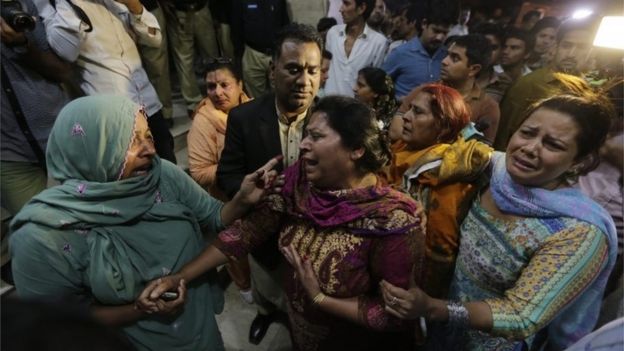
Terrorism strikes. 35 people killed and more than 300 injured.
Terrorism strikes again five days later.  On Holy Easter Sunday.  At least 72 killed, many of them children.

One received extensive front page news coverage for a couple of days, and the other was barely mentioned in the front page on the day after.

From the BBC

It is the same old story all over again.  When terrorists strike in Western Europe or North America, it is serious news.  When terrorists strike and kill way more people in the brown-skinned world, the attitude is pretty much along the lines of "who cares!"  As Rafia Zakaria notes in this op-ed:
 Two days after Sunday’s attack, Lahore has disappeared from the top headlines. Pakistan’s pain has already been extinguished from the global news cycle, its catastrophe a news item and not — as in Paris or Brussels — a news event. 
A hundred, two hundred years ago, it was the white skinned who terrorized the brown skins.  Take the case of Belgium, which was the recent site of terrorism in Western Europe, and Leopold,who was its king towards the end of the 19th century.  Even a simple Google search attempt results in this autofill:


Why is it referred to as a genocide in the Belgian Congo?  I have excerpted the following from an old (1998) New York Times article that I tracked down; it is a review of the book that I have also used as the title for this post:
 Under the reign of terror instituted by King Leopold II of Belgium (who ran the Congo Free State as his personal fief from 1885 to 1908), the population of the Congo was reduced by half -- as many as 8 million Africans (perhaps even 10 million, in Hochschild's opinion) lost their lives.
Some were beaten or whipped to death for failing to meet the rigid production quotas for ivory and rubber harvests, imposed by Leopold's agents. Some were worked to death, forced to labor in slavelike conditions as porters, rubber gatherers or miners for little or no pay.
Some died of the diseases introduced to (and spread throughout) the Congo by Europeans. And still others died from the increasingly frequent famines that swept the Congo basin as Leopold's army rampaged through the countryside, appropriating food and crops for its own use while destroying villages and fields. 
Perhaps based on all the data, somebody has already done calculations somewhere on how many brown skins equals one white skin.

I am, yet again, reminded of the narrow-minded empathy that we often tend to display:
It favors vulnerable children and animals, and discriminates against unattractive people. You’re more likely to sympathize with someone in your social group rather than an outsider, especially one who looks different.
The typical European looks more like the majority American and, thus, they are all in the same "social group" that triggers the tsunami of empathy?

At some point, the earlier the better, we need to truly, genuinely, understand that a human life somewhere in the world is as much a human life in any other part of the world.  The more we fail to even acknowledge this, and the more we continue to behave as if some humans are infinitely more valuable than others, I worry that we will face decades of bloodshed ahead.


Monday, October 26, 2015

Are you, too, waiting for good news from Afghanistan?

After all the traveling to and in California, it was great to be back home and sleep in my own bed.  I care not if the mattress and the pillows at the hotel were of higher quality than what I have, but the older I get the better the sleep is in my own home and on my bed.  East or west, home is best, indeed.

I went to sleep all pumped up about the classes--have I ever told you how much I love doing what I do!  As if my regular classes aren't exciting enough for me to head to campus, I had an additional incentive.  A wonderful student had emailed me.  Students emailing is not any man-bites-dog story, of course.  But, this email had something special: "My mother would like to sit in on Monday's class; is that all right?"  What an awesome idea!  And what a coincidence that I had re-posted, from three years ago, the piece yesterday in which I had written:
I would love it if taxpayers routinely observed our classrooms and judged for themselves whether their hard-earned monies are being put to good use. 
This Monday morning, I woke up, as I always do, with NPR's news and commentaries.  It was about an earthquake in Afghanistan.  Can that country ever catch a break, right?  The later reports suggest that it is no minor shake:
A massive earthquake rocked northeastern Afghanistan on Monday with devastating tremors rippling across the region, leaving more than 215 dead amid collapsed buildings, panicked stampedes and fears of landslides. Officials braced for even more casualties.
The full extent of damage and human toll was not immediately clear as rescue teams tried to assess areas hardest hit by the quake, which had a preliminary magnitude of 7.5 and was centered in a remote area of the Hindu Kush mountains.
Even for a person like me, who has been obsessed with the world's problems ever since I was a kid, I simply needed some kind of a good news about this country that has been cursed by the cosmos, it seems.  I scanned for news about Afghanistan.  There is some good news.  You ready?  You sitting down?  Nothing breakable in your hand that could fall and shatter to pieces?  Get this:
Afghanistan have clinched a historic one-day international series over Zimbabwe after a 73-run victory
In case you don't understand that sentence, that is about the game of cricket.  Afghanistan beat Zimbabwe in a cricket match series.  That is a huge piece of good news from that country.  Why?  Let me explain with what I wrote in one of my newspaper columns six years ago about Pakistan:
The unrest and violence in Afghanistan is intricately linked to Pakistan’s. So, is there any simple metric that we could employ in order to understand whether things are getting better or worse in Pakistan, such that it can then feed into the decision-making process regarding Afghanistan?  Yes, there is: All we need to do is keep track of the game of cricket in Pakistan. As simple as that!
What is good for the goose is good for Afghanistan, too.  Well, ok, the games were not played in Afghanistan but in Zimbabwe.  But, here is the best part: to use the American sport language, Afghanistan's cricket team is a minor league team and they beat the crap out of a powerful major league team.
The national team was only formed in 2001 and while they are yet to shock one of the eight leading international sides, a series win over an International Cricket Council full member represents a major landmark.
Unable to play at home in war-torn Afghanistan, they were granted ODI status in 2011. 
Isn't that a small little ray of sunshine for you to feel good about Afghanistan?

Of course, this won't be of comfort to the hundreds who died from the quake, and the thousands who have to deal with the destruction of property.  We can help--by contributing to relief efforts, and by also wishing the country and its people well.

Wednesday, September 02, 2015

When two elephants fight, it is the grass that suffers

It is that season again.

No, not autumn, but the crazy season when India and Pakistan violate their ceasefire agreement and use gunpowder to match the amped up rhetoric.  Compared to these two siblings, even the two Koreas seem to be getting along much better!

Source
Let us count the number of years since 1947 when they gained their independence from the white supremacist colonial masters: sixty-eight.  A human born in 1947 will now be coasting along in retirement, while these two countries continue to behave worse than middle-school boys during recess!

The situation is so crazy that their mutual neighbor, China, is urging them to, you know, talk..  China, of all countries!  Yep, the same China that every single day seems to want to make the neighboring countries across its waters nervous and jittery.
China on Tuesday advised India and Pakistan to exercise restraint on the border, and try to resolve differences through dialogue and mutual consultation.
Of course, there is another reason for China to interject--it is getting ready for the grand parade and celebrations in Beijing "honoring the 70th anniversary of the end of World War II."  Pakistan is sending its president, while India will be represented by a second-tier federal cabinet minister.  Guess which country China favors? ;)
The stakes are high for China, which has committed to invest $46 billion in infrastructure and power development in Pakistan, and build an economic corridor which will link it to the Arabian Sea through the Gwadar port. New Delhi has reasons to worry about China's quest to obtain access to the Arabian sea, which touches the west of India.
The China funded economic corridor will also pass through Pakistan Occupied Kashmir, which India considers as its own territory. 
India and Pakistan are engaged in a "dialogue of the deaf," this op-ed notes:
Lurking under this neighborly rage are stereotypes that refuse to fade. India thinks Pakistan is an aging terrorism addict that keeps hitting up the world for loose change so it can get its next fix. Pakistan thinks India is an old uncle who has come into some money late in life but still doesn’t know how to dress. India says Pakistan is the pesky kid who is always picking a fight in the neighborhood. Pakistan says India is the real bully — and if you don’t believe it, go ask the other kids on the block: Bangladesh, Sri Lanka, Nepal. Still don’t believe it? Go ask the Kashmiris. India says no one should ask the Kashmiris anything because Pakistan has poisoned their minds.
The net result is a tragic bottom-line: "Three generations have lived either with war or the imminent threat of war."  Nothing else to show for these 68 years!
Are these two nuclear powers talking to each other, or are they two teenagers playing a game of dare?
Maybe it’s time India and Pakistan did away with the pretense that they want peace. Hundreds of miles of barbed wires on the border, countless searchlights and mile-long visa forms haven’t made us feel secure about each other.
What a waste of time, resources, and lives!  If only the leaders and the people of both the countries had instead spent their precious resources on human development.  If only!


Friday, June 12, 2015

Distractingly Sexy Despite Being A Woman

Every once in a while, I wonder, simply wonder, whether I might one day sit at my computer not knowing what to blog about.  A complete blank.  Because there's nothing new to report, critique, or think through.

But, the world is a cornucopia, I have come to understand, and overflows with nourishing food for the mind.  This wannabe thinker, thus, has no problems whatsoever on issues and ideas to blog about ;)

A couple of days ago, I posted this on Facebook:


An hour later, a high school friend, who has a wonderful sense of sarcastic humor, replied:
You know #DespiteBeingAWoman was the tag to use.
I didn't know.  So, I then spent a few minutes reading some of the #DespiteBeingAWoman hashtagged posts on Facebook and Twitter and had quite a few laughs.

The day ended.

Another day, another gaffe.

Thankfully, not by Modi this time.  It was by a Nobel-prize winning scientist, Sir Tim Hunt:
“Let me tell you about my trouble with girls,” Mr. Hunt said Monday at the World Conference of Science Journalists in South Korea. “Three things happen when they are in the lab: You fall in love with them, they fall in love with you, and when you criticize them they cry.”
This is a scientist who knows well how to dig really deep holes for himself--in a later interview, while saying sorry, he "clarified" his thoughts:
“It’s terribly important that you can criticize people’s ideas without criticizing them and if they burst into tears, it means that you tend to hold back from getting at the absolute truth,” he said. “Science is about nothing but getting at the truth, and anything that gets in the way of that diminishes, in my experience, the science.”
The twitter world was soon trending with #DistractinglySexy.

Modi and Hunt speak for the old days and an older generation. Deep inside them rests the old stereotypes about the "weaker sex."  The good thing is that the old generation is dying, and the youth live in a considerably less unequal world and are growing up with far healthier understanding of girls and women in society--even in countries that are notorious for their awful treatment of girls and women.  Like Pakistan, where the "first female fighter pilot is smashing stereotypes."

Yes, a female fighter pilot in Pakistan, even as Sir Tim Hunt thinks that women can only burst into tears!
Flight Lt. Ayesha Farooq, Pakistan’s only combat-ready female air force pilot, has become both an international celebrity and a symbol of a new Pakistan, where women are breaking barriers and taking on roles traditionally closed to them.
 Yes, "the times they are a changin."
Farooq's mother was completely supportive of her daughter's path. Her extended family, however, didn't approve.
"But Ayesha won them over with her determination," Shah explains. "Today, they ask her for advice on how their daughters can join the air force,” she says. ...
“What we’re seeing is huge change. ... What’s coming out is that all these issues about women are being highlighted when before they were never paid attention to. ... I’m really excited myself to be witnessing this in this day and age,” Shah says.
I, too, am excited to be a witness to all these wonderful changes.  We do live in some interesting times, which include the likes of Modi and Hunt too!


Thursday, April 02, 2015

What could have been ... a point of no-return ... it is Pakistan!

Modeled after "How to write about Africa" was this piece on "How to write about Pakistan," in which the author noted, with sarcasm:
Pakistan is just like India, except when it’s just like Afghanistan. (Has anyone else noticed how we seem to have geographically shifted from being a side-thought of the subcontinent to a major player in the Greater Middle East? Is this progress?)
The more years go by, the more things change, the more things stay the same.  A recent piece in Foreign Policy on Pakistan's identity problem begins with:
When you hear about Pakistan, what most often comes to mind? The place where schools, markets, and neighborhoods are routinely bombed? The terrorist haven where Osama bin Laden hid for almost a decade? The “Pak” in Af-Pak? The difficult ally America can’t drop because of its nuclear capabilities? The country where Malala Yousafzai was shot? All of this is true, but there is so much more to this country of 182 million people.
The common perception of Pakistan is more similar to its neighbor in the west (Afghanistan) than the one in the east (India), the country with which it shares its history.
What a mess, since the horrific partition in 1947, which only worsened after East Pakistan became Bangladesh!  Terrible!

Who caused this mess, which has made the daily lives of the 182 million miserable for the most part?
This is a direct result of how Pakistan’s “establishment” — its military and political elite — has defined its identity. This definition emphasizes Islam above all else, and pitches Pakistan as completely different from India.
If only I believed in something after death, I will curse all those to eternal damnation!  I would wish that Zia-ul-Haq be subject to every possible torture in that hell.  The maniac got away relatively easily in an unexplained plane crash, when he should have had an exit that would have made Gaddafi's last minutes seem painless!

Thanks to all those maniacs:
Because Pakistan has disavowed large parts of its past and its identity, it is easier to define it in terms of its present struggle with terrorism. There is little else people know about it. Few people ask me about what Pakistan is really like, about life in my hometown, Lahore, the city of gardens.
Lahore.  Remember the events there thanks to which the country hasn't had any international cricket played there?  I wonder whether they have at least changed the name of the stadium. I hope so.

Zia the maniac made it uber-Islamic.  And then the drive towards the "Islamic bomb" brought Pakistan and Saudi Arabia close, and with that money came the Wahhabi madrasas too.
Since the 1970s, Pakistan’s military and political elite have chosen religious fundamentalism over a democratic plurality. The establishment has emphasized a Sunni Muslim identity at the exclusion of all other ethnic, religious, and sectarian identities. Saudi-imported Wahhabism — an ultra-conservative version of Sunni Islam that lies at odds with South Asia’s tradition of Sufi-influenced Barelvi Islam — has been making in-roads in Pakistani society since the 1980s.
The House of Saud is one screwed up government; oh well, that has to be for another day.

Pakistan could have been so different.  Even with the partition, which I will always believe was one of the worst ever ways to end the Raj.  It could have been a model Muslim country, way better a model than Turkey is hailed to be.  Had it worked out that way, odds are that Afghanistan's story would have been very different too.

If things were different, the image of Pakistan would not be one of terrorism.  Instead, it will be like this:

Will end the post with this; try watching and listening without moving your feet ever, without ever cracking a smile, without rhythmically swaying your head!


Monday, March 16, 2015

On the "attempts to make India a saffron Pakistan"

As India's prime minister, Narendra Modi, approaches the completion of the first year in office, there are certainly a few trends that will worry everyone except the Modi fans.  One is about the sense of a de-secularization of the public space and the uneasiness among the Muslims and Christians in particular.

I often think that this was to be expected.  After all, Modi has never hid from the public his allegiance to the divisive RSS and to the idea of Hindutva.  The leopard, as they say, doesn't change its spots, and Modi has never seemed to even try changing his spots!

What was surprising was to read an opinion piece that simply went for the jugular.  But then the author, Julio Ribeiro, too hasn't changed his spots.  A former pull-no-punches high ranking, and highly decorated, police officer, stays on character when he writes:
Today, in my 86th year, I feel threatened, not wanted, reduced to a stranger in my own country.  The same category of citizens who had put their trust in me to rescue them from a force they could not comprehend have now come out of the woodwork to condemn me for practising a religion that is different from theirs. I am not an Indian anymore, at least in the eyes of the proponents of the Hindu Rashtra.
That ought to hurt the RSS fanatics; but then they don't care.  After all, if they cared, they would not be fanatics, right?

Ribeiro adds:
Is it coincidence or a well-thought-out plan that the systematic targeting of a small and peaceful community should begin only after the BJP government of Narendra Modi came to power last May?
Of course it is no coincidence.
It is tragic that these extremists have been emboldened beyond permissible limits by an atmosphere of hate and distrust. The Christian population, a mere 2 per cent of the total populace, has been subjected to a series of well-directed body blows. If these extremists later turn their attention to Muslims, which seems to be their goal, they will invite consequences that this writer dreads to imagine.
That atmosphere of hate and distrust that has been created since last May won't easily go away.  A tragedy, indeed!  It didn't take much time to destroy even the little bit of trust that was built slowly over the years.

In another interview, Ribeiro says:
People need to know that attempts to make India a saffron Pakistan will not work and should not be encouraged. India is where people from different religions, communities live. We are not Pakistan but we can get there if certain people and their actions are not opposed. I may be over reacting but I feel it is my responsibility to oppose this openly.
As one who has been observing the trends from the outside, I don't see anything in what Ribeiro says to think he is over-reacting.

It is a shame that India's politics have gone this route.  And an awful tragedy!


Friday, August 22, 2014

What the hell is happening in Pakistan?

I suppose it is a curse that some families and countries face--just when everything seems settled, they create new problems on their own and it is crisis all over again.

After decades of turbulence, for all the right and wrong reasons, for the first time ever a democratically elected government completed a full term in office and handed over power to another democratically elected government.  Marking that historic transition, I blogged (which later morphed into an op-ed):
Let us hope that this third attempt will help strengthen democracy in Pakistan, and usher in peace and prosperity to the hundreds of millions of Pakistanis who have been patiently waiting for better days.
But, apparently the politicians decided otherwise.

Despite his deep-rooted Hindu nationalist politics, the newly elected Narendra Modi invited to his inauguration Pakistan's prime minister, Nawaz Sharif.  It provided hope that the siblings could perhaps finally work out a truce.

That was in May.  

"What a difference a day makes" sang Dinah Washington.  Pakistan set out to prove that a lot more can happen in a hundred days!

Pakistan's former ambassador to the US, Husain Haqqani, writes that Pakistan risks anarchy with its obsession over India:
Sharif’s participation in Modi’s inauguration was billed as the first time a Pakistani prime minister had attended such celebrations in India – an opportunity for laying foundations of a new relationship between India and Pakistan. The prospect of a new beginning, however, was soon undermined by incidents of firing along the Line of Control in Jammu and Kashmir.
Haqqani reminds us that the original idea was very different:
Soon after independence, Pakistan’s founder Muhammad Ali Jinnah had said that he expected India and Pakistan to live alongside each other like Canada and the United States. But as long as Pakistan’s establishment continues to paint India as an existential threat and a permanent enemy in the minds of its people, no Pakistani leader –civilian or military –can embrace the Canada-US model. For now, the two sides will maintain their well-worn pattern of diplomatic engagement interspersed with periods of intense hostility.
The firings across the LoC rubbed Modi the wrong way, and he called off the talks after Pakistan's ambassador to India held talks with leaders of separatists in Kashmir.  It does not take a rocket scientist to figure out that such a meeting will not win brownie points with India's government and, yet, Pakistan went ahead with it?

If that is the case across the border, well, it is worse within the borders!  The former opening blower superstar, Imran Khan, is leading the offense against the government:
Khan, a famed cricketer-turned-politician, and fiery cleric Tahir-ul-Qadri have led massive protests from the eastern city of Lahore to the gates of parliament in Islamabad to demand the resignation of Prime Minister Nawaz Sharif
Caption at the source:
Supporters of Pakistani opposition politician Imran Khan attend an anti-government protest
in front of the Parliament building in Islamabad.
Across the border, India canceled the high level talks.  Within the borders, it is no different:
"I have suspended the talks with the government," Khan said. He warned that his supporters would storm the prime minister's office if authorities launched any crackdown. It was not immediately clear if Qadri was also pulling out of the talks.
Because the US government issued a statement reminding everybody that Sharif heads a democratically elected government, Imran, as he is known, is pissed off at the US:
"You like only those governments in Muslim countries that are your slaves," Mr. Khan said in remarks directed at the U.S. "Is there another democracy for you, and another for us?"
This commentary in the Financial Times ends noting that:
In his third term, Mr Sharif has failed to restore the economy to health or end the electricity shortages Pakistanis so detest in the heat of summer. But the government has been in power for only 15 months, and even if Mr Sharif is removed from office, it may not be Mr Khan who replaces him. He may have made his move a year too soon. 
"He may have made his move a year too soon."  That's all there is to such irresponsible political leaders.  In other words, it is a big "fuck you" to the 200 million Pakistanis.  What a curse!

Wednesday, May 21, 2014

Three neighbors with nuclear weapons ... surely nothing can wrong!

I have no idea whether Osama bin Laden chose 2001 for his ghastly plan because he knew that it would be the first year in office for a newly elected US President.  Given the evils that bin Laden schemed up, it is probable that the timing was intentional.

September 2001 was not the first time that the newly elected President was tested either.  On April 1st, only ten weeks into his presidency, Bush had to deal with the Hainan Island incident that became a gripping geopolitical news story for ten days.

I think about those incidents of April and September 2001 as I follow the news stories from India about the elections and now the upcoming inauguration of a new government led by Narendra Modi.  Modi, like Bush, comes with a couple of terms of governing experience in a state, and very little of international experience.  Bush was even quite proud of his regular guy life and how he had not spent time outside the US unlike those Democratic elitists.

Modi and his people have said and done enough to make Pakistan cautiously pessimistic.  As for the other nuclear neighbor,
Modi noted that Beijing would have to shed its “expansionist policies and forge bilateral ties with India for the peace, progress and prosperity of both nations.” India has in the past complained about China’s refusal to accept Indians from Arunachal Pradesh as Indian citizens and its insistence that Arunachal Pradesh is disputed territory.
Both Pakistan and China will closely watch every move that Modi makes over the next couple of weeks.

I would think that the US Ambassador to India will be one heck of an important position at this point, not only to keep track of the goings on, but also to play the role of an intermediary should situations arise.  Oddly enough, the Obama administration did not make it a high priority to nominate anybody even though the ambassador announced her retirement back in March?
 Kathleen Stephens, a former U.S. ambassador to South Korea, will serve as head of mission until a new permanent ambassador is nominated and confirmed.
With this oppose-everything Republicans in the Senate, who are also sensing control of the body come November, and with the summer lull fast approaching, the US might not have a permanent ambassador until the new year?  Why the low, low priority to that part of the world?  

A nightmarish scenario could be something along the following lines: crazy militants with ties to Pakistan strike terror in India, perhaps in Delhi or in Gujarat, in order to test the new prime minister.  Modi is pushed into retaliation by the very forces that worked hard to get him elected.  

Or, China tests Modi by placing a few military feet on India's side of the border.  Modi is pushed into retaliation by the very forces that worked hard to get him elected.  

O course, all the three have enough and more nukes to settle scores.  Don't be fooled into thinking that Mutually Assured Destruction always works as a wonderful deterrent--"states waging conventional wars might escalate to using nukes."

Why worry about this, right?  It will all be rosy as was September 10, 2001.

Tomorrow is another day!

Saturday, September 21, 2013

Obama as Nixon, and Kerry as Kissinger? They just talk and look better!

So, there is the US seemingly flailing over the Syria issue. With Iran, there are problems. North Korea, Venezuela, and Cuba have been needling the US for quite a while. And then there are the likes of Russia and Brazil with whom it is a dysfunctional relationship.

Overlay all the recent revelations of the NSA spying operations. And the drone-based killings in far away lands.  Think about the long-running Guantanamo issue.

Add to this the interventions in Afghanistan, Iraq, Libya, and the very strange relationship with Pakistan and Egypt.

All set?

Now, try to put together a statement on what America stands for.

Confused?  You can't seem to figure out what exactly is the ideal for which America carrying is the torch?

There is a vast divide between the ideals that we think America represents and the reality of America, right?

This is not new at all. It has always been this way.

In my early years, back in the old country, I was dead set against the US because I could not understand how America could talk all glorious things and act like a jerk.  Which is why my parents were quite shocked when they came to know that I had decided in favor of graduate schooling in the US, with an even larger goal of making America my home.

It is just that I had made my peace with the fact that all the countries act like jerks and that there is no saintly country.

One of my earliest experiences with the disconnect between the American ideal versus the American realpolitik was during the 1971 India-Pakistan wars that led to the birth of an independent Bangladesh.  It was a simple question that my young mind had: if America is all for democracy, then wouldn't America support India instead of supporting Pakistan?

A simple question, a simplistic one, that only kids might have, right?  But, often we overlook those simple bottom-lines.  I suppose as adults we lead lives full of contradictions that we automatically begin to discount the conflict between the ideals and the reality.  How depressing that this is, also, a part of growing older and "wiser!"

All those memories of my growing up years in India seem to have been dusted off by this wonderful book-review essay by Pankaj Mishra, who writes about "Nixon, Kissinger, and the Bangladesh genocide." (sub. reqd.)

It jolts me, yet again, even after all these years, to read about the language that Nixon and Kissinger used, which reflects their attitudes towards the people of the Subcontinent, its leaders, and their priorities. Indira Gandhi was a "bitch," Indians are "such bastards" and "a slippery, treacherous people" and more.

How unfortunate that Kissinger is praised as a statesman, and even Nixon too!  As Shakespeare wrote, "For Brutus is an honourable man; So are they all, all honourable men."

It is not only that they made such comments, but made them when the US ambassadors stationed in India and Pakistan were sending them cables that Pakistan was destroying democracy and committing genocide. Mishra offers this Nixon quote from one of the books he reviews:
Biafra stirred up a few Catholics. But, you know, I think Biafra stirred people up more than Pakistan, because Pakistan they're just a bunch of brown goddamn Moslems."
"For Brutus is an honourable man; So are they all, all honourable men."

And what was the larger purpose that Nixon and Kissinger were aiming for?  Even as Nixon dismissed Pakistanis as "brown goddamn Moslems" he was using the Pakistani dictator-general Yahya Khan as "the principal intermediary between Beijing and Washington, personally conveying to Chinese leaders the Americans' desire for a closer dialogue."

Nixon and Kissinger are celebrated for opening up to China.  You know, the Asian country of Mao that was a champion for democracy and human rights!  "It is like Nixon going to China" is now a phrase to describe major policy shifts.

"For Brutus is an honourable man; So are they all, all honourable men."

In wrapping up the essay, Mishra writes:
[Many] postwar Administrations, Democratic as well as Republican, violated American ideals of democracy and human rights while pursuing what they saw--mostly wrongly--as national interests.
We have this profound image of America as a symbol for democracy and human rights. Time and again, we are reminded that reality has nothing to do with the symbol.

More from Mishra:
Obama was expected to restore an ethical sheen to post-9/11 foreign policy, but he has intensified drone warfare in Yemen and Pakistan, pursued whistle-blowers, and failed to close down Guantanamo.  It is difficult to imagine him risking Israel's security by taking a hard line against the Egyptian generals--especially not while he weighs the appropriate response to Syrian war crimes, copes with the human costs of Iraq occupation and of the intervention in Libya, seeks peace with honor in Afghanistan, re-starts peace talks between Israel and Palestine, and controls the fallout from Edward Snowden's revelations.
Who cares for the millions of real people who get killed, tortured, driven out of their homes, in the process, right?

Aren't you happy that you are also older and "wiser?"

Thursday, August 29, 2013

The Perils of (Pauline) Pakistan

Decades ago, when I was young, one of the first "English films"--movies in the English language that is, American or British--I watched was "Perils of Pauline."

No, I am not that old!

It just so happened that I lived in a small town in India, and the English language movies we watched were often ten or fifteen years old, sometimes even older!

Watching movies was, of course, not the real reason why I went to the outdoor "Park Club"--it was, after all, the teenage years and I had a huge girl problem!

Anyway, where was I?  Yes, The Perils of Pauline.

The perils of Pakistan began right from birth, with independence in 1947. War with India. Military takeover. War with India. More military. War with India. Even more military. Hanging of a former prime minister. Almost war with India. Post 9/11 and the Taliban.  Gruesome assassination of a former prime minister, who was the daughter of the former prime minister who was hanged.

In between, thrown in earthquakes, rains, floods.

In case Pakistanis thought that they could turn to their beloved game of cricket to escape from everything, well, the situation is so awful there that no country wants to sends its team to play matches in Pakistan.

Any good news at all from Paulinistan?

How did things go so wrong? :(

Thursday, August 15, 2013

Mr. Modi goes to London? I hope he doesn't get to New Delhi!

India recently celebrated its 66th birthday as an independent country.  If we parse those years into periods of 20+ years, it certainly looks like this is the end of the one of those periods and the proverbial fork in the road for India.

After about twenty years--in 1966--Indira Gandhi assumed the leadership position and set the country further down the path of nationalization, and empowering Ramamirthams in the licence raj that, in turn, worsened corruption, which is another form of "rent-skeeing" in economics jargon.

After another twenty-plus years, with the death of Indira and later her son Rajiv, the country's economy and polity took a different turn more because of a necessity than as a choice.  In politics, there was no Nehru/Gandhi scion to continue to treat the country like some kind of a kingdom over which they had a right to rule, and in economics it was crisis time.  A crisis that put India on the verge of defaulting on its loans. The IMF bailed India out, and Manmohan Singh entered the scene.

In the twenty-plus years since, India's economic liberalization paid off, enough to trigger slogans like "India Shining" and the country was famously discussed by Thomas Friedman when he suddenly discovered that there were things happening in India.  Friedman proclaimed that the world was flat, and Wall Street beat the BRIC drums.

Now, yet again, India is looking at economic and political transitions.  The rupee has been falling, sometimes way too steeply, which would surely cause the new chief of the central bank to have quite some sleepless nights.  There is less investor confidence and, hence, foreign capital isn't flowing into the country even to the extent it previously did. All these in addition to the wide trade and budgetary deficits ought to make people in India worry, a lot.
The country is in a better position to counter a crisis, with $277 billion foreign reserves, enough to cover more than six months of imports, according to data compiled by Bloomberg. That compares with less than two months of import coverage in 1991, according to a RBI report in August 2012. 
But, no serious policy discussions might be possible at this time because the country is only a few months away from general elections. Manmohan Singh may have hoisted the flag for a record tenth time at Red Fort to mark the Independence Day, but it is most likely that there will be a new prime minister the next time around.

Narendra Modi wants to be that new guy. He so wants it. Wants it really, really, bad. But, he comes with train-load of baggage. A literal train-load as well. That baggage is also why he has been, for a few years now, persona non grata in the United States. Modi knows all too well that he needs to convince India that he will be able to deal with the rest of the world. Especially the US, the UK, and the Euro Zone.  He has found an opening--Modi "has been invited to address MPs in the House of Commons."

Barry Gardiner, Labour MP for Brent North, has defended the invitation to the politician to address MPs on "the future of modern India".
Mr Gardiner said: "This is a man who has been re-elected three times as the chief minister of the state in India with which Britain does the most business. In fact, we do more business with Gujarat than with the rest of India put together.
"He is now the leader of India's official opposition party. He is obviously a key player in Indian politics, and as such he is somebody British politicians need to hear from."
Shailesh Vara, Conservative MP for Cambridgeshire North West, has also invited Mr Modi to speak to a group of MPs in Westminster.
"I am aware that Mr Modi is controversial, but I am also aware that over the years there have been three inquiries, and that none of them have found anything against him," he told the BBC's Asian Network.
Interesting how both the Conservative and Labour arguments are being made with the business calculus.  Politics makes strange bedfellows, indeed!

But, hey, the UK is not China. So, the opposition to Modi is loud as well.

As if all these aren't enough hassles for the country that seems to be in perpetual denial with its obsession over cricket and movies, the siblings--India and Pakistan--seem to be getting angrier at each other with every passing day, and bombs are bursting across the Line of Control at Kashmir:
Using heavy calibre guns, Indian Army retaliated strongly after Pakistani troops on Thursday resorted to unprovoked and indiscriminate firing with rocket and mortar shell attacks at LoC posts in Jammu &  Kashmir's Poonch sector that injured three Army jawans and a civilian.
This is the 11th ceasefire violation by Pakistan in the past five days, Army officials said.
With a new government in Pakistan, and the end of the current government in India, it might be the most opportune moment for various factions to pursue their own narrow self-interests.  It won't surprise me if the fragile situation brings the worst from the humans. I will be surprised, however, if the crisis in both countries become opportunities for wonderful things to bloom.

I hope to be surprised.

Friday, May 17, 2013

A toast to Pakistan: here is to hoping that democracy won't be toast!

As unfair as it might seem, one-term US presidents simply cannot ever return as presidential candidates to give the presidency another shot.  Thus, Jimmy Carter and George H.W. Bush didn't need anyone telling them that their political days ended with their respective defeats.  Further, the constitution compels the re-elected President to pack up and leave the White House after eight years.  The presidency is the ultimate act in American politics.

This is not the case in most other countries, especially in the parliamentary systems where defeated leaders can come back again and again.

In the parliamentary system that Pakistan inherited from its erstwhile colonizer, Britain, Nawaz Sharif was elected prime minister for the third time.  His first time was in 1990, and was given another opportunity in 1997.  On both those occasions, Sharif did not complete the full five year term in office.  In 1993, the military's opposition forced him to step down, and fresh elections were held soon after. He succeeded again in the elections in 1997, but his time in the prime minister's office was shorted yet again when Pervez Musharraf, whom he had handpicked as the army chief, ousted him in a coup in 1999.

Sharif then spent years in exile in Saudi Arabia and the United Kingdom.  We in the US might think that his political story ended there, given our unique idea of there is no second act in politics.   But, Sharif's recent election as prime minister for the third time reminds us that Yogi Berra was correct, after all, when he said "it ain't over till it's over."

Now, Sharif is in charge of the government. Ironically, his old tormentor, Musharraf is under house arrest after returning to Pakistan from his own exile in the UK.  Our television daytime soap opera stories seem to have less convoluted scenarios compared to the dizzying merry-go-around in Pakistan.

Amidst all these is the historic first ever in Pakistan--a civilian elected government over a full term handing over the power to another elected civilian government.

Nearly 68 years after its creation as a country, Pakistan has its first democratic transition in government.  It is a tragedy, no doubt, that it has taken this long, but what a welcome change when all other governments were interrupted by the country's powerful military.  Since independence in 1947, Pakistanis have been ruled by the military for almost as many years as they have been governed by people they had elected to power.

Whether or not Sharif succeeds as the prime minister, we ought to recognize this remarkable moment in Pakistan's politics, which is also something that President Obama did in his congratulatory phone call to Sharif.  According to the White House, "the President also thanked Mr. Sharif for his role in the historic transfer of power between civilian governments, a significant milestone in Pakistan’s democracy."

As with all elected governments, this is the honeymoon period when even opponents will remain quiet.  But, not everything is calm and peaceful there.  Violence continues on as it has over the recent years.  On the first Friday after the elections, bombs exploded in two Sunni mosques, killing at least fifteen and injuring more than fifty.  It is a gruesome reminder that Sharif and his government have a huge task of bringing about peace within the country, reducing tensions with the sibling across the border--India--and pulling the country out of its economic doldrum.

Perhaps Sharif will prove that third time is the charm.  Let us hope that this third attempt will help strengthen democracy in Pakistan, and usher in peace and prosperity to the hundreds of millions of Pakistanis who have been patiently waiting for better days.

Tuesday, March 26, 2013

Pakistan is a worse "money order economy" than Kerala

A while ago, I noted here about Kerala being a "money order economy"--if not for the remittances from abroad, especially from the Middle East, the state will be in a worse economic condition than it already is.

At least, Kerala's social indicators are healthy--from literacy to life expectancy to women's rights, etc.  Imagine a society without such high social indicators and worse economic conditions in which foreign remittances play even more a significant role.  Ok, you don't need to imagine it when we have the real case of Pakistan:
“This is our savior for keeping Pakistan out of the oxygen tent,” Farooq Sattar, former Minister for Overseas Pakistanis said in an interview in Karachi last month before his party quit the government alliance. “It has kept us from a complete economic collapse.”
Almost 10 million Pakistanis work overseas and the sum they’ve sent home has doubled in the four years through June, to a record $13 billion.
Remittances are about six percent of Pakistan's GDP.  How awful will conditions in Pakistan be if the billion-plus dollars don't keep coming in every month?  Pretty much bankruptcy!
 In 2008, Pakistan averted a balance of payments problem by securing an $11 billion IMF loan package, but the IMF suspended the programme in 2011 after economic and reform targets including widening the country's miniscule tax base were missed.
Some analysts have since warned about the prospect of a new balance of payments crisis.
Asked if Pakistan could avoid going back to the IMF, Liepach said: "I don't see that happening. It's a question of time. They need to do this before the end of this calendar year."
"It needs to be $6 billion to $9 billion."
Even the money that comes in is an underestimate because there are significant amounts that are transferred via off-the-books channels:
Pakistan was among the world’s top 10 recipients of recorded remittances in 2012, according to the World Bank. Sattar estimates billions of rupees from abroad are unreported, transferred with the help of illegal money operators known as hawala or hundi. Pakistan’s recorded remittances would double if the illegal channels were closed, he said.
Sometimes, looking at these issues from the outside, I do wonder why people simply cannot get their act together.  In Pakistan, a country where power shortages are so acute that they even had a floating power plant on loan, people would rather spend money to bomb the shit out of civilians because they happen to be of a different ethnicity or Islamic sect or whatever?  Maniacs would rather attempt to kill a young teenage girl than fixing up the mess the country is in?  It is a mad, mad, mad, mad world!

BTW, how are things in Kerala?  It is complicated. Kerala's labor force understands that almost always they can earn more if they moved out of state or the country.  Meanwhile, the state's below-replacement-level fertility rates mean that the state is rapidly aging, which then draws in labor from other states in India that have even worse economic conditions.  One heck of a migratory world in which we live.  
a study conducted by Gulati Institute of Finance and Taxation (GIFT) points out that these young migrant workers are breathing life into the state’s gasping farm sector, propelling its burgeoning construction industry, toiling at small industrial units, hotels and similar places. In short, they do all the menial works in the state. Without them the wheel of Kerala economy would not move.

The last count shows that about 25 lakh migrant labourers are working in Kerala having a population of 3.33 crore. And their numbers are growing at an incredible pace of 10 per cent annually.

In contrast, nearly 22.8 lakh Keralites are working abroad and nearly 10 lakh are in other states, says the study quoting a State Planning Board’s statistical reports for 2011. It shows that Kerala labour market needs at least 5 lakh workers more to maintain the balance between demand and supply.

This will further skew the native-migrant ratio in favour of the latter. Naturally, the state pays a heavy price for maintaining such a huge workforce from outside.  They drain out Rs 17,000 crore annually from the state by way of wages alone which incidentally is equivalent to the plan size of the state for the next fiscal. 
No state or country can't live off money orders alone.  At least, Kerala is a part of the Indian union.  Pakistan has to fend for itself.  Let us see how the elections mess up Pakistan even more!
Kerala, 2006