Showing posts with label Piketty. Show all posts

Wednesday, August 03, 2016

Life has never, ever been this good!

A couple of years ago, a 700-page book that very few people read (not me!) was discussed by a whole lot of people (including me, of course!)  I am deeply  impressed with the ability of those who can read that kind of a lengthy work.  I think it is harder for a reader to go through those pages than it is for the author.  Imagine being the editor for such a book; phew!

This time, it is another 700-pager: The Rise and Fall of American Growth.  The book has a subtitle too: The US Standard of Living Since the Civil War.  I wonder why this was not the favorite beach read for millions of Americans, who instead preferred to play Pokémon Go ;)

Anyway, first from the author, Robert J. Gordon, who is a highly respected academic:
Can future innovations match the great inventions of the past? Will artificial intelligence, robots, 3D printing and other offspring of the digital revolution do for economic growth what the second industrial revolution did between 1920 and 1970? The techno-optimist school of economics says yes. I disagree.
The rise in the U.S. standard of living from 1870 to 1970 was a special century -- and won't likely be repeated.
BTW, what a clear statement upfront, right?  I wish more people would write like that!

Gordon adds:
Growth over the next quarter century will resemble the slow pace of 2004–2015, not the faster growth rate of 1994–2004, much less the rapid rate achieved between 1920 and 1970.
700 pages to back up that argument.  That is some serious scholarship, which is what I would expect from a respected academic at one of the elite research universities.  I wish the teaching universities would abandon their pretentious pursuit of intellectual onanism.  But, I digress.

The NYRB has a review essay, whose author, William Nordhaus, too is a highly respected academic.  He too leads off with clarity, (along with a humorous note that "at nearly eight hundred pages it weighs as much as a small dog"):
The message of Rise and Fall is this. For most of human history, economic progress moved at a crawl. According to the economic historian Bradford DeLong, from the first rock tools used by humanoids three million years ago, to the earliest cities ten thousand years ago, through the Middle Ages, to the beginning of the Industrial Revolution around 1800, living standards doubled (with a growth of 0.00002 percent per year). Another doubling took place over the subsequent period to 1870. Then, according to standard calculations, the world economy took off.
Gordon focuses on growth in the United States. Living standards, as measured by GDP per capita or real wages, accelerated after 1870. The growth rate looks like an inverted U. Productivity growth rose from the late nineteenth century and peaked in the 1950s, but has slowed to a crawl since 1970. In designating 1870–1970 as the special century, Gordon emphasizes that the period since 1970 has been less special. He argues that the pace of innovation has slowed since 1970 (a point that will surprise many people), and furthermore that the gains from technological improvement have been shared less broadly (a point that is widely appreciated and true).
Nordhaus highlights a point that Gordon makes in his book:
A consistent theme of this book is that the major inventions and their subsequent complementary innovations increased the quality of life far more than their contributions to market-produced GDP…. But no improvement matches the welfare benefits of the decline in mortality and increase in life expectancy….
Yes, this is something that we far too often forget when we are obsessed with economic growth and whether we have the latest Iphone model.  Our lives have never, ever, been so good with long and healthy lives.

Such optimism comes naturally to the wealthiest guy on the planet, who also reads a whole lot of books in his downtime.  Bill Gates found the book to be "a fantastic read, and well worth the time" and writes:
How do you calculate the value of millions of pages of free information at your fingertips? ... In the future, GDP may not grow as fast as it did in the past—or, for all we know, it may—but that alone doesn’t tell you whether people’s lives are going to get better.
Gates makes an important point:
And I should add that Gordon limits his scope, understandably, to the U.S. But you can’t read his book without thinking about the billions of people around the world for whom a quality of life equal to the America of 1970 would be a vast improvement.
Learning about the speed at which the U.S. was able to spread innovations—from sanitation to electricity—makes me more hopeful about what is possible for the world rather than less hopeful about what is in store for America. 
Indeed.  For hundreds of millions of people around the world, it would be a dream life to live like how the typical white American lived in 1970.  I wish people--especially the Berniacs and Trumpsters--would adopt such a global view.  

I will end it with the optimist's words:
When it comes to choosing a side in the debate between optimism and pessimism, my money is on the incredible forces of technological progress at work every day. Although the book is called The Rise and Fall of American Growth, I am confident that “fall” will not be the final word in America’s story.
If only the ultimate pessimist would read the book, or at least Bill Gates' review!

Source

Tuesday, May 13, 2014

Has income inequality increased or decreased? Yes!

When eminent economists at the world's elitist of elite universities disagree, then it all comes down to a simple question: who you gonna believe?

Income inequality is one heck of a hot topic now and even normally the dismal scientists would have had plenty to say about it.  And then came a French dude, with a name that I didn't really know how to pronounce and was going about butchering his last name as I butcher any word that I come across.  At least, thanks to the New Yorker, I know that even Nobel Laureates had some trouble with this:
The economist Paul Krugman burst into an office at the CUNY Graduate Center one recent evening with a pronunciation question. “Is it Pik-etty?” he asked, so that the name rhymed with “rickety.” “Or is it Pikit-tay? And are we going with Tho-mah, or Thom-as?” Three academics stood nearby, clutching wineglasses. They had assembled as part of a welcoming party, but no one knew how to pronounce the name of the guest of honor, the French economist Thomas Piketty. “How about Dr. P.?” Chase Robinson, the interim president of the Graduate Center, suggested.
So, really, how is it to be pronounced?  Tell us, Dr. P.:
Peek-et-tee,” he said.
That is the only easy thing about the storm that “Peek-et-tee,” has kicked up!

It turns out that there are long lines of reputed economists on either side of the issue.  I have no idea how to make sense of it all.  I am inclined to believe the pro-Piketty crowd, only because my emotions tend to sympathize with that.  After all, there is still that remnant of the commie spirits that flooded my teenage brain.

But, my rational mind wonders why there is that other line, also with economists of the highest calibre.  Take Kenneth Rogoff, for instance. A Harvard economics professor and a former chief economist with the IMF.  Enough cred for you?  Rogoff writes:
Reading Thomas Piketty’s influential new book Capital in the Twenty-First Century, one might conclude that the world has not been this unequal since the days of robber barons and kings. That is odd, because one might conclude from reading another excellent new book, Angus Deaton’s The Great Escape (which I recently reviewed), that the world is more equal than ever
Which view is right?
I say the answer is via another question: who you gonna believe?

If you believe Rogoff, well:
The answer depends on whether one looks only at countries individually or at the world as a whole
Why does that make any difference?
The same machine that has increased inequality in rich countries has leveled the playing field globally for billions. Looking from afar, and giving, say, an Indian the same weight as an American or a Frenchman, the last 30 years have been among the greatest in human history for improving the lot of the poor
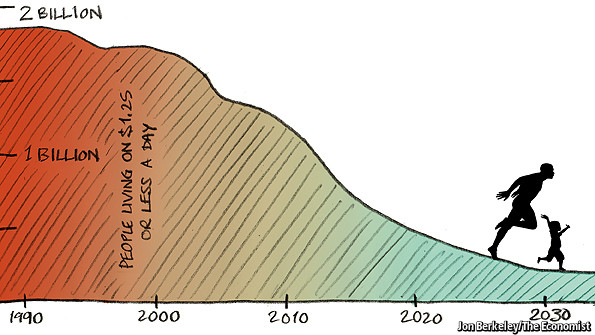
Indeed, over the last thirty years we have seen tremendous improvement in extreme poverty.
In 1990, 43% of the population of developing countries lived in extreme poverty (then defined as subsisting on $1 a day); the absolute number was 1.9 billion people. By 2000 the proportion was down to a third. By 2010 it was 21% (or 1.2 billion; the poverty line was then $1.25, the average of the 15 poorest countries’ own poverty lines in 2005 prices, adjusted for differences in purchasing power). The global poverty rate had been cut in half in 20 years.
The story of India and China now having a significant middle class also happened over the thirty years.  Which is why Rogoff says the answer depends, and concludes with this:
In accepting Piketty’s premise that inequality matters more than growth, one needs to remember that many developing-country citizens rely on rich-country growth to help them escape poverty. The first problem of the twenty-first century remains to help the dire poor in Africa and elsewhere. By all means, the elite 0.1% should pay much more in taxes, but let us not forget that when it comes to reducing global inequality, the capitalist system has had an impressive three decades.
So, who you gonna believe?

I turned to my favorite when it comes to income distribution issues: Branko Milanovic.  He writes:
When we look at the global population rather than at countries, however, there is a positive side. The unprecedented growth of China and, from the early 1990s, of India, as well as much of the rest of Asia has lifted millions out of poverty. For the first time since the industrial revolution, income inequality among world citizens has fallen.
See, again, from a global perspective, things have never been this good.

Milanovic concludes thus:
What is the role of national inequalities? On a purely arithmetic level, if real growth is given, greater inequality slows poverty reduction and probably the expansion of the middle class. But those who believe in trickle-down economics argue that without greater inequality there would not be strong growth. While this might have been true for China in the past 20 years, it is doubtful that further growth in inequality there will be so benign. China’s Gini – a measure of inequality – at about 44 is already greater than America’s. Can it rise further, deepening regional and urban-rural divides, without slowing the expansion of the middle? India’s inequality, long thought to be in the mid-30s Gini range, may if assessed in terms of income rather than consumption already be as high as 50, practically at the Latin American level.It is therefore growth with redistribution (a familiar development formula from the 1970s) that should be our objective in the years to come, if we want both global poverty and global inequality to continue their downward trend. 
So, who you gonna believe?