Showing posts with label military. Show all posts

Tuesday, May 25, 2021

They are here!

A few days after I blogged about UFOs and the much anticipated government report on it, the New Yorker had a lengthy essay on how the Pentagon started taking UFOs seriously.  Unlike most people like me who rarely ever get away from terra firma, the military's pilots fly high above in the atmosphere.  The reports from its pilots became too many to ignore. 

The government may or may not care about the resolution of the U.F.O. enigma. But, in throwing up its hands and granting that there are things it simply cannot figure out, it has relaxed its grip on the taboo. For many, this has been a comfort. In March, I spoke with a lieutenant colonel in the Air Force who said that about a decade ago, during combat, he had an extended encounter with a U.F.O., one that registered on two of his plane’s sensors. For all the usual reasons, he had never officially reported the sighting, but every once in a while he’d bring a close friend into his confidence over a beer. He did not want to be named. “Why am I telling you this story?” he asked. “I guess I just want this data out there—hopefully this helps somebody else somehow.” 

The object he’d encountered was about forty feet long, disobeyed the principles of aerodynamics as he understood them, and looked exactly like a giant Tic Tac. 

The military has a security interest in this, of course. What do scientists think?

Not much.

And therein lies a serious problem, writes Avi Loeb.

Loeb is the Harvard astrophysicist who argued that the interstellar object Oumuamua might have been the remnant from another civilization somewhere else in the universe.  Scientists promptly ridiculed him.  Even America's friendliest and well known astrophysicist, Neil deGrasse Tyson, mocked the argument.

It seems as if scientists do not want to consider the possibility.  Loeb writes that scientists and the scientific establishment are not doing us any favors by preemptively shutting down investigations.

Finding extraordinary evidence requires a commitment of extraordinary funds. This was true in the successful searches for the Higgs boson or gravitational waves, and it is definitely true in the so-far unsuccessful search for the nature of dark matter. Lack of evidence can be a self-fulfilling prophecy, the result of not investing enough in the search. All four proposals for explaining the anomalies of ‘Oumuamua in the context of a natural origin contemplated objects that we had never seen before in the solar system, including a hydrogen iceberg, a nitrogen iceberg, a tidal disruption fragment or a dust bunny. Therefore, by taking a close-up photograph of an ‘Oumuamua-like object in the future, we will learn something new about the nurseries that give birth to objects that we never imagined before ‘Oumuamua’s discovery. Our scientific knowledge will benefit irrespective of whether these objects are natural or artificial in origin. Only one scenario will maintain our ignorance—that of “business as usual” and lack of interest in ‘Oumuamua’s anomalies.

The chance that Earth is the only place in the universe with intelligent life, as we understand it, is way lower than the probability that we are not alone in the universe whose vastness we are yet to comprehend.  Not too long ago, most of humanity believed that we were at the center of it all.  Galileo muttered under his breath "And yet it moves," after surrendering to the Catholic Church and recanting his claim that Earth moves around the Sun.  Wouldn't we want to allocate funds for scientists understand these unexplainable aerial phenomena, instead of muttering under our breaths, "and yet they move"?

Monday, August 07, 2017

I scream!

Two decades ago, my parents made their first and only visit to the US.  An incident from that trip that my mother recalled, when we were talking during my visit to India, revealed a lot about my regimented and boring life.  An incident about which I have no recollection till this very day.

So, what happened?  As my mother remembers it, I had almost warned her that everything sugary is inexpensive in America and, therefore, she should pay particular attention to chocolates and ice cream that she ate. Especially ice cream, for which she had an extra fondness.  Apparently I had also explained the logic for the warning: Ice cream is a easy way to gain pounds in no time at all.  On top of that, well, because of diabetes in the family.

What a horrible son, right?

Wait, there is more to the story.

Soon after they returned to India, a routine blood test revealed that she had diabetes!

See, I am a good son, after all! ;)

Ice cream is very American.  In my first "winter" in Los Angeles, I was surprised to see Americans rushing to the ice cream outlets even when it was cold outside.
Kids and adults eat ice cream.
A lot.
While walking.
Sitting.
Standing.
And, of course, while driving too.

Ice cream is so much a part of America, in ways about which I had no idea. Like this one:
When the 18th Amendment outlawed the sale of spirits in 1920, many early American breweries, including Yuengling and Anheuser-Busch, turned to soda and ice cream to stay afloat. By the end of the decade, Americans were consuming more than a million gallons of ice cream per day—and, crucially, associating it with the comfort and diversion formerly assigned to alcohol.
"Ice cream had become inseparable from the American way of life" so much so that the boys fighting for the country abroad had to served with this comfort food that reminded them of home.  Ice cream became a part of the massive military-industrial-complex:
The U.S. Navy spent $1 million in 1945 converting a concrete barge into a floating ice-cream factory to be towed around the Pacific, distributing ice cream to ships incapable of making their own. It held more than 2,000 gallons of ice cream and churned out 10 gallons every seven minutes. Not to be outdone, the U.S. Army constructed miniature ice-cream factories on the front lines and began delivering individual cartons to foxholes. This was in addition to the hundreds of millions of gallons of ice-cream mix they manufactured annually, shipping more than 135 million pounds of dehydrated ice cream in a single year
Of course, for many of us with bloodlines outside Europe, all that intense lactose of ice cream is one big hassle.  At the same time, I too crave for the ice cream experience. And, of course, I too love the comfort food that stirs the memories of childhood days in India.  America offers a product for that too:
Description at the site:
We make this exotic sorbetto simply with ripe Indian mangos, pure sugar and fresh lemon. It’s vegan and free of milk, though your mouth might have trouble believing it at first. Just keep eating it until your mouth admits it was wrong and apologizes.

God bless America! ;)


ps: A "cold" fact that will make this guy happy: Talenti is a subsidiary of Unilever, after the fast-growing upmarket private company was snapped up for an undisclosed amount ;)

Monday, June 26, 2017

The World According to Saudi Arabia

Five weeks ago, I included the following photograph in this post:

,
That NY Times photo ran with the caption: "A woman with cholera was treated at a hospital in Sana, Yemen, on Sunday."

Yes, cholera!

Over the five weeks, the president made a triumphant return to the country after having gained even more confidence from touching the orb.  Saudi Arabia, which is one the main reasons why Yemen is in a completely messed up state, also gained in confidence from the president touching the orb, and decided to let Qatar and Iran know who the big dog is in that part of the world.

Meanwhile, nobody cared about Yemen.

Is it any surprise that things have become worse, as if that is even possible?
Seized by violence and teetering on the edge of famine, Yemen is grappling with another danger that threatens to outpace them both: cholera.
"We are now facing the worst cholera outbreak in the world," international health authorities said in a statement Saturday.
Cholera is one of the easiest to stop, if you think about it.  Right?
The disease should not be so ferocious. Preventing cholera is pretty simple in theory: wash your hands with clean water, drink clean water, and eat food that has been boiled or cooked.
But ...
But clean water in Yemen is a luxury. Municipal workers in Sanaa have not been paid in months. And so we have no electricity, rubbish piling high in the street, and a crippled water system.
The sewer system stopped working on 17 April. Ten days later, cholera hit.
How terrible!
Yemen now suffers three-way tragedy: a population under siege, suffering the violence of war and unable to work or access nutritious food or health care; an economic collapse that has led to a rise in criminality; and now a devastating health crisis.
This all leads to what could be the largest cholera outbreak of our lifetime.
America couldn't care, even though the world knows that we are an accomplice in Yemen's deepening humanitarian crisis:
"There's a U.S. imprint on every civilian death inside Yemen that's caused by the Saudi bombing campaign," Democratic Sen. Chris Murphy of Connecticut told NPR's Michele Kelemen last month after the U.S. signed a new arms deal with Saudi Arabia.
"The Saudis simply could not operate this bombing campaign without us," he continued. "Their planes can't fly without U.S. refueling capacity. They are dropping munitions that we've sold them. We are standing side by side with them often when they are reviewing intelligence about targets."
As Fareed Zakaria noted, "Saudi Arabia played Donald Trump":
The United States has now signed up for Saudi Arabia’s foreign policy — a relentless series of battles against Shiites and their allies throughout the Middle East. That will enmesh Washington in a never-ending sectarian struggle, fuel regional instability and complicate its ties with countries such as Iraq that want good relations with both sides. But most important, it will do nothing to address the direct and ongoing threat to Americans — jihadist terrorism. I thought that Trump’s foreign policy was going to put America first, not Saudi Arabia. 
Shame on us, and on the 63 million voters!

Saturday, February 11, 2017

The huge budget deficit because of that damn foreign aid we give!

When discussing alternatives to carbon, students suggested--and correctly--that alternatives are either expensive or cannot serve the huge demand.  The class seemed pretty confident that the way forward is to aggressively pursue clean energy.

But then this is Oregon and these are wonderfully young people who have not been tainted by alternative facts.

One student, from the back, slowly raised his hand.  "Even a ten percent cut in the military budget can pay for a lot of this stuff."

This president and his minions are in serious trouble if more Americans are like the students in that class.  But, here's what is working well for this president and his adopted white supremacists party:
Fortunately for Trump, most voters have no real idea how the government spends its money
Which is why when this president presents his alternative facts about federal workers being a waste, the crowd applauds thinking believing that he will make America great again!
The sociologist Arlie Hochschild, in her recent book “Strangers in Their Own Land,” about working-class Republicans in Louisiana, documented wider misconceptions. Many of the people she talked to believe that the federal government employs forty per cent of American workers; it’s closer to two per cent. “They think that the government is full of waste and freeloaders,” Hochschild told me.
Think about it.  The reality is a number that is close to two percent.  It is not as if the loyal Republican white working class thought the number was four, or five, or even ten percent.  They thought the federal government employs forty percent of American workers.  40 versus 2!

It is the same case with everything that the party beats up on, which the loyal base applauds, and treats as god-given facts.  Which is why they beat up on foreign aid, or NPR, as if these are the reasons why we have deficits.  You ask them about the military budget and they will repeat the party line that the damn Democrats have weakened the military by repeatedly shredding the budget.  And, therefore, the Democrats are traitors!

This president and his falsehood-peddling minions can talk all the shit they want, but they won't be able to balance the budget.  Simple math:
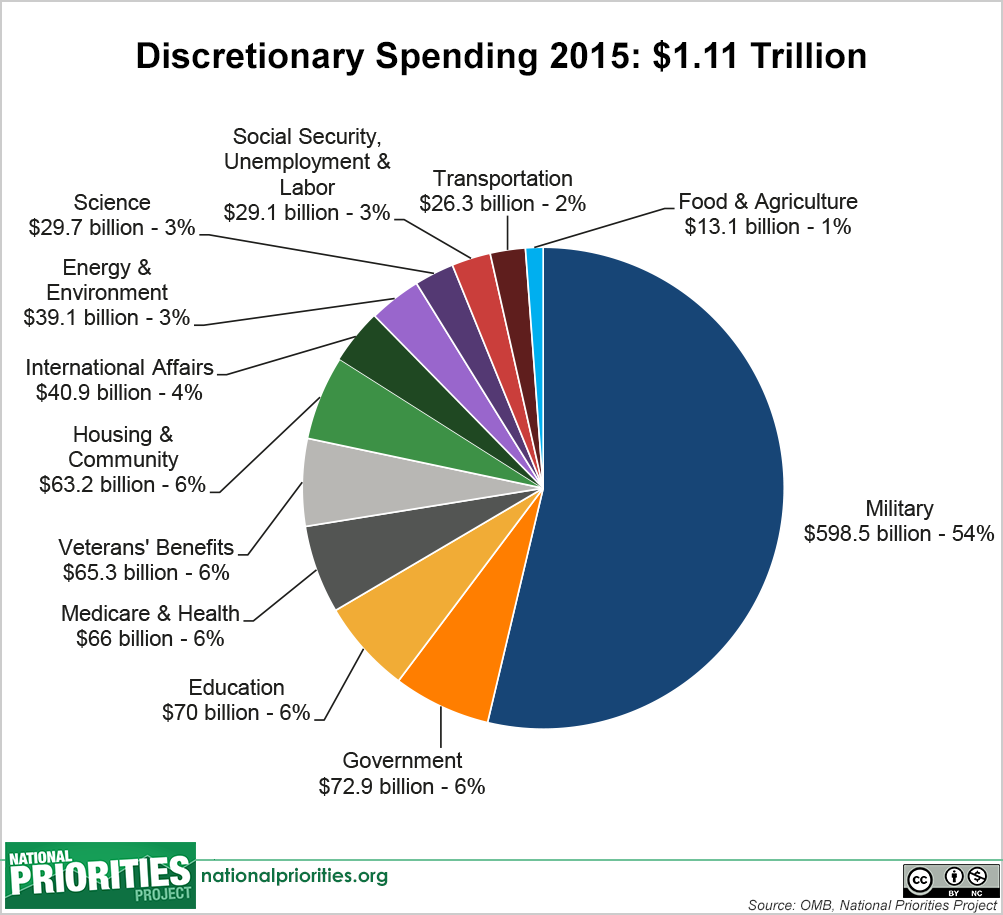
Most federal spending is nondiscretionary, meaning that it goes to entitlements (such as Social Security, Medicare, and unemployment insurance) and to pay the interest on the national debt. Discretionary spending totals just $1.2 trillion a year (out of a budget of almost four trillion), and roughly half of that goes to national defense, which Trump insists that he won’t touch. The federal budget deficit is around six hundred billion dollars a year, and analysis by the Tax Foundation suggests that Trump’s proposed tax cut would reduce federal revenue by another half trillion or so. So it’s simply impossible for Trump to balance the budget while protecting defense and entitlement spending.
The theatre of endless discussions over foreign aid or PBS will entertain the masses, yes, but the budget hole will continue to get bigger and bigger and bigger.

Such insanity--and remember that this is an administration that is only three weeks old--is also why no economist of any decent reputation wants to go anywhere near being an adviser to this president:
Other than Mr Navarro, Mr Trump struggles to find economists who will support him. Perhaps as a result, his cabinet will be wonk-free.
Seriously, 63 million Americans voted for this man?  The Republican Party kowtows to this nincompoop?  There is simply no way that there can be anything good about a Trump voter!  Assholes, all of them!

Source


Friday, October 16, 2015

Cameroon: The latest attempt to educate Americans about the world

Remember that old Mark Twain quote about the geographic illiteracy of Americans?  What?  You don't?
God created war so that Americans would learn geography.
Are you not impressed that he said that a long time ago?  And, therefore, are you not mighty relieved that our collective ignorance about the rest of the world, and the apathy, is not anything new?  I suppose if there is one thing that we can hold on to as a truly American trait, it is that we don't know much about geography and we don't care either.  After all, that ill-informed view was what led to the formation of these United States, thanks to Christopher Columbus stumbling upon "India"!

But then, we try our best to learn about the countries and people in different parts of the world by bombing the shit out of them.  In the past seventy years, since the ending of the world war that followed the world war that was supposed to end all wars, the US has bombed an impressive list of countries:


Awesome, right?

How many Americans will be able to accurately identify all those countries on a world map, and say something substantive about those countries and the people?  We try our best but Americans still don't care.  (BTW, a special note on Syria: for the first time since the end of WW II, the US and Russia will be bombing the same country!)

In this important task of continuing education, we are dispatching the next set of teaching assistants--armed with the latest gadgets, of course--to Cameroon.  Hey little boys and girls, do you know Cameroon?
White House spokesman Josh Earnest said the mission would be "part of a broader regional effort to stop the spread of Boko Haram and other violent extremist organisations in West Africa".
More details, please?
The force, which will be 300 strong, will conduct airborne intelligence, surveillance, and reconnaissance operations in the region.
Cameroon and Chad have been targeted by the Islamist militants from northern Nigeria.
Mr Obama said the forces would remain in Cameroon until "no longer needed".
I am sure "until "no longer needed" means that the US forces will be there only for a couple of months,  Like how our forces came back from Japan after the war ended and how we no longer have military bases there. Yeah, right!

Sometime soon we will have to start educating Americans about the planetary system and outer space, given our scientific illiteracy.  Maybe we should think in terms of bombing those Martians?


Thursday, April 02, 2015

What could have been ... a point of no-return ... it is Pakistan!

Modeled after "How to write about Africa" was this piece on "How to write about Pakistan," in which the author noted, with sarcasm:
Pakistan is just like India, except when it’s just like Afghanistan. (Has anyone else noticed how we seem to have geographically shifted from being a side-thought of the subcontinent to a major player in the Greater Middle East? Is this progress?)
The more years go by, the more things change, the more things stay the same.  A recent piece in Foreign Policy on Pakistan's identity problem begins with:
When you hear about Pakistan, what most often comes to mind? The place where schools, markets, and neighborhoods are routinely bombed? The terrorist haven where Osama bin Laden hid for almost a decade? The “Pak” in Af-Pak? The difficult ally America can’t drop because of its nuclear capabilities? The country where Malala Yousafzai was shot? All of this is true, but there is so much more to this country of 182 million people.
The common perception of Pakistan is more similar to its neighbor in the west (Afghanistan) than the one in the east (India), the country with which it shares its history.
What a mess, since the horrific partition in 1947, which only worsened after East Pakistan became Bangladesh!  Terrible!

Who caused this mess, which has made the daily lives of the 182 million miserable for the most part?
This is a direct result of how Pakistan’s “establishment” — its military and political elite — has defined its identity. This definition emphasizes Islam above all else, and pitches Pakistan as completely different from India.
If only I believed in something after death, I will curse all those to eternal damnation!  I would wish that Zia-ul-Haq be subject to every possible torture in that hell.  The maniac got away relatively easily in an unexplained plane crash, when he should have had an exit that would have made Gaddafi's last minutes seem painless!

Thanks to all those maniacs:
Because Pakistan has disavowed large parts of its past and its identity, it is easier to define it in terms of its present struggle with terrorism. There is little else people know about it. Few people ask me about what Pakistan is really like, about life in my hometown, Lahore, the city of gardens.
Lahore.  Remember the events there thanks to which the country hasn't had any international cricket played there?  I wonder whether they have at least changed the name of the stadium. I hope so.

Zia the maniac made it uber-Islamic.  And then the drive towards the "Islamic bomb" brought Pakistan and Saudi Arabia close, and with that money came the Wahhabi madrasas too.
Since the 1970s, Pakistan’s military and political elite have chosen religious fundamentalism over a democratic plurality. The establishment has emphasized a Sunni Muslim identity at the exclusion of all other ethnic, religious, and sectarian identities. Saudi-imported Wahhabism — an ultra-conservative version of Sunni Islam that lies at odds with South Asia’s tradition of Sufi-influenced Barelvi Islam — has been making in-roads in Pakistani society since the 1980s.
The House of Saud is one screwed up government; oh well, that has to be for another day.

Pakistan could have been so different.  Even with the partition, which I will always believe was one of the worst ever ways to end the Raj.  It could have been a model Muslim country, way better a model than Turkey is hailed to be.  Had it worked out that way, odds are that Afghanistan's story would have been very different too.

If things were different, the image of Pakistan would not be one of terrorism.  Instead, it will be like this:

Will end the post with this; try watching and listening without moving your feet ever, without ever cracking a smile, without rhythmically swaying your head!


Tuesday, March 11, 2014

Guns v. butter. No, make that shoes v. butter!

Remember this chart from a few days ago?


I am sure you forgot all about it and went your ways. Because you have way too many other things to worry about.  But, you--whether living in the US or in Chennai--cannot "afford" to forget it!

The Economist offers an interesting example for why the military budget is tough to tame.  Before getting into the example itself, these comments from the magazine newspaper:
[Harnessing] austerity to reform the defence budget will be dauntingly hard. Congress will have final say over Mr Hagel’s plans and something about camouflage gear has a strange effect on politicians. Even in this era of cuts, the Pentagon’s budget is vast: America accounts for about four of every ten dollars spent on defence worldwide. The temptation is always there to play at industrial policy or simple favouritism.
The scale and the complexity of Pentagon spending make it hard to assess the real prospects for reform.
You ready for the example?  Consider military boots:
 The plant in Big Rapids is still more unusual: every component used there is American, from leather (a Minnesota tannery provides most hides) to shoelaces, eyelets and the yarn used for linings.
 When we live in a world where the shoes we buy might have been manufactured in Cambodia, and shirts from Bangladesh, interesting to note that even the shoelaces for the military issued boots are red-blooded American. Why so?
 This patriotism is explained not by sentiment, but the law. Military footwear is governed by the Berry amendment, passed by Congress on the eve of war in 1941 to ensure that troops would be given home-grown wool and food. Today the amendment applies to most uniforms, tents, flags and processed food bought with Pentagon funds. These must be entirely American-made or -grown, unless domestic firms simply do not make the product.
Make up your mind: do you want to laugh or cry about that?

So, that was about those tough military footwear. If only the politics stopped with that!
 a bipartisan clutch of senators and members of Congress—notably from states with some domestic shoe production—has spent years prodding the Pentagon to start buying a product that does not exist: all-American military running shoes. Under orders from Congress, defence officials formally asked domestic shoemakers in January to report if they could make “Berry-compliant” athletic shoes. The inquiry was made through gritted teeth. Market forces do a fine job of supplying comfortable, cheap running shoes to recruits. Defence officials argue that costs may rise if trainer choices are limited, and that injuries may even follow. The signals are clear enough: the Pentagon has no desire to get into the sneaker-design business.
Yes, even the Pentagon is opposed to the very proposal from the lawmakers
Again, make up your mind: do you want to cry or laugh?

All that was over shoes. And then there are tanks. Aircraft carriers.  Submarines. Fighter planes. Bombs. Missles. ...

Meanwhile, we fight over scraps to maintain soup kitchens.  USA, USA, USA!!!  As Paul Krugman recently put it:
The total failure to accept that the poor face real physical hardship, that affluent politicians have no business lecturing people having trouble buying food or having trouble paying for health care about dignity, is just stunning.
Awful!

For the final time: do you want to cry or laugh?

Friday, February 28, 2014

I am a wuss even at supporting the anti-war cause?

When driving back from work, if I leave campus during a certain time block, I can expect to see a dedicated anti-war group standing on the curb by the courthouse and waving signs advocating for peace.  As I pass them, I sound the horn once or twice and wave out to them.  These are no spring chicken, but, dedicated as they are, rain or fog or the sun never stops them, it seems.

The older I get, the more I am becoming anti-war and anti-violence. I suspect it is because I understand way more now than ever before how fragile life is.  When young, too, I was against war and violence, but I had no idea about the fragility of life. The commitment to peace is, thus, a lot deeper than it ever was.

Yesterday, when I left the parking lot, I knew I would see them. The pacifist in me smiled at the thought of waving at like-minded people.

I was about a mile away from the courthouse when a vehicle changed lanes and ended up ahead of me. The licence plate caught my attention--it was a "veteran" plate.

As we neared the courthouse, I now had a serious dilemma.  Will it be ok to honk and wave in support of the anti-war stance when driving right behind a veteran?  If it is the veteran driving the vehicle, as opposed to some other family member using the vehicle, then wouldn't it be rude?  Should I worry about the veteran's feelings when, after all, this was a public space? What if the veteran is also anti-war?

I told a friend the other day that sometimes I want my brain to shut down. It seems to be always at work. I am not sure how good or harmful that is. In this case, too, I would have preferred if my brain hadn't started analyzing all these and I had simply sounded the horn and moved on.

But, I am what I am, I suppose!

I drew parallel with the group on the curb. My hand came off the horn. I merely waved out at them. I drove on.

Does life always have to be this complicated?

The day ended with the nerdy me catching up on my reading. And, this chart on the US defense expenditure fed my anti-war feelings:


I will remember this chart the next time around and sound the horn four times to make up for the lost time!

Friday, March 22, 2013

Higher education should be about outcomes. Not about doing time!

I sometimes semi-seriously joke with students that an 18 year old has to choose one from the following institutions as the option for at least four years:
The military institution,or
The penal institution, or
The mental institution, or
A higher education institution.
"You made the call to come here in order to avoid the other three" I joke, punctuating it with my muahaha.

We require them all to clock in and clock out somewhere, until they can be of legal drinking age (ok, drinking-age plus one!)

In higher education, we do not question why it has to be a four-year degree.  We do not question why every student has to go through the same process, even when we are fully aware that students differ in their abilities.

It is a mass production factory system--yes, that, too, is sometimes what I tell students.  How much ever things have changed in "the real world," we dare not question some of the fundamental units of higher education.

Like, why an academic year is only thirty weeks.  A century ago, the logic was that students were much needed as labor in the farms during the precious summer months of up in the latitudes here.  The old folks talk about picking one fruit variety after another throughout the months.  It is a different world now, and even the summer farm labor demand is now met by legal and illegal immigrants.  So, what do students then do in the summer months?  That is increasingly becoming a difficult blank to fill.

We require all the students to spend the same amount of time in order to develop and demonstrate competency in whatever that we require.  Even though in any class it is clear that some students can develop the competence in the subject in a few weeks less than a term, while others might need more than a term.

Could it be that we continue to engage in such practices because:
Institutions will try to preserve the problems to which they are a solution.
I came across that marvelous statement, cynical as it is, in this essay on literature and the publishing industry.  I suppose that quote, from the social thinker Clay Shirky who apparently has that as a rule named after him, can be applied in many, many contexts; such is the world in which we live!

Thus,
The military institution tries to preserve the problems to which it is a solution.
The penal institution tries to preserve the problems to which it is a solution.
The mental institution tries to preserve the problems to which it is a solution.
Why should we expect higher educational institutions be any different, eh!

Thursday, February 14, 2013

Pakistanis hate the US and love their military

Elections are round the corner in Pakistan; thankfully, it won't be on the Ides of March!  But then, it seems like the country is in a perennial Ides of March, and an election on that day maybe the equivalent of two negatives making a positive!

So, how are things there? (ht)
With President Barack Obama's first term characterized by strained relations between Pakistan and the U.S., more than nine in 10 Pakistanis (92%) disapprove of U.S. leadership and 4% approve, the lowest approval rating Pakistanis have ever given.Trend: Approval of U.S. Leadership in Pakistan
Really?  There is still 4% that approves the US leadership? Damn; we aren't doing a good enough job with our drone strikes then.  Oh, wait, what drone strikes?

To begin with, it is one heck of a shaky democracy in Pakistan. To add fuel to that fire, which was not always merely metaphorical, we did everything from drone strikes to, well, remember that crazy shooting incident?  Of course, there is that wonderful line up of prime ministers and presidents accused of corruption.  Should we then be surprised at all with the following?
confidence in the interventionist military -- the organization that has ruled the nation for over half of its post-independence history -- climbed to 88% in October 2012. While support for the military in Pakistan has traditionally been very high, it has regularly met or eclipsed 80% since 2010.Trend: Pakistan: Confidence in Military and National Government The upcoming May elections in Pakistan will be of seismic importance for the future direction of the country and for U.S.-Pakistani relations. 
Oh my!  88% versus 23%.  No contest there!

If elections are held as scheduled in May, and if a civilian government follows, then it will be a historic event--two consecutive civilian governments.  A civil transfer of power.  But, of course, three months to go and a great deal can happen in between.

A few months ago, I wrote that "Pakistan seems to be rapidly fading from our radars":
On our part, here from the US, we ought to cheer these developments, and support them in every possible way we can. We definitely do not want to perpetuate a long‐held sentiment around the world, particularly in Pakistan, that the US quickly forgets as soon as its own selfish objectives have been met.
Oh well ... even more to worry about in that Gallup poll:
Pakistanis now more than at any other time in the past three years feel threatened by interaction with the West, according to a May 12-June 6, 2012, survey. A majority (55%) say interaction between Muslim and Western societies is "more of a threat," up significantly from 39% in 2011. 
Not good at all!

Let us hope that it will be a peaceful spring in Pakistan.

Sunday, February 10, 2013

Why is even Paul Krugman pro-military spending? :(

I know better than to disagree with a public intellectual who is a Nobel recipient.  But, the following lines in Paul Krugman's piece don't resonate well with me, at all:
Start with a basic point: Slashing government spending destroys jobs and causes the economy to shrink.
This really isn’t a debatable proposition at this point. ...
Even Republicans admit, albeit selectively, that spending cuts hurt employment. Thus John McCain warned earlier this week that the defense cuts scheduled to happen under the budget sequester would cause the loss of a million jobs. It’s true that Republicans often seem to believe in “weaponized Keynesianism,” a doctrine under which military spending, and only military spending, creates jobs. But that is, of course, nonsense. By talking about job losses from defense cuts, the G.O.P. has already conceded the principle of the thing.
Seriously?  Krugman arguing in favor of maintaining the defense spending, too?  And by mockingly citing the "weaponized Keynesianism" he thinks he is reinforcing his argument?  Something is certainly rotten!

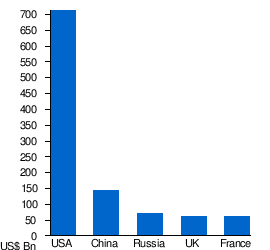
In his zealous pursuit of a certain policy option, has Krugman completely overlooked a simple fact that the US now spends more on military than the rest of the world combined.  Yes, the rest of the world combined! Ye tu, Professor Krugman?

If even Paul Krugman can write defending the military's budget, then we are in deep shit.

Contrast that with the following observation:
Every gun that is made, every warship launched, every rocket fired signifies in the final sense a theft from those who hunger and are not fed, those who are cold and not clothed. This is a world in arms. This world in arms is not spending money alone; it is spending the sweat of its laborers, the genius of its scientists, the hopes of its children. . . . This is not a way of life at all in any true sense. Under the clouds of threatening war, it is humanity hanging from a cross of iron. 
That quote on guns and hunger is, of course, from President Dwight Eisenhower's famous farewell speech that gave us the phrase the "military-industrial complex."  Jill Lepore reminds us about Ike's warning shot and a lot more in this New Yorker essay on the question on how much military is enough.

It is not merely the defense expenditures that worry me.  Even more than the dollars we spend there, I get depressed when I read and watch how much anything military has become sacred.  As Lepore writes:
Americans “have fallen prey to militarism, manifesting itself in a romanticized view of soldiers, a tendency to see military power as the truest measure of national greatness, and outsized expectations regarding the efficacy of force. To a degree without precedent in U.S. history, Americans have come to define the nation’s strength and well-being in terms of military preparedness, military action, and the fostering of (or nostalgia for) military ideals.” Even as military spending has soared, war has become more distant: less known than imagined, less remembered than forgotten. War has become a fantasy: sleek, glossy, high-tech (more “Top Gun” than “Apocalypse Now”), and bloodless. Americans have less experience of war, and know less about the military, than at any point in the past century. 
I agree; "a romanticized view" is a better description.  It is simply bizarre.  So bizarre is this unholy combination of a romanticized view and weaponized Keynesianism that we continue to push for the manufacturing the tanks that even the military doesn't want!

Krugman is, of course, not the first economist, it seems like, who makes atrocious statements when caught up with the goal of maximizing the GDP.  Nearly two years ago, Larry Summers made the following point:
Never forget, never forget, and I think it’s very important for Democrats especially to remember this, that if Hitler had not come along, Franklin Roosevelt would have left office in 1941 with an unemployment rate in excess of 15 percent and an economic recovery strategy that had basically failed.
What a disgraceful fall from that wonderful starting point that Lepore reminds us about
The United States, a nation founded on opposition to a standing army, is now a nation engaged in a standing war.
As Jill Lepore notes:
“God help this country when someone sits in this chair who doesn’t know the military as well as I do,” Eisenhower once said.   
Looks like even god can't--we have a bigger military than hers!

Wednesday, January 30, 2013

So what if cuts in defense spending shrink the economy?

It is one of those news items that might seem like bad news, but is not:
The U.S. economy unexpectedly shrank from October through December, the first quarterly drop since 2009 and a reminder of the economy’s vulnerability as automatic cuts in government spending loom.
I do not mean to suggest that a contraction in the economy is good, when unemployment, especially among the educated youth, is at levels that are way higher than a "normal" rate of unemployment.

It is a good news because of the underlying reasons for the contraction:
The decline in federal spending last quarter was the largest drop since 1973. Spending at all levels of government fell 6.6% in the period.
That drop was the primary culprit for the economy contracting, said Alan Krueger, chairman of the White House's Council of Economic Advisers.
"Several private-sector components of GDP continued to make positive contributions," Mr. Krueger said. "A likely explanation for the sharp decline in Federal defense spending is uncertainty concerning the automatic spending cuts that were scheduled to take effect in January," and are now set for March 1.
I am cheering not because I a rabid libertarian who believes that all government is evil.  But because at least for a short while we have had a drop in military expenditure.  A slight, very slight, tempering of our war infrastructure is something that ought to relieve us.  If only we can continue to go after the military budget, which, if not for the "fiscal cliff," is always treated as a sacred cow that had to be fed more and more. (too many metaphors?)

If we don't spend money on guns, then we will have more money for butter.  The more we can decrease spending on guns, the better off we will be.  Do not allow yourself to be scared into thinking that this drop in defense spending is bad news.
Economists stressed that the key factors that dragged on GDP in the fourth quarter could prove short-lived, even though the economy faces other threats in 2013.
“Frankly, this is the best-looking contraction in U.S. GDP you’ll ever see,” Paul Ashworth, an economist at Capital Economics, said in a research note. “The drag from defense spending and inventories is a one-off. The rest of the report is all encouraging.”
For all of 2012, the economy expanded 2.2 percent, better than 2011’s growth of 1.8 percent.
We might already be witnessing the "more butter" aspects:
consumer spending accelerated and business investment rebounded, suggesting some fundamental strength that should help to support the recovery even as Washington tightens its belt.
"We are not concerned that the economy is slipping back into recession," said John Ryding, chief economist at RDQ Economics in New York.
A second report showed private employers stepped up hiring in January, suggesting an improvement in the labor market. 
Yep, we don't need a gazillion more bombs and fighter planes and submarines and drones.  Think about the many ways we could constructively spend all that money! (the chart compares the top five military budgets in 2012.)
Source

Sunday, October 16, 2011

Occupy Wall Street heading towards ... Guy Fawkes Night ...

Looks like we are slowly moving towards what could become an eventful Guy Fawkes Night, three weeks from now on November 5th.  People are protesting (causes for dissatisfaction is all across the spectrum) and politicians and governments seem to be quite helpless at figuring out hot to get to address the dissatisfied Americans.

In such grave economic contexts, one would imagine reconsidering all the major expenditure items, especially at the federal level, which means talking about the massive military spending that we do.  But then how do you counter a propaganda campaign-by the government and the military industry--that it will be doom and gloom if we cut our defense budget even a tiny bit!


Saturday, July 23, 2011

How did the deficit get this big?

Like so:


More here

And, yet, defense expenditures are off the table!

If only alternatives were any better, we would send Obama packing!

Of course, my rantings here don't influence a damn thing (editor: have you forgotten the hate email, which is proof that there are people who read what you write?)

Therefore, it is all the more a consolation when I find that the likes of Krugman and Stiglitz and Sachs and ... write about these in ways that are far, far, far more influential. Here is Sachs (ht):
[At] every crucial opportunity, Obama has failed to stand up for the poor and middle class. ... Obama is on the verge of abandoning the poor and middle class, by agreeing with the plutocrats in Congress to cut spending on Medicaid, Medicare, Social Security, and discretionary civilian spending, while protecting the military and the low tax rates on the rich (if not lowering those top tax rates further according to the secret machinations of the Gang of Six, now endorsed by the president!)
 If everything--including social security--is on the table, why then is military off the table?  On a special velvet-cushion chair all by itself?  Sipping a martini while expenditures over at the civil society are being shredded?

As Congressman Barney Frank said:
Scoffing at the suggestion that “everything is on the table’’ in budget negotiations between the Obama administration and congressional leaders, Frank said, “The military budget is not on the table. The military is at the table, and it is eating everybody else’s lunch.’’
A double-martini lunch, indeed!

How much do we spend on the military?


Friday, July 15, 2011

Mumbai terror yet again reveals the difference between India and the US

I was reminded of one of my posts from almost a couple of years ago where I had excerpted from the prolific Pankaj Mishra:
India may have been passive after the Mumbai attacks. But India has not launched wars against either abstract nouns or actual countries that it has no hope of winning or even disengaging from. Another major terrorist assault on our large and chaotic cities is very probable, but it is unlikely to have the sort of effect that 9/11 had on America.
This is largely because many Indians still live with a sense of permanent crisis, of a world out of joint, where violence can be contained but never fully prevented, and where human action quickly reveals its tragic limits. The fatalism I sense in my village may be the consolation of the weak, of those powerless to shape the world to their ends. But it also provides a built-in check against the arrogance of power — and the hubris that has made America’s response to 9/11 so disastrously counterproductive.
 How counterproductive?  Like so:


Afghanistan.
     Iraq.
          Pakistan.
               Yemen.
                    Libya.
                         Somalia.

And counting :(


Saturday, July 09, 2011

Quote of the day: military eating the employment lunch

I am not always a fan of Congressional Representative Barney Frank--he is too ideological for my political tastes.  What he says here is a gem:

Scoffing at the suggestion that “everything is on the table’’ in budget negotiations between the Obama administration and congressional leaders, Frank said, “The military budget is not on the table. The military is at the table, and it is eating everybody else’s lunch.’’

Frank also commented a few days ago that after Obama announced troop withdrawal from Afghanistan, Congress didn't bother to take back the billions originally appropriated for those troops as well.

When it comes to war and defence, there is one one hell of a scary bipartisanship.

We are at war in Iraq, Afghanistan, Libya Yemen, Pakistan.  In the first two, we have "boots on the ground."  In Yemen and Pakistan, we use drones.  And Libya, of course, is not war but "kinetic military action."

Meanwhile, scary employment and economy scenarios back here at home.

These are the kind of situations when I wonder why I even bother to read the news anymore :(

Wednesday, June 08, 2011

Wars and the economy. Guns v. butter

Variations on the theme of guns v. butter ... would you rather spend gazillion dollars on the military, or ...


Yes, the horrible guns v. butter reality ...
Not to be confused with Guns N Roses :)

Monday, November 29, 2010

Stat/quote of the day: America's military spending

The U.S. defense budget is now about the same as military spending in all other countries combined.
That is Gregg Easterbrook (ht) writing about the out of control defense budget, which grows even despite mounting concerns over the deficit and debt.  Even under Barack "Change" Obama's presidency:
This year, the United States will spend at least $700 billion on defense and security. Adjusting for inflation, that’s more than America has spent on defense in any year since World War II—more than during the Korean war, the Vietnam war, or the Reagan military buildup. Much of that enormous sum results from spending increases under presidents George W. Bush and Barack Obama. Since 2001, military and security expenditures have soared by 119 percent.
And then Easterbrook has this nugget way towards the end of his essay, which has plenty of specifics:
The mindset of top-heavy spending has also infiltrated the realm of counterterrorism and intelligence. For security advice, the president now has a secretary of defense, a secretary of state, a director of national intelligence, a national security adviser, a Central Intelligence Agency, a National Security Council, a President’s Intelligence Advisory Board, a National Security Agency, a Defense Intelligence Agency, separate Air Force, Navy, Marine, Army, and even Coast Guard intelligence commands, a National Counterterrorism Center, an FBI Directorate of Intelligence, a State Department Bureau of Intelligence and Research, a National Reconnaissance Office, and a National Geospatial-Intelligence Agency. Even the Treasury Department has an Office of Terrorism and Financial Intelligence.
The specter of terrorism obviously required an improvement in intelligence. But spending for the sake of spending doesn’t make the nation any safer, while multiple overlapping bureaucracies may only slow reaction time. The new security hierarchies are sagging under the weight of senior-grade officials who spend much of their time in turf battles. Recently, the director of national intelligence, Dennis Blair, resigned after just 16 months on the job, after a sandbox squabble with the CIA over whose name comes first on memos. If that’s how people at the top of the security hierarchy are behaving, imagine how those in the middle are wasting the public’s time.

Tuesday, August 31, 2010

More on China versus America: warships

Not that I am on a anti-China warpath ... I am merely blogging the facts :)
Guess which country has the most number of warships on this planet?  You got that right!