Showing posts with label colonialism. Show all posts

Tuesday, June 16, 2020

Xochitl and the Way of Humanity

A day or two before the term begins, I look up the names in the roster.  I started this practice early in my teaching career, back in California, because of a lack of familiarity with some names that I had come across and, therefore, to watch out for how students pronounced them when they introduced themselves.

One name stumped me.  It was "Xochitl."

I had never seen that name before.  Those days, when Alta Vista was the go-to search engine, there was no way of figuring out from the Web how to pronounce anything.

It was class time.  I was ready to learn how to say Xochitl.

She said her name that sounded like SHO-Chee.

The always curious me then asked her where that name came from.

It was Aztec.

Nahuatl.

Students have no idea how much they have taught me over the years.  I am glad they don't charge me tuition for it and they pay me instead!

Similar to how the Bastard Empire harshly and suddenly interrupted the history and thought of Tamil, the Spanish did that same--and worse--to Nahuatl.
Nahuatl is what we call a group of two dozen interrelated languages spoken mostly in central Mexico for the past 1,500 years and by 1.5 million ethnic Nahua people today. The lingua franca of the Aztec Empire, Nahuatl was decreed the official language of the Spanish colonies in 1570, and was used as the language of missionary work in indigenous communities. Scholarship arose around the language. Catholic Nahua elites proudly spoke their native tongue, using it to record ancestral histories. Then, in 1696, King Charles II decreed Spanish to be the one and only official language. Nahuatl survived, but in remote communities or in the hushed conversations of working-class urban Nahuas.
It is bizarre that a king who lived a huge ocean away, who never even visited the land, would impose his language, religion, customs, and more on a people who had been living their own lives for thousands of years!

Of course kings and warriors fought over territories.  But, this "enlightenment" colonialism was something else.  (Trevor Noah and John Leguizamo address this in their own ways.)

The author, David Bowles, writes about the "soft, melodic rhythms" of Nahuatl.  But, language is not merely about the language.  It is about the traditions, the thought, the myths, the explanations of life.  It is about our very existence that all of us, anywhere on this planet, try to understand.
Aztec thought recognised a need to gather the broken bits of oneself and rebuild, discarding those elements that hamper enlightenment and happiness. It’s a self-directed therapy that echoes in the sacred tale of our creation.
I like the way the author phrases it: "gather the broken bits of oneself and rebuild, discarding those elements that hamper enlightenment and happiness."  He refers to this as what "the philosopher Gloria Anzaldúa called the Coyolxauhqui Process."
Rediscovering the unadulterated indigenous myths of Mexico can help both Mexicans and Mexican Americans clarify their sense of self, of belonging to something greater, of being the latest in a long line of heroic and noble souls that have sought to balance chaos and order in North America for millennia. Psychological healing and health arise from such a perspective.
But using Classical Nahuatl as a way to harness the Coyolxauhqui Process and find spiritual equilibrium in the midst of nepantla? That is Tlacayotl, the Way of Humanity. A gift bequeathed by the ancients to all of us, their biological and spiritual children alike.
 The Way of Humanity.

And, oh, what does Xochitl mean?  Flower.

Sunday, October 06, 2019

Pull down a few statues

Years ago, I was absolutely delighted with a statue that my grandma's town had installed in the town's center.  A statue of Vanchi.  The freedom fighter from the village who shot dead the British administrator for that region.  As I noted in this post a while ago, "The old teenage emotions on colonialism and anti-Britain have never gone away inside me."

Of course, the Raj ended more than seven decades ago.  But, the scars are always there.  Our lives today are not independent of the historical events. In fact, in many instances, our lives today are very much a result of historical events.  The contemporary lives of Native Americans and African-Americans today, or the lives of the Dalit, are continuations of an unbearable past, how much ever some might want to pretend, or even believe, that looking back does not do any good.

Even universities are not exempt from this.  The older the university, more the skeletons that it most likely has in its closet. Some, like Georgetown, have systematically gone about atoning for the past and are trying to make things right--symbolically, because the literal is impossible.

In the colonial countries, things are barely beginning.  I came across an essay from 2016, by Amia Srinivasan.  The last name is a dead giveaway--from my part of the old country.  But, Amia Srinivasan is not from the old country--she has origins back there.  She is a philosopher playing at the topmost tiers:
I am an associate professor of philosophy at St John’s College, Oxford. From January 2020 I will be the Chichele Professor of Social and Political Theory at All Souls College, Oxford. Previously I was a lecturer in philosophy at University College London.
She earned her BA at Yale.  Yep, that Yale!  In 2007.  Supposing that she were a traditional student means that now as a 34-year old, Srinivasan will be a chair-professor at Oxford. Holy shit!

Now, Oxford is in the old colonial capital.  Which means that there is plenty that they need to apologize for and make amends.  One of them is a highly visible reminder--a statue of Cecil Rhodes, who is not new to this blog.  Amia Srinivasan's essay from three years ago was about Oxford's controversial decision to retain the statue despite the student protests.

A big time philosopher who also writes for publications that even us non-philosophers can read and understand.  We need more like her.  She says:
Scholarly, specialist work is important, and we should defend it fiercely, not just in philosophy, but in all disciplines. And a lot of what goes under the name of “public” philosophy is simplistic and condescending. What we need isn't so much more philosophy that tries to speak to a non-philosophical audience, as more philosophy that comes from a place of engagement with the non-philosophical world.
Yes, I too hate that condescending tone that academics take when they climb down from their ivory towers in order to tell the masses what they think. Good for her. And good for us too.

Saturday, July 28, 2018

Ganga, Tirukoṇamalai, and Salt Spring Island

Remember those British bastards who screwed up the lives of people all over the world?  For ever and ever?  How could you not?  After all, we are all products of the white supremacists' empire building!

They haunt me even when I go far, far, far away!


Yes, I am pointing to "Ganges" on the sign-post.

Notice the small little Salt Spring Island?  Of course, it is way small.  But, of course, no island was too small for the island that is increasingly irrelevant to the world!


Zooming into Salt Spring will reveal the reason behind the title of this post:


The spot marked is Ganges, and the channel to the north and east is, as you can read it, Trincomali Channel.

Yep, at a location that is about 49 degrees north of the Equator is Ganges by Trincomali Channel.

The backstory is all about the British colonial bastards.
Ganges Harbour, from which Ganges takes its name, was originally called Admiralty Bay but was renamed by Captain Richards in 1859 after HMS Ganges, and indirectly after the Ganges river in South Asia.
What about Trincomali Channel? "It is named for HMS Trincomalee which was assigned to the Royal Navy's Pacific Station at Esquimalt in the 19th Century."

The island had been home to indigenous people for about 8,000 years.  And then, one day, the white man arrived.

The rest of the story unfolded as one would hypothesize: Small pox wiped out most of the natives.  The women "married" the white invaders, the marriage then making it "rightful" for the white man to claim property that was not otherwise claimed through guns.

god save the queen, of course!


Thursday, July 05, 2018

Cry me a river!

Europe has become an anti-immigrant continent.  Germany, too, where its chancellor is fighting to hold on to her job, which is under threat because of her past strong support for immigrants, especially refugees.

Anti-immigration sentiments mostly stem from "they" being "different."  The looks, speech, habits, dresses, ... Particularly if "they" are Muslims.  Even in the tiny country that is mostly irrelevant on the global stage.  No, I am not referring to the UK, but Denmark.
For decades, integrating immigrants has posed a thorny challenge to the Danish model, intended to serve a small, homogeneous population.
So, what is the Danish approach?
Denmark’s government is introducing a new set of laws to regulate life in 25 low-income and heavily Muslim enclaves, saying that if families there do not willingly merge into the country’s mainstream, they should be compelled.
Ah, yes, compel them.  "That tough approach is embodied in the “ghetto package.”"  And then the beatings will continue until the morale improves!

Whenever I read anything like that, the old anti-colonialist teenager that I was come out from within me.  But, what am I gonna do?  Stop eating havarti?

I did the only thing that I could do as a powerless member of the public.  I wrote a letter to the newspaper.  That will send a powerful message to the Danish government!  

Oh well, I know the letter wouldn't even get published, given the volume that the NY Times receives.  But, hey, I have my own blog where I can publish whatever I want; so, here is that letter:
Dear Editor:
I read with interest, "In Denmark, Harsh New Laws for Immigrant ‘Ghettos’".
Every time I read one of these reports on how European countries are "struggling" to deal with immigrants, especially Muslims , I wish such reports also included reminders about the past.
While Denmark might be peaceful now, with its people being the happiest on earth, the Danes imposed themselves on places and people far away from Scandinavia.  I grew up in the state of Tamil Nadu, in the southern tip of peninsular India.  In a small coastal town, Tharangambadi, Denmark established a trading post and then a fort nearly 400 years ago.  The Danish East India Company couldn't match the resources of the British East India Company, and ended up with a very small footprint in the Subcontinent.
Whether it is Denmark or France "struggling" with foreigners with hijabs and the Koran, it is history echoing how peoples far away from Europe "struggled" with foreigners who came with guns and the Bible.  I wonder if the native Danes are being educated about this even as the "ghetto children" are being forced into assimilation camps.


Sunday, January 28, 2018

Shitholes aren't natural. They were created

During my meeting with the dean, who too has personal connections to the old country, she remarked about how unknown the partition of India is to almost all the students on any American campus.  I wanted to add that the partition is unknown to most Americans of all ages--not only the students.

It is not a historical factoid that is at stake.  Nope. When they don't know about that important part of history, chances are overwhelming that they have no idea that three hundred years ago the Subcontinent was one of the richest places on the planet.  And, therefore, when the President refers to the shitholes of the world, there is a good chance that there is no understanding among most on how these shitholes came to be created by white supremacists.

Of course, there are plenty of modern day defenders of the old fashioned colonialism.  These apologists argue that the colonized browns "lacked the social and intellectual resources to transform themselves":
But the reality, at least in some of its colonies, was the opposite. Consider India. At the beginning of eighteenth century, India’s share of the world economy was 23 percent, as large as all of Europe put together. By the time Britain left India, it had dropped to less than 4 percent. “The reason was simple,” argues Shashi Tharoor in his book Inglorious Empire. “India was governed for the benefit of Britain. Britain’s rise for two hundred years was financed by its depredations in India.” Britain, Tharoor argues, deliberately deindustrialized India, both through the physical destruction of workshops and machinery and the use of tariffs to promote British manufacture and strangle Indian industries.
And that is how shitholes were created by white supremacists!
It was not just India from which resources flowed back to Britain, though in different countries it happened in different ways. Britain’s West Indian colonies were at the heart of the “triangular trade” by which goods from Britain were used to purchase slaves from West Africa who were taken to the Caribbean, and from whose labor great riches flowed back to British merchants in Bristol, Liverpool, and London.
So, when the white supremacists walk around with condescension towards the browns in the shitholes, well, ...
Without the slave plantations, it is unlikely that Britain would have been able to industrialize, or to forge an empire, as it did.
Slaves and almost-slaves created the wealthy European countries and the US.
In 1807, Britain passed a law banning the slave trade. But for three centuries, that trade had been dominated by Britain; three centuries of savage enslavement, pitiless brutality, and casual mass murder. Twelve million Africans are thought to have been transported to the Americas, half of them in the peak years of the Atlantic slave trade between 1690 and 1807. In those peak years, about half of these slaves were taken on British ships. Historians estimate that at least one in ten, and possibly one in five slaves, died on the Middle Passage, the journey from Africa to the New World. This suggests that half a million Africans may have lost their lives while being transported on British ships.
How horrible!  Just horrible!!!
Supporters of the British Empire argue that its rule was far more benign than the terror of the Belgian Congo. That is not to place the moral bar very high.
Indeed.  Whenever the apologists defend those bastards, I quickly refer them to the Bengal famine, which is one of the most well-documented mass atrocities that the white supremacists committed in the old country towards the end of their colonizing years.

I don't expect white supremacists to disappear anytime soon, given how much they have become emboldened in the US, and across Europe.  Which is all the more the reason why we cannot forget the past and let the white supremacists, including the one in the Oval Office, rewrite history.


Tuesday, September 26, 2017

Who cares for the brown-skinned in the colonies!

Life just happens way too fast.

Only a month ago, in my response-comments to this post, I wrote:
Yep, it is a colony. Like how Puerto Rico is. Like how American Samoa is. Without using the word "colony" John Oliver describes that condition in the video that I had embedded. 
And we treat them that way because, ahem, they are brown-skinned.
And then Hurricane Maria happened.  The lives of three million Puerto Ricans completely devastated.  It is a huge humanitarian crisis.

But, apparently Americans do not care.  Why so?
Many Americans don’t realize that what happened in Puerto Rico is a domestic disaster, not a foreign one.
A new poll of 2,200 adults by Morning Consult found that only 54 percent of Americans know that people born in Puerto Rico, a commonwealth of the United States, are U.S. citizens.
Now, leave alone the notion that we ought to respond to a humanitarian crisis wherever that might be.  But, we can and should care at least about fellow citizens, right?  But, then how many Americans know that fellow citizens include the people of Puerto Rico, Guam, St. John, ...  More importantly, how many of the fascist's solid base know about these fellow-citizens?
Inaccurate beliefs on this question matter, because Americans often support cuts to foreign aid when asked to evaluate spending priorities. In our poll, support for additional aid was strongly associated with knowledge of the citizenship status of Puerto Ricans. More than 8 in 10 Americans who know Puerto Ricans are citizens support aid, compared with only 4 in 10 of those who do not.
We Americans are now behaving like how the Bastard Raj and its cigar-chomping bastard did during the famine in Bengal, which was after all only a colony with brown-skinned people!

Tribalism in the 21st century!
In this case, the lack of media attention could lead people to ignore Puerto Rico’s plight. Our sympathies for other people depends in part on whether we see them as fellow members of our tribe. Without more coverage, it may be easy to forget that the people suffering are our fellow Americans.
How did the fascist talk about Puerto Rico?
"This is an island sitting in the middle of an ocean. It’s a big ocean, it’s a very big ocean."
And how does he know about the people there?
"I grew up in New York, so I know many people from Puerto Rico. I know many Puerto Ricans. And these are great people."
The demagogue tweeted a lot more about the NFL than about Puerto Rico!  This is the guy that 63 million, including past commentators here, voted for!  Shame on them!

Wednesday, September 13, 2017

Yes, Virginia, colonialism exists!

I was an intern in a regional planning agency in Los Angeles, during my graduate school days, thanks to this departed friend.  The internship was one of the many awkward and uncomfortable phases of my life, but that is a different story for another day.

My supervisor was an African-American woman.  Boy was she excited when Clinton beat Bush!  There were two younger women of color who worked in the adjacent cubicles.  Both were full-time employees.  One was from Eritrea.  She was the first person, and the only one ever, from Eritrea with whom I have talked to in real life.

The other woman was from from the Caribbean, she said.  St. Thomas, she added.

My reaction was simple. "St. Thomas?"

Hey, there is only so much one can know.  Life does not teach everything all at once to everybody.  Learning is a lifelong activity.

It was before the days of the world wide web.  Back then, we learnt from each other.  I asked her a whole bunch of questions about St. Thomas.  Including whether they too enjoyed Belafonte's songs.

I thought I had learnt everything important that was to be learnt about St. Thomas.  Of course, wrong I was.  I had no idea all these years that:
One hundred years ago, the islands were called the Danish West Indies. Denmark sold the islands in 1917 to the United States for $25 million.
The Danish West Indies.  One speck of a tiny European country colonizing remote parts of the world, the old country included.

St. Thomas was in the news, but briefly.  Hurricane Irma smashed into the islands there.  Even though the island, along with a few others, is a part of the US, well, the people there aren't "real Americans."  We Americans are the colonizers, and they are the natives who are part of the whole but without any voting rights.

The island has been devastated.
When I finally received a text from my Aunt Cecile on Thursday, she wrote, “The post office is gone.” “What do you mean ‘gone’?” I texted back. She responded with a list: “Grocery stores gone. Schools gone. Hospital gone.” “What do you mean ‘gone’?” I asked again. “Gone,” she texted again. “Demolished. No roof. No walls.”
Imagine the scenario.  A tiny island. No where to run to.  You are stuck.  And now without anything.  Not even food and fresh water.  And you expect your government to come to your rescue, right?

Wrong!

Because, they are not "real Americans."
Virgin Islanders are led by a president who makes clear delineations between “real” Americans and all the rest. True, the people of the Virgin Islands didn’t vote for this current president. The people of the Virgin Islands didn’t vote for any president of our United States of America, because voting in the general election is not a privilege of citizenship that the federal government extends to us. Like the citizens of Puerto Rico, Guam and the other United States territories, we are not yet real Americans.
We Americans do not care when cyclones batter Bangladesh. We don't care even for the Virgin Islands.
No wonder TV networks and even the president’s homeland security adviser, Tom Bossert, can’t seem to get it right.
In a press briefing last Friday, Mr. Bossert appeared to chastise the news media for not covering the government response to Hurricane Irma’s assault on the Virgin Islands. Watching him, I held my breath, wondering if now someone would claim us. But he mentioned the evacuation of American citizens from the Virgin Islands in the same way he talked about the evacuation of American citizens from St. Maarten and St. Martin. I took him to mean: We are evacuating the real Americans from these foreign Caribbean islands.
It is like how post-Katrina, many commentators were referring to the people fleeing Louisiana as "refugees"--because "real Americans" are white and, therefore, the non-whites were like those running away from Eritrea!

I suppose the "real Americans" are very happy with this real-American president!

Thursday, October 06, 2016

The F*ing British Empire

Four decades of life since the early teenage anger against the murderous thugs who (mis)ruled the old country has dampened my anger and disgust only a tad.  If I believed in hell, I could at least curse those white supremacists to the darkest chambers of hell!

My anger over the colonial white supremacists gets regularly stoked with news reports and analyses of the white supremacists empire and its actions.  Or, it will be better if I rephrased it as whatever historical records that the empire and its loyalists did not destroy.  Yep, after all the rape and plunder was done, the empire on its way out made sure to also destroy the historical records.
The Colonial Office devised a system known as “Operation Legacy” that worked on the principle of parallel registries. Reliable civil servants, which in the government’s eyes meant only those who were “British subjects of European descent”, were given charge of identifying and collecting all “sensitive” documents and passing them up the bureaucratic chain. This meant that when the moment of independence came, if not before, they could either be destroyed on site or removed (“migrated” became the official term) to the UK. As to the so-called “Legacy” files that the colony’s new government would inherit, it was important that they gave an impression of completeness, either by creating false documents to replace those that had been weeded out or by making sure there was no reference to them in the files that remained.
So, they burned the papers.  And more.
According to official instruction, the waste left by bonfires “should be reduced to ash and the ashes broken up”. If burning was thought to be too difficult or unsuitable, then the sea offered an alternative. Officials in Kenya were told that documents could be “packed in weighted crates and dumped in very deep and current-free waters at maximum practicable distance from the coast”.
We don't have to wonder why:
Operation Legacy was intended to ensure that “the British way of doing things” would be remembered with “fondness and respect” – that the conduct of its imperial retreat would be seen as exemplary.
What a sophisticated PR campaign, eh!  They plundered and raped, and then the rapists and plunderers wanted to be "remembered with “fondness and respect.""  I think I am going to puke!

Of course, it is not as if life in the old country was all wonderful before the White Supremacist Raj was established.  Far from that.  For starters, the caste system as it was practiced then--including by my ancestors--along with horrific customs like sati, made sure that life for an overwhelming majority was nasty and hellish.  But, that does not make the White Supremacist Raj any nobler.

Which is also why I worry over the possibility of young boys and men in countries around the world who could be angry at my adopted country.  I have no idea how the female mind works in these contexts, but we have rich historical evidence of angry young men causing destruction to life and property--after all, not all angry young men are also committed to nonviolence as a few of us are.  But, the presidential candidate of the party that is mostly supported only by whites seems all out to create more angry young men all around the world :(

I can't wait for the end of supremacy of any kind.

Monday, May 02, 2016

Stinking history!

(I have sent this across to the editor)

Higher education has been afire with discussions—substantive and rhetorical—about the dark histories of the people after whom buildings and colleges have been named. Locally, at the University of Oregon, two buildings, Deady and Dunn Halls, have made us rethink the biographies of the namesakes. The older the university, the more the possibility of controversial history. For instance, recently, Georgetown University has been in the news for how it sold its 227 slaves in 1838 in order to pay off the debts and sustain the financially struggling college.

We humans have been struggling forever, it seems, to figure out how to respond and react to the origins of wealth that is then used for honorable causes, like education. By and large, we seem to have operated along the lines of a Latin phrase that is almost two thousand years old—“Pecunia non olet” which translates to “money does not stink.”

The “stink” of the money is, thus, not new by any means. It is just that we conveniently opted not to talk about it. The recent discussions about Georgetown and Deady and Dunn have, thankfully, brought to the forefront those difficult and inconvenient issues.

Many of us from India have often pointed to Yale University as an example of “Pecunia non olet.” In order to understand this, we need to know more about the namesake. Elihu Yale was a Bostonian by birth, but was mostly raised in London because his father found the New England Puritanism too stifling. Growing up in England, Yale signed up for the promising and pioneering multinational corporation of the seventeenth century—the East India Company.

In 1670, Yale was assigned to work in one of the most profitable operations—in Madras, which is in southern India. (This city, where my parents and sister live, was renamed Chennai in 1996.) It was in Madras that Yale even got married—to his friend’s widow—and it was in the same city that his three-year old son was buried after an untimely death.

Yale’s personal, professional, and political lives were all made in India after his relatively humble economic beginnings. As one author put it, “Yale had come to India with the entry-level title of a company "writer" and an annual salary of £10—about half a shilling a day at a time when an English cloth suit cost around 15 shillings.” Yale proved that he knew a thing or two about the art of making a deal and he quickly made himself rich and powerful, while helping make the East India Company rich and powerful. Thus, from a lowly “writer” Yale quickly rose to become the governor of Madras. His aggressive methods also led to his downfall—he was fired from the post in 1692 after which he returned to England.

The two decades-plus in Madras had made Elihu Yale a wealthy man. As he got older, and because he did not have children to whom he could have willed the inheritance, Yale’s fortunes were sought by many. One of the beneficiaries of his largesse was the Collegiate School in Connecticut that was later renamed to Yale College in 1718, as a way of honoring Yale’s contributions.

Because of the connections to Madras that provided Yale University with its name, some of us from that part of the world joke that we deserve legacy admissions with free tuition. After all, the East India Company was more than a mere trading corporation, and a monopoly at that. In a matter of years, the company became a mighty political force with its own military forces with which it ruled a vast territory in the Subcontinent.

The land became the British Raj after the monarch assumed direct control. India, which accounted for more than a quarter of the entire world’s economy when these mercantile operations began more than three hundred years ago, was reduced to a poster-child for poverty, starvation, and beggars by the time the British government reluctantly granted independence in August 1947 to the newly created countries of India and Pakistan.

Thus, whether it is Yale or Georgetown or the United Kingdom of today, the question is the same one from the Roman days: Does money have a smell?

Perhaps the best approaches in these troubling issues will begin with an honest recognition of the patron’s past, especially regarding the wealth they accumulated. History cannot be undone, of course. We can constructively move forward by learning from history, and by establishing procedures whereby philanthropy will be appropriately vetted for the money’s olfactory backstories.

Saturday, March 07, 2015

How the bastards, er, British looted India. And how that model to loot continues

Three mornings ago, I read William Dalrymple's essay and tweeted about it.  Thanks to the author re-tweeting it, my original note reached thousands more, as this screenshot of the analytics shows:


Dalrymple's essay has a catchy, wonderful beginning:
One of the very first Indian words to enter the English language was the Hindustani slang for plunder: “loot”. According to the Oxford English Dictionary, this word was rarely heard outside the plains of north India until the late 18th century, when it suddenly became a common term across Britain. 
Who can resist reading the essay after such a sampler, right?  Plus, of course, to somebody like me who continues to hold a huge grudge against the colonizers, especially those who resisted granting freedom even to the point of killing millions, Dalrymple's essay was awesome.

Dalrymple makes an important point:
We still talk about the British conquering India, but that phrase disguises a more sinister reality. It was not the British government that seized India at the end of the 18th century, but a dangerously unregulated private company headquartered in one small office, five windows wide, in London, and managed in India by an unstable sociopath – [Robert] Clive.
Unregulated private corporation + an unstable sociopath = utter destruction of a rich culture thousands of miles away!

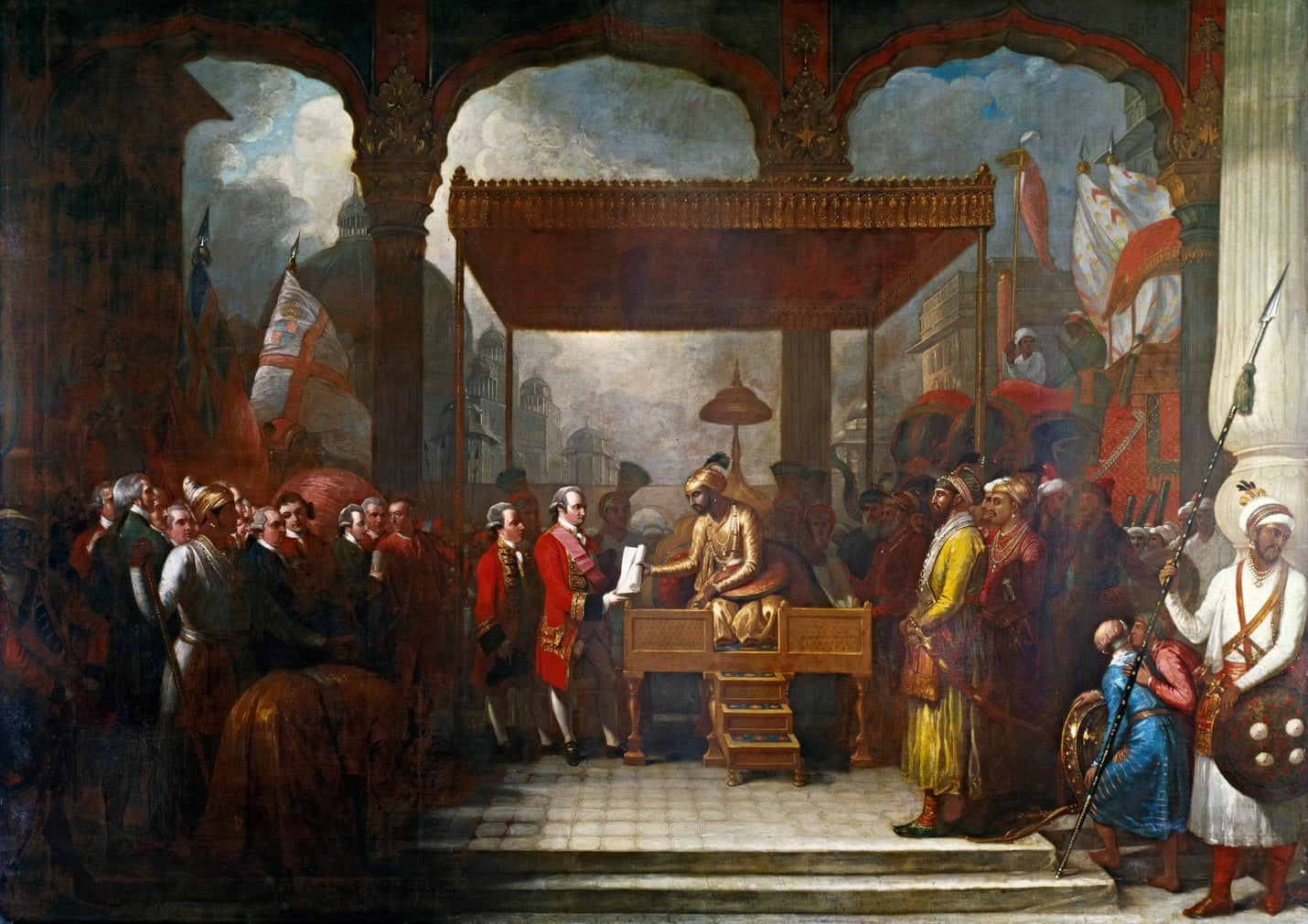
Caption at the source:
The Mughal emperor Shah Alam hands a scroll to Robert Clive, the governor of Bengal,
which transferred tax collecting rights in Bengal, Bihar and Orissa to the East India Company

A powerful moment in history--until then, the route to plundering a country, killing people, was via any royal madness.  The king decided to wage wars and conquer lands.  With the East India Company, a corporation led the way!

Through the essay, Dalrymple not only provides rich details of how India was looted (not that this is news; graduate schooling was where I learnt a lot about this) and also reminds us why studying history is important:
In many ways the EIC [East India Company] was a model of corporate efficiency: 100 years into its history, it had only 35 permanent employees in its head office. Nevertheless, that skeleton staff executed a corporate coup unparalleled in history: the military conquest, subjugation and plunder of vast tracts of southern Asia. It almost certainly remains the supreme act of corporate violence in world history. For all the power wielded today by the world’s largest corporations – whether ExxonMobil, Walmart or Google – they are tame beasts compared with the ravaging territorial appetites of the militarised East India Company. Yet if history shows anything, it is that in the intimate dance between the power of the state and that of the corporation, while the latter can be regulated, it will use all the resources in its power to resist.
My only problem with that formulation: notice that he, too, lists Walmart, the oil corporations, and the "usual suspects," but not Apple.  Why does everybody give Apple a free pass?  Am I the one who is messed up then?
Bengal’s wealth rapidly drained into Britain, while its prosperous weavers and artisans were coerced “like so many slaves” by their new masters, and its markets flooded with British products. A proportion of the loot of Bengal went directly into Clive’s pocket. He returned to Britain with a personal fortune – then valued at £234,000 – that made him the richest self-made man in Europe.
History is full of assholes like Robert Clive.  BTW, until I read this essay, I had no idea about how Clive's life ended, which Dalrymple writes about:
Clive, hounded by envious parliamentary colleagues and widely reviled for corruption, committed suicide in 1774 by slitting his own throat with a paperknife some months before the canvas was completed. He was buried in secret, on a frosty November night, in an unmarked vault in the Shropshire village of Morton Say. Many years ago, workmen digging up the parquet floor came across Clive’s bones, and after some discussion it was decided to quietly put them to rest again where they lay. Here they remain, marked today by a small, discreet wall plaque inscribed: “PRIMUS IN INDIS.”
A fitting end, indeed!

Dalrymple reminds us about the shady and atrocious relationship between this first multinational corporation and the state:
It seemed impossible that a single London corporation, however ruthless and aggressive, could have conquered an empire that was so magnificently strong, so confident in its own strength and brilliance and effortless sense of beauty.
Historians propose many reasons: the fracturing of Mughal India into tiny, competing states; the military edge that the industrial revolution had given the European powers. But perhaps most crucial was the support that the East India Company enjoyed from the British parliament. The relationship between them grew steadily more symbiotic throughout the 18th century. Returned nabobs like Clive used their wealth to buy both MPs and parliamentary seats – the famous Rotten Boroughs. In turn, parliament backed the company with state power: the ships and soldiers that were needed when the French and British East India Companies trained their guns on each other.
If you thought those days, years, have ended, well, think again:
In September, the governor of India’s central bank, Raghuram Rajan, made a speech in Mumbai expressing his anxieties about corporate money eroding the integrity of parliament: “Even as our democracy and our economy have become more vibrant,” he said, “an important issue in the recent election was whether we had substituted the crony socialism of the past with crony capitalism, where the rich and the influential are alleged to have received land, natural resources and spectrum in return for payoffs to venal politicians. By killing transparency and competition, crony capitalism is harmful to free enterprise, and economic growth. And by substituting special interests for the public interest, it is harmful to democratic expression.”
So, the closing lines, Dalrymple?
[The] East India Company – the first great multinational corporation, and the first to run amok – was the ultimate model for many of today’s joint-stock corporations. The most powerful among them do not need their own armies: they can rely on governments to protect their interests and bail them out. The East India Company remains history’s most terrifying warning about the potential for the abuse of corporate power – and the insidious means by which the interests of shareholders become those of the state. Three hundred and fifteen years after its founding, its story has never been more current.
Screwed we are! :(

Friday, July 04, 2014

Pecunia non olet? Not if it is from Yale. From Chennai?

The title of this post should not, by any means, mislead a reader into thinking that I am now a Latin student at Yale.  Far from that; they would not allow the likes of me at those Ivies!

A few years ago, when I was in Boston for a conference, I went to Harvard, and walked about.  When I was in the law school buildings I decided to use the restroom instead of hunting for one later on.  As I like to joke about it, I have contributed a lot to Harvard!

Boston's Charles River, 2008

While those kind of contributions stink, we stink, therefore we are human ;)  Money, however, apparently has no smell.  Remember that earlier post on Pecunia non olet?

It is most appropriate that I continue with that smelly topic from here in Chennai.  Not because of the stink in Chennai, about which one could write doorstoppers.  But because of Chennai's connection with Yale.  With the university's namesake, that is.
Elihu Yale was more a product of the East India Co. than of any place or political jurisdiction. Descended from a Welsh family, he was born in 1649 in Boston but spent most of his childhood in London, where his father, David, sought freedom from the puritanical strictures of New England and a friendly environment for trade. Young Yale enjoyed an education from William Dugard, headmaster of the storied Merchant Taylors' School, before obtaining a job with the East India Co. in 1670. He soon shipped out to Fort St. George, the company's lucrative outpost in southern India, around which had grown the town of Madras, now Chennai, India's sixth largest city. There he remained for the next quarter-century, eventually becoming governor of the settlement. In between, he and his wife, Catherine, would become the first couple married at St. Mary's Church—India's oldest Anglican church—and Elihu would amass a fortune dealing in textiles and precious stones on his own account. After retiring to a grand estate in London, he arranged for a burial at his ancestral home in Wrexham, Wales, beneath a tomb paying homage to his peripatetic life: "Born in America, in Europe bred / In Afric travell'd and in Asia wed / Where long he liv'd and thriv'd; at London dead."
From a common puritan to a governor.
Yale had come to India with the entry-level title of a company "writer" and an annual salary of £10—about half a shilling a day at a time when an English cloth suit cost around 15 shillings. Having demonstrated a knack for negotiations with local trade partners, by 1687 he had been named governor.
Sounds like there is no reason why his money should smell, right?
His position was precarious: Opportunities for graft were extraordinary, and governors were vulnerable to accusations of improprieties. It didn't help that Yale was widely regarded as a brusque and divisive manager. After the company replaced Yale in 1692, a wide array of allegations regarding his tenure as governor emerged, keeping him on the legal defensive in Madras. But he used the time off the company's payroll in India to focus on growing his vast estate. The precise size of his fortune by the time he left India is unclear, but his assets were numerous enough that their disposal at his death required seven separate auctions.
I suppose the formula is simple.
First, you plunder.
Then create universities or hospitals or scholarships and launder that money clean.
And get recorded in history as one of the greats.
Yale had ensured that his name would emerge in the centuries to come as a byword for learned privilege. Always a a shrewd trader, Yale found in his gift to the fledgling New Haven school the best deal he ever made.
Oh well ... I have other smelly problems to deal with rather urgently--like how no amount of deodorants can help me in Yale's old robbing grounds ;)

Thursday, September 12, 2013

The contemporary irrelevance of a small island where the sun never set

I blog in the English language, while living in what was once a colony of Britain, after having immigrated from a country that was also a British colony.  All thanks to Britain having colonized huge territories.

It boggles my mind how Britain managed to achieve all these and more from the tiny outpost it is in the northern seas.

It is not merely the conquering of lands along, which, I still have a tough time believing was possible at all.  I mean, think about it.  From far, far away, crossing the waters, and then ruling over countries with populations  large enough to have easily overrun the rulers!  Yes, we can talk forever about the advantage of guns over swords, and the cunning divide-and-conquer approach, and whatever else.  But, at some point we have to assemble that jigsaw puzzle and wonder how that ever happened, yes?

It is not merely the conquering, and ruling over, distant lands.  Britain's empire achieved way more than that.  It has made millions like me think in the English language.  Thinking in a language has profound consequences:
‘It is hard to realize,’ Coomaraswamy writes in The Dance of Shiva, ‘how completely the continuity of Indian life has been severed. A single generation of English education suffices to break the threads of tradition and to create a nondescript and superficial being deprived of all roots—a sort of intellectual pariah who does not belong to the East or the West.’
If you cannot imagine the sheer geographic aspect of this, look up in a world map the locations of the UK and Sri Lanka, which was home to Coomaraswamy.  Think about a world before modern ships and planes and emails and telephones.  Britain's rule forever changed the histories of the lands colonized in the name of the crown.  That historical continuity was gone. For eternity. 

When I visit India, there is far less Tamil literature anymore when compared to my growing up years.  When the Tamil nativists worry that Tamil is slowly dying, their concerns are not baseless.  Students there seem to be a lot more familiar with the British and American histories, for instance, than about the Sangam literature or even the Chola Empire.

Now, look at the same world from the British perspective.  Since the end of the Second World War, Britain's influence on the rest of the world has been in a rapid decline.  The sun, which once never set in the empire, now rarely shines.  The colonies in the past wondered whatever happened to their power and influence; that same set of questions preoccupies their erstwhile masters.

Thus, I bet it hurt their sentiments a lot when Vladimir Putin's aide brushed aside the UK with a single statement about Britain's irrelevance in the ongoing Syrian drama:
“a small island … no one pays any attention to them”
The old teenage emotions on colonialism and anti-Britain have never gone away inside me and, hence, I was delighted with that statement.  I wish somebody a lot more acceptable had uttered that and not one of the minions of the maniacal Putin.

The Telegraph reminds us that this is merely the latest in a rich tradition of insults directed at Britain, including this one that I particularly like for the obvious reason:
A demon took a monkey to wife – the result by the Grace of God was the English.
Indian saying 
Thinking about Britain along these lines reminded me of the tshirt I bought two years ago when I was in Chennai.  The young entrepreneur was impressed with my fondness for the Tamil language despite my life that is anything but that of a traditional Tamil.  We continued to chat even after I bought the tshirt about which I have blogged before.  I told him about the "Veera Vanchi" stories that I grew up with.  As he got a sense of how much I hated the fact that the lands became somebody else's colony, and how history was disrupted, he brought out another tshirt and said, "this is the last piece I have, and I didn't want to sell it.  But, I think you will like it."

I bought that thsirt too. 


That young fellow's website for the tshirt advertising and sales exists no more.  I bet his business failed because there is no interest even among Tamils in Tamil Nadu for tshirts with Tamil words, and even Tamils in Tamil Nadu prefer English words and sentences instead on their tshirts--the very social problem that the entrepreneur wanted to address via his tshirts.

That is one mighty legacy for a small island that no one pays attention to.

ps: I located this translation of the verse in the tshirt ... sounds good enough to me
Like the men,
who failed to think beyond the next meal;
who find pleasure, in the faults of the rest;
whose souls toil in constant despair - mind
tangled in desparation and agony;
who wish ills to their neighbour;
who subject themselves to luck's mischief;
who live burdened with miseries,
and passed life as a burden
Born human,
did you wonder, if like those men,
I would also fall for fate's follies?