Showing posts with label Europe. Show all posts

Monday, January 14, 2019

The Chinese and the Mayans didn't care. Europeans did. We now have trump!

One of the factoids that I share with students is how India and China were the richest countries on the planet for the longest time.  Not only rich, but advanced in scientific and literary fields also.  Math, astronomy, metallurgy, whatever it was, well, they had it all.

Yet, they didn't seem to have had a great deal of interest in exploring the rest of the world in order to colonize them.

Trevor Noah joked about this in one of his bits, where he asks the audience to imagine Jamaicans, living in the paradise that the Caribbean is, going to cold Europe to colonize the people and the land.

The world changed in 1492.  Jill Lepore writes that "it is a little surprising that it was western Europeans in 1492, and not some other group of people, some other year, who crossed an ocean to discover a lost world."

Lepore gives us an idea of some of the other groups of people:
The Maya, whose territory stretched from what is now Mexico to Costa Rica, knew enough astronomy to navigate across the ocean as early as AD 300.
(A quick comment/question: Why is Lepore using the "AD" instead of "CE"?)

Lepore adds:
The Chinese had invented the compass in the eleventh century, and had excellent boats. Before his death in 1433, Zheng He, a Chinese Muslim, had explored the coast of much of Asia and eastern Africa, leading two hundred ships and twenty-seven thousand sailors. But China was the richest country in the world, and by the late fifteenth century no longer allowed travel beyond the Indian Ocean, on the theory that the rest of the world was unworthy and uninteresting.
Similarly, the Middle East and North African Muslims couldn't care about the rest of the world because they already dominated trade--Mediterranean and continental.

Trevor Noah's Jamaicans serve as wonderful metaphors.  The world outside of Europe was happy and content.

Europeans, on the other hand, were not.
It was somewhat out of desperation, then, that the poorest and weakest Christian monarchs on the very western edge of Europe, fighting with Muslims, jealous of the Islamic world's monopoly on trade, and keen to spread their religion, began looking for routes to Africa and Asia that wouldn't require sailing across the Mediterranean.
Columbus discovered America!
Between 1500 and 1800 roughly two and a half million Europeans moved to the Americas; they carried twelve million Africans by force; and as many as fifty million Native Americans died, chiefly of disease.
The genocide, the rape of cultures, and more that they don't always teach in school!

I suppose white supremacy was also born!

By the end of the 19th century, China and India had been reduced to lands of beggars by white colonialists and imperialists, and the material and cultural riches of Central and South America had been wiped out by Europeans.  Two decades into the 20th century, the Middle East was carved into prizes for Europeans.  And Africa was raped and plundered--even by the tiny Belgians.

These truths are setting up the book well.  Looks like it might be a depressing read.  After all, all these truths have given us trump and his 63 million.  I hope Jill Lepore will give me plenty to be cheerful about too.

Thursday, July 05, 2018

Cry me a river!

Europe has become an anti-immigrant continent.  Germany, too, where its chancellor is fighting to hold on to her job, which is under threat because of her past strong support for immigrants, especially refugees.

Anti-immigration sentiments mostly stem from "they" being "different."  The looks, speech, habits, dresses, ... Particularly if "they" are Muslims.  Even in the tiny country that is mostly irrelevant on the global stage.  No, I am not referring to the UK, but Denmark.
For decades, integrating immigrants has posed a thorny challenge to the Danish model, intended to serve a small, homogeneous population.
So, what is the Danish approach?
Denmark’s government is introducing a new set of laws to regulate life in 25 low-income and heavily Muslim enclaves, saying that if families there do not willingly merge into the country’s mainstream, they should be compelled.
Ah, yes, compel them.  "That tough approach is embodied in the “ghetto package.”"  And then the beatings will continue until the morale improves!

Whenever I read anything like that, the old anti-colonialist teenager that I was come out from within me.  But, what am I gonna do?  Stop eating havarti?

I did the only thing that I could do as a powerless member of the public.  I wrote a letter to the newspaper.  That will send a powerful message to the Danish government!  

Oh well, I know the letter wouldn't even get published, given the volume that the NY Times receives.  But, hey, I have my own blog where I can publish whatever I want; so, here is that letter:
Dear Editor:
I read with interest, "In Denmark, Harsh New Laws for Immigrant ‘Ghettos’".
Every time I read one of these reports on how European countries are "struggling" to deal with immigrants, especially Muslims , I wish such reports also included reminders about the past.
While Denmark might be peaceful now, with its people being the happiest on earth, the Danes imposed themselves on places and people far away from Scandinavia.  I grew up in the state of Tamil Nadu, in the southern tip of peninsular India.  In a small coastal town, Tharangambadi, Denmark established a trading post and then a fort nearly 400 years ago.  The Danish East India Company couldn't match the resources of the British East India Company, and ended up with a very small footprint in the Subcontinent.
Whether it is Denmark or France "struggling" with foreigners with hijabs and the Koran, it is history echoing how peoples far away from Europe "struggled" with foreigners who came with guns and the Bible.  I wonder if the native Danes are being educated about this even as the "ghetto children" are being forced into assimilation camps.


Saturday, March 10, 2018

Keeping time

In my previous life ... you know, as an electrical engineering student, I worked with three other students on our project work.  The "capstone" work, as we refer to in the higher educational settings here in the US.

The project work was a microprocessor based "Maximum Demand Controller."

Wait, wait ... don't fall asleep! ;)

Alright ... I will cut to the chase.

We demonstrated our work to the supervising faculty and to an external reviewer, who was from another engineering college in town.

He looked at our work.  He shook his head this way, and that way, and every possible way.

And then he had a question.  How would this account for deviations from the 50Hz frequency?

We were stumped!  We did not have an answer.

But, hey, we graduated.  That's all that matters!


Why write about that now?

I heard on NPR, and then read in the NY Times that clocks are running slow in Europe ... because of a row between Kosovo and Serbia.
A dispute between Serbia and Kosovo has disrupted the electric power grid for most of the Continent, making certain kinds of clocks — many of those on ovens, in heating systems and on radios — run up to six minutes slow.
It is one of the stranger examples of technology binding together far-flung parts of the world, and one quirky effect of more than two decades of conflict in the former Yugoslavia.
The slowdown began in mid-January, and since then clocks in 25 countries, from Poland to Portugal and Denmark to Turkey, have lost time.
So, what does this have to do with my undergraduate project work and the deviation from the 50Hz that we did not account for?
In technical terms, power systems in Europe, and much of Asia and Africa, run on alternating current at 50 hertz, meaning that the flow of electricity changes directions 50 times per second. (In the United States and most of the Americas, the standard is 60 hertz.)
Because of the disruption in the Balkans, the grid for most of Europe has run since January at an average of 49.996 hertz.
You see, even a small deviation from that number can lead to disruptions.
Most clocks tell time using internal mechanisms or, like cellphones, get the time from a radio signal, and those have been fine. But clocks that measure time by that alternating current have been fooled by the drop in frequency.
This is the same mistake that we had committed in the project work.  We had programmed the microprocessor chip to count the alternating current cycle as a way to measure time.  We did that mistake 33 years ago though--we were pioneers in screwing things up ;)

Tuesday, August 22, 2017

Rice is god, but lentils are my life

I often refer to an "original sin" that humans committed, which is the cause of daily complaints that we have about work.  You know, "the worst mistake ever," as Jared Diamond phrased it.   The invention of settled agriculture, and the life away from hunting and gathering, has condemned us to working, even if they are only bullshit jobs.

Diamond wrote:
For instance, the average time devoted each week to obtaining food is only 12 to 19 hours for one group of Bushmen, 14 hours or less for the Hadza nomads of Tanzania. One Bushman, when asked why he hadn't emulated neighboring tribes by adopting agriculture, replied, "Why should we, when there are so many mongongo nuts in the world?"
When hunting and gathering, humans worked just about enough to get their food.  Even if they wanted to get more, well, there was no storing that dead animal or the berries, right?  Further, they had way more variety in their diets than we do.  Oh well, we traded that life for the dependable supply of a more limited variety of food that could be saved for the literal and metaphorical rainy day.  And, 12,000 years later, here we are with our fancy computers and planning to send humans to Mars!

In this story of life after the Neolithic Revolution:
The crucial role of wheat, goats and sheep is always emphasized.  Legumes, not just lentils but chickpeas, vetches and later peas, somehow get short shrift. But it is likely that they play as great or even greater a role than meat and dairy in supplying protein to the growing population.  This is a matter of simple efficiency. Per acre, lentil provides more calories than grazing cattle.
Give beans the Aretha Franklin treatment--give them R.E.S.P.E.C.T. ;)

It is not only efficiency, but also the insurance against possible famines.  Why?  "Beans are practically indestructible if thoroughly dried and well stored."  Add to this the roots of the legumes drawing nitrogen from the air and fixing it in the soil, thereby making land more productive.  No wonder that Umberto Eco, from the land of pasta e fagioli, declared that beans saved European civilization:
But what I really want to talk about is beans, and not just beans but also peas and lentils. All these fruits of the earth are rich in vegetable proteins, as anyone who goes on a low-meat diet knows, for the nutritionist will be sure to insist that a nice dish of lentils or split peas has the nutritional value of a thick, juicy steak. Now the poor, in those remote Middle Ages, did not eat meat, unless they managed to raise a few chickens or engaged in poaching (the game of the forest was the property of the lords). And as I mentioned earlier, this poor diet begat a population that was ill nourished, thin, sickly, short and incapable of tending the fields. So when, in the 10th century, the cultivation of legumes began to spread, it had a profound effect on Europe. Working people were able to eat more protein; as a result, they became more robust, lived longer, created more children and repopulated a continent.
We believe that the inventions and the discoveries that have changed our lives depend on complex machines. But the fact is, we are still here -- I mean we Europeans, but also those descendants of the Pilgrim Fathers and the Spanish conquistadors -- because of beans. Without beans, the European population would not have doubled within a few centuries, today we would not number in the hundreds of millions and some of us, including even readers of this article, would not exist.
 All these do add up a hill of beans! ;)


ps: Yep, am continuing with the book on beans ;)

Wednesday, May 25, 2016

Build a better mousetrap, and ... wait, are you allowed to do that?

The mousetrap is a metaphor, of course.  I don't want you to think that the next gazillions are to be made from a better mousetrap ;)

One of my favorite charts is from The Economist.  Incidentally, implementing austerity measures at home, I did not renew the subscription to the magazine newspaper.  I have also canceled the cable connection, which means my favorite television channel is also gone.  Woe is me!!!

Where was I?  Yes, one of my favorite charts.  This one:


For the longest time, the world's economy was dominated by two countries--India and China.  Which is also why people from the rest of the world wanted to get to India and China.  And then things changed.  In a hurry.  Other people got rich.  And now China is also rich. India too is getting rich.  The middle class in India now leads a life that is far more luxurious than the emperor's life that Akbar's was.  How rich are we, and how fast was this transformation?
Two centuries ago, the average world income per human (in present-day prices) was about $3 a day. It had been so since we lived in caves. Now it is $33 a day—which is Brazil’s current level and the level of the U.S. in 1940. Over the past 200 years, the average real income per person—including even such present-day tragedies as Chad and North Korea—has grown by a factor of 10. It is stunning. 
Before we complicate the story with colonialism and white supremacy, we do need to wonder why the rapid rise to wealth did not happen in India or China, and why it began in Europe, right?
The answer, in a word, is “liberty.” Liberated people, it turns out, are ingenious. Slaves, serfs, subordinated women, people frozen in a hierarchy of lords or bureaucrats are not. 
How well phrased, right?  I have always been a big fan of the author of that commentary--Deirdre McCloskey.  It was in graduate school that this began when I read McCloskey's The Rhetoric of Economics.  A scholar of the highest caliber.

McCloskey continues:
By certain accidents of European politics, having nothing to do with deep European virtue, more and more Europeans were liberated. From Luther’s reformation through the Dutch revolt against Spain after 1568 and England’s turmoil in the Civil War of the 1640s, down to the American and French revolutions, Europeans came to believe that common people should be liberated to have a go. You might call it: life, liberty and the pursuit of happiness.
We often fail to recognize and appreciate life today, like how McCloskey presents it:
Look at the magnificent plenty on the shelves of supermarkets and shopping malls. Consider the magical devices for communication and entertainment now available even to people of modest means. Do you know someone who is clinically depressed? She can find help today with a range of effective drugs, none of which were available to the billionaire Howard Hughes in his despair. Had a hip joint replaced? In 1980, the operation was crudely experimental.
It has been a magical transformation, in merely two centuries.  McCloskey is everywhere, because of a new book that is coming out.  From a commentary at Reason:
Hear again that amazing fact: In the two centuries after 1800, the goods and services made and consumed by the average person in Sweden or Taiwan rose by a factor of 30 to 100—that is, a rise of 2,900 to 9,900 percent. The Great Enrichment of the past two centuries has dwarfed any of the previous and temporary enrichments. It was caused by massively better ideas in technology and institutions. And the betterments were released for the first time by a new liberty and dignity for commoners—expressed as the ideology of European liberalism.
 It is such an enrichment that has made possible our daily complaints about the cable company, cellphone signal being weak, gluten, ... So, pause for a moment and be thankful that you live now and not two hundred years ago ;)

And, thank the freedom(s) that you have.

Saturday, May 14, 2016

Theology defined by numbers makes an interesting religious marketplace!

To atheists, this is perhaps the best of the times.  Unless one is in Bangladesh!  By and large, there is no equivalent of a Spanish Inquisition that tortures infidels.  For another, it is immense entertainment watching the religious tie themselves into knots (re)defining what god supposedly said.

Take the case of Quakers.  Until yesterday, I had no idea that of the about 300,000 Quakers in the world, "over one-third of them live in Kenya."  This factoid, by itself, is pretty darn interesting.  But, this atheist is more interested in this:
Today, there are more Quakers in Kenya than in any other country in the world.
But it wasn’t until 2007 that a major international Quaker gathering was held in Kenya. The meeting, and the ones that ensued, weren’t without controversy. In 2012, a gathering held in Nairobi was almost canceled halfway through because of arguments between liberal and conservative Quakers over same-sex marriage.
What did god say about same-sex marriage?  What is the theology here?  The believers beat their chests on how they know what god said about this issue, or other such contemporary social issues too.  However, in the Western tradition, ever since Martin Luther opened the door for democratization of thinking, it is usually the numbers that redefine what god said.  As the numbers in favor of contraception became huge, for instance, the theological interpretations changed on whether contraceptives were allowed by god, which meant that whether sex for pleasure--as opposed to sex for procreation--was allowed by god.  Fun times here on the sidelines!

The future of Christianity is in Africa.
The Pew Research Center estimates that there will be two and a half times more Christians in Africa than Europe by 2050. Currently, the numbers are about equal.
Which is why every denomination, from Roman Catholics to Quakers, and even the Mormons, are targeting Africa.  Demography is destiny!

But, the Quakers are not the first ones to raise same-sex issues as a deep theological struggle for believers.  Earlier this year, the Anglican church suffered a rebellion.  There, too, the numbers are with Africa.  I recall one NPR segment in which a senior church leader from Nigeria complained that Europeans were imposing their colonial liberal bleiefs over them.  But then wasn't Christianity itself a result of European colonialism?

Recently, the Anglican Church held a summit in Lusaka.    The Archbishop of Canterbury writes:
There are plenty of problems, I’ll come to those in a moment, but the central news is that if God, by his Spirit, is working among us, that the future is one of hope, of purpose and of blessing in our call to fulfil the mission of God in the world.
The challenges in Lusaka flowed from issues that we have been facing for many years, especially those around human sexuality, and most recently the decision of the Episcopal Church (TEC) to change its canon on marriage in order to accept same-sex marriage in its churches. It should be noted that at the same time they also decided to make provision for those who disagreed, and no diocese could be compelled to accept this change, nor can an individual priest.
So, what exactly god said will be a negotiated truth after all!

As in any negotiation, here too some of the major disagreeing parties boycotted the summit:
There was no hiding the fact that we had great differences, nor diminishing the sorrow that some Provinces (Nigeria, Uganda and Rwanda) had chosen not to attend for reasons which I fully understand.
I wonder who amongst the seven billion-plus knows what god really thinks!


Monday, April 25, 2016

My university and Europe

The university where I work invited interested faculty members to self-nominate themselves to serve on the Strategic Planning Committee.  Given my interests in higher education, and given that the directions that the university sets through this committee will be in place until I retire or am fired, I nominated myself and provided evidence of my track record in thinking above and beyond mere courses and the small little bubbles in which most discussions are trapped.

Of course, I was not selected to be on that committee.  What do I know about higher education!

In a brief thank-you email after receiving the notification that also included the list of faculty named to serve on the committee, I added a sentence that I hoped would make them all think about the committee's composition:
BTW, it seems kind of odd that faculty membership does not include any "people of color" as they say ;)
It was not diversity for the sake of diversity that I pointing out, but was instead about the need to think of the demographic reality.  Strategic Planning is about consciously developing specific action items for the future.  The demographic future of the country is in beige, the 2042 that even comedians joke about.  Oregon is notorious for not knowing how to deal with diversity, whether based on the superficial skin or on religion.   Especially Islam.

Everybody is talking and writing about Islam and the Arab world and Muslims.  The more one delves into the news, the more we realize we don't know anything about Islam, the Arab world, and Muslims.  Robert Kaplan writes that "Europe was essentially defined by Islam. And Islam is redefining it now."
The cultural purity that Europe craves in the face of the Muslim-refugee influx is simply impossible in a world of increasing human interactions.
“The West,” if it does have a meaning beyond geography, manifests a spirit of ever more inclusive liberalism. Just as in the 19th century there was no going back to feudalism, there is no going back now to nationalism, not without courting disaster.
In his short essay, Kaplan makes extensive reference to Edward Said's Orientalism.  Naturally.  Said had plenty of profound observations on the distorted--and intentional at that--understanding that the "West" has about Islam and the Arabs.
The scholar Edward Said took this point further, writing in his book Orientalism in 1978 that Islam had defined Europe culturally, by showing Europe what it was against. Europe’s very identity, in other words, was built in significant measure on a sense of superiority to the Muslim Arab world on its periphery. Imperialism proved the ultimate expression of this evolution
In a lengthy essay after his book was published, Said wrote--keep in mind that this was in 1980:
 If you were to ask an average literate Westerner to name an Arab or Islamic writer, or a musician, or an intellectual, you might get a name like Kahlil Gibran in response, but nothing else. In other words, whole swatches of Islamic history, culture and society simply do not exist except in the truncated, tightly packaged forms made current by the media. As Herbert Schiller has said, TV’s images tend to present reality in too immediate and fragmentary a form for either historical or human continuity to appear. Islam therefore is equivalent to an undifferentiated mob of scimitar-waving oil suppliers, or it is reduced to the utterances of one or another Islamic leader who at the moment happens to be a convenient foreign scapegoat.        
If that is the case with the average literate Westerner then do we need to even wonder why there are plenty of Americans today who eagerly embrace the anti-Muslim and anti-Arab rhetoric from Donald Trump and Ted Cruz!

Even at the university, the numbers of students from Saudi Arabia and their families have not been strategically used as opportunities to truly understand "them."  Instead, it seems that my university, like many others, merely continues to treat the foreigners as revenue sources, which is not that different from the "scimitar-waving oil suppliers" caricature that Said was upset about.

At this rate, it seems like it will be a close race between my exit from the university and the ultimate exit itself ;)

Monday, August 05, 2013

You sure that milk does a body good? Always? For all?

When I was in the seventh or eighth grade, one afternoon I decided to open up the old valve-radio at home and take a look at things inside.  Yep, combine a curious kid with a boring afternoon and he can show you how many devils are at work inside an idle mind!

I thought I replaced the diodes and triodes in their respective slots.   But, apparently not, because the radio did not work when I rotated the knob to the on position.

My mother couldn't care.  Father lectured me on how GD Naidu used to include slippers by the different gadgets that were on display.  Apparently the gadgets had a note by the side that said anybody could play with the gadget as long as they knew what they were doing.  Should they meddle with it and screw things up, then the sign said that the rubber slippers by those gadgets would be used to beat the crap out of them.

He never beat me and even now I continue to screw things up all the time!

Anyway, father hired a young technician to fix my screw-up.  As always, father asked him if he would like to have coffee.  Turned out that it was another learning opportunity for me when he replied that he was allergic to milk.  Until that moment, I had not known of anybody whose systems could not process milk.

A few years later, I realized that my stomach making gurgling noises soon after I had ice cream or milkshakes was nothing but lactose intolerance, though on a much smaller scale.  Even a glass of milk.  It is funny how my system can process yogurt, or the milk sweets, cheese, and chocolate, but doesn't keep quiet if I were to feed it a glass of milk.  It is perhaps because I still retain a little bit of that old genetic formula that all humans once had before we gained the mutation to process lactose:
During the most recent ice age, milk was essentially a toxin to adults because — unlike children — they could not produce the lactase enzyme required to break down lactose, the main sugar in milk. But as farming started to replace hunting and gathering in the Middle East around 11,000 years ago, cattle herders learned how to reduce lactose in dairy products to tolerable levels by fermenting milk to make cheese or yogurt. Several thousand years later, a genetic mutation spread through Europe that gave people the ability to produce lactase — and drink milk — throughout their lives. That adaptation opened up a rich new source of nutrition that could have sustained communities when harvests failed.
This two-step milk revolution may have been a prime factor in allowing bands of farmers and herders from the south to sweep through Europe and displace the hunter-gatherer cultures that had lived there for millennia. “They spread really rapidly into northern Europe from an archaeological point of view,” says Mark Thomas, a population geneticist at University College London. That wave of emigration left an enduring imprint on Europe, where, unlike in many regions of the world, most people can now tolerate milk.

Once we humans started domesticating animals--I still chuckle at the phrase "animal husbandry"--it was only a matter of time before we figured out we could consume cow's milk.  Well, except the legendary Khushwant Singh who has been an avid milk-avoider. He wrote a long time ago that he did not care to drink milk from animals because these did not come in attractive packages unlike the human milk he was given!

Slowly the dairy practice spread:


It is now practically a global habit to drink milk and consume milk products.  India's "White Revolution" has been discussed in plenty.  The large middle class in China that is rapidly gaining quite a bit of disposable income is one attractive market for exporters of milk and milk products.  That is a dog-bites-man kind of blah news, until something happens.

I suppose in our own ways, we are mutants, aren't we, with the many genetic mutations?  We, too, are X-Men!


Friday, February 08, 2013

Holy carbon! US exports coal and Europe imports it!!!

A chart that I would never have imagined would be the case:
Wow!
In the United States, natural gas is now frequently less expensive than coal for power, so demand for the hard, black fuel has plummeted. Ships are steaming the coal around the world instead. U.S. coal exports to Europe were up 26 percent in the first nine months of 2012 over the same period in 2011. Exports to China have increased, too.
But, ... but, ... aren't Europeans supposed to be, ahem, greener than thou?  
Green-friendly Europe has a dirty secret: It is burning a lot more coal.  Europe’s use of the fossil fuel spiked last year after a long decline, powered by a surge of cheap U.S. coal on global markets and by the unintended consequences of ambitious climate policies that capped emissions and reduced reliance on nuclear energy.
So, Germany shuttered its nuclear program after the Fukushima incident, and now burns more coal instead.  The truth is always dizzying!

How much have things changed in Germany?  Like so, in a community not far from the Polish border:
Last year, the power plant consumed 88,000 tons of lignite a day and generated more electricity than it had since 1981, according to Vattenfall, the Swedish company that runs it. That record is even more impressive given that in 1981, Communist East German officials didn’t have to contend with labor laws or environmental regulations and could run the mines almost every day of the year.   
The expansion of lignite mining has stunned some people who live in its path. One community under threat is the tiny hamlet of Atter­wasch, a cluster of 250 people on the edge of a proposed expansion of the Jaenschwalde mine. They might have to leave their homes, as well as their church, whose chapel was built in 1294.   
“This church survived the Thirty Years’ War [in the 1600s], two world wars and socialism,” said Mathias Berndt, the senior pastor at the church, which is festooned with anti-coal-mining protest banners. “Now a free country is coming and saying, ‘Good for you, but now you have to move.’ ”
Germans are in love with coal now.  And that too one of the dirtier varieties--lignite.  It was their expertise with lignite that led the West Germany of those old times to provide technical assistance in the town in India where I grew up.

The burning of coal is understandable when poor countries do it--they simply cannot afford to use way more expensive resources, especially when they have to import it.  "Moving away from fossil fuels could be devastating for some of the world's poorest countries."  But, Germany? The Netherlands?

Why is Germany so much anti-nuclear energy, even to the extent of burning more coal?  For that matter, it is a shame that an anti-nuclear energy stance has come to be typical of the liberal left. Why so?  Ashutosh Jogalekar discusses the following five reasons in detail over at the Scientific American:
  1. Ignorance: This simple reason remains remarkably pervasive. I am not trying to sound preachy or elitist here but reading two or three books would greatly benefit people who have a gut reaction against nuclear energy.
  2. Bad psychological connections: There are two bad connections in the minds of many liberals, both of which are rather unjustified and contribute to their dislike of nuclear power. One is the connection between nuclear power and nuclear weapons.  ... Another flawed connection is between environmentalism and the boycott of nuclear power. Unfortunately die-hard environmentalists are mainly responsible for reinforcing this connection. Their decades-long opposition to nuclear energy started with some reasonable premises, but then mainly descended into irrational, uninformed and exaggerated polemic.
  3. Waste: ... Many people think that this is the single greatest threat from nuclear power, that we will all be inhabiting vast atomic wastelands if we allow nuclear power to flourish. ... It’s not a trivial issue, but many of the problems have to do with inefficiency and increased proliferation threats from burying valuable plutonium-containing nuclear waste.
  4. Damn them Republicans: There is actually a third connection- that between nuclear weapons and belligerent right wing political leaders that drives liberals’ disdain for all things nuclear. If the erroneous connection between power and weapons takes hold in your mind, then it is not too difficult to perceive a connection between nuclear energy and right wing excesses.
  5. Fear of the unknown: This is again related to the first point. Fear of the unknown has unfortunately driven negative liberal reactions to many other promising technologies, including vaccines and GMOs. 
An argument in favor of rationally approaching the global energy issue, and the energy needs of the developing countries in particular, is not new to this blog.  Especially when Europe is importing coal like there is no tomorrow!

BTW, the US is flush with coal because fracking has made natural gas available in plenty, and at low prices.  And Europe is grabbing that coal.  Why doesn't Europe also use natural gas then?
One big part of the problem, experts and officials say, is Europe’s cap-and-trade system, which aims to reduce European Union-wide industrial greenhouse gas emissions by 20 percent by 2020. The system is the centerpiece of Europe’s green policies. But the program, which charges industries for permits to emit greenhouse gases, no longer serves as a major disincentive to pollute. Industrial production fell dramatically during the economic crisis, so overall greenhouse gas emissions remain well underneath the cap, and they are still falling. The price per ton of carbon emissions is barely more than a tenth of its 2008 peak. Energy companies, who must plan decades in advance, have shied away from investing in gas-fired power plants because they are not profitable in comparison to coal.
Yep, carbon is way too cheap now!  Burn, baby, burn!

Friday, December 03, 2010

The miseducation of rioting European students

So, there are student protests in Britain and in Continental Europe as well.  Apparently more protests are planned.  It is because of fee increases, which were triggered by the spiraling budget problems, except perhaps in cash-rich Germany.

I am not sure whether these protests are any sensible and rational behavior by students, and seems more like anarchic outpourings, like what we used to see at the annual meetings of the WTO or the IMF. 

I mean, these students should go after their parents and grandparents who gave themselves rich retirement and other benefits, which otherwise could have gone into subsidizing education. 

The citizens of many European countries have for decades had a social contract with their governments: The people pay absurd levels of taxes and the government takes care of them from cradle to grave. Nationalized healthcare, Ample pensions. Hefty labor rights. Early retirement. Generous unemployment benefits. But can this contract survive the euro crisis? The heavy obligations imposed on European government budgets by the welfare system were already set to become even heavier as Europe's population ages. That means fewer working age and taxpaying Europeans will have to support a greater number of retired old timers. Now here comes the euro crisis, in which the stability of the national finances of European states have come into focus. That's going to put extra pressure on European governments to keep their debt and deficits under control.
Heather Mac Donald writes:
What a boon to anarchy—having your self-righteous tantrums treated as important and newsworthy.  I don’t know how to break out of the dilemma that all such preening displays of lawlessness pose.  Ideally, they would not command any breathless coverage from reporters who come running, cameras flashing, at the slightest hint of revolt against the “establishment.”  Pretending that such theatrics are significant is especially galling when the protesters are ignorant students who don’t understand anything about the world and certainly not about work and commerce.  Yet at some level one does need to know  what is going on.  Perhaps photos of riots against common-sense government reforms or good-faith police actions could be balanced by photos of businessmen struggling to balance their books while drowning in a sclerotic, state-sodden economy.
The commentary at Spiked is, as always, an interesting contrarian read:
The excited student protestors first imagined that smashing an office window was a victory over ‘Tory scum’, and then did their victory dance in front of the banks of cameras (there apparently being as many photographers as rioters present) without trying to conceal their identities. More than a few of them will soon be facing up to the consequences of their naivety as prosecutors study the film for evidence. Cynics have observed that it is a sad reflection on the miseducation of the nation’s youth that some seem to think you riot first, then put the masks on afterwards. Don’t these young adults know how to dress themselves? They also failed geography, attacking the wrong building - because they assumed that the Conservative HQ was still in Millbank Tower - before they realised it had moved down the road.
But if anything, Her Majesty’s finest in the Metropolitan Police looked even more out of their depth. Police commanders more used to looking tough in a press conference than fighting street battles appeared never to have thought that there might be any unpleasantness at a demonstration involving thousands of pissed-off young people. Nor did it seem to have occurred to them that Prime Minister Cameron’s Conservative Party might just become a target for the anger.

Friday, October 15, 2010

Underestimating Africa

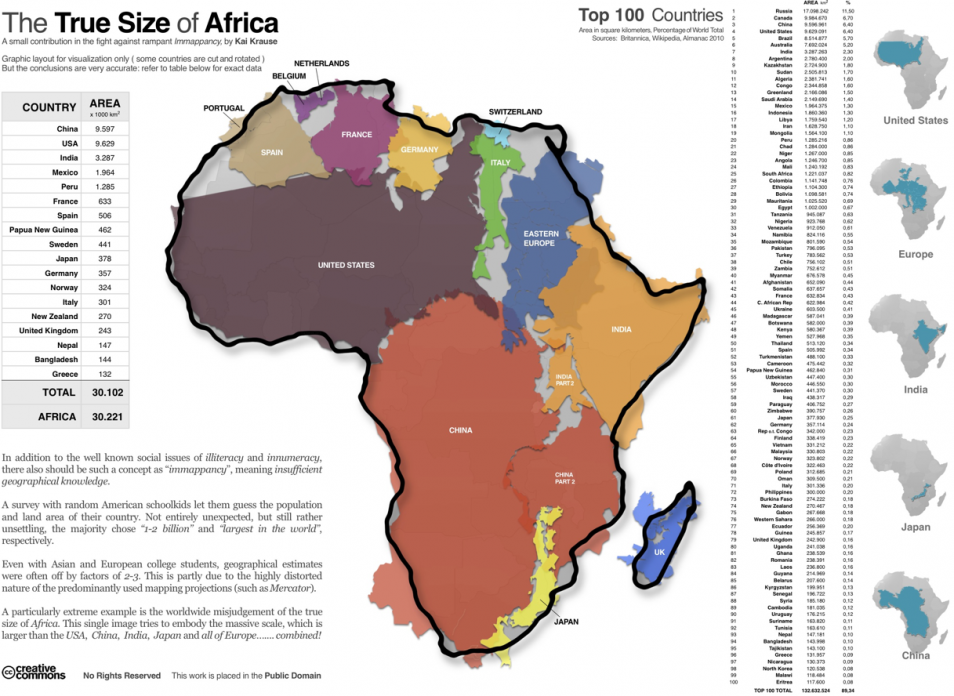
If only I had seen this map of Africa even a week earlier ... in a quick overview of Africa, I showed students in one of my classes a comparison of the physical areas of the Democratic Republic of Congo and those of Germany, France, Slovakia and Oregon.  I know for sure I saw quite a few eyes waking up to the realization that if Congo itself is that big, then the continent is HUGE. I will show them this map even if it is the case that next week's discussions have nothing to do with Africa.

It is unfortunate that the university where I teach is like most colleges and universities that continue to remain Euro-centric in what we teach.  Everything from literature to the social sciences is mostly about Europe and North America, with a little bit about South and Central America. It is pathetic, for instance, that the history department at my university offers more courses about Slovakia and the Balkans than about Africa and its countries.

This term, for instance, there is not a single class about Africa in History.  Perhaps all the African history is finished by the time a freshman completes HST 104: World History?  Plenty of Europe. Same story in Political Science. Sociology is still dealing with the dead and cremated Communism, while the alive Africa is neglected. 
Nothing in my own department either.

The result is that Anthropology is the only place where students might encounter Africa. I would not be surprised if the courses there then end up reinforcing the stereotypes of Africa.

Awful!

We are committing some serious crimes in higher education.  I, too, stand accused :(


Tuesday, September 28, 2010

Sunday, July 11, 2010

The disappearing middle class

I will outsource this to James Fallows, who is quoting a German executive who, get this, was an Indian by birth--born in Madras (Chennai) ... aahh, the circular universe we will live in... the name of this executive, Bharat Balasubramanian, is such a typical Tamil brahmin name that maybe dad will tell me that he is some nth cousin or soemthing :)
"I will state that there will be a polarization of society here in the United States. People who are using their brains are moving up. Then you have another part of society that is doing services. These services will not be paid well. But you would need services. You would need restaurants, you would need cooks, you would need drivers et cetera. You will be losing your middle class.

"This I would not see in the same fashion in Europe, because the manufacturing base there today can compete anywhere, anytime with China or India. Because their productivity and skill sets more than offset their higher costs. You don't see this everywhere, but it's Germany, it's France, it's Sweden, it's Austria, it's Switzerland.... So I feel Europe still will have a middle level of people. They also have people who are very rich, they also have people doing services. But there is a balance. I don't see the balance here in the US."

Sunday, October 11, 2009

The global Muslim population

The web and blogging are simply fantastic when it comes to getting updates, discussing policies, ..... Many academics have also taken up blogging big time.  I suspect that in many cases, blogging provides a lot more interactive discussions than a journal article can.  Juan Cole is one of those academics who has blogged a lot--on the Middle East in particular.  Here, he responds to the news item that a quarter of the world's population is Muslim:
I don't think most people in the West realize the implications of the likelihood that one-third of humankind may soon be Muslim. We don't have a real sense of scale in the US. We don't realize that Brazil alone is nearly as big as the US in area, or that the US could be fitted into East Africa. We don't realize how huge Iran is, or what it implies when we call India a subcontinent.

One of the implications is that the US is a little unlikely to thrive as a superpower in the 21st century if its more venal and bloodthirsty politicians go on barking about "Islamo-fascism" (they never said Christo-Fascism even though Gen. Franco in Spain was a good candidate for the label) and denigrating Islam and Muslims and seeking to militarily occupy their countries and siphon off their resources. That kind of behavior may have worked in the 19th century before Muslims were mobilized, but it does not work now.

The Muslim world is the labor pool of the next century, and is also the custodian of much of the world's fuel. New American crusades of the sort favored on the right of the Republican Party may finally induce imperial overstretch and deeply harm the US. Some 5 percent of the population cannot dominate by force 25 percent of the globe and what may eventually be 33% of the globe.
You know, I would never have guessed that there are an estimated 16 million Muslims in RussiaHT

Friday, August 28, 2009

Islamophobia, and Eurabia

A British Minister walks out of a Muslim constituent’s wedding protesting against segregation of male and female guests; a prominent moderate Muslim scholar, Tariq Ramadan, is hounded out of not one but two separate jobs for hosting a show on an Iranian television channel; aggressive right-wing campaigners in Switzerland demand removal of minarets from all mosques; and French President Nicolas Sarkozy calls for a ban on wearing burqa in public.

These incidents, occurring within days of each other in recent weeks in different parts of Europe, have coincided with a rash of new books portraying European Muslims in the darkest possible colour. Their alarmist tone has reminded many of the sort of things once written about European Jews.

Are these simply isolated events? Or is Europe in the grip of a new wave of Islamophobia?

A well-thought out essay by Hasan Suroor, who alerts readers about the growing anti-Muslim sentiment in Europe, and in North America. It is not looking good.
Suroor concludes that:
It would be foolish to conflate incidents which may be no more than just local difficulties and blow them up into an anti-Muslim conspiracy. Yet to dismiss them as an aberration would be to deny the prejudice that Muslims face across Europe.

Wednesday, July 15, 2009

The cost of parking


Urban planners and economists keep harping on the notion that parking is severely under-priced, and the more a good is under-priced the more the incentive for consumers to over-consume. The result is that almost universally we complain about lack of parking spaces.

According to the Economist,
The cheapest parking in the survey is in India, where a spot in Chennai costs 96 cents a day.
Even in Indian prices, that is awfully cheap. It is amazing how expensive parking is in some of the European cities.

Monday, June 01, 2009

Add prisoners to the unemployed? Higher unemployment!

Outsourced to one of my favorite bloggers, Megan McArdle:
John Quiggin has been arguing it is. That's why he wants to add America's higher incarceration rate to its unemployment statistics when comparing us to Europe.

To my surprise, when I proposed this theory to Mark Kleiman a while back, he disagreed. Crime is only very weakly correlated with changes in the labor market. It spiked during the golden age of unskilled employment in the 1950s and 1960s, and then fell for no particular reason during the poor labor market of the early 1990s. Crime is a labor market outcome in the sense that people with poor impulse control gravitate towards a "job" that requires little in the way of gratification delay, not in the sense that people who end up in jail literally had no alternatives, or even no better alternatives. In the normal operation of the American economy, most people who want a job can find something. Given the low probability-weighted returns to crime, often even something better than sticking up 7-11s.

There are other problems with the theory. Even if crime were a labor market outcome, incarceration is a policy outcome, not a labor market outcome, because incarceration has increased even as crime has fallen. Furthermore, what correlation there is between crime and the economy is to property crimes--burglary, etc. Violent crime, which accounts for more than half of America's incarceration rate, and virtually all of the change in our incarceration rate since 1980, isn't clearly related to the economy. In theory, being laid off might make you more prone to bar fights or beating on your girlfriend. In practice, it doesn't seem to show up in the numbers.

Now, one could argue that high incarceration rates are supressing the unemployment figures. But America's employment-to-population ratio is still higher than Europe's, though a number of individual European countries do better than we do.

Sunday, April 05, 2009

Sunday, September 28, 2008

Paulson's plans across the Atlantic

Interesting comments by Wolfgang Münchau in the Financial Times:
What about the lesson from the US to Europe? It is that bank bail-outs require a swift political response. When you look at the eurozone, it is not clear at all where this response could come from.
By the time European ministers have travelled for a meeting in Brussels, let alone reached or implemented a decision, the financial markets would have long melted.
Peer Steinbrück, the German finance minister, who last week told the Bundestag that the US would soon be finished as an economic superpower, should show more humility. He was lucky that last week’s crisis did not happen in Berlin or Paris or Rome. He and his colleagues would have been totally unprepared. ...
While the Americans need a better rescue plan, the Europeans need a lot more: a system that could produce a rescue plan in the first place.

And, in the same paper, Larry Summers writes,
[The] worst possible actions in the current context would be steps that have relatively modest budget impacts in the short run but that cut taxes or increase spending by growing amounts over time. Examples would include new entitlement programmes or exploding tax measures. The best measures would be those that represent short-run investments that will pay back to the government over time or those that are packaged with longer-term actions to improve the budget. Examples would include investments in healthcare restructuring or steps to enable states and localities to accelerate, or at least not slow down, their investments.

Saturday, September 13, 2008

Elections, and the possibility of a dead Osama bin Laden

Given that elections are now just over 50 days away, how much will things change if the US incursions into Pakistan yield Osama himself--dead or alive--or even al Qaeda's number two man-Zawahiri?

It is not outside the domains of possibility. But, imagine for a moment that happens--even as late as the Monday before elections. The global implications will be HUGE--far more than influencing the elections here on November 4th.

For starters, nabbing bin Laden or Zawahiri will just swing the elections to the Republican side. Not only the presidential elections, but even the Congressional seats. Every Democrat who opposed Bush's approach on the war on terror will pretty much be on an ejection seat. While as loyal citizens, Democrats will be thrilled with the capture of bin Laden or Zawahiri, I am guessing this will be ultimate nightmare scenario.
(I think early voting might make all the difference then. I suspect Democrats will urge their faithful to vote as early as possible--taking such a scenario also into consideration.)

Not only will Republicans end up winning it all, it might then take Democrats more than a decade to recover and gain any significant political strength. Conservatives would have completely taken over the Supreme Court by then.

If such a scenario unfolds, then we can expect Britain's Labour Party to be thrashed at the polls. Gordon Brown is a weak leader even now. We can also expect tough-on-terrorists parties to sweep elections in continental Europe. This will also strengthen Putin and Medvedev, who think that anybody who disagrees with them is a terrorist.

Israel will be tempted to become even more aggressive towards Syria, Hezbollah, and Iran. In turn, Iran will feel even more threatened and could start volleying missiles in the Strait of Hormuz, and shut down oil shipping for weeks.

Many Islamic countries will have to deal with a public face of being happy that the terrorists were caught, but will have to deal with the internal displeasure from a significant percentage of their citizenry that won't be happy if bin Laden is caught or found dead.

And, given that the world's economy is quite in doldrums now, I can only imagine that this (more so if Iran shuts down Hormuz even for a month) will trigger a global economic depression.

My own personal preferences aside, as an academic interested in politics and public policy, this is a scenario that completely fascinates me.