Quick question: was the US economic recovery after the Great Depression a result of FDR's economic policies?
Larry Summers provides the answer (ht) play the embedded video here--it will start from where I have bookmarked. Watch and listen for a minute-plus at least.
Did the "H" word in his response creep you out? The way Summers lays it out?
Showing posts with label larry summers. Show all posts
Showing posts with label larry summers. Show all posts
Monday, July 18, 2011

Sunday, October 03, 2010
Quote of the day, on Larry Summers and economists
Summers is unquestionably brilliant, as all who have dealt with him, including myself, quickly realize. And yet rarely has one individual embodied so much of what is wrong with economics, with academe, and indeed with the American economy. For the past two years, I have immersed myself in those worlds in order to make a film, Inside Job, that takes a sweeping look at the financial crisis. And I found Summers everywhere I turned.Oooooh .... "burn," as my students say :)
The author, Charles Ferguson (director of the new documentary Inside Job and the 2007 documentary No End in Sight: The American Occupation of Iraq) argues that Summers is not the only one, but perhaps the most important among those at an unholy intersection:
Summers's career is the result of an extraordinary and underappreciated scandal in American society: the convergence of academic economics, Wall Street, and political power.He makes it sound almost as if these modern day academic economists peddling to political and financial powers are the very "economic planners" that those in favor of deregulation and free markets critique. Another instance of hating somebody so much because of the intense love within? muahahaha
Now, for a mighty blow to the profession:
Over the past 30 years, the economics profession—in economics departments, and in business, public policy, and law schools—has become so compromised by conflicts of interest that it now functions almost as a support group for financial services and other industries whose profits depend heavily on government policy. The route to the 2008 financial crisis, and the economic problems that still plague us, runs straight through the economics discipline. And it's due not just to ideology; it's also about straightforward, old-fashioned money.All right! Am enjoying this intellectual assault. I am sure there will be plenty of responses at different places. All in time for the Prize in memory of Nobel.
Whoever said that intellectual life is a bore. When it comes to ideas, there is always a battle or two beginning.
The only problem: these are not mere intellectual discourses in a seminar room, but have profound and mostly disastrous results as policies.
Sunday, August 08, 2010
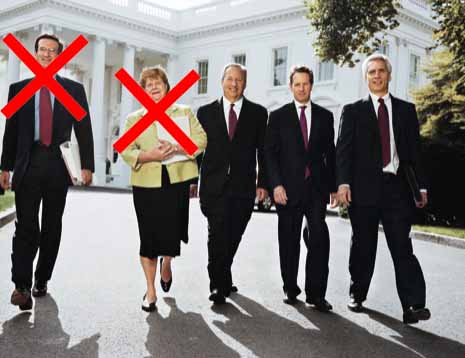
Who will be Larry Summer's next victim?
That is the label for this awesome photo/graphic of the day (ht):
 The original photo without the "x" is a part of an older New Yorker essay that described Summers and his economics team.
Monday, April 26, 2010
Larry Summers unites the left and the right :)
In graduate school, a professor once remarked that on some issues, if you go far enough, the left and the right will agree. Yet again, he was proven right--in this case with Larry Summers. Both the leftist Nation and the libertarian Reason have labeled Summers a liar, and for the same stuff he said.
The context is this PBS interview with Summers
According to the Nation: " Larry Summers is a clumsy public liar." There, as simple as that! Well, there is more than that:
The context is this PBS interview with Summers
According to the Nation: " Larry Summers is a clumsy public liar." There, as simple as that! Well, there is more than that:
Summers's claims about what caused the banking crisis were, likewise, aggressively misleading to plain deceitful. "Regulators didn't have the specific mandate for the consumer." Wrong. The Federal Reserve and other agencies had plenty of legal authority to protect consumers. They chose not to use it. Their dereliction actually occurred on Summers's watch, when he himself was Treasury secretary under Bill Clinton.Ok, that is from the left. Next up, from the libertarian perspective, here is Reason:
"Regulators didn't have authority in a comprehensive way to monitor the derivatives market." This is a flaming lie. The principal regulatory agency--the Commodity Futures Regulatory Commission--was actually preparing to impose stricter oversight on derivatives in the late 1990s when Larry Summers stopped it. Summers and Republican allies intervened in 2000 with legislation that castrated that agency and prohibited it from acting further. Derivatives exploded thereafter.
When Summers was finally asked about his own responsibility for encouraging the dangerous financial instruments, he responded with a mouthful of double talk. "You know, the situation's changed hugely.... So people were actually focused on a very different set of issues." Summers even tried to make it sound like he personally had wanted to tighten the oversight, but was blocked by "Congressional opposition."
Liar, liar, pants on fire.
More serious than Summers' well established habit of citing a fake consensus of experts to support his claims is that these comments embarrass an administration that is trying to promote the fiction that it is seriously interested in ending bailouts for gigantic banks. It might make intuitive sense that regulators would rather deal with a few big, identical institutions than with many diverse ones, but that's not the story the Democrats are using to sell their financial reform plan. So between Thursday and yesterday, somebody must have found a woodshed big enough to take Summers out to. Here's what he had to say on one of the Sunday talk shows:You can understand why I like these: After all, I identify myself as a libertarian Democrat :)
"We must end too big to fail," he said on Face the Nation. "There is no one associated with the White House who believes "too big to fail" is acceptable, or that it's acceptable for financial institutions to rely on a bailout."Glad that's squared away.
Sunday, April 25, 2010
Wall Street, White House, and Congress: a horrible alliance
Two different columns, in two different publications, in two different countries, but the bottom line is the same: the nexus between Wall Street's big banks and the political establishment in DC is not healthy for democracy.
First, here is Robert Reich, writing in the Financial Times. (The guy is on a roll--only a few days ago he had a column in the WSJ!!!)
Bet Against The American Dream from Planet Money on Vimeo.
First, here is Robert Reich, writing in the Financial Times. (The guy is on a roll--only a few days ago he had a column in the WSJ!!!)
Tight connections between Washington and Wall Street are nothing new, of course, especially when it comes to Goldman. Hank Paulson ran the bank before becoming George W. Bush’s Treasury secretary. Robert Rubin followed the same trajectory under Bill Clinton, then returned to Wall Street to head Citigroup’s executive committee. Dick Gephardt, the former Democratic House leader, lobbies for Goldman. Some 250 former members of Congress are now lobbying on behalf of the financial industry. President Barack Obama himself received nearly $15m from Wall Street during his 2008 campaign, of which almost $1m came from Goldman employees and their families.And then, Frank Rich in the NY Times:
Politicians cannot continue to have it both ways. The close nexus between Washington and Wall Street is eroding trust in government.
The truth is that both parties are too often in hock to the financial sector, and both parties bear responsibility for the meltdown. In response to a question from Jake Tapper of ABC News last weekend, Bill Clinton was right to say that he and two of his Treasury secretaries, Rubin and Lawrence Summers, “were wrong” to leave derivatives unregulated.
Bet Against The American Dream from Planet Money on Vimeo.
Monday, April 12, 2010
Quote of the day: on the fiscal mess we are in
Robert Reich:
If any three people are most responsible for the failure of financial regulation, they are Greenspan, Larry Summers, and my former colleague, Bob Rubin. In 1999 they advised Congress to repeal the Glass-Steagall Act, which since 1933 had separated commercial from investment banking. By 1999, Wall Street was salivating over such a repeal because it wanted to create financial supermarkets that could use commercial deposits to place bets in the financial casino. That would yield the Street trillions.Meanwhile, there is a talk that Summers is leaving the administration ...
At the same time, Greenspan, Summers, and Rubin also quashed the efforts of the Commodity Futures Trading Corporation to regulate derivatives, when its director began to worry that derivative trading already was getting out of control.
Yet Greenspan continues to take no responsibility for what occurred. In the interview he just completed he avoiding saying anything about the failure of the Fed under his watch to adequately oversee the banks, and the absence of sufficient financial regulation to begin with.
I dislike singling out individuals for blame or praise in a political system as complex as that of the United States but I worry the nation is not on the right economic road, and that these individuals — one of whom advises the President directly and the others who continue to exert substantial influence among policy makers — still don’t get it.
Thursday, April 02, 2009
China and the US: Mutually Assured Destruction!
China is trying to get some momentum going on some kind of a new global currency. Good luck on that. I don't see anybody even shifting big time to the euro, and it was kind of a profound statement that as the world slipped into a deep recession, the dollar started appreciating.
I have blogged before about this, and have quoted James Fallows quite a bit.
Paul Krugman has his comments on it in his NY Times column. Frankly, there is nothing new in Krugman's column--nothing new that Fallows did not describe in his two pieces in the Atlantic. Almost as if Krugman just woke up to this issue; given his Nobel and his public intellectual perch, well, I suppose most of us will always expect a Nobel-prize winning idea in every column, which is not fair to Krugman .... Anyway, an excerpt from Krugman:
The following is an excerpt from Larry Summers' speech five years ago!
I have blogged before about this, and have quoted James Fallows quite a bit.
Paul Krugman has his comments on it in his NY Times column. Frankly, there is nothing new in Krugman's column--nothing new that Fallows did not describe in his two pieces in the Atlantic. Almost as if Krugman just woke up to this issue; given his Nobel and his public intellectual perch, well, I suppose most of us will always expect a Nobel-prize winning idea in every column, which is not fair to Krugman .... Anyway, an excerpt from Krugman:
Bonus for reading until here :-)So what Mr. Zhou’s proposal actually amounts to is a plea that someone rescue China from the consequences of its own investment mistakes. That’s not going to happen.
And the call for some magical solution to the problem of China’s excess of dollars suggests something else: that China’s leaders haven’t come to grips with the fact that the rules of the game have changed in a fundamental way.
Two years ago, we lived in a world in which China could save much more than it invested and dispose of the excess savings in America. That world is gone.
Yet the day after his new-reserve-currency speech, Mr. Zhou gave another speech in which he seemed to assert that China’s extremely high savings rate is immutable, a result of Confucianism, which values “anti-extravagance.” Meanwhile, “it is not the right time” for the United States to save more. In other words, let’s go on as we were.
That’s also not going to happen.
The bottom line is that China hasn’t yet faced up to the wrenching changes that will be needed to deal with this global crisis. The same could, of course, be said of the Japanese, the Europeans — and us.
The following is an excerpt from Larry Summers' speech five years ago!
I am reluctantly convinced that the most serious problem we have faced in the last 50 years is that of low national saving, resulting dependence on foreign capital, and fiscal sustainability, which has far-reaching implications for the US and the global economy. ....
[Let] us imagine that it were possible at this level of national saving to continue to borrow on this substantial scale to finance investment and that this situation were sustainable into the indefinite future, a situation of which none of us can be confident. Is it healthy for the US economy or for the global system? I would suggest not for three reasons. ....
First, it’s not our capital. The saving rate is what reflects the accumulation of wealth by Americans, and if we are not saving, regardless of how much investment we finance, the returns from that investment will not be available for the United States. Now Pete Peterson would argue—and I think he is right—that the saving rate that is appropriate today in the United States is one that is substantially greater than the rate that was appropriate 10, 20, or 30 years ago because the baby boom generation will begin retiring in 2011. Even if he is not right in that supposition, it is hard to see why wealth and savings should be lower than they have been at any point historically, or how they are going to get better automatically.
Second, a situation of substantial dependence on foreign capital and a substantial current account and trade deficit, when it has taken place in the United States, has historically at every point been associated with a substantial increase in protectionist pressure. Whether the protectionist pressure derives from the relative level of the dollar or the relative level of the trade deficit is a question that econometricians and politicians can debate—I don’t think the data really permit a distinction—but it is hard to believe that the protectionist pressures would be as serious as they are if the United States did not have a trade deficit of the current magnitude, and it is hard to believe that trade deficits of the current magnitude will not lead to increases in protectionist pressure in the future.
The third troubling aspect of this dependence on foreign capital is its geopolitical significance. Here it is most difficult to speak with definitiveness. There is surely something odd about the world’s greatest power being the world’s greatest debtor. In order to finance prevailing levels of consumption and investment, must the United States be as dependent as it is on the discretionary acts of what are inevitably political entities in other countries? It is true and can be argued forcefully that the incentive for Japan or China to dump treasury bills at a rapid rate is not very strong, given the consequences that it would have for their own economies. That is a powerful argument, and it is a reason a prudent person would avoid immediate concern. But it surely cannot be prudent for us as a country to rely on a kind of balance of financial terror to hold back reserve sales that would threaten our stability. (emphasis added)
Saturday, January 10, 2009
Two down; the third is in Obama's administration!

Difficult to imagine Alan Greenspan being invited to many parties any more, given that we are all in a drive to cancel all celebrations.
Robert Rubin is now on his way out of Citigroup. I don't think he will be invited to join any corporate boards any time soon.
Larry Summers is still around--in quite a powerful position in the Obama administration. He will find great company with yet another Rubin-school product: the nominee to be the treasury chief. I suppose this is like coaches in the NFL--as soon as they get fired by one team, they get picked up by another team, and their coaching lives continue on .....
Sunday, September 28, 2008
Paulson's plans across the Atlantic
Interesting comments by Wolfgang Münchau in the Financial Times:
And, in the same paper, Larry Summers writes,
What about the lesson from the US to Europe? It is that bank bail-outs require a swift political response. When you look at the eurozone, it is not clear at all where this response could come from.
By the time European ministers have travelled for a meeting in Brussels, let alone reached or implemented a decision, the financial markets would have long melted.
Peer Steinbrück, the German finance minister, who last week told the Bundestag that the US would soon be finished as an economic superpower, should show more humility. He was lucky that last week’s crisis did not happen in Berlin or Paris or Rome. He and his colleagues would have been totally unprepared. ...
While the Americans need a better rescue plan, the Europeans need a lot more: a system that could produce a rescue plan in the first place.
And, in the same paper, Larry Summers writes,
[The] worst possible actions in the current context would be steps that have relatively modest budget impacts in the short run but that cut taxes or increase spending by growing amounts over time. Examples would include new entitlement programmes or exploding tax measures. The best measures would be those that represent short-run investments that will pay back to the government over time or those that are packaged with longer-term actions to improve the budget. Examples would include investments in healthcare restructuring or steps to enable states and localities to accelerate, or at least not slow down, their investments.
Tuesday, August 26, 2008
The economic agenda for the next administration
Larry Summers:
Nations are increasingly preoccupied with their relative economic standing, not the living standards of citizens. Issues of strategic leverage and vulnerability now play a bigger role in economic policy discussions.
At the same time, it is unclear which underlying driver of global growth will replace the one in place for the past decade – the US as importer of last resort. Global growth has depended on US growth, which has depended on the US consumer; and the US consumer has depended on rising asset values first of stocks and more recently of real estate. With falling house prices and a challenged financial system, US consumer spending is falling. The US is no longer in a position to be a net source of demand for the rest of the world. Indeed, with the drop in value of the dollar, US growth – which had been focused on imports and which had enabled the export-led growth of other countries – is a thing of the past. Already, Europe and Japan are in or are very close to being in recession.
The current global policy debate is a cacophony. It is all very well to advocate increased US saving and a cut in the US current account deficit but the process for bringing it about will mean less US demand for foreign products. That will put pressure on jobs and output growth in other countries if no countervailing measures are put in place. Conversely, the return of a stronger dollar without other policy changes will raise US demand for exports but at the price of cutting demand for domestically produced goods and compounding the recession.
These problems will be with us for some time. They may not be at the top of anyone’s agenda right now. But the success of the next administration could depend on its ability to engage with a wider range of global economic stakeholders, on a broader agenda, at a time when disagreements are increasing not just about means but also about ultimate ends.
Monday, June 30, 2008
Larry Summers: we are in a dangerous moment
Lawrence Summers - What we can do in this dangerous moment: "we are in an economic environment where we have more to fear than fear itself. But this is no excuse for fatalism. The policy choices made in the next few months will matter to the lives of millions of Americans, to America’s economic strength and to the global economy"
Is there an end in sight to this economic nightmare? And what might that end be?
Is there an end in sight to this economic nightmare? And what might that end be?
Subscribe to:
Posts (Atom)