Showing posts with label ptsd. Show all posts

Wednesday, August 13, 2014

There is no finish to a war

I know of only one way to fight, whether at workplace or in geopolitics--civil disobedience.  Thanks to Gandhi, of course.  And the older I get, the more I turn away from violence.  

Thus, these days, this news junkie finds very little to be enthused about.

We are far from Gandhi's pacifism.  What a horrible spring and summer it has been in this year alone.  It is almost as if we humans decided that we will not rest until we completely nuke away the "peace dividend" that we thought was possible when the Soviet empire collapsed and the Cold War ended.

It appears that we have forgotten that, as Hemingway put it, war is hell.  He wrote in A Farewell to Arms:
"There is nothing as bad as war. ... When people realize how bad it is they cannot do anything to stop it because they go crazy.  There are some people who never realize. There are people who are afraid of their officers. It is with them the war is made"
"I know it is bad but we must finish it."
"It doesn't finish.  There is no finish to a war."
"Yes there is."
Passini shook his head.
"War is not won by victory. ...
Yet, we continue with wars. There certainly seems no finish.

The following, which Einstein said in the context of nuclear weapons, is applicable to the non-nuclear kind too:
We cannot desist from warning, and warning again, we cannot and should not slacken in our efforts to make the nations of the world, and especially their governments, aware of the unspeakable disaster they are certain to provoke unless they change their attitude toward each other and toward the task of shaping the future.
Even Japan, a country that renounced war, in favor of peace, right in its constitution, has eased up on that and now encourages exports of weapons.  We humans are, perhaps, doomed to live as the most violent animals until we cause our own extinction.

This piece at the New Yorker discusses, via a Hirohima survivor, a public-health hypothesis that
suggests that untended wartime trauma can move vertically and horizontally through individuals and families, morphing across years, decades, or even centuries.
All the more to worry that there is no finish to a war, right?
Sixty-nine years ago last week, a slender woman named Tomiko Shoji was struck and sent aloft by a bright white light. She’d just arrived at her secretarial job, at a tobacco factory, and was standing by the door when the flash occurred; the light’s source had a nickname, Little Boy, but it meant nothing to her at the time. She flew backward under the crushing force of the office door, passed out, and awoke with shards of glass in her head and an expanse of bodies around her—some dead, some alive but dazed, and many more, she soon found, floating “like charcoal” in nearby rivers. The nineteen-year-old climbed up and out of the shell of her younger self; she had survived the U.S. atomic bombing of Hiroshima. Nearly seven decades later, Keni Sabath, Shoji’s youngest granddaughter, started to wonder: Had the bombing’s aftermath reshaped not just the psyche of her bachan (grandmother) but also, in ways both culturally and historically particular, her own?
The horrors of war!
In recent years, a growing body of scholarship has sought to better understand accounts like Shoji’s and Sabath’s through the framework of “trans-generational trauma,” which traces experiences of catastrophic loss across the span of a family or a community. A wide range of studies have examined evidence of “secondary trauma” in the children of Holocaust survivors, the wives of Vietnam veterans, and, more informally, in the families of U.S. veterans who’ve faced P.T.S.D. after deployments to Iraq and Afghanistan. In 2007, a study on the wives of fifty-six traumatized war veterans in Croatia found that more than a third of the veterans’ wives met the criteria for secondary traumatic stress; often, this meant symptoms “similar to those present in directly traumatized persons: nightmares about the person who was directly traumatized, insomnia, loss of interest, irritability, chronic fatigue, and changes in self-perception, perception of one’s own life, and of other people.” More recently, speaking to Mac McClelland for an article on trauma in the families of Iraq and Afghanistan war veterans, the clinical psychologist Robert Motta said, “Trauma is really not something that happens to an individual.” Instead, he proposed, “Trauma is a contagious disease; it affects everyone that has close contact with a traumatized person.”
Wishing for peace is something we have been doing for thousands of years.  Perhaps every time we think we are getting close to achieving it, we humans decide to return to our old ways of killing.  I will leave it to Hemingway to explain why this happens:
"There is a class that controls a country that is stupid and does not realize anything and never can. That is why we have this war."
"Also they make money out of it."
I am guessing that the typical war-monger has never read Hemingway :(

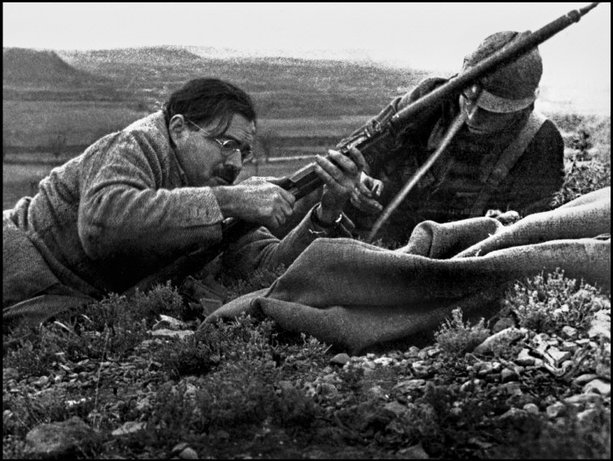
Caption at the source:
MORA DE EBRO, Spain—Hemingway on the front lines with members of Gen. Enrique Lister’s Loyalist 5th Regiment
who were holding out against Gen. Franco's offensive, Nov. 5, 1937.
Update at 22:45 on Aug 14th:
Marine Cpl. Robert Richards, a medically retired combat veteran who was badly wounded in Afghanistan and later appeared in a controversial video urinating on dead Taliban insurgents, was found dead Wednesday night in his home in North Carolina. He was 28.
...
a sniper team led by Richards recorded a video on July 27, 2011, of him and other Marines urinating on the remains of Taliban fighters they had killed. It was never intended to be seen by the public, but Richards later said that the Marine who owned the camera stepped on an IED a couple weeks afterward, and it ended up in the hands of another Marine in the unit. It was posted online, causing an international uproar that led to eight Marines facing discipline.
...
In an exclusive 90-minute interview with this reporter for Marine Corps Times in September 2013, Richards acknowledged intense struggles with post-traumatic stress and night terrors afterward, and taking a variety of medications to deal with it. In one ugly night in Florida, he said he was caught off-guard by a celebration involving replica cannons being fired, and fired a pistol in his hotel room while his wife, Raechel, was present. He thought he was under attack, he said.
There is no finish to a war :(

Sunday, September 19, 2010

On the death of two American soldiers

It had been a while since I checked in with Tom Ricks' blog, The Best Defense, and I did on this last Sunday of the summer.

Bad idea.
Truly depressing and distressing stories about two soldiers.

The first one was about a Marine, Tom Bagosy, who committed suicide on May 10th.
Bagosy joined the Marine Corps in 2004 and married Katie in 2005. They have two children.
He was deployed to Iraq in 2006 and promoted to sergeant in 2007. He joined Marine Corps Force Special Operations Command in October 2008 and was deployed to Afghanistan. During his tours he earned several medals including two Combat Action Ribbons and a Marine Corps Good Conduct Medal, according to information from MarSOC.
But, he was far from healthy inside--severe PTSD ... how tragic ... and a system that couldn't help him despite his wife's pleas:
“I spoke to his psychiatrist and when that didn’t seem to help — at this point I felt the same as Tom that no one was listening to him or cared enough to help — I wrote a letter asking for a new doctor,” she said. The referral didn’t go through until a week after Bagosy died. ...

“I talked to his psychologist and I said that he was suicidal and tried to overdose the day before and had a gun and needed in-patient,” Katie Bagosy said.

When Bagosy discovered his doctors wanted to admit him to the hospital, he bolted from his Substance Abuse Rehabilitation Program and headed for the parking lot. Staff tried to stop him and even asked other Marine patients to grab him, but Bagosy got away, according to witnesses and his wife.

“As Tom drove away he called me and said something about pulling a gun on someone and then said, ‘I love you and I don’t think I’m ever going to see you again,’” Katie Bagosy said, adding her husband was crying hysterically. He then hung up on her.

While being pursued by two provost marshals, Bagosy stopped on McHugh Boulevard and shot himself in the head.
Sgt. Tom Bagosy was 25 years old when he died.

In another post, Ricks linked to this story about "the US Soldier Who Committed Suicide After She Refused to Take Part in Torture"
Spc. Alyssa Peterson was one of the first female soldiers who died in Iraq. Her death under these circumstances should have drawn wide attention. It's not exactly the Tillman case, but a cover-up, naturally, followed. ...
Peterson, a devout Mormon—her mother, Bobbi, claims she always stuck up for "the underdog"—had graduated from Flagstaff High School and earned a psychology degree from Northern Arizona University on a military scholarship. She was trained in interrogation techniques at Fort Huachuca in Arizona, and was sent to the Middle East in 2003, reportedly going in place of another soldier who did not wish to go.
On September 15, 2003, Peterson shot herself with the service rifle because she did not want to participate in the torture practices.
The official probe of her death would later note that earlier she had been "reprimanded" for showing "empathy" for the prisoners. One of the most moving parts of the report, in fact, is this: "She said that she did not know how to be two people; she…could not be one person in the cage and another outside the wire."
The article includes a note from her brother, and this slide-show narrated by her mother; I doubt if one can watch and listen without getting emotional.

Spc. Alyssa Peterson was 27 when she died.

Wednesday, January 13, 2010

We are at war :(

Fewer than two in 10 soldiers on their first or second combat deployment showed signs of mental illness or reported marital problems, according to battlefield research in Afghanistan completed last year. The rate increased to three in 10 soldiers for those on a third or fourth deployment.
... Suicides are at record levels. The divorce rate among enlisted soldiers has steadily increased during the war years. Rates of mental health and prescription drug abuse are on the rise.
With a growing number of injured or wounded soldiers, painkillers are now the most abused drug in the Army. One in four GIs admit to illicitly using narcotic medication during a 12-month period, according to a 2008 Pentagon health survey.
That is from a USA Today story on repeated deployments of US troops.  Just awful conditions.

The Army's aim is to allow two years of recovery for every year in combat. Given the current pace of war, however, it will be a "couple of more years" before that goal is met, says Adm. Michael Mullen, chairman of the Joint Chiefs of Staff. For those in the infantry, who do so much of the fighting, a return to combat often comes within a year.
Meanwhile, soldiers must return to war again and again because the size of the nation's all-volunteer force is limited, Army leaders say. In the past, the government could grow the Army quickly through conscription, allowing the burden of war to be shared by more people.

Sunday, November 29, 2009

"Finish the job"--out of Iraq and Afghanistan NOW!


Tuesday is apparently the big day when President Obama will announce his decision on Afghanistan.  Reports suggest that he will increase the US troop presence there.  It is unfortunate that Obama will add not subtract.

I have no idea what our (US) mission is for the US and NATO forces in Afghanistan.  The number of US military personnel dead is one too many.  The number of Afghans, and Iraqis, who have died, been injured, and displaced is one too many.

Meanwhile, here at home:

Iraq veteran Jessie Bratcher shot the man he was told had raped his girlfriend. An Oregon jury found he had been legally insane at the time because of post-traumatic stress disorder.
The sociologist, William Brown, quoted in that story is my colleague--he is known to friends and colleagues as "Bud."  A Vietnam veteran himself, Bud has invested a great deal of time and his own money in post traumatic stress disorder (PTSD) cases in particular.  He provides a compelling analogy to help us laypeople understand.  There is a difference between civilian and military lives and work.  For all purposes, the civilian and military "operating systems" and software are very different and, sometimes, incompatible.  Unfortunately, while the military is very good at  installing new software when civilians enlist, it does a horrible job of removing the killing software before returning the soldiers to civilian lives.

To make things worse, the VA does not give PTSD the attention and respect it deserves.

I can only imagine that pretty much the entire Afghan society is in a permanent state of PTSD.  Given that Afghanistan was practically in a state of civil war even before the Soviet tanks rumbled into Kabul that fateful Christmas night in 1979, we are now looking at two generations of Afghans who have known nothing but wars and chaos in their countries.  That is the "normal" for them?  What a crazy world we live in!

End the bloody wars now. Please.

Tuesday, October 07, 2008

PTSD claims a two-tour Iraq veteran

U.S. Marine Cpl. Contreras, a 2003 graduate of South High, died two weeks ago after surviving two tours in Iraq.
He took his own life after suffering, it appears, from post-traumatic stress disorder. ....
Being in battle wasn’t supposed to be part of his job, but on one occasion he and some fellow Marines left the base and ended up in the middle of a gunfight.
“He had to use his weapon,” Esther said. “Five guys were shooting in a crowd of women and children. He knows he shot a woman. He didn’t know if he shot any children.”
At one point, he had a nervous breakdown during a Disneyland fireworks show, his family said. Light flashing in the air had been a signal for help in Iraq.
The episode was one of the few moments his family and friends noticed something out of the ordinary with Leonardo.

Read the entire report, with photographs, here.