Showing posts with label freedom. Show all posts

Sunday, February 07, 2021

Will the real Joe Biden please stand up!

I usually stay away from commenting about the goings on in the old country.  Because, more often than not, it is simply heartbreaking even to read about the news about India!

This morning, I woke up to the news about a dam break in the northern part of India, after "part of a Himalayan glacier broke off, triggering an avalanche of rock, mud, water and debris that swept away a hydroelectric dam."

It was a disaster that was bound to happen: "Environmentalists have long cautioned against building dams and power plants there, because it's so prone to landslides and flooding."

A terrible tragedy.

I hope that people will India will think more about how much we – and our economies – are ‘embedded’ within Nature, not external to it.  If only the religious in India too can be motivated to do something about the natural environment.

But, I want to first catch up on an older issue.  It is about how the authoritarian government is tightening its chokehold on the country.

In response to the growing farmers protests, the artist Rihanna tweeted:

Rihanna has a following.  Nearly 102 million!

So, of course, the fanatics in India burned her effigy.

The teen activist icon Greta Thunberg tweeted about the protest. So, of course, the fanatics in India burned her effigy.

Meena Harris tweeted:

In case any academic decided to write or talk about these issues, the Indian government was ready for them:

In a new restriction on academic freedom at the country’s publicly-funded universities, professors and administrators will now have to get prior approval from the ministry of external affairs (MEA) if they want to hold online international conferences or seminars that are centred around issues relating to the security of the Indian state or which are “clearly related to India’s internal matters”.

The latter phrase is so broad as to include virtually every topic of interest to academics. The farmers’ protest relates to ‘India’s internal matters” as does the government’s handling of the COVID-19 pandemic, or caste issues or even the pros and cons of demonetisation.

In addition, the names of all participants in such seminars will have to be approved in advance by the government.

Am I shocked?  Not one bit.  

This is what anti-democratic forces do. This is why I have been blogging against the current prime minister and his toadies forever.  

I am not at all shocked.  I am terribly sad though that my old country has been reduced to such a pathetic state of affairs.

What can one do besides issuing statements that won't have any influence on "the strong man"?

Why aren't we talking about all these?


Saturday, January 19, 2019

The revolution in the "shithole"

This is the first long weekend of a new year; Monday is Martin Luther King Day.  Therefore, I will continue to focus on the slavery history of the United States in Jill Lepore's book.

I have written--many times--even in this blog, that I have no idea how African-Americans live without always being angry at the white folk who proudly claim their slave-owning history.  Or, when they openly talk about white supremacy.

Lepore gives me plenty to get angry about--despite that I am not an African-American, and was raised with Brahmin privilege in the old country.  I have no firsthand experience of being the underclass ever, and I am pissed off!

Consider this, for instance: The American Revolution of 1776 echoed across the waters with the French Revolution in 1789.  Liberty, Equality, Fraternity. Right?

It was the same France that had colonized Haiti, which was then known as Saint-Domnigue. It was "the largest colony in the Caribbean, and the richest."  Whites on the island were outnumbered by slaves, whose population was eleven times the population of whites.

A "democratic" revolution in the nearby United States, and another in the colonial power.  So, of course, Haiti's brown people rose up in 1791.

The leaders of the American revolution did not support the revolution in Haiti.  Instead, they attacked it.  Not just with words: "Between 1791 and 1793, the United States sold arms and ammunition and gave hundreds of thousands of dollars in aid to French planters on the island."  Yep, the young republic set a precedent way back then by sending money and materials to a war, not to help the downtrodden but to support the white and the wealthy!

American newspapers did not cheer the Haitian Revolution, but instead reported it "as a kind of madness, a killing frenzy."

America reinforced itself not as a land of liberty, but as a land of slavery.  How awful!

When George Washington called it quits and headed back home, some of their slaves fled.  Washington "sent a slave catcher" after one of them, who offered to return only if she would be granted freedom.  "Washington refused, on the ground that it would set a "dangerous precedent.""  When Washington died, blacks outnumbered whites in that room, Lepore writes.

Nearly 230 years after that revolution, the sitting President of the United States casually and callously referred to Haiti as a "shithole".

"For Brutus is an honourable man; So are they all, all honourable men."

Sunday, October 15, 2017

Anxiety and the nanny state

In my early years of graduate school, I came to read about--and watch on television as well--the free speech movement at Berkeley, and how Reagan, who was the governor of California then, could not stand those student protests.  Reagan perhaps even owed his political successes to the radical movements, which he attacked and capitalized on in his culture war against freedom in many ways and for many people.

Fifty years later, we continue to fight those same culture wars of free speech.  But, oddly enough, young people these days prefer restrictions on free speech, and seem to be even losing faith in freedom!
protecting children from needless harm became conflated with shielding them from stressors and uncertainties (such as having to solve everyday problems, like getting lost, on one’s own) that are critical for developing personal independence.
Those raised on free speech movements turned around to protect and shelter their precious kids so much that now these young adults are scaredy cats who don't want to be free!  On college campuses, it has taken on crazy forms:
Colleges and universities have exacerbated the problem of dependence by promoting what is sometimes called a culture of victimhood. American college students (who are some of the safest and most privileged people on the planet) are to be protected from, and encouraged to be ever-vigilant about and even report, any behavior that could cause emotional distress. Feelings and experiences that were once considered part of everyday life, such as being offended by someone’s political views, are now more likely to be treated as detrimental to mental health.
I get angry and depressed with trump's words, yes.  But, that idiot saying whatever pleases him is the very mark of freedom that makes America different.  How can college-age adults--the key word is "adults"--not understand freedom of expression?

One of the reasons is: Fear and anxiety.
Anxiety is the most common mental-health disorder in the United States, affecting nearly one-third of both adolescents and adults, according to the National Institute of Mental Health.
That begins right from when they are children:
Suniya Luthar, a professor of psychology at Arizona State University who has studied distress and resilience in both well-off and disadvantaged teenagers, has found that privileged youths are among the most emotionally distressed young people in America. “These kids are incredibly anxious and perfectionistic,” she says, but there’s “contempt and scorn for the idea that kids who have it all might be hurting.”
What are the adults doing?
In a seemingly well-meaning effort to help kids avoid what makes them anxious, administrators actually make anxiety worse. “Anxiety is all about the avoidance of uncertainty and discomfort,” Lyons explained. “When we play along, we don’t help kids learn to cope or problem-solve in the face of unexpected events.”
And, given that you have been reading this blog for years, you know well there is one major factor behind an increased level of anxiety these days: Social media!
Anxious kids certainly existed before Instagram, but many of the parents I spoke to worried that their kids’ digital habits — round-the-clock responding to texts, posting to social media, obsessively following the filtered exploits of peers — were partly to blame for their children’s struggles. To my surprise, anxious teenagers tended to agree. At Mountain Valley, I listened as a college student went on a philosophical rant about his generation’s relationship to social media. “I don’t think we realize how much it’s affecting our moods and personalities,” he said. “Social media is a tool, but it’s become this thing that we can’t live without but that’s making us crazy.”
When these kids grow up ...?
Lyons sees a connection between how some schools deal with anxious students and what she worries is a generation of young people increasingly insistent on safe spaces — and who believe their feelings should be protected at all costs. “Kids are being given some really dangerous messages these days about the fact that they can’t handle being triggered, that they shouldn’t have to bear witness to anything that makes them uncomfortable and that their external environments should bend to and accommodate their needs,” she told me.
You can now see why college students now actually favor restriction on expression.

A few years ago, there was a young woman ready to graduate from the Honors Program.  She was heading to law school on the east coast after graduation.  Her only sister was already in London working on her graduate degree.  I asked her what her parents thought about their two daughters going so far away from home, from Oregon.

Her response was awesome.  And says a lot about her parents.  The parents apparently always told the two daughters that their task was to help the daughters grow their wings, after which they expected--and wanted--the daughters to fly on their own.

At graduation, I met her parents.  I shared with them what their daughter had told me.  They smiled.  They were happy.  No anxieties.  No fear.  No worries.  But that was a decade ago, and apparently life has changed a lot since then--seemingly for the worse!

Saturday, January 21, 2017

Langston Hughes said it first: Make America (great) again!

e.e. cummings said it best for, and on behalf of, people like me::

"next to of course god america i
love you land of the pilgrims' and so forth oh
say can you see by the dawn's early my
country 'tis of centuries come and go
and are no more what of it we should worry
in every language even deafanddumb
thy sons acclaim your glorious name by gorry
by jingo by gee by gosh by gum
why talk of beauty what could be more beaut-
iful than these heroic happy dead
who rushed like lions to the roaring slaughter
they did not stop to think they died instead
then shall the voice of liberty be mute?"

He spoke. And drank rapidly a glass of water


And here is "Let America be America Again" by Langston Hughes

Let America be America again.
Let it be the dream it used to be.
Let it be the pioneer on the plain
Seeking a home where he himself is free.

(America never was America to me.)

Let America be the dream the dreamers dreamed--
Let it be that great strong land of love
Where never kings connive nor tyrants scheme
That any man be crushed by one above.

(It never was America to me.)

O, let my land be a land where Liberty
Is crowned with no false patriotic wreath,
But opportunity is real, and life is free,
Equality is in the air we breathe.

(There's never been equality for me,
Nor freedom in this "homeland of the free.")

Say, who are you that mumbles in the dark?
And who are you that draws your veil across the stars?

I am the poor white, fooled and pushed apart,
I am the Negro bearing slavery's scars.
I am the red man driven from the land,
I am the immigrant clutching the hope I seek--
And finding only the same old stupid plan
Of dog eat dog, of mighty crush the weak.

I am the young man, full of strength and hope,
Tangled in that ancient endless chain
Of profit, power, gain, of grab the land!
Of grab the gold! Of grab the ways of satisfying need!
Of work the men! Of take the pay!
Of owning everything for one's own greed!

I am the farmer, bondsman to the soil.
I am the worker sold to the machine.
I am the Negro, servant to you all.
I am the people, humble, hungry, mean--
Hungry yet today despite the dream.
Beaten yet today--O, Pioneers!
I am the man who never got ahead,
The poorest worker bartered through the years.

Yet I'm the one who dreamt our basic dream
In the Old World while still a serf of kings,
Who dreamt a dream so strong, so brave, so true,
That even yet its mighty daring sings
In every brick and stone, in every furrow turned
That's made America the land it has become.
O, I'm the man who sailed those early seas
In search of what I meant to be my home--
For I'm the one who left dark Ireland's shore,
And Poland's plain, and England's grassy lea,
And torn from Black Africa's strand I came
To build a "homeland of the free."

The free?

Who said the free? Not me?
Surely not me? The millions on relief today?
The millions shot down when we strike?
The millions who have nothing for our pay?
For all the dreams we've dreamed
And all the songs we've sung
And all the hopes we've held
And all the flags we've hung,
The millions who have nothing for our pay--
Except the dream that's almost dead today.

O, let America be America again--
The land that never has been yet--
And yet must be--the land where every man is free.
The land that's mine--the poor man's, Indian's, Negro's, ME--
Who made America,
Whose sweat and blood, whose faith and pain,
Whose hand at the foundry, whose plow in the rain,
Must bring back our mighty dream again.

Sure, call me any ugly name you choose--
The steel of freedom does not stain.
From those who live like leeches on the people's lives,
We must take back our land again,
America!

O, yes,
I say it plain,
America never was America to me,
And yet I swear this oath--
America will be!

Out of the rack and ruin of our gangster death,
The rape and rot of graft, and stealth, and lies,
We, the people, must redeem
The land, the mines, the plants, the rivers.
The mountains and the endless plain--
All, all the stretch of these great green states--
And make America again!                          

Wednesday, July 06, 2016

We hold these truths to be self-evident

In commenting at this post, before Anne returned to her senses, er, to this blog, Mike referred to Woodrow Wilson's racism.  In my rejoinder, I hoped that we are at least moving forward in the correct direction.  I had also noted about the founding fathers--"slave owners on the one hand, but talking the big talk about all men being created equal and about freedom."

Why not explore that some more?

Consider Thomas Jefferson.  He was the main author of the Declaration of Independence.  Jefferson was only 33 years old when he drafted that.  Only 33!  With soaring, majestic, rhetoric, Jefferson tells us:
We hold these truths to be self-evident, that all men are created equal, that they are endowed by their Creator with certain unalienable Rights, that among these are Life, Liberty and the pursuit of Happiness
The same Jefferson was a big time slave owner.   Writing at the Scientific American, John Horgan says that it was more than a small blemish; Jefferson was "an egregious hypocrite, who willfully betrayed the ideals he espoused."

"Willfully" is the key word here.  I.e., Jefferson knew better, and yet continued with his slave owning.
Jefferson was a “brutal hypocrite” even when judged by the standards of his time, according to historian Paul Finkelman. He notes that “while many of his contemporaries, including George Washington, freed their slaves during and after the revolution--inspired, perhaps, by the words of the Declaration--Jefferson did not.” Jefferson also “dodged opportunities to undermine slavery or promote racial equality,” Finkelman writes. As a Virginia state legislator Jefferson “blocked consideration of a law that might have eventually ended slavery in the state.” As President he purchased the Louisiana Territory but “did nothing to stop the spread of slavery into that vast ‘empire of liberty.’” Finkelman accuses Jefferson of being “deeply racist,” noting that he called blacks “inferior to the whites in the endowments of body and mind.”
Pause.  Think about this.  Jefferson writes that "all men are created equal."  Many of his notable contemporaries, including Washington, freed their slaves consistent with the spirit of the revolution and the very idea that "all men are created equal."  Yet, Jefferson not only did not free his slaves, he even resisted legislative attempts to free them!

The public "doesn't know enough about Jefferson's poor record on issues of race."
"I don't think you go around honoring people for behavior that was truly awful, and Jefferson's relationship with slavery and race was truly awful, even from his own times," Finkelman said. "This is not looking back from now," he stressed.
...
"George Washington ceased using white overseers to manage his plantations before he became president," and gave the positions to slaves "as a prelude to emancipating them in his will," Finkelman said. Jefferson never took such a step. "Washington famously said that he did not take men to the market like cattle, but Jefferson sold nearly 100 slaves in the 1790s," Finkelman said.
Which is why I appreciate Horgan's use of the word "willfully" when it comes to Jefferson's slave ownership.  Not only Jefferson knew better, his contemporaries were freeing slaves whereas he continued to treat them worse than cattle.

Horgan runs quite a list of Jefferson's hypocrisy.  He ends with this:
The United States has come a long way since Jefferson’s era. Our moral progress is exemplified by the fact that a black man is President. But this country still falls far short of its professed ideals of peace, equality, justice and liberty for all. Perhaps if Jefferson had set a better ethical example, we would have come further by now. 
If Jefferson had set a better example by freeing his slaves, and as a legislator and president if he had championed the rights of blacks, perhaps our history would have been different.  Maybe we would have moved much faster in the correct direction towards Life, Liberty and the pursuit of Happiness, and I would not be worried about the possibility of a racist in the White House making a speech in 2019 marking the four hundredth anniversary of twenty captive Africans sold into slavery in the British colonies in North America!

Sunday, June 19, 2016

Freedom is just another word for nothing left to lose

The years since 9/11 have been of government watching us in many ways.  The same years have also provided us with phenomenal digital technological wonders that also keep watching many, many things we do and think.  A typical young person today has grown up in this environment of being watched practically all the time and, by and large, they seem to be ok with it.  It does not seem to trouble them.

These trends bother me.  They worry me.

Even the nearly two years of experiencing life under Indira Gandhi's "emergency" was enough for me to understand the value and importance of freedom.  A freedom in which we do not have to think about freedom itself.

It is this freedom, and the near total lack of it, that Herta Muller writes about in a haunting and surreal poetic prose that is as much a "witness literature" as is Svetlana Alexievich's.  I jumped to Muller's book out of sheer logistics--Alexievich's Secondhand Time is hardcover, whereas Muller's The Land of Green Plums is easy to carry paperback, which was convenient for the travel.  The writing styles are different, the locales are different, but both are about humans and their lives in repressive regimes.

Muller's Nobel Prize speech is a wonderful bonus in the book.  I read that even before I got to the book.  A few pages into the book, I wondered whether the speech ought to have been a prologue of sorts, so that readers like me would have been mentally primed for the haunting tale that Muller tells.

Romania's Nicolae CeauÈ™escu and his totalitarian state is the setting in which Muller weaves her surreal images.  In an interview two years ago, Muller said that she didn't quite buy into the notion that the Romanians didn't have organized resistance "because they were more tightly controlled, the country is small and more easily monitored":
But I always wondered about this. You had this magnificent language, and then there was this combination of utter cluelessness—as a kind of default predisposition, a preemptive stance—and brutality. But it’s precisely this cluelessness, this utter lack of interest in political affairs, that’s the problem. Because people who aren’t interested aren’t prepared for hard times, they’re quick to give in, quick to conform, and then they’re quick to act brutally against others so as not to put themselves in jeopardy. 
The cluelessness, the utter lack of interest in political affairs, in this country--especially among the young--deeply worries me.  Particularly because throughout this twenty-first century, various processes have made conforming to be the easier route.

Even if we want to dismiss the worries that I have, the life that she describes in the fictional work will come across as not that different from the ongoing Syrian crisis, for instance.  Muller writes:
Everyone lived by thinking about flight.  They thought of swimming across the Danube until the water becomes another country. Of running after the corn until the soil becomes another country.  You could see it in their eyes: Soon they will spend every penny they have on detailed maps.  They hope for fog in the field and fog on the river for days on end so they can avoid the bullets and the guard-dogs, so they can run away, swim away. ... You could see it on their lips: Soon they will whisper to a stationmaster in exchange for every penny they have.  They will climb into freight trains so they can roll away.
Practically a line-by-line description of those fleeing Syria, right?  And she adds:
The only ones who didn't want to flee were the dictator and his guards. You could see it in their hands, eyes, lips. ... You could feel the dictator and his guards hovering over all the secret escape plans, you could feel them lurking and doling out fear.
Freedom is a very recent concept and it is quite a struggle to make sure we don't lose it.  My worry is that there are far more people eager to curtail freedom than there are to fight for it.  The cluelessness, the utter lack of interest in political affairs, in this country, in an era of increasing technological surveillance and ready-to-conform behavior worries me that America, too, might end up with a fascist in power.    


Sunday, May 15, 2016

The murderous insanity that began fifty years ago

I lucked out with having the radio on when this program was aired.  It was a re-broadcast of a two-decades old interview with the Chinese activist Harry Wu. He died recently at age 79.  I listened to it.  I started tearing up.  Do not read the transcript there--listen to the interview and you, too, will get emotional.

The interview ends with Wu saying this:
My parents, my brother, they are still over there and many, many of my inmates, my friends they are over there. I cannot stop thinking about them. The nightmares always come back to me. I am lucky. I survive. I want to enjoy my life in a peaceful land. I'm a very normal person. I want to be loved. I want to love. But I cannot turn back on these people, these nameless, voiceless, faceless people. Forget means betraying. I cannot do that.
Chairman Mao was one of the worst humans ever in recent memory.  He killed his own people by the millions.  He starved to death tens of millions.  And crushed the spirits of many who lived. 
Fifty years ago, on May 16, Mao Zedong unleashed an attack aimed at smashing his own Communist Party apparatus from top to bottom, having concluded that it was going capitalist. “Bombard the headquarters!” he urged the masses in a famous People’s Daily article. Millions of young zealots responded, becoming Mao’s Red Guards, his fanatical foot-soldiers. Thus began China’s Great Proletarian Cultural Revolution, a period of murderous insanity that ended only with Mao’s death a decade later, in 1976. 
One of Mao's crazy plans was to "rusticate" the Chinese youth.  The "cultural revolution" features in this essay, whose author, Sheng Yun, is the only child of parents who were sent to the countryside:
Once at a family dinner, my parents were reminiscing about their time among the farmers: six or seven years in my mother’s case, around two in my father’s. I had just read The Lost Generation: The Rustication of China’s Educated Youth (1968-80) by Michel Bonnin. I interrupted: ‘You were sent to the countryside because there were too many of you in the city, and there weren’t enough jobs for you.’ I still remember the expression of shock, disappointment and hurt on their faces.
How do people not get angry at such things?  Am I the only person walking around with a great deal of corked-up anger?  Why don't people yell and scream "fuck you" at Mao's giant portrait at Tianamen Square?  Oh, yeah, that's right--they can't!

The author narrates a part of the family history:
My maternal grandfather was a literary critic and actor. In the 1930s and 1940s he went underground as a member of the Communist Party, writing in support of the cause. He had seen the corruption of the Kuomintang regime, and believed that Mao was the saviour of the Chinese people. In 1954, the famous poet Hu Feng wrote a 300,000-word letter to the Bureau of the Central Committee, describing the difficulties writers faced. Mao saw this as defiance on the part of the intellectuals, and a literary argument rapidly turned into a political purge. More than two thousand people were punished, 78 of whom were described as members of the Hu Feng Counter-Revolution Group, including my grandfather. He was sent to Jia Bian Gou (the labour camp in Wang Bing’s 2010 film, The Ditch), located in the remote province of Gansu. Jia Bian Gou, sometimes called the Chinese Gulag, was probably the worst of the labour camps for dissidents. While he was not close to Hu Feng, and had only met him a few times, he had remained an admirer. 
After 25 years in the Chinese Gulag, the grandfather returned home.  
His mother opened the door to a hump-backed, pigeon-chested old man whom she failed for a moment to recognise as the handsome young man she’d last seen in the 1950s.
Seriously, how come people aren't angrily shouting "fuck you" and defacing Mao's portrait?  Oh, yeah, that's right--they can't!  Especially when the current leader embraces Mao's radical legacy:
China’s current leader, Mr. Xi, will not stand to see Mao denigrated, even though his own father, Xi Zhongxun, one of Mao’s top lieutenants, was purged in the Cultural Revolution and a half-sister killed herself. Mr. Xi himself was one of 18 million urban youths banished to the countryside to learn from the peasants.
He has declared that it is just as unacceptable to negate Mao’s 30 years in power as it is to speak critically of the 30 years that followed under Deng. He has set side-by-side, on equal footing, a period marked by spasms of mass killing and destruction and an overwhelmingly peaceful era that saw the greatest economic progress in human history.
Xi is on a mission:
Mr. Xi’s “China Dream” depends to a large degree on silence, secrecy and propaganda about the Cultural Revolution, which traumatized some 100 million Chinese. Authorities won’t allow open discussion of that era for fear that it would discredit Mao and undermine the party’s legitimacy.
That Wall Street Journal report ends on this note:
The Cultural Revolution lives on.

How awful!


Monday, September 14, 2015

Stability is not a static phenomenon

Over the years, and many times in this blog, I have expressed my deepest commitment to free thinking and my distaste for politics--whether at my campus or in China--that does not allow free expression.

It is one thing for me to write about those ideals.  But, I am not that much a fool into believing that my ideal world is already here.  As even the neighborhood and campus politics suggest, the world is a far too messy place to allow for free thinking, unfortunately.

As I look across the global geopolitics, it seems like there is a growing attraction for a Singapore/China model of politics and governance in which individuals operate within well-defined limits to expression.  India's society and politics don't seem to want more freedom.  Russia and the Central Asian "Stans" resemble the old Soviet Union more than the relatively freer Eastern European countries.

What happened?
With the collapse of Communism, “what we may be witnessing,” Mr. Fukuyama wrote hopefully in 1989, “is the end point of mankind’s ideological evolution and the universalization of Western liberal democracy as the final form of human government.”
But couple the tightening of Chinese authoritarianism with Russia’s turn toward revanchism and dictatorship, and then add the rise of radical Islam, and the grand victory of Western liberalism can seem hollow, its values under threat even within its own societies.
In September 2000, I would never have imagined the world that it is today.  I would have described a world of freer people, and would have been emphatic about the coming future with less interference from government and religion.  Yet, here we are in September 2015 and the world is anything but that.

China fascinates me for the very reason that is articulated in that NY Times essay:
China is often cited as a counterexample to the universality of democracy and human rights. But what distinguishes China is its disinterest in spreading its model to the rest of the world.
Western universalism was real, if rivalrous. The Soviet Union tried to spread revolution and Communism, France had its “Declaration of the Rights of Man” and the United States its self-image as “the city upon a hill.” But China engages with the world in its own interest, divorced from moral aims, with little desire to proselytize.
The Chinese vision is not universalist but mercantilist, and Beijing is interested less in remaking the world than in protecting itself from vulnerabilities of globalization, including the chaotic freedoms of the Internet. China, like Russia now, pushes back against Western aspirations and efforts to reshape the world in its own image.
The China described here is the "new" China, in contrast to the old China of Mao that was certainly interested in influencing similar peasant revolutions in its neighboring countries, including India.  

A few weeks ago, the New Yorker featured a marvelous essay by Peter Hessler, who also described China and its entrepreneurs as dispassionate producers and sellers of goods.  The context for Hessler's essay was the strange juxtaposition of Chinese merchants selling lingerie to uber-conservative and traditional Muslim women in the smaller cities of Upper Egypt.  
Upper Egypt is the most conservative part of the country. Virtually all Muslim women there wear the head scarf, and it’s not uncommon for them to dress in the niqab, the black garment that covers everything but the eyes. In most towns, there’s no tourism to speak of, and very little industry; Asyut is the poorest governorate in Egypt. Apart from small groups of Syrians who occasionally pass through in travelling market fairs, it’s all but unimaginable for a foreigner to do business there. And yet I found Chinese lingerie dealers scattered throughout the region.
Hessler's essay is a beauty; I won't be surprised if it ends up a serious contender for awards that recognize nonfiction.  He writes there:
All told, along a three-hundred-mile stretch, I found twenty-six Chinese lingerie dealers: four in Sohag, twelve in Asyut, two in Mallawi, six in Minya, and two in Beni Suef. It was like mapping the territory of large predator cats: in the Nile Valley, clusters of Chinese lingerie dealers tend to appear at intervals of thirty to fifty miles, and the size of each cluster varies according to the local population. Cairo is big enough to support dozens. Dong Weiping, a businessman who owns a lingerie factory in the capital, told me that he has more than forty relatives in Egypt, all of them selling his products. Other Chinese people supply the countless underwear shops that are run by Egyptians. For the Chinese dealers, this is their window into Egypt, and they live on lingerie time. Days start late, and nights run long; they ignore the Spring Festival and sell briskly after sundown during Ramadan. Winter is better than summer. Mother’s Day is made for lingerie. But nothing compares with Valentine’s Day,
Hessler, too, notices how it is all about business:
I've never met Chinese people in Egypt who express an interest in changing the country. They often talk about what they perceive to be weaknesses—a lack of work ethic among the people, a lack of system in the government—but the tone is different from that of many Westerners. There’s little frustration; the Chinese seem to accept that this is simply the way things are. There’s also no guilt, because China has no colonial history in the region, and its government engages with both Israel and Palestine. Chinese entrepreneurs often speak fondly of the friendliness of Egyptians and their willingness to help strangers, two qualities that the Chinese believe to be rare in their own country. They almost never seem disappointed by the Egyptian revolution. This is not because they believe that the Arab Spring has turned out well but because they had no faith in it in the first place.
So, whither democracy and the rights of the individual?  Is America not the beacon on the hill?  Back to that NY Times piece:
“Our own preachiness and lecturing tendencies sometimes get in the way, but there is a core to more open democratic systems that has an enduring appeal,” he said. That core is “the broad notion of human rights, that people have the right to participate in political and economic decisions that matter to them, and the rule of law to institutionalize those rights.”
The result “doesn’t have to look like Washington, which may be for the good,” Mr. Burns said. “But a respect for law and pluralism creates more flexible societies, because otherwise it’s hard to hold together multiethnic, multireligious societies.”
But, China seems to hold together, right?
[Democracies] in whatever form seem more capable of coping with shifting pressures than authoritarian governments. History does not move laterally but in many different directions at once, Mr. Burns said. “Stability is not a static phenomenon.”
I am not sure if I can handle any more instability than what I see out there.

Tuesday, June 03, 2014

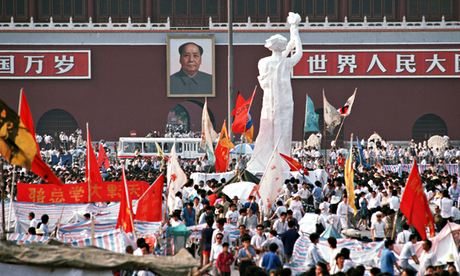
Eight-nine-six-four: Freedom and the Tiananmen Square Massacre

On this 25th anniversary of that horrific event, and looking across at China as the world's factory now, it does feel like that was all a bad dream. A mere dream.

If only the massacre were a bad nightmare!

source

The thoughts expressed by some of those who protested then are moving. Powerful.  Like this protester:
Hu Jia is one of China’s best-known political activists. He participated in the 1989 Tiananmen protests as a fifteen-year-old, studied economics, and then worked for environmental and public health non-governmental organizations. A practicing Buddhist, Hu spent three and a half years in prison between 2008 and 2011 for “inciting subversion of state power” and currently is under house arrest for having launched a commemoration of the June Fourth massacre in January.
What does Hu have to say about today's China?
After being in power for sixty-five years, the worst thing the CCP has done is create a sense of spiritual confusion. We have no belief or faith. Instead we have brutal competition and treating people brutally. If someone falls, no one goes to help them. People have to consider if they’ll be accused by the old person of having caused the accident. This happens all the time, so no one goes to help people.
That’s what China is like now.
 About the protests, Shen Tong, a student leader then, and now living in the US, says:
If Chinese Communist history is any guide, no matter how careful we were, no matter how 'well-behaved', the crackdown was inevitable. If we'd asked for a little bit more. if we'd asked for regime change – China would have been very different. We had generals warning the government not to open fire.
When another opportunity comes about, will protests be so organised and peaceful? It is when; there's no if; there's a moral direction in history. The night before they began, the protests were impossible; the morning after, they were inevitable.
 As another young protester then, and a Harvard lecurer now, Rowena He says:
China has to face its past in order to have a future.
No bad dream it was. Young people died. Mothers continue to mourn them:
Xu Jue’s son was shot dead by a soldier. Within a few weeks, her husband’s hair had turned white. Five years later he died. Qisile, she explained: angered to death. On her husband’s tombstone is a poem explaining what killed both men:
Let us offer a bouquet of fresh flowers
Eight calla lilies
Nine yellow chrysanthemums
Six white tulips
Four red roses
Eight-nine-six-four: June 4, 1989.

Sunday, May 18, 2014

The Jasmine Revolution that did not reach Tiananmen Square

There was one brief period in my life, in my early life, when I understood what it means not to have the freedom of expression.  I was barely into my teenage and I knew I hated the very idea of government clamping down on that glorious freedom.

It was when federal rule was imposed as a result of a declaration of national emergency.  The prime minister, Indira Gandhi, and her minions--especially her second son, Sanjay Gandhi--turned India into a police state.  One of my favorite magazines, Thuglak, carried blank spaces in its pages--the blank resulting from the government censors axing out paragraphs that, one would assume, were critical of the government.

A fearful life was not worth it even though trains ran on time and workers actually worked.  It became the beginnings of the doubts about the communist ideas that so much fascinated me, though it took me a few more years to completely rid myself of the red within.

A little more than a decade later, I, like hundreds of millions of others on this planet, watched transfixed the protests at Beijing's Tiananmen Square.  Pro-democracy protests by students who were in my age cohort.  The rawness of the emotions!

Recalling the protests, Nicholas Kristof writes:
A quarter-century has passed. The bullet holes in the buildings along the Avenue of Eternal Peace have been patched, and history similarly sanitized....
The great Chinese writer Lu Xun once wrote, about an earlier massacre: “Lies written in ink cannot disguise facts written in blood.”
I have to remind myself that it has been 25 years since those protests.  Twenty-five years!

Individual freedom is way too valuable for me to give up.  I empathize with those who yearn for it.  When the Arab Spring spread, I hoped that the protests in Tunisia and others in the Arab world would reach China and trigger a Jasmine Revolution.  It never happened, of course.

If you can read this blog post, tweet, update your status on Facebook, or even yell out loud that your government is fucked up, those are all evidence that you--and I--have freedoms that did not come easily.  A great many made this possible for us, and often they paid for it by suffering torturous deaths.  For now, it might seem as if the deaths of the Tiananmen protesters was all in vain.  Not by any means.  For one, it reminded millions like me that freedom is precious.  Further, as Kristof writes:
As China prospers and builds an educated middle class, demands for participation will grow. I’ve covered democracy movements around the world, from Poland to South Korea, and I’m confident that someday, at Tiananmen Square, I’ll be able to pay my respects at a memorial to those men and women killed that night.
I can only hope that we are not far from that day in the future.

Here is the late poet Faiz Ahmed Faiz:
Speak, by Faiz Ahmed Faiz
Speak, your lips are free.
Speak, it is your own tongue.
Speak, it is your own body.
Speak, your life is still yours.

See how in the blacksmith's shop
The flame burns wild, the iron glows red;
The locks open their jaws,
And every chain begins to break.

Speak, this brief hour is long enough
Before the death of body and tongue:
Speak, 'cause the truth is not dead yet,
Speak, speak, whatever you must speak.

Wednesday, October 09, 2013

The importance of expression means that democracy is messy!

It has been a few days since I last posted anything here, because I had imposed on myself a ban on blogging until Monday.  For personal reasons.

The ban did not work out the way I thought it would.  I was becoming more and more unproductive.  It was seriously affecting my state of mind.

Thus, when I found that I was wide awake at almost the same ungodly hour when the whole thing began a few days ago, I knew that as the one who imposed the ban, I had to release myself from that ban.

I wonder if that experience was also the subconscious trigger behind this piece, which I have sent to the editor for possible publication.

Even as the the US government reached partial shutdown, newspaper cartoonists and friends in India started wisecracking on the topic. Their jokes were typically variations of “India is far ahead of America. Congress shut down our government years before Congress shut down the US government.”

The reference in India is to the party that is currently in power--the Indian National Congress, which is almost always referred to as the Congress Party--and the ineffectiveness of the government led by the prime minister, Manmohan Singh.

Dysfunctional politics and governance in the two largest democracies on either side of this world offer plenty to think about.

At the outset, these are situations in which we can recall Winston Churchil’s wonderful observation that “democracy is the worst form of government, except for all those other forms that have been tried from time to time.”

Of the many reasons why democratic governance becomes messy, opposition to ideas plays a significant role. Humans we are with our own perspectives on life and the role of government, we are bound to differ on how to govern ourselves.  The more argumentative the culture, the more diverse and spirited the views are and, opposition, does not always have to constructive either.  The result is what we see both in the United States and in India.

It is tempting, in such situations, to look across at Russia and China and note that their governments are more “efficient.”  A few months ago, well before this partial shut down, even the New York Times columnists, Thomas Friedman and Nicholas Kristof, had written about how the Chinese get things done while we squabble here.  When Valdimir Putin effortlessly pushes ahead with his agenda, there are appreciative comments as well.

But, such a mess that we find ourselves in comes with the package of democracy that we prefer.  We engage in the war of ideas, however extreme some are, because it is only democracy that allows for such expression--a freedom that does not exist in Russia or China and many other countries of the world.

In India, there are plenty of people who then fondly look across the border at China and wonder whether their country would benefit from lesser freedoms.  Commentaries are in plenty there on how a Putin-like strong leader is what the country needs now.

There is, therefore, a significant support for Narendra Modi, who is the anointed prime ministerial candidate if his party were to win the elections next spring.  But, Modi comes with a huge baggage of anti-democratic past.  His decisions as the chief minister (the equivalent to the governor here in the US) of the state of Gujarat, especially during the religious riots in 2002, are why the US government has consistently refused to grant him a visa.   Of course, it is not that the US holds every foreign leader to the same standard--after all, we do heartily welcome leaders from other countries with a lot more anti-democratic baggage.  But, that is realpolitik!

The mess of democracy will only get messier into the future.  The more individuals feel empowered, the more we can and should expect them to voice their opinions.  Compared to the the bad old days of India, contemporary India has truly enfranchised millions of people.  The US of today is vastly better than the country of even two decades ago when it comes to the involvement of women and minorities in political discussions.  Both these democracies have progressed along a healthy path of systematically including into the fold those who had been systematically excluded before.  There is a lot more work to be done, yes, but the progress is to be lauded.

The internet and social media have further provided immensely more opportunities than have ever existed before for people to rally behind ideas with which they sympathize   We can expect a lot more “Twitter Revolutions.”  All these will also make easy to organize a significant vocal minority, which is all it takes to make governance in India or the US seemingly dysfunctional.

It does not mean that I am delighted with the chaos in these two large democracies.  I wish that opposition would always be responsible and constructive, and not merely for the sake of opposing.

I even worry that other countries that are slowly emerging from dictatorial and authoritarian regimes might then prefer a Russia or a China model for their own governance, instead of being inspired by Lady Liberty, who was such a powerful symbol even during the fateful protests in China’s Tiananmen Square in 1989.

However, at the end of it all, there is no doubt that I am delighted to have a life that has been enriched by two democracies, warts and all!

Sunday, July 14, 2013

Liberté, égalité, fraternité

Way back, I mean way back, in the ninth or tenth grade when we covered world history, we learnt about the French Revolution and the storming of the Bastille.  Suddenly the phrase "liberty, equality, fraternity" became familiar.

However much I might complain about the contemporary world, I am equally convinced that humans have never had freedom at the individual level as we do now.  With more and more countries transitioning to liberal democracy, the number of people with liberty will only increase.  We owe a huge thanks to the Magna Carta, the American Revolution, and the French Revolution, that got this liberty ball rolling.

The turmoil in the Arab world or Myanmar or Tibet are all nothing but examples of people fighting for their freedoms.  Whether it is societies like those where liberty is highly restricted, or here in the US or in France, the rally for liberty depends on we the people. It depends on us.  We worry about the NSA snooping around, for instance, because we understand how much the liberation of individuals could be easily reversed.  The quieter we become, the odds of freedom getting restricted rise, and rise rapidly.

Here is the late poet, Faiz Ahmed Faiz on the urgency of it all:
Speak, by Faiz Ahmed Faiz
Speak, your lips are free.
Speak, it is your own tongue.
Speak, it is your own body.
Speak, your life is still yours.

See how in the blacksmith's shop
The flame burns wild, the iron glows red;
The locks open their jaws,
And every chain begins to break.

Speak, this brief hour is long enough
Before the death of body and tongue:
Speak, 'cause the truth is not dead yet,
Speak, speak, whatever you must speak.

Monday, November 19, 2012

Bal Thackeray's spirit refuses to die. A spectre of fear haunts Mumbai!

The pile of papers to grade gets higher and higher; if only I resorted to the easy, no stress, bubbling-in scantron tests, right?

Sorry, I had to rush to the bathroom to puke and get that thought out of my system :)

Anyway, all those papers to grade, and even more pressing is the need for catharsis by blogging about the atrociousness of Bal Thuggeray's goons.

As when he was alive, Thuggerary brought the city to a standtill even when dead.  It was a bandh that closed everything down.

Most Mumbaikars know that how much ever they are pissed off at Thuggeray, well, they ought to keep those thoughts to themselves.

Which is not what two young women knew, perhaps.

"21-year old Shaheen Dhada" posted on Facebook:
With all respect, every day, thousands of people die, but still the world moves on.
On Facebook. How dare she disrespect Thuggeray!  20-year old Renu Srinivasan made another mistake--she "liked" it.

Dhada had added:
Just due to one politician died a natural death, everyone just goes bonkers. They should know, we are resilient by force, not by choice. When was the last time, did anyone showed some respect or even a two-minute silence for Shaheed Bhagat Singh, Azad, Sukhdev or any of the people because of whom we are free-living Indians? Respect is earned, given, and definitely not forced. Today, Mumbai shuts down due to fear, not due to respect. 

The Gestapo knocked on their doors and hauled them off to jail.  Yes, for posting and "liking" on Facebook.

What were they charged for?
“promoting enmity between classes” and “sending offensive messages through [a] communication service”
WTF!

A former judge of India's Supreme Court, among others, rallied support for these two young women.  One of the comments to his open letter is bloody eerie:


WTF!

India Today reports that the families were also threatened by Thuggerary's Sainiks, which is also echoed in this report:
"The Sainiks came with a lawyer, who was armed with printouts of the Facebook message and the address of the girls. I think everyone will agree that the situation was sensitive in the light of Balasaheb Thackeray's demise," said Ramdas Shinde, subdivisional police officer in Palghar.
A mob also vandalized a medical clinic run by her uncle.

WTF!

I can only hope that the arrest of the two young women will be the proverbial straw to break the back of the unscrupulous politicians who have screwed up India every which they can.

Of course, it is easy for me to blog about it from the safety of my home here in the US.  Well, as long as I am not on the President's kill list!

It is a mad, mad, mad, mad world :(

Saturday, August 11, 2012

Pussy Riot: "join us in a taste of freedom”

Following-up on the Pussy Riot story, which has been atrociously handled by a lethal nexus of Putin's authoritarianism and the cold-hearted and irrational Russian Orthodox establishment.  The New Yorker appropriately and wonderfully calls this an absurd drama, but, of course, with tragedy written all over it.  Another New Yorker blog has this to say:
A punk-feminist collective, Pussy Riot is a band of political rebel-artists who, faced with years in a Russian prison, turn out to be courageous, self-possessed, and historically aware. And in their testimony they have shown themselves to be defiantly intelligent, worthy of the long tradition of Andrei Sinyavsky, Larisa Bogoraz, Joseph Brodsky, and so many other dissidents who stood in the dock and spoke for themselves and the cause of freedom.
The closing statements (here and here) are powerful, and educational. (ht)
I now have mixed feelings about this trial. On the one hand, we now expect a guilty verdict. Compared to the judicial machine, we are nobodies, and we have lost. On the other hand, we have won. Now the whole world sees that the criminal case against us has been fabricated. The system cannot conceal the repressive nature of this trial. Once again, Russia looks different in the eyes of the world from the way Putin tries to present it at daily international meetings. All the steps toward a state governed by the rule of law that he promised have obviously not been made. And his statement that the court in our case will be objective and make a fair decision is another deception of the entire country and the international community. That is all. Thank you.
Verdict on Wednesday, according to news reports. 

Won't it be wonderful if the legal system paid attention to this from their closing statement?
Our attitude toward religion, and toward Orthodoxy in particular, is one of respect, and for this very reason we are distressed that the great and luminous Christian philosophy is being used so shabbily. We are very angry that something beautiful is being spoiled.” It still makes us angry and we find it very painful to watch.
The lack on our part of any show of hatred or enmity has been attested by all the witnesses examined by the defence. And by the evidence of our characters. In addition to all the other character statements, I’d like you to consider the findings of the psychiatric and psychological tests the investigator ordered me to undergo in detention. The expert’s findings were as follows: the values to which I am committed in my life are justice, mutual respect, humanity, equality and freedom. That’s what the expert said, someone who doesn’t know me and Investigator Ranchenko would probably have very much liked him to write something different. It would appear, however, that there are more people who live and value the truth, and the Bible’s right about that.

Finally, I’d like to quote a Pussy Riot song because, strange as it may seem, all our songs have turned out to be prophetic, including the one that says: “The KGB chief, their number one saint, will escort protestors off to jail” – that’s us. What I’d like to quote now, however, is the next line: “Open the doors, off with the shoulder-straps, join us in a taste of freedom.” 
 So, Virgin Mary, put Putin away, and free these women!

Thursday, March 03, 2011

America, what a country! Glad to be here edition

The US Supreme Court provided yet another evidence for me as to why I continue to place my long-term bets on America, and not on any other country, and gives me an opportunity then to follow-up on my earlier post on freedom. 

The Court ruled that the Constitution protects hateful, bigoted, speech, in the case of those awful people who go to funerals of American soldiers and chant anti-gay and anti-other-religion slogans:
“Speech is powerful,” Chief Justice John G. Roberts Jr. wrote for the majority. “It can stir people to action, move them to tears of both joy and sorrow, and — as it did here — inflict great pain.”
But under the First Amendment, he went on, “we cannot react to that pain by punishing the speaker.” Instead, the national commitment to free speech, he said, requires protection of “even hurtful speech on public issues to ensure that we do not stifle public debate.”
What a wonderful contrast in how we in America handle expression, against a background of millions of people in the Middle East and Africa standing up, perhaps for the first times in their lives, to gain at least a little bit of this kind of freedom, and are even ready to give up their lives for it.

The chief justice wrote
the protesters’ speech “cannot be restricted simply because it is upsetting or arouses contempt.”
I cannot begin to understand how any person will be that much full of bigotry in order to be able to go picket at funerals of soldiers.  I am sure they fully understand that they are able to do what they do only because they are in this good ol' US of A.

The times when this immigrant gets all emotional about his adopted home country! 
Let us rope in another immigrant, from another country, to explain "freedom" in America ... yes, even in this kind of a situation, I have to fall back on humor--maybe to hide the love for USA? :)


Well, it is of course true that I don't have any free expression on campus here.  A few years ago, the faculty union's president wrote in an email to me:
join the union and go through the Bargaining Team.  If not, then please shut up 
I suppose we ought to appreciate the politeness in "please shut up" and not merely "shut up" :)

The in-coming union president at that time wrote in an email to me:
I think you should apologize for your self-serving attempt to mislead the faculty
Guess what?  I am still here!!!

Wednesday, March 02, 2011

Lack of freedom in the Middle East--I have tasted it :(

Back in 2004, I went to Dubai during a trip to India.  No, I didn't stay at the Burj Al Arab--I merely stood outside the gates and took the photo on the right.  They don't pay me enough to have even a cup of coffee there!

I stayed at a decent hotel that was a couple of blocks away from my brother's apartment.  A few hours after checking in, I went downstairs to check my email from the computers in the lobby.

I typed in www.wou.edu and waited for the university's home page to load up so that I could get to the email.  Boy was I shocked when instead of the familiar page, the monitor displayed in big, bold, bright red colors "Site Banned."

It was one hell of a shock that completely rattled me.  My immediate thoughts were along the lines of, "if I can't access my university email, then what are the other ways in which anybody might be watching my moves?"  My next thought was whether I should hide my American passport and identity, and kind of merge in with the huge Indian population there.  Particularly because my trip there was soon after the American invasion of Iraq, which wasn't favorably viewed especially in the Middle East.

For the rest of the four days that I was there, I hid my American identity as much as I could.  I couldn't wait to get the heck out of Dubai and the UAE.

I couldn't understand then, nor can I even now, how people continue to live in societies where simple freedoms are circumscribed by big brother governments.  My brother suggested that I find a university job in Dubai or anywhere in the Middle East because they paid American faculty a whole lot of money.  I laughed it off--I didn't want to offend him by describing the "site banned" incident and how I way prefer to be a pauper in a freer society than otherwise.

Do I think that freedom is a universal right?  I am not ready for that leap of faith. All I know is that I prefer freedom and, as I tell students, I would take America any day over any of the countries that I have visited or read about.  The primacy of freedom is also why I am a card-carrying member of the ACLU--you should too.

I do wish for a world without authoritarian regimes, and for people to have the option to choose freedom.

Sunday, February 27, 2011

Waiting for a Jasmine Revolution in China

I have never been a fan of the Chinese model of development; having grown up in India, and then life in America means that I have been mostly free than otherwise.  Those two awful years under Indira Gandhi's "emergency rule" were when I experienced government controls on expression.  One of my favorite Tamil magazines, Thuglak, used to have blank spaces in the commentaries--the sentences that were nuked by the censors.  Even as a kid--I was a pre-teen when all hell broke loose after the Supreme Court verdict in the case that Raj Narain had filed--I was highly uncomfortable with that political development, which all of a sudden muted India.

Of course, when we look beyond political freedom, onto issues of daily existence--from food to water to sanitation--the Chinese model has delivered a lot more than what India's government has given its people.
Kevin Hassett, director of economic policy studies at the American Enterprise Institute, explained that evidence is emerging that developing “countries that are economically and politically free are underperforming the countries that are economically but not politically free.” China, of course, is in the lead of the economically free but politically unfree nations. Hassett wrote, “The unfree governments now understand that they have to provide a good economy to keep citizens happy, and they understand that free-market economies work best.... Being unfree may be an economic advantage. Dictatorships are not hamstrung by the preference of voters for, say, a pervasive welfare state. So the future may look something like the 20th century in reverse. The unfree nations will grow so quickly that they will overwhelm free nations with their economic might.”
The kleptocrats who have ruled many developing countries in past decades have tended to come unstuck when Western aid dwindles, their own economies falter and then fall backward, and all too often rivals emerge within their armies. The China Model presents the possibility that such rulers can gain access to immense wealth through creaming off rents while at the same time their broader populations become content, and probably supportive, because their living standards also are leaping ahead.
The fascination to implement the Chinese model is, therefore, not difficult to understand.  Examples are a plenty, from Singapore which is geographically and culturally close to India and China, to Rwanda, which is in a completely different cultural and geopolitical context.
The China Model is, of course, admired in the West, too, with business leaders’ words (at platforms such as Forbes magazine conferences and the World Economic Forum, which has just instituted an annual summer session in China) providing great reinforcement for Chinese leaders. The World Bank is just one of the international institutions that champion China (its greatest client and in some ways its boss) as a paradigm for the developing world. Also fascinating is the appeal of the China Model to Russia, which as Azar Gat, professor of national security at Tel Aviv University, writes in Foreign Affairs, “is retreating from its post-communist liberalism and assuming an increasingly authoritarian character as its economic clout grows.”
Can this model last, not only in China itself but also its variations throughout the world?  Just as the world was beginning to erroneously conclude that perhaps even people prefer the Chinese model, well,
The example of Tunisia raises a related question, equally awkward. For China’s rulers, Zine El Abidine Ben Ali, the ousted dictator, would have been seen as following their own approach—the so-called “Chinese model” of economic growth combined with political repression—and having much success with it, or so it was assumed for many years. But the Tunisian people took to the streets to overthrow him. Did the people want something more than the Chinese model? How could that be?
One hell of a tough question, which all the dictatorial and authoritarian regimes now have to deal with.  Even in China:
evidence is strong and growing that the top leaders have become extremely nervous about the current situation, as they watch people rising up in country after country in North Africa and the Middle East, assisted by social media and the Internet. No doubt China’s leaders fear what would happen if jasmine ferment really did spread to their own masses—many of whom already harbor a lengthy list of grievances over corruption, bullying, land seizures, environmental destruction, and other items of unjust treatment. 
So, what did the Chinese government do?  Held special politburo meetings, and ...
On the morning of February 19, President Hu Jintao went to the Central Party School to deliver a speech to an audience of provincial governors and central government ministers on maintaining social stability. The speech stressed the glorious achievements of the Communist Party, emphasized the correctness of Party ideology, and in other ways bristled with unenlightening jargon. Its purpose seems to have been to present a public version of the policies decided at the secret Politburo meeting of a week earlier. Without directly mentioning the Middle East or any of the events in China that were making authorities so nervous, Hu made three basic points: one, we need to greatly strengthen control of information on the Internet; two, we need to regulate the “virtual society” that it has given rise to; and three, we need to guide public opinion in this society in “healthy directions.”
I cannot imagine this crazy system continuing on for a long time.  "If something cannot go on forever, it will stop."  I hope this news is only the beginning of the end of the Chinese model:
Online calls for peaceful Chinese protests to resemble Tunisia's "Jasmine Revolution" have ended with a number of reporters and citizens being bundled into Chinese security vehicles.
The protests had been planned via anonymous messages left on a U.S. website in China, and called for people to rally against the government in 13 cities including in Beijing and Shanghai to mirror the ongoing Mideast democracy movement.

Friday, October 08, 2010

"I do not feel guilty for following my constitutional right to freedom of expression"

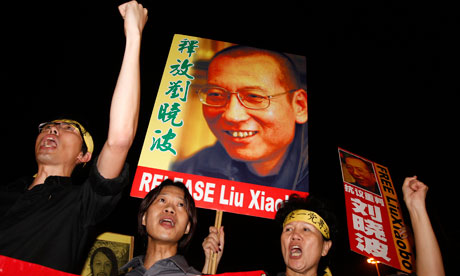
The Nobel Peace Prize recipient:
The award of the 2010 Nobel Peace Prize to Chinese dissident Liu Xiaobo follows an occasional precedent of recognizing human rights campaigners who are either imprisoned or subjected to state restrictions or harassment.
In announcing the prestigious award, Norwegian Nobel Committee President Thorbjoern Jagland cited Liu for his "his long and non-violent struggle for fundamental human rights in China." Liu is currently serving an 11-year jail sentence in China for inciting subversion of state power.
China is pissed :
The Beijing government summoned the Norwegian ambassador in protest. It called Mr Liu a "criminal", said the award violated Nobel principles and could damage relations with Norway. ...
Foreign ministry spokesman Ma Zhaoxu said: "Liu Xiaobo is a criminal who violated Chinese law. It's a complete violation of the principles of the prize and an insult to the peace prize itself for the Nobel committee to award the prize to such a person."
Here is an excerpt from Liu's statement from December 2009: (ht)
Ask me what has been my most fortunate experience of the past two decades, and I’d say it was gaining the selfless love of my wife, Liu Xia. She cannot be present in the courtroom today, but I still want to tell you, my sweetheart, that I'm confident that your love for me will be as always. Over the years, in my non-free life, our love has contained bitterness imposed by the external environment, but is boundless in afterthought. I am sentenced to a visible prison while you are waiting in an invisible one. Your love is sunlight that transcends prison walls and bars, stroking every inch of my skin, warming my every cell, letting me maintain my inner calm, magnanimous and bright, so that every minute in prison is full of meaning. But my love for you is full of guilt and regret, sometimes heavy enough hobble my steps. I am a hard stone in the wilderness, putting up with the pummeling of raging storms, and too cold for anyone to dare touch. But my love is hard, sharp, and can penetrate any obstacles. Even if I am crushed into powder, I will embrace you with the ashes.
Given your love, my sweetheart, I would face my forthcoming trial calmly, with no regrets about my choice and looking forward to tomorrow optimistically. I look forward to my country being a land of free expression, where all citizens’ speeches are treated the same; where, different values, ideas, beliefs, political views... both compete with each other and coexist peacefully; where, majority and minority opinions will be given equal guarantees, in particular, political views different from those in power will be fully respected and protected; where, all political views will be spread in the sunlight for the people to choose; all citizens will be able to express their political views without fear, and will never be politically persecuted for voicing dissent; I hope to be the last victim of China’s endless literary inquisition, and that after this no one else will ever be jailed for their speech.
Freedom of expression is the basis of human rights, the source of humanity and the mother of truth. To block freedom of speech is to trample on human rights, to strangle humanity and to suppress the truth.
I do not feel guilty for following my constitutional right to freedom of expression, for fulfilling my social responsibility as a Chinese citizen. Even if accused of it, I would have no complaints. Thank you!
Powerful statement.

Tuesday, July 06, 2010

Name this country

Guess in which country is the gathering in this photo? Click on the photo for the answer