Showing posts with label darwin. Show all posts

Monday, February 12, 2018

Moronic Monday!

Today is Charles Darwin's birthday.  Darwin Day!

It is time to showcase the anti-evolutionists. You know, those creationists.

But, it is no fun anymore to write about such ignoramuses in the GOP here in America.  It is so boring.

So, instead, on this Darwin Day, I turn to my old country.

A minister in modi's cabinet created quite some interesting moments a few days ago:
 Union minister Satyapal Singh has claimed that Charles Darwin’s theory of evolution of man was “scientifically wrong” and it needs to be changed in school and college curriculum.
Mr. Singh, the Minister of State for Human Resource Development, said our ancestors have nowhere mentioned that they saw an ape turning into a man.
Yep, the moron did not come across any reference in the literature of an ape turning into a man.  Ergo, Darwin is wrong.
“Nobody, including our ancestors, in written or oral, have said they saw an ape turning into a man,” he said, adding “No books we have read or the tales told to us by our grandparents had such a mention.”
The moron stood by his profound words of wisdom:
Satyapal Singh stood by his comments on Monday, saying his ministry was ready to host an international conference at which “scientists can come out and say where they stand on the issue”.
“I have a list of around 10 to 15 great scientists of the world who have said there is no evidence to prove that the theory of evolution is correct,” Singh told a crowd at a university in Assam state, adding that Albert Einstein had agreed the theory was “unscientific”.
I know what you are thinking.  This is a moment when we witnessed an Indian politician man turning into a monkey! ;)

What is even more shocking is that this monkey is credentialed:
The Minister is a retired IPS officer, a student of science who has M.Sc and M.Phil degrees in chemistry, and has obtained a Ph.D He is the author of several books and papers and, according to the Lok Sabha website, is working on four more books.
I suppose it is true--at some point, the randomness of this cosmos means that a monkey could end up writing the Hamlet or earning a doctorate in chemistry! ;)

Chances are that the monkey minister has no idea that even the Rig Veda is a lot humbler about Creation:
There was neither non-existence nor existence then.
There was neither the realm of space nor the sky which is beyond.
What stirred?
Where?
In whose protection?
Was there water, bottlemlessly deep?

There was neither death nor immortality then.
There was no distinguishing sign of night nor of day.
That One breathed, windless, by its own impulse.
Other than that there was nothing beyond.

Darkness was hidden by darkness in the beginning,
with no distinguishing sign, all this was water.
The life force that was covered with emptiness,
that One arose through the power of heat.

Desire came upon that One in the beginning,
that was the first seed of mind.
Poets seeking in their heart with wisdom
found the bond of existence and non-existence.

Their cord was extended across.
Was there below?
Was there above?
There were seed-placers, there were powers.
There was impulse beneath, there was giving forth above.

Who really knows?
Who will here proclaim it?
Whence was it produced?
Whence is this creation?
The gods came afterwards, with the creation of this universe.
Who then knows whence it has arisen?

Whence this creation has arisen
- perhaps it formed itself, or perhaps it did not -
the One who looks down on it,
in the highest heaven, only He knows
or perhaps even He does not know.
I will now step outside to see if any die-hard-creationist is evolving from an ape ;)

Sunday, February 12, 2017

"Light will be thrown on the origin of man and his history"

Alright. Quick reflex answer needed. No deep thinking before responding. Ok?

Answer with a yes or a no.

Do you think that people who are convinced that humans descended/evolved from apes will, by and large, subscribe to ideas that any one human "race" is superior to another?

Or, to put it differently, do you think that people who deny that we descended/evolved from apes might possibly belong to supremacist groups, or might operate with a sense of one human "race" being superior to another?

As I look at the American socio-political landscape, I see among the Republican Party a great overlap between those who deny evolution and those who are also convinced about their white supremacy.

Apparently there is a reason for me to think along those lines.  Darwin’s theory of evolution might have encouraged the abolition of slavery.  How?  First, what did Darwin himself say about where humans came from?
Darwin was so concerned about the heretical nature of his message that he decided to avoid mentioning the most incendiary of all his conclusions: that humans, supposedly created in the image of God, were in fact nothing more than modified great apes. He therefore devoted just 12 timid words to human evolution in the entire 500-page work: “Light will be thrown on the origin of man and his history.”
The man buried the lede, eh!

What's the connection to abolishing slavery?

Darwin, whose birthday is today--and, hence, this second post of the day--published his opus in 1859.  In that era, prior to his publication:
At the time, it was debated whether humans had a single origin or several, with each race being separately created. The multiple-creation school, polygenism, was popular with apologists for slavery. If, as they supposed, the Adam-and-Eve creation produced whites, but other races derived from earlier and inferior acts of creation, then whites were justified in applying a different moral standard to people of nonwhite race, who were not created in God’s image. Polygenists sometimes saw blacks as subhuman intermediates or even as members of a different species, justifying their subjugation and enslavement.     
You can see where this is going.  And you can, therefore, see why those who championed white supremacy in the American South even made a lawsuit out of the teaching of evolution.  (Click here for an older post on this topic.)

So, back to 1859.  Darwin's ideas are heretic.
But if humans had a single origin (monogenism), as Darwin proposed for other species, then all human races were genealogically connected: Blacks were every bit as human as whites — equivalent to distant cousins — and slavery became morally untenable.
Aha, you say!

Of course, even by 1859, there were enough abolitionists, and enough of a momentum to abolish slavery.  Darwin's book might have added that much more to the abolitionists' arguments.
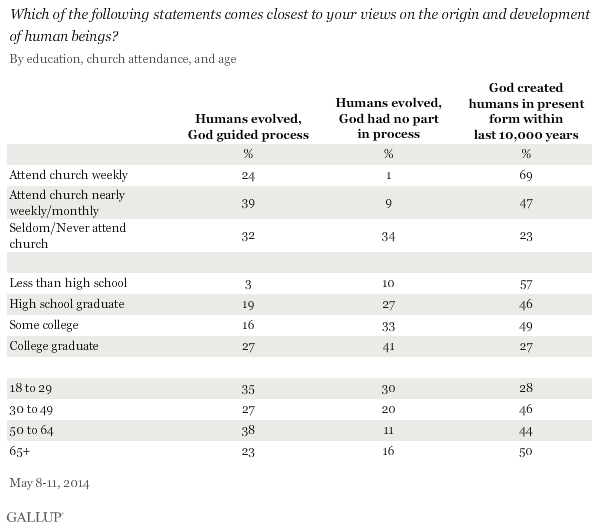
Things haven’t changed much since 1860. A 2014 Gallup poll showed that 42 percent of Americans are young-Earth creationists, while another 31 percent are theistic evolutionists like Gray, accepting some form of human evolution but insisting it was directed by God. And only 19 percent of us — 1 in 5 — adhere to Darwin’s view that humans evolved in a purely naturalistic way with no supernatural help. Slavery, thankfully, is no longer with us
Only 1 in 5 view that humans evolved without a divine intervention.  Only one in five!  Oh My Darwin! ;)


Wednesday, December 16, 2015

Face it, this post is hairy!

“You cannot grow a beard in a moment of passion” wrote G.K. Chesterton.   Of course.

Or, as a late great-uncle--a bearded man himself--put it, "I don't grow a beard.  I simply stopped shaving."

As a bearded male, I have more than a passing intellectual interest in beards.  If only I could recall that exact moment in graduate school when I decided that I would grow one--a beard, that is.  But, those are the moments that I seem to have forgotten.  Just like I don't really remember when it was that the first hair on my chest showed up.  Or on the legs?   For that matter, when did the first pubic hair appear?  I wish somebody had told me to remember those historic events in my own life; instead, I remember trivial events of world history!

Intellectually, scientists have long been puzzled by the facial hair--on men, to be clear.  As I noted earlier in the context of many young men sporting beards these days,
The answer, according to The University of Western Australia researchers, is because men are feeling under pressure from other men and are attempting to look aggressive by being more flamboyant with their whiskers.
Published in the journal Evolution and Human Behaviour, Dr Cyril Grueter and colleagues were investigating the idea that in big societies, male primates have developed increasingly ostentatious "badges" which may enhance male sexual attractiveness to females and give them the edge over other males.   
But, there is more to the scientific curiosity about male facial hair.  A lot more.  Especially because it is so unique:
It is tempting to think that beards are a holdover from our much hairier progenitors, that for whatever reason, this trait survived as we developed into the naked ape. Yet bonobos, our closest relative in the animal kingdom, lack hair around their mouths—precisely where the human beard grows. It would seem that, if anything, human beings have added hair to their faces, even as they lost it most other places. Even if our ape ancestors had had hairy faces, a question would remain: Why did women lose this hair while men retained it? As it is, a hairy chin and upper lip are virtually unique to the human male.
No, do not slip into thinking that we were made in god's image; most Indian male gods are clean-shaven, which would make me a satan then!

What if the beard is nothing but an evolutionary accident?  You know, that old theory--shit happens!
But most scientists have been reluctant to let it rest there. For one thing, insignificance is an unprovable supposition. It is impossible to say for certain that beards are simply along for the ride, at least not until all the functions of all the human genome are discovered. Scientists seek reasons for things, after all, and it is far more interesting to suppose that beards serve a purpose, obscure though it may be.
In other words, scientists always want to know why that shit happens.  Or, here, why the male facial hair?
A second possible solution builds on Darwin’s idea that beards are ornaments that charmed prehistoric women and can presumably still charm women today. Adherents of this line of thought have worked to replace Darwin’s reliance on vague notions of taste with more concrete psychological and biological explanations for women’s preferences. A third theory takes the opposite approach, arguing that hair is a threat device useful in intimidating rival males and establishing dominance. Women, then, have been attracted, not to the beard as such, but rather to the social dominance that impressively bearded men achieve over other men.
My beard serves a practical purpose too--stroking the beard makes it seem like I am a thoughtful and thinking professor in the classroom.  It works, as long as students do not find out that the beard is a mere prop in the awesome stage that the world is, especially in the fifth part (age):
And then the justice,
In fair round belly with good capon lined,
With eyes severe and beard of formal cut,
Full of wise saws and modern instances;
And so he plays his part.

Saturday, June 07, 2014

He that troubleth his own house shall inherit the wind

One phenomenally good news about my fellow Americans is this: 19 percent do not think that god was involved in how we came about.

Yes, 19 percent and that is good news.
Because it is an all-time high, and has doubled in thirty years.
Yes, doubled.
And, yes, in thirty years.

Now for the bad news: 73 percent think that either god created humans or guided the process of evolution from other life forms.
73 percent!


Why is this issue so difficult for my fellow Americans?

In order to think through that, well, this is where the subject of this post comes in.  "He that troubleth his own house shall inherit the wind: and the fool shall be servant to the wise of heart" is a proverb from the Bible.  "Inherit the wind," which is a part of that, was a play that I watched with two friends last night at one of the oldest community theatres in the country.

The play
is a fictionalized account of the 1925 Scopes “Monkey” Trial, which resulted in John T. Scopes’s conviction for teaching Charles Darwin’s theory of evolution to a high school science class, contrary to a Tennessee state law. Although the play is not meant to be a historical account, the characters of Matthew Harrison Brady, Henry Drummond, Bertram Cates and E. K. Hornbeck correspond to the historical figures of William Jennings Bryan, Clarence Darrow, John Scopes, and H. L. Mencken, respectively. The trial makes for one of the outstanding dramas of our time—and a subject that still resonates today!
A 1955 play based on the real life events of 1925, and which was made into a movie in 1960.  Despite all the Hollywood gizmos since then, it has been difficult to shake loose this bible-thumping creationist belief, apparently.

Why do I relate the 73 percenters to Bible-thumping?  Because, that too was addressed in the survey:


As the Gallup poll notes:
These Americans tend to be highly religious, underscoring the degree to which many Americans view the world around them through the lens of their religious beliefs. Those who adopt the creationist view also tend to have lower education levels, but given the strong influence of religious beliefs, it is not clear to what degree having more education or different types of education might affect their views.
Oh well!


With our continued anti-science, anti-evolution, outlook, we certainly are destined to inherit nothing but the wind!

Sunday, April 08, 2012

Competition, altruism, and social darwinism, in biology and US politics

Slowly catching up with issues of the New Yorker that I had missed reading, thanks to the sabbatical--I had to wait until now to read the articles that are paywalled at the magazine's site. 

Jonah Lehrer's essay on the genetics of altruism is one of those inaccessible behind the paywall.  The essay is very much a story of the scientific method, as much as it is about altruism and selfishness.  From Charles Darwin, who regarded altruism "as a potentially fatal challenge to his theory of natural selection" to William Hamilton, in 1964, explaining that as a cost/benefit equation, rB > C, where "genes for altruism could evolve if the benefit (B) of an action exceeded the cost (C) to the individual once relatedness (r) was taken into account."  This was born the "inclusive fitness theory."

Lehrer writes that E.O. Wilson was the biggest champion of this neat little equation, though it was not an idea that was easy to sell.  But then, Wilson himself begins to question the validity of this equation--a classic example of the scientific method to forever question any explanatory framework, even if it is your own favorite one.  Wilson came up with a dramatically different framework about relatedness that it is "a consequence of eusociality, not the cause."

But, what about the evidence for this? In 2010, Wilson co-authors a paper in Nature that presents a lot more complicated mathematical model on the evolution of eusociality, which apparently has ignited one hell of a firestorm amongst biologists.  "Wilson is the only one who seems to be enjoying the controversy.  His appetite for scientific brawls seems, if anything, to be increasing with age." 

Wilson continues with an essay in The Daily Beast, on what drives humans to form tribes and then make wars of many types with other tribes. 
The drive to join is deeply ingrained, a result of a complicated evolution that has led our species to a condition that biologists call eusociality. “Eu-,” of course, is a prefix meaning pleasant or good: euphony is something that sounds wonderful; eugenics is the attempt to improve the gene pool. And the eusocial group contains multiple generations whose members perform altruistic acts, sometimes against their own personal interests, to benefit their group. Eusociality is an outgrowth of a new way of understanding evolution, which blends traditionally popular individual selection (based on individuals competing against each other) with group selection (based on competition among groups). Individual selection tends to favor selfish behavior. Group selection favors altruistic behavior and is responsible for the origin of the most advanced level of social behavior, that attained by ants, bees, termites—and humans.
He concludes with this:
Civilization appears to be the ultimate redeeming product of competition between groups. Because of it, we struggle on behalf of good and against evil, and reward generosity, compassion, and altruism while punishing or downplaying selfishness. But if group conflict created the best in us, it also created the deadliest. As humans, this is our greatest, and worst, genetic inheritance.
Now, compare such complex analyses of how humans behave, and how we might have evolved, with the President casually tossing out highly flammable rhetoric when criticizing the GOP budget plan:
 Reigniting his clash with Republicans over how to tame the debt and deficits, President Obama delivered a blistering attack on the House Republican budget Tuesday, calling it “thinly veiled social Darwinism” and a “prescription for decline.”
To some extent, this is a kind of war between two tribes, right?  And such a war is also an example of how our greatest genetic inheritance is also our worst inheritance :(

Robert Reich runs fast with the President's comments:
We are likely to hear a lot more about social Darwinism in the months ahead. It was the conservative creed during the late 19th century – legitimizing a politics in which the lackeys of robber barons deposited sacks of money on legislators’ desks, and justifying an economy in which sweat shops were common, urban slums festered, and a significant portion of America was impoverished.
Seriously?  Come on; Social Darwinism?  Even if the President uses it as battle rhetoric, for Reich the academic to re-use that?

Professor Linda Hirshman's column is a lot more substantive than is Reich's.  I agree with her bottom line about the election: "Let the wild rumpus begin."

Monday, April 18, 2011

We are one of the great apes. Bananas please!

When I was driving back from Seattle, for a while I listened to the conversation with Richard Leakey in Ira Flatow's program

It was such a delight to be able to listen to a casual, and yet informative and educational, conversation.  I tracked down from the transcript the following exchange:
FLATOW: You know, a lot of people who are creationists and do not believe in human evolution, they like to say that no human has descended from a monkey or an ape or a chimpanzee. And that's exactly correct, isn't it? It's not that we were descendants from them, but there's a common ancestry somewhere.
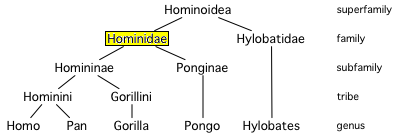
Dr. LEAKEY: Well, indeed. And I think if we were very fair, which humans aren't, and one did - had the classification of primates done by a non-primate, there would be six great apes, not five, because we are just an ape. We just happened to have been a more intelligent one who did the classification ourselves.
I am not sure which one will be a tougher sell with the anti-evolution crowd: that we descended from an ape, or that we are also apes!
 I'm quite sure had Charles Darwin not suggested that we, too, had evolved, evolution would have been perfectly acceptable to everybody. But it wasn't thus and all the evidence today, and there's abundant evidence and very clear evidence, is that we have evolved. And if you go back far enough, our ancestors don't look anything like we do today.
I wasn't sure if Leakey meant it in all seriousness, or was making a political point of sorts that we--the surviving homo sapiens--ought to be recognized as a separate ape.  I am ok with knowing that I am on the planet of the apes :)

Leakey then went on to add this:
people didn't like the idea that the world wasn't the center of the universe. People didn't like the idea that the world wasn't flat. Given time and evidence, people learn to accept these things if they're true. And I think there's no question of the truth of human evolution. None at all.
But, it is quite a challenge:
Dr. LEAKEY: I personally believe that if we could accept human evolution and evolution, science would be much more acceptable. And I think the only way out of the mess this species that's in today is for science to get greater currency value in the world. And I think a lot of biological natural science has been discounted because of the fear of evolution.
Evolution is nothing to be afraid of. And if we could get a lot of money and a lot of attention and look at the last 100,000 years - which I think we can do now - I think we can clear this up once and for all. And it's late, but there is still time.
FLATOW: Are you saying it's a worldwide fear of evolution, or is it mostly in the United States?
Dr. LEAKEY: I think it's growing. I think it's - it is worldwide. I think it's much more of a case in areas where Christianity is - and Islam have a lot of influence. And I think the fundamentalist approach to religion that you're seeing both in those two great religions is making this worse. But you find it in Europe. You find it in England. You find it in Africa. In fact, there are very few African leaders who believe in human evolution and science.
FLATOW: Is that right?
Dr. LEAKEY: And it's very, very worrying, because Africa's problems will only be resolved by African scientists working on those problems. And if we don't teach science from early on, we're not going to get out of this hole, because nobody is going to pull us out of the hole, because they're in one themselves.
FLATOW: Does it make it hard to excavate in these African countries if they don't believe?
Dr. LEAKEY: Funny enough, it doesn't. Because if they don't believe we're looking for human ancestors, they don't care what you're doing.

Monday, June 14, 2010

Kafka and the Gulf of Mexico Oozathon

I have always been drawn to Kafka, and now I can't stop myself from following the BP catastrophe ... It is neat that thanks to one of my favorite websites I came across this fantastic piece that combines Kafka and the great ooze from the bottom of the sea:
Is there any hope in the situation? This is where on our darker days, Kafka is a bleak New Orleans prophet. He was often dark, though never a nihilist. He lived, always, at the edge of faith. Once, his friend Max Brod asked him if there was any such thing as hope in the universe. “Yes,” Kafka replied, “of course there’s hope, plenty of hope—for God. Just none for us.”
I know that punch line sounds grim, but right now it hurts so much it’s funny. In the land of disaster, even a bitter laugh is a start.

Kafka offers wonderful insights through his works.  It is too bad that many universities provide enough and more pathways for students to completely bypass Kafka--they can graduate and earn diplomas without ever even having heard about Kafka.  Unfortunate.  There is one college that has apparently been requiring incoming freshmen to read Kafka and Charles Darwin's works in the summer before they start college, and then the first few weeks of college is nothing but Kafka and Darwin all the time
[We] have asked incoming first-year students to read two texts in the summer before they arrive at Bard---Kafka's The Metamorphosis and the fourth chapter of Darwin's The Origin of Species, "Natural Selection." On some level, students will find something familiar about these summer readings as well as something counterintuitive and obscure. A simplified version of what takes place in Kafka's short story has some presence in popular culture, and at a minimum most students will have heard someone use the word "Kafkaesque." A direct encounter with the writing of this remarkable German-speaking Jew from Prague who was reluctant to have his writings published can be inspiring precisely because of the tension between image, reception, and textual reality that characterizes both The Metamorphosis and Kafka's life.
090206-charles-darwin-02.jpgThe disjunction between image and reality could not be more pronounced than in the case of Charles Darwin. The claims of no other thinker or scientist, with the possible exception of Einstein, have been so mangled and distorted in the popular imagination. Somehow every citizen thinks he or she knows what Darwin thought without actually having read his writings. Direct engagement with Darwin's work not only makes the character and significance of modern biology more apparent, exciting, and vital, but the brilliance and subtlety of Darwin's thought quickly dispel the distortions that dominate scientific journalism in the popular media.
Colleges must counter the experience of conventional high school education in the United States, where learning is little more than a standardized test-driven chore with utilitarian benefits. In college, students should discover that most of the important writings and discoveries they will study were not generated for their benefit, but rather came into being in order to illuminate and improve life. It is precisely the connection between learning and living that justifies the life of the mind and makes study and inquiry a treasured form of human activity and among the most rewarding.
This belief cannot be preached; it can only be experienced. What better mechanism to set this experience in motion than assigning common readings in the summer?

Saturday, May 15, 2010

"The hurling habit dies hard" :)

Or, as one commenter has described it,
Wham, Bam, thank you Ma'am! 


BBC has blocked access to that clip, which includes footage after the victorious male meets the female.  The following clip stops with the male and female shaking hands, er, legs :)

Wednesday, October 07, 2009

A miraculous Darwin-Shaped Wall Stain in Tennessee


DAYTON, TN—A steady stream of devoted evolutionists continued to gather in this small Tennessee town today to witness what many believe is an image of Charles Darwin—author of The Origin Of Species and founder of the modern evolutionary movement—made manifest on a concrete wall in downtown Dayton.
...
Added Freiberg, "Behold the power and glory of the scientific method!"
More here

Monday, March 30, 2009

This is a carbon-starved planet!

A colleague recently returned from a trip to the UK--he was there for the Darwin experience, given that this is the 200th anniversary of his birth, and 150th anniversary of his famous treatise. This colleague was thrilled that it was Darwin's poster everywhere he turned. Which is exactly the way it ought to be. More so in this century, which I am convinced is the century of biology, as much as the 20th century was of physics.

Meanwhile, here in the US? Well, watch this Congressional hearing--yes, at the US Congress--and see for yourself where Darwin might fit :-(

How do you like this nutcase's argument that we are right now carbon-starved!!!
Thanks to the DailyDish for the Youtube link.