Showing posts with label sleep. Show all posts

Wednesday, April 08, 2020

Sleep tight ... especially in the time of the coronavirus

"I hope you are resting enough and sleeping well," I recently wrote to a friend in the old country.

Sleep has always been an integral part of good health, and being healthy is even more important during these COVID-19 times than ever before.

Even when life was calmer, I have blogged in plenty about sleep.  Like:
Back in 2015, I remarked about the income inequality aspect in sleep too--"The less you make, the likelier you are to sleep less than six hours a night"!
In 2016, I was concerned that our eyes being focused on electronic gadgets for hours on, especially before bed time, is seriously screwing up our sleep patterns.
A year later, I happily noted that my boring life includes good sleep: "The more all our daily practices are aligned, the better off we will be.  Of course, the downside is that others then refer to us as being regimented and boring.  I will gladly take "boring" because I don't ever want to have sleep issues."
Now, the coronavirus makes me sleep even more, because there is very little to do.

It is not only the hours of sleep, but it is also about the regular schedule, which is what I wrote about in 2016: "All I know about sleep is very simple: go to bed about the same time, and wake up about the same time,  Weekday or weekend. America or India."

It is all about a rhythm to life.  The rhythm that makes me boring to many ;)  It is a rhythm that is also largely in sync with sunrise and sundown.  The kind of rhythm that our ancestors in east Africa experienced.  This circadian rhythm is a prescription for good health over the next two years of COVID-19:
Social distancing and washing hands have become the frontline in the fight against COVID-19, but there is another powerfully protective resource immediately available to all: your circadian rhythm.
A powerful booster shot.  How can we maintain a robust circadian rhythm? "Sleep is the most profound predictor of a healthy circadian rhythm."

So, yes, washing your hands. Stay apart for now so that we can come together later.  And, sleep well.  And, oh, pay no attention to that orange man behind the curtain!

Monday, October 23, 2017

Dream on!

With regularity, I seem to blog about sleep.  Yes, sleep! (Try this, or this, or this)

I find the topic of sleep to be fascinating for two important reasons: First, many--the young and the old alike--seem to have sleep issues these days.

I am interested in this topic for another reason too-- it is impressive that scientists have figured so many things out, but don't know squat about sleep, which babies do really well.  In fact, we are often envious, it seems, so much so that if we had an awesome sleep, we even say, "I slept like a baby."

I clearly remember one incident from years ago, well, decades ago, during the wedding of a cousin (who tragically died young.)  There was the usual loud thavil and naadhasvaram in the crowded setting. A much younger cousin, who was perhaps five or six years old, fell asleep while seated right next to the thundering thavil. An older uncle of mine commented jealously about the kid sleeping in that noisy setting. Slept like a baby, indeed!

I have a solution for all those who have trouble falling asleep: Listen to the recordings of my lectures in the classes.  In no time at all, you too--like many students--will promptly and easily settle into a deep sleep! ;)

Every time I read yet another essay on sleep, I am impressed with the trivial and the profound alike.  Like this one:
All humans dream, usually three to five times a night. And every time a man dreams he has an erection; every time a woman dreams, the blood vessels of her vagina become engorged. These changes in our genitalia are apparently unrelated to sexual thoughts before sleep or to sexual content in the dreams themselves. Rather, erections and vaginal engorgement seem to be the result of the state of dreaming itself.
That is the trivial one, of course! ;)

But, seriously, what the heck, right?

Over the years, I have also become convinced that no amount of comfy mattresses and gadgets can really deliver that awesome sleep.  Wasn't there an old Tamil movie song where that emperor of poetry, Kannadasan, wrote about this?

So, if science does not know any damn thing about sleep, and it is not all the fault of technology, then is there anything else we can think about as a way to good sleep?
A recent study now raises the possibility that sleep could be affected by the degree to which someone feels like their life is purposeful or meaningful.
A meaningful life.
Perhaps developing a sense of purpose in life could be as effective at improving sleep as following healthy habits, such as limiting coffee. In addition to promoting good sleep hygiene, doctors may end up recommending mindfulness practices or exploring one’s values as ways of helping older adults sleep better.
All I can say is that I am not surprised at such possible relationships in our behaviors.  It is the total package.  The more all our daily practices are aligned, the better off we will be.  Of course, the downside is that others then refer to us as being regimented and boring.  I will gladly take "boring" because I don't ever want to have sleep issues, as I prepare myself for that final sleep ;)


Wednesday, July 13, 2016

The advantage of being boring? No hyperarousal ever!

I love sleeping.

Even during those long flights to India, and even if I don't get a free upgrade to business class!  I typically start a movie, wear the awful headset that the airlines distributes, and then a few minutes into the movie I am fast asleep.  Once, I slept through the meal they served and was ticked off.  Having learnt that lesson, these days I either place the sticker to remind them to wake me for food--if they have such a sticker--or I even tell the attendant that I wish to be woken up for food.  I don't care if the food is not that tasty--but, dammit, as long as I live, I shall not go hungry ;)

Here on terra firma, I love the deep sleep from which when I get up I can't really place where I am or what day of the week it is.  It takes a few seconds for me to reconstruct my life before I can even sit up on the bed.  The older I get, the rarer such deep sleep.  My daughter has quite a few stories of how she had to struggle to wake me up.  One of these days, it will be a deep sleep from which I will never, ever wake up ;)

Science has nothing definitive about sleep.  All we know is that we need sleep.  We need to spend about a quarter to a third of our lives sleeping.  Beyond that, scientists have no clue as to why we need it, how much of sleep we need, when we need it ... The scientific community has nothing but a bunch of educated guesses.

All I know about sleep is very simple: go to bed about the same time, and wake up about the same time,  Weekday or weekend. America or India.  There is also one more important aspect of sleep that I have come to understand: I need to prepare my mind and body to invite the sleep.  As much as one needs to be in the mood for food, or movies, or sex, one needs to be in the mood for sleep too.  I enjoyed the fact that my intuitive understanding is no different from what "a psychologist specialising in sleep and dream medicine, and a clinical assistant professor of medicine at the University of Arizona's Center for Integrative Medicine" writes:
Invoking sleep helps us fall in love with the act.
It makes perfect sense to me.  There is preparatory work in everything that we do, right?  Why should it be any different for sleep?  To invite sleep requires physical and mental preparation, which is increasingly difficult for people in this age of hyperarousal:
It refers to a turbocharged pace of life that is not modulated by adequate rest.
Strongly endorsed by popular culture, hyperarousal is a socially contagious condition rooted in an arrogant disregard for natural rhythms. It’s a cheap high, a kind of synthetic passion that is not without serious side effects.Characterised by racing brainwaves and a rapid heartrate, hyperarousal is linked to an overheated body and mind. By tethering us to the heights of waking, hyperarousal not only interferes with our nightly descent into sleep, it also masks our daytime sleepiness.
I suppose hyperarousal is not something that boring people like me worry about!
Hyperarousal leaves us sick and ‘t’wired’: simultaneously tired and wired. Being t’wired is the psychological equivalent of being on the rack.
The problems we humans bring upon ourselves!  If only we would stare into nothing and get bored.  Instead, we constantly check our smartphones, while a movie or a game is on the flat screen.  The blue light engages our brains even as we continue to sip coffee or alcohol, and it is already eleven at night.  Then we wonder why we can't sleep at night!  Hyperarousal is an understatement, methinks.

Source

Tuesday, January 26, 2016

American solution to an American problem

A few weeks after I came to this country for graduate studies, it was nearing Thanksgiving and the television ad for Alka-Seltzer that I watched then is what I refer to as American solutions to American problems.

What was the ad about?

In this ad, the audio commentary and the pictures presented all the wonderful foods that the viewer ended up eating at Thanksgiving, which then resulted in stomach aches and heartburn. And, presto, Alka-Seltzer to the rescue!

While watching the commercial, my reflexive thought was simple: if the problems came from overeating, then why not simply advise the viewer to eat less?

Of course, as I have come to realize, to consume less is not American.  Instead, the American way is to consume more, and then when problems develop savvy entrepreneurs provide solutions to facilitate further consumption.

Today's exhibit along those lines?  Apparently more and more people have trouble falling asleep in this consumer capital of the world.  No, it is not from food, though certainly contributes its own problems.  This sleep hassle is thanks to the gazillion electronic gadgets that seemingly surround us every minute of the day and on which our eyes are fixated.  From television screens to smartphones, screens of all types.  What's the link?  It is from the blue part of the spectrum:
Blue wavelengths—which are beneficial during daylight hours because they boost attention, reaction times, and mood—seem to be the most disruptive at night. And the proliferation of electronics with screens, as well as energy-efficient lighting, is increasing our exposure to blue wavelengths, especially after sundown.
You want more detail?
Recent studies have shown that short-wavelength [blue] light has a greater effect on phase shifting the circadian clock and on melatonin suppression. In 2014 my colleagues and I examined the effects of reading on a light-emitting device compared with reading a printed book. Participants who read on light-emitting devices took longer to fall asleep, had less REM sleep [the phase when we dream] and had higher alertness before bedtime [than those people who read printed books]. We also found that after an eight-hour sleep episode, those who read on the light-emitting device were sleepier and took longer to wake up. In the study all participants had to stop reading and turn off the lights at exactly 10 P.M., even if they did not feel sleepy. At home, I would expect people do not have the motivation to turn off their devices and go to bed, so they would stay up longer and experience even more circadian delay and shorter sleep times. The effects in the real world could actually be even greater.
Got it?  Let's recap.  Light influences our sleep pattern.  Especially the blue light.  As animals, normally we would begin to prepare for sleep after sundown.  But, on top of the lights all around, there is the blue wavelength from the gadgets that end up screwing up our sleep (and the internal clock that influences the working of organs in our bodies.)

The solution would be simple, right?  No gadgets into the night hours.  Especially when there is no ambient lighting, as in looking at the glowing screen in a dark room.  But, nope, it is un-American to propose such solutions and, worse, to implement it.

Hence, an American solution to an American problem:
Along with various other health-focused apps, the new version of Apple's mobile operating system, iOS 9.3, will include the Night Shift feature. This app will use the device's clock and geolocation to determine what time the sun sets and will automatically shift the phone's display color to the warmer, or redder, end of the light spectrum until the following morning.
This is merely.the latest in the consumption culture.  Do not even dare to suggest that we put those devices down; to borrow from Charlton "NRA" Heston, people'll give their screens when you pry them from their cold, dead hands ;)


Saturday, May 09, 2015

Sleep tight ... if you can afford it!

It all began a few days ago when the neighbor's dog started barking and howling just as I was falling off asleep.  I suppose I am truly old--unlike my younger self who slept through earthquakes, street noises, and loud television sets, I was wide awake with the dog barking.

Source

I walked up to the front door.  No wonder it was loud--the beagle was right outside my steps as if his intention was to wake me up.

It was a drama that lasted more than an hour, when finally the dog was reunited with his people.

It was one awful lesson on how the days get ruined when sleep is all messed up.  The old age meant that it took me a couple more days to finally get back to my sleep routine.

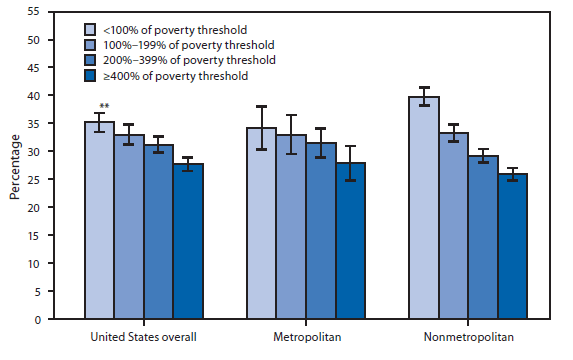
I am one of the fortunate few, it seems.  And I can afford to sleep as well; "The less you make, the likelier you are to sleep less than six hours a night"
"Percentage of Adults Who Average ≤6 Hours of Sleep"
Source

Scientists don't have a convincing theory, yet, on how exactly sleep plays a role in life, and what might be the average hours of sleep one might need.  What I didn't know was this about "segmented sleep":
Perhaps the most surprising feature of early modern sleep, however, is that it was seldom taken in one long stretch. The forgotten practice of ‘segmented sleep’, memorably described by the historian A. Roger Ekirch in At Day’s Close: A History of Night-time (2005), meant that people generally slept at night in two equal intervals, spending up to two hours awake between their first and second slumber. In the long, dark winter months, when the labouring classes may have spent as many as 14 hours in bed, broken sleep was regarded as routine and natural and only disappeared in Europe with the advent of artificial lighting.
As you can imagine, this was a practice far away from the equator.  In the European realm, winter nights were long and artificial light was expensive.
The first sleep, regarded as the most indispensable and restorative, was followed by a period of ‘watching’, a state of quiet, dark and often prayerful meditation, before the second sleep led towards dawn.
So, what did people do after that first sleep?
In the middle of the night people made love, stoked the fire or even caught up on household chores.
Sounds like a practical idea to work during the short day, have a good sleep, and then wake up to make passionate love.
Couples who copulated "after the first sleep", wrote a 16th-century French doctor, "have more enjoyment, and do it better".
Then, after the animal fire within was extinguished, tend to the fire, snack a tad, do some chores, and settle down for some serious nap before getting up with the rising sun.
Venner’s advice still rings true today: ‘If therefore ye desire peaceable and comfortable rest, live soberly, eschew crudity, and embrace tranquillity of minde.’
Sounds good to me.  But, wait, does this formula include all those activities in the middle of the night, after that first sleep? ;)

Source

Friday, July 19, 2013

"My dream last night was sponsored by Facebook"

I bet there are plenty of people in this world who love sleeping long hours. They talk about how they didn't get out of bed until well into the day.

I am not one of them.

I might waste time, and I do plenty of that, yes.  In fact, I would even make a case that we don't do enough of wasting time. Just idling. Doodling around. Instead, we commit ourselves to way too many activities. Worse, we even bring up kids that way anymore--we wake them up early in the morning, shove down breakfast into their sleepy bodies, pack them off to school, schedule after-school activities, and leave no time at all for simply doodling around.  For kids to then say "I'm bored!"

I get bored a lot. Am so happy that I have enough waking hours and non-working hours to get bored. As a kid, too, I was bored a lot.  My grandmother has commented quite a few times in her life, in response to our whining about being bored, in a highly annoyed tone, "என்ன இது எப்ப பாத்தாலுà®®்?" (what is this all the time?)

Now, boredom has never meant that I should sleep more.  I wake up just to get bored, it seems like.  Boredom and ennui are highly under-appreciated and under-rated, more so in this 24x7 culture that we have created for ourselves.  As Joseph Brodsky noted a few years ago:
When hit by boredom , let yourself be crushed by it; submerge, hit bottom. In general, with things unpleasant, the rule is: The sooner you hit bottom, the faster you surface. The idea here is to exact a full look at the worst. The reason boredom deserves such scrutiny is that it represents pure, undiluted time in all its repetitive, redundant, monotonous splendor.
Boredom is your window on the properties of time that one tends to ignore to the likely peril of one’s mental equilibrium. It is your window on time’s infinity. Once this window opens, don’t try to shut it; on the contrary, throw it wide open.
The mirror image of this--to be constantly doing something--whether it is work or (at the risk of annoying Ramesh, again!) entertainment, is what capitalism seems to prefer.  So much so that the system tries hard to interrupt even that pleasure of sleeping that people might otherwise enjoy:
Sleep, indeed, is a standing affront to capitalism. That is the argument of Jonathan Crary’s provocative and fascinating essay, which takes “24/7” as a spectral umbrella term for round-the-clock consumption and production in today’s world. The human power nap is a macho response to what Crary notes is the alarming shrinkage of sleep in modernity. “The average North American adult now sleeps approximately six and a half hours a night,” he observes, which is “an erosion from eight hours a generation ago” and “ten hours in the early 20th century”.
I sleep for about six hours a night--way less than the average, yes.  But, that is not because I am working hard to make more money, and nor am I being entertained by the money-making entertainers.  I could easily spend time being bored, and I do!
You can’t get more “eyeballs” if the people to whose brains the eyeballs are physically connected are asleep. Hence the interest – currently military; before long surely commercial, too – in removing our need for sleep with drugs or other modifications. Then we would be more like efficient machines, able to “interact” with (or labour among) electronic media all day and all night. (It is strange, once you think about it, that the phrase “He’s a machine” is now supposed to be a compliment in the sporting arena and the workplace.)
If only people would spend time thinking about their lives and what they want to make of it.  How would they want to be remembered after their death?  That they had machine-like work abilities and that they watched a lot television?  Imagine reading that kind of an obituary!
After finishing this book, I had a dystopian nightmare. One day, through clever magnetic stimulation of the brain, it might be possible to insert adverts into our dreams. You could even volunteer to have them interpolated into your sleeping life in exchange for money. (“My dream last night was sponsored by Facebook and Walkers Crisps.”) If that day ever comes, we won’t be safe anywhere
I bet the book-reviewer has now provided the likes of Facebook with a research agenda to insert advertisements in our sleep.

I guess that will be ok as long as the ads in my dreams feature a whole lot of Liril girls ;)


Saturday, August 22, 2009

Now I know what my problem is :-)

A typical day that begins for me at 530 or so ends by 1130 or midnight. Which means I usually sleep for just under six hours. Given how much science has not fully understood sleep, and given that most people sleep for eight hours (or even more on weekends in particular) I have wondered if my sleep habit was ok. Hey, science rescues me with this report that early risers are mutants:
now they say they have found the first genetic mutation in humans that appears to affect sleep duration rather than sleep timing. The mutation lies in DEC2, a gene that codes for a protein that helps turn off expression of other genes, including some that control circadian rhythm, the internal clock that regulates a person's sleep-wake cycle. The mutation occurred in just two people, a mother and her daughter. The women sleep an average of only 6.25 hours, whereas the rest of the family members sleep a more typical 8 hours.

To confirm that this mutation shortens sleep, Fu and colleagues engineered mice to carry the mutant form of DEC2. The mutant mice slept about an hour less than normal mice, the team reports today in Science. The finding also held for fruit flies: Mutant flies slept about 2 hours less than normal flies.

DEC2 likely isn't the whole story when it comes to short sleep. "Genetic control of sleep is going to be complex and is going to include multiple types of genes," says Shaw, who was not affiliated with the study. But that doesn't diminish the importance of this paper, he notes. "It's really an amazing piece of work."

Am glad to join the X-Men :-) HT