Showing posts with label floods. Show all posts

Wednesday, August 30, 2017

Climate Change? Bullshit!

One of the many, many, many problems that trump has created for me is this: The fascist sucks up so much of my time and energy that I have very little left for the world outside.  I used to have plenty of time for the rest of the world; now, despite being on furlough, I barely have time to keep up with his shit!  And boy does he shit by the truckload every single day!!!

I don't even have the time anymore to talk about the old country.  Well, ok, that is also because I have given up on that old land.  But, it is not as if I don't keep up with the news about the Subcontinent.  For one, talking to my father every other day means that I have an idea of life there, however skewed that reporting might be.

As I have blogged before, one of the regular features of our conversations is about water.  Yep, water.  About the water shortage in Chennai.  About groundwater depletion in Sengottai.  And, of course, the monsoon.

We might be far removed from the village and farming life of our ancestors, but we father and son always worry about water, and the rains.

Therefore, the monsoon floods in different parts of India, too, have been regular topics.  "Remember the old news reels before the movies that you kids made fun of?  "பீகாரில் வெள்ளம்" (Floods in Bihar) in that grave newscaster voice?" he remarked.  Because, well, there have been floods in Bihar.  And in Assam. And ...

We humans are messed up; we do not understand how integral water is to our existence on this planet.  Despite scientists searching for water in the universe as signs of life, we fail to truly understand the preciousness of water.  We continue to abuse and mis-manage this life-giving resource.

But, hey, we humans are nothing but pesky irritants on this planet.  The more we try to mess with the planet, the more our own very lives will be threatened--either as water shortage, or as floods.

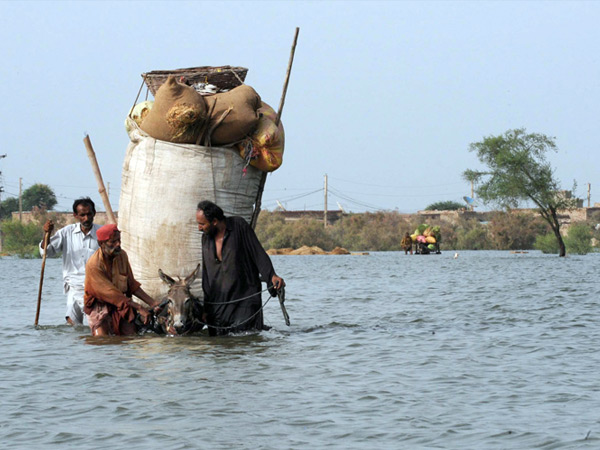
This summer, more than a thousand have died in the floods in South Asia; "while flooding in the Houston area has grabbed more attention, aid officials say a catastrophe is unfolding in South Asia"
“This is the severest flooding in a number of years,” Francis Markus, a spokesman for the International Federation of Red Cross and Red Crescent Societies, said by phone from Kathmandu, Nepal’s capital.
...
Asked how the situation in Nepal compared with that in Houston, Mr. Markus said, “We hope people won’t overlook the desperate needs of the people here because of the disasters closer home.”
India has also suffered immensely. Floods have swept across the states of Assam, Bihar, Odisha, West Bengal and other areas.
It is not over yet.
And the rain keeps coming.
On Tuesday, Mumbai, the sprawling financial capital, was soaked to the bone. Nearly all day, the rain drummed down. As people scurried up the sidewalks, the wind tore umbrellas out concof their hands.
The sky seemed to fall lower and lower, pressing down on the building tops, cutting visibility to a few blocks, then a few yards. By midafternoon, it was so dark it felt like nightfall.
And, yes, like with Hurricane Harvey, climate change likely played a role:
"This is not normal," Reaz Ahmed, the director-general of Bangladesh's Department of Disaster Management, told CNN. "Floods this year were bigger and more intense than the previous years."
Climate change appears to be intensifying the region's monsoon rains.
Climate change?  News to me!
 Unchecked urban development has also left many communities in the region without proper drainage systems, which only compounds the problem when a natural disaster strikes. "A lot of the urbanization ... has happened in a largely unplanned matter," Abhas Jha, the World Bank sector manager for Transport, Urban and Disaster Risk Management for East Asia and the Pacific, told CNN
It is one thing if my blog-posts and op-eds echoing such logic are ignored; after all, I am but a lowly academic at a podunk university.  But, it is a shame that real experts continue to be attacked by the fascist and his adopted party.  What a fuck up!

Caption at the source:
Flood-affected people sleeping by a highway toll plaza in the Indian state of Bihar last week.

Monday, December 02, 2013

When even the Wall Street Journal is against the 1% ...

In one of my many favorites of George Carlin's routines, he makes fun, in his trademark manner, the arrogance that we humans have when interacting with nature.  Carlin mocks how we build homes next to volcanoes and wonder why there is lava in the living room.

But, even George Carlin couldn't force people to think and act sensibly.  What chance do I have then, right?

Of course, my Quixotic pursuits mean that I have yelled and written about that kind of madness too.

Back on March 3, 1997--yes, almost 17 years ago--the Bakersfield Californian published my op-ed in which I questioned the sanity behind "locating a home or a business in a flood plain in the first place."  To me, this is simply asking for trouble.  And when homes get flooded, we immediately demand that government bail out the homeowners.
Instead of asking such "real" questions, we insist on playing Russian Roulette with the chaotic forces of nature.  The result is that it has become quite common for every natural happening to be labeled a disaster. 
If we were rational, then we would not build homes in flood plains and by the coastlines.  We would keep a safe distance between those natural boundaries and our built environment.  But, irrational we are.  And worse than being irrational, we are irrationally arrogant!

Here is the irony: in poor countries--think Bangladesh, for instance--it is the poor folk who live in those dangerous lowlands.  Because they cannot afford any better.  Here in a mighty rich society, it is the other way around--the richer one is, the closer they want to have their buildings near the pounding waves and the flowing waters.

So, ask yourself this: when we bail out these rich folks, does it not mean that poor in inner cities or rural hinterlands are being shortchanged?

But, who ever listens to me!

Which is why I nearly fell off the chair when I read a Wall Street Journal editorial that came out swinging with this opening sentence:
Federal flood insurance is a classic example of powerful government aiding the powerful, encouraging the affluent to build mansions near the shore
Say what?
Congress finally had the gumption to reform the program in 2012, but now the beachfront homeowner and housing lobbies are trying to reverse this progress.
Imagine that!  Thanks to a bipartisan reform signed into law by President Obama, "the federal insurer is slowly raising its rates to actuarially sound levels" and that is being opposed by lobbies, when the beneficiaries are the rich.  How insane is that?
When Republicans hear such good sense from the Obama Administration, they ought to embrace it. They should not endorse another taxpayer subsidy for those who want to live next to the ocean while sticking others with the costs of their lifestyle.
My failure to influence any action is easily understandable.  You, dear reader, are as powerless as I am.

You think the mighty Wall Street Journal and its allies will be able to fight those lobbies that are active on behalf of the one-percent?

I doubt it.  "We the people" will always get screwed over and over.

Maybe my problem is that I don't dream enough to be in the one percent ;)

Friday, September 17, 2010

Photo of the day: walking on the edge

Caption at the source:
Women farm labourers crossing the overflowing tank at Kothapalli village on the outskirts of Karimnagar town in Andhra Pradesh. Photo: Thakur Ajay Pal Singh

Sunday, September 12, 2010

Photo of the day: A wandering rhino

Not to be confused with RINO :)
The source has this caption: "WRONG JUNGLE: A one-horned Rhino takes refuge near high-voltage electric posts inside the flooded Pobitora Wildlife Sanctuary in Morigaon district of Assam. Photo: Ritu Raj Konwar"

BTW, the reason for this rhino movement: heavy rains in India's northeast, which includes the Kaziranga National Park.  The wild Brahmaputra River becomes even wilder. An interesting name for a river, in the sense that while normally in India the rivers mostly (always?) have female names, this one is masculine: "putra" means son.

Wednesday, September 01, 2010

Nothing seems to go well in Pakistan!

There are a few countries in the world that are in need of an extreme makeover.  Zimbabwe, North Korea are in the top rung. Not far behind them is Pakistan.  And, lately, everything seems to be going in the wrong direction for this country.

I mean, look at the recent issues alone, even without going too much back in time.  The catastrophic floods even failed to generate significant global interest in this human tragedy.  Even as the government was ineffectively managing that crisis (their version of "heckuva job, Brownie," right?) the cricket team decided that they needed to shine the Commonwealth's attention on the Pakistan--not because they played well, but with a few players engaging in match-fixing schemes. One can imagine the magnitude of this scandal when even the Los Angeles Times reports on this. In America.  On the game of cricket!

The Times notes:
At the core of the scandal are allegations that two cricketers colluded with a middleman to manipulate the course of a match against England last week in London.

Since then, Pakistani television channels daily have been airing video of the middleman, identified as London-based businessman Mazhar Majeed, flipping through wads of cash as he meets with British tabloid reporters posing as members of an Asian gambling cartel.

The tabloid, News of the World, said Majeed accepted $232,000 from the undercover reporters to ensure that Pakistani cricketers bowled "no balls," the equivalent of an illegal pitch in baseball, at specified times during the match. The manipulation, known as spot-fixing, occurs because gamblers sometimes bet not only on the outcome of a match but on individual occurrences or actions during the contest.
Say it ain't so, Joe Asif!

Meanwhile, the terrorists--of which many flavors operate in Pakistan--decide that this is no time to pause. So what if 20 million are messed up thanks to the floods is their thinking, I suppose.  Further, with the weak government's attention being forced on the crisis, and with people unhappy with the government's performance, perhaps the terrorist elements are all the more pumped up. Thus, Pakistan continues to rock with explosions; the latest was in Lahore, whose soil has been bloodied quite a bit with such tragedies in recent months.  The latest one:
At least 25 people have been killed and 170 injured after three bombs exploded during a procession by Shia Muslims in the Pakistani city of Lahore. ...

Officials say the first explosion came shortly before nightfall on Wednesday, at the end of a procession by some 35,000 Shia to mark the death in the Seventh Century of the first Shia imam, Ali bin Abi Talib.
Footage of the moment shown on Geo television showed a small explosion amid a crowd of people near the Karbala Gamay Shah imambargah, followed by a large plume of smoke.
Minutes later, as hundreds of people fled, a suicide bomber blew himself up near an area where food was being prepared for the marchers to break the Ramadan fast, a senior police officer, Zulfiqar Hameed, told the Associated Press news agency.
A second suicide bomber then detonated his explosive belt at an intersection near the end of the procession, Mr Hameed added.
That's right--in the middle of the month-long Ramadan fasting ... how awful!

Tuesday, August 24, 2010

The Pakistan crisis: Easy ways to donate


Yes, there are plenty of reasons to be upset with the Pakistani government.

But, for now,we can't afford to look past the 20 million whose lives are completely messed up.

One easy way to donate, here in the US:
"text CERF to 90999 and give $5, up to 5 times. The donation will appear on your cell phone bill"

For donations of larger amounts, a number of options exist; here are two of them:

The Red Cross/Red Crescent

The UN Fund

Friday, August 20, 2010

The apathy towards Pakistan and its floods

Quite a few days ago, as the crisis started unfolding, I noted Pakistan's' president Zardari being apathetic about the catastrophic floods in his country.  So, if the country's president could have behaved thus, why should we be surprised that the floods have barely made a dent on the world's consciousness/conscience!

First, the latest numbers.  Even in that earlier post, I argued that the numbers of people affected will quickly grow to a very large number.  Current estimates are that at least 20 million people have been messed up by these floods of unimagined magnitudes.

Yet, a question remains: why has this not hit emotional resonance across the planet, especially in the affluent world?

My cynical mind says it is in the timing.  Mid-August pretty much the entire European world,a even the broke Greeks, tunes out and head to beaches and villas and rivieras.  Watching BBC or CNN while on vacation, even if one did, will not jolt one into caring.  And Australia is in the middle of an intensely close election.  I would guess that in India it is difficult to evoke sympathy for Pakistan even under ordinary circumstances, and recently tensions have been quite high.  This means we are left with China and the USA.  China couldn't care for anything on this planet unless it stands to benefit, which means that we should be surprised if anything like a huge aid comes from China.

Despite labeling this as cynicism, I find it difficult to walk away from these reasons.  Others have been thinking about this as well, it seems.

Over at Foreign Policy, Mosharaff Zaidi writes:
Between our fear of terrorism, nervousness about a Muslim country with a nuclear weapon, and global discomfort with an intelligence service that seems to do whatever it wants (rather than what we want it to do), Pakistan makes the world, and Americans in particular, extremely uncomfortable. In a 2008 Gallup poll of Americans, only Afghanistan, Iraq, the Palestinian Authority, North Korea, and Iran were less popular than Pakistan.
The net result of Pakistan's own sins, and a global media that is gaga over India, is that Pakistan is always the bad guy. You'd be hard pressed to find a news story anywhere that celebrates the country's incredible scenery, diversity, food, unique brand of Islam, evolving and exciting musical tradition, or even its arresting array of sporting talent, though all those things are present in abundance.

From the venerable Brookings Institution comes this:
The relatively limited media coverage of the Pakistani floods is puzzling. Our analysis of major global English-language print and broadcast media shows that Pakistan’s floods have been covered far less than other major disasters. Ten days after the flooding began there were approximately 320 broadcast news stories and 730 print news stories covering the Pakistan flood disaster with the number of stories in print media rising to almost 1,800 by day 20. In virtually every other major disaster, including the Indian Ocean tsunami, Hurricane Katrina and the recent Pakistan and Haiti earthquakes, coverage was well over 3,000 stories in both print and broadcast media respectively by day 10 and by day 20.
The slow-onset nature of the disaster may be one reason for the limited attention. Earthquakes, tsunamis and hurricanes are one-time calamitous events, making it easy to capture the public’s attention, especially if real life mimics Hollywood movie scenarios. At the beginning of the Pakistan floods, rivers rapidly overflowed destroying everything in their wake. However, water levels are currently rising more slowly. Water is steadily enveloping more and more of Pakistan’s countryside every day. ...
The negligible media attention in the English-language press is certainly a factor in the limited support for flood victims from private individuals, foundations and corporations, especially in the U.S.
AidWatch presents another angle:
one third of the variation in how much TV attention a disaster gets is explained by how popular the affected country is with US tourists. Sadly for the flood survivors, Pakistan is nowhere on the list of top destinations for US travelers in Asia and the outlook’s not great: the World Economic Forum ranked Pakistan 113 out of 133 countries in its latest Travel and Tourism Competitiveness Report.
In addition to all these observations, the Economist notes:
Some donors still have bad memories of an earlier disaster, in 2005, when an earthquake struck the Pakistan-run bit of Kashmir, killing nearly 80,000 people. Foreign governments and charities promised some $6 billion in aid, to be spent by Pakistani officials and by local and foreign NGOs. Some, inevitably, was wasted or stolen. More troublingly, some local charities, such as Jamaat-ud-Dawa, which had links to extremists, ended up claiming credit for the relief work. And that is before taking into account the credible worries that Pakistan’s spies support elements of the Taliban in Afghanistan and have done too little to rein in Islamist terror directed at India.
The magazine argues, and I concur here, that:
In Pakistan the greatest need will be in the coming weeks and months, as flood waters recede, homes and roads need to be rebuilt and fields have to be replanted. That gives donors time to find effective ways to co-ordinate their help—ways that, where possible, should bypass Mr Zardari’s loose-fingered friends. Already there are signs of progress. Some $3 billion has been offered by the World Bank and the Asian Development Bank, the UN has set up a fund and donations from governments are starting to flow. America, a provider of much military and other aid to Pakistan, is lending helicopters and providing other help, hoping to show ordinary Pakistanis that it is not the hostile bully many of them believe it to be.
India, Pakistan’s traditional foe, could also turn disaster into opportunity. Some have described the current floods as the worst battering Pakistan has taken since the man-made disaster of partition from India in 1947. India itself has suffered recent floods and has offered some help (Pakistan is unsure whether to accept). Delivering it could show that India genuinely wants its troubled neighbour to recover and to prosper. A little money now could go a long way.
Zaidi puts it much better:
The fact that people in other countries don't like Pakistan very much doesn't change the humanity of those affected by the floods or their suffering. It is right and proper to take a critical view of Pakistani politicians, of their myopia and greed. It is understandable to be worried about the far-reaching capabilities of the Pakistani intelligence community and reports that they continue to support the Taliban in Afghanistan. It is even excusable that some indulge in the fantasy that a few hundred al Qaeda and Taliban terrorists are capable of taking over a country guarded by more than 750,000 men and women of the Pakistani military, and the 180 million folks that pay their salaries.
But are the farmers of Pashtun Ghari, of Muzzafararh and Dera Ghazi Khan, of Shikarpur and Sukkur, really obligated to allay these fears before they can get help in replacing their lost livelihoods? Twenty million people are now struggling to find a dry place to sleep, a morsel of food to eat, a sip of clean water to drink -- and the questions we are asking have to do with politics and international security. The problem is not in Pakistan. It is where those questions are coming from.
Pakistan has suffered from desperately poor moral leadership, but punishing the helpless and homeless millions of the 2010 floods is the worst possible way to express our rejection of the Pakistani elite and their duplicity and corruption. The poor, hungry, and homeless are not an ISI conspiracy to bilk you of your cash. They are a test of your humanity. Do not follow in the footsteps of the Pakistani elite by failing them. That would be immoral and inhumane. This is a time to ask only one question. And that question is: "How can I help?"
Finally, if one needed yet another before/after photo of this catastrophe, here is one from NASA:
Before (August 2009)
And, after:

Sunday, August 31, 2008

More than a million affected by massive floods

Even as we are on the Hurricane Gustav watch, India's northern state of Bihar is reeling from massive floods. Well, Nepal too.
AFP reports that "More than 400,000 people have been evacuated in an operation involving local authorities, emergency workers and the army, disaster management ... Another 800,000 people have made their own way out and sought shelter in overcrowded relief centres set up by the government or in concrete buildings and temples, officials in Bihar said, but at least one million remain stranded."

Bihar has been a tragic story for decades. It is probably the least developed state, with the highest level of corruption and violence. A classmate of mine, Vijay Nambisan, wrote a book on Bihar a few years ago. A columnist quotes Vijay: Probably one of the best intros to Bihar could be the book by Vijay Nambisan, Bihar. "No one who has seen the Ganga plain after the monsoon and the annual flood, who has seen what it produces despite more than 2,000 years of intensive cultivation, can think that the state of Bihar is a poor one. The soil is incredibly fertile: Poke in a seed and it sprouts," writes the author.
Cut to the tale of Pushpa, thin, dark and short-statured who tells Vijay's wife, Kavery, "Why should I worry about that? I will be dead by 40."
Vijay comments: "It seemed incredible that a woman in her mid-20s, in the year of grace one thousand nine hundred ninety-seven, in a democratic republic which purports to guarantee the welfare of all its citizens, could make such a statement. The most horrible thing about it, of course, was that it was true."