Showing posts with label venezuela. Show all posts

Saturday, February 17, 2018

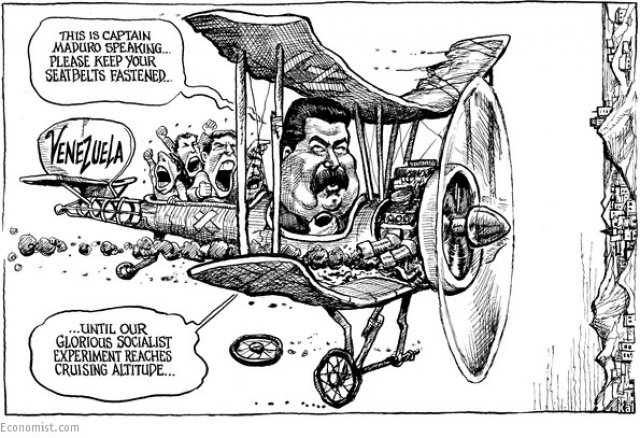
The left behind Venezuela

"What ever happened to the new left in Latin America?" asked a friend when she was over here for dinner with a visiting Peruvian.

Remember those days of the Bolivarian Revolution?  Those were some heady days when Hugo Chavez, Evo Morales, and the Castro brothers made all the headlines, right?

Caption at the source:
President Nicolás Maduro, of Venezuela, at a rally in Caracas on Feb. 3.
Chavez has been gone for a while, and his anointed successor has been carrying the torch since.  Fidel is gone, with his brother carrying the torch since.  And, of course, Morales is still there.  But, as the Economist points out:
A bigger worry than regress in Latin America is political decay—“when political systems fail to adjust to changing circumstances” because of opposition from entrenched stakeholders, as Francis Fukuyama, a political scientist, puts it. 
Political decay.  Of course, we here in the US have lost any moral high ground from which we can comment on political decay elsewhere.  But, I, who was consistently anti-trump and worried about him winning, and warned that the Berniacs will end up helping trump, have earned my privilege to comment on the decay anywhere!

Do you ever wonder though what the uber-liberals have to say about the disaster that has been the Latin American left?  Especially about Venezuela, after all the praises that they heaped on Chavez?  That left wing embrace of Chavez is why the the left is silent now.  Because, if they open their mouths about Venezuela, then they have to first acknowledge their error. 

As Bret Stephens, who I don't care much for, writes:
the Venezuelan regime was a cause of the left, cheered by people like Naomi Klein, Sean Penn and Danny Glover. Left-wing publications such as Glenn Greenwald’s “The Intercept” have gone out of their way to make excuses for the regime and treat its critics as Washington stooges. Jeremy Corbyn, who could yet be Britain’s next prime minister, memorialized the late dictator Hugo Chávez in 2013 for his “massive contributions to Venezuela & a very wide world.”
It is like how the left tied itself in knots after the Soviet Union came tumbling down.  Search all you want, but you will read practically nothing from those celebrities and intellectuals about contemporary Venezuela.  They have moved on to other topics that bring them fame and money.  Keep in mind that the likes of Naomi Klein and Noam Chomsky are in the elite of elite when it comes to wealth that they accumulated from their writing and speaking about the favorite left causes of the day.

Stephens asks a good question:
How many more Venezuelans have to starve or drown before Western liberals do something more than merely shake their heads?
Ask your favorite Naomi Klein fan to answer that question!

Thursday, August 03, 2017

From riches to rags! :(

It was once the richest country in the continent. Now, its people are fleeing. Some of its women try to make a living by doing sex work in the neighboring country.  Those who haven't fled are terribly undernourished.

No, it is not some cliched African country.  But, a country that until recently was a darling of the left.  Venezuela!
According to the International Monetary Fund, Venezuela’s GDP in 2017 is 35% below 2013 levels, or 40% in per capita terms. That is a significantly sharper contraction than during the 1929-1933 Great Depression in the United States, when US GDP is estimated to have fallen 28%. It is slightly bigger than the decline in Russia (1990-1994), Cuba (1989-1993), and Albania (1989-1993)
Just awful!
Venezuela is now the world’s most indebted country. No country has a larger public external debt as a share of GDP or of exports, or faces higher debt service as a share of exports.

So, where is the fucking intellectual left that used to adore Chavez, whose policies set Venezuela down this hell hole?
The list of Western leftists who once sang the Venezuelan government’s praises is long, and Naomi Klein figures near the top.
In 2004, she signed a petition headlined, “We would vote for Hugo Chavez.” Three years later, she lauded Venezuela as a place where “citizens had renewed their faith in the power of democracy to improve their lives.” In her 2007 book, “The Shock Doctrine,” she portrayed capitalism as a sort of global conspiracy that instigates financial crises and exploits poor countries in the wake of natural disasters. But Klein declared that Venezuela had been rendered immune to the “shocks” administered by free market fundamentalists thanks to Chavez’s “21st Century Socialism,” which had created “a zone of relative economic calm and predictability.”
How about the big guy himself?  You know the one. Noam Chomsky?
Chomsky, whose anti-capitalist teachings have inspired millions of American college students, praised Chavez's "sharp poverty reduction, probably the greatest in the Americas." Chavez returned the compliment by holding up Chomsky's book during a speech at the U.N., making it a best-seller.
Is Chomsky embarrassed by that today? "No," he wrote me. He praised Chavez "in 2006. Here's the situation as of two years later." He linked to a 2008 article by a writer of Oliver Stone's movie who said, "Venezuela has seen a remarkable reduction in poverty."
I asked him, "Should you now say to the students who've learned from you, 'Socialism, in practice, often wrecks people's lives'?"
Chomsky replied, "I never described Chavez's state capitalist government as 'socialist' or even hinted at such an absurdity. It was quite remote from socialism. Private capitalism remained ... Capitalists were free to undermine the economy in all sorts of ways, like massive export of capital."
What? Capitalists "undermine the economy" by fleeing?
Chomsky has always been good with words, and knows how to use them in order to make sure he comes across as the wise sage.  Godawful!

Just because I will not forget nor forgive the 63 million who have unleashed trump and his demons on us, does not mean that I will be soft on the near mirror image on the left: the Berniacs, whose economic policies are nearly as insane with their anti-globalization and America-first rhetoric.  Which is why I will wrap up this post with this:
In the age of Trump, Brexit and a wider backlash against globalization, left-wing economic populists are enjoying a resurgence in mainstream credibility by railing against free trade and “neoliberals.” This is a scandal. For in the form of the Bolivarian Republic of Venezuela, the world has a petri dish in which to judge the sort of policies endorsed by Jones, Klein, British Labor Party leader Jeremy Corbyn, homegrown socialist Sen. Bernie Sanders and countless other deluded utopians.
There, the ghastly failures of their ideas are playing out for everyone to see; a real-time rebuke, as if another were needed, to socialism. That these people are considered authorities on anything other than purchasing Birkenstocks, much less running a country, is absurd.
When you buy the socialist rhetoric, Caveat emptor, as "neoliberal" economists like to say!


Sunday, July 16, 2017

93 percent of the population cannot afford food

No, not in some sub-Saharan African country.

It is not in India.

It is in Venezuela!
Venezuela was once the richest country in South America, but food prices have skyrocketed in recent years, forcing many to scavenge for things to eat.
We humans are remarkably creative on the destruction that we can bring about :(

Everything was going well.  So well that a horrible human being--no, not this guy--stepped up to ruin it all.
Elected in 1998, President Hugo Chávez became widely popular for his promise to share the country’s oil wealth with the poor and to guarantee food security. To fund his “21st Century Socialism” agenda, he relied on oil revenues, which accounted for 93 percent of exports in 2008.
In one decade, chávez turned that country around, yes.  But, heading in the wrong direction.
During the oil price boom, the percentage of households in poverty fell to 29 percent from 53 percent. The government has not released poverty data since 2015. But a survey by three of the top universities in the country indicates that in recent years the government underestimated the level of poverty, which reached 82 percent in 2016.
"Put simply, many Venezuelans are starving to death. And their government often can’t or won’t do anything to help."

Two years ago to this date, the madman announced his candidacy for the presidency, and since then we have not been able to focus on serious issues like Venezuela.  What a tragedy!


Saturday, May 06, 2017

The Maduro Diet

The fuhrer is trying to suck up all the energy.  It is a daily struggle to look past him, and to make sure I don't accidentally let his voice come through on the radio.

I cannot believe that 63 million voters, including past commenters at this blog, voted for him!

But, hey, I will survive, yes.  There are plenty others, even in this country, who won't--some even literally.

South of us--way south--things are getting worse.
Venezuela has the world’s highest inflation—estimated by the International Monetary Fund to reach 720% this year—making it nearly impossible for families to make ends meet. Since 2013, the economy has shrunk 27%, according to local investment bank Torino Capital; imports of food have plunged 70%.
Hordes of people, many with children in tow, rummage through garbage, an uncommon sight a year ago. People in the countryside pick farms clean at night, stealing everything from fruits hanging on trees to pumpkins on the ground, adding to the misery of farmers hurt by shortages of seed and fertilizer. Looters target food stores. Families padlock their refrigerators.
Three in four Venezuelans said they had lost weight last year, an average of 19 pounds, according to the National Poll of Living Conditions, an annual study by social scientists. People here, in a mix of rage and humor, call it the Maduro diet after President Nicolás Maduro.
In normal times, we would have paid attention to the unfolding events in Venezuela--despite the typical American attitude to not care about the rest of the world.  But, these are extraordinary times.  Unchartered waters.  So, now we couldn't be bothered with the humanitarian crisis in Venezuela.

Please, please read the entire WSJ report
Perhaps you are wondering whether the president has done anything regarding Venezuela.  Yes, he has--he took the half-million dollars that were donated to his inauguration gala.
Trump’s predecessor, Barack Obama, took a principled stand in US dealings with Venezuela, imposing sanctions to rein in rogue behavior, a policy that drew broad bipartisan support. The Trump administration needs to stay the course, especially as lower oil prices have weakened the Venezuelan government’s hand. Instead of bashing Latin America, the US needs to show it can be a steady and principled friend that will not be swayed by corrupt bribes of any type.
"principled"?  This pussy-grabbing president? This president who mocked a disabled reporter?  Hah!

Meanwhile, more agony in Venezuela :(


Sunday, October 30, 2016

Not this shit again

Julian Assange and James Comey have delivered all the October surprises that we did not need.  It didn't matter to me; I was done with my ballot last weekend, and signed, sealed, and delivered it last Monday.  If everything goes well, on the evening of November 8th, the world will breathe a sigh of relief that the US dodged electing the guy who could be the greatest recruiting poster for all the disaffected crazies in the troubled Islamic countries.

The American elections have been one heck of a reality TV show around the world.  But, there are far more compelling human dramas unfolding in real time.  Tragedies, with no end in sight.  No, this post is not about Syria. Nor about the migrants. Nor about Yemen. Nor about ...

It is about Venezuela:
a relatively large, relatively sophisticated major oil producer just three hours’ flying time from the United States has just become the second all-out, no-more-elections dictatorship in the Western Hemisphere.
The courts have suspended what would have been a referendum to recall the "loathed authoritarian president, Nicolás Maduro."

A referendum that Maduro would have lost; there were eight voters lined up against him for every supporter, according to surveys.  Given such intense opposition,
how does Maduro retain enough support going forward to hang on to power? Where is his genuine source of support at this point?
You want a nanosecond to think about it?
People with guns. That includes the military of course, which has been given enormous privileges during the last 18 years. [It has] been put in charge of mining businesses, been part of the oil industry, and smuggling, and cocaine, and a lot of other things.
"Includes the military" because it is not merely the military:
It’s the paramilitarization of the ruling party. So [the] PSUV, or Partido Socialista Unido de Venezuela, has what are called colectivos. [These are] sort of grassroots supporter civilians who are armed and organized. What they are is paramilitaries. They are armed civilian groups that support the government. The degree of tactical cooperation between the armed security forces and these paramilitary groups is shocking now and really, they’re not trying to hide it. And these days there’s Twitter—you can’t hide things even if you want to. 
So, ... what next?  If life in Venezuela has already gone from bad to worse to worst, ...?
We are in deeply uncharted territory here, so to try to forecast it now is really, really dicey. There’s a sense in the opposition now of learned helplessness. [A sense of,] “we’ve done a lot, we’ve done a lot to try to get rid of these guys and they’ve worn us out every time, and we’ve failed every time and the country has gotten worse and worse and worse.” So in a way, that’s the hardest thing to get over. Part of the reason that people reacted to the offer of the Vatican mediation the way they did is precisely that: Not this shit again.  
"Not this shit again" can equally apply to the presidential campaign here in the US too.


Tuesday, May 17, 2016

I'm mad as hell and I'm not going to take this anymore

Sometimes, I feel like I should grab the Bernies and the Trumpsters and shake them to get their attention.  And then I want to tell them, "enough with your pessimism and doomsday sloganeering.  The end is not anywhere near."  If only they understood how hundreds of millions around the world will gladly trade places with the Bernies and Trumpsters who are being hysterical!

Greg Easterbrook writes that somehow optimism has become uncool in the country known for its boundless optimism:
An April Gallup poll found that only 26 percent of Americans call themselves “satisfied” with “the way things are going” in the United States. It’s been this way for a while: January 2004, during the George W. Bush administration, was the last time a majority told Gallup they felt good about the nation’s course.
For a decade now!

"Objectively, the glass looks significantly more than half full," says Easterbrook with a whole bunch of evidence.  He then quotes that rich dude from Omaha:
Recently Warren Buffett said that because of the “negative drumbeat” of politics, “many Americans now believe their children will not live as well as they themselves do. That view is dead wrong: The babies being born in America today are the luckiest crop in history.”
 Exactly!  I complain about many public policy issues, yes, but--as I often comment to students--this is the best time ever and the "good old days" were actually bad old days.  But, somehow, the Bernies don't get it (I have complained enough about the Trumpsters already!) and they are actually mesmerized by a candidate who proudly favors socialism!  Glenn Reynolds has a great line in his op-ed warning the Bernies not to be a sucker for socialism:
Under capitalism, rich people become powerful. But under socialism, powerful people become rich.
Reynolds adds later on:
But at least in America, becoming powerful isn’t the only way to become rich. Under socialism, you’re either powerful, or you’re poor.
He goes on to list some of those socialist experiments, including Venezuela.  In this blog, I have cried enough for Venezuela, and the horror stories keep growing in that rapidly failing state.  The story of the 14-year old described in this essay on how Venezuela is falling apart will make any decent human angry like hell.  That 14-year old, who died because of a shortage of his anti-epilepsy prescription drug, is but one story from Venezuela.

Maybe the angry Bernies should spend a week in Venezuela, and the pissed off Trumpsters should experience daily life in Russia.  That will be quite a reality check on their views of the world.


Thursday, April 28, 2016

Venezuela's Hunger Games

Three months have gone by.  So, of course, it is time to blog about Venezuela!

How bad is the situation there?
“Venezuela Doesn't Have Enough Money to Pay for Its Money.”
Yes, you read that right.
The situation is so bad that the government appears unable to pay for the new bills it has ordered from foreign currency makers (because, like almost all things, Venezuela has to import its money).
I don't think any dictionary has enough words to describe the conditions there.  I so want to ask the colleague who was always in utter praise of the architect of this mess--Hugo Chavez--what she now thinks about him and the successor, Nicolas Maduro, that he handpicked.
When President Hugo Chavez passed away in 2013, he left behind a stunted national economy almost wholly dependent on oil production. As a result, the collapse of crude prices has been disastrous. All the while, an ill-advised system of currency and price controls, partly meant to curb inflation, have led to shortages of basic goods and a thriving black-market economy.  
And what is the inflation rate?  Sit down and take a deep breath before you find out!

No food, no toilet paper, no condoms, and now?  No electricity!  So, what is Maduro's temporary fix?
Venezuela's years-long economic disintegration hit a sad new milestone on Tuesday, when President Nicolas Maduro announced that government employees would work only on Mondays and Tuesdays for at least the next two weeks to save scarce electricity.
Under these circumstances, you wouldn't expect the people to just sit back and wait for life to unfold, especially when it is already one of the most violent countries, right?
Angry residents in darkened towns around the country took to the streets Tuesday night, setting up flaming barricades and raiding shops for bread and other scarce food.
On Wednesday, more than 1,000 police fanned out around the western city of Maracaibo after a night of riots.
And to think that less than thirty years ago, I was in Maracaibo, enjoying arepas with cheese :(
Caracas is being spared from the rolling blackouts and has not seen violent protests. Some Venezuelans complain that the country is starting to resemble the dystopian series "The Hunger Games," in which districts suffer for the benefit of a heartless capital city.
"Dystopian" is the word, yes.  


Saturday, January 23, 2016

Dear Venezuela: I really, really wish I knew how to quit you

Venezuela was the first country that I visited after coming to America.  It has been a long association with that country, which has been nothing but a poster-child for oil as a resource curse.  With the price of oil in a free fall of sorts, I was sure the news about Venezuela would not be pretty; after all, "Venezuela needs oil prices to hit $111 a barrel just to break even" and oil is trading at less than $30!

The Wall Street Journal opens its report with this:
The plunge in the price of oil is causing more investors to bet that Venezuela will default on its $120 billion pile of foreign debt, an event that would trigger a messy battle over the country’s oil shipments and deepen its economic and political crisis.
When pretty much all the oil-export revenue will go to serving the debt obligations, it leaves little for anything else:
The government owes more than $50 billion to private companies that service its economy, ranging from oil contractors and airlines to supermarkets that need dollars to import everything from flour to toilet paper. Major airlines have halted flights to the country and auto manufacturers and others have shut plants after the government was unable to pay for imports of needed parts and materials.
Oil prices are not projected to go up anytime soon.  So, more misery for the people in Venezuela.
Venezuela’s consumer inflation, already the world’s highest, will more than double this year to a level above all estimates from economists surveyed by Bloomberg, the International Monetary Fund said.
Inflation will surge to 720 percent in 2016 from 275 percent last year, according to a note published by the IMF’s Western Hemisphere Director, Alejandro Werner.
720 percent?
Venezuela’s economy will shrink 8 percent this year following a 10 percent contraction last year, according to the IMF. 
WTF!

When economic conditions worsen, then what happens to stuff that people need?  Remember this post from last April about the shortage of toilet-paper thanks to the screwed up "socialism" of Hugo Chavez and his anointed successor?

The situation has worsened, to say the least, since last April.
It’s also having a serious impact on the sex lives and health of many Venezuelans.
How so, you ask?
Contraceptives, including birth control pills and condoms, are also on the growing list of hard-to-get items. Only one-tenth of the normal volume of contraceptives used by Venezuelans was available last year, El Pais reported earlier this month, citing the head of the country's pharmaceutical federation. 
No milk. No toilet paper. No contraceptives.  Hmmm, can it get any worse?
Experts have been warning of the potentially devastating consequences of the contraceptive shortage in a country that already has one of the highest rates of HIV infection and teenage pregnancy in the region. ...Venezuela's economic crisis could turn into a health disaster.
Oh my!  Add to this the Zika virus too.

How awful!

Thursday, August 27, 2015

Dear Venezuela: "I wish I knew how to quit you"

In a national survey, the pollster Consultores 21 found 30% of Venezuelans eating two or fewer meals a day during the second quarter of this year, up from 20% in the first quarter. Around 70% of people in the study also said they had stopped buying some basic food item because it had become unavailable or too expensive.
That is in Venezuela, not in some stereotypical sub-Saharan African country ravaged by decades of civil war after gaining independence from the colonial White supremacists!

I am not even from Venezuela and I get worked up reading such news--all because it was the first ever country that I visited after leaving India and making myself at home here in these United States.  In many posts, the last one in April, I have written about my intellectual and personal experiences in Venezuela, and about my utter disappointment with the recent developments.  I suppose for my own health, I should cease my relationships with countries and people; but then, to quote that wonderful line from Brokeback Mountain, "I wish I knew how to quit you."  Thus, here I am reading up and blogging about Venezuela!
Food-supply problems in Venezuela underscore the increasingly precarious situation for Mr. Maduro’s socialist government, which according to the latest poll by Datanálisis is preferred by less than 20% of voters ahead of Dec. 6 parliamentary elections. The critical situation threatens to plunge South America’s largest oil exporter into a wave of civil unrest reminiscent of last year’s nationwide demonstrations seeking Mr. Maduro’s ouster.
Even as I read that, I recalled a colleague rambling on and on a few years ago about how Hugo Chavez--Maduro's predecessor and mentor--was the best thing that ever happened to Latin America.  "He is not any dictator like how he is presented here" she--an uber-left White American academic--argued.  I suppose every sociopath has his defender!

Caption at the source:
A woman holds up a giant hundred Bolivar note with the word, “Hungry” written on it in Spanish during a gathering to protest the government of President Nicolas Maduro, as well as economic insecurity and shortages, in Caracas, Venezuela, August 8, 2015.
The messed-up Chavez policies that Maduro has continued with were underwritten by high oil prices, which have fallen way down from their triple-digit highs.
A year ago, the international price per barrel of oil was about $103. By Monday, the price was about $42, roughly 6 percent lower than on Friday.
Indications are that the oil prices will not bounce back up any time soon.
David L. Goldwyn, who was the State Department special envoy and coordinator for international energy affairs in the first Obama administration, said that if the Brent global oil benchmark price stays below $45 a barrel, that is “a red flag for stability issues across the oil producing world.”
“The hemorrhaging of government budgets reliant on oil will force dramatic cuts in spending or dangerous increases in borrowing, if not both,” Mr. Goldwyn said. “The countries without significant foreign exchange reserves are most at risk, and they include Nigeria, Angola, Algeria, Venezuela and Iraq."
So, what is Venezuela doing?  Adding more zeroes to its currency in order to counter hyperinflation! 
Many Venezuelans have to carry wads of cash in bags instead of wallets as soaring inflation and a declining currency increase the number of bills needed for everyday purchases. The situation is set to get worse. Inflation, already the fastest in the world, could end the year at 150 percent, said the official.
Larger denominations will help those people from having to carry bags of cash to buy bread and milk!
The new notes -- of 500 and possibly 1,000 bolivars -- are expected to be released sometime after congressional elections are held on Dec. 6, said a senior government official who isn’t authorized to talk about the plans publicly.
When oil prices were high, Venezuela's Chavez sent highly subsidized oil across the waters to his pal, Castro.  What an irony that the Castro brothers have all but ditched their socialist rhetoric and now want to make friends with the US, while Venezuela is adrift in a hyperinflationary socialist mess where supermarket shelves are bare.  

Tuesday, April 07, 2015

Hey, at least capitalism helps us wipe our shit!

The last time I blogged about Venezuela, which was less than a hundred days ago, I wrote:
As in the old Soviet Union, Chavez and Maduro have no understanding of price.  All they know is the empty flame-throwing rhetoric attacking "capitalism," whatever that means to whoever listens to them! 
The comparison with the Soviet Union seems like an eternal gift that keeps on giving.  Writing at Cato (yes, the libertarian think-tank, in case any of my faculty union "comrades" are reading this!) David Boaz notes (ht):
In 1990 I went to a Cato Institute conference in what was then still the Soviet Union. We were told to bring our own toilet paper, which was in fact useful advice. Now, after only 16 years of Chavista rule, Venezuela has demonstrated that “Socialism of the 21st Century” is pretty much like socialism in the 20th century
Yes, toilet paper.

What happened, you ask?
 “For over a year we haven’t had toilet paper, soap, any kind of milk, coffee or sugar. So we have to tell our guests to come prepared.”…
Boaz comments:
But what I never understood is this: Why toilet paper? How hard is it to make toilet paper? I can understand a socialist economy having trouble producing decent cars or computers. But toilet paper?
Chavez's "Bolivarian Socialism" gift to the people!

But, of course, one can always pay a high price in the black market, thanks to bachaqueros.  Who are they, you ask?
Often moving in motorized packs, bachaqueros specialize in ferreting out what items are available and where they can be found among the various government-sponsored food outlets and privately run stores. The bachaqueros depend on inside informants and satiated buyers who tip them off before word gets out to most people.
Purchasing the goods with cash, they resell them through informally arranged delivery networks set up through social media. They sell milk powder, chicken and disposable diapers at outrageous markups, counting on Venezuelans to pay premiums to avoid the hassles of la cola, which means standing in line but which has become a synonym for the act of shopping itself.
Maduro, the heir selected by Chavez himself, is making sure that when he is done, the country will be FUBAR.  What is FUBAR, you ask?  Fucked Up Beyond All Repair!

So, how does Maduro respond?
President Maduro blames Washington and "imperialism."
Saint Chavez can't be wrong, and neither can his anointed one, right?

But, Maduro does not stop with that.  No sir.  He is one hell of a nutcase.
President Nicolas Maduro is drumming up a petition, to be signed by Venezuelans opposed to the measure, to hand Obama in person at the Summit of the Americas in Panama April 10-11.
But, that is only a few more days to go.  How can Maduro get this done, you ask?
Well, he began last week by ordering all Venezuelan schools to hold an "anti-imperialist day" against "U.S. meddling" in the oil-rich but bitterly divided nation's internal affairs.
Activities would include — you guessed it — the "collection of the signatures of the students, and teaching, administrative, maintenance and cooking personnel."
Maduro's next step, according to the opposition and human rights groups, was to order state workers to join in, or be sacked.
Ah, yes, will make Hugo Chavez smile from that socialist heaven!
Discussing his petition this week, he said: "I believe that the threat from Obama has awoken the greatest love for what we are doing for the fatherland."
"History books will recall him, President Obama, as the one who attempted to threaten a people and what he did was lift up their national, patriotic and Bolivarian spirit."
There is not enough toilet paper to wipe the shit that comes out of Maduro's mouth!


Friday, January 30, 2015

God does not care for Venezuela!

There is one huge problem that I end up with after traveling to a country--I end up worrying about that country, too.  As a kid, life was simpler for the only reason--in this context--that all I worried about was, well, India, though I was fascinated by other countries also.  Then, from the moment I landed in Los Angeles, my worries about the US began.

The first on this list of my "special" countries--other than the old country and the adopted one--was Venezuela.  In the summer after the first year of graduate school in Los Angeles, I went to Venezuela with a group of fellow graduate students.  As I have blogged more than once, I have warm memories of that country and its people, and how that experience was even a part of my growing up in so many different ways.

It pains me--and such empathy is no good for my heart--when I read about the chaos there, thanks to the resource-curse and the dirty rotten scoundrels who have governed Venezuela.  I don't know enough about its history to figure out whether Hugo Chavez was the worst of them all, but I bet he is up there in the hall of shame.
“I’ve always been a Chavista,” said Ms. Noriega, using a term for a loyal Chávez supporter. But “the other day, I found a Chávez T-shirt I’d kept, and I threw it on the ground and stamped on it, and then I used it to clean the floor. I was so angry. I don’t know if this is his fault or not, but he died and left us here, and things have been going from bad to worse.”
Indeed, from bad to worse!

In the old days, we used to joke about life in the Soviet Union, with its shortages.  Like this one:
A customer walks into a shop and says, "oh, you don't have any fish".
The shop worker angrily retorts with, "you have come to the wrong shop, comrade.  This is a butcher's shop where we don't have any meat."   And then he adds "the store where they don't have any fish is in the fish shop across the road!"
Those were the days that I was sure we would not return to.  But then, well, there was Hugo Chavez!
Venezuelans have put up with shortages and long lines for years. But as the price of oil, the country’s main export, has plunged, the situation has grown so dire that the government has sent troops to patrol huge lines snaking for blocks. Some states have barred people from waiting outside stores overnight, and government officials are posted near entrances, ready to arrest shoppers who cheat the rationing system.
Lines and crowds like in this photograph:


What a tragedy!

Chavez died and made sure that his chosen successor would further screw things up for the people:
President Nicolas Maduro stuck to the party line, blaming oil's ruinous price plunge on the global capitalism "of the north.""The capitalism of the world of the north is trying to destroy OPEC, to control sources of energy, to destroy the just prices that we need and have been assimilated by the entire world," said Maduro. 
As in the old Soviet Union, Chavez and Maduro have no understanding of price.  All they know is the empty flame-throwing rhetoric attacking "capitalism," whatever that means to whoever listens to them!
Venezuela has the world’s largest estimated petroleum reserves, and when oil prices were high, oil exports made up more than 95 percent of its hard currency income. Mr. Chávez used the oil riches to fund social spending, like increased pensions and subsidized grocery stores. Now that income has been slashed.
“If things are so bad now, I really cannot imagine how they will be in February or March” when some of the lowest oil prices “materialize in terms of cash flow,” said Francisco J. Monaldi, a professor of energy policy at the Harvard Kennedy School of Government.
Mr. Maduro spent 14 straight days in January traveling the globe in an effort to court investment and persuade other oil-producing nations to cut production and push the price back up.
“We have serious economic difficulties regarding the country’s revenue,” Mr. Maduro said to the legislature during his annual address, which had to be pushed back because of the trip. “But God will always be with us. God will provide. And we will get, and we have gotten, the resources to maintain the country’s rhythm.”
Aha, so there lies the difference between the Soviets and the Chavistas: at least the Soviets didn't believe that god will provide and rescue them from their terrible sins!  

Two boys who wanted to pose for me during that trip in 1988

Thursday, June 19, 2014

It goes with the territory

The summer after the first year of graduate school, I went to Venezuela with a group of fellow graduate students for three weeks on a research project.  After the first two days in Caracas, we proceeded to Maracaibo, which was the project site.

It didn't take long for many students to grumble about the heat. Our professor casually remarked, "it goes with the territory."

I remember that I didn't complain much about Maracaibo's heat and humidity even as the Anglos in the group whined.  They had good reasons; the temperature in late-May and early-June when we were there was awful.  Maybe the reason I didn't complain then was rather simple--I hadn't known anything better, having been out of the hot Tamil Nadu conditions for only a few months.

Lake Maracaibo (Venezuela) ... 1988

Since then, I have come to love that phrase, "it goes with the territory."  The older I get, the more I appreciate it.
Snow in January in Boston?
Rain in Oregon?
Well, "it goes with the territory." 

Thus, as much as I would love to complain about the heat and humidity in Chennai, which is almost exactly what I experienced in Maracaibo twenty-six years ago, I know better--"it goes with the territory."

But, seriously, this hot?  This humid?  Have I become this wimpy after twenty-seven years away from this place?  It also means that I won't ever go back to Juanita in Maracaibo? ;)

Over the years, I have come to understand how "it goes with the territory" is applicable to non-meteorological contexts too.

No electricity in rural Tanzania?
Mosquitoes in the Alaskan summer?
Atrociously small hotel rooms and bathrooms in Venice?
Dysfunctional Congress?
"it goes with the territory."

But, seriously, this hot? This humd? This blinding sunlight?

Thursday, May 23, 2013

On the Latin American Indians. The "East Indians" that is!

In commenting on this post on the multinational existence of my extended family, Chris wonders about the Indian migration to Latin America, which then makes me recall old stories, in a Bill Cosby-like rambling fashion!  Pull up a chair, and get yourself a cup of coffee first.

About this time of the year, 25 years ago, I went to Venezuela with a few other graduate schoolmates, on a three-week study trip.

One of the very few photos from my Venezuela trip
In the initial couple of days, we were guided by a local guy, Carlos.  Right from the first minute of meeting him, I thought to myself that the guy looked Indian.  As in from India.

If I am an idiot now with no social skills, well, I was worse then.  I am guessing that I would have phrased it in the most awkward and politically incorrect way possible when I asked him if he had any Indian connections.

Turned out that he had!

Curiosity was, for once, useful—Carlos’ grandparents were from India. They came to Guyana, from where his father later immigrated to Venezuela, married a local and, hence, Carlos the Venezuelan!

The Guyana connection was especially interesting because a student in our group was from Suriname.  And, yes, she too was an "Indian" whose great-grandparents, I think, had emigrated from India to Guyana, if I correctly recall. Like many of Indian origin from there, she, too, was keen on getting out of the country.

She never said "Indian" but always used the phrase "East Indian."  Understandable--to differentiate from the "Indians" in the Americas and the "West Indians."  What a confusion thanks to Columbus!

I have in my mind this blurry image of her mother and sister cooking a fabulous meal for a whole bunch of us when they were in Los Angeles.  They all settled down later in New York.  The years have taken a toll on my memory and I have absolutely no idea about her name; how sad!

I do remember Trevor, however.

Trevor was from South Africa and, yes, was a product of the Indian dispersion into that country.  Not merely India, but from Tamil Nadu!

The common thread here is, of course, the colonizer--Britain.

So, after recalling those old stories, the nerd in me gets curious.  Would the British connection then have opened up a portal for Indians into Belize?  Are there people of Indian origin in Belize?  Can one get an aaloo paratta there? ;)

The web comes to my rescue:
The "East Indians" as they were referred to, perhaps in order to distinguish them from the original "Maya Indians" that inhabited this part of the world, were first brought to Belize to supplement the African laboring population.  It was not until slavery had been abolished that the first East Indians, between 1870 and 1880 first arrived in Belize. 
 Tada!
East Indian food, a significant aspect of culture, is still very much prevalent in the homes of the contemporary East Indian population, as well as Belizeans as a whole. Today the East Indian community is identified by a distinctively "Indian" appearance, either in hair, or facial features. Although they have adopted many of the social practices, customs and values of the creolized Belizean populace they have given as much in return, so much so that they remain among Belizeans a group that has truly become a dear collaborator, sharing their culture and most notably, their food.
So, any Indian eateries in Belize?  I am awfully curious by now.

Another search and Lonely Planet recommends Sumathi Indian Restaurant!  Meet the chef:


What a fascinating world!

By the way, why does the chef not smile for the photograph?  Not smiling is in the Indian genes?

Sunday, February 03, 2013

Don't cry for me, Venezuela!

Over the years, I have come to understand one trait of mine: when I travel to a city or a country, then those, too, are places that I then read about as a way of keeping in touch with those old friends, whom I might never visit again.  As with "real" friends, I get excited if what I read about is positive and exciting, and feel awful if otherwise.

For a few years now, I have felt nothing but awful about Venezuela, which was the first country I visited  in 1988, a year after coming to the US.

The graduate student group, of which I was one, spent only a couple of days in Caracas before we shifted to the project site--Maracaibo. Twenty five years have passed, and the airline that we flew, PanAm, has long since disappeared from the world of business.

Recently, when I was in Ecuador, I was reminded a lot of Venezuela and Simon Bolivar.  That Bolivar legacy, has not worked out well for the country--Hugo Chavez claims to be doing all the crazy things that he does in that grand Bolivar style, and what a mess the country is in now!

The New Yorker had a lengthy piece (sub. reqd.) on the Venezuela and Caracas of today, that have been completely messed up by the bizarre policies of Chavez.  What a curse!

A couple of years ago, when I was on talking terms with a few faculty colleagues, a conversation with one of them--yes, an ultra-left sympathizer--turned to Chavez.  Despite all my interests, I preferred to stay quiet and end that conversation because I knew well that she wouldn't like my take on Chavez' policies.  The New Yorker essay is a reminder of how awful the conditions are now.

My graduate school professor, who  was the guide for our project work back in 1988, has also blogged about this essay and adds this note:
A couple of good friend Venezuelan expats (Tico and Aloha Moreno, now in Florida) sent me this video (and accompanying story in Spanish) about how chickens are distributed (not sold) in Maracaibo. You can tell students all you want about prices rationing on the demand side and eliciting on the supply side, but show them the video first.
We can chuckle from a distance, but these are episodes from the real lives of real people. 
Yes, the real lives of real people that Chavez has messed up.  And messed up big time.

Now, with his illness, it appears that Chavez is battling for his life, not in his country but in Cuba, and this writer notes that the entire Chavez presidency and the country's political misfortunes can make for a good telenovela:
The long and at times surreal saga surrounding the illness of President Hugo Chavez has many Venezuelan writers and intellectuals likening the nation's drama to a soap opera. Venezuela has long produced such telenovelas, and some say no one could have imagined a more bizarre plot than the one that has unfolded in the more than seven weeks since Chavez traveled to Cuba for his operation and disappeared from public view.
"Reality in Venezuela has turned implausible. It's hard to believe that these events are happening, where each one exceeds the last one, and where our capacity to be amazed is being constantly challenged," said Leonardo Padron, a writer of Venezuelan telenovelas and a critic of Chavez's government.
It seems more and more like a re-telling of that other notoriously screwed-up South American country--Argentina, whose messed up leader has been more than a telenovela star, thanks to Evita.

To paraphrase Jorge Luis Borges, a lot in literature and in life does seem like a constant re-telling of old stories.  But, why don't we want to re-tell wonderful stories and, instead, we are so fascinated to repeat horror stories?

Caption at the source:
A mural in Caracas, inspired by “The Last Supper,” which depicts Jesus
 flanked by Fidel Castro, Mao, Lenin, Marx, Simón Bolívar, and others.

Wednesday, September 19, 2012

The lost age of innocence. Hey, we grow up!

When I started graduate school, one thing was absolutely clear: compared to my American classmates, I had no freaking clue about the ways of the world.  From driving to conversations at parties to, well, almost every damn thing that we engage in the life outside of the classroom setting.  It was all the more a stark realization because most of them were within a year or two of my age.  I felt like a younger, much younger, sibling of theirs, always amazed at what they could do.

It was one of the many such lessons on how different life in the US was (and is) from the one I had lived back in India.  In India, more than a few people appreciated my adult-like behavior and perspectives on life and, yet, here I was a kid all over again.

But then, of course, I quickly caught up with them.  Except for the driving license, which took some time.  At least, that is what I thought.

One "difference" came up at an unexpected moment.  It was the summer after my first year, and a group of us were down in Venezuela for three weeks on a project work.  As we settled down into a work schedule after the first couple of days, evenings were about hanging out, sometimes at the rented house where we were staying.


One evening, a bunch of us were at a bar.  I had a soft drink as I always did.  Across from me at the table were John and Charles, and the rest were at other tables.  These two were both Peace Corps guys and had been around, in every sense of that phrase.

As bar talk amongst guys often becomes, well, this one, too, got to the subject of girls.  John, who was about ten years older than me, started teasing me about how the local young women were eager to chat up with me whenever we were at the university library or the stores. 

That is when he asked me, "have you been with a woman, Sriram?"

I didn't even have to respond; John laughed and exclaimed, "oh my god, you are blushing!"

Until then I hadn't known that even darker-complexioned people like me can have enough color change to blush in a semi-lit bar!


I suppose the older we get, the less innocent we become and, therefore, no blushes!  No wonder there is an industry to fake the blush :)

Saturday, June 25, 2011

Simon Bolivar and I, in Venezuela and Ecuador

It was in the summer of 1988 that I went to Venezuela.  In a technological time frame, the big thing then was a laptop computer, which was terribly expensive, had very low battery life, and was way beyond the reach of all of us who were starving graduate students.  It was also the days of roll-film cameras.  I could not afford anything more than a simple and inexpensive automatic camera, and had also decided on a budget of the number of rolls that I would use.

One of the fellow-graduate students in that trip was another student from India, Shivsharan Someshwar.  Shiv, who was a couple of years older than me, and a lot more experienced about the world, described the need to get out into the open in the early hours of the day for the best photographs.  In Maracaibo, which is where we spent most of the three weeks, many mornings did I walk about and rationed my camera shots--from mango trees, young boys playing soccer, the weekend trip a few f us took to the beach, cityscapes.  

These photos were my prized possession, along with a poster of Carlos Andres Perez, who was a candidate for the presidency and later won the elections.  Even though I had very few possessions as a graduate student, and even though the few photos from the Venezuela trip were immensely valuable to me, they are now lost--thanks to the number of moves from one apartment to another, and then from one city to another. 

After returning from Ecuador, a couple of days ago I remembered to ask my father whether he has any of the copies I had sent my parents.  "I don't remember seeing any of those photos" he said.

But then in 1988, my parents too were in transition.  Dad was in the last few months of his contract as a consulting engineer at a project in Orissa.  They returned to Madras after that project ended.  I suppose my Venezuela photos were meant to be lost, forever!

Oh well! 

In Venezuela, wherever I went there was some reference to Simon Bolivar--the cinematic Venezuelan hero who fought for independent rule, and had dreams of unifying many of the newly independent countries into a political unit that would be without any Spanish influence. 

After 23 years, Simon Bolivar once again featured in my Ecuador experiences.  For starters, the hotel where I stayed in Quito is on a street named, yes, Bolivar!


I walked a lot in the old town, Centro Historico, where my hotel was located, and more--even beyond the park where the new town begins.  At this transition is is a huge statue honoring Simon Bolivar--riding a horse and leading the charge.

I have memories of taking photos of Bolivar portraits and statues when I was in Venezuela. If only I can track them down.  But, it is not as if I have lost nothing else in life!  I suppose in life we gain some, and lose some.


Bolivar himself can never be lost in the shuffling around in history though.  After all, one of the countries that he led to its liberation is named after him--Bolivia.  I hope this does not mean that my next trip to South America will be to Bolivia.  I have nothing against that country; I would rather get to Argentina first.

Tuesday, June 21, 2011

To Quito with love, and very few dollars in my wallet.

“I do not know why more tourists from the US don't come to Ecuador” commented Mario.  “They think that Ecuador is like Africa, and they want to go only to Galapagos, as if Galapagos is a country of its own” he complained.

I nodded my head as we walked up the steep rise on the way to the Itchimbia Cultural Center from where, Mario assured me, I would be able to have a fantastic view of Quito, with the statue of Virgin Mary off on a hill in one direction, and the basilica in another direction. 

Mario was really getting into this tourism topic.  “The challenge is to figure out how to get the tourists who go to Europe and Thailand, because they are the big spenders.  The tourists we get now are not the tourists who spend money in France and Italy.”

I didn’t know whether I was supposed to feel complimented or insulted at that point.  It was true, however, that as a tourist in Ecuador I was spending very little money.  I was staying in a budget hotel and counting my dollars every night before I went to sleep.  

The tourists I encountered did not seem to be big spenders either.  Quite a few were students—undergraduate and graduate.   Two undergraduate students I met at a pizza place were from Saint Michael’s College in Vermont, doing research on how much Ecuador has met the UN’s Millennium Development Goals.  A larger contingent at another table seemed to be graduate students and, boy, did they carefully count the dollar bills and coins when they had to pay up!

The tourists I met on the tour to Cotopaxi –the Romanian, German, and the very bubbly Polish guy who was working and living in Austria—also seemed like budget travelers like me.  In fact, the Polish guy said that even Ecuador seemed to be more expensive than Argentina, where he said food and lodging cost even less.  I was then reminded of a Wall Street Journal report from a year ago that Argentina was the place to visit for the very reasons of the best return on the US dollar.

As we continued walking and panting, I thought about the typical question I was asked: “why Ecuador?” 

When people talk about their plans to travel to Ireland or Japan or even the Galapagos Islands, the listener has only appreciative things to say or ask.  But, with Ecuador itself, it is a question that almost seems like it is meant to question the mental capacity of the person wanting to travel to that country.

I had always wanted to go back to South America after my only visit there over the years—back in the summer of 1988, I went to Venezuela with a few fellow graduate school students.  We were to work on an economic development strategy for the region surrounding the city of Maracaibo.  The first two days we spent in Caracas, after landing there on a PanAm flight.  It is new world now where PanAm has been condemned to history!

The three weeks in Venezuela were wonderful.  I ate a lot of arepas with cheese and ketchup—I had yet to shed my vegetarian upbringing.  I was pleasantly surprised when charming Venezuelan girls tried to strike up conversations with me, much to the amusement of the gringo grad students I was with.  One day, John seriously asked me, “hey Sriram, what is your secret?”  My guess was that it was all because I looked like a local, and was less a threat compared to their very alien looks and John’s aggressive behavior.

Ecuador was not on the top of my list, however.  It was Argentina that I wanted to get to because of my interest in that country going back to my younger days in Neyveli when, as a news junkie, I was intrigued by the Peronistas who were screwing up the country.  Later, when the Falklands War broke out between Argentina and the UK, I was cheering Argentina only because I wanted the colonizer Britain kicked out from yet another place.  And was so disappointed when Britain and Margaret Thatcher prevailed.

Watching Evita much later in life confirmed all the more that I wanted to check out the Casa Rosada. 

Ecuador was, thus, my second choice.  Nonetheless, it was a preferred choice.  So, when I was asked “why Ecuador” my immediate thought was “why not?”

I didn’t tell Mario all these, but agreed with his bottom line that not many tourists from the States seemed to want to visit Ecuador.  I made sure I said “States” and didn’t repeat the earlier mistake of saying “America.”

We reached the top of the hill and the Cultural Center itself was a gorgeous sight.  Mario said it was also referred to as the Crystal Palace, and it certainly looked like one.


Tuesday, April 19, 2011

The travelin' man ... and his classmates? :)

In an earlier post, I wrote about how much, it turns out, my high school classmates have traveled all over the world.  One of them, apparently lived a life of island hopping from one island to another for many years, from Seychelles to Micronesia to Polynesia ... and now to Fiji ... As I was driving later, and thought about Polynesian islands, my mind kept going back to Ricky Nelson's "The Travelin' Man"


My first trip abroad was to the US.  It was from here, at the end of my first year, that I went to Venezuela.  During this trip that my fellow-grad students (I can't recall their names, except two!) introduced me to Belafonte's music.  His "Sweetheart from Venezuela" is a classic indeed.

The song that we did sing often was, of course, Belaftonte's "Banana boat song"

Wednesday, November 12, 2008

Oil at $58.40 per barrel

Oil prices are collapsing faster than how the NY Mets collapse towards the end of the regular season! It is now trading at less than $60 per barrel; in fact, as I am typing this, it is at $58.40! What a mighty fall from $147 per barrel only a couple of months ago!

One of the best things that can come out of this: it will mess up Iran, Russia and Venezuela. Venezuela's Hugo Chavez will soon be in big trouble, because:
The government has based its 2009 budget on a price of $60 per barrel. Oil revenues account for some 90% of Venezuela's export earnings, more than 50% of the government's budget revenues and around 30% of gross domestic product.
There is thus much at stake. Government rhetoric is now dominated by talk of saving money and austerity, and the country being able and willing to take steps to live with oil prices at 2007 levels ($60 to $70 dollars per barrel) or less. Stress is also being put on the scale of Venezuela's international reserves of nearly $40 billion.

It is speculated that Russia might want to form an OPEC-like natural gas cartel. And it also wants a greater role in global oil prices. Well, wouldn't Putin like that! In fact, that might be the only way he can prop up the prices and also secure his own position.

And in Iran, 60 economists have published an open letter critiquing Ahmedinejad's policies:
"Meager economic growth, widespread jobless rate, chronic and double-digit inflation, crisis in capital markets, government's expansionary budget, disturbed interaction with the world, inequity and poverty have combined with the global economic downturn to leave undeniably big impacts on exports and imports," the letter says.Ahmadinejad immediately blasted back, contending at a seminar on economic development that Iran has been "least affected by this international financial crisis" and urging economists to design "an independent economic system and model based on justice," according to the official Islamic Republic News Agency.

Saturday, October 18, 2008

Axis of Diesel: Falling oil prices good?

After reaching a high of $147 a barrel, oil prices have plunged in recent days in response to worsening economic indicators all over the world. And more so in the largest oil consuming economy--the US. It has fallen through the $70 level. The good thing is if this continues, Venezuela will be bankrupted and Hugo Chavez will be in huge trouble :-)

Ok, seriously, could this plunge resemble the kind of price drops that followed the peaks reached in the early 1980s? OPEC is worried about this and has called an emergency meeting to stablize prices in the 70-90 dollars price range. The Times has aptly referred to all this as the Axis of Diesel--the Brits are funny with their headlines :-)

Writing in the NY Times Magazine, Roger Lowenstein argues that we ought not be too thrilled with falling oil prices because it might just about take away the incentive to explore alternatives to oil. He notes there:
You can argue that last July’s $147 peak was irrational, but Aubrey McClendon, the chief executive of the Oklahoma-based Chesapeake Energy, says it was merely the answer to a real-world economics quiz: at what price would the world consume less oil? Americans began to cut back on their driving at $50 oil, and at something like $120 oil they garaged their S.U.V.’s en masse. People in many emerging nations were slower to react, because their governments subsidize local gasoline prices. But as the price rose, such a subsidy became costly, and beginning in May, China, India, Indonesia and others cut their subsidies. The upper bound had been reached.

Lowenstein concludes his essay with a forceful argument that if the price falls below $70, which it has, then we ought to have a comparable tax on oil. Good luck on that, Lowenstein--we lost that opportunity back in 2001 soon after the 9/11 attack--Americans would have gladly put up with that tax as a patriotic duty. The president lost that opportunity. In fact, he beckoned us to continue on with our shopping! Not now when the economy is tanking, when people are losing homes and jobs.
What the country doesn’t want is to remain dependent only on oil — to lose the urgency to develop alternatives. It happened once before. After the gas lines of the ’70s, Jimmy Carter declared that solving our energy problems was the moral equivalent of war. Then, in the 1980s, Americans forgot.
The way to avoid a repeat is to dust off an idea that Gerald Ford once proposed: a tax on oil. Ideally, it would kick in only if the price fell back to, say, $70 a barrel. The beauty of this tax is that, very likely, no one would have to pay it. The tax would merely serve as a floor — a new lower bound. Auto companies would never have to worry that cheap gas would tempt consumers away from efficient cars; investors could finance development of batteries and fuel cells, because cheap oil could never undercut them. Oil itself would be used more sparingly and last longer. The oil market did its part when it sent the price to almost $150. The government should make sure there is no going back.