Showing posts with label JHSS. Show all posts

Thursday, August 10, 2017

The bougainvillea of life and death

Those were the simpler days of childhood innocence.

I woke up every morning looking forward to going to school, and to spending time with my friends.  It was a twenty-minute walk to the school, before the years of riding the bicycle.

One school day, perhaps in the fifth standard it was, I was walking back home with my best friend back then.  We started arguing about the spelling of a word.  The name of a flower.  Bougainvillea.  The argument was about whether or not there was an "e" in the word.

Soon, we traded the few "bad words" we knew.  When that colorful language was not enough, our arms started swinging.

Before I knew it, my shirt pocket was ripped and I had a tear that was beyond repair.  My school uniform shirt.  We stopped our fight right then and there.  We knew we were in deep trouble with our parents.

The rest of the walk was in silence.  When we reached the roundtana, we went our separate ways.

I reached home and explained to my mother how I ended up with a huge hole in my school shirt.

And then I rushed to check with the dictionary.

He was correct.

Of course he was, as I had suspected was the case all through the argument and the fist-fight.

As if that fight was the cause, which it was not, we slowly drifted apart as we got older and became teenagers.  I visited with him a couple of times during our undergraduate years, before he withdrew from college in order to follow his true love of writing.

After a long gap, I met with him, and his parents, about six years ago.  We laughed about the infamous bougainvillea incident.

Today, there was an email from my brother:
Not sure if u heard the news
If not sorry to let u know
My old childhood friend, Vijay Nambisan, has died.

Vijay now joins two other wonderful childhood friends--Manibaba and Rangayya.

Vijay was remarakbly gifted and talented.  He was one of the very few that I have known in life who were exceptional in the analytical and the creative.  He was truly one of a kind.  I wish we hadn't drifted apart.  But that is what life is--we grow into our own personalities, and we live our own lives.

I picked up from my bookshelf the book that I got from him as a gift more than forty years ago.  His friendship, and the fight over the spelling of bougainvillea, were even better gifts of life.


Tuesday, September 08, 2015

On the making of teachers ...

Until I joined graduate school, I had never thought about where school teachers came from.  All I knew about school teachers, especially the awesome ones, and the awful ones too, was from the experience as a "lifer" in that wonderful school, and from two relatives from my father's generation who were high school teachers.  I had never spent even a minute into thinking about the making of a teacher, and questions like: Who trained them?  What makes people wanting to teach?

In graduate school, depending on my mood, I would wander into any one of the libraries on campus and either do my own work or read something from the collections there.  Others perhaps call this as "wasting time" but I enjoyed such intellectual wanderings.

USC Doheny Library, summer 2009

One of the libraries was at the School of Education, which is also where I got into the habit of reading The Chronicle of Higher Education.  It fascinated me that there was a School of Education.  There were even undergraduate students who were on a teacher preparatory path.  All through my years in India, I had never known of any young person who was studying to be a school teacher.  This was all getting to be really interesting.

When I started teaching in California, it turned out that quite a few students who were in my economic geography class were there because it was required for their teacher-prep majors.  Now, I started getting some insights into the making of a teacher.  I was impressed with a few of them.  And was disappointed with most of them--if their attitude towards learning was this awful, how would would they ever inspire their students to learn!

Here in Oregon, a math colleague, who a few years ago moved across the continent to be closer to her family, once remarked at a faculty senate meeting about the immense responsibility that we faculty have.  "We blame high schools for the bad quality students they send us; the high schools blame the middle schools; the middle schools point their fingers at elementary schools.  We forget that we are the ones preparing teachers for all those schools."  I was the only one who was impressed with her plea--the rest couldn't care; I suppose they could not wait to get back to writing their journal articles and books and here she was wasting their precious time!

The interest in making sure we have good teachers is huge outside the academic walls.  Everybody, from the President to the kid on a skateboard has firm beliefs on what is wrong about teaching and teachers.  Some opinion writers even claim that a high school diploma is all one needs to teach kids.  How can we make sure that we have wonderful teachers for kids?
Policy makers have debated the best way to evaluate teacher effectiveness, but have shown little interest in the training that is supposed to make them effective in the first place. That’s changing, but it’s not obvious where and how to intervene. Tougher entry requirements for teacher training? A more challenging certification test? New accreditation standards for teacher training programs? The problem is that many different organizations influence various aspects of the teacher training process. 
It is cacophony out there!

Meanwhile, I am now left thinking about yet another issue: how come in the vast extended family we have engineers and doctors and MBAs and college professors and whatever else, but no school teachers?  Is it because it is not considered worthy enough a profession?  Nothing makes sense the older I get!

Saturday, June 27, 2015

Asti अस्ति

I knew I had no choice but to exit and take a look when I read the name of the community: Asti.

What's the big deal about "Asti," you are wondering, right? If you guessed it sounds Italian, you are absolutely right.  But, if you thought that I exited because of that Italian connection, you are dead wrong ;)

My mind played with how the word "asti" sounded and I was reminded of the Sanskrit classes decades back in the old country.  अस्ति means "to be."  It is.  It exists.  Asti.

If only the teachers and the system back then had provided us with a wonderful exposure to the humanities--and to languages, in particular.  Whether it was Sanskrit or Tamil or English or Hindi, the teachers did not teach us how to appreciate the beauty of the language.  Even worse, they failed to convey the rich history that comes with any language.

Instead, all they drilled into us was about learning the mechanics of whatever language they wanted us to learn.  Now, looking back, all I can do is smile at how ironical it was that one of the essays that we read for the English class was Winston Churchill's piece on his learning Latin as a schoolboy.  it is a long tradition of making languages unappealing to students!

Thus, Asti as अस्ति in my mind was why I decided to exit.  I knew there was a story waiting for me.

But then, I suppose stories are never waiting for any of us.  It is up to us to tell stories.  A story is in the eye of the beholder.  Let me tell you what story I saw there.

Asti is named for the Italian town for a reason--this is in California's wine country.  There are vineyards everywhere, and it should surprise nobody that a small community here is named after a place in Italy.  Off the exit ramp, I turned right, and drove slowly admiring the scenery.  A cop car passed me. Otherwise nothing.  It did not seem like there was any story.

I turned around.  I drove past the exit.  There was my story.


I was tempted to park, get down, and take a few photographs.  But, what if I upset them in the process?  Did I really want to mess around with people walking around spraying chemicals that are apparently so powerful that they have to wear Ebola-fighting outfits?  I am, after all, a wuss.  I reached out for my camera, which was lying on the passenger seat, and clicked without even lowering the window.  What they didn't know won't bother them, right?

We seem to do bizarre things in the name of progress, like using chemicals that are so powerful that we need to protect ourselves from them.  While wrapped up  in protective suits, we spray those chemicals on produce that we eventually consume!  We certainly are fucked up. I wonder how I might say "fucked up" in Sanskrit; I wish Pattabhiraman "sir" had taught me that back in the old country! ;)

Friday, June 26, 2015

Watch out for the tree!

Way back, in the social studies class in the old country, the textbook had a photograph of a car driving through a huge tree in California.  I bet I am not the only one from my class, from my school, who thought it would be cool to look at the tree in real life.

There are plenty of things we read about, hear about, that pique our curiosity.  But, not always are we able to follow-up on everything.  It is perhaps a good thing that we forget--else, our lives will be filled with disappointment after disappointment.

I never forgot about this tree.  When I came to California decades ago, I learnt that the drive through tree was in Yosemite, but that the tree fell years ago.  But that there were private ones.

Years went by.  I left California.

You see, many things in life require us to make them happen.  Rarely do they automatically happen. This time, on the way back from California, I knew was going to make it to to a drive-through tree.  I knew it because I was going to take the coastal route.

Sure enough, there were signs.  I exited.

"Is it a busy day?" I asked the woman at the counter as I handed her five dollars for the entrance fee.

A busy day it was.


The drive through the tree itself is what America is about.  An entrepreneurial mind cooks up an idea and then sells it.  We suckers fall for it, and give those creative minds our wallets.  "Build a better mousetrap, and the world will beat a path to your door" they say; we surely do drive the path to that doorway hollowed out in a tree.

And then there it was.


Soon that excitement was over, and I continued on.

I drove through the Avenue of the Giants.  I could begin to understand why Rockefeller donated the money to save the trees after his visit a century ago.  I stopped every few minutes to take it all in.


When I was parked at one place, I thought my vehicle deserved a thanks as well, inanimate it might be.  A 140-horse chariot that did not exist when I was a kid who read about the drive-through tree in a faraway place called California.


Tuesday, April 28, 2015

Things will be great when you're downtown

I felt old.

Ok, it was merely yet another instance.  This time, it was not in a store, not at an office, and not at the barber's.  This was personal.  

My high school friend's son came to meet with me for a couple of hours when I was in Chicago.  And he called me "uncle" throughout the conversation.  Uncle Sriram!  Or, "Sriram Uncle" as they say in India.

As we were walking around on the lively downtown streets, I felt old.  I wondered if this is how my father would have felt when he was my age and pointing out interesting aspects of the urban landscape to a twenty-two year old.  

I now became self-conscious of everything around me.  

I then started thinking about my father. Now a grand old man at 85.  I suppose kids and adults like this 22-year old would no longer refer to my father as "uncle." He is now past that rank and is everybody's grandfather.

Meanwhile, there I was walking with the 22-year old. I pointed out the landmarks that I have come to recognize in Chicago, having been there before.

I recalled how more often than not I was inattentive when I was a young man and "old men" talked with me.  I wondered how many stories I missed out on.  I re-assured myself that I did pay attention.  Which is why I know all those old stories.  And I know them well enough to even remind my father about some of them.

When we reached an intersection, I remarked that the original deep dish pizza place was somewhere nearby.  I remembered from my previous trips.  While this old man tried to search through his memory, the young man searched in his iPhone.  We walked those two blocks.


Later, after reaching home, I updated my father about meeting the high school friend's son.  And that I took him around in downtown.

"Yes, I remember Chicago" he said.

Of course he would.  A civil engineer would love such downtowns.  The high rises. The concrete and the glass.  The old and the new. The broad avenues and the narrow alleys.  The cars and the trains.  The bridges. 

Some day, perhaps before I even know it, I won't be an "uncle" anymore to a kid in India.  I will recall walking about in cities. Walking about in villages. Hiking up the trails. Hiking by the rivers.  I would have become an old man. "Sans teeth, sans eyes, sans taste, sans everything."

Thursday, January 15, 2015

On the Swiss Franc and Euro. I demand a refund of my school fees. Wanna join me?

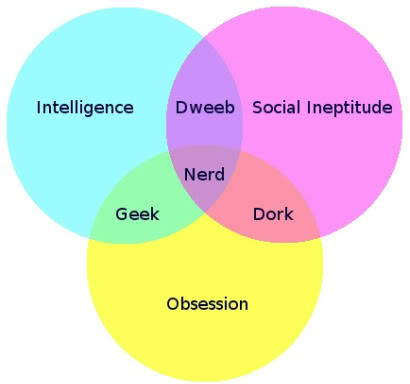
Yes, I have been a nerd all my life.  Now, keep in mind that there is a huge difference between a nerd and a geek.  Or a nerd and a dork. Definitely no dweeb, as this playful Venn diagram explains:

Source

The nerd in me remembers a whole lot of ideas and concepts, while maintaining a selective amnesia about people and events.  Thus, I remember about a play called Refund that was a part of the curriculum years ago in high school. Or, was it The Refund, I wonder.

A wonderful farce the play is, for which the setup is a chance encounter that two old high schoolmates have two decades after graduation.  A Google search provides me with the full text of the play; how about that!  Anyway, the setup is this--the protagonist, Wasserkopf, says:
Here I was walking along the street, fired from my last job, and wondering how I could get hold of some cash, because I was quite broke. I met Leaderer. I said, ‘How goes it, Leaderer?’ ‘Fine!’ he says. ‘I’ve got to hurry to the broker’s to collect the money I made speculating in foreign exchange.’ ‘What’s foreign exchange?’ I said. He says ‘I haven’t got the time to tell you now, but, according to the paper, Hungarian money is down seventy points, and I’ve made the difference. Don’t you understand?’ Well, I didn’t understand. I said, ‘How do you make money if money goes down?’ and he says, ‘Wasserkopf, if you don’t know that, you don’t know a damn thing. Go to the school and get your tuition fees back.’ Then he hurried away and left me standing there, and I said to myself, ‘Why shouldn’t I do that?’ He’s right, now that I’ve thought it over. 
Of course, the principal and teachers make sure he does not get a refund, by explaining that his bizarre answers are all correct.

I, too, want to get to get a refund because I, too, cannot fathom what the hell is going on with the Swiss Franc-Euro foreign exchange thing that has been in the news all day long.  Somebody made money and that wasn't me!  To add insult to the injury, when I read this in the Economist, it seemed to me that understanding theoretical physics will be immensely easier.  The WSJ tries to be helpful by dumbing things down, but that puts me only closer to asking for a refund of my fees.  Forbes makes it worse.

To this guy, whose favorite dreams are about money and taxes, well, I am sure he needs no refund, especially given his immense wealth.  I suppose I can console myself that my school fees at least paid for his understanding of all this money-mumbo-jumbo! ;)

Oh, wait ... does this mean that I was never a nerd but only a dork? ;)

Monday, September 22, 2014

I became a time traveler when I read about Einstein's "Time Dilation"

The mortal that I am, I have worries in plenty.  It is difficult to put into practice the wonderful words of wisdom from the old country of centuries past:

शोकस्थानसहस्राणि दुःखस्थानशतानि च ।
दिवसे दिवसे मूढमाविशन्ति न पण्डितम् ॥
- महाभारत, अरण्य

Everyday there are thousand reasons to feel sad, hundred reasons to worry.
Such things only bother fools; not wise men.
Mahabharata, Aranya

A fool I am!  Let us see when I become wise ;)

When I decided that I needed a distraction from what seemed like a growing mountain of worries, oddly enough it was not poetry that I turned to.  It was not music that I played.  Instead, I moused over to the Scientific American website.  I suppose there is always that old math and science nerd in me!

Even more interesting was this: Scientific American did not let me down.
Experiments at a particle accelerator have confirmed the "time dilation" effect predicted by Albert Einstein's special theory of relativity
What a wonderful distraction to read about this!

The nerd was curious now.  At least two clocks will be needed to compare the slowing down, which means the question was simple: where was that second clock?
 the researchers used the Experimental Storage Ring, where high-speed particles are stored and studied at the GSI Helmholtz Centre for heavy-ion research in Darmstadt, Germany.
The scientists made the moving clock by accelerating lithium ions to one-third the speed of light. Then they measured a set of transitions within the lithium as electrons hopped between various energy levels. The frequency of the transitions served as the ‘ticking’ of the clock. Transitions within lithium ions that were not moving served as the stationary clock.
The researchers measured the time-dilation effect more precisely than in any previous study, including one published in 2007 by the same research group. “It’s nearly five times better than our old result, and 50 to 100 times better than any other method used by other people to measure relativistic time dilation,” says co-author Gerald Gwinner, a physicist at the University of Manitoba in Winnipeg, Canada.
I have no idea what these people are talking about anymore.  The frequency of transitions serving as the ticking of a clock?  WTF!

But, that didn't stop me.  As an old Sanskrit couplet noted, the mind is the fastest mode of transport ever, and before I knew it, the mind had moved away from the website and was back in the old country.  I was a student talking and arguing physics with my old friend.

The worries are there, yes.  But, pleasant memories do help.

To live a life is, I suppose, to create enough pleasant memories that can sustain us through.  The third act of the drama of life is all that remains to create memories, and to overcome worries--which will only increase, I imagine.  I wonder what the future holds--if only the mind could travel into the future too!

Source

Sunday, September 07, 2014

Unfinished business ... I want to meet with those who ragged me!

The friend remarked a few days ago about unfinished business in one's life.  I have always known that there is one in my life that I would like to square away.

It is from a particular incident, from years ago in the old country.

I was as an excited seventeen-year old who headed out all the way from Neyveli to Nagpur, to join the Visvesvaraya Regional College of Engineering (VRCE) as it was called then, which is now the Visvesvaraya National Institute of Technology.

(Source)

The college had a lovely, spacious campus with trees and buildings woven together into a pleasing landscape.  Tea shops outside the college walls where students were hanging out was exactly the kind of ambiance I had pictured in my mind. 

A group of senior students, also from Tamil Nadu, treated my much older cousin—who was to help me with the travel and transition—and me very well, and I was confident that I had come to the right place.  I was having such a good time that all I could think was how friendly people were. 

My cousin had barely left for the railway station to return to Madras when one of the seniors suggested that I go with him.  He led me into a hostel room.  There were about seven or eight students sitting around an empty space in the middle.

Before I knew it, the seniors, who only about an hour earlier had been joking with me, turned out to be the dreaded raggers that I had often been warned about.  It was one of those “et tu, Brute” situations—I had no idea about the devils inside all the friendliness they displayed when my cousin was there. 

But, I had no time to analyze the situation as I was led to that empty space in the middle of the room.  I knelt down, as per the instructions, quite dazed, trying to figure out how to extricate myself from this situation.

Meanwhile, the group was getting impatient with me.  The guy who was closest to me--was his name Asokan?--slapped me hard over my left ear and repeated the instruction.  I was now even more shocked that I was being slapped for no fault of my own.   

There was no way I was going to carry out the orders--after all, I was the same guy who had tried, and continues to try, his best to resist authority.

Before I could process the instructions coming from all around, more slaps and more bizarre questions followed.  I was also made to understand that this was only the initial session and that there were quite a few more to follow. 

I endured one more day of this and then I packed up my stuff and left the college for good. 

After I returned home, a schoolmate, who even until today has no idea of the details, remarked that I could have easily handled the ragging, given that I was an avid reader of spy and war novels.   I wondered if the implicit understanding was that boys were expected to toughen up by reading stories where physical and mental tortures were the norm.  Or, was this remark a pathetic example of how our senses get dulled to such an extent that we fail to recognize acts of violence?

I have often wondered why I did not protest at the first minute itself.  Should I be ashamed that I did not stand up to them?  But then I remind myself that I was, after all, only seventeen.  Yes, way closer to seventeen than to eighteen. 

Every once in a while I think about those raggers.  Did they feel bad after I packed up and left?  Or did they laugh at how much a wimp I was, and that they were merely training me to be tough?  Did at least one among them feel a sense of remorse that they messed up my life?

I suppose there will always be a few humans who delight in causing misery to others.  It will be truly wonderful if the world were otherwise—where people exist not to harm but to help others.

That wonderful world surely did exist, in my mind, when I was a naïve and idealistic seventeen-year old.  And then it was slapped to pieces.  "All the king's horses and all the king's men | Couldn't put Humpty together again."

At the reunion, one of the classmates, Kishan, who was also at the same college for a brief while--a little longer than my stay--remarked, with laughter, to a few others who were standing around "ரகின்க்ல அவன் செம்ம அடி வாங்கினான்" (he was beaten up badly during the ragging) ... oddly enough, it was comforting to know that there was at least one person who knew about the violence.  But, it was, and is, absolutely creepy that he laughed about it :(

The reality is also that it does not take much to remind me about my experience.  Every minute of the day I feel the effect of ragging; the sharp stinging slap across my left ear apparently damaged the hearing mechanism.  A few years ago I started hearing chirping sounds from within my ear, and my physician said that those sounds are normally the first signs of hearing loss.  Now, my left ear is only about a third effective, and I can no longer locate the origin of the sound by triangulation, which means I sometimes end up looking in the wrong direction--a problem that, until now, I have been able to successfully camouflage in the classroom.

My doctor recommends that I consider wearing a hearing aid if I want to overcome that hearing loss, and I guess it is my vanity that prevents me from doing that.  I ask myself, well, if I can wear glasses for my eyes, then why not a device for my left ear, more so when the hearing loss was inflicted by somebody else? 

I would like to meet with those few, who will be middle-aged parents of children perhaps about the age that I was when they beat and tortured me.
I don't want them to apologize--I don't care for that, and never have.
I want to find out from them what they were thinking when they did what they did.
I want to know what they were thinking when they were informed that I had quit the college because of their actions.
I want to know whether they continued to rag students during the rest of their college lives.
I want to know whether they have thought about these in the decades since then.

A very strange piece of unfinished business, yes.

Saturday, July 05, 2014

On this sweet life ...

Many, many decades ago, back in school, there was an attempt, feeble as it was, to start Boy Scouts and Girl Guides.  I have no idea what the girls did, but we boys didn't do much though, once, we even went on a day trip--on our bicycles, as I recall.

I was never interested in camping and tieing tying different kinds of knots anyway.  But, there was one aspect that impressed me--a Scout maintained a daily list of socially constructive actions, which could include even acts like helping an old person cross the street.

Yesterday, I was a Boy Scout, who helped an old woman on the street.

I was barely out of the compound on the way to buy a jar of honey to go with the jackfruit that awaited me when a woman, who was perhaps in her late 70s and attired in the old traditions of the old country, stopped me.  "Do you know where number 7 is?" she asked me in Tamil.  Obviously, I had no idea.

But, I did not have the heart to merely tell her that I didn't know.  There was a look of desperation in her.  It is an awful feeling of being lost--literally and metaphorically.  When somebody points out the way or helps along, life becomes a lot more pleasant.

"I am not from here.  But, I will try to figure this out" I assured her.

It was amazing how much more relaxed she became in her facial expression.

"I have come to see "S" and his wife, who recently had an operation ..." she started.  I bet she would have told me her life story if I had allowed her to.

"They have two numbers here--an old number and a new number.  Is "7" an old one or new?" I asked her, fully anticipating that she would not know.  Of course, she did not know.

"Can you call "S"" she asked.

"Oh, I don't have a cell phone."

"I have a phone.  But, I don't know how to call."

"Do you have the number?"

"It is in the phone."

I cannot understand why corporations cannot manufacture and sell simple cell phones that older folks can use.  To make a simple phone call.  But, the cell phones and their gizmos end up terrorizing the older folks.

She handed me the phone.  Her genuine trust in me humbled me.  I live in a world where we are always suspicious of people and their motives.

I located a number for "S" and dialed it.  I gave her the phone.

"It is ringing" she updated me.  Soon she started talking with "S" and asked him where "7" was.

I walked with her to the street adress "7."  "Romba thanks" she said.  She was now an assured, calm, smiling face, unlike how she looked when she stopped me.

This boy scout earned his jackfruit with honey.  It tasted all the more delicious.


Tuesday, June 24, 2014

The world needs taxi drivers too

Decades ago, Robert invited us over to his place for dinner when his mother was visiting.  A hyper-energetic college professor he was, who liked to cook too.  Thankfully, he spared us from eating matzos and instead made dishes like molé, which was awesome especially when that was the first time ever for me!

After the initial introductions, it was time for friendly banter.  I asked Robert's mother whether as per the stereotype she was disappointed that her son did not go into a career in law or medicine.  We laughed.

Mike was yet another deviation from the stereotypical Jewish lawyer or doctor.  The well-read and well-informed Mike hadn't formally educated himself after high school and, instead, pursued his passion in machines and was a highly successful at it.  Mike once took us to the synagogue to which he and his wife belonged.  He introduced us to some of the people there--professionals and tradespeople across the economic spectrum, and not the lawyer/doctor caricatures.

In the rut that we often walk, we tend to believe that the paths to prosperity are not many.  In my old days in the old country, the dominant belief was that a life of struggles awaited those who did not go into engineering or medicine.  My fellow argumentative Indian at this blog is a wonderful example to prove otherwise.  But, habits die hard, I suppose:
As many as 38 students — six girls and 32 boys — of the Neyveli Jawahar Higher Secondary School, successfully cleared the Joint Entrance Examination (Advanced)-2014. They would be admitted to the Indian Institutes of Technology for the current academic year.
Chairman-cum-Managing Director of the Neyveli Lignite Corporation B. Surender Mohan felicitated the IIT aspirants at a brief function held at the Telugu Kala Samithi here on Saturday.
It is quite an achievement, yes, that so many from the same school gained admission to the prestigious engineering schools in the country.  Note, however, that the celebratory event was not held at the school but at "the Telugu Kala Samithi."  What's the connection?  This cultural organization had arranged for "coaching classes" for students.  I can easily imagine that the life of those students would have been nothing but hours in school, hours preparing for tests and exams, and then more hours at the coaching classes.  As long as it all works out for them; but, I worry that there is seemingly nothing done at all to encourage the growth and development of more than a one-dimensional human.

What do the rest of the students from that school do anyway?  After all, with or without coaching classes, not everyone will attend an engineering or a medical college.  
Turns out that the cosmos is always providing us with answers to questions.  It is just that often we are either asking the wrong questions, or are oblivious to the answers, or both.  Yesterday, I happened to catch one of those answers.

The taxi driver, a young man in his early twenties, seemed to be a tad hesitant about the roads and the routes.  "Shall I go via West Mambalam, sir?" he asked me.  I was sitting in the front passenger seat for the obvious reason--to get the blast from the AC vents ;)

"I have no idea" I replied and relayed the question to father, who greenlighted the suggestion. 

At the end of the round trip, when we were two minutes away from home, father asked him if he was new to town.  

"Yes, sir.  Only five months now."

"Where did you come from?"

"Neyveli, sir. Neyveli Township."

We all got excited that the young driver was from the place that has a special place in our hearts.  

"For more than twenty years we lived there" father said.  "All my children went to Jawahar School."

"You say children.  He looks at me and all he sees is an old man" I joked.  I had to.  Else, it is a boring one-dimensional life!

We wished him well as we got off the taxi. 

A Neyveli-born and raised taxi driver.  A couple of years ago, an artist from Neyveli.  How about that!

Sunday, June 15, 2014

Recalling my love for "Close Encounters of the Third Kind" is a Father's Day tribute?

It is one of my favorite movies ever.  It is not only because of the fantastic movie it is, or for how uniquely the movie depicted humans and aliens communicating with each other, for Dreyfuss' crazed and possessed looks ... But also because it is a reminder of a glorious time in my childhood.

I was a little more than 15 years old then, and after the written part of the National Talent Search exams, I was one of the few students invited to interview at the Madras campus of the Indian Institute of Technology.  Two other students from my class, Vijay and Krishna, had also gotten to this stage.  The prospect of the interview itself did not excite me as much as the thought that I would be at the fabled IIT campus for some serious, official, business.

Father took me to Madras--yes, that's how the city was called then.  We stayed at the home of my favorite uncle, whose sons were always a delight to hang out with ...

The following day was the big moment at IIT.  But, I didn't care about the interview, and was immensely excited playing cards and cricket with the boys.

The morning came.  We reached the campus and the interview site.

I knew I screwed up my chances because I messed up the first question big time.  If only I had the ability to forget the bad experiences! ;)

The first question was rather simple, compared to the later ones and even though I did well in the ones that followed, I am sure that the "golden duck" was how I lost the honor of the scholarship ... and that simple question was, "what is the maximum value of the tangent of an angle?"

Throughout my school life, my math teachers--right from the earliest days that I can recall--tried their best to help me understand that I needed to pause and think about the questions before I answered them, even when confident of the answer, only because of the remarkably silly mistakes I did while being in a hurry as if I were in a race against the devil.  But, stupid is as stupid does, as I would learn much later from Forrest Gump.  Thus, consistent with that track record of buzzing in the answer almost as a reflex action, I said "one."

That answer bothered me.  If only they had asked me "is that your final answer?"

But, they continued to toss more questions my way, including one where I was required to solve a problem on the chalkboard.  A green board it was, in contrast to the black boards I had been used to.

After I was done, and while exiting the campus, I realized the enormity of erring in that first question itself, which was the simplest of them all.

Perhaps father realized that I was kicking myself for my haste.  He did two things.  First, he took me to the beach.  We then walked over to a restaurant across from the road, where I ordered a cucumber/tomato sandwich.  And then he said we could go to any movie of my choice.  Which is how we went to "Close Encounters of the Third Kind." I think this was at the Satyam complex.

After the movie ended, and as we were exiting, father said, "I didn't understand anything there."

Thursday, June 12, 2014

The "student athlete" and the American university

After "five years and thousands of pages of filings":
The class-action lawsuit filed by lead plaintiff Ed O'Bannon -- a former UCLA star basketball player -- calls into question the long-held NCAA notion of amateurism and seeks an injunction that would effectively allow top men's basketball and football players to profit from their names, images and likenesses that are used in live broadcasts, rebroadcasts, video games, DVDs and more.
Of course, I am cheering the plaintiffs.  I would love to see the complete annihilation of the NCAA as we know it.  The whole college sports industry is an abomination, and an uniquely American one at that!

First, this excerpt:
Another course that I didn't like, but somehow managed to pass, was economics. I went to that class straight from the botany class, which didn't help me any in understanding either subject. I used to get them mixed up. But not as mixed up as another student in my economics class who came there direct from a physics laboratory. He was a tackle on the football ball team, named Bolenciecwz. At that time Ohio State University had one of the best football teams in the country, and Bolenciecwz was one of its outstanding stars. In order to be eligible to play it was necessary for him to keep up in his studies, a very difficult matter, for while he was not dumber than an ox he was not any smarter. Most of his professors were lenient and helped him along.
You will be surprised that the excerpt was not from this NCAA antitrust lawsuit.  It is from James Thurber's hilarious tales from his university days, almost a hundred years ago!

Sounds absolutely contemporaneous, right?

We read this Thurber piece back in high school in India.
Yes, back in India!
The India where we students, perhaps with the exception of that one guy, had absolutely no idea that the football in America was not the same football that we played.

But, I bet many of us could relate to Thurber's experience in the botany lab!  I was (and continue to be) awful with hand-drawing and, well, I "outsourced" to my good friend the drawings we were required to do for the biology lab work.  Somehow I didn't think it was unethical at that time, and now as a faculty I worry about my students outsourcing their work :)

The fact that I loved that humor even without the faintest idea of the nuances of American higher education system and the role that football has in it means that, well, it is no surprise that I am now a huge fan of the New Yorker magazine--the Thurber's kind of intelligent humor and cartoons continue on, even decades after Thurber exited the magazine and this world. 

I wonder how Thurber would have made fun of the NCAA! Well, there is always that other finest source to tickle my funny bone;)
Saying the student-athletes would have definitely become an enormous thorn in their side, officials from the NFL front office expressed their profound relief Tuesday that Northwestern University’s pro-labor activist football players will never make it to the pros. 

Friday, November 22, 2013

Poem for a cold November night. Cold day too!

Frosty has arrived on the rooftops and on the grass.  Two consecutive mornings of feeling blasted by the cold air when I ventured out to the front porch to get the newspaper.

The car's thermometer display said 27 degrees (not in Celsius!) when I left home yesterday for work.  This morning, it feels that the overnight temperature might have been down to 20 or even the high teens.  Way, way below the normal for this time of the year.  I suppose old man winter is poking his head early through the couple of leaves left on the trees.

It is this cold because it has not rained for a while.  The sky is clear--plenty of sunlight during the day, and moonlight streams in through the windows in the night.  Makes me fondly miss the grey, overcast, and rainy conditions because if we had those rains, the temperature would never dip this low.

Back in India, in high school physics, we learnt about how cloudy nights are warmer.  That was one of the many "theoretical" ideas that made me wonder why we didn't have more local, contextual examples to work with.  I recall another situation too, which was also about heat.  In that word problem, a guy orders coffee for himself and his friend, who is expected to join him in five minutes.  He adds cream to his cup of coffee, while the friend's coffee is black.  The question asked us to think about which cup would be the warmer of the two when the friend arrives after five minutes.

I had no problems working out the physics of cooling.  But, I could not understand why they made coffee that way--after all, I was only used to the traditional பில்ட்டர் காபி, which is something like the latte we drink here.  Perhaps it was me and my limited imagination, but back then I thought the whole coffee by itself was pretty darn stupid.  Even more confusing was the "cream" part; what the heck was that!

All because the book used examples from a cultural context that was alien to me.  Alien then.  Not strange anymore.  Now, I routinely drink black coffee, and buy cream or milk only if I have to take care of a visiting friend.

Back as a kid, "the weather outside is freezing" was also nothing but a theoretical understanding.  Now, I experience it, a lot more than I would like to.  It is almost as if I came here to this part of the world to do the practicals, as we referred to the lab work then, in order to understand the theory.


I scanned the web for poems that would tell the story of a cold night in November. I lucked out; here is one:
November Night
by Adelaide Crapsey
Listen. . .
With faint dry sound,
Like steps of passing ghosts,
The leaves, frost-crisp'd, break from the trees
And fall.

Tuesday, October 29, 2013

Four letter words in education. And life. Two of them, actually

Decades ago in the old country, when I was in my early teens, a couple--family friends--came to visit with us one summer evening. That was typical of the life then--friends dropped in for conversations and coffee.  After all, it was before the internet, before television, before cellphones, when it was rare to even have landlines at homes.  To visit with friends was the only way to keep in touch.  Almost always, visiting also meant long walks between the homes.

It was the beginning of the summer break and we kids hadn't yet taken off for the annual visit to Sengottai.  Or, perhaps it was one of those rare summers when we stayed put in town.  Bored as we were, even we young folks looked forward to visitors--there were only so many books one could read in a day, and so many fights one could fight with siblings! For the most part, I way preferred school days to those lengthy vacations because I was way less bored when school was in session.  And, of course, there were girls at school, and one girl in particular!

The couple had brought along the youngest of their three sons.  He was excited that he had completed "first standard"--first grade, as we call them here in the new country.  Father teasingly asked him whether he got the report card.  The kid vigorously nodded a yes. Which is when it got hilarious and so memorable that even after all these years, we laugh about that incident--especially when we meet with that family.

"பாசா பைலா?" father teased the kid.  (Did you pass or fail?)

"நான் பைலு" the kid replied right away. (I failed.)

We laugh, and laugh heartily, when we recall that நான் பைலு.

That kid is, of course, a kid no more as much as I am am decades past my teenage.  He is now a successful self-employed businessman in India, often traveling abroad to strike deals.

Those days seem a lot simpler as I now recall them.  We didn't care much about school, which perhaps reflects well on my parents more than anything else.  As long as we kids behaved well, there was nothing they worried us about.  Sure, we siblings fought--after all, that is an unwritten rule in life.  Even there, as long as we boys didn't strike the sister and as long as we boys had only mild fistfights, all was well.

"Try harder" was perhaps something we heard father say every once in a while.  But, mother never cared for what we did or we did not do in school.  What a wonderful way to approach life, instead of constantly nagging kids to do this or the other.

Now, the educator that I am, I try to get across to students many of those aspects of the life that I have lived.  It is not about passing or failing, but is about having tried with all sincerity.  "You want to make sure you gave life your best shot" I told a student yesterday when he met with me in my office.

Given our different abilities, we might do well in physics but not in music even when give it our best shot. Or on the track field. Or maybe in acting. Or cooking.

Perhaps we don't do well in anything at all, which, too, is ok.  We fail in life all the time. We fail in love. In marriage. In careers. Failures are also what life is all about.

Life is about recognizing the failures. Even laughing about them. Like how that innocent kid cared the least that he failed the first grade. (They didn't hold back kids, and automatically promoted them in those early grades.)

But, I worry that I come across as the oddball when I express such sentiments, especially to students, when the prevailing ethos is all about success, which is measured by the GPA. Where failure is not an option even for a kid.

Am all the happier that my childhood was in a different time period.

An unrecognizable teenage me with a few classmates

Sunday, September 08, 2013

"I don't want to live to be 90" ... "Today is a good day to die"

I called up an old high school friend.  Unlike me, he is a busy guy.  For that matter, practically everybody on the planet is way busier than I ever am.

After two attempts over the last month, I got him this time.  The third time is the charm rule, I guess.  "I am so sorry, boss" he apologized when I told him about the previous attempts.

His usage of "boss" reminded me of those wonderful, but angst-ridden, teenage years.  We talked about "back in the day" and laughed.  The advantage of the memories we share with friends and family is that we can laugh, or cry, over events and people that we both know about.  The lack of shared memories and, therefore, the need to create new ones, is also what makes forging new relationships extremely difficult as we age.

As we chatted, I inquired about his parents.  "Other than some minor health issues, they are doing well" he replied.  And he continued, "the reality is that we are at an age when any moment anything can happen to our parents and our worlds will turn upside down.  We have to be thankful that things are going well."

Indeed. This past year alone, fathers of a few school-mates, and quite a few deaths in the extended family as well.  They all lived long lives, their ages ranging from 80 to 102.  When death removes from our world the parents of our classmates, our parents have fewer and fewer numbers in their cohort and the mortality of parents becomes more and more evident.  By that same logic, our own mortality becomes far too real.

Of course, it is not merely my friend and I thanking the stars for a "normal day" and dreading that phone call that will, as he put it, turn our worlds upside down.  And when that moment comes, it will be one tough decision after another to make:
A generation of middle-aged sons and daughters are facing this dilemma, in an era when advanced medical technologies hold out the illusion that death can be perfectly controlled and timed.
The other day, I perhaps shocked a friend when I said I want to be over and done at 75.  I have experienced a good life, have seen quite a bit of this world, and have met a mix of good and bad people.  A quarter century more seems a luxury at this point.  And when that end comes, I look forward to a good death, without machines and tubes and chemicals to keep me "alive."  I,  therefore, all the more relate to this:
Why don't we die the way we say we want to die? In part because we say we want good deaths but act as if we won't die at all. In part because advanced lifesaving technologies have erased the once-bright line between saving a life and prolonging a dying. In part because saying "Just shoot me" is not a plan. Above all, we've forgotten what our ancestors knew: that preparing for a "good death" is not a quickie process to save for the panicked ambulance ride to the emergency room. The decisions we make and refuse to make long before we die help determine our pathway to the final reckoning. In the movie "Little Big Man," the Indian chief Old Lodge Skins says, as he goes into battle, "Today is a good day to die." 
Why, yes, even today would be a good day for me to die.  I walked by the river on a gorgeous sunny afternoon. As I neared my front door, my neighbor offered me a chocolate cupcake.

I made myself "puli aval" (புளி அவல்) that I had been drooling for a while.  My first ever attempt, in all these years, to make it.  It tasted nowhere near what my brain remembers from my years of eating the version that mother made.  But, hey, I tried.  What is life if we did not try! I enjoyed eating that crappy version I made, while sitting on the patio and listening to the sounds of life all around me.


I traded emails with a couple of friends who are always keen about my welfare. I talked at length with my parents.

"Today is a good day to die."

In our modern world, we casually toss around the phrase "you only live once," and justify stupid drunken behaviors with a hashtag YOLO and follow it with LOL.  That is far from what life and death are about.  We have forgotten how to respect and appreciate death and, thereby, how to respect and appreciate life itself.  
 From the plagues of the Black Death through the 19th century's epidemics of typhoid, childbed fever and tuberculosis, they helplessly watched people die, from youth to old age. By necessity, they learned how to sit at a deathbed and how to die.
Ask yourself whether you will be ok with the grim reaper knocking on your door tonight.  If "today is a good day to die."   If not, then the logical follow-up question is what exactly do you want to get done before that moment arrives, right?

Wednesday, August 28, 2013

Rare is a government school alum among the Indians in America?

The school that my father and his brother attended in the small village of Pattamadai was established by a family and was a private school.  Even back in those days, they had to pay fees, which was not affordable for many.  Not that grandmother was rich.  To make things worse, she was barely 18 when she was widowed with a two year old and a two-month old, and had to be ultra-careful with how she spent the assets.  (Thus, my father did not even have footwear until he was in high school!)

Literacy was expensive, and was a privilege that only the middle and upper classes could afford.

An independent India understood the importance of education and literacy and established government schools.

In the town where I grew up, we siblings went to a private school. Whenever we kids teased grandmother about her not knowing anything in English, her humorous comeback was (in Tamil, of course) "I didn't pay fees and study in an English-medium school."  Her schooling until the fourth grade was in Tamil.

Thanks to the British, English had become the language of commerce and government in the Subcontinent and, therefore, there was a recognition early on that schooling with English as the medium of instruction might payoff.  At the school that I attended, English was the instructional language.  Some teachers were maniacal enough about English that they faulted us kids if they overheard us chatting in a language other than English.

Horsing around by the playground during the high school reunion, 2011

However, government schools often tended to instruct students in the local vernacular, of which there are plenty in India. Thus, in Tamil Nadu, Tamil was often the medium of instruction in government schools, with a few rare ones offering an English-medium option.

Over the decades, English has gained even more ground as the global language of commerce and science, and the poor in India, too, are acutely aware of it.  They then face roughly two options: send their kids to government schools or to private schools.  The former almost always in the local language and also at atrocious quality, whereas the private schools promise better quality and, more importantly, with English as the instructional language.

Is it any surprise that even the poor choose to send their kids to privately run English-medium schools?
In rural India, 24 to 40 percent of children are enrolled in private schools. In poor urban areas, the figure is at least 65 percent. These low-cost private schools provide even the poorest parents value for their investment. (To give just one example, they are much likelier than government schools to provide instruction in English, a skill that can raise hourly wages by 34 percent.)
This news is not new, really; studies have often reported similar decisions that even the poor in India make:
Researchers tracked 3,000 children who were randomly selected from different social and economic backgrounds in Andhra Pradesh.
They found that in 2002 about one quarter (24 per cent) of seven and eight year olds attended private schools, but by 2009 the rate had almost doubled to 44 per cent.
The study suggests that the trend is fuelled by the availability of low fee-paying private schools, and the perception among parents that children will make better educational progress in private schools.
Parents said they valued English-medium teaching offered by private schools, whereas government schools mostly teach in the regional language, Telugu, the statement added.
The poor--even when illiterate--know the value of a good education for their kids, as I noted in this post from more than three years ago:
many of the schools Tooley visited were tucked away in poorly lit, dilapidated, smelly buildings without toilets, and teachers there did lack government training certificates, and were paid less than in the public system. But Tooley found that in low-cost private schools, across the board, classroom sizes were smaller, and teachers were much more likely to be found teaching during an unannounced visit. They are also achieving better results: the students in private schools outperformed their public school peers in nearly every subject they were tested in.
When there are such consistently strong trends, then one might wonder why the market hasn't jumped on this opportunity.  Schumpeter's column, a couple of months ago, in the Economist was about this very issue:
That poor parents will pay for something the state provides free speaks volumes. India’s state schools pay their teachers far more than private ones, yet they are often worse. Surveys suggest that a quarter or more of government teachers are absent at any given time. Unions prevent the authorities from disciplining slackers or rewarding good teachers.
The willingness of poor parents to pay is also a sign of something more positive: ordinary Indians’ passion for education. Slums like Brahmpuri are full of garish advertisements for makeshift computer-training colleges and English schools. (Workers who are fluent in English earn 34% more than those who are not.) 
Politics and teachers unions make for a nasty combination anywhere on the planet, I suppose.  As Schumpeter notes there, the healthcare industry in India, on the other hand, innovates to serve the domestic and foreign demand.

India's polity recognized this and, as with everything else, they came up with a quota system!
Many of the world's top private schools offer scholarships to smart poor kids. But India's plan is more sweeping: It reserves a quarter of admissions for underprivileged kids. Rules prohibit admission-testing of students, rich or poor, although private schools can set some parameters, such as nearness to the school or gender.
But, a mere quota system does nothing to level the playing field:
One recent morning, teachers Sujata Gupta and Shilki Sawhney asked their class of 4-year-olds to name examples of purple things. The rich kids shouted out "blackberries," "blackcurrant ice cream" and "potassium permanganate," a chemical used to clean fruits and vegetables.
None of the seven low-income kids raised their hands. Unlike the wealthier children, they hadn't learned their colors at home, spoke no English, and were further confused by examples of things they had never heard of.
The teachers, repeating everything in Hindi for the poor kids, then asked anyone wearing a purple T-shirt to stand. Nitin Raj, saucer-eyed and wearing green, rose.
"He's not understanding at all," Ms. Gupta said.
Not to forget that India being the India, class and caste matter a lot even after all these years!:
 Resistance has also come from some private school parents. School officials in New Delhi who asked not to be named told of parents requesting that their children not be seated next to poorer classmates or telling their children not to befriend poorer students.
Sunil and Elizabeth Mehta, who run Muktangan, a nonprofit group that provides English-language education to 1,800 poor children in public schools in Mumbai, said that if parents were made aware of the importance of expanding access to quality education, prejudices would eventually melt away.
“People are socially sensitive if something is explained to them,” Mr. Mehta said. “But you can’t expect them to change right away.”
Nope. Change does not happen overnight. It is a slow incremental process.  But, the good thing is that change is happening.         

It is such complications in India that Americans fail to notice.  But, I don't blame my fellow citizens and our leaders.  After all, they only get to see the successful Indians--here in the US or back in India--and very, very rarely is any of the success stories a product of a government run school in India.  If only politicians here in the US would understand that people like me do not represent the average person in India.

Sunday, May 12, 2013

On Mothers ... wisdom from the old country

A continuation of sorts of the posts over the years.

Growing up in India, there was no concept of a special day for mothers.  Or fathers.

In my initial years in the US, the concept of wishing mother or father seemed strange.  Very odd.  The idea of wishing on a designated day is the strange part that is, not the idea of recognizing the mother's importance in life.

I would imagine that mothers were way up high in pretty much every culture's list of important people, and the old country emphasized it in so many different ways.  A long, long time ago, we learnt a verse in the Sanskrit class in high school:
राजपत्नी गुरोः पत्नी मित्रपत्नी तथैव च
पत्नीमाता स्वमाता च पञ्चैता मातरः स्मृताः
- चाणक्य नीति

Transliteration:
raajapatnI guroH patnI mitrapatnI tathaiva cha
patnImaataa svamaataa cha pa~nchaitaa maataraH smRutaaH
- chaaNakya nIti


Meaning of the subhAShita:
The king's wife, the teacher's wife, friend's wife, wife's mother and his own birth mother - these 5 should be deemed as mother figures
The source from where I copied and pasted it has a commentary on the deeper meanings of this verse.

I have had an incredibly lucky life with wonderful motherly women.  As I noted in this post, my mother, grandmothers, and aunts, made sure that my life was sweet--literally as well.  Older friends here in the US sometimes treat me as their son.  Life can't be that bad then.

Incidentally, another verse advises to keep mothers, fathers, and teachers also happy.  I hope students in my classes are reading this post ;)  It is from Manusmriti--the Laws of Manu--which is about 2,000 to 2,500 years old.  Manu wrote:
तयोर्नित्यं प्रियं कुर्यात् आचार्यस्य च सर्वदा ।
तेष्वेव त्रिषु तुष्टेषु तपः सर्वं समाप्यते ॥
- मनुस्मृति
One must do all he can to keep his parents and teacher happy. 
If they are satisfied it is equivalent to any (all) penance.
- Manu Smriti
It has been thirty-plus years since my last Sanskrit class.  It has at least served one purpose--I continue to remember and value the verse on the five mothers.


Wednesday, March 06, 2013

On this absurd life!

Decades ago, my best friend from high school proceeded to study physics in the Soviet Union.  Yes, that long ago where there was a big USSR on the maps!  In one of his earlier letters from there, he mentioned something being a Sisyphean struggle.  We went to the same school and here was this guy using words that I didn't know.  It is amazing how we can have forty kids in a classroom and how every one of us can come out with different experiences.  Somewhere, somehow, he had picked up on Sisyphus; what was I doing in school, right?

Anyway, as soon as I finished reading the letter, I was off to discover and understand the word "Sisyphean."

Since then, I have not lost track of that phrase nor that idea.

Perhaps I am reminded of that now because we are into the final stretch of the term.  The Sisyphus me has rolled the boulder almost to the top.  The boulder will start rolling down as the term ends.  And then, I get to do it all over again.  And again.

But, here is where I find Camus' take absolutely refreshing.  It is not a struggle at all.  I look forward to the term ending and then a new one beginning.

In the years past when I used to at least sit in on meaningless faculty meetings and conversations, the chit-chat often included colleagues remarking about how they were looking forward to the term coming to an end, or the academic year ending, and I would feel puzzled.  And, sometimes feel sorry for them feeling so trapped doing a job from which they constantly seem to dream of escaping.  Theirs was truly a Sisyphean struggle.

I almost always feel sad when the term ends because the ending comes just when I am beginning to know the students and understand what gets them and what doesn't. Two days ago, in one of my classes, I quoted Shakespeare's "parting is such sweet sorrow."  

But then, it is a wonderful lesson to remind me of the impermanence that our existence is.  As much as students come and students leave, we are born and we die.  In such a framework, the Sisyphean struggle is not about the boulder rolling down, but about Sisyphus finding happiness and contentment with what he does.  It is about me as the instructor beginning a term and ending it while being happy and content even as I know that I will be repeating this process all over again.

I am perhaps beginning to understand why my mother didn't think she has a raw deal in having to get up everyday thinking about what she was going to cook, and what chores she was going to do.  Not in the conventional thinking, but in a Camus' interpretation, hers is a Sisyphean contentment and happiness in doing pretty much the same thing day in and day out.  She was not cursed nor condemned to that punishment.

Pushing the rock up only to watch it roll down as we near the top is then not as absurd as it might seem.  Life  is what happens between birth and death.  In the initial stages, we learn to push the boulder.  And then we push, it rolls down, we push, it rolls down.  It is up to us to find happiness in this process.  If not, well, we die unhappy and miserable.

I, have no plans to die unhappy or miserable.

Friday, November 23, 2012

Remembrance of things past: The beat goes on ...

Trading emails with the usual suspects, R and S, means that there are enough and more reasons to think about life that was three and four decades ago.  Sometimes, when I think about the days past, I do worry whether that old adage is true: the more we look back means that there is less to look forward to.  I hope not!

Remembrance of things past can be a blessing or a curse, depending on what the mind recalls.  I am thankful then that I do not have to worry about hyperthymesia!

Anyway, primarily thanks to S, and partly because it is almost a year since the school reunion, in the process of thinking about a few classmates I ended up recalling how Prasad often entertained us with his percussion skills.  With his fingers and palms rhythmically beating against the rudimentary wooden desk, he easily entertained us with popular beats.

BoneyM's Rasputin and  were his specialty, and we often requested him too:
The other one was a Hindi song, which was a trailblazer in a number of ways:
Prasad was not at the reunion; I am sure he is enjoying the beat somewhere!

Ah, memories!

Friday, September 07, 2012

The French have some 'gaul' to expel the Roma!

A little more than an hour into the drive after landing in France, I spotted a marker along the road that said something about one of the important battles with the Romans having been fought there.

Romans fighting in a corner of France and not being able to win it over?  Could this be Asterix's and Obelix's territory, I wondered.  But, wasn't I in a different part of the country and not in in the Gaulish Village?  I didn't want to request "S" to backtrack so that I could take a photo of that road-sign. 

We reached home, and settled down to catch our breath.  In the morning, I wandered into the kitchen, while the rest of the household was asleep, and made myself an espresso to go with the delicious chocolate croissants that were calling me.

Which is when I spotted two figurines: Asterix and Obelix.  So, I hadn't misunderstood the sign by the road. Yay!  

 In the old, old days before India liberalized its economy, anything "foreign" was very rare among us kids, and Asterix comic books was a special rarity.  If ever any classmate managed to get a copy that seemed to materialize out of nowhere, every once in a while, then it quickly passed from one hand to another.  We read it even in class, during the breaks, and after school.  Sometimes we read the same comic book a second or third time.  


High school ended, and thirty years later I was in that fabled comic book geography?  Yay!

The familiarity with the comic book characters meant that the first thought I had when I spotted this editorial cartoon was, hey, they have drawn Obelix while calling it Asterix!


My second, and a more substantive, reaction was about the gypsies--the Roma.  One of the classmates with whom I have read and discussed the Asterix comics was Srikumar, who now works with/for the Roma people in the Czech Republic.  

I have noted earlier, too, France's casual treatment of the Roma.  Was there something in the news for this editorial cartoon to have popped up?  Yep:
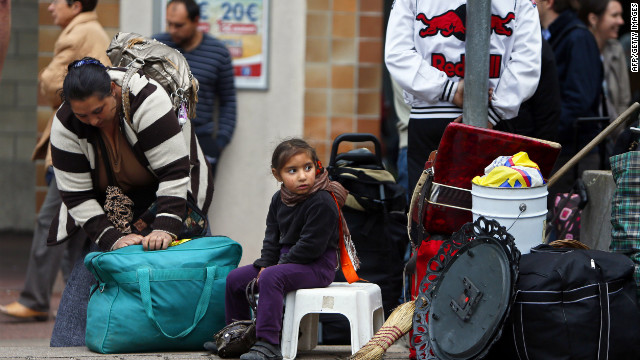
French Interior Minister Manuel Valls ordered police early Monday to dismantle a Roma camp set up along suburban railway tracks in Evry, south of Paris, and expel 72 inhabitants, including 19 children.
It is a controversial decision for President Francois Hollande's Socialist Party, which attacked former President Nicolas Sarkozy when his party dismantled Roma camps around France in 2010. Since the beginning of August, five camps have been dismantled under Valls' directive.
 An interesting coincidence it is that the CNN story carries a byline of Dheepthi Namasivayam, which reflects a Tamil heritage.

The Wall Street Journal adds:
Mr. Hollande's government has gone to great lengths to distinguish itself on social policy from Mr. Sarkozy, who served as interior minister before becoming president in 2007 and made law-and-order crackdowns a signature of his governing style. But breaking up Roma camps and offering financial incentives for repatriation appears to be a continuation of the initiatives of Mr. Sarkozy, whose mass expulsion of foreign Gypsies sparked an outcry in France and a row with the European Commission, the European Union's executive arm.
At the time, European Commissioner for Justice Viviane Reding called Mr. Sarkozy's policies and a government circular singling out Roma a disgrace and initiated legal proceedings against the country. Ms. Reding has weighed in on the latest evictions, though she has welcomed France's cooperation and the government's pledge not to target any particular group.
"The Commission will follow the developments in France very closely," she wrote in an op-ed published in Thursday's Libération. "There are 12 million Roma in Europe, who, like us, are at home in Europe. It is our responsibility to help them integrate."
To rework Obelix's favorite phrase "Ils sont fous ces romains," I suppose the French are simply insane!  Oh well, if only we could all get along ...