Showing posts with label war. Show all posts

Monday, October 19, 2020

War and Peace

Back in January 2019, I wrote this about David Shulman:

I am stumped at everything that Shulman offers.  A guy who was born in Waterloo, Iowa, who immigrated to Israel, seems to know more about Tamil than all but a handful of the 80 million Tamil-speakers put together!

A polyglot Shulman is.  In addition to English and Hebrew, "he has mastered Sanskrit, Hindi, Tamil and Telugu, and reads Greek, Russian, French, German, Persian, Arabic and Malayalam."

Which is why Shulman comfortably writes that one of the most powerful interpretations of the Mahabharata was written in Malayalam: "By far the most powerful such interpretation that I have read, Wandering the Mahabharata, was written in the South Indian language Malayalam by a maverick scholar, Kuttikrishna Marar"

We are all better off thanks to scholars like Shulman who interpret history and old texts for the vast multitude of us who are barely literate in one language.

Shulman's essay is about a recent book on the Mahabharata.  The first paragraph alone blows my mind on how fluent he is with various aspects of life in the Subcontinent, in addition to his mastery of the epic itself:

The Mahabharata, the great Sanskrit epic, is a fiery, dangerous book. One is not supposed to keep a copy in the house, lest it burn down. And it is dangerous, perhaps fatal, to read it from beginning to end, in linear sequence. Similarly, translating it from Sanskrit into another language, beginning at the beginning, is not recommended. The classical Telugu version from South India has three authors; two died during its composition.

More than a year ago, when I helped my parents move, and when my parents were donating and getting rid of many of their possessions, my father complained that nobody will want his copy of a scholar's interpretation of the Mahabharata--for the very reason that Shulman notes.

Shulman weaves his phenomenal understanding of the Subcontinent when reviewing Until the Lions: Echoes from the Mahabharata.  After listing works that interpreted the epic in innovative and powerful ways--I have no clue about any of those!--he writes:

But surely the most lyrical of all such attempts to see the Mahabharata through the eyes of its characters is the remarkable dramatic poem Until the Lions by the Kerala-born, Paris-based poet, dance producer, and librettist Karthika Naïr.

She has given her book an appropriate subtitle: “Echoes from the Mahabharata.” The thirty haunting, heartrending chapters, in a wide range of forms and styles, resonate powerfully with one another; together they offer a text clearly meant for live performance, in oral recitation—or rather incantation—and in dance. ...

The poems of Until the Lions are graphically typeset on the page so that they seem to be dancing, a celebration of visible sound. Karthika plays with metrical modes—canzone, rima dissoluta, the Panjabi Sufi acrostic form known as Si Harfi, and the Tamil andadi, in which each new verse begins with the final syllables of the previous one.

Read the entire essay.  If you are like me, after reading it, you too will immediately place an order for the book from your favored retailer.

I will end with this nugget from Shulman on the continued relevance of the Mahabharata:

[This] two-thousand-year-old book is, in a way, a template for Indian civilization; it remains as vital and relevant today as it ever was, and not only for South Asia. The apocalypse it describes is something all too human, driven by greed, egotism, spite, and the usual phoney fixation on the glories of dying in war. 

Sunday, January 05, 2020

Bomb,bomb, bomb | Bomb, bomb Iran

Ever since tRump started campaigning, I have been blogging here and telling anybody who wanted to listen to me that he merely crudely distills the same message that most of the Republicans have always expressed more euphemistically.  Every once in a while, even those "statesmen" let their guard down and adopted a tell-it-as-it-is, which is tRump's winning electoral approach.  One of those was about Iran.

Unlike President Obama and the Democrats who wanted to to work a way out of the hostilities, most Republicans were hell bent on bombing Iran back into the stone age.  It was such a sentiment that then candidate Senator John McCain expressed when he sang about bombing Iran.  Recall that campaign moment?

tRump is making that Beach Boys cover song come true!

As a wimp, a wuss, a pacifist, war is never on my mind.

Of course, as most young boys are, I too was once fascinated by wars and battles.  Back in grandma's village, I eagerly listened to what later turned out to be exaggerated accounts of an extended family elder's service in the military during the Indo-Pak war that birthed Bangladesh.  As a teenager, I read books and watched movies that were set in the context of WW II.

And then I grew up.

It started with the excerpt from All Quiet on the Western Front that was required reading in school.  Suddenly, war began to make no sense.  Mohandas Gandhi's pacifism appealed a lot more to me.  But, it was not any immediate Damascene Conversion to pacifism.  I continued to oscillate back and forth through my late teens and early twenties.

By the time of the Iraq War during the first Bush presidency, I was a committed anti-war nutcase.  And have been since.

Reading Ernest Hemingway and re-reading Joseph Heller and others cemented my pacifism.  War is hell. So much so that even movies that featured violence appealed less and less to me.

But, wars continue. Wars are good for business and politics.  There are now new chants for yet another war against yet another country in the Middle East that has been in the Republican radar for a long time.  That context compels me to blog about war and peace.  There are others who tweet about their direct experiences, like this lengthy thread (and the comments there that I urge you to read.)

Saturday, November 10, 2018

War is hell

Back in high school, one of the essays that we read was an excerpt from Erich Maria Remarque's All Quiet on the Western Front.  It made an impression on me--enough that I am blogging about it forty years later!  The horrors of World War I and the anti-war sentiments in that essay appealed to the pacifist in me.

Much later in life, I read Hemingway's A Farewell to Arms.  This too was set in the context of World War I.  And, a lot more emotional and moving anti-war statement it was, as I have blogged here.

Tomorrow--the 11th--will be the 100th anniversary of the 11th hour on the 11th day of the 11th month when fighting ended with an armistice.  The world has witnessed a lot more wars since that war to end all wars.

Hemingway channeled through his characters about the insanity of wars:
"There is nothing as bad as war. ... When people realize how bad it is they cannot do anything to stop it because they go crazy.  There are some people who never realize. There are people who are afraid of their officers. It is with them the war is made"
"I know it is bad but we must finish it."
"It doesn't finish.  There is no finish to a war."
"Yes there is."
Passini shook his head.
"War is not won by victory. ... We think. We read. We are not peasants.  We are mechanics.  But even the peasants know better than to believe in a war.  Everybody hates this war."
"There is a class that controls a country that is stupid and does not realize anything and never can. That is why we have this war."
"Also they make money out of it."
Catch 22 was another anti-war work, though it was set during a war that happened a half-century later, in a completely different geographic and political context.
... Outside the hospital the war was still going on.  Men went mad and were rewarded with medals.  All over the world, boys on very side of the bomb line were laying down their lives for what they had been told was their country, and no one seemed to mind, least of all he boys who were laying down their young lives.  There was no end in sight. The only end in sight was Yossarian's own ...
Here's to hoping that peace will soon prevail--well before the proverbial eleventh hour--in places like Yemen and Syria where wars have been ongoing for a few years now.


Thursday, August 30, 2018

The killing poppy fields: Exit stage left

I wish John Oliver would devote one of his shows to Afghanistan.  You know, the country that the Soviet Union fucked up for a while, after which the Taliban screwed for a while, and finally leaving it to the US to have some jolly good fun. 

Yes, that Afghanistan!

As I noted in my op-ed back in 2008, the Soviet Union rolled into Afghanistan in December 1979, making it one awful year; annus horribilis, as I refer to it.  The countries with the international geopolitical events that year continue to be involved in geopolitical issues even now: Afghanistan, Iran, Iraq, Pakistan, and Saudi Arabia.

In everyday life, chances are that most Americans have completely forgotten about Afghanistan.  If only they knew about how much the Taliban has been winning friends and influencing people!
The Taliban have long had a powerful presence in Pakistan, where its leadership is based. In addition, both Iran and Russia have been providing some Taliban units with logistical support. It’s notable that, in parallel to the intensified military campaign, the Taliban has ramped up its diplomacy. In August, the group sent delegations to Uzbekistan and Indonesia, and Taliban representatives are frequent visitors to China.In early September, the Taliban is also sending a delegation to Moscow to take part in a conference on the future of the region convened by President Putin, who is now taking on the part of Afghan peacemaker. The US was invited but, needless to say, neither Washington nor Kabul will attend. In many countries, it seems, the Taliban are being met with open arms—and as the future victors of a war whose conclusion all now judge foregone.
putin, of course, never lets such opportunities slip past him. 
What is happening now is deeply reminiscent of how the Taliban conquered the country in the first place, during the 1993–1996 period that followed the Soviet withdrawal. In that campaign, the Taliban first secured the countryside, recruiting soldiers widely and offering the rural population the false promise of an end to the civil war even as they extended the fighting. ...  For Afghans, this present predicament is indeed a miserable moment. It appears that the international community is giving up its nation-building efforts and shifting its focus to opening relations with the Taliban. Seemingly forgotten in foreign chancelleries is how the first age of Taliban rule destroyed the country and deprived the population of economic opportunity, civil liberty, and education.
But, hey, it is not like the US really cared about Afghanistan anyway!  Why should we care for a country where men wear turbans and women wear hijabs and niqabs, right?
Unlike Vietnam, though, there are no mass American casualties, no draft, and no peace movement for the military planners and political decision-makers to contend with. The melancholy fact is that the American public is not much engaged with what happens in Afghanistan, either way. 
Mission accomplished! :(


Tuesday, March 20, 2018

March Madness

This is not about the scandalous NCAA basketball fuck-offs.  Nope.  It is about something that is immensely more important that we apparently do not care about.

It is about this: War!

In recent years, the US launched on March 19th not one war but two.

In 2003, the draft-dodging bush/cheney combination engaged in a massive propaganda campaign to fool us Americans into going to war against Iraq.  We destroyed the country, from which recovery does not seem likely for a while.
No one knows for certain how many Iraqis have died as a result of the invasion 15 years ago. Some credible estimates put the number at more than one million. You can read that sentence again. The invasion of Iraq is often spoken of in the United States as a “blunder,” or even a “colossal mistake.” It was a crime. Those who perpetrated it are still at large. Some of them have even been rehabilitated thanks to the horrors of Trumpism and a mostly amnesiac citizenry. (A year ago, I watched Mr. Bush on “The Ellen DeGeneres Show,” dancing and talking about his paintings.) The pundits and “experts” who sold us the war still go on doing what they do.
And then in 2011, the Nobel Peace Prize recipient Obama led the US from behind when he lobbed missiles at Libya. 

When the US and NATO forces got ready to strike against al Qaeda and the Taliban forces in Afghanistan, I half-heartedly supported it.  There was no doubt that the Taliban and al Qaeda were evil, especially for the people living in Afghanistan.  Though, it seemed to me like the war was in haste and that we might be better with a little more planning, I supported it even as the specter of the Soviets, the British, the Greeks all loomed large in the background.

When bush, cheney, and rumsfeld started beating pretty loudly the war drums to invade Iraq, I was completely opposed to it.

I recall watching on television Colin Powell's presentation at the United Nations and feeling sick in my stomach.  Harry Belafonte was correct!

As the war drums got louder, my colleagues at my new place of work here in Oregon decided that they would collect money to publish a peace petition in the student newspaper.

Despite my intense anti-invasion pacifist sentiments, I did not sign the peace petition and nor did I contribute for the advertisement expenses.  I hadn't yet been tenured and, yet, was firm about not signing on with the rest.

A couple of years ago, I found the petition on the bulletin board and made a copy for myself.  It was interesting to note that somebody had scribbled there about 9/11--perhaps a student who supported the war, and I continue to have a strong urge to convince that scribbler about a lack of connection between 9/11 and Iraq.
There was only one other colleague in the division at that time who didn't sign on that page, and he dissented because of his affiliation with, and support for, the GOP.  In my case, political party affiliation has never been a factor, nor was I in favor of the war.

I was not a signatory for a very good reason.  Not because of the phrasing, which is indeed a poorly constructed argument, especially considering the number of PhDs involved in the effort.

Unlike my faculty colleagues who apparently thought their duty ended after such a rhetorical display, which would have impressed only a few gullible students, I thought I ought to work on helping a few more students and members of the public understand about Iraq, the Middle East, and Islam.  As an academic, I have never been convinced that signing peace petitions is the best way I, or most academics, can contribute to society.  To join the academy is to think and inquire, which then means that by sharing the products of inquiry with students and the public we can contribute--a lot more than by signing petitions.

Meanwhile, the maniac in the Oval Office, who was the choice of 63 million voters and who dodged the draft citing his bone spurs, is itching to go to war and show that he is the manliest of men.

The madness continues!

Saturday, August 05, 2017

Our own moral awakening

More than a year ago, I received a letter from a then 96-year old woman--"a member of the WWII generation."  She wrote in the letter, which was in response to my op-ed on homelessness in America:
You and no one living in the USA at this moment would be where he or she is if my generation had not made it possible.  That includes the dropping of the bomb.
This pacifist hates wars. Hates conflicts. The older I get, the less I am able to tolerate fights and destruction even in movies.  Therefore, it is always jarring to me when people defend the destruction to civilian life and property from the bombs that were dropped in Hiroshima--on August 6th--and three days later on Nagasaki.

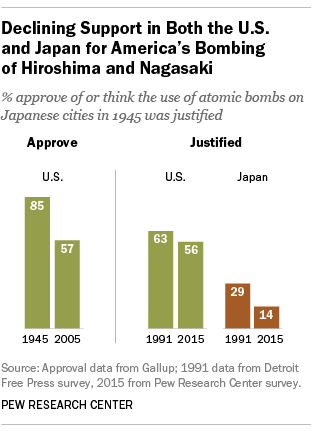
The interpretations of the historical happenings are conflicted.  I am biased; I believe that the war could have, would have, been brought to an end without America flexing its nuclear muscles. My preferences for peace are why I find it discouraging that there is a majority in America that agrees with the letter writer regarding the bomb:

Source

A year ago, Obama visited Hiroshima, ahead of the anniversary of the tragic event.  In all these years since 1945, Obama was the first sitting president to visit the Hiroshima Peace Memorial.  In a moving speech, Obama noted how the world changed since "death fell from the sky" on that cloudless August morning in Japan:
Those who died, they are like us. Ordinary people understand this, I think. They do not want more war. They would rather that the wonders of science be focused on improving life and not eliminating it. When the choices made by nations, when the choices made by leaders, reflect this simple wisdom, then the lesson of Hiroshima is done.
The world was forever changed here, but today the children of this city will go through their day in peace. What a precious thing that is. It is worth protecting, and then extending to every child. That is a future we can choose, a future in which Hiroshima and Nagasaki are known not as the dawn of atomic warfare but as the start of our own moral awakening.
These are dark times.  But, one has to be hopeful; what other choice do we have.  Here is to hoping that despite the effects of the fateful elections this past November, we will get on to the path of our own moral awakening--sooner than later.


Monday, June 26, 2017

The World According to Saudi Arabia

Five weeks ago, I included the following photograph in this post:

,
That NY Times photo ran with the caption: "A woman with cholera was treated at a hospital in Sana, Yemen, on Sunday."

Yes, cholera!

Over the five weeks, the president made a triumphant return to the country after having gained even more confidence from touching the orb.  Saudi Arabia, which is one the main reasons why Yemen is in a completely messed up state, also gained in confidence from the president touching the orb, and decided to let Qatar and Iran know who the big dog is in that part of the world.

Meanwhile, nobody cared about Yemen.

Is it any surprise that things have become worse, as if that is even possible?
Seized by violence and teetering on the edge of famine, Yemen is grappling with another danger that threatens to outpace them both: cholera.
"We are now facing the worst cholera outbreak in the world," international health authorities said in a statement Saturday.
Cholera is one of the easiest to stop, if you think about it.  Right?
The disease should not be so ferocious. Preventing cholera is pretty simple in theory: wash your hands with clean water, drink clean water, and eat food that has been boiled or cooked.
But ...
But clean water in Yemen is a luxury. Municipal workers in Sanaa have not been paid in months. And so we have no electricity, rubbish piling high in the street, and a crippled water system.
The sewer system stopped working on 17 April. Ten days later, cholera hit.
How terrible!
Yemen now suffers three-way tragedy: a population under siege, suffering the violence of war and unable to work or access nutritious food or health care; an economic collapse that has led to a rise in criminality; and now a devastating health crisis.
This all leads to what could be the largest cholera outbreak of our lifetime.
America couldn't care, even though the world knows that we are an accomplice in Yemen's deepening humanitarian crisis:
"There's a U.S. imprint on every civilian death inside Yemen that's caused by the Saudi bombing campaign," Democratic Sen. Chris Murphy of Connecticut told NPR's Michele Kelemen last month after the U.S. signed a new arms deal with Saudi Arabia.
"The Saudis simply could not operate this bombing campaign without us," he continued. "Their planes can't fly without U.S. refueling capacity. They are dropping munitions that we've sold them. We are standing side by side with them often when they are reviewing intelligence about targets."
As Fareed Zakaria noted, "Saudi Arabia played Donald Trump":
The United States has now signed up for Saudi Arabia’s foreign policy — a relentless series of battles against Shiites and their allies throughout the Middle East. That will enmesh Washington in a never-ending sectarian struggle, fuel regional instability and complicate its ties with countries such as Iraq that want good relations with both sides. But most important, it will do nothing to address the direct and ongoing threat to Americans — jihadist terrorism. I thought that Trump’s foreign policy was going to put America first, not Saudi Arabia. 
Shame on us, and on the 63 million voters!

Thursday, October 27, 2016

Where does the neighborhood end?

Usually when I call my parents, thanks to life on opposite sides of the world, I end up calling them when they have just about wrapped up a hot breakfast, and when they are contemplating what to prepare for lunch.  Usually.

Not that one day.  Their lunch prep was on hold.

The preparations had to wait because the neighbor had died and they did not want to get the kitchen operations going until the body was taken away.  Whatever be the religious reasons, there is a basic humanitarian reason for such a delay, which you may have already figured out.  Indian cooking releases a gazillion mouth-watering aromas (or, strong odors, if you don't care for them) and such an act while the neighbor's family is sitting with the dead person is simply an awfully discourteous behavior.

In the old days, in my grandmothers' villages, one of the reasons for a quick disposal of the body was to also make sure that the neighbors were not put to a great inconvenience--after all, when tragedy strikes in our life, it is not a tragedy for everybody, right?

Which is what I want to get to in this post.  Where does that neighborhood boundary end?

Tragedies happen every minute of every day all around the world.  But, that does not stop us from cooking delicious meals, traveling, having sex, ... whatever.  While it is a wonderful survival mechanism to make sure that we don't involved with the tragedies all around, my objective in this post is a much simpler one: For us to be reminded that there are real people all around with real problems that are far more compelling than our problems with the overcast skies and crappy cellphone coverage.

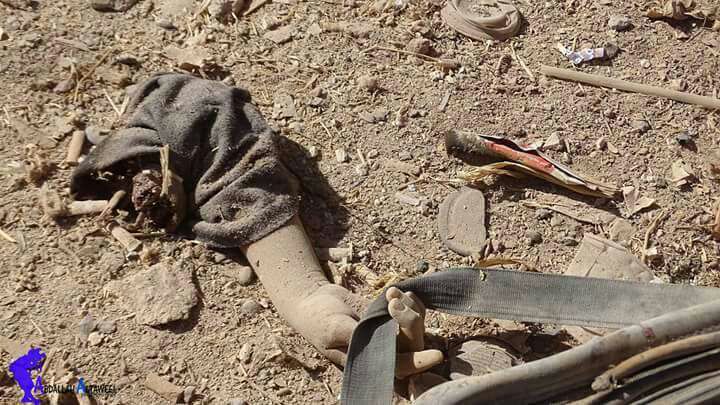
One of those tragedies was this image that appeared in my Twitter feed:


The tweet noted:
it's a kid arm holding to his bag after today's bombing
Yet another tragic day in Syria :(

I started following that Twitter feed after reading a Nick Kristof column, in which he had included details about a kid and her mother in Aleppo.  Now, thanks to that, I am reminded every day that life is not normal in Syria.  The image of a kid's severed arm lying on the ground with the fingers wrapped around a school bag is, sadly, only the latest of the horrific images that we have seen over the past couple of years.

Later, news reports provided a complete picture related to that image:
A school compound in a rebel-held part of northern Syria was repeatedly hit by airstrikes on Wednesday in an assault that monitoring groups and rescuers said had left dozens of people dead, including many children.
Unicef, the United Nations Children’s Fund, said the assault in Idlib Province may have been the deadliest on a school since the Syrian war began more than five years ago.
Twenty-two children and six teachers were killed in the strikes, Unicef said. 
Neither my parents nor I stop our lunch and dinner preparations in order to honor and respect the dead in Aleppo. Or in Mosul. Or in wherever.  Because ... they aren't our neighbors?!

Thursday, August 25, 2016

Obama's guaranteed legacy: Droning the shit out of brown people

Consider this:
Our Peace Prize president has now been at war longer than any other American president, and has overseen the use of military force in seven countries—Afghanistan, Iraq, Syria, Pakistan, Libya, Yemen, and Somalia. In the latter four countries, virtually all the force has come in the form of unmanned drones executing suspected terrorists said to be linked to al-Qaeda or its “associated forces.”
That an antiwar president has found the drone so tempting ought to be a warning sign.
Here is the scariest aspect of this war legacy--neither major party candidate will scale this back!

The killing of people in other countries--sometimes even US citizens--without the politically hot "putting boots on the ground" is one awful, awful direction in which Obama has led as the commander-in-chief.

I have blogged about this plenty of times before (like here and here) and other than the peace-loving greenies in the Democratic coalition, most of the Democrats don't seem to care.

Further, this is not a legacy that Obama leaves behind merely for his successor.
Other countries are unlikely to be reticent about resort to unmanned aerial warfare to “solve” problems beyond their borders. Already, Israel, the United Kingdom, Iran, Iraq, Nigeria, and Pakistan have joined the US in deploying armed drones. China is selling them at a list price of only $1 million. In short order, most of the developed world will have them. And when other nations look for precedents, Obama’s record will be Exhibit A.
What an atrocity!

Of course, when it comes to drone-killings, there is practically a bipartisan unanimity.  On the other hand, try talking to the esteemed politicians about potentially helping the homeless and they will throw you out!
The question for President Obama is whether he wants to be remembered as the leader who ushered in the era of permanent, low-level drone warfare. His actions will be looked to for justification by those that follow, here and abroad. As Daniel Reisner, former head of the Israel Defense Forces legal department, has said, “If you do something for long enough, the world will accept it…. International law progresses through violations.”
I suppose we have reached a point of no return as far as war and killings are concerned.    Obama's legacy "will be as the Nobel Peace Prize winner who pioneered a dramatically dangerous and ethically dubious form of warfare."

Meanwhile, a lengthy essay in the Atlantic, "Is America any safer?" the author concludes:
As Trump’s hard-line rhetoric about the president being weak on terrorism demonstrates, Obama and anyone who follows him and tries to continue on that path will be an easy target for opponents who will claim that transforming homeland security from the fantasy of never-again prevention to a combination of prevention and mitigation and recovery is throwing in the towel.
That this is still a debate in an election season 15 years after the 9/11 attacks is evidence that although we’ve made progress, we’re still a long way from adjusting—politically and psychically—to this new normal, where, unlike during the Cold War, there is no relying on deterrence for protection.
The droner-in-chief is labeled "weak" on terrorism!  Which only further confirms George Carlin satirical comment that we like war :(

Sunday, August 14, 2016

Ninety years of (In)Fidel

The two major party presidential contenders are no spring chicken.  Senators who ought to have retired long ago continue to run and, even more bizarre is how they get re-elected; there are 25 current senators in DC who are at least 70 years old!  A quarter of the Senate!  I hope this guy, who has become highly unprincipled, is booted out even now--well before he becomes the next Strom Thurmond!

And then there is that one guy chomping away at his cigar:
Fidel Castro used the occasion of his 90th birthday to lash out once more against President Obama.
Wait a second.  Shouldn't he thank Obama for normalizing US relations with Cuba?  And how come thugs like Castro and Mugabe live such long lives?

What was Castro's gripe anyway?
"I believe that the United States' president's speech lacked stature when he visited Japan,” Castro wrote, “and it lacked an apology for the killing of hundreds of thousands of people in Hiroshima, in spite of the fact that they knew the effects of the bomb. The attack on Nagasaki was equally criminal, a city that the powerful chose at random. It's for that reason that I must hammer on the necessity of preserving peace, and that no power has the right to kill millions of human beings."
Wait a second.  How many people were killed by Castro and his people?  I tell ya, we live in a world in which the likes of Castro and Putin and Trump can say anything that pleases them.  As my grandmother used to say, "கேக்கறத்துக்கு ஆள் இல்லை" (roughly translating to "nobody to question")

Meanwhile, the post-modernist extraordinaire marked the occasion:
Castro received a congratulatory call from Russian President Vladimir Putin on his birthday, according to the Russian leader's office.
Of course!

So, is it senility, or ideological rigidity, that made Castro rant against Obama?  A Cuba specialist, Ted , thinks it is a lot more basic than those:
To Henken, Castro's aversion to Obama is transparent. "He doesn't like Obama because Obama has stolen his charismatic thunder," he said.
Obama has certainly stolen the charismatic thunder from quite a few people around the world.  I am going to miss him, even though I have had plenty of problems with many of his political decisions--especially about war and peace.
 
Source

Thursday, February 04, 2016

Remember a country far away ... called Afghanistan?

Blogging about the warmongers led me to think about Afghanistan.  How much have we--the US--sunk in there?

Of course, the war spending is a staggering amount.  In case you forgot that amount, you might want to sit down first and hold on to a firm table or pillar.  The wars in Afghanistan and Iraq cost the US.taxpayers $1.6 trillion, according to the Congressional Research Service.  But, that is an underestimate:
A truer measure of the wars’ total costs pegs them at between $4 trillion and $6 trillion. This fuller accounting includes “long-term medical care and disability compensation for service members, veterans and families, military replenishment and social and economic costs,” Harvard economist Linda Bilmes calculated in 2013.
The Pentagon and its civilian overseers don’t like to talk about war costs, either before or after the shooting. That’s because a high price tag beforehand acts as an economic brake, making war—assuming that’s the goal—less likely.
After all that spending ...

Anyway, that was for the wars that supposedly ended.  Since then, we have also been investing in Afghanistan for its reconstruction.  How much has that been?  Even after adjusting for inflation, our spending there has exceeded the amount that we spent in Europe via the celebrated Marshall Plan.  I wonder who really benefited from all those hundreds of billions of dollars--certainly not the students in my classes who work anything between 15 and 40 hours every week in order to make sure they will not have huge debts when graduating.

So, after all that spending ...
Wasil was waiting Monday at a fruit stand in Tirin Kot, the capital of southern Afghanistan’s Uruzgan province, when he was shot dead by two gunmen. His uncle said he was 12 years old.
What was special about Wasil?
Wasil Ahmad learned to fire a gun at age 9, after his father was killed by Taliban militants.
Before long, his uncle said, the boy had become a celebrated Taliban killer, credited with gunning down six insurgents during a battle last summer.
And,
Local officials in Uruzgan and others hailed Wasil as a hero, but some said his story offered yet another example of the price paid by Afghan youth in the more than 14-year conflict.
In the first six months of 2015, the U.N. Mission in Afghanistan documented 1,270 casualties among children — 320 deaths and 950 injuries — a 13% increase over the prior year.
Yep, that is the Afghanistan today, after all that spending ...
Forgotten by the West, Afghanistan is facing a multidimensional civil war with the Afghan Taliban, which is being aided now by a plethora of groups such as al-Qaeda, the Islamic Movement of Uzbekistan, Chechens, and Pakistan’s Lashkar-e-Tayyaba.
Oh, hey, aren't you glad that we were wonderfully distracted and entertained by the likes of Trump and Palin and more?
In at least two provinces bordering Pakistan (Nangarhar and Zabul) the Taliban are also fighting ISIS, which is trying to recruit among dissatisfied Taliban members. Not until the end of January were US Special Forces in Afghanistan given authorization to go after ISIS fighters in the country—one reflection of how lackadaisically the Pentagon is responding to the crisis there. US forces can now pursue ISIS fighters, who have been declared a threat to the US. One may well ask, What about the threat that the Afghan government has already faced from ISIS all these months as the group has built up its base areas?
Ah, do the blabbering bellicose buffoons who want to lead the Republican Party care about such details before they go to all corners of the world to kick ass and bomb people to oblivion?

Caption at the source:
12-year-old Wasil Ahmad, who was killed by gunmen in southern Afghanistan on Monday, Feb. 1, 2016

Saturday, October 24, 2015

This day ... three years ago (2)

(Re-posting from 2012)

It is ok for Obama to kill people because he is not Bush?

This graphic ((ht) says a lot, right, about how we have escalated the killing campaigns?:


As if the old stories on the kill list (have my colleagues nominated my name to be in the list?) were not enough to make us worry about due process and the constitution, the Washington Post reports:
Over the past two years, the Obama administration has been secretly developing a new blueprint for pursuing terrorists, a next-generation targeting list called the “disposition matrix.”
The matrix contains the names of terrorism suspects arrayed against an accounting of the resources being marshaled to track them down, including sealed indictments and clandestine operations. U.S. officials said the database is designed to go beyond existing kill lists, mapping plans for the “disposition” of suspects beyond the reach of American drones.
WTF!

I thought "kill list" was enough of a new and unwanted phrase in our dictionaries.  "Disposition matrix"???

As I expected, Glenn Greenwald is furious about this, and he is way smarter and informed than I ever can be:
The Post's Miller recognizes the watershed moment this represents: "The creation of the matrix and the institutionalization of kill/capture lists reflect a shift that is as psychological as it is strategic." As he explains, extra-judicial assassination was once deemed so extremist that very extensive deliberations were required before Bill Clinton could target even Osama bin Laden for death by lobbing cruise missiles in East Africa. But:
Targeted killing is now so routine that the Obama administration has spent much of the past year codifying and streamlining the processes that sustain it.
To understand the Obama legacy, please re-read that sentence. As Murtaza Hussain put it when reacting to the Post story: "The US agonized over the targeted killing Bin Laden at Tarnak Farms in 1998; now it kills people it barely suspects of anything on a regular basis."
Oh my freaking lord!

To hell with Obama and Romney!

More Greenwald:
It is literally impossible to imagine a more violent repudiation of the basic blueprint of the republic than the development of a secretive, totally unaccountable executive branch agency that simultaneously collects information about all citizens and then applies a "disposition matrix" to determine what punishment should be meted out. This is classic political dystopia brought to reality (despite how compelled such a conclusion is by these indisputable facts, many Americans will view such a claim as an exaggeration, paranoia, or worse because of this psychological dynamic I described here which leads many good passive westerners to believe that true oppression, by definition, is something that happens only elsewhere).
Need I remind you that Obama was awarded the Nobel Peace Prize . What a wonderful living illustration of George Orwell's 1984 scenario ofwar is peace :(


Friday, October 16, 2015

Cameroon: The latest attempt to educate Americans about the world

Remember that old Mark Twain quote about the geographic illiteracy of Americans?  What?  You don't?
God created war so that Americans would learn geography.
Are you not impressed that he said that a long time ago?  And, therefore, are you not mighty relieved that our collective ignorance about the rest of the world, and the apathy, is not anything new?  I suppose if there is one thing that we can hold on to as a truly American trait, it is that we don't know much about geography and we don't care either.  After all, that ill-informed view was what led to the formation of these United States, thanks to Christopher Columbus stumbling upon "India"!

But then, we try our best to learn about the countries and people in different parts of the world by bombing the shit out of them.  In the past seventy years, since the ending of the world war that followed the world war that was supposed to end all wars, the US has bombed an impressive list of countries:


Awesome, right?

How many Americans will be able to accurately identify all those countries on a world map, and say something substantive about those countries and the people?  We try our best but Americans still don't care.  (BTW, a special note on Syria: for the first time since the end of WW II, the US and Russia will be bombing the same country!)

In this important task of continuing education, we are dispatching the next set of teaching assistants--armed with the latest gadgets, of course--to Cameroon.  Hey little boys and girls, do you know Cameroon?
White House spokesman Josh Earnest said the mission would be "part of a broader regional effort to stop the spread of Boko Haram and other violent extremist organisations in West Africa".
More details, please?
The force, which will be 300 strong, will conduct airborne intelligence, surveillance, and reconnaissance operations in the region.
Cameroon and Chad have been targeted by the Islamist militants from northern Nigeria.
Mr Obama said the forces would remain in Cameroon until "no longer needed".
I am sure "until "no longer needed" means that the US forces will be there only for a couple of months,  Like how our forces came back from Japan after the war ended and how we no longer have military bases there. Yeah, right!

Sometime soon we will have to start educating Americans about the planetary system and outer space, given our scientific illiteracy.  Maybe we should think in terms of bombing those Martians?


Tuesday, May 19, 2015

Can we have more butter, please?

For a long time, in blog-years, I have been worried that the Great Recession and the anemic recovery are not any temporary issues but that they could be reflective of serious transformations in the economic structure.  Nothing in the American economy, nor in the global economy, has given me reasons to think otherwise.  The only good news is that students do not come asking for career and employment advice--because, if they do, then I would end up sharing my gloomy assessment, which will not do them any good.

But then, thankfully, I am only a nobody harboring such worries.  It is not like such assessments are in the New York Times, in analyses authored by respected economists who are not of the "loony left."

Oh, wait, here is Tyler Cowen writing in the New York Times
the recession was a learning experience that we haven’t fully absorbed. From this perspective, the radical and sudden changes of the financial crisis were early indicators of deep fragility and dysfunctionality.
In case you are not aware of Cowen, he is is an economics professor at George Mason University.  Cowen and his folks at George Mason are far from the "loony left."  Check out the blog that Cowen and his buddies run in order to understand their approach to public choice policies.

Anyway, back to Cowen's NY Times piece.  The title of that says it all:
Don’t Be So Sure the Economy Will Return to Normal
Welcome to the "new" normal!
Slowly but surely, we may be responding to these difficult revelations by scaling back our ambitions for the economy — reinforcing negative trends that were already underway. In this troubling view, we have finally begun to discover some unpleasant truths. Borrowing a phrase from the University of Toronto economist Richard Florida, it’s possible that we are experiencing a “Great Reset.”
So, what do we do then?  How can we reset this Great Reset?
If a reset is underway, we might have to accept that public policy cannot reverse it easily. Once unsustainable economic structures begin to fail, it takes a significant improvement to make them viable again. Yet because of the difficulty of making major changes under our current political alignment, most new government policies today are no more than changes at the margin. Perhaps the most basic problem is that it is difficult to be sure when a reset is underway, and it is harder yet to raise public alarm about changes that seem to be gradual and slow.
Most of all, it is not always wise to fight a reset.
Ouch!
Perhaps the most crucial issue is whether economies will return to normal conditions of steady growth, or whether we are witnessing a fundamental transformation, unveiled in bits and pieces. Nominations for the nature of that transformation include a “robot economy,” a new political economy where elites have too much power or, perhaps, a new global economy where the United States no longer holds such a dominant position, to the detriment of American firms and workers.
No one knows whether or how much of a reset may be underway.
It is rare for economists to openly admit that "no one knows."  Which means only one thing: things are not looking good.  They are looking real bad.

BTW, here's one more worry, which is more like a corollary.  When the American economy falters, staggers, guess what the bipartisan approach is to revving up the economy?  Think.  Think some more.  Yep, war.


Wednesday, August 13, 2014

There is no finish to a war

I know of only one way to fight, whether at workplace or in geopolitics--civil disobedience.  Thanks to Gandhi, of course.  And the older I get, the more I turn away from violence.  

Thus, these days, this news junkie finds very little to be enthused about.

We are far from Gandhi's pacifism.  What a horrible spring and summer it has been in this year alone.  It is almost as if we humans decided that we will not rest until we completely nuke away the "peace dividend" that we thought was possible when the Soviet empire collapsed and the Cold War ended.

It appears that we have forgotten that, as Hemingway put it, war is hell.  He wrote in A Farewell to Arms:
"There is nothing as bad as war. ... When people realize how bad it is they cannot do anything to stop it because they go crazy.  There are some people who never realize. There are people who are afraid of their officers. It is with them the war is made"
"I know it is bad but we must finish it."
"It doesn't finish.  There is no finish to a war."
"Yes there is."
Passini shook his head.
"War is not won by victory. ...
Yet, we continue with wars. There certainly seems no finish.

The following, which Einstein said in the context of nuclear weapons, is applicable to the non-nuclear kind too:
We cannot desist from warning, and warning again, we cannot and should not slacken in our efforts to make the nations of the world, and especially their governments, aware of the unspeakable disaster they are certain to provoke unless they change their attitude toward each other and toward the task of shaping the future.
Even Japan, a country that renounced war, in favor of peace, right in its constitution, has eased up on that and now encourages exports of weapons.  We humans are, perhaps, doomed to live as the most violent animals until we cause our own extinction.

This piece at the New Yorker discusses, via a Hirohima survivor, a public-health hypothesis that
suggests that untended wartime trauma can move vertically and horizontally through individuals and families, morphing across years, decades, or even centuries.
All the more to worry that there is no finish to a war, right?
Sixty-nine years ago last week, a slender woman named Tomiko Shoji was struck and sent aloft by a bright white light. She’d just arrived at her secretarial job, at a tobacco factory, and was standing by the door when the flash occurred; the light’s source had a nickname, Little Boy, but it meant nothing to her at the time. She flew backward under the crushing force of the office door, passed out, and awoke with shards of glass in her head and an expanse of bodies around her—some dead, some alive but dazed, and many more, she soon found, floating “like charcoal” in nearby rivers. The nineteen-year-old climbed up and out of the shell of her younger self; she had survived the U.S. atomic bombing of Hiroshima. Nearly seven decades later, Keni Sabath, Shoji’s youngest granddaughter, started to wonder: Had the bombing’s aftermath reshaped not just the psyche of her bachan (grandmother) but also, in ways both culturally and historically particular, her own?
The horrors of war!
In recent years, a growing body of scholarship has sought to better understand accounts like Shoji’s and Sabath’s through the framework of “trans-generational trauma,” which traces experiences of catastrophic loss across the span of a family or a community. A wide range of studies have examined evidence of “secondary trauma” in the children of Holocaust survivors, the wives of Vietnam veterans, and, more informally, in the families of U.S. veterans who’ve faced P.T.S.D. after deployments to Iraq and Afghanistan. In 2007, a study on the wives of fifty-six traumatized war veterans in Croatia found that more than a third of the veterans’ wives met the criteria for secondary traumatic stress; often, this meant symptoms “similar to those present in directly traumatized persons: nightmares about the person who was directly traumatized, insomnia, loss of interest, irritability, chronic fatigue, and changes in self-perception, perception of one’s own life, and of other people.” More recently, speaking to Mac McClelland for an article on trauma in the families of Iraq and Afghanistan war veterans, the clinical psychologist Robert Motta said, “Trauma is really not something that happens to an individual.” Instead, he proposed, “Trauma is a contagious disease; it affects everyone that has close contact with a traumatized person.”
Wishing for peace is something we have been doing for thousands of years.  Perhaps every time we think we are getting close to achieving it, we humans decide to return to our old ways of killing.  I will leave it to Hemingway to explain why this happens:
"There is a class that controls a country that is stupid and does not realize anything and never can. That is why we have this war."
"Also they make money out of it."
I am guessing that the typical war-monger has never read Hemingway :(

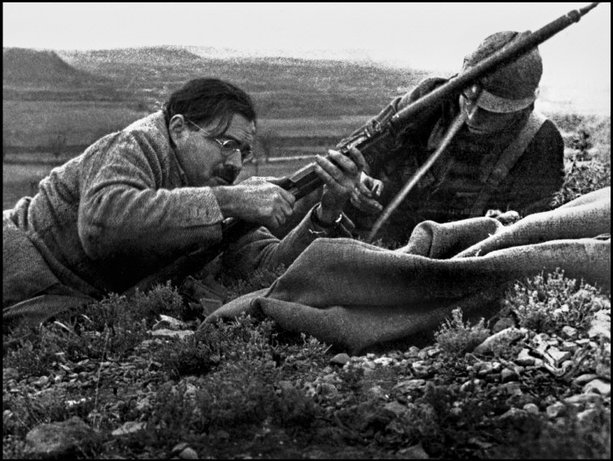
Caption at the source:
MORA DE EBRO, Spain—Hemingway on the front lines with members of Gen. Enrique Lister’s Loyalist 5th Regiment
who were holding out against Gen. Franco's offensive, Nov. 5, 1937.
Update at 22:45 on Aug 14th:
Marine Cpl. Robert Richards, a medically retired combat veteran who was badly wounded in Afghanistan and later appeared in a controversial video urinating on dead Taliban insurgents, was found dead Wednesday night in his home in North Carolina. He was 28.
...
a sniper team led by Richards recorded a video on July 27, 2011, of him and other Marines urinating on the remains of Taliban fighters they had killed. It was never intended to be seen by the public, but Richards later said that the Marine who owned the camera stepped on an IED a couple weeks afterward, and it ended up in the hands of another Marine in the unit. It was posted online, causing an international uproar that led to eight Marines facing discipline.
...
In an exclusive 90-minute interview with this reporter for Marine Corps Times in September 2013, Richards acknowledged intense struggles with post-traumatic stress and night terrors afterward, and taking a variety of medications to deal with it. In one ugly night in Florida, he said he was caught off-guard by a celebration involving replica cannons being fired, and fired a pistol in his hotel room while his wife, Raechel, was present. He thought he was under attack, he said.
There is no finish to a war :(

Friday, February 28, 2014

I am a wuss even at supporting the anti-war cause?

When driving back from work, if I leave campus during a certain time block, I can expect to see a dedicated anti-war group standing on the curb by the courthouse and waving signs advocating for peace.  As I pass them, I sound the horn once or twice and wave out to them.  These are no spring chicken, but, dedicated as they are, rain or fog or the sun never stops them, it seems.

The older I get, the more I am becoming anti-war and anti-violence. I suspect it is because I understand way more now than ever before how fragile life is.  When young, too, I was against war and violence, but I had no idea about the fragility of life. The commitment to peace is, thus, a lot deeper than it ever was.

Yesterday, when I left the parking lot, I knew I would see them. The pacifist in me smiled at the thought of waving at like-minded people.

I was about a mile away from the courthouse when a vehicle changed lanes and ended up ahead of me. The licence plate caught my attention--it was a "veteran" plate.

As we neared the courthouse, I now had a serious dilemma.  Will it be ok to honk and wave in support of the anti-war stance when driving right behind a veteran?  If it is the veteran driving the vehicle, as opposed to some other family member using the vehicle, then wouldn't it be rude?  Should I worry about the veteran's feelings when, after all, this was a public space? What if the veteran is also anti-war?

I told a friend the other day that sometimes I want my brain to shut down. It seems to be always at work. I am not sure how good or harmful that is. In this case, too, I would have preferred if my brain hadn't started analyzing all these and I had simply sounded the horn and moved on.

But, I am what I am, I suppose!

I drew parallel with the group on the curb. My hand came off the horn. I merely waved out at them. I drove on.

Does life always have to be this complicated?

The day ended with the nerdy me catching up on my reading. And, this chart on the US defense expenditure fed my anti-war feelings:


I will remember this chart the next time around and sound the horn four times to make up for the lost time!

Wednesday, May 01, 2013

Bombs and missiles are ok in Syria, but gas is not ok? WTF!

Last night, even as my eyes were half-closing, and with my right arm tiring quickly holding the New Yorker thanks to the tennis-elbow issue that I am dealing with, I simply had to, had to, finish reading the absolutely depressing narrative on the people in Aleppo burying their dead.

If it was depressing to read, I cannot imagine how awful it was for the reporter to be there.  And even more awful for the Syrians who live in Aleppo.  And way more awful for those whose friends and family are dead. What a terrible situation there!

The entire essay is bloody depressing.  Within that insanity, one of the most insane was this: there is a bridge that divides the rebel area from the regime's.  People use it even as there is fighting all around because, well, they have to keep going with their lives.  And then this happens:
In several places, to evade government snipers, you must run.  Nearly every day, the snipers kill people--but, if you reach the bridge, chances are that the soldiers on the other side will let you in.
The snipers shoot commuters in order to bait rebel fighters and would-be rescuers.  Often, it is women and children who are shot. 
Even Catch-22 didn't include such levels of insanity.

It is now more than two years of fighting.  The UN has registered and processed more than 1.2 million refugees.  As one can imagine, a lot more are internally displaced.

So, when all these are happening, why should the use of gases be some kind of a red line that Assad's government cannot cross?  The 1.2 million refugees don't matter? The 75,000 dead is within our tolerance limits?  The regime's use of aircraft and missiles against its own people is normal?

This artificial notion of gas used against Syrians as some kind of a barometer on whether or not we should act is just bizarre.  Stupid, actually!

It is a long corridor of geopolitical instability from Kashmir all the way to the Mediterranean.  We need to draw a red line around the thousands of miles of this corridor.  And there isn't enough red ink for that!

All I can do in such contexts is rely on the old masters; here is Hemingway in A Farewell to Arms
"There is nothing as bad as war. ... When people realize how bad it is they cannot do anything to stop it because they go crazy.  There are some people who never realize. There are people who are afraid of their officers. It is with them the war is made"

"I know it is bad but we must finish it."

"It doesn't finish.  There is no finish to a war."

"Yes there is."

Passini shook his head.

"War is not won by victory. ... We think. We read. We are not peasants.  We are mechanics.  But even the peasants know better than to believe in a war.  Everybody hates this war."

Saturday, March 02, 2013

Anti-war. Yet, I didn't sign the peace petition pre-Iraq War

Ten years ago, we in the US, and people elsewhere, were following the preparations that were going on to invade Iraq.

When the US and NATO forces got ready to strike against al Qaeda and the Taliban forces in Afghanistan, I half-heartedly supported it.  There was no doubt that the Taliban and al Qaeda were evil, especially for the people living in Afghanistan.  Though, it seemed to me like the war was in haste and that we might be better with a little more planning, I supported it even as the specter of the Soviets, the British, the Greeks all loomed large in the background.

As President Bush, Cheney, and Rumsfeld started beating pretty loudly the war drums to invade Iraq, I was completely opposed to it.  I recall watching on television Colin Powell's presentation at the United Nations and feeling sick in my stomach.  It was difficult to watch even a minute of arrogant war talk from Bush, Cheney, Rumsfeld and their likes, who made the proverbial snake oil salesmen look saintly.

I was no longer a Californian, having made myself home in Oregon.  My colleagues at my new place of work, which is where I continue even now, decided that they would collect money to publish a peace petition in the student newspaper.

But, despite my intense anti-invasion pacifist sentiments, I did not sign the peace petition and nor did I contribute for the advertisement expenses.  I hadn't yet been tenured and, yet, was firm about not signing on with the rest.

A couple of years ago, I found the petition on the bulletin board and made a copy for myself.  It was interesting to note that somebody had scribbled there about 9/11--perhaps a student who supported the war, and I continue to have a strong urge to convince that scribbler about a lack of connection between 9/11 and Iraq.
There was only one other colleague in the division at that time who didn't sign on that page, and he dissented because of his affiliation with, and support for, the GOP.  In my case, political party affiliation has never been a factor, nor was I in favor of the war.  But, no singing kumbaya with the group.

I was not a signatory for a very good reason.  Not because of the phrasing, which is indeed a poorly constructed argument, especially considering the number of PhDs involved in the effort.

Unlike my faculty colleagues who apparently thought their duty ended after such a rhetorical display, which would have impressed only a few gullible students, I thought I ought to work on helping a few more students and members of the public understand about Iraq, the Middle East, and Islam.  As an academic, I have never been convinced that signing peace petitions or organizing marches is the best way I, or most academics, can contribute to society.  To join the academy is to think and inquire, which then means that by sharing the products of inquiry with students and the public we can contribute--a lot more than by signing petitions.

I write op-eds, which is one heck of a political activity, like the old-style pamphleteers.  But, even more a political activity, which Azar Nafisi noted as "subversive:
SOME ASSUME that the only way academics can engage the politics of the day is by coming out of their ivory tower and protesting in front of the White House. But in conveying knowledge, the academy has a far more important and subversive way of dealing with political issues. Knowledge provides us with a way to perceive the world. Imaginative  knowledge provides us with a way to see ourselves in the world, to relate to the world, and thereby, to act in the world. The way we perceive ourselves is reflected in the way we interact, the way we take our positions, and the way we interpret politics.
Curiosity, the desire to know what one does not know, is essential to genuine knowledge. Especially in terms of literature, it is a sensual longing to know through experiencing others—not only the others in the world, but also the others within oneself. That is why, in almost every talk I give, I repeat what Vladimir Nabokov used to tell his students: curiosity is insubordination in its purest form. If we manage to teach our students to be curious—not to take up our political positions, but just to be curious—we will have managed to do a great deal.
It is not that I am political in the classroom; far from that.  I ask questions, present facts, and make them think.  I make them at least a tad more curious to know.  I tell them that they never have to worry about what my personal opinion is because my job is only to help them learn to learn.  But, to make students think about Iraq, the Middle East, and Islam meant that I had to read up a lot more before I could offer any class on those issues.  I took some time, and then offered a class.

The Iraq War dragged on. An even longer engagement in Afghanistan. The Presidency is a lot more powerful, and secretive about its powers, than it seems to have been.  Guantanamo's prisoners are in one tragic suspended state. Drones shower bombs on terrorists, innocents, and even American citizens from Afghanistan to Yemen.

I will continue to write and teach, fully aware that it won't amount to any hill of beans.

Sunday, February 17, 2013

Why do beauty contestants wish for world peace?

As a kid, who had no idea about what wars meant, I remember being confused when we were told that we might have to turn out the lights and go dark during the 1971 war with Pakistan.  Yes, even though we lived in a town that was far, far away from Pakistan!

The following summer, or was it a year after that, when we were in Pattamadai to spend our school vacation time with the grandmothers, we kids were thrilled to listen to stories from the battlefront, narrated under the stars--the narrator was practically a family member, who was an army "javaan."

Of course, it was only later in life did I come to know that he was not anywhere near the front itself!  The older we get, the more we learn about the un-truths; turns out we live in a world of truthiness!

But, other than during those childhood years, I have never been a fan of war and violence.  I was a graduate student at USC when Bush, Sr., decided to liberate Kuwait from Saddam's invasion, and I joined the anti-war rallies at the campus square by Tommy Trojan.  War was not the answer, as far as I was concerned.

Into my adulthood, I have become more and more of a pacifist, and even people yelling and screaming is a huge turnoff anymore.  There are certainly plenty of ways in which we can express disagreements without resorting to violence in words and, definitely, in action.

Reading Hemingway's A Farewell to Arms and re-reading Catch-22 further convinced me that war is hell. War supporters are almost always, in Joseph Heller's words, the scum of the earth.

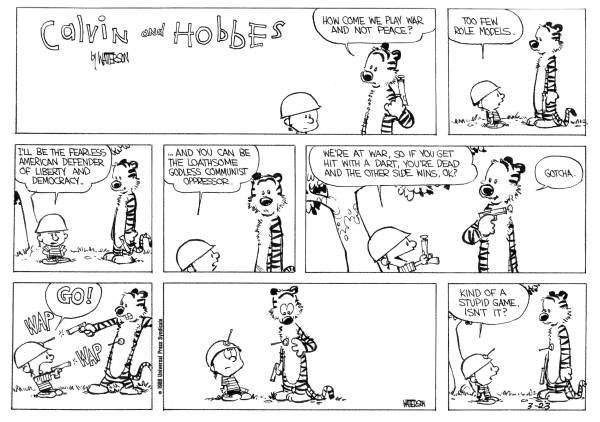
But, for all those who are pressed for minutes and seconds in these modern times, there is no one better to succinctly explain the idiocy of war than Calvin himself.

No, not John Calvin, but the one who walks around with Hobbes.  No, not that Hobbes either :)
If only Watterson hadn't retired!  Oh well ....
So, why war all the time?
Yep, stupid!  Hellishly stupid!

Sunday, January 20, 2013

Mali: How do you say "African Afghanistan" in French?

We have now been in Afghanistan for ever and ever, it seems like.  If it feels that way, there is at least one good reason: it has been the longest war. Ever. (ht)
Don't hold your breath for hope and change, and for all our troops to return soon.  You can count on warmongers to offer arguments that will be variations of this: