Showing posts with label english. Show all posts

Tuesday, September 22, 2020

I listened to a lovely poem. You too should.

I have often written (like here) about the problems that I encountered, and continue to face, because English is a second language to me.  With the rare exceptional people who have a flair for languages, most of us reconcile ourselves to some aspects of the second language that we simply cannot master.

But, hey, the wonderful thing is that we are fluent in a second language.  What an accomplishment!

Back in the old country, the English language is an integral part of urban life.  Urbane is measured by how much the English language is used!

In such a setting, there are people who want to be in, even if their English proficiency is not up to par.  And there are people who look down on those who lack proficiency--I used to be one of them, sadly!

Once you, dear reader, understand this context, you will be able to appreciate and enjoy the poem “Goodbye Party for Miss Pushpa T. S.” by Nissim Ezekiel.

A note on Nissim Ezekiel. 

As with almost every aspect of life, here too I was ignorant.  I had no idea about a Nissim Ezekiel. 

A Google search led me to this obituary tribute from 2004:

Nissim Ezekiel, who has died aged 79, was the father of post-independence Indian verse in English. A prolific dramatist, critic, broadcaster and social commentator, he was professor of English and reader in American literature at Mumbai (formerly Bombay) University during the 1990s, and secretary of the Indian branch of the international writers' organisation PEN.

Ezekiel belonged to Mumbai's tiny, Marathi-speaking Bene Israel Jewish community, which never experienced anti-semitism. They were descended from oil-pressers who sailed from Galilee around 150BC, and, shipwrecked off the Indian subcontinent, settled, intermarried and forgot their Hebrew, yet maintained the Sabbath. There were 20,000 Bene Israel in India 60 years ago; now, only 5,000 remain. Most of Ezekiel's relatives left for Israel; he served as a volunteer at an American-Jewish charity in Bombay.

This part sets it up well for “Goodbye Party for Miss Pushpa T. S.”

After 1965, he also began embracing India's English vernacular, and teased its idiosyncrasies in Poster Poems and in The Professor. In the latter he wrote: "Visit please my humble residence also./ I am living just on opposite house's backside."

I would rather that you listened to the poem.   

Friday, September 18, 2020

Why can't the English learn to speak?

When English is the second language, one of the problems that I and many others face is that we would have seen and read the written word before knowing how it is pronounced.  This always trips us up at conversations.

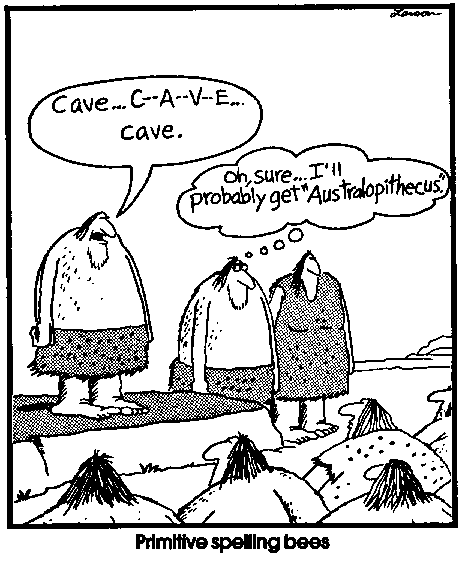
Take an everyday, simple word like "locate."  Not a big deal of a word.  A word that won't ever be asked at a Spelling Bee.

But, until I came to the US, I had no idea that there is way more to pronouncing it than what I had been doing back in India.  Because ... it turned out that the "loc" of "locate" has a lengthier sound like with the "loc" in "locusts."  The "o" is stretched out in the pronunciation.

That is merely a simple example of the many that I can offer, and there are quite a few examples that completely mess up the communication itself because the other party simply had no idea what I was referring to.  Like "mishap" that I never imagined being mis-hap, and I was merely adding an ending "p" sound to "misha."   The emPHAsis in multi-sylLABle ...

Those who are raised with the language have a different kind of a problem--they know the sound, but have a tough time spelling some words.  For instance, in papers that I have graded, native students have spelled "parity" as "parody."

English is not like Tamil or Sanskrit where the pronunciation is no different from how the word is spelled.  If all these sound "ghoti-y" it is because the bastard language has drawn words from other other languages makes life difficult for all of us.  Imagine one's horror when incorrectly pronouncing "hors d’oeuvre" at a "soiree"!

This post resulted from reading this column.  Read the comments there; says a lot about the bloody language!


Tuesday, September 15, 2020

Can you hear me now?

As a kid, I did what other kids and many adults did--I made fun of others.  Laughter at the expense of others was considered normal. It extended well into the undergraduate years as well.  After all, nobody ever told me anything otherwise.

But then, slowly wisdom dawned.

I can not ever understand why the damn wisdom should show up only much later in life!

These days, most jokes that I make are about me.  I love it because nobody gets hurt, and I get a wonderful outlet for my bizarre sense of humor, which is also an outlet for all my angst.  It is a win-win all around, except for those who have to suffer my humor--especially the captive audience in the classroom, where I have not been since last March :(

One of the earliest realizations was about the way we speak.  The accents. The choice of words.  The idioms. In the early phase of my life, those were the low hanging fruit for the crude humor.  Visiting grandmothers' places meant exposure to the way of speaking in that part of the old country, and it was so easy to make fun of it.

Now, as I get older, I find the jokes on accents to be awful.  In the old country, people do that a lot even now.

As an older and wiser man, I find the different accents, the unusual phrasings, to be charming. They add color to the otherwise monotonous same-old, same-old.  It is so robot-like if everybody talked the same way.

Further, the ultimate understanding of all: it is about communication and human interactions.  After all, we "hear" those differences only in the real world of human interactions, right?  As an old New Yorker cartoon put it, in the internet nobody knows you are a dog!  I would rather hear somebody's accented voice in a discussion than yet another "like" on Facebook.

An old anthropologist friend of mine used to tell his students that everybody has an accent.  It just depends on the context.  Of course, that didn't stop him from making fun of my accent. But, I laughed when he joked about my pronunciations because I knew he meant no harm.  After all, it is one thing to chuckle, but another to laugh with condescension and I know well where that dividing line is.

Over the years of life here in the US, my speech has slowed down. A few words and phrases I say it differently from how I pronounced them back in the old country.  I quickly learnt about using "the."  But, by and large, I have managed to remain the same person that I was.

A few years ago, when I went to the deep, deep South for the first time, I was all set to listen to the charming southern accent. The drawl. The y'all. I was so disappointed.  In the public space, the number of people who spoke "like a Southerner" was way less than what I had imagined would be the case.

The nasty jokes and condescending attitudes towards some accents and way of speaking, while lauding others, is "back door to discrimination."  We forget that "the so-called standard is simply an invention of a given society."
"We talk a lot about racial discrimination," explains Ms. Lawson, who is now a junior. "We talk about judging people based on their socioeconomic status" and on other, more visibly identifiable factors. But people rarely talk about language, even though it is socially stratified in the United States, as in most countries.
"When I came to college," Ms. Lawson says, "people kept telling me how strong my accent was." She thought, "Wow, y’all need to come home with me and hear how other people sound." She was doing what linguists call code-switching — toning down her accent in favor of a standardized English considered to be more acceptable.
Exactly!  The arrogance of Englishnisation.  We humans are stupid, stupid, stupid!

I wish somebody had told me all these at least when I was twenty years old!  Oh well, wisdom better late than never, eh.

Friday, November 16, 2018

The is the point of this post

It wasn't until I came to the US for graduate school did I know that I was not using "the" when I had to, and was overusing it when I didn't need to.  It ain't easy to learn English as a second language!

It goes back to the Tamil language that was, as we used to say in the old country, my mother tongue.

Even with that usage--"mother tongue"--I recall this hilarious incident from my elementary school days.  Our math teacher--the maths master, as we said then--was a quirky, funny, old man.  Well, he seemed old to us when we were kids and, for all I know, perhaps he was the age I am now!  "PK Master" was how we referred to him.

PK Master would suddenly ask a student something interesting while seemingly looking at another.  And, at the same time tap yet another on the head with a long ruler that he always seemed to have in his hand.  We knew that we always had to be on the alert in his class.  Every once in a while, he would intentionally make a mistake in the problem he would have worked out on the blackboard in order to check whether we were merely copying things down or if we were thinking for ourselves.

One of our old classroom buildings

Where was I?  Yes, the mother tongue. So, one rainy day PK Master was walking around while we were trying to solve the problems he had assigned when he asked one of the girls, Madhulika, what her mother tongue was.

I bet she was petrified as much as any of us were whenever PK Master asked us anything; she blurted out, "it is pink."

It is funny as hell now.  But, if you had been in PK Master's class, you would have blurted out even worse things, I tell ya!

Anyway, English is a funny language to learn, with its rules that make no sense.  One of the rules that apparently I hadn't mastered was about "the."  When to use it and how to use it.

For instance, if one were to think in Tamil a statement "நான் லைப்ரரிக்கு போறேன் " and then translate that into English, the translation would be "I am going to library."  Note that the translation does not include "the."

We have to systematically learn to add "the" and say in English "I am going to the library."  Once we pick up such bad habits, well, it takes a lot of effort to unlearn the incorrect ways and learn the correct ones.  I wonder why the English teachers back in my school never pointed this out to me; can't blame them when there were forty kids in the class, eh!

As I started re-learning the English language as a graduate student, I spotted this craziness in all kinds of casual contexts too, not merely in grad school work.  One of the instances in which the "the" issue came up was about the Philippines.

My apartment-mate's father was working in the Philippines at that time--with the Asian Development Bank.  He was also a Tamil.  I noticed that the country was "the Philippines" when a bunch of us Tamil folks spoke in English. But, it was "Philippines" if we spoke in Tamil--there was no "the" there.

So, what is "the" deal with the Philippines?  Here is Wikipedia to "the" rescue:
The official name of the Philippines has changed several times in the course of its history. During the Philippine Revolution, the Malolos Congress proclaimed the establishment of the República Filipina or the Philippine Republic. From the period of the Spanish–American War (1898) and the Philippine–American War (1899–1902) until the Commonwealth period (1935–1946), American colonial authorities referred to the country as the Philippine Islands, a translation of the Spanish name.[25] Since the end of World War II, the official name of the country has been the Republic of the Philippines. Philippines has steadily gained currency as the common name since being the name used in Article VI of the 1898 Treaty of Paris, with or without the definite article.[35]
It is not because of the bizarre grammar rules in English, but all because of Spanish?  Oh the crap! ;)

Friday, September 14, 2018

When hell freezes over!

English as the second language gave us plenty to laugh about.  Especially in school, where some teachers were more at ease in the local vernacular.

Our physical training (PT) master was one of those.  As school kids, most of us did not know any better than to make fun of him. In my middle-age, as I look back at those times, this too is one of the many that makes me realize that we all screw up when we are young.  Our words and behavior later as adults, by when we ought to know right from wrong are what matter.  Of course, some are assholes, unlike most of us who become better people with age.

That PT master was not at ease with the language that the colonizers left behind.  One day, when PT was rained out and we had to stay in the classroom, he told a student who was sitting by the window to open it.  I suppose it was closed to keep the rain spray away.  "Open the window, and let the climate come in," he ordered.

We barely concealed our smiles, and we laughed loudly later.  For days.  Like I said, we didn't know any better.

It is one thing for a person who is not a native language speaker to confuse the climate and weather.  It is another when native speakers intentionally treat them as synonyms only because they are anti-science and deny that we are going through human-caused climate change that is affecting the weather patterns.
[A]  changing climate can “load the dice” on weather, making certain kinds of extreme event more likely. For example: the amount of water vapor that the atmosphere can hold increases with temperature. Heat it up by 1° F, and the moisture content increases by about 3 percent. The result? More intense rainstorms. Similarly, heat waves happen more often when the planet as a whole gets warmer. Does one torrential storm or one bad heat wave prove climate change is happening? Of course not. Multiple long-term lines of evidence do that. But climate change will make heavy rainfall even heavier, and heatwaves hotter and more frequent. It’s reasonable to suspect that climate change plays a role in recent events.
Remember that infamous incident at the US Senate when a moronic senator tossed a snowball as evidence that there is no global warming?  More morons in North Carolina even banned the discussion of science-based policies.

As Hurricane Florence slowly makes it way to the land--it looks like it will be one hell of a slow crawl, which means dangerous levels of rains and floods--I wish reporters will ask those moronic politicians to explain the difference between weather and climate, and how climate change affects weather.  But, of course, those morons will dodge it, like how they always respond that it is inappropriate to talk about about gun-control policies right after yet another mass shooting.

As a middle-aged man, when I know better than what I knew as a high school kid, I know it is most fitting to make fun of these deniers who do not want to acknowledge the difference between weather and climate, and how the changing climate affects the weather.

Hey, PT master, you are alright!  Thanks.


Thursday, September 14, 2017

A conspiracy against the laity

The title of this blog is a GBS quote, as I have always noted in the margin.

When I first came across GBS, which was in middle or high school years in the old country, of course I had no idea about this quote.  It was a joke about the spelling and pronunciation issues in the English language that first made me aware of a George Bernard Shaw.

For many of us who grew up with a language other than English, and with the native script simultaneously phonetic as well, English was--and continues to be--a pain in the ass.  Or, a "royal" pain in the "arse," for those who prefer the Queen's English!

Thus, it delighted me to no end when I read that a certain GBS had made fun of the English language, by showing how "ghoti" should be pronounced as "fish."  (Much later in life, I would learn that the GBS-ghoti story is a myth!)

Then came GBS in the high school curriculum: An excerpt from his Pygmalion.

Once there was a collection of GBS in real life in the Readers Digest.  Here is how I remember two of them:
At a dinner party, GBS is seated next to a famous stage actress.  She tells him that if the two should have a baby together, it might be a powerful combination of her beauty and his brains.  Without missing a beat, GBS responds that it will be a disaster because the baby will have his beauty and her brains!
Another one:
GBS sent Winston Churchill two tickets to the opening night of his play, along with a note that one ticket was for Churchill and the second for any friend--if Churchill had a friend.
Churchill replied to that with a note that he would attend the second day of the play, if there would ever be a second day.
And then came GBS the Socialist.  Back in my commie days, I got to read about the Fabian Society, which had attracted the likes of GBS and Nehru.

GBS the socialist apparently adored Stalin!
Beneath Shaw’s infatuation with Stalin, moreover, was a force that is still with us: a desire to see in Russia all the qualities that the Western democracies lack.
I can easily relate to what the author writes as the context that lies under GBS' infatuation with Stalin:
But underlying all of this, there was an even stronger impulse: the fantasy of Russia itself. Long before the Bolshevik Revolution gave the dream a very particular political content, Shaw was primed to expect a global spiritual resurrection that would begin in Russia. This hope was not as fanciful as it may now seem: In the late 19th century, when Shaw’s political and artistic consciousness was being formed, Russian music, drama and literature were at the leading edge of modern Western culture. As he later wrote to Maxim Gorky, “I myself am as strongly susceptible as anyone to the fascination of the Russian character as expressed by its art and personally by its artists.”
I didn't know about GBS's Russian literature fixation, but I can relate to it.

By not understanding the tremendous richness of Russia's cultural past, and by equating Russia only with Communism--and putin--we do ourselves a huge disservice.  This tunnel vision is also a reason for why we are at a loss when it comes to understanding the Russian longing for the glory days of the old, which Svetlana Alexievich writes about.

Shaw's infatuation with Stalin is a lesson for all of us, especially in the donald "puppet" trump era:
Shaw’s infatuation with Russia became a full-on love affair with a Soviet autocrat, whereas the Trump bromance with President Putin appears unconsummated. But they share a fatal attraction that both preceded and survived the Soviet Union: the allure of a faraway place where the great leader is obeyed because he embodies a people’s soul.
All I can say is that the trump administration and the republican congress are certainly a conspiracy against the laity!


Sunday, May 29, 2016

Gesellschaft. Feldenkrais. Who knew!

An epic battle ended with the contestants declared as co-winners.  No, I am not referring to the Warriors v. Thunder, which preoccupies this couch potato.  I am referring to the recently concluded Spelling Bee:
Crowd favorite Nihar Saireddy Janga, a fifth-grader who charmed the audience and many on social media with his slight voice and knowledge of obscure words, and Jairam Hathwar, whose brother Sriram Hathwar was a co-winner in 2014, were declared this year’s champions.
The two Indian-American boys squared off against each other for more than 20 rounds
Indian-Americans winning the Spelling Bee is not anything new.  In fact, it will be news only if the champion is not an Indian-American!

I wrote about Indian-Americans and the Spelling Bee, back in 2010.  It feels wonderful to be able to look back at my own work from six years ago and present it again, especially to an audience that did not know me then ;)
Here is that essay:

It is almost a non-story anymore when an Indian- American kid wins the Scripps National Spelling Bee.
Last Friday, for the third year in a row and the eighth time in the past 12 years, an Indian-American student won it all. This year’s champion, Anamika Veeramani, won after out-dueling another Indian-American, Shantanu Srivatsa.
The linkage between the spelling bee and Indian- Americans started back in 1985 when Balu Natarajan won the event. That “kid” is now Dr. Natarajan, a physician with a specialty in sports medicine, who notes on his Web site that “winning the ‘bee’ was definitely an important experience,” and adds that he is more proud of being a good doctor and the work he does with his patients.
Given Natarajan’s profession, and the career choices of quite of a few other past winners, it is not a surprise that this year’s champion also plans to go into medicine. Anamika wants to be a cardiovascular surgeon.
It is far more intriguing that these champion spellers do not seem to be keen on careers in English literature. It is not that these contestants lack an interest in literature, either — one, who is not even a teenager yet, lists “Gone With the Wind” as a favorite book.
Despite the rather jaded reaction to yet another Indian- American winning the bee, the champion’s first and last names caught my attention. There was a fantastic message in her first name being Anamika, a Sanskrit name that literally translates to “without a name.” Like “anonymous.”
One might wonder then why parents would name a child “anonymous.” Well, it’s because there is a much more profound and philosophical meaning behind that name. “Anamika” means that there are not enough words to describe the value, beauty and importance — the equivalent in English is when we say something like “there are no words to describe it.”
Thus, it is quite a linguistic irony that the Spelling Bee recognizes kids who are talented with words, while this year’s winner has a name that means there aren’t enough words to describe her preciousness!
The champion’s last name, Veeramani, suggested an origin in Tamil Nadu, a state in southern India. Tamil Nadu, or the “land of the Tamils,” is where most of India’s Tamil-speaking population is concentrated. A significant minority of neighboring Sri Lanka’s population is also Tamil.
Having been raised a Tamil, with immediate and extended families still living in Tamil Nadu, I naturally was curious about Anamika’s parents. I even checked with my father to find out whether we might know them, and was a tad disappointed at being unable to bridge the degrees of separation. But that’s understandable, given that there are an estimated 75 million Tamils worldwide.
Anamika’s parents’ names turn out to be equally cinematic of sorts. The father’s name is Alagaiya and the mother is Malar. In the Tamil language, “malar,” as a noun, means a flower. The same word also can be used as a verb to mean “to bloom.” The father’s name is derived from a Tamil word for beauty — “Alagu.”
Typically it is only in fictional worlds that someone named “flower” would marry one named “beauty” and then together they would have a child named “anonymous,” who would go on to win a championship that is all about words. Real life, yet again, is more exciting and dramatic than fiction.
The Indian-American dimension of the spelling bee is as much a story of immigration to the United States as it is a reflection of a common heritage of having been British colonies, which is the reason English is the lingua franca. America and India were once a part of the British Empire, where the sun never set.
One particular connection is quite poignant. Lord Cornwallis, who was the governor-general of British India from 1786 to 1793, previously had served the crown as an army officer during the American War of Independence. It is strange that after surrendering to George Washington and returning to England with Benedict Arnold, Cornwallis was rewarded with a powerful and influential posting in India.
To paraphrase Paul Harvey, now you know “the rest of the story” behind the non-story of yet another Indian-American winning the spelling bee.

Score this for the mashed potatoes :)

Thursday, December 18, 2014

If 2+2 = 4 in math, what is the answer in maths?

When I was a school kid, one grandmother lived with us for a few years till her death.  She was mighty pleased with whatever we said we did in our classes.  As one who was not schooled beyond the third grade, she was unfamiliar with many words we used that were from the English language.   We kids, of course, would immediately correct her, to which one of her responses, in Tamil, was "I didn't go to a fee-paying school system."

For instance, she referred to "maths" as "maks."  If only she knew that in the US, it was not even maths but math; I wonder how she would have pronounced "math."

The self-appointed spokesman for the "Queen's English" often harasses me for my American spellings, way more than the trouble I gave my grandmother.  So, what is the deal with maths v. math, right?
Americans and Canadians tend to say math while Brits and Australians opt for maths.
The welfare queen, er, Her Majesty, might think that maths is the correct contraction for mathematics.  Not so fast:
In the 17th century, English speakers fell under the spell of a peculiar linguistic fad. With some exceptions, they started to use a seemingly plural form of a field of study to refer to it in the singular. Enter physics, acoustics, economics, acrostics. The rule wasn’t applied uniformly: Disciplines that had been around for a while, such as arithmetic, had already rooted deeply enough in people’s minds to avoid the trend. But mathematic, the classical and somewhat arcane science of all things numerical, acquired an S.
Are you thinking what I am thinking after reading that?  "What the hell is acrostics?"  If you are "puzzled" then go figure that out yourself; I Do It Only Tuesdays!

Where was I?  Yes, about mathematic.  
Math as an autonomous term for mathematics came first to the United States, in 1890.
So, what about in Britain?
The British maths cropped up in 1911, and both terms leapt in usage for their respective countries during the second half of the 20th century.
Wait, so all these mean that there is no damn logic in why and how usages like math and maths developed?
Really, though, fate and chance factor into linguistic trends as much as anything. It only takes a few solemn Oxford whizzes talking about maths before much of London catches on, and then Australia, and then … you do the maths.
Which means if there were enough people like my grandmother, then we might have as well ended up with "maks"?  Well, you do the math! ;)

PS: remember how 2+2 =5 in 1984?


Tuesday, February 25, 2014

Are you worried about Englishnisation?

I did not invent the word Englishnisation:
There are some obvious reasons why multinational companies want a lingua franca. Adopting English makes it easier to recruit global stars (including board members), reach global markets, assemble global production teams and integrate foreign acquisitions. Such steps are especially important to companies in Japan, where the population is shrinking.
There are less obvious reasons too. Rakuten’s boss, Hiroshi Mikitani, argues that English promotes free thinking because it is free from the status distinctions which characterise Japanese and other Asian languages. Antonella Mei-Pochtler of the Boston Consulting Group notes that German firms get through their business much faster in English than in laborious German. English can provide a neutral language in a merger: when Germany’s Hoechst and France’s Rhône-Poulenc combined in 1999 to create Aventis, they decided it would be run in English, in part to avoid choosing between their respective languages.
Tsedal Neeley of Harvard Business School says that “Englishnisation”, a word she borrows from Mr Mikitani, can stir up a hornet’s nest of emotions.
I told you that it was not me!
businesses worldwide are facing up to the reality that English is the language on which the sun never sets. Still, Englishnisation is not easy, even if handled well: the most proficient speakers can still struggle to express nuance and emotion in a foreign tongue. For this reason, native English speakers often assume that the spread of their language in global corporate life confers an automatic advantage on them. In fact it can easily encourage them to rest on their laurels. Too many of them (especially Englishmen, your columnist keeps being told) risk mistaking their fluency in meetings for actual accomplishments.
We are really off to an empire where the sun never sets. All from a tiny island that is barely the size of Madagascar!  As I noted in this post, the British Empire disrupted and severed history and traditions, and it continues on with the increasing adoption of English as the language of commerce.


Slowly, this Englishnisation will trigger a greater awareness of the local languages. A couple of years ago, during the extended sabbatical stay in India, I bought at the Chennai Book Fair tshirts that had Tamil lettering.  When I wore them, boy did it attract attention from the autorickshaw driver to waiters at the restaurant!

Sadly, the business model of those tshirt makers didn't survive the brutal dynamics of the marketplace. But, they were on to something, as evidenced by this report in The Hindu:
There are so many reasons why quirky Tamil T-shirts are doing well these days, whether it is the increasing love for the language or adding a local flavour to one’s wardrobe. With more number of youngsters getting into this business, it is evolving from being just a fashion statement into a movement with everything from movie dialogues to Subramania Bharati’s poetry being flaunted on colourful, contemporary tees.
They sell because:
These tees, say the entrepreneurs, help people connect to the language and instil a sense of pride.
Exactly!

As long as it is not French that is imposed on us! ;)

Friday, July 19, 2013

Warms the cockles of my heart? WTF!

Yep, lots of hair in September 2002!
It is now eleven years since I joined this university.  Time flies when having fun!

When the summer ends, the annual ritual at any university includes a back-to-school address by the president.  In my early years, I made the mistake of attending those events and speeches.  Now, I know better, I think.

The president during those first three years was from Tennessee and not only spoke with a very different accent, but also used idioms and phrases that were new to me.  During his meandering address one year, he said something about how it warmed the cockles of his heart.

"What of his heart?" was my thought.

One of the advantages I have as very Indian looking and sounding fellow is that I can easily admit to not knowing any damn thing about the English language.  Plus, there are always people around who think they have to educate me; yes, I am being sarcastic!  Sometimes, faking ignorance is also my way of escaping from conversations in which I don't want to participate.  After all, only people who know me know how familiar I am with Americana!

Anyway, I was really lost with this cockles of my heart thing.  I asked a colleague who was seated next to me.  Unlike me, he was a "real American," if you know what I mean.  Well, he didn't know either.

Now, keep in mind that this was before the days of smartphones.  So, no googling while sitting in an auditorium, waiting for the whole damn thing to end.

The address finally ended.

As with practically every university, ours too has a tradition of lunch for faculty and staff after this event. Yes, those early years I went to that communal breaking of bread, until I figured out that the community existed only for the true believers, and I am not one.

I was waiting in the long line behind a Spanish language professor.  Another "real American."  An older colleague--she has retired--who was always gentle and humble.  The few times our paths crossed, we always stopped to chat.

Anyway, it was, after all, idle small talk time.  I asked her what the president meant by "cockles of my heart."

It stumped her.  It was one of those idioms that she had grown up with, she said, and that it meant an emotion of one being truly happy and content with whatever had happened.  But, otherwise, she was at a loss to explain what a cockle was and, therefore, what it meant to warm one's cockles.

Isn't that the case with many things we say and do?  We continue with some practices because, well, that is how it was.  We don't always pause to inquire about whatever it is that we believe in, or say, or do.  We often continue along the same rut that people before us traversed.

Thus, way back somebody came up with an expression of "warms the cockles of my heart" to mean contented happiness, and soon those string of words came to mean that sentiment without the users knowing what a cockle was.  Soon that rut becomes deeper and deeper and it gets difficult to even claw one's way out of it.

I suppose it will be fair to say that I have been trying to stay away from various ruts of life ever since my high school years.  Thus, after exploring what a cockle is and what that idiom meant, I decided that it was an awful rut that was not worth traversing.

Are you still wondering what a cockle is and how it fits into that phrase?  Let me tell you this much: we will all be better off with plain speaking.  As I often remind students, just tell me what you want to tell me and do not hide behind fancy-shmancy words.

If that doesn't satisfy you, well, google it yourself; I don't want to be held responsible for pushing you into that rut--you can fall into it yourself!

Friday, July 05, 2013

Prepone that non-veg order. Pukka?

Odds are that if you got that, you are from India, or you are intensely familiar with India.  Let me explain.

A couple of days ago, I was cleaning up the kitchen while listening to NPR in the background (so, what's new, eh!) and I heard Robert Siegel welcoming the actress/chef/writer Madhur Jaffrey.

This was one awesome combination for me: NPR + Siegel + India + food.

I stopped cleaning and walked up closer to the radio.  Water dripped from my hand on to the wood floor. I figured the maid would clean it up later.  Who am I kidding here--I am the maid, and I later cleaned the floor, too!

In the course of the interview, this exchange happened:
SIEGEL: So the great separation in India was indeed a great mixing of cooking styles...
JAFFREY: Exactly, exactly. But it tends to be that these kind of kebabs, which are often meat, are eaten by people who obviously eat meat, and Muslims eat a lot of meat. So you find a lot of kebabs in Pakistan, and you find a lot of meat kebabs amongst the nonveg people of India, but they're exceedingly popular.
"Nonveg."

Suppose you didn't know what nonveg (also written out as non-veg) meant, then you would do a Google search, right?  Go ahead, search.  Do you see a pattern in the result?

The search pulls up a whole bunch of pages related to Indian food, restaurants, and recipes.  Right?

It is because that usage is an Indian creation.  Well, it will be correct to state that it is an Indian Subcontinent creation.

Meat eating is the default food habit in the UK or the US.  The ones who do not, have to identify themselves as vegetarians or vegans or whatever else.  When the Subcontinent absorbed the language, a new usage was created for the food habits there: non-veg.  As in not-vegetarian.

Non-veg is merely one of the many words that have resulted from the creative ways in which the English language has been adapted in the Subcontinent.  It is a fascinating land in which historically people from different cultures have come in for commerce or to conquer, and either way the Subcontinent warmly embraced many new ideas, of which words are merely one example.

Non-veg brings about a certain logic to the usage.  After all, English, being a bastard language itself, is notorious for not having any logic at all.  At the Orosi Lodge, one afternoon, as I was collecting my key from the front desk, Connie said "I have a question for you. About English grammar."

I noticed that she was working with a Tica.

"You know how we say big, bigger, biggest?" Connie asked.  I nodded my head.

"But, it is beautiful and more beautiful.  It is not beautifuller.  I just know that is the case.  But how do I teach her that it is different for different words?"

Yes, the pain of learning English as a second language.  There is no bloody logic to anything.

So, people in the Subcontinent developed a logic.  If one who doesn't eat meat is a vegetarian, then a meat-eater is a non-vegetarian.  Non-veg, for short.  It makes sense, doesn't it?  (I am hoping that there is no other story behind this non-veg usage.  Perhaps some etymologist is all set to send me a thesis on how I am bullshitting here!)

Those logical usages are the default usages in India.  Like prepone.  If postpone can exist, then surely its antonym ought to be, well, prepone, said some Indian. It was a done deal!

One more reason why Indian-Americans are pukka at Spelling Bees.  Pukka?

A non-veg dish, with chicken, I cooked a while ago

Tuesday, June 11, 2013

American English kicks French butts. Kicks British butts too. Amurica rulz!

I have to remember to keep the grammar Nazi inside me well under control as I begin to grade the final papers.  After all, rmmbr, we r in txtn wrld. prblms w grmmr n sntnces n englsh can luk like polish! lynne truss goin crzy.

At least, we don't do this at our university at graduation; wait, do we?


I don't understand it either!

English rules now, and one awesome aspect of the language is that if enough people mess up the grammar then the mess becomes the norm.  I love it and hate it at the same time ;)

The phenomenal adaptability the language, in addition to this reason (!), means that it now reigns supreme as the language of commerce and science.  Even the French have no option but to use it.  Ha!  And that too American English (ht), not the stiffer British one.  Ha, ha!
Everyone in the world - except Dutch and Scandinavian footballers - learns American English because it is today’s lingua franca. It’s the principal means for disseminating ideas and getting work, as Latin used to be. As Luc Ferry of Le Figaro, writing approvingly of the new French legislation, noted last week: ‘Si Descartes n’avait pas écrit en latin, come le feront encore après lui Leibniz ou Spinoza, il n’aurait jamais été lu dans le monde entier.’ People stopped using French when that country went into decline and lost influence in the nineteenth century, and it was the same story for British English in the twentieth. But neither language has disappeared, and neither is ‘threatened’ by American English. It’s also worth remembering that as America declines, so will its influence and the importance of its language. No empire lasts for ever.
The American empire ain't declining no time soon, buddy! Yo, Amurica rulz! ;)


Wednesday, May 29, 2013

PS: I love you!

I like to think that the reason for the adoption of English as a dominant global language lies not in its adaptability or the geographic reach of the British Empire, but in a phenomenally easy one: the utterly uncomplicated, and simple-syllable, way of saying "I love you."

That phrase explains it all.

Many of the Tamil and the Hindi movies that I watched when growing up in India, if they were not stories that were strictly rural in their settings, had "I love you" sometimes even more than once in the dialog.  After all, most movies dealt the affairs of the heart and they ran for nearly three hours.

My guess is that thanks to the movies, even quite a few among the population who didn't know how to read and write were familiar with "I love you" as an expression and its meaning.

If one of the characters had to say "I love you" in Tamil, for instance, it is way more than three syllables.  நான் உன்னை காதலிக்கிறேன் (Naan unnai kaadhalikkiren)

Way easier to say "I love you" instead and seal the deal by running around the trees!

Or, consider in Hindi (I hope I am correct here with my rudimentary knowledge that is nearly 30 years old): मैं तुमसे प्यार करता हूँ (Main tumse pyar karta hun)  Isn't the English version way easier for the mouth?

I like to also think that the words and sounds needed to express that feeling is why those were also not said much when I was a kid.  To this day, I have never heard my parents tell each other "I love you."  Of course, it is the cultural aspect here--where such expressions were not a part of the everyday existence.  I wonder if India has changed, and whether my generation, or their kids, freely say "I love you."

Back in my life in California, once we had invited over for dinner an older couple, who had immigrated from South Korea.  It was hilarious when during the conversation the wife remarked that her husband doesn't say "I love you" to her.

She then looked at him and practically dared him.  He didn't bite though!  My guess is that it is way more syllables in Korean than it is in English :)

He had a wonderful sense of humor, too and maybe that was his key to success at home and at his business. Without a pause, he replied in his Korean accent, "but, what has love got to do with marriage?"

We all laughed.  Unlike "I love you" laughter is easy and the same in any language.

Tuesday, December 06, 2011

(Mis)spellings and (embarrassing) humor. The awful English language

One small error, as the finger slipped over one key on to another, and what a difference it makes!

All I wanted to ask a friend was "may I bug you for a sec?"

Now, take a look at the keyboard, if you cannot immediately visualize the layout.  Notice the letters adjacent to "c."

If a finger were to miss the "c" and were to end up on one of the keys in that neighborhood, the possible words, in place of "sec," are:
sed
sef
sev
sex
Yep, of all the typos, it was "sex" and the chat message became "may I bug you for a sex?"

Such situations are nearly cliched jokes in sitcoms and movies, but are terribly embarrassing in real life.  The only way out is to recognize the error, LOL, and move on.

Or, blog about it also!  A public confession!

Speaking of "public" ... Reminds me of my days in school in India, when we got to learn about human anatomy in the biology class.

True to my nerdy nature, there I was scanning through the biology textbook chapters in order to get a feel for the topics yet to be discussed in class, when I could have been doing so many other things.  I was stumped; I simply could not fathom why they had to name the hair around the, ahem, private parts as "public hair."

For days on, I chuckled about what I thought was one hilarious joke concocted by biologists with a sense of humor.

And then, one day, it struck me--there was no "l" in the spelling.  It was not "public" after all and the joke was on me!

After that discovery, I became terribly self-conscious when I had to use the word "public" because I became painfully aware of what the word might mean if I were to miss the "l" in spelling it.

Now, I will have to worry about "sec."

Damn the English language, eh!

Thursday, September 22, 2011

The crazy language called English ... and the wonderful game of bridge.

I loved the following description:

It defies logic. If English made any sense, the word 'lackadaisical' would refer to a shortage of flowers

Awesome, no?

It didn't come from some obscure pedant.  This is from the column by Frank Stewart--his daily columns are on the game of bridge.  I read his bridge columns not only because I play bridge, but all the more because of the wit and word play he brings to the discussion.

We siblings learnt playing bridge from dad (and mom, who would reluctantly join us.)  Now, I play online, which eliminates the need to organize a bridge-playing group in the real world. 

In the small town where I grew up, there were some serious bridge players, who organized tournaments at the local Park Club.  I mean, it was more than a game to them--serious, serious looks they sported.  I particularly remember one of them because of the picture he presented: he was an engineer, with a traditional brahmin tuft of hair, and there he was playing bridge in a room which was cigarette-smoke filled.  Strange juxtapositions.  In a way, a more visible version of the mixed bags that each and every one of us are.

Mom taught us the other thinking game--chess.  My brother and I have fought quite a few physical fights only a few minutes into a round of chess--perhaps rarely ever did we complete a game :)

One of my favorite movies from India also deals with the game of chess--Shatranj ke Khilari.  

Anyway, back to English. One hell of a crazy language it is.  I joke with students that most of them lucked out with English being their first language--they, therefore, have no idea what a pain the rear end learning it can be!  More here, and here, for starters.

Saturday, May 14, 2011

WTF is a semicolon, eh! "Death to high school English"

No, it is not about my high school English teacher, who on two occasions slapped the life out of me for no reason at all.  Nor is it about how he knocked up the attendant in the chemistry lab and, as a result, married her.  Oh, it is definitely not about his embezzlement later on, for which he and his wife were fired.  (editor: anything else you have to publicly trash him? Awshutupalready!  editor: why all the fretting and fuming; what is this post about then? will you shut up so that I can get to it?)

My students know all too well that I want them to focus on the mechanics of writing, even though I am not a language instructor teaching them how to write.  I typically refer them to George Orwell's fantastic essay on how related writing and thinking are.

While I am not one of those grammarian colleagues I had in California, who said her favorite bedtime readings were books about the art and craft of writing, I am always fascinated by discussions on this topic.  And sometimes I actually do understand them!  A few years ago, when Lynne Truss' book came out, I quickly purchased for myself a copy and was so close to making it a required reading for one of my courses until a colleague pointed out that students might not easily relate to the British examples and language that Truss discusses.  I was, like, er, WTF :)

Which is why it has been a good Saturday morning--I read two commentaries that deal with different aspects of the English language and grammar.

In this essay in Salon, from where I have borrowed the quote in the title of this post, the author notes:
after seven years of teaching college composition, have I started to consider the possibility that talking about classics might be a profound waste of time for the average high school student, the student who is college-bound but not particularly gifted in letters or inspired by the literary arts. I've begun to wonder if this typical high school English class, dividing its curriculum between standardized test preparation and the reading of canonical texts, might occupy a central place in the creation of a generation of college students who, simply put, cannot write.
For years now, teaching composition at state universities and liberal arts colleges and community colleges as well, I've puzzled over these high-school graduates and their shocking deficits. I've sat at my desk, a stack of their two-to-three-page papers before me, and felt overwhelmed to the point of physical paralysis by all the things they don't know how to do when it comes to written communication in the English language, all the basic skills that surely they will need to master if they are to have a chance at succeeding in any post-secondary course of study.
One more reason to wonder if college is for everybody, and if college, then what exactly do we want students to get from that experience.  Oh well ... a discussion for another day, I suppose.

Anyway, the author finds out from the English teacher at a large school district on what exactly is going on in high schools these days:
"It's very hard to get a lot of teachers to teach those things, especially grammar. We have such a need to engage students. There's such an emphasis on keeping student enthusiasm going and getting them to want to actively participate. When you start talking about grammar, it's like asking them to eat their vegetables, and no one wants to ask them to do that. They prefer class discussion, which is great but to a certain degree, goes off into the wind."
So, then even this foreign-born geography faculty ends up teaching grammar?  Why do we emphasize writing, and why don't students want to learn it?
When I ask her why she thinks there's such resistance to prioritizing and teaching writing, given its numerous applications, given its overlap with critical thinking skills, analytical skills, basic communication skills, she hesitates for a moment, then answers in three words: "It's not fun."
True, but then, teaching (and for that matter, learning) isn't always fun. Changing my kid's dirty diapers isn't fun. Dragging my fat ass onto a treadmill isn't fun. Helping my grandmother "fix" her computer isn't fun. Sometimes we do things not because they're fun but because they're important.
Oh well ...

And even when do get students who are careful about grammar, grammarians make it difficult for us and we have to worry about where to put that damned question mark in the quote--inside the quotation marks or outside?  And today I find out there is something called "logical punctuation" that sounds more of an oxymoron than anything else :) 
the British way simply makes more sense. Indeed, since at least the 1960s a common designation for that style has been "logical punctuation."
British and logical? You got to be kidding!  And in a language in which, as Bernard Shaw pointed out, "ghoti" can be pronounced as "fish"?  Hey, notice that I placed the question mark after the quotes? Haha!


Thursday, July 22, 2010

Shakespeare + Sarah Palin = Shakespalin

Ever since Sarah Palin invoked Shakespeare's name to defend her usage of a non-existent word, refudiate, the web and Twitter has been all the more an exciting place with creative "Shakespalins" :)
Here are a few that I liked about the Bard of Wasilla:
ellagreeneyes  "Wherefore art thou Romeo? I'll try to find him and bring him to ya."
adn_jomalley "The lady doth refudiate on Twitter"
TheRealSucrerey O mighty Palin! dost thou lie so low? Are all thy Bushisms, panderings, dunders, idiocies, Shrunk to this little tweet?
PDXp2b Et tu', Webster's?
french7 "By the winking of her eye, something stupid this way comes."
AgentM83 Now is the winter of dis continent
linc0lnpark: To be Governor, or not to be Governor; a book deal is in question.
cruzi Why then 'tis none to you; for there is nothing either truth nor lies, but Faux News makes it so     
geekjokes Plumber Joe, Plumber Joe, where for art thou Plumber Joe
zaoelpis What fools these voters be!

Wednesday, April 07, 2010

Quote of the day

The modern American typically relates warmly to the use of English to the extent that it summons the oral — “You betcha,” “Yes we can!” -- while passing from indifference to discomfort to the extent that its use leans towards the stringent artifice of written language. As such, Sarah Palin can talk, basically, like a child and be lionized by a robust number of perfectly intelligent people as an avatar of American culture. And linguistically, let’s face it: she is.
Complete essay hereht

Tuesday, September 15, 2009

The decline of the English department

I blogged about this a few months ago, and my reasoning was that among other things,
the focus has shifted from helping students comprehend the world and understanding their own individuality and individual place in this world, to some horribly rotten dumbed down version of doctoral topics so that professors can then pretend to be ultra-smart in the eyes of students.
And this is a deep, deep disappointment for me. Because, I have gained so much from reading, and re-reading books. This past summer, I re-read Fathers and Sons after almost 25 years. It was many, many times more profound than it was when I first read it. And then I read Kafka. Simply awesome short stories. And, how can I forget One Hundred Years of Solitude,, which I read again after quite a few years.

Anyway, Professor William Chace has a lengthy essay in the American Scholar, and is disappointed with how English, and the rest of the humanities, is more a liability now than an asset. Chace writes,
at the root is the failure of departments of English across the country to champion, with passion, the books they teach and to make a strong case to undergraduates that the knowledge of those books and the tradition in which they exist is a human good in and of itself. What departments have done instead is dismember the curriculum, drift away from the notion that historical chronology is important, and substitute for the books themselves a scattered array of secondary considerations (identity studies, abstruse theory, sexuality, film and popular culture). In so doing, they have distanced themselves from the young people interested in good books.
Yes, sir!
By the way, where then are the college students headed, if they are bypassing the humanities?
With more than twice the majors of any other course of study, business has become the concentration of more than one in five American undergraduates. Here is how the numbers have changed from 1970/71 to 2003/04 (the last academic year with available figures):

English: from 7.6 percent of the majors to 3.9 percent
Foreign languages and literatures: from 2.5 percent to 1.3 percent
Philosophy and religious studies: from 0.9 percent to 0.7 percent
History: from 18.5 percent to 10.7 percent
Business: from 13.7 percent to 21.9 percent

In one generation, then, the numbers of those majoring in the humanities dropped from a total of 30 percent to a total of less than 16 percent; during that same generation, business majors climbed from 14 percent to 22 percent. Despite last year’s debacle on Wall Street, the humanities have not benefited; students are still wagering that business jobs will be there when the economy recovers.

It is a similar story with geography too. We don't offer the kind of courses that many students would like to take, because we think they are all "old school" and not some cutting edge courses. Ahem, no wonder that our fate is not very different from that of the folks in English.

The two largest majors at our campus? Business and Criminal Justice. Kind of interesting that pair, eh! One set of graduates can throw the other set of graduates in jail. muahahaha!!!