Showing posts sorted by relevance for query doniger. Sort by date Show all posts

Saturday, March 01, 2014

Blogging about reading Wendy Doniger's "The Hindus": #1

I started reading Wendy Doniger's "The Hindus." As I noted in this earlier post, the trigger was the news about how the Hindutva elements pressured the publisher, Penguin, to withdraw all the copies and pulp them and not sell the book in any form in India.

I am doing this not to merely piss off the Hindutva idiots--that is merely a wonderful bonus. I figured that this whole brouhaha is a neat opportunity to read a scholarly book, about a religion and tradition in which I grew up, though it has been decades since I gave up on any religion--not only Hinduism.

If the first few pages are any indication, then this will be a joy to read. The language is so light and reader-friendly even as she presents some serious materials.  And a great deal of humor too!

I plan to provide quotes from Doniger on a regular basis, and add my own comments as well. Here is the first of what might be a long series.

Hindus may approach their scriptures as a part of their piety or as scholars who study Hinduism as they would study any other human phenomenon, or both simultaneously. ... But there are also advantages in a more academic approach, such as a religious studies approach, to which the religion of the scholar in question is irrelevant. ...Nowadays most non-Hindu scholars of Hinduism strike the familiar religious studies yoga posture of leaning over backward, in their attempt to avoid offense to the people they write about. ...I sympathize with the many American and British Hindus who have been raised in a particular tradition, generally the philosophical neo-Vedantic tradition, and therefore are genuinely shocked to hear, from an American woman, about aspects of their own tradition that are not only entirely new to them but often offensive by virtue of their violence or sexuality. But it is precisely for the sake of such Hindus, and for their children, as well as for non-Hindus who know nothing about Hinduism, that I feel it important to write about the lesser known aspects of the tradition, particularly those aspects that revisionists have purposely erased from contemporary versions of the texts. .... And so I intend to go on celebrating the diversity and pluralism, not to mention the worldly wisdom and sensuality, of the Hindus that I have loved for about fifty years and counting.(excerpted from pages 13-16)
An intellectual, religious studies, approach is about questioning and understanding, and not to simply treat the texts as the words from god.  Of course, that is bound to be upsetting to the true believers--I am reminded of my grandmothers whose typical comeback was "you don't ask why" to questions I had. .  And more so when the analysis and interpretations are being done by a person who grew up in a different faith, in a different country, and who is a woman.  Three strikes and you are out ;)  

I love the way Doniger writes about scholars striking "the familiar religious studies yoga posture of leaning over backward, in their attempt to avoid offense to the people they write about."  That is such a shame.  And all the more heartening and refreshing to note how Doniger goes where the analysis takes her.  

And most of it all, I can certainly relate to her comment about "celebrating the diversity and pluralism, not to mention the worldly wisdom and sensuality, of the Hindus that I have loved for about fifty years and counting."  While in Doniger's case the fifty years and counting was from the time she became intellectually, and emotionally, invested in Sanskrit and India, in my case it has been from birth.  I suppose I will echo her thoughts if I write similar phrases about the United States.

Can't wait to get through the entire book--690 pages of text alone, excluding the notes, bibliography, and index, which makes it a weighty tome at 779 pages!  

Tuesday, February 11, 2014

If no incoming fire, you are bombing the wrong place

It all started with a tweet. A short one in my Twitter feed.

I haven't read that book, but remembered that it created a controversy in India and that there was pushback from nationalistic and Hindutva groups.

So, I then did a quick search to see if the author might have said anything about it.  There was nothing, but I came across a recent interview with her, which I watched. I then tweeted a response:

Apparently this was not a case of a tree falling in the forest and nobody hearing the sound it did, or did not, make:
It always amazes me that those who want to deny the freedom of expression and inquiry often do that with discourteous language too.  Not that I care for their courtesy while shutting me up!

Some random Twitter user is not going to scare me.  As a first step, I let "Teja" know that this "Stupidest fuck" read the tweet by ... well, I retweeted it!

The WSJ reports on this decision by Penguin:
One of India’s largest publishing houses has agreed to withdraw and pulp all copies of a 2009 book written by a leading scholar of Hinduism that reinterprets the history of the ancient religion. Penguin Books India Pvt. Ltd complied with an agreement drawn up by a court in Delhi on Monday to recall and withdraw all copies of “The Hindus: An Alternative History” by Wendy Doniger, a professor of the history of religions at the University of Chicago, and cease to publish or sell it in India. 
In that same report, the WSJ reminds us that this is not the first instance of a book being banned in India. What a shame!

The paper also notes this:
A review of the book, published in the Journal in 2009 said that Ms. Doniger had succeeded in “making modern sense of the texts and tales of Hindu society, as well as of the rituals and symbols of the Hindu people.” 
At the end of it all, I figured that the best thing I can do is to buy a copy of this banned book, and read it over the next couple of months. "Teja" and his buddies will be delighted that their work has catalyzed me into buying the very book they have successfully banned in India.


As for the title of this post, I heard something along those very words in an NPR segment--I wish I remembered when it was for me to zoom into it and attribute the source.

Update: I should have known that some of the commentators I pay attention to will have something to say ... here is Shikha Dalmia:
[Her] aim in writing the book was to save Hinduism from misinterpretations of both hostile alien interlocutors and nativist Hindutva boosters.
Here is a flavor of the book from a review by Daily Beast columnist Tunku Vardarajan, former Newsweek international editor:
A religion without a central church or pontiff — and with no predominant sacred place (a la Mecca) -- Hinduism has spawned hundreds of competing devotional sects and theological strains. Ms. Doniger does a deft job of tracing their few unifying tenets — those of karma (actions) and dharma (righteousness) and a merit-based afterlife and of holding these beliefs up to critical examination against the obvious injustices of the caste system. Her most beguiling chapters, though, are the ones in which she examines the impact on the Hindus of India's numerous foreign invaders -- from the earliest "Aryans" in the second millennium B.C. to the imperial British, the last and perhaps greatest external shapers of Hindu society.
Am all the happier that I purchased the book. The paperback. I prefer the old style, when it comes to books.  As Dalmia notes:
The silver lining in all this, as Doniger told England-based Salil Tripathi last night, is that in the age of Internet, Penguin can’t actually ban the book. “Anyone with a computer can get the Kindle edition from Penguin, NY, and it’s probably cheaper, too.”
So go for it dear readers. It’s for a good cause.
Yes, buy it.

Sunday, March 02, 2014

Blogging about reading Wendy Doniger's "The Hindus": #3

Three years ago, India's Supreme Court noted that India, too, is a land of immigrants and that about 92 percent of the population descended from immigrants from the northwest and the northeast.  India has been at interesting crossroads throughout--people and ideas came in from over the mountains and across the seas. Doniger writes that "India functioned, throughout history, less like Shangri-la than like Heathrow or O'Hare."

She builds on that imagery, and draws a parallel with that icon for immigrants to the US:
The proliferation of polythetic polytheisms may pose problems for the definition of Hinduism, but they are its glory as a cultural phenomenon. Pluralism and diversity are deeply ingrained in polylithic Hinduism, the Ellis Island of religions; the lines between different beliefs and practices and permeable membranes.  Not only can we see the Hindu traditions a divided among themselves on many central issues throughout history, but we can see what the arguments were on each point, often far more than two views on major questions. The texts wrestle with competing truths, rather than offer pat answers.
Not only are new people and new ideas coming in to stir things up, the Hindu traditions are divided amongst themselves with competing truths. Thus, when a new layer is added:.
The Parsis ("Persians"--i.e., Zorastrians) in several communities in India tell a positive story about social hybridity. They say that when the Parsis landed in India, the local Hindu raja sent them a full glass of milk, suggesting that the land was full. The Parsi leader added sugar and returned the glass, indicating that his people could mix among the Arabs and Hindus like sugar in milk, sweetening it but not overrunning it. The metaphor of sugar in milk suggests the extreme ideal of communal integration, in which individuals change the community by melting into it, flavoring it as a whole with their qualities (Zorastrianism, or sweetness).  The Parsis did not in fact dissolve into Islam and Hinduism; they remained Parsis and indeed were often caught in the crossfire during the riots that followed the Partition of India and Pakistan in 1947. This seems to me the more accurate way to view such cultural mixes: as a suspension of discrete particles rather than a melting pot.
Which is all the more why I find it so un-Indian like to protest against Wendy Doniger's book, and to compel the publisher to withdraw all the copies and pulp them.  To borrow from an Indian sport that was accidentally invented in England, this battle cry against a foreigner and her ideas is simply not cricket.

Doniger wraps up the first of the twenty-five chapters with this:
I would therefore argue for the recognition of the simultaneous presence of a number of pairs of opposites, throughout the history of the Hindus, the both/and view of community. The historiographic pendulum of reconciliation, never resting at the swing either to one side or the other, forces us to acknowledge the existence, perhaps even the authenticity, of the two extremes of various ideas, and also their falseness, as well as the fact that there is no pure moment at either end of the swing, and leave it at that
Perhaps such an interpretation reminds one of Amartya Sen's The Argumentative Indian.  I wonder if I picked up on the multiplicity of truths, even without my knowing, right from my young days and, to this day, am hell bent on ticking people off because I rarely ever subscribe to anything as the truth!  The earliest I remember when I felt my views on Hinduism challenged and, thereby, my view of the world itself, was during my preteen years and father had brought home from his magazine club the tabloid Blitz.  In that was an article about the Shiva Lingam being a phallic symbol.  A phallic symbol!  I talked about that with my cousin, who seemed to be aware of that interpretation but was not at all bothered by it.  Doniger does write about that, which is not really news anymore, but can easily upset the true believers who worship the lingam.  I am sure she will have more on these in the later chapters.

The Gudimallam Lingam, aka Lingodhbhava
Source

Tuesday, March 04, 2014

Blogging about reading Wendy Doniger's "The Hindus": #5

So, back to Wendy Doniger after that brief diversion to appreciate the world ;)

All we know is that the Indus Valley Civilization people vanished into thin air, and there were the people of the Vedas.
What was the relationship between the people who composed the Vedas (the ancient Sanskrit texts beginning with the Rig Veda, in around 1500 BCE) and the people who lived in the Indus River Valley?  Where were the people of the Indus Valley Civilization after the end of the IVC?
I would assume that one awesome, awesome prize awaits the person who successfully and convincingly answers those questions.

I wonder if it is also built into the old tradition not to get preoccupied with the origins. There is a Tamil saying that I often heard expressed back in the old country: "ரிஷி மூலம் நதி மூலம் ஆராயக்கூடாது" (do not try to trace the origins of sages and rivers.)  Thus, there was no systematic effort to dig up the past?  And now we are stuck with the best guesses that we can possibly come up with in order to sort out what happened to the IVC people, and where the Vedic people came from?

Doniger walks us through the guesses:
The Aryans invaded India from Indo-Europe
The Caucasians strolled in from the Caucasus
The Vedic people originated in India
The Vedic people lived in the Indus Valley
I am tempted to write "no dice" but cannot because Doniger writes that the six-sided dice that we use now traces its origin back to, yep, you are thinking correctly:
Archaeological evidence suggests that the use of the cubical dice began in South Asia and indeed in the IVC.
Some gamblers they were, it seems. It is high time India and Pakistan collected royalties from the trillions and trillions that have been gambled since that invention ;)

Grabbing the evidence from the horse's mouth--yes, horses are evidence here--Doniger writes:
Knowing how important horses are in the Vedas, we may deduce that there was little or no Vedic input into the civilization of the Indus Valley or, correspondingly, that there was little input from the IVC into the civilization of the Rig Veda.  
So, what's the answer?  Forget trying to solve the IVC/Vedic people puzzle.  Where and how did Hinduism originate?  There are at least five cultures that have made Hinduism "a bricoleur, a rag-and-bones man, building new things out of the scraps of other things."
(1) Stone age cultures in India long before the Indus are the foundation on which all later cultures are built.
(2) At some point, impossible to fit into the chronology or even an archaeology, come the Adivasis, the "Original Inhabitants" of India, who spoke a variety of languages and contributed words and practices to various strands of Hinduism. ...
Next come (3) the Indus civilization and (4) the village traditions that preceded, accompanied, and followed it, and after that (5) the culture of the Vedic people. Along the way, other language groups too, such as (6) the Tamils and other Dravidian speakers, who may or may not have been a part of the IVC, added pieces to the puzzle.
So, there, you have it.

Or, if you prefer a shorter answer: we have no freaking clue!

Sunday, March 02, 2014

Blogging about reading Wendy Doniger's "The Hindus": #2

Where does one begin the narrative on the Hindus, right?  Will be quite a challenge.  No wonder the book is as long as it is, and I am yet to move past the introductory chapter!

Meanwhile, a friend informs me that the saga continues:
Another book on Hinduism by American indologist Wendy Doniger has come under attack from the same Delhi-based group which had compelled the publishers of an earlier work by her to withdraw the title. 
Shiksha Bachao Andolan Samiti (SBAS) demanded on Saturday that the Aleph Book Company stop sales and pulp all remaining copies of Doniger's book "On Hinduism", published in 2013. 
Which is why negotiating with terrorists is a bad idea--they get emboldened the moment you yield. 

Anyway, continuing on with "The Hindus" by Wendy #Doniger (the immediately previous post here):
The textbook of legal code (dharma) attributed to Manu (first century CE) does not use the word "Hindu" but does offer a geographical definition of the people to whom his dharma applies (a definition that, it is worth noting, uses animals to define humans):
From the eastern sea to the western sea [the Indian Ocean and the Bay of Bengal], the area in between the two mountains [the Himalayas and the Vindhyas] is what wise men call the Land of the Aryas. Where the black antelope ranges by nature, that should be known as the country fir for sacrifices; and beyond it is the country of the barbarians. The twice-born [the upper classes and particularly the Brahmins] should make every effort to settle in these countries.
At first blush,, it might seem like Manu was the biggest ignoramus that ever lived. But, in jumping into that conclusion, we forget to contextualize his observations.  It was 2,000 years ago, when humans had very little idea of the planet, and its physical and human geography.  It is, therefore, quite an impressive achievement that Manu was familiar with the geography that he describes.  If we laugh at his idiocy now, imagine how generations two centuries from now will find our own idiocy to be a tragic farce!

However, those few sentences also underscore the rising importance of the upper classes, and the Brahmins in particular. A social dynamic that has immensely messed up India forever.

The narratives about India and Hinduism often completely ignore the non-Sanskrit stories. I grew up in a Tamil language environment--the oldest living language with a rich literature past.  A language that is not derived from Sanskrit, and which uses a script that is not god's own, Devanagiri, that Sanskrit uses.  Thus, the world outside rarely has any clue about the Tamil and Dravidian stories--of Hinduism and otherwise.  How did that happen?
Sanskrit is the model for most North Indian languages (and the source of much of their grammar and some of their vocabulary), , as Tamil is for the Dravidian languages of the south (such as Telugu, Kannada, and Malayalam.) ... Not only did southern ideas go north, and vice versa, and not only did Tamil flow into Sanskrit and Sanskrit into Tamil, but Tamil went north and Sanskrit south.
...
The British used texts as a way of disregarding actual Hindu practices and justifying their own imperial project with textual citations. And the Orientalist orientation to texts is the orientation toward Brahmins (and Sanskrit, and writing.) More recently, scholars have begun to pay more attention to ritual, archaeology, art history, epigraphy, the records of foreign visitors, and, in the modern period, ethnography, revealing new aspects of a lived religion that is very differently represented in texts.
There was a great deal of non-Sanskrit, non-Vedic, Hinduism that I was familiar with right from when I was a kid.  At grandmothers' villages, there were village deities that had nothing to do with the Vedic gods.  There was the "maadan"--spirits. The "god" who protected the population from the dreaded smallpox was non-Vedic. The favorite god of many Tamils, "Murugan," is almost exclusively worshipped in the Dravidian south.

The "kodai" festival at Pattamadai was a village celebration in non-Vedic ways. My father's cousin sister has a favorite story about this.  Girls could go to those celebrations up until they hit puberty.  But, rarely were kids--boys and girls--taken to those because of the "strange" practices there.  This aunt of mine nagged her father enough--she was the youngest of four--that he took her to the festival. One strange thing after another. And finally they sit down for the feast. A guy proceeds to cut himself on his elbow and blood gushes out.  He then moves from one plantain-leaf-plate to another and places a drop of his blood on each.  The aunt said she almost fainted.  This was less than fifty years ago!

I have always considered it a tragedy that the old country did not spend time and energy understanding such old faiths, which were also part of Hinduism.  Instead, it all became a Brahminical, Sanskrit, version of a very complex and diverse religion.  I am sure Doniger will get to such discussions as well.

At the temple out in the wilderness where our "family temple" is located

Tuesday, September 13, 2022

Lessons from a family feud

For Tamil Hindus of my age, I would think that it is not uncommon for Rajaji to have been our interlocutor for the Mahabharata.  His retelling/summarizing of the epic into a manageable tome in the local vernacular, Tamil, was a fascinating read.  A gripping story involving a gazillion characters and complex inter-relationships between the characters.

Of course, it is not a mere story for the believers, of whom I was one.  I was a true believer when I read Rajaji's Mahabharata but even then it came across more as an awesome story than as a religious text.

As the polymath-polyglot-scholar-intellectual David Shulman noted in his review of a wonderful book

[This] two-thousand-year-old book is, in a way, a template for Indian civilization; it remains as vital and relevant today as it ever was, and not only for South Asia. The apocalypse it describes is something all too human, driven by greed, egotism, spite, and the usual phoney fixation on the glories of dying in war.

As Karthika Nair observed in the introduction to her book:

Unlike in the Ramayana, where the enemy is far away and some Other, here "that mortal enemy is one's own kin; the blood the heroes spill is all their own."

In this great epic, the war is between cousins; the sons of two brothers.  And one set of brothers has the counsel of god--Krishna. During a critical part of the war, when Arjuna loses his composure at the thought of killing his uncles and cousins, Krishna advises him that it is his dharma to fight.  Wendy Doniger wrote about the transformation of a war cry into something else that it is not:

How did Indian tradition transform the Bhagavad Gita (the “Song of God”) into a bible for pacifism, when it began life, sometime between the third century BC and the third century CE, as an epic argument persuading a warrior to engage in a battle, indeed, a particularly brutal, lawless, internecine war? It has taken a true gift for magic—or, if you prefer, religion, particularly the sort of religion in the thrall of politics that has inspired Hindu nationalism from the time of the British Raj to Indian Prime Minister Narendra Modi today.

The Gita is a mere subplot in this massive epic.  The war does not end the epic though.  A confusing aspect of Rajaji's short versionof the epic were the pages well after the war, when the victorious brothers and their common wife are all dead.  This part of the Mahabharata is what Wendy Doniger is after this time in her latest work of translation, After the War: The Last Books of the Mahabharata.

In reviewing the book, Sunil Iyengar writes, "Why are the final books of the Mahabharata so unsettling, so gloomy about postwar prospects for what we now might call closure?"  Exactly.  That's how I have always felt about the post-war part of the story.  But, there was nobody that I could talk to about it, nor was I interested in religion and its stories for too long anyway.

Iyengar adds:

“The Mahabharata wants to have its karma and eat it too,” Doniger writes in her introduction. ... Doniger hails this ambiguity as an enduring charm of the text. It “is precisely the uncompromising and unresolved nature of their ethics,” she writes, “that makes these books particularly useful to us in this age of doubt and confusion.”

I was in my pre-teens when I read Rajaji's version for kids.  I can understand now why the final chapters of the Mahabharata were so confusing to me.  I was looking for a tidying up of the story, all wrapped up with a bow on top, but the end was not cut and dried.  (Too many metaphors in one sentence? To heck with that rule!) 

I have placed an order for the book.  Perhaps you too should?

Postscript: Vyasa is credited as the author of the Mahabharata.  To give you an idea of the complex inter-relationships between the characters, here is one: Vyasa is the father of the brothers Pandu and Dhritarashtra, whose sons battle it out on the killing fields of Kurukshetra.  Karthika Nair sarcastically described Vyasa like this:


Monday, November 24, 2014

The Bhagavad Gita in the killing fields of the Mahabharata

When I wrote about "do the right thing," I was, of course, channeling a thought from the Bhagavad Gita.  In the conversation that I mentioned in that post, my old friend referred to the Gita and the larger story of the the Mahabharata, as from more than four- or five-thousand years ago.  The nerd that I am, well, even in that friendly conversation I had to hem and haw and dissent about the Mahabharata being way more recent than that.

To engage with a religious text without being blinded by faith is a feature of religious studies.  Religious studies is not merely for those who are religious. If only many more among us studied the religions of the world; but, I digress!

The context for the Gita is far from what an uninformed person might imagine.  It was in the context of one of the biggest battles ever in Hindu mythology.
The text is in the form of a conversation between the warrior Arjuna, who, on the eve of an apocalyptic battle, hesitates to kill his friends and family on the other side, and the incarnate god Krishna, who acts as Arjuna’s charioteer (a low-status job roughly equivalent to a bodyguard) and persuades him to do it.
What might one make of such a setting in which Krishna convinces Arjuna that his duty is to, ahem, kill his friends and uncles and cousins?  What would Gandhi do?
Confronted with Krishna’s exhortation to Arjuna to engage in a violent battle, Gandhi argued that by urging him to “fight,” Krishna meant simply that Arjuna should do his duty. “Fighting” was merely a metaphor for the inner struggle of human beings, and nonviolence was a corollary of nonattachment to the fruits of action; therefore, actions such as murder and lying are forbidden, because they cannot be performed without attachment.
To a true believer, the Mahabharata is not any mythology, and, therefore, the Gita is not anything metaphorical.  Gandhi appears to have waffled there, eh.

Wendy Doniger--yes, that Doniger--has authored an essay reviewing a "masterful new biography of the Gita" from which I excerpted the quotes.  She writes:
How did Indian tradition transform the Bhagavad Gita (the “Song of God”) into a bible for pacifism, when it began life, sometime between the third century BC and the third century CE, as an epic argument persuading a warrior to engage in a battle, indeed, a particularly brutal, lawless, internecine war? It has taken a true gift for magic—or, if you prefer, religion, particularly the sort of religion in the thrall of politics that has inspired Hindu nationalism from the time of the British Raj to Indian Prime Minister Narendra Modi today.
Doniger sketches how this transformation happened.  I will leave it to the interested to read that argument in its entirety, which is a must-read especially for those interested in the political economy of India and "the role of the Gita in the rise of Hindutva in India today."

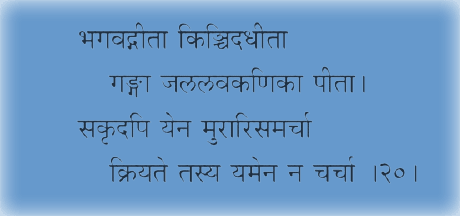
I have no doubt that the Gita has plenty of lessons for us mortals to think about in order to lead a good life.  I remember my great-uncle reciting, as he often did, the following verse:


At the source of that image is a translation of the verse:
One who has studied the Bhagavad Gita just a little,
drunk even a drop of Ganga water,
has worshipped Murari (Krishna) just once,
does not meet with Yama (lord of death).
This atheist cares not about worshiping Murari, is convinced that there won't be any encounter with Yama, and will not dare to drink a drop of the highly polluted Ganga water.  But, yes, I believe that I immensely gained from the Gita that I read, even if I understood nothing, way back during my angst-filled undergraduate years.

Monday, March 03, 2014

Blogging about reading Wendy Doniger's "The Hindus": #4

It looks like blogging on other topics might have to be put on hold for a while.

Doniger writes,
"Much of what we now call Hinduism may have had roots in cultures that thrived in South Asia long before the creation of textual evidence that we can decipher with any confidence. Remarkable cave paintings have been preserved from Mesolithic sites dating from c. 30,000 BCE in Bhimbetka, near present-day Bhopal, in the Vindhya Mountains in the province of Madhya Pradesh.
My first reaction was: did I sleep though the Indian history class in high school when they might have discussed this?  30,000 year old cave paintings that I hadn't even heard before?  This being in India, are those paintings well protected?  Have by now people already scribbled on them the equivalent of "sriram wuz here?"

India is filled with all kinds of mysteries!  One of them is the unresolved question of where and how did the Hinduism as we refer to originate:
There were other early settlements in India, notably the culture of Baluchistan, in the westernmost part of what is now Pakistan, dating to before 6000 BCE. But from about 2300 BCE the first urbanization took place, as great cities arose in the valley of the Indus River, 150 miles south of Baluchistan, also in Pakistan. The material remains of this culture, which we call the Indus Valley Civilization or the Harappan Civilization (named after Harappa, one of two great cities on the Indus, the other being Mohenjo-Daro), present a tantalizing treasure chest of often enigmatic images that hover just beyond our reach, taunting us with what might well be the keys to the roots of Hinduism.
Damn those people for not leaving behind clear records for us--maybe we need to outsource decoding this to Martians ;)
For the resemblances between some aspects of the IVC [Indus Valley Civilization] and later Hinduism are simply too stunning to ignore. As the Late Harappan culture declined, its survivors must have carried some of it into the Ganges-Yamuna basin. ... [The] process of urbanization moved gradually south from the Indus cities to the site of Kaushambi, near modern Allahabad in the Gangetic plain, and to the surrounding villages. ... The Indus Civilization may not have simply gone out like the flame of a candle or, at least, not before lighting another candle.
...
We can see the possible survival, in transformation, of a number of images. ... These patterns, and the rough outlines of other images that we have considered, perhaps even the stone lingas and the voluptuous women, may have gradually merged with the culture of the people of the Veda.
Which then leads us to the question of where these Vedic people came from. Who were they?  How did they relate to the IVC people? To the Dravidians?

Frustrating because the Vedic people left behind the sounds of knowledge (Vedas) but otherwise they cleaned up before they turned the house over. Not a scrap remains of their existence.

But, before that, what triggered the collapse of the Indus Valley Civilization?  Interestingly enough, Scientific American has this today:
The decline of Bronze-Age civilizations in Egypt, Greece and Mesopotamia has been attributed to a long-term drought that began around 2000 BC. Now paleoclimatologists propose that a similar fate was followed by the enigmatic Indus Valley Civilization, at about the same time. Based on isotope data from the sediment of an ancient lake, the researchers suggest that the monsoon cycle, which is vital to the livelihood of all of South Asia, essentially stopped there for as long as two centuries.
The monsoon did not fail for merely a season or two: " the regular summer monsoons stopped for some 200 years."

Ouch!
If a lack of monsoons did spell the end of the Indus Valley civilization, says Hodell, “it is an example — and there are other examples of this — of how ancient societies have had to contend with climate. There are some lessons for us and our future, in which we will have to deal with anthropogenic climate change”.
Hmmm ...  Jared Diamond now gets another piece of evidence that adds to the thesis of Collapse.

Source

Wednesday, February 19, 2014

From nothing came infinity

What was there before the Big Bang?  Did all these come out of something, or out of nothing at all?

Won't it be awesome if humans figured this out?  That question has probably been driving us humans crazy ever since we started to think. How did we get here is, to me, far more exciting and challenging, and mysterious compared to why we are here. When it comes to the why, I am far more tempted to explain it with George Carlin's answer!  

As Stephen Hawking observed (at least, in my understanding of his book) time itself began only with that biggest of bangs the universe has ever known. What was there before means that even the word before does not apply--there was no time prior to the Bang.  Aaaaah!  But, dammit, where did the Bang come from?

We may never, ever find out. Isn't that a shame!  A tragedy. I am with Neil DeGrasse Tyson--I would love it it if some superior life form on some other planet knew the answer and could tell us--but, I would probably be dead before that happens, and won't do me any good.

Other than the curiosity aspect of it all, does it matter even one bit whether or not we figure out the cosmos before that Singularity?  But, dammit, what an awesome thing it will be to crack that puzzle.

Different religions and traditions have their own narratives on how all these came about. Growing up as a curious kid in a traditional, Hindu Brahmin family, I got more than the typical dose of the religious and philosophical explanations compared to most, I would think.  It was that curiosity that led me to "shunyam."  Shunyam is not zero.  Zero is something specific. It is neither a positive number nor a negative number.  Zero, thus, represents a value.  It is "poojyam."

Shunyam is more like null. Empty. Vaccuum. I have a vague recollection of a Vedic chant that was about this Shunyam. But then maybe I am imagining it.

The Rig Veda has a wonderful hymn that deals with Creation, and this site has a translation by Wendy Doniger--yes, that same controversial Doniger.  Set aside the controversy, and focus on the content here:
There was neither non-existence nor existence then.
There was neither the realm of space nor the sky which is beyond.
What stirred?
Where?
In whose protection?
Was there water, bottlemlessly deep?

There was neither death nor immortality then.
There was no distinguishing sign of night nor of day.
That One breathed, windless, by its own impulse.
Other than that there was nothing beyond.

Darkness was hidden by darkness in the beginning,
with no distinguishing sign, all this was water.
The life force that was covered with emptiness,
that One arose through the power of heat.

Desire came upon that One in the beginning,
that was the first seed of mind.
Poets seeking in their heart with wisdom
found the bond of existence and non-existence.

Their cord was extended across.
Was there below?
Was there above?
There were seed-placers, there were powers.
There was impulse beneath, there was giving forth above.

Who really knows?
Who will here proclaim it?
Whence was it produced?
Whence is this creation?
The gods came afterwards, with the creation of this universe.
Who then knows whence it has arisen?

Whence this creation has arisen
- perhaps it formed itself, or perhaps it did not -
the One who looks down on it,
in the highest heaven, only He knows
or perhaps even He does not know.
I love the "perhaps even He does not know."

The old tradition in the old country recognized that from that nothing came about the infinite. While the world salutes India for inventing the zero, I am not sure if the world outside of India was familiar with the concept of infinity either.

The rhythmic and mellifluous chant of this couplet is a sheer joy to listen to in a real world setting:
puranam adah, purnam idam, purnat purnam udacyate
purnasya purnam adaya purnam evavasisyate.
which translates to:
That is infinite, this is infinite;
From That infinite this infinite comes.
From That infinite, this infinite removed or added;
Infinite remains infinite
Of course, the infinite that is referred to here is way more than mathematical concept, and if often interpreted through hours and hour of lectures that are devoted to each and every word in the couplet.

What always has impressed me, and continues to impress me, despite the atheist that I am, is that the Vedantic text and discourses in the old country made that wonderful and powerful link between nothing and infinity, and attempted to provide a narrative on how everything came about.

Here we are, a couple of thousand years later, struggling to figure out a narrative that is not merely based on conjectures but on evidence.  It is a frustrating project, I would think, to those in the quest for the answer via evidence and for people like me who would like to understand that evidence.  But, hey, that quest is not for nothing. Wait, it is for nothing!


Friday, March 07, 2014

I don't care about the uselessness of what I do

I am amazed, and sometimes even envious, of people who are single-minded in their approach to life. There might be that one thing which is their thing, which they know and do well, and they care not to spend time on anything else or even know about anything else.

I am very much unlike them.

If only I knew how to confine myself within some narrow walls, is what I think every once in a while. Quickly those thoughts vaporize, thankfully.

Which is why, as informative and a great reading experience as Wendy Doniger's The Hindus is, I had to take a break from it and look around at the rest of the world.

Not only look at the world, but also blog about it!

Not that the blogging about all things wonderful (and not) about this world yields any tangible and positive results.

source

The world being such a fascinating place, there is no shortage of topics to blog about.  But, I can see that sometime in the future, I will, for certain, feel like how Philip Roth explains his retirement from writing:
Everybody has a hard job. All real work is hard. My work happened also to be undoable. Morning after morning for 50 years, I faced the next page defenseless and unprepared. Writing for me was a feat of self-­preservation. If I did not do it, I would die. So I did it. Obstinacy, not talent, saved my life. It was also my good luck that happiness didn’t matter to me and I had no compassion for myself. Though why such a task should have fallen to me I have no idea. Maybe writing protected me against even worse menace.
Now? Now I am a bird sprung from a cage instead of (to reverse Kafka’s famous conundrum) a bird in search of a cage. The horror of being caged has lost its thrill. It is now truly a great relief, something close to a sublime experience, to have nothing more to worry about than death.
Yes, keeps me out of trouble, as I like to say.  Though, there are times when I wonder if I my identity is so wrapped up with such a behavior that not engaging in what I do will then be a cause for a complete breakdown. Thankfully, those thoughts also quickly vanish.

I am stuck with reading, and thinking, and commenting, for a long, long, long time to come, I hope.  What a wonderful problem to have!

Saturday, December 28, 2019

"what prompted the book choice"

Even for this wannabe writer, there is plenty to write about from places that I go to, people I meet and interact, books and essays that I read, ... writing is how I process many of those.

In an email to a friend, I wrote:
I am just about wrapping up a book titled Amma. It is Perumal Murugan's book that has been translated from the Tamil.  The translation is not the stellar quality that Murugan's work deserves though.  But still the narration, his Amma and family and community that he writes about are all so real and relatable.
In the friend's reply was a comment/question: "what prompted the book choice"

Where do I begin?!

As I became aware of the world around me starting in my tweens, I began to understand that there were plenty of "others"--the differences of religion, caste, income, skin complexion, ... And people were signaling hierarchy explicitly and implicitly based on these, which were also often inter-related.  People even lived in different places because of these differences!  My curiosity to make sense of these added to my discomfort over the privileged position that I was afforded.

The stories that I read rarely ever addressed these issues.  Instead, most of the Tamil literature was about kings and queens of the past, or set in the context of the struggle for independence from the bastards.  Occasionally I chanced upon something by Pudumaipithan or Jayakanthan, whose writings laid bare the problems that I wanted to know more about.  Once in a while, a movie like Elipathayam or Yarukkaga Azhudaan helped me make sense of the context in which I was growing up.

Graduate school provided me a window into these but strictly from a social science perspective.  Complementing that, there were short stories and full-length books in plenty--in the English language and set in American contexts--that were all about the human condition.  There were art movie houses that screened American and European works about the lives of people in all the complexity.

Into my middle age, I became more and more interested in understanding the human condition.  Intellectual approaches did not help.  They didn't reach into the emotions as much as fiction, movies, and music did.  It was heavenly when non-white Americans too began to educate and comfort me.

I kept an eye out for anything from the old country too--if ever they rose to the occasion.  Even if they were only tshirts!  It was consoling to read others who lamented about "how completely the continuity of Indian life has been severed. A single generation of English education suffices to break the threads of tradition and to create a nondescript and superficial being deprived of all roots—a sort of intellectual pariah who does not belong to the East or the West."

Meanwhile, it seemed like Indians were becoming obsessed with material economic growth, cricket, and masala movies, and all the tamasha that never endsBook-reading had become an endangered human habit. To hell with art and creativity!

And worse was when people in India decided that any writing that was critical of the privileged would not be tolerated.  I was shocked at how much Wendy Doniger was attacked.  It was even more atrocious when a local--Perumal Murugan--writing in the vernacular was driven out of his job and writing; Murugan exclaimed that "Author Perumal Murugan has died"  Right then I placed an order for his book that created the controversy:


The book never arrived and my money was refunded.

Since then, during my visits to India, I have scanned the bookstores for One part woman.  No luck.  I did find one gem during my last visit.

A couple of weeks ago, I read in The New Yorker a review essay about Murugan's latest book in translation: The story of a goat.  Which reminded me about my unfinished business.

At my favorite bookstore in Chennai, I was again confused by the chaos, and sought help.  "Where do you have Perumal Murugan's books?"

He led me to a shelf.  One part woman.  Next to it was Amma.  I picked up both.

"Do you have his story of a goat?"

"It is out of stock. We have placed an order," he replied.

I didn't choose the books; they chose me.

Monday, March 17, 2014

Balls to you!

Way back, as a married man and when the daughter had yet to leave for college, and in a life that also involved two dogs at home, one of my many jokes, which I found to be very funny, was about how the difference between me and the dogs was that I was not castrated in a world of women!

I was never at ease at having the dogs castrated.  It seemed unnatural and cruel. I imagined the situation being the other way around, like in the Planet of the Apes.  It seemed awful that I would have to live a castrated life in a cage or as a pet.  The intellectual discussion of the presumed supremacy of humans over other forms met a real life situation, and the intellectual argument was nowhere to be found.  The dogs lost their balls, and more.


I thought about those dogs, especially the long-haired chihuahua, Congo, who was the kindest dog ever, when I read this essay, authored by an animal doctor.  An essay that is like a contemporary equivalent of the animal (and people) stories that James Herriot made us think about.   The author, John Brooke, had one crazy week, it seems:
I review this week with some disturbance at the remarkable number of animals I have sterilised. I counted the castrations: 40 calves, two colts, three dogs, one cat, one ferret and a coatimundi (a raccoon-type thing from South America that has very long teeth). I counted the ovariohysterectomies (spays): two cats, two bitches and one rabbit.
All of these mutilations were elective, mostly for behavioural rather than medical reasons.
We need to note here that these were pretty much for the same behavioral reasons that I, like a gazillion other pet owners, got the two dogs neutered.  Because, once the testicles are gone, well, so is the testosterone:
The behavioural benefits of castration are enormous: dogs do not thrust themselves on anything that passes by; queen cats do not try to break out of the house when they are in season/oestrus; geldings will graze peaceably in fields, while a colt will jump fences to clamber on top of any mare that winks at him; rabbits will not mate with their siblings and those of the same sex are less likely to try to maim each other.
Some cojones we have to do what we do!
But what sort of brave new world is this in which we practise? If an animal’s sexual activity is problematic, it is either sterilised or euthanised. Animals are tied to our social contract. The development of dog breeds shows how natural selection has been undermined: some breeds can give birth only by Caesarean section; many have inherited disorders that can now be treated. The breed of the dog is an easy indicator of what conditions are likely to affect it.
So it is that many mutilated creatures with inherited defects roam the country.
I often remark in classes that many issues we can relate back to one question: what does it mean to be human?  And depending on the context, we can think through what it means to be human.  In this case, does being human mean that the entire world of living and non-living things is at our disposal for us to do whatever pleases us?  Or, does being human mean that we treat them all humanely.  Does treating non-humans humanely mean that we should not neuter or spay the animals--that we should treat them more than as if they are our toys?

It often feels like we have given up raising such questions anymore.  When secular groups like PETA address animal rights, they wildly make their point, no differently from how the uber-religious make their own points.  When religions address this, well, the answer depends on the religion, and it is then choose whatever answer that appeals to you.  The Judeo-Christian traditions seem to validate to their followers that god made humans in his image and told humans that everything on earth is for them to rule over. (Yes, I am simplifying.)  Jains disagree with this view. The Hindu tradition treats some animals as sacred and some are treated like, well, dogs!  The dog is always referred to in the Vedic texts as the impure one, writes Wendy Doniger (when will I be able to get back to that one!)

So, yes, there are multiple answers possible, it seems.  But, wouldn't it be awesome to raise such questions and have everybody discussing their own answers than not raising the questions at all?

Thursday, December 19, 2019

Will the real Buddha please stand up!

I thought I would stay away from blogging for a while.  A break.  Perhaps to also re-charge.

Wrong I am.

It is difficult.  Too. Damn. Hard.

I am reminded of a comment made by a former student, who is now a faculty colleague.  She loves dancing, and during the earlier years of her undergraduate years, she even toured with a dancing group.  Now, as a faculty, she works with a local dance theatre--I put her in touch with another former student who, too is dancer.  Anyway, she said, "we dancers have to dance."

It is not about being the best dancer ever.  It is not about becoming a star dancer.  It is about being a dancer. 

And I simply want to write.

So, here I am, hoping that an occasional reader might find something here.

Recall the story of the prince Siddhartha, whose mother had that vision when she was pregnant with him?  And the stark encounter of life provoking an existential crisis in the prince, which then leads the prince to ditch his royal luxuries in search for the meaning of life?  And how finally he became the awakened one--the Buddha?

What if all that story was, well, mere story?

Who was the real Buddha?

I suppose this is an example of how "religious studies" and faith diverge.  In the old tradition, it was often said, "ரிஷி மூலம் நதி மூலம் ஆராய கூடாது" (one should not try to find out the origins of the sage nor of the river.)  But, this is exactly what religious studies scholars do. Even when it pisses off the fanatics, as Wendy Doniger's experience demonstrates.

So, who was the real Buddha?
Bringing the reliable historical fragments together, and discarding mythic elaborations, a humbler picture of the Buddha emerges. Gotama was born into a small tribe, in a remote and unimportant town on the periphery of pre-imperial India. He lived in a world on the cusp of urbanisation, albeit one that still lacked money, writing and long-distance trade.
I think this Gotama becoming such a profoundly influential figure is far more impressive than the story of the princely Siddhartha growing up in a huge palace.

Impressive that from a small and remote place in that area between modern day India and Nepal, Buddha and his teachings have spread far and wide.  Of course, when the teaching spreads, ideas are morphed in a number of different ways.  The modern day mindfulness and meditation in the West too have their origins in the Buddhist teachings.  But, even the Buddha might not recognize and understand the contemporary practices of mindfulness!
The Americans who adapted mindfulness in the late-20th century drew on a 19th-century revival of meditation in Burma. And so rather than transmitting an ancient practice, they instead promoted a new spiritual discipline, formulated when Burmese Theravada was suffering in the shadows of the British Empire.
A feature of the modern mindfulness movement, inherited from fairly recent Burmese innovations, is its appeal to the laity, and hence its essentially therapeutic, rather than salvific, aim. Nothing could be further removed from the Buddha’s radical ideal of sagehood. By insisting on ascetic discipline and a life of homeless wandering, Gotama presented mindfulness as a total life commitment. Practised in this way, attending to the constituents of experience can be transformative: Gotama claimed it is a way of undoing one’s mentally constructed world, along with all its unsatisfactoriness and suffering.
Writing too helps me with the world "along with all its unsatisfactoriness and suffering."  Om!

Sunday, August 30, 2015

Strange are the ways of the academics!

I was drawn to the headline of a news item in the paper that I grew up reading in the old country:
Modi visit: U.S. academics sound caution
The curious me continued reading the text that followed:
 Prime Minister Narendra Modi’s visit to the Silicon Valley next month to woo its movers and shakers to provide heft to his Digitial India initiative, has met with its first roadblock with several leading academics in American universities advising IT firms to exercise caution when engaging with the Indian Government.
So, of course, I read the statement.  It begins with:
As faculty who engage South Asia in our research and teaching, we write  to express our concern s about the uncritical fanfare being generated over Prime  Minister  Narendra  Modi’s visit to Silicon Valley to promote “Digital  India” on September 27, 2015.
It never ever ceases to surprise me when I read about academics issuing calls and signing off on statements like this.  "Oh, listen to me because I am an academic" always amuses me.  When will academics ever figure out that issuing statements from the comforts of their chairs won't do a damn thing other than the awesome boosts that they feel to their already self-inflated egos!

I am no fan of Modi.  I routinely critique him, his past, his affiliations with the Hindu nationalist groups, his fascination for the Chinese economic model, his security alliance with Israel, ... the list is endless.  But, even if I were not at a podunk university but at one of the research universities where the signatories are from (we podunks don't matter to those folks,) I ain't signing no political petition that asserts that we have to be listened to because we faculty know it best.  Intellectual arrogance!  And, worse, these are faculty here in the United States--not even based in India--and I wonder how many of them are Indian citizens!

It is not that I don't sign petitions.  I do.  But those are petitions that are not merely from academics and are, instead, open to anybody from any walk of life.  It does not matter if I am an academic or a ditch-digger or a filthy rich capitalist; those petitions are from "we, the people."  I run far, far away from "we, the academics."  Remember this one, for instance?

It is not that I am an apolitical faculty either.  I will be the first to admit that I am highly subversive.  But, I am a subversive who uses his class and his professional responsibilities with care. I have blogged enough about that and shall spare you all those posts but will quote, once again, one of my favorites:
SOME ASSUME that the only way academics can engage the politics of the day is by coming out of their ivory tower and protesting in front of the White House. But in conveying knowledge, the academy has a far more important and subversive way of dealing with political issues. Knowledge provides us with a way to perceive the world. Imaginative knowledge provides us with a way to see ourselves in the world, to relate to the world, and thereby, to act in the world. The way we perceive ourselves is reflected in the way we interact, the way we take our positions, and the way we interpret politics.
Curiosity, the desire to know what one does not know, is essential to genuine knowledge. Especially in terms of literature, it is a sensual longing to know through experiencing others—not only the others in the world, but also the others within oneself. That is why, in almost every talk I give, I repeat what Vladimir Nabokov used to tell his students: curiosity is insubordination in its purest form. If we manage to teach our students to be curious—not to take up our political positions, but just to be curious—we will have managed to do a great deal.
I scanned through the list of the eminent signatories.  It includes Wendy Doniger, whose book on Hinduism resulted in quite a bit of controversy in the old country, about which I blogged a few times.   I recognized two names from my graduate school days.   

I am reminded, yet again, of the caustic, sarcastic, and polemical essay that Robert Nozick authored on the strange behavior of the "intellectuals."  He wrote there:
The school system imparts and rewards only some skills relevant to later success (it is, after all, a specialized institution) so its reward system will differ from that of the wider society. This guarantees that some, in moving to the wider society, will experience downward social mobility and its attendant consequences. Earlier I said that intellectuals want the society to be the schools writ large. Now we see that the resentment due to a frustrated sense of entitlement stems from the fact that the schools (as a specialized first extra-familial social system) are not the society writ small.
If only "we, the faculty" realized that society is not "schools writ large."  Oh well, it is but one letter of a difference between faculty and faulty! ;)

Thursday, March 06, 2014

We were all black. That is fair and lovely!

My only trip to Africa was when I spent three weeks in Tanzania, in December 2009. The English language newspapers at Dar es Salaam reported on the front pages about the anti-gay fervor in neighboring Uganda and the role of US-based missionaries in that brouhaha. I was so convinced that it was all a fleeting political issue that I threw away those pages; little did I know!  Instead, I brought with me a couple of pages that were news items on how beauty products were marketed targeting the women--because, among others, the products included "skin whiteners."

The anti-gay nastiness has become a law of the land in Uganda, and it seems like it might even spread to a few more countries in Africa. That will be a post for another day, I am sure.  The skin whiteners continue to fascinate me because I grew up in a culture, in a country, where the skin complexion was categorized in so many ways, like.
Coal black
Dark
Dark brown
Brown
Light brown
Wheatish
Fair
Very fair
And, yes, even white!
A graduate school friend, who was from Nigeria, used to joke that there isn't any black skin--it is all only various shades of brown.  A white American grad school colleague noted that there is no white skin and once held a blank sheet of white paper against his skin to prove his point.

In the old country, "Fair & Lovely" was a product that was sold as a skin whitener.  It still is. In a "liberalized" economy that India now is, there are, I bet, quite a few competing products as well.

"White," as I used to joke in graduate school, is nothing but a serious medical condition of pigment deficiency.  Lack of melanin.  My version of "brown pride," I suppose.

The Economist reports a study that confirms why we have melanin:
One suggestion often proferred is that the melanin in black skin, by absorbing ultraviolet light which might otherwise damage DNA and cause mutations, protects against skin cancer.
The confirmation came via:
a study by Mel Greaves, of the Institute of Cancer Research, in Britain, just published in the Proceedings of the Royal Society, settles the question in favour of cancer being the driving force. Dr Greaves does so by reviewing the clinical data about those Africans who do not have black skin because they are albino.
As humans wandered into the northern latitudes, there was less of a danger of cancer from the way-less intense sunlight. On the other hand, a lighter skin tone facilitated synthesizing Vitamin D.  The cost-benefit analysis then yielded the "whites."

My favorite Tamil expression for the much adored skin tone is பால் நெரம் (milk color.)  Imagine a Tamil walking around with a skin color that matches the color of milk. If such a person existed, that will be one brief existence on the planet, in those uber-hot conditions!

Of course, this also means that the darker skinned Tamil folks like me living in northern latitudes that aren't our original home, and especially in this part of the Pacific Northwest where the sun rarely ever peeks through the cloud cover, well, we need Vitamin D supplements. But, hey, no worries about any skin cancer though ;)

I wonder if Wendy Doniger will have anything about the "fair" and "dark" skinned Hindu gods.  I will find out when I return to blogging about "The Hindus."

Saturday, March 08, 2014

I am not a contrarian. Irreverent is the word!

During graduate school, I was a student intern at a public agency.  Right from the first day there I knew I would not survive in such environments. But, of course, life is one cruel joke after another, and I ended up working for another public agency for more than five years before I returned to academia.

Even on that first day, I was reminded of a comment a graduate school professor made about how he became a libertarian.  It was all because of the summer internship he did at the Los Angeles County government when he was an undergrad.  After one day, I could certainly relate to him, though, even now, I am not a libertarian, but a Democrat who leans that way.

Anyway, a couple of weeks into my internship, during a discussion with my supervisor, I presented a view that was not what she apparently wanted to hear.  "I noticed you are a contrarian" she remarked.

The lowly intern that I was, I did not want to correct her that I was not taking such a stance because I wanted to argue but because what she claimed was wrong.

The irreverence--towards people and false ideas alike--is also why I think I naturally gravitated towards the likes of Christopher Hitchens.  Though, I had always wondered why he chose the title of "contrarian" for his Letters to a young contrarian. His questioning of accepted wisdom was not as a merely debating strategy but because to him there was no sacred cow.  It was sheer irreverence. Who else would have gone after Mother Teresa like how he did!

As Hitchens notes towards the end of the interview,which is when Charlie Rose gets to the book itself, living that irreverent (or contrarian) life is living a life, as opposed to having a career or a job.  It is truly who we are that we live.  And, yes, Hitchens, too talks about leaning towards libertarianism.

I would think that when in pursuit of truth, we naturally become irreverent. The progress of science has nothing but been one instance of irreverence after another.  In the old days, when irreverence was religious blasphemy, heresy, well, a philosopher like Giordano Bruno was burned at the stake.  While irreverent explorations in science are no longer questioned, irreverence in the pursuit of understanding social aspects is far from tolerated, as the recent controversy related to Wendy Doniger's The Hindus demonstrates.

The academic world is no different from the rest of society.  As long as one holds hands with the rest and sings the preferred version of Kumbaya, then all is well.  There is no place for the irreverent, which is a complete contrast to the idealized version of academe that I had in mind.

But, hey, I never set out to win the popularity contest anyway!  So, today's question: whom should I piss off? ;)