Showing posts with label academics. Show all posts

Friday, September 16, 2016

Thus spake the market!

Think about this: Most kids and adults like to be entertained.  Most kids and adults alike do not care to invest time and energy into reading and thinking.  Are those fair enough generalizations?

Thus, if we had money to spend along with the time, then most of us would shell out our time and money on entertainment.  And what better entertainment than sports, right?

If we leave everything to the market, then that is the kind of an outcome we can expect.  Which is also what we see increasingly happening in higher education, where students spend their time and money.  And with plenty of help from taxpayers, sports rule.  The flashier and more exciting the sport is, the more is the money spent on it.

Which is why it is no surprise that this op-ed (in the NY Times!!!) author has taken it to the logical extreme: He (of course it is always a "he" when it comes to such nutcases!) says it is high time universities offered majors in football and basketball and ...: He cites how the market has already spoken in favor of this:
Last weekend, nearly 157,000 people packed Bristol Motor Speedway in Tennessee to see the University of Tennessee battle Virginia Tech, the largest crowd ever to turn out for a football game, college or professional.
With popularity comes money, and lots of it. In April, the N.C.A.A. signed a deal with CBS and Turner Broadcasting for an eight-year, $8.8 billion extension of their March Madness basketball TV contract to 2032, while the college football bowl series brings in more than $500 million annually.
Exactly.  When was the last time a philosophy match brought in such money?

The author offers more:
Athletic budgets have swelled as a result. Texas A&M is on the verge of becoming the first campus to bring in more than $200 million a year from athletics. The University of Iowa just announced a 10-year, $45 million contract extension for its football coach. In 40 states the highest paid public employee is a college coach.
Oh, I get it now; the high salaries of coaches at colleges is to be lauded as the market speaking loudly.  What was I thinking!
 The $6.9 million annual salary of Nick Saban, the head football coach at the University of Alabama, is equal to the combined average salary for nearly 100 assistant professors at the school, according to the most recent data available.
Get rid of those faculty in geography and pay the football coach some more, I say.

Oh, wait, except that coaches earning gazillions, and the NCAA being an awesome cash machine, are not the results of the free market.  Click here, and in the table sort it out by the final column on "% Subsidy" if you want to puke all over the screen!

And, oh, while the coaches get paid gazillions, the worker-bees, also known as students, do not get paid.  Surely that is how the market works.  It does not?
It's wrong that taxpayers are forced to subsidize professional sports teams via stadium deals and the like. It's equally wrong that taxpayers and students see their bills jacked up to fund college sports teams, no matter how enjoyable the spectacle. I suspect that if and when the actual payouts to athletic departments for sports programs become better known, this worm will turn.
Nope, in this entertainment obsessed world, no worm will turn anywhere.  Who cares if 30-year old Johnny can't read and lives in mom's basement as long as he gets screens full of entertainment!

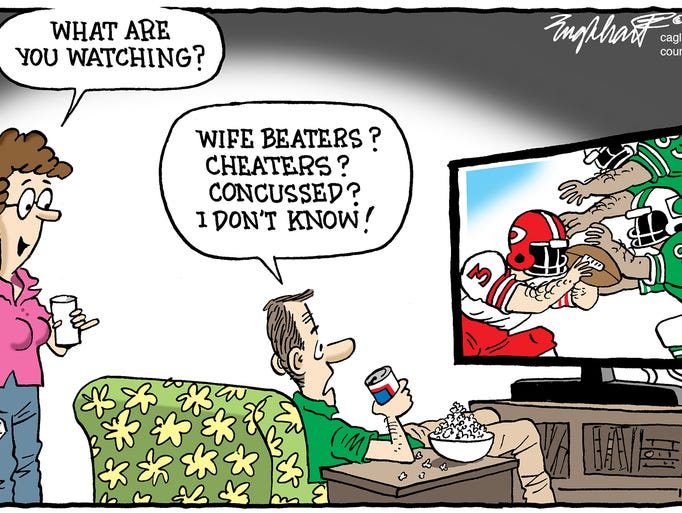
Sunday, May 01, 2016

Incompatibles: Football and the mission of higher education

The Sunday edition of the local newspaper had plenty of pages dedicated not to the Syrian crisis, nor to climate change, and not even to the latest antics of the Donald.  The pages, with color photographs galore, were about football at the local university!  Thankfully, I did not throw up all over the paper ;)

It is simply bizarre that everybody, from the president--who was his usual masterful self at the comedy improv last night--down to the high school student complains about the cost of higher education and, yet, there are only a few of us who have been railing against the wasteful allocation of precious dollars towards college football (and basketball too.)  About five years ago, in this post, I quoted Katha Politt who phrased it well:
In no other country’s university system, after all, does sports play anything like the central role it does in American academic life. Men do not go to Oxford to play cricket; the Sorbonne does not field a nationally celebrated soccer team. Even in the most sports-mad countries, sports is sports and education is education. That’s a better system.
Which is why it was refreshing to read about a public university in a neighboring state deciding that it did not want to participate in the athletic arms race.  The president of the University of Idaho, which is the state’s land-grant university, writes that some of the alumni and supporters do not agree with his decision because of the impact on the "institution’s “prestige” and “relevance.”  The university president responds to them:
Success on the football field should complement the prestige and relevance of our academic institution. But football affiliation or performance should not define prestige and relevance. The impact of our institution should define us, as measured by the entire experience for our student body, including our athletes; by academic excellence across the university; by sustained research, scholarly activity and creative success; and by deep engagement with communities and partnerships with industry.
Oh my!  Finally, a university president develops a spine to stand up against the brainwashed who believe that colleges and universities exist in order to entertain them!
Why should my university's decision about what conference to play in matter to anybody outside our institution? Because I think our situation has potential implications for dozens of universities that play big-time college football and says a lot about the state of college athletics.
Exactly!  This is 'yuge', as the guy with short fingers and a huge ego says.
We can and will create an outstanding student-athlete and communitywide experience around our program, a vibrant football culture that is a great front porch for Idaho’s leading, national research university, a draw for future students and a continued source of pride for current students. And we can do it in a way that does not constrain the university and does not distract from our core mission.
"Core mission."  What a quaint idea for a university president to make a decision based on the mission's and higher education's mission!  How do we get other universities and their presidents to understand this simple concept?  More importantly, how do we get the American public to understand what education is about?

Source

Sunday, August 30, 2015

Strange are the ways of the academics!

I was drawn to the headline of a news item in the paper that I grew up reading in the old country:
Modi visit: U.S. academics sound caution
The curious me continued reading the text that followed:
 Prime Minister Narendra Modi’s visit to the Silicon Valley next month to woo its movers and shakers to provide heft to his Digitial India initiative, has met with its first roadblock with several leading academics in American universities advising IT firms to exercise caution when engaging with the Indian Government.
So, of course, I read the statement.  It begins with:
As faculty who engage South Asia in our research and teaching, we write  to express our concern s about the uncritical fanfare being generated over Prime  Minister  Narendra  Modi’s visit to Silicon Valley to promote “Digital  India” on September 27, 2015.
It never ever ceases to surprise me when I read about academics issuing calls and signing off on statements like this.  "Oh, listen to me because I am an academic" always amuses me.  When will academics ever figure out that issuing statements from the comforts of their chairs won't do a damn thing other than the awesome boosts that they feel to their already self-inflated egos!

I am no fan of Modi.  I routinely critique him, his past, his affiliations with the Hindu nationalist groups, his fascination for the Chinese economic model, his security alliance with Israel, ... the list is endless.  But, even if I were not at a podunk university but at one of the research universities where the signatories are from (we podunks don't matter to those folks,) I ain't signing no political petition that asserts that we have to be listened to because we faculty know it best.  Intellectual arrogance!  And, worse, these are faculty here in the United States--not even based in India--and I wonder how many of them are Indian citizens!

It is not that I don't sign petitions.  I do.  But those are petitions that are not merely from academics and are, instead, open to anybody from any walk of life.  It does not matter if I am an academic or a ditch-digger or a filthy rich capitalist; those petitions are from "we, the people."  I run far, far away from "we, the academics."  Remember this one, for instance?

It is not that I am an apolitical faculty either.  I will be the first to admit that I am highly subversive.  But, I am a subversive who uses his class and his professional responsibilities with care. I have blogged enough about that and shall spare you all those posts but will quote, once again, one of my favorites:
SOME ASSUME that the only way academics can engage the politics of the day is by coming out of their ivory tower and protesting in front of the White House. But in conveying knowledge, the academy has a far more important and subversive way of dealing with political issues. Knowledge provides us with a way to perceive the world. Imaginative knowledge provides us with a way to see ourselves in the world, to relate to the world, and thereby, to act in the world. The way we perceive ourselves is reflected in the way we interact, the way we take our positions, and the way we interpret politics.
Curiosity, the desire to know what one does not know, is essential to genuine knowledge. Especially in terms of literature, it is a sensual longing to know through experiencing others—not only the others in the world, but also the others within oneself. That is why, in almost every talk I give, I repeat what Vladimir Nabokov used to tell his students: curiosity is insubordination in its purest form. If we manage to teach our students to be curious—not to take up our political positions, but just to be curious—we will have managed to do a great deal.
I scanned through the list of the eminent signatories.  It includes Wendy Doniger, whose book on Hinduism resulted in quite a bit of controversy in the old country, about which I blogged a few times.   I recognized two names from my graduate school days.   

I am reminded, yet again, of the caustic, sarcastic, and polemical essay that Robert Nozick authored on the strange behavior of the "intellectuals."  He wrote there:
The school system imparts and rewards only some skills relevant to later success (it is, after all, a specialized institution) so its reward system will differ from that of the wider society. This guarantees that some, in moving to the wider society, will experience downward social mobility and its attendant consequences. Earlier I said that intellectuals want the society to be the schools writ large. Now we see that the resentment due to a frustrated sense of entitlement stems from the fact that the schools (as a specialized first extra-familial social system) are not the society writ small.
If only "we, the faculty" realized that society is not "schools writ large."  Oh well, it is but one letter of a difference between faculty and faulty! ;)

Tuesday, December 30, 2014

A new year means a new highest paid "educator" ever at nine million dollars!

With fewer and fewer students choosing to enroll in my classes, soon I will be forced to blog for loose change.  So ... how much would you pay to subscribe to my daily rants and raves?

Of course you would not spare a penny, and would rather condemn me to the unemployment lines, right?

Because you--well, not personally you, but as a stand-in for an American--would rather be entertained.  I don't entertain.  Not even close.

So, you want to be entertained.  And that is how you would spend your money.  There are millions of Americans expressing such choices.

So, guess what?

Shit like this happens: Jim Harbaugh is done with the San Francisco 49ers.  The team that he coached was not entertaining enough this year.  Off with his head then!

But, oh, this is Jim Harbaugh.  So, guess what?  Shit like this happens:
Harbaugh is expected to become college football's highest-paid coach, earning more than the $8 million per-year salary that was originally reported, sources told Rapoport. Nick Saban is the highest-paid college coach at $7.2 million per year. Harbaugh's number could reach as high as $9 million per year, according to NFL Media's Albert Breer.
Are you now happy that nine fucking million dollars a year is what a public university will spend on a football coach in order to entertain the masses?  Are you not entertained?

As you the consumer make these choices, there are fewer dollars to spend on other things. Like, you know, education.  Who cares for those youth who come from low- and middle-income families with no trust funds for their education, right?  It is their mistake not to have been born into rich families.

It is only a matter of time before the university where I teach gets into a budget squeeze that has already affected other institutions.  You as the taxpayer will then point to classes like mine with three and five students and remark, "what a waste of money with only three students in a class!" because you are not being entertained with your tax dollars.  You would rather have that tax money back in your wallet in order to spend it on football coaches who will entertain you.

A liberal democracy means that you have the right to make these choices.  More power to you.  May you have enough and more entertainment in the new year and beyond.


Can you locate Michigan on this map and determine whether its needs to be updated? ;)
Source

Friday, August 15, 2014

Neither you nor I is an academic ... if you understand this post!

For a couple of years, the late Denis Dutton, who founded one of my favorite websites ever and one which I religiously check every single day, ran a bad writing contest.  No, you did not write in order to win this championship--I would think that Dutton and his colleagues would have had one hell of a challenge choosing from the bad writing that was in plenty in the academic world.

Consider the following "winner," for instance:
The move from a structuralist account in which capital is understood to structure social relations in relatively homologous ways to a view of hegemony in which power relations are subject to repetition, convergence, and rearticulation brought the question of temporality into the thinking of structure, and marked a shift from a form of Althusserian theory that takes structural totalities as theoretical objects to one in which the insights into the contingent possibility of structure inaugurate a renewed conception of hegemony as bound up with the contingent sites and strategies of the rearticulation of power.
Whereas Renee Zellweger's character in Jerry Maguire famously said, "you had me at hello," chances are pretty good that you did not even read through the "winning" sentence because it had you, I mean had you, at "The move from a structuralist account."

While that sentence, my dear reader, is an extreme, most academic writing is similarly beyond comprehension.  I have always suspected that academics write after a few glasses of wine, and the reviewers and editors read those essays after consuming a few bottles of wine.  There is no way, otherwise, those kind of sentences will ever, ever, end up in print.  Even worse that some even talk that way in conversations and at meetings!

Imagine the horrors when faculty expect students to learn to write like how they do.  Guess what?  That horror happens term after term, in college after college.  Should not surprise, therefore, that at the end of the undergraduate program graduating students come across as even worse off than how they were as mere high school graduates?

The author of this essay in the Chronicle of Higher Education asks, "how many professionals these days, apart from actual academics, write in an academic style?"  Nobody.  Therefore:
The fact that they’re students, and that they’re operating in an academic environment, does not make them academics. Nor will more than a fraction of them go on to become academics, thank goodness. The overwhelming majority won’t be writing academic prose in their professional lives, so why should we be teaching it to them in college, much less high school?
That indoctrination to academic writing is part and parcel of what appears to be the only goal that most faculty have, which is to replicate themselves.  Thus, they actively sell the subjects they teach and try to convert as many students as possible to their own fields of study--the "majors"--and teach students how to think and write the way they do.  Awful.  Simply awful!

I am sure that my colleagues who read my self-evaluation report would not have been pleased with the following sentences (among many others) that I had there:
My approach to teaching has always been about helping students understand the world, and not by any means to impress them with my fluency with the academic jargon, and not to recruit them into majoring or minoring in Geography either. My goal in teaching is to develop in students a commitment to, and an interest in, learning in ways that I hope will also become a lifelong pursuit.
Thus, if ever a student wrote papers with sentences that even remotely resembled that "winning" sentence, my favorite comment on the margin of the paper is this: "what are you trying to say?"

Is it any wonder then that my colleagues do not consider me to be "academic" enough!

ps: one of my exciting moments was when Denis Dutton commented at my blog.  Yes, he did!  I cannot thank him enough for Arts and Letters Daily.

Sunday, May 12, 2013

Students ignore their debts as long as their athletic teams win?

This blog post on the tax we are effectively imposing on the younger generation attracted quite a few visits, according the site traffic data.  I commented there, rather sarcastically, that:
The youth are paying big time for all our irresponsible decisions. But, youth being youth, their focus might not be in the metaphorical screw but in the literal one, and it will be a while before they will realize how much we have messed them up!
I should have noted there that jingoistic athletic worship distracts students as much as, or even more than, sex does.  How else could one explain students not only failing to protest against data--like the in map below, which is about the highest paid public employees in each state--but that they actually support increasing expenditure on athletics even though that only adds to their financial obligations come graduation?

As noted in the source for that map, such an allocation of money means:
This is money that is overwhelmingly going to field football, baseball, lacrosse, and other sports teams. It's not going to create new sections of Biology 101 or English 251 or underwrite the discovery of the next Streptomycin or publish the next Economics and the Public Interest or anything that remotely comes close to education or research.
I simply cannot understand how the public and elected officials alike can continue to engage in such a moronic and wasteful use of scarce resources that is not doing anything productive to make future generations richer and wiser!

In fact, it is the other way around: there is an athletic arms race.  
The trend begins with the broadest comparison possible in Division I – the more-elite FBS programs vs. the smaller, less-wealthy FCS ones. While the cost of instruction rose 53.3 and 48.2 percent at FBS and FCS institutions, respectively, and tuition rose 54.6 and 47.0 percent, instructional salaries increased only 15.8 and 14.14 percent. Total athletic coach salaries, meanwhile, rose 67.1 and 59.4 percent, and football coaches’ salaries rose even faster: 80.8 and 61.9 percent.
Narrow that down to the most elite of the elite, and the difference becomes even more stark. In the Bowl Championship Series conferences, whose champions automatically qualify for a slot in one of the five BCS bowl games, instructional salaries rose 15.8 percent – which, as it happens, is 1.7 percent higher than the increase at FCS programs. But total athletic coach salaries rose 78.4 percent, and football coach salaries rose 96.6 percent.
These are the few occasions when I allow myself to say this: Fuck!!!
“Presidents should really start asking the question, what is the purpose for athletics on my campus"
Oh yeah?  Good luck with that!

Meanwhile, students continue to pay for tuition and fees and don't even bother showing up for classes and don't care to turn in assignments.  What the heck is going on?

It is all beginning to show up in the real world:  
The Federal Reserve Bank of New York, in a new study, found that 30-year-olds with student loans were now less likely to have debts like home mortgages than 30-year-olds without student loans — even though most of those with student loans are better educated and can expect to earn more money over their lifetimes. The same pattern holds true for 25-year-olds and car loans. 
“It is a new thing, a big social experiment that we’ve accidentally decided to engage in,” said Kevin Carey, the director of the Education Policy Program at the New America Foundation, a research group based in Washington. “Let’s send a whole class of people out into their professional lives with a negative net worth. Not starting at zero, but starting at a minus that is often measured in the tens of thousands of dollars. Those minus signs have psychological impact, I suspect. They might have a dollars-and-cents impact in what you can afford, too.” 
The weak economy and tight credit standards remain the main culprits preventing young people just establishing themselves from making major purchases. But millions now face putting a substantial share of their take-home pay toward past debts rather than present needs. Student loan debt leaves them with less money for things like clothes and restaurant meals. And it is even more likely to suppress purchases of more expensive items that need to be bought with credit. A poor job market is compounding the problem
Who cares, right, as long as the athletic monster is well fed?  Let me use that word once more: Fuck!!!

Thursday, November 29, 2012

Universities are for sports? All of us ain't Stanford!

As the BCS adrenaline rushes through the blood of "real" Americans, this might not be a good time to comment that we cannot hope to build Oregon’s economy merely on football and sports.  But then not often do I stop myself from writing anything unpopular; when will I ever learn!

Way back in the 1980s, when I was a graduate student at USC, the storied football program was far from perfect on the field.  In fact, “Tailback U.” went into a tailspin, which resulted in a quick shuffling of coaches. 

John Robinson was shown the door almost as soon as he was invited.  When Larry Smith was the coach, USC lost to a then unknown team from Arizona, and towards the end of the game the loyal Trojans in the stands were singing in chorus “Na Na Hey Hey Kiss Him Goodbye,” but with the word “Larry” taking the place of “kiss him.”  And, yes, soon Smith was gone.  Those who bleed “cardinal and gold” would rather airbrush the coach Paul Hackett out of the otherwise fabulous legends from Troy.

Meanwhile, something more important was happening: USC’s academic reputation was on the rise.  The university’s academic quality, whose overall ranking in the early 1980s made it obvious that it was no Harvard, was the focus of the new university president, Steven Sample.  Without marginalizing the athletic traditions of the university, Sample led the university’s campaign to become known for academics as much as, if not more than, it was famous for football.

If the proof is in eating the pudding, well, the results are in.  Two decades later, USC, and its cross-town rival, UCLA, have marched ahead in their respective academic rankings.  US News and World Report, whose rankings of academic institutions are closely followed even when highly disputed, now ranks USC and UCLA tied at #24.

The money kept flowing in as USC's academic reputation gained, and there was a turnaround in football too.  It might very well be decades before USC wins another football title or UCLA grabs one in basketball.  But, it is highly doubtful that these two universities are ever going to stop their forward momentum in what ought to be the fundamental focus of any university—academics.  A little north of these two schools, Stanford, whose academic reputation has never been questionable, soars high with a football team too.  Perhaps recruitment into the football team at Stanford is as highly selective as academic admissions are?

It is not any coincidence that all these happened amidst an even more interesting sports background in Southern California.  In 1994, the region said adios to the two professional football teams—the Rams and the Raiders.  Since their exit, there has not been a professional football team in the metropolitan area, despite the many attempts by the National Football League to locate a team in this huge market. 

Thus, as we celebrate the success of college sports in Oregon, let us not forget that the economic future of the state and its peoples depend not on whatever happens at Autzen Stadium or the brand new Matthew Knight Arena, but on the employment conditions in economic activities from machine shops to semiconductor factories. 

The challenge is to successfully re-build Oregon’s economy.  It is difficult to ignore the depressing news about continuing unemployment, and that Oregon’s per capita income trails behind the national average.  It is a tough challenge for which there is no easy solution, particularly in a rapidly changing global economy. 

However, we do know that the academic quality and reputation of our universities—public and private—is an important ingredient to this rebuilding effort.  Relegating academics--the very reason for the existence of universities--to the dark background will certainly not be a winning formula for the future of Oregonians.

Oh, in case you are wondering.... the University of Oregon is ranked #115 and Oregon State University is at 139.  I suppose we should merely be excited about their football and basketball programs, right?