Showing posts sorted by relevance for query china sea. Sort by date Show all posts

Wednesday, September 21, 2011

The Indian-Chinese pissing match in the waters of the South China Sea

We are fast nearing the fiftieth anniversary of the war between India and China.  A little after Jawaharlal Nehru, India's prime minister at that time, loudly and proudly proclaimed "Hindi Chini bhai bhai"--Indians and Chinese are brothers--China decided to re-enact a recurring theme in the story of humans: a battle between brothers.

It was a short war in which India was humiliated. Even after all these years, territorial claims remain unresolved.

As if those land-based issues were not enough for geopolitical tensions, the two countries now seem to want to take their fight to the open seas. In the South China Sea, to be specific.

Why?

To borrow from Bill Clinton's election slogan, it's the energy, stupid!

More than two years ago, Robert Kaplan wrote in Foreign Affairs:
Already the world's preeminent energy and trade interstate seaway, the Indian Ocean will matter even more in the future. Global energy needs are expected to rise by 45 percent between 2006 and 2030, and almost half of the growth in demand will come from India and China. China's demand for crude oil doubled between 1995 and 2005 and will double again in the coming 15 years or so; by 2020, China is expected to import 7.3 million barrels of crude per day -- half of Saudi Arabia's planned output. More than 85 percent of the oil and oil products bound for China cross the Indian Ocean and pass through the Strait of Malacca.
India -- soon to become the world's fourth-largest energy consumer, after the United States, China, and Japan -- is dependent on oil for roughly 33 percent of its energy needs, 65 percent of which it imports. And 90 percent of its oil imports could soon come from the Persian Gulf. India must satisfy a population that will, by 2030, be the largest of any country in the world. Its coal imports from far-off Mozambique are set to increase substantially, adding to the coal that India already imports from other Indian Ocean countries, such as South Africa, Indonesia, and Australia. In the future, India-bound ships will also be carrying increasingly large quantities of liquefied natural gas (LNG) across the seas from southern Africa, even as it continues importing LNG from Qatar, Malaysia, and Indonesia.
As the whole Indian Ocean seaboard, including Africa's eastern shores, becomes a vast web of energy trade, India is seeking to increase its influence from the Plateau of Iran to the Gulf of Thailand -- an expansion west and east meant to span the zone of influence of the Raj's viceroys. India's trade with the Arab countries of the Persian Gulf and Iran, with which India has long enjoyed close economic and cultural ties, is booming. Approximately 3.5 million Indians work in the six Arab states of the Gulf Cooperation Council and send home $4 billion in remittances annually. As India's economy continues to grow, so will its trade with Iran and, once the country recovers, Iraq. Iran, like Afghanistan, has become a strategic rear base for India against Pakistan, and it is poised to become an important energy partner. ...
India has also been expanding its military and economic ties with Myanmar, to the east. Democratic India does not have the luxury of spurning Myanmar's junta because Myanmar is rich in natural resources -- oil, natural gas, coal, zinc, copper, uranium, timber, and hydropower -- resources in which the Chinese are also heavily invested. India hopes that a network of east-west roads and energy pipelines will eventually allow it to be connected to Iran, Pakistan, and Myanmar.
India is enlarging its navy in the same spirit. With its 155 warships, the Indian navy is already one of the world's largest, and it expects to add three nuclear-powered submarines and three aircraft carriers to its arsenal by 2015. One major impetus for the buildup was the humiliating inability of its navy to evacuate Indian citizens from Iraq and Kuwait during the 1990-91 Persian Gulf War. Another is what Mohan Malik, a scholar at the Asia-Pacific Center for Security Studies, in Hawaii, has called India's "Hormuz dilemma," its dependence on imports passing through the strait, close to the shores of Pakistan's Makran coast, where the Chinese are helping the Pakistanis develop deep-water ports.
Indeed, as India extends its influence east and west, on land and at sea, it is bumping into China, which, also concerned about protecting its interests throughout the region, is expanding its reach southward. Chinese President Hu Jintao has bemoaned China's "Malacca dilemma." The Chinese government hopes to eventually be able to partly bypass that strait by transporting oil and other energy products via roads and pipelines from ports on the Indian Ocean into the heart of China. One reason that Beijing wants desperately to integrate Taiwan into its dominion is so that it can redirect its naval energies away from the Taiwan Strait and toward the Indian Ocean.
The Chinese government has already adopted a "string of pearls" strategy for the Indian Ocean, which consists of setting up a series of ports in friendly countries along the ocean's northern seaboard. It is building a large naval base and listening post in Gwadar, Pakistan, (from which it may already be monitoring ship traffic through the Strait of Hormuz); a port in Pasni, Pakistan, 75 miles east of Gwadar, which is to be joined to the Gwadar facility by a new highway; a fueling station on the southern coast of Sri Lanka; and a container facility with extensive naval and commercial access in Chittagong, Bangladesh. Beijing operates surveillance facilities on islands deep in the Bay of Bengal. In Myanmar, whose junta gets billions of dollars in military assistance from Beijing, the Chinese are constructing (or upgrading) commercial and naval bases and building roads, waterways, and pipelines in order to link the Bay of Bengal to the southern Chinese province of Yunnan. Some of these facilities are closer to cities in central and western China than those cities are to Beijing and Shanghai, and so building road and rail links from these facilities into China will help spur the economies of China's landlocked provinces. The Chinese government is also envisioning a canal across the Isthmus of Kra, in Thailand, to link the Indian Ocean to China's Pacific coast -- a project on the scale of the Panama Canal and one that could further tip Asia's balance of power in China's favor by giving China's burgeoning navy and commercial maritime fleet easy access to a vast oceanic continuum stretching all the way from East Africa to Japan and the Korean Peninsula
All of these activities are unnerving the Indian government. With China building deep-water ports to its west and east and a preponderance of Chinese arms sales going to Indian Ocean states, India fears being encircled by China unless it expands its own sphere of influence. The two countries' overlapping commercial and political interests are fostering competition, and even more so in the naval realm than on land. Zhao Nanqi, former director of the General Logistics Department of the People's Liberation Army, proclaimed in 1993, "We can no longer accept the Indian Ocean as an ocean only of the Indians." India has responded to China's building of a naval base in Gwadar by further developing one of its own, that in Karwar, India, south of Goa. Meanwhile, Zhang Ming, a Chinese naval analyst, has warned that the 244 islands that form India's Andaman and Nicobar archipelago could be used like a "metal chain" to block the western entrance to the Strait of Malacca, on which China so desperately depends. "India is perhaps China's most realistic strategic adversary," Zhang has written. "Once India commands the Indian Ocean, it will not be satisfied with its position and will continuously seek to extend its influence, and its eastward strategy will have a particular impact on China." These may sound like the words of a professional worrier from China's own theory class, but these worries are revealing: Beijing already considers New Delhi to be a major sea power.
As the competition between India and China suggests, the Indian Ocean is where global struggles will play out in the twenty-first century.

Geographers immediately pounced on this argument, and denounced it as old-fashioned geopolitical theories that have been thrown out.  I disagreed with them, and worried all the more after reading Kaplan's essay.  (Though, there is a little bit of tiredness and ennui when I see Kaplan talking up anarchy and disorder over and over again!)

Turns out that Kaplan was quite on the mark--India and China have upped the competition for access to oil and natural gas.  And, it is not in the hilly terrains by the Brahmaputra or Burma, but near Vietnam.

The Hindu reports:
The Chinese government on Monday reiterated its opposition to exploration projects by the Oil and Natural Gas Corporation (ONGC) Videsh and Vietnam in the South China Sea, saying any deal without its approval would be “illegal and invalid” and an infringement on China’s sovereignty.
The comments from the Foreign Ministry came as Indian officials said ONGC Videsh would continue with exploration projects in two blocks, located near the Paracel Islands, over which Vietnam claims sovereignty. India has reportedly taken the position that Vietnamese claims were in accordance with international laws.
China, however, has conveyed its opposition to the Indian government about the project, citing its claims of sovereignty over all the South China Sea and the disputed islands. China’s claims are contested by a number of countries, including Vietnam, Malaysia and the Philippines.
Asked about India’s reported decision to go ahead with the projects, Foreign Ministry spokesperson Hong Lei, without directly referring to India, said on Monday that China enjoyed “indisputable sovereignty” over the South China Sea islands.
“Any country engaging in oil and gas exploration activities in this jurisdiction without the approval of the Chinese government,” he said, “constitutes an infringement upon China’s sovereignty and national interest.”
The Times of India adds:
Soon after India announced its decision to go ahead with oil exploration in South China Sea with Vietnam, China on Saturday said it would expand its exploration of 10,000 sq km of seabed in southwest Indian Ocean. This was announced as part of its 2011-2015 oceanic development policy. ...
In an opinion piece in Xinhua, China asked India to wise up and "refrain" from moves in the South China Sea, where China retains "absolute sovereignty". "For countries outside the region, we hope they will respect and support countries in the region to solve this dispute through bilateral channels," the Chinese foreign ministry spokesperson said while responding to a question concerning ONGC's plans to explore in two offshore oil blocks in South China Sea.
As the old Swahili saying goes, "when two elephants fight it is the grass that suffers."

Of course, China has most countries in this region quite tense, even without this showdown with India.  Richard Rousseau notes in Foreign Policy Journal:
The importance of the sea routes, the presence of hydrocarbons and the abundant marine resources in the South China Sea are the three main causes of sovereignty disputes over the high number of islands. Guaranteeing sovereignty to any country over any part of the sea, and thus laying the basis for its legal right to exclusive exploitation of the seabed and the surrounding waters and islands, remain a controversial issue. This situation is further complicated by the strategic interests of the United States, which for its part consider the area vitally important for its strategic interests.
So, hey, why not change the name from South China Sea, eh!
Some ASEAN nations proposed a name change of the South China Sea to the Southeast Asia Sea.

The South China Sea has been known as the East Sea to the Vietnamese, the West Philippine Sea to Filipinos and the South Sea to the Chinese. The South China Sea has been used so long by Western mapmakers without Southeast Asian people’s consent.

It might have originated from mapmakers in Europe who were not conscious of the probable impact afterward. The naming of the sea is becoming a sensitive issue to ASEAN nations, as much as that of the sea between Korea and Japan is for the Korean people.

National Geographic has accepted a dual name, the East Sea/the Sea of Japan. Some proposed a neutral sea name such as the Blue Sea or the Green Sea. 
I wrote about a similar name issue quite some time ago, in the context of the Persian Gulf/Arabian Gulf controversy.  We humans can make a fight out of anything!

Sunday, November 25, 2012

Maps: A line in the sand. Or, on the rocks. Or, in the waters.

I suppose we humans have been fighting over stuff even from our ape years.  Despite that long track record of beating the crap out of others, and despite the likes of Steve Pinker trying to convince me that we fight and kill less than ever before, I can't help but wonder at the extent to which we continue to duke it out.

The latest exhibit: a "paper fight" of sorts.

The paper happens to be passports.

It appears that China is hell bent on asserting its territorial rights over land and sea.  In the latest iteration, the country has apparently been issuing passports with maps that have ticked off quite a few of its neighbors.
China has enraged its neighbours by claiming ownership of the entire South China Sea and Taiwan on a map printed in its newly revised passports.
Inside the documents, an outline of China printed in the upper left corner includes Taiwan and the sea, hemmed in by dashes. The change highlights China's longstanding claim to the South China Sea in its entirety, though parts of the waters also are claimed by the Philippines, Vietnam, Taiwan, Brunei and Malaysia.
China's official maps have long included Taiwan and the South China Sea as its territory, but reproducing this on passports could be seen as a provocation since it requires other countries to tacitly endorse the claims by affixing their official seals to the documents.
Smooth!  Every visa stamped on those passport pages is an affirmation of the maps too. Brilliant mandarins!

Well, if only the others were born suckers, right?
The Indian embassy in Beijing is said to have retaliated by stamping Chinese visas with a map of their own which shows the territories in India.
Several of China's neighbours have also protested against the new map.
Vietnam, the Philippines, and Taiwan have all objected because it shows disputed islands in the South China Sea and Taiwan to be a part of China.
They have described the new design as a violation of their sovereignty. 
Vietnam is playing defense against this paper offense:
Chinese state media reported Saturday that Vietnam was refusing to stamp the passports, instead admitting Chinese visitors whose passports show the map by stamping a separate piece of paper.
 India, which fought a losing war in 1962 against China has gone into a tit-for-tat approach:
After the practice was discovered three to four weeks ago, India mulled over the issue for some time and decided the best response would be to issue visa stickers stamped with a map ``as we know it'', said an official, which means including Aksai Chin and Arunachal Pradesh.  
All because of the unresolved territorial disputes with India:
In New Delhi, China is viewed with suspicion as a longtime ally and weapons supplier to Pakistan, India’s bitter rival. For Beijing, the presence in India of the Tibetan spiritual leader, the Dalai Lama, and 120,000 other exiles from Tibet remains a source of tension.
India says China controls 41,440 square kilometers (16,000 square miles) of its territory in Aksai Chin in Kashmir, while Beijing claims that the Indian state of Arunachal Pradesh, which shares a 1,050-kilometer (650-mile) border with the Chinese-run region of Tibet, is rightfully Chinese territory.
The Economist notes from India's border state of Arunachal Pradesh:
Back in the Tawang valley, Dorjee Khandu Thongdok, a jovial politician, campaigns to raise awareness over the “agony and sufferings during the Chinese aggression” of 1962. Munching on roasted sweetcorn just harvested from nearby fields, he has no trust in talks with China. A military solution is certainly no answer, he insists. But he would, he says, not be surprised if the Chinese again invade Arunachal, just as they did half a century ago. The task of both Indian and Chinese leaders is to ensure that he is wrong.
Time for a Hollywood take on "the Chinese are coming, the Chinese are coming"

Sunday, October 16, 2011

Energy politics worsen--in India, and South China Sea

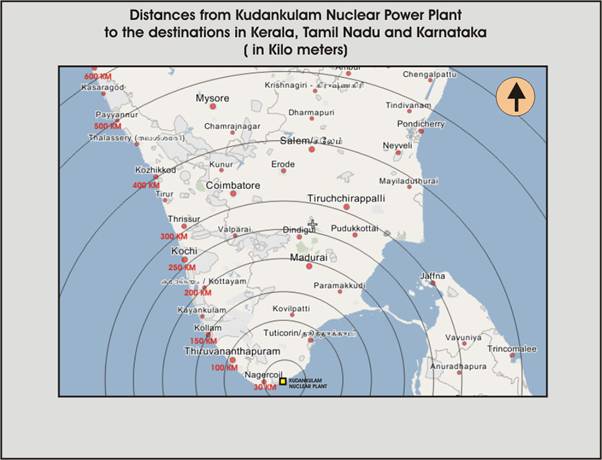
Consider this: in a rapidly growing economy, to go along with a huge population that is hungry for electricity, a power generation facility is ready for commissioning after years of construction.  While one might hypothesize that this will be a welcome relief from the blackouts and energy rationing, it has become controversial. Because, it is a nuclear power station--the Kudankulam project in the southern Indian state of Tamil Nadu.
People's activists want the Kudankulam nuclear power plant shut down completely; Tamil Nadu's politicians have the less ambitious aim of halting work on the project until the fears of local people are allayed. The plant was originally scheduled to begin operations later this month. 
A combination of the Fukushima aftermath and the nature of politics in India have brought this about.  The Fukushima angle is not only because Kudankulam is a nuclear power generation facility, but also because of its location by the sea, and the populated peninsular India.


Looking at the map, one might be reminded of the Indonesian earthquake that triggered the tsunami, which reached the coastlines of India and wiped out people and communities.


In a tropical country like India, where it is the sea that guarantees limitless water supply, well, nuclear power plants tend to be located very near the coast: as the Union of Concerned Scientists explains:
Nuclear power plants are usually built next to lakes, rivers, and oceans.1 Not for the scenic views that such locales provide, but because water can absorb the waste heat produced by the plants. Nuclear power plants consume vast amounts of water during normal operation to absorb the waste heat left over after making electricity and also to cool the equipment and buildings used in generating that electricity. In event of an accident, nuclear power plants need water to remove the decay heat produced by the reactor core and also to cool the equipment and buildings used to provide the core’s heat removal.

So, ... One can easily imagine the complex politics in this context.  A country with severe electricity shortage while demand rapidly increases; a facility constructed at quite an expense in a country that has nearly half a billion poor; the location dynamics affected by the consequences of earthquakes and tsunamis; politicians and activists who are only too eager to seek short-term victories; cavalier statements by officials; and endless commentaries (including this one!)

This will, however, not be the final battle over nuclear power. 
as for China, India, and South Korea -- countries with a growing appetite for nuclear power that account for the bulk of active plant construction -- only the first has put any of its nuclear plans on pause, and that's just pending a safety review. India and South Korea have vowed to tighten safety standards, but have otherwise forged ahead with plans for nuclear expansion.
The battle is far from over because the energy demand simply cannot be met through renewable "green" sources of energy.
There are three reasons why hydrocarbons will continue to dominate the global energy mix for decades to come: cost, the slow pace of energy transitions, and scale.

Further, carbon-based sources are already being contested, as I noted even recently, when  I worried about the growing tensions, primarily between India and China, over valuable oil and natural gas in the South China Sea, off Vietnam.

The South China Sea war of words is escalating as well:
India is playing with fire by agreeing to explore for oil with Vietnam in the disputed South China Sea, a major Chinese newspaper said on Sunday, advising the Indian company to reconsider and pull out. ...

The China Energy News, published by Communist Party mouthpiece the People's Daily, said cooperation between India and Vietnam in these seas was a bad idea.

"India's energy strategy is slipping into an extremely dangerous whirlpool," it said in a front page commentary. ...

"Challenging the core interests of a large, rising country for unknown oil at the bottom of the sea will not only lead to a crushing defeat for the Indian oil company, but will most likely seriously harm India's whole energy security and interrupt its economic development.

"Indian oil company policy makers should consider the interests of their own country, and turn around at the soonest opportunity and leave the South China Sea," it said.

I can only imagine that these resource issues will worsen this decade before they can get any better.

Friday, January 13, 2017

Only white commies are the demagogue's friends ... not the Asian ones!

The horrible human being and his minions are only a week away from taking control of the executive branch of the government, thanks to the unprincipled Republican voters who lovingly licked his golden boots and voted for him!

The morons have already ruffled more than a few geopolitical feathers.  Especially with China--the country whose name the demagogue often pronounced during the campaign as if it sounded like a short for woman's genitals!  The only difference is that he loves those genitals so much that he grabs them when can!

The guy in his cabinet who will be the face of the country to the rest of the world--a slippery oil man--said a few things during his confirmation hearings that have pissed off the Chinese.  In response, let me quote this China expert:
Normally, you would take these as childish antics that diplomats love to indulge in. Unfortunately, not so with China. One of the sad facts of Chinese society is that jingoism has been so drilled into the population that almost everybody seriously believes that the Chinese have been oppressed throughout history and that everybody is out to get them even now. With a highly controlled media, and no access to world perspectives, this is being fanned to a massive degree by the Communist Party. Look at the hatred of Japanese that has been whipped by a few rocks in the sea where not even goats live . So as long as this dangerous nationalism exists, China is always a threat.
That quote is this friend-debater's response to my post from November 2012.

While I have been only a China-watcher, he has lived there for years and continues to follow the political developments.  I assume he throws ping-pong and cricket balls at the screen when he hears the morons dump on China.

Anyway, the oil man who headed the company that systematically engaged in climate change denialism opened his big fat mouth in the Senate:
Tillerson told members of the Senate Foreign Relations Committee on Wednesday that China’s multibillion-dollar island-building campaign in the oil-and-gas rich sea was illegal and “akin to Russia’s taking of Crimea.”
“We’re going to have to send China a clear signal that, first, the island-building stops,” Mr. Tillerson told the senators. “And second, your access to those islands also is not going to be allowed.”
Should those words be translated into action after Donald J. Trump assumes the presidency on Jan. 20, it would be a remarkable change in the American approach to Beijing’s island-building in the South China Sea
Of course the oil man is interested in that part of the world--it has lots of oil and natural gas.  Which is why India too got into all that pissing match, remember?  Will keep that discussion for another day.  For now, the focus on China; its media responded as my China-watcher friend would have predicted:
It is not clear which point, among the many he made, he will prioritize. But it is worth looking at his remarks that China should not be allowed access to the islands, since this is the most radical statement from the US side so far.
China has enough determination and strength to make sure that his rabble rousing will not succeed. Unless Washington plans to wage a large-scale war in the South China Sea, any other approaches to prevent Chinese access to the islands will be foolish.
... As Trump has yet to be sworn in, China has shown restraint whenever his team members expressed radical views. But the US should not be misled into thinking that Beijing will be fearful of their threats.
Tillerson's statements regarding the islands in the South China Sea are far from professional. If Trump's diplomatic team shapes future Sino-US ties as it is doing now, the two sides had better prepare for a military clash.
And then there is Taiwan!

Have a nice day, you crazy Republicans!

Sunday, May 14, 2017

To get rich is glorious

Thus spake Deng Xiaoping almost forty years ago, as he opened up the struggling Communist China to the world.

Source

China has transformed in a hurry since then.  And with a clueless pussygrabber as the American president who is increasingly bogged down with various political issues, the Chinese president, Xi Jinping, is playing an awesome global game making his, and China's, presence known all over the world.
To celebrate China’s new global influence, Mr. Xi is gathering dozens of state leaders, including President Vladimir V. Putin of Russia, in Beijing on Sunday.
It is global commerce on China’s terms.
Mr. Xi is aiming to use China’s wealth and industrial know-how to create a new kind of globalization that will dispense with the rules of the aging Western-dominated institutions. The goal is to refashion the global economic order, drawing countries and companies more tightly into China’s orbit.
Today is that Sunday, as I blog.  While all that is happening, most of my fellow citizens don't even know the name of China's president, but I digress!  Two other strongman-leaders were in attendance:
Presidents Vladimir Putin of Russia and Recep Tayyip Erdogan of Turkey also spoke at the opening ceremony.
The pussygrabber adores those three because he realizes that the American president cannot ever get the kinds of power those strongmen have, but I digress.

Unlike the pussygrabber, Xi knows well the old stories, like this one:

Source

Xi wants to continue to remind the world about China.  His ambitious project is about those old glories, which will take on a 21st century twist.  But, the Economist noted that Xi's modern day Silk Road plan is "running into three linked problems."
First, it is unclear what its priorities are, or who is running it. ...
A second problem is finding enough profitable projects to match the vaulting ambition of the scheme, which aims to create a Eurasian trading bloc rivalling the American-dominated transatlantic area. ...
Third, locals in some countries are angry about what they view as China’s heavy-handedness.
All these are wonderful fodder for me.  In one course that I am teaching this term, this upcoming week is all about the China model for economic development.  In another, I will have students think about some of the issues related to China--from the treatment of Uighurs to the territorial disputes in South China Sea.

If only people would listen to me and recognize the urgency to understand and respect China, instead of voting to power the pussygrabber who talks about "gina"!


Wednesday, September 02, 2015

When two elephants fight, it is the grass that suffers

It is that season again.

No, not autumn, but the crazy season when India and Pakistan violate their ceasefire agreement and use gunpowder to match the amped up rhetoric.  Compared to these two siblings, even the two Koreas seem to be getting along much better!

Source
Let us count the number of years since 1947 when they gained their independence from the white supremacist colonial masters: sixty-eight.  A human born in 1947 will now be coasting along in retirement, while these two countries continue to behave worse than middle-school boys during recess!

The situation is so crazy that their mutual neighbor, China, is urging them to, you know, talk..  China, of all countries!  Yep, the same China that every single day seems to want to make the neighboring countries across its waters nervous and jittery.
China on Tuesday advised India and Pakistan to exercise restraint on the border, and try to resolve differences through dialogue and mutual consultation.
Of course, there is another reason for China to interject--it is getting ready for the grand parade and celebrations in Beijing "honoring the 70th anniversary of the end of World War II."  Pakistan is sending its president, while India will be represented by a second-tier federal cabinet minister.  Guess which country China favors? ;)
The stakes are high for China, which has committed to invest $46 billion in infrastructure and power development in Pakistan, and build an economic corridor which will link it to the Arabian Sea through the Gwadar port. New Delhi has reasons to worry about China's quest to obtain access to the Arabian sea, which touches the west of India.
The China funded economic corridor will also pass through Pakistan Occupied Kashmir, which India considers as its own territory. 
India and Pakistan are engaged in a "dialogue of the deaf," this op-ed notes:
Lurking under this neighborly rage are stereotypes that refuse to fade. India thinks Pakistan is an aging terrorism addict that keeps hitting up the world for loose change so it can get its next fix. Pakistan thinks India is an old uncle who has come into some money late in life but still doesn’t know how to dress. India says Pakistan is the pesky kid who is always picking a fight in the neighborhood. Pakistan says India is the real bully — and if you don’t believe it, go ask the other kids on the block: Bangladesh, Sri Lanka, Nepal. Still don’t believe it? Go ask the Kashmiris. India says no one should ask the Kashmiris anything because Pakistan has poisoned their minds.
The net result is a tragic bottom-line: "Three generations have lived either with war or the imminent threat of war."  Nothing else to show for these 68 years!
Are these two nuclear powers talking to each other, or are they two teenagers playing a game of dare?
Maybe it’s time India and Pakistan did away with the pretense that they want peace. Hundreds of miles of barbed wires on the border, countless searchlights and mile-long visa forms haven’t made us feel secure about each other.
What a waste of time, resources, and lives!  If only the leaders and the people of both the countries had instead spent their precious resources on human development.  If only!


Sunday, October 01, 2017

Deal with your own shit!

Some of us knew that it was only a matter of time.  It finally happened.

We have to deal with our own crap--it is no longer somebody else's problem!

"We" as in even right here in Eugene: "On Thursday, the reverberations of China’s tough stance reached Sam Miller, owner of Lane Apex."

What does Lane Apex do?  "picks up curbside commingled recyclables such as plastics, unsorted paper, cardboard and metal cans from homes in Eugene."

What has this got to do with China?
China, by far the world’s biggest importer and re­processor of recyclables, has put the United States on notice that this fall and early next year, it will begin turning away all but the most pristine used plastics and unsorted waste paper.
Of course, it is not merely Eugene:
With China’s looming ban, the entire West Coast system for sorting and shipping off recyclables is beginning to slow down, as the industry realizes it may not be able to get rid of the stuff
Back in 1987, when I was new to this country, one of the interesting stories for me was about the barge from New York that was on the sea and for thousands of miles--the gar-barge.  The awesomely rich geographic areas have always used poorer ones as their dumping grounds.  China used to be one of those poorer areas.  Not anymore.  It is now an economic and political power in the world.  And it is no longer interested in other people's garbage.
“It could have a negative impact on recycling in general, as the system has relied on China for so long now,” said Brent Bell, vice president of recycling for Waste Management, the largest waste-service provider in the U.S. If the Chinese market is no-longer available, some experts question whether U.S. municipal recycling programs can remain viable, or if many of the products now considered “recyclable” will be reclassified as garbage bound for landfills.
How did this export of garbage to China come about?
For decades, the market for recycling exports has benefited thanks to the massive U.S.-China trade deficit. With more container ships arriving on U.S. shores then heading the other way, shippers were desperate for anything they could find for the return trip.
“And the thing they chose was scrap materials,” Moore told Bloomberg BNA. “Because of discounts the shipping companies offered, it ended up being cheaper to send that stuff to China than to process it here.”
Let's see.  China makes a whole bunch of stuff, while polluting its air, water, and land, and while treating its people like shit.  We buy the stuff that we really do not need, and generate a whole lot of recyclable trash.  But, we don't want to pay for the processing of the recyclables.  We put them in the empty containers and sent them to China.  Now, it is time to pay the piper!

Meanwhile, we have shifted to online shopping because, well, we don't have enough time to spend on Facbook and Instagram and whatever else and, therefore, we can't be bothered to go to the store round the corner to get a roll of toilet paper.  We place orders online, and they are delivered with a whole lot of packing materials.
“Online retailers like Amazon still need cardboard boxes and most comes from China,” said Jakob Rindegren, the recycling policy adviser of the U.K. association.
One corrugated box retailer on the online shopping site Taobao reached by Reuters, said the price of cardboard boxes had nearly doubled since the end of August to 8.8 yuan ($1.33) each.
As I wrote in this post on recycling, two years ago--almost to the very date:
I am especially drawn to issues like this because we are forced to think through the complications and question our own preferred ideas on how to make this world a better place for tomorrow.  A constant examination, a Socratic questioning, in which there is no sacred cow, so to speak.
The solution to all these is simple, right?  Consume less, and take care of your own shit!             

Friday, September 09, 2016

China sneezes, and the world gets the shivers!

Every once in a while, I wonder if I might open up the blogging window ... and draw a blank.  What if I don't have anything to write about?

And then I laugh. Hysterically.  Because, the world story is full of strange twists and turns, and I love making meaning out of them.  In fact, making meaning is what education and learning are all about--not some stupid diploma that ain't worth even wiping one's butt.  (BTW, please do not use your diploma to wipe your butt--I assume that the paper will be way too rough and it won't absorb either ... hahaha!)

Consider the craziness in shipping.  On the one hand, we need ships to transport goods all over the world.  On the other hand, old ships that are no longer useful need to be put to death.  Right?

The Chinese economy has been messing with both.  Yep, both the shipping business and the ship-breaking business.

First the shipping story.  In case you missed it, the big news is that Hanjin has declared bankruptcy.
Last week, South Korean shipping company Hanjin, the world’s seventh-largest container line, filed for bankruptcy after failing to reach an agreement with its creditors to alleviate its $5.37 billion in debt. This has left 85 of the 97 container ships the company operates literally stranded at sea, as ports refused to admit them for fear that stevedores and tugboat crews won’t be paid. Even if the situation is resolved soon, the unprecedented mess is an ominous indicator about the state of global trade.
You are thinking, 'hey, that's a South Korean company, and what has China got to do with this?'  If you thought so, then you are my kind of a thinking person.   Good for you!

What happened?  Oversupply.  Yep, way too many ships out there.  Because you are a thinking person, your next question is, 'hey, but in this global economy aren't we making something somewhere, and selling them somewhere else?'  Yes.  But then think about who makes them.  Ahem, China.
“Hubris and ego and insanity in the shipping industry,” says Baker. “It happens over and over again, cycle after cycle. Thus it was and ever will be.” The arms race was ignited by wildly optimistic global trade forecasts made in the waning days of the global recession, notably by Denmark’s Maersk, the world’s largest shipping company. What they didn’t count on was China’s recent economic slowdown. “We had a generation of people working in shipping that have lived under the China effect,” says Baker, referring to the years when the country’s construction boom and skyrocketing manufacturing sector kept the global commodities market humming. “To a large degree, everyone thought it would remain like that.”
China's economy slowed down.  And now ships are stuck at sea!

So, what has this got to do with the ship-breaking industry?  Interestingly, not too long ago, South Korea was the place where ships went to die.  Then, Korea became rich and this activity moved to places like India's Alang.
In the world’s biggest ship-recycling yard, dozens of men toil under a blazing sun, carving up the remaining portion of a vessel on the seashore. During the nearly five months it has taken for the ship they are working on to arrive at the yard and get broken apart for scrap, the price of the steel the yard is culling has skyrocketed, then plummeted—dragged along by roller-coaster trading thousands of miles away in China.
Yep, China's economic slowdown is affecting even the ship-breaking industry.
Many of the yards here, in the western Indian state of Gujarat, are saddled with losses from buying near-record numbers of boats when steel prices were surging earlier this year, then selling the scrap metal after prices had crashed.
You want more, right, because you are now fascinated?
One yard owner, who asked to remain unnamed, said he bought a ship in January for around $280 per ton, including the cost of labor. He ended up selling the scrap metal at a loss, for $250-$260 per ton, when the ship was being broken up in April and May.. 
Ultimately, it is the human interest in the story that we need to think about:
In the rows of wooden shacks that house thousands of workers at one yard in Alang, many men are waiting without pay in case more ships arrive, but face the prospect of returning home with no money for their families.
Sushil Kumar Pal, 20, is worrying about money for his two younger brothers’ schooling and for his elderly parents.
“There are so many workers here and not enough jobs going around,” he says. “So how will anyone work?”
It is one crazy world out there.  Those of us who are comfortably retired, or with secure jobs, have it easy.  The rest are, in some way or the other, at China's mercy.


Tuesday, February 07, 2017

Chinese food, Mexican food, Indian food. Boycott them all!

In contemporary America, it seems like every Republican, following their standard-bearer's lead, beats up on China, Mexico, and India--that these three countries are responsible for the stagnation/collapse of middle-class jobs and wages.

Forget the economic (il)logic for now.  Here's something to consider: How many of the rabid supporters of this POTUS will be able to name the heads of the governments of China, Mexico, and India?

Think about it.  What does it mean when people don't have a freaking idea about those leaders even as they beat up on those countries day after day?  Shouldn't they be familiar with their names as much as they know the name Putin?

Especially the Chinese president.  It might come as a surprise to most Americans that China is the world's largest economy.  Add to that its military might.  The names of Chinese leaders ought to be familiar even to high school students, right?  Like how everybody knew about the Cold War leaders on the Soviet side?

So, if you are a Chinese, what would you think?  My guess is that they will be pissed off at the Rodney Dangerfield treatment that they get from America and its people.  Do we really want to ignore and intentionally isolate them?
Mao was clearly petrified of closer ties with America, telling the Soviet ambassador in January 1955 that a lack of relations with the United States “gives us the chance to more freely educate our people in the anti-American spirit.”
Starting a trade war with China or gearing up for a military conflict in the South China Sea will do very much the same.
Mexico is our neighbor.  Why don't people know the name of Mexico's president, but they know the name of Canada's prime minister?

What the hell must a non-white do in order to get some level of a recognition?

Forget the maniacal supporters this president--these things do not matter to the fake news they read and watch.  I would love to ask students graduating from colleges and universities across the country in the spring whether they can name these three people.

My guess is that it will be a tiny minority who can score the trifecta.  Of those who name one or two, they perhaps will have a personal connection to those countries, or might have majored in disciplines where they studied something about those countries and the governments.

I try my best to tell students that if they really want to understand the world through a study abroad, then they should spend at least three to six months living and studying in China.  Preferably in a place like Xian--a huge city, with a phenomenal history, and far away from the typical haunts of Beijing and Shanghai.  (Well, I have had this plan to travel to Xian for a long time, ever since reading about it in high school in the context of the Silk Road.  And, especially after meeting a few years ago, thanks to the friend, a Chinese environmental lawyer from Xian.  Some day!)

But then I, too, suffer from the Rodney Dangerfield problem of no respect.  Nobody cares about what I have to say.


Monday, June 20, 2016

Build that freaking wall!

I don't care whether or not Einstein really said or wrote somewhere that insanity is doing the same thing over and over again and expecting different results.  It makes a lot of sense.  Yet, humans often tend to do the same bloody things over again, believing things will work out differently.

I wonder if Einstein ever considered in his thought experiments the possibility that humans do the same thing again not because they expect different results, but because they completely deny the results.  Such denial would never occurred to his logical mind, perhaps.  Einstein versus the climate change deniers would have been one interesting discussion.

Yet, that is what is unfolding in plain sight.  People are gladly doing the same things.  Like this, in in South Florida:
Its very existence depends on the continued allure of the beaches, waterways and natural environment. Yet, by 2050, an estimated $15 billion to $36 billion of Florida’s coastal property will be threatened by sea-level rise, according to a report last year from the Risky Business Project, a Bloomberg Philanthropies effort that quantifies economic risks from climate change.
In South Florida, sea-level rise and climate change are already having an effect on available drinking water, roads and sewer lines in low-lying areas, and storm and flood insurance rates.
If problems are showing up in every day life even now, then Einstein's logic will tell us that people won't develop the land and sell multi-million dollar homes, right?  Welcome to the insanity:
there’s an emerging industry eager to find a way to help people stay in that paradise, a place born of real estate speculation and rebirthed cyclically out of natural disasters like hurricanes and man-made disasters like real estate bubbles.
Developers have started marketing storm-resistant homes and resilient buildings, like a high-rise in downtown Miami designed to withstand 300-mph winds. In Miami Beach, the city is beginning to implement building codes that require new construction and city infrastructure to be elevated. Fort Lauderdale is considering raising the height limits on sea walls.
Rising sea-levels will be matched by rising sea walls!  Ah, the insanity that is more than my criticism of American solutions to American problems!
“Sea level is rising, and we have to plan for the next 50 to 100 years. You have to, for the purposes of marketing, build for the future. You have to build for the future, even if the code may not allow it.”
Seriously?

Meanwhile, whatever the deniers might want to believe, the data trend is worsening.
The last station on Earth without a 400 parts per million (ppm) reading has reached it.
Where was that, you ask?  In Antarctica.  Far, far, away from South Florida and China and India and humanity.
In the remote reaches of Antarctica, the South Pole Observatory carbon dioxide observing station cleared 400 ppm on May 23, according to an announcement from the National Oceanic and Atmospheric Administration on Wednesday. That’s the first time it’s passed that level in 4 million years (no, that’s not a typo).
So, those of us who are not into insanity, nor into denial, will worry about trends like this:
“The increase of carbon dioxide is everywhere, even as far away as you can get from civilization,” Pieter Tans, a carbon-monitoring scientist at the Environmental Science Research Laboratory, said. “If you emit carbon dioxide in New York, some fraction of it will be in the South Pole next year.”
It’s possible the South Pole Observatory could see readings dip below 400 ppm, but new research published earlier this week shows that the planet as a whole has likely crossed the 400 ppm threshold permanently (at least in our lifetimes).
Passing the 400 ppm milestone in is a symbolic but nonetheless important reminder that human activities continue to reshape our planet in profound ways
And, one of the results will be, yes, rising sea levels in South Florida too.

Guess who is in favor of building higher sea walls even when denying the very climate change?  Yes, it is the fascist, who is worried about his wealth!

Insanity!

Sunday, April 05, 2009

In energy, too, it’s the water

Over spring break, I did what university faculty members are notorious for. I attended an academic conference in Las Vegas — and got more depressed about the state of the world!

At the opening plenary session, the speakers talked about the increasing problems with water in the American Southwest, which might also be related to systematic changes in worldwide precipitation patterns. One piece of local data: Water levels in Lake Mead, the reservoir behind Hoover Dam on the Colorado River, are down to 48 percent of capacity.

So the following day I headed out to Hoover Dam — consistent with the teacher in me who favors field trips as key learning exercises. My previous visit there was more than 10 years ago, when my parents visited us from India. My father had studied about Hoover Dam in his civil engineering program, and I recalled his eager beaver excitement when we were there.

This time around, the low water level was obvious. The bathtub rings above the water’s surface looked like nasty scars. To see the conditions in person was way more real and worrisome than it was when I listened to the speakers while comfortably perched in the conference hall.

Tourists rushed past me as I was parked overlooking the dam, and I wondered how the changing water and drought conditions around the world might affect electricity generation. We tend to forget that even coal-fired power stations need a lot of water; globally, about 45 percent of electricity comes from coal.

I grew up in an industrial company town — Neyveli — in southern India, where the principal activity is to generate about 2,500 megawatts of electricity by firing up the lignite mined there. Lignite, a variety of coal, has a low energy content compared to more energy packed varieties like bituminous or anthracite.

Generating power from lignite requires water every step along the way — which, in Neyveli, came from underground. The area was fortunate to have extensive aquifers, naturally recharged by the approximately 40 inches of monsoon rains every year. However, many engineers, including my father, were and are worried that continued large-scale use of groundwater might catalyze sea water intrusion — after all, the sea is barely 20 miles away.

Thus, strange as it was to think about how water shortages might affect coal-fired power generation while standing atop Hoover Dam, it was more worrying to think about the following confluence of factors:

Coal is being used extensively worldwide as a source of energy. In India and China, 70 percent to 80 percent of electricity is coal-based.

Burning coal is a major source of carbon dioxide, an agent for global warming and climate change.

Huge quantities of water, often groundwater, are needed to sustain coal-based power generation.

Water is absolutely necessary for life on this planet, and there are enough data trends to justify worry about the future availability of water — especially groundwater.

Therefore, instead of urging countries, particularly India and China, to stop using coal, perhaps we ought to focus on how to a large extent it is all about water. Many parts of India, China and other countries have low levels per capita of available water. For instance, while the United States has about 1,600 cubic meters of water per person, the average in China is about 400 cubic meters, and even less in India. This immensely valuable resource can be put to better uses than in coal-fired power plants.

This is but another incentive for us to explore alternative energy sources that do not impose additional demands on water, which will then also mean lesser reliance on coal. Water-constrained countries such as China, India and Israel ought to encourage innovation on this urgent issue.

At the same time, we here in the United States have a wonderful opportunity to use our research and development infrastructure to develop feasible and economical approaches that will ease the pressure on water resources, and thereby help the world.

After all, to borrow a water metaphor, we sink or sail together!

For The Register-Guard
Posted to Web: Sunday, Apr 5, 2009 04:29PM
Appeared in print: Monday, Apr 6, 2009, page A7

Wednesday, August 10, 2016

Water, water everywhere ...and it is all good?

Everyday something or the other completely amazes me.  It could be nature, my own stupidity, or an impressive achievement.  No, the achievement is not an Olympic gold medal--after all, you know well what I think about that expensive mass entertainment ;)

A human achievement that amazed me?
Israel now gets 55 percent of its domestic water from desalination, and that has helped to turn one of the world’s driest countries into the unlikeliest of water giants.
In the old days, we used to joke that with enough money, water will run uphill.  Without money and water running uphill, Southern California will be one heck of a desert by now.  Instead of being bone dry, it now gets water from all directions, with water running uphill at many places thanks to the power of electricity and pumping, which cannot happen without money.

Now, money and ingenuity turns salty sea water into a potable variety.
Just a few years ago, in the depths of its worst drought in at least 900 years, Israel was running out of water. Now it has a surplus. That remarkable turnaround was accomplished through national campaigns to conserve and reuse Israel’s meager water resources, but the biggest impact came from a new wave of desalination plants.
Boggles my mind!  Aren't you also impressed?  What a turnaround in a decade!
In 2008, Israel teetered on the edge of catastrophe. A decade-long drought had scorched the Fertile Crescent, and Israel’s largest source of freshwater, the Sea of Galilee, had dropped to within inches of the “black line” at which irreversible salt infiltration would flood the lake and ruin it forever. Water restrictions were imposed, and many farmers lost a year’s crops.
It was the same drought that catalyzed the instability in Syria.
 “The drought lasted for years, and no one said anything against the government. Then, in 2011, we had had enough. There was a revolution.” That February the Arab Spring uprisings swept the Middle East. In Syria, protests grew, crackdowns escalated and the country erupted with 40 years of pent-up fury.
Israel managed its meager resources well.
The turnaround started in 2007, when low-flow toilets and showerheads were installed nationwide and the national water authority built innovative water treatment systems that recapture 86 percent of the water that goes down the drain and use it for irrigation — vastly more than the second-most-efficient country in the world, Spain, which recycles 19 percent.
Pause for a second and re-read that.  Israel recaptures about 86 percent of the water that goes down the drain, and the next best effort comes from Spain, which recycles 19 percent.  It is one hell of a gap between 19 and 86, right?  Think about India and China and everywhere else, and about all the water that is wasted.

If all that does not impress you enough, consider this:
Water produced by desalination costs just a third of what it did in the 1990s. ... Israeli households pay about US$30 a month for their water — similar to households in most U.S. cities, and far less than Las Vegas (US$47) or Los Angeles (US$58).
As the article notes, this level of a sophisticated desalination technology is a game changer.  If only our collective efforts would be directed towards such important aspects of life, instead of on Olympics and Facebook and ...

Friday, July 16, 2010

The Dalai Lama Dilemma

I can't figure out this Tibet stuff.

I mean, yes, the Chinese were awful and brutal in the 1950s that led to large-scale ethnic cleansing of sorts with the Dalai Lama and tens of thousands of his followers fleeing Lhasa and its vicinity.  And, yes, the suppression of a basic freedom to believe in whatever one wants to is a gross violation of human rights.  I written about these (like this one) and have blogged a lot as well.

But, on the other hand, I have always wondered whether we are idealizing Tibet, the Tibetan life, and overly glorifying the Dalai Lama.  After all, there is a long track record of Western countries celebrating the simple lifestyles of the poor, when many of that same poor would way prefer not to be poor and starving and ill and illiterate ....

The ever contrarian Spiked makes it all the more difficult to figure this out:
The first sounds that greet me as I arrive in Lhasa are the incandescent honking of horns as car-drivers and motorcyclists (some with three to a bike) negotiate the roads. My own Tibetan driver is wearing a Playboy jacket. Maybe he bought it in the Playboy shop that I later see in the centre of Lhasa. It’s near the Tibet Steak House (‘juicy meat for you!’) and the Lhasa casino, in which Tibetan men in leather jackets pile coins into slot machines. On the streets young men in Kappa and Nike sweatshirts (fakes, I’m guessing), with hair by Topman, flirt with casually dressed young women, one of whom is sporting hotpants that even Kylie would consider too risqué. How can they dress like this in the freezing kingdom of snow and Yetis, as made famous by Tintin in Tibet? Because that’s another myth of Tibet, at least in July, and at least here in Lhasa: I might be 3,650 metres above sea level, inside a mountain range and with the clouds so close by I almost feel I could touch them, but it’s so hot that I get sunburnt.
Of course, one could argue that the dreaded hotpants would not have been there, and the Shangri-La would have continued, had the Chinese government not interfered in Tibet the way it did and continues to do.  But, what if all that Shangri-La talk itself is a myth?
it is during that period of the self-serving Orientalism of British rule in Tibet that the popular modern image of Tibet as a mystical, cut-off entity takes shape - most notably in James Hilton’s Lost Horizon (1933), which invented the idea of ‘Shangri La’. As McKay points out, the writings of the British imperialists, and of their sympathisers, are still regularly cited in the propaganda produced by the Dalai Lama’s people, which is designed to prove that Tibet is a unique and special place that only they can and should govern. Some of those old Orientalist writings were available at that hippy-fest in Lambeth, too - British imperial paternalism recycled as anthropological New Age ‘at-oneness’. What connects the old imperialists with the new Tibetophiles is their desire to have Tibet as a ‘buffer state’ – only where the imperialists wanted to use Tibet to protect their material interests against China and Russia, the new lot want to use it to protect their emotional interests, to preserve an idea of innocent, childlike humanity so far uncorrupted by modernity.
Reminds me of that controversial book on Orientalism from my graduate school days.  Speaking of which, Rongsheng, who was a fellow graduate student, always argued that the Chinese government was trying to get rid of feudal traditions and ignorance in Tibet, and that the West was keen on maintaining those horrible systems that do not help the Tibetans themselves.

I suppose the only way I can figure this out for myself is to travel in and around Tibet.  Will you, the reader, please pay for this important educational trip? Please? :)

Meanwhile, the Economist dryly notes that:
China seems to calculate that the eventual death of the Dalai Lama, a charismatic and internationally popular figure, will make its job in Tibet easier. Each passing birthday brings that day closer. But it also offers supporters of the Dalai Lama and his cause a chance to sing his praises.
That is some realpolitik, eh.

Saturday, February 27, 2010

Ug99 Fungus: big ag problems ahead?

A neat follow-up to my eggplant post, with respect to how important the agricultural battles are going to be:
The enemy is Ug99, a fungus that causes stem rust, a calamitous disease of wheat. Its spores alight on a wheat leaf, then work their way into the flesh of the plant and hijack its metabolism, siphoning off nutrients that would otherwise fatten the grains. The pathogen makes its presence known to humans through crimson pustules on the plant’s stems and leaves. When those pustules burst, millions of spores flare out in search of fresh hosts. The ravaged plant then withers and dies, its grains shriveled into useless pebbles.
On the one hand, the rising population and their affluence will trigger higher demand for food of various types. On the other hand, the possibility of pests causing large-scale problems.  The report at Wired.com continues:
While languishing in the Ugandan highlands, a small population of P. graminis evolved the means to overcome mankind’s most ingenious genetic defenses. This distinct new race of P. graminis, dubbed Ug99 after its country of origin (Uganda) and year of christening (1999), is storming east, working its way through Africa and the Middle East and threatening India and China. More than a billion lives are at stake. “It’s an absolute game-changer,” says Brian Steffenson, a cereal-disease expert at the University of Minnesota who travels to Njoro regularly to observe the enemy in the wild. “The pathogen takes out pretty much everything we have.”
These are the kind of reports that make me dismiss the extraordinary events that Hollywood movies, for instance, portray as our huge dangers.  In contrast, it is such "small" and "old" problems that I worry will cause large-scale havoc on this planet.  It turns out that Yemen is at the nerve center of this problem too:
The fungus is also an efficient traveler: A single hectare of infected wheat releases upwards of 10 billion spores, any one of which can cause the epidemic to spread. The circumstances have to be just right, though — the prevailing winds must blow toward an area of wheat cultivation, and the P. graminis spores must survive the airborne journey.
That is precisely what happened in the case of Ug99. Two years after its initial discovery at Kalengyere, the pathogen drifted into the fields of central Kenya, where it caused major losses and wreaked havoc on thousands of subsistence farms. The pathogen’s next stop was Ethiopia, sub-Saharan Africa’s biggest wheat producer, followed by eastern Sudan. (So far, those two countries have escaped major damage thanks largely to dry weather, which tends to hinder.) By 2006, the pathogen had hopped over the Red Sea into Yemen, a disturbing migratory milestone. “I look at Yemen as the gateway into the Middle East, into Asia,” says David Hodson, former chief of Cimmyt’s Geographic Information Systems unit and now with the Food and Agriculture Organization in Rome, where he tracks global wheat rusts.

Sunday, December 05, 2010

India goes nuclear--for electricity

India is going nuclear.  I do not mean the nuclear weapons—after all, that is almost a forty-year old news since the country detonated its first device in 1974.  The latest stir was caused by the federal government’s green-lighting of a nuclear power plant in the state of Maharashtra—the home of India’s commercial capital, Mumbai.

The rapid economic growth rate over the last two decades has resulted in an ever increasing demand for electricity from India’s businesses and households.  As with China, most of the electricity generation comes from coal-fired power plants, which account for about 70 percent of India’s power supply. 

However, in a land of a billion-plus people, there simply isn’t enough for everybody.  According to the International Energy Agency (IEA) “South Asia currently accounts for 42% of the total number of people in the world without access to electricity.”  Even Sub-Saharan Africa is better on this measure, with only 31 percent not having access to electricity there.  The IEA reported that more than 400 million in India “don’t have access to the energy needed for lighting, mechanical power, transport and telecommunications.”  That is a mind boggling statistic as we begin the second decade of the 21st century!

Energy consumption is result of economic prosperity as well as a requirement for economic growth and development.  The lack of capacity means that power cuts are a regular feature of life in India, particularly in settlements far away from the major urban centers.  One aunt of mine who lives in a smaller town, about 400 miles from Chennai where my parents are, has learnt to live with power cuts that last for anything from three to six hours every day.

Thus, it is understandable why the Indian government is exploring every possible way to speed up the expansion of capacity on this front. 

The proposed nuclear power plant, in Jaitapur, is expected to play a big role in filling the gap between the supply and demand.  With the nuclear reactor technology from France, the plan calls for a total capacity of 9,900 megawatts of power, which will make it the largest nuclear-power plant in the world.  The first of the six units is expected to be commissioned by 2018. 

As much as here in the US we have our own worries over nuclear power, there is considerable opposition to the project within India too.  In addition to issues of safety and radioactive wastes, there are serious ecological concerns.  The proposed site is by India’s western coast along the Arabian Sea, and a project of this magnitude is bound to have immense impacts on the marine life.  And, it is in an area that, like many parts of India, is not without any seismic risk. 

Despite opposition to the project, the federal minister for environment, Jairam Ramesh, came out swinging when he announced the clearance for the project: “I know the environmentalists will not be very happy with my decision, but it is foolish romance to think that India can attain high growth rate and sustain the energy needs of a 1.2 billion population with the help of solar, wind, biogas and such other forms of energy. It is paradoxical that environmentalists are against nuclear energy,” he said.

This battle between the economy and the environment will only get more complicated over the years, it appears.  We in the US, too, have a lot of soul searching to do in this regard, given that we lead the world in electricity consumption.  India’s total consumption is only a sixth of what we consume in America.  This means that on a per capita basis an average American consumes almost twenty times the amount of electricity consumed by an average Indian. 

It is not difficult, therefore, to imagine that as Indians begin to generate and consume electricity at even a fifth of our consumption, the impacts on the global environment will be a lot more than probably what we could imagine.

The atrociously awful tragedy is how much we in the United States just don't want to engage in constructive public discussions on our own domestic energy policies, and about the global situation.  Soon after 9/11, we had a wonderful chance to rethink the energy policy.  We blew that.  As we slid into recession, we had another small chance to rethink our energy approaches.  That ship has also sailed now.  

All we are left with is how the US tried to buy votes at Copenhagen, and how the Cancun summit will be a disaster as well.

Saturday, May 02, 2009

The revenge of geography

That is the title of Robert Kaplan's essay in Foreign Policy. He writes there:
[Rather] than eliminating the relevance of geography, globalization is reinforcing it. Mass communications and economic integration are weakening many states, exposing a Hobbesian world of small, fractious regions. Within them, local, ethnic, and religious sources of identity are reasserting themselves, and because they are anchored to specific terrains, they are best explained by reference to geography. Like the faults that determine earthquakes, the political future will be defined by conflict and instability with a similar geographic logic. The upheaval spawned by the ongoing economic crisis is increasing the relevance of geography even further, by weakening social orders and other creations of humankind, leaving the natural frontiers of the globe as the only restraint.

So we, too, need to return to the map, and particularly to what I call the “shatter zones” of Eurasia. We need to reclaim those thinkers who knew the landscape best. And we need to update their theories for the revenge of geography in our time.

And then he goes on to discuss the "shatter zones." It is an interesting read, and he discusses MacKinder's thesis on heartland and rimland, and updates it for the 21st century. Of his descriptions and analyses of the shatter zones, I like the one about Iran the best:

It is not an accident that Iran was the ancient world’s first superpower. There was a certain geographic logic to it. Iran is the greater Middle East’s universal joint, tightly fused to all of the outer cores. Its border roughly traces and conforms to the natural contours of the landscape—plateaus to the west, mountains and seas to the north and south, and desert expanse in the east toward Afghanistan. For this reason, Iran has a far more venerable record as a nation-state and urbane civilization than most places in the Arab world and all the places in the Fertile Crescent. Unlike the geographically illogical countries of that adjacent region, there is nothing artificial about Iran. Not surprisingly, Iran is now being wooed by both India and China, whose navies will come to dominate the Eurasian sea lanes in the 21st century.

Of all the shatter zones in the greater Middle East, the Iranian core is unique: The instability Iran will cause will not come from its implosion, but from a strong, internally coherent Iranian nation that explodes outward from a natural geographic platform to shatter the region around it. The security provided to Iran by its own natural boundaries has historically been a potent force for power projection. The present is no different. Through its uncompromising ideology and nimble intelligence services, Iran runs an unconventional, postmodern empire of substate entities in the greater Middle East: Hamas in Palestine, Hezbollah in Lebanon, and the Sadrist movement in southern Iraq. If the geographic logic of Iranian expansion sounds eerily similar to that of Russian expansion in Mackinder’s original telling, it is.

The geography of Iran today, like that of Russia before, determines the most realistic strategy to securing this shatter zone: containment. As with Russia, the goal of containing Iran must be to impose pressure on the contradictions of the unpopular, theocratic regime in Tehran, such that it eventually changes from within. The battle for Eurasia has many, increasingly interlocking fronts. But the primary one is for Iranian hearts and minds, just as it was for those of Eastern Europeans during the Cold War. Iran is home to one of the Muslim world’s most sophisticated populations, and traveling there, one encounters less anti-Americanism and anti-Semitism than in Egypt. This is where the battle of ideas meets the dictates of geography.