Showing posts with label intifada. Show all posts

Sunday, October 31, 2010

Just give up on Kashmir. End the intifada

Earlier today, when I was jumping from one hyperlink to another, I came across a link to this decade-old paper, which is in the context of the Balkan crisis.  Forget that context and merely read the following sentences:
An unpleasant truth often overlooked is that although war is a great evil, it does have a great virtue: it can resolve political conflicts and lead to peace. This can happen when all belligerents become exhausted or when one wins decisively. Either way the key is that the fighting must continue until a resolution is reached. War brings peace only after passing a culminating phase of violence. Hopes of military success must fade for accommodation to become more attractive than further combat.
Since the establishment of the United Nations and the enshrinement of great-power politics in its Security Council, however, wars among lesser powers have rarely been allowed to run their natural course. Instead, they have typically been interrupted early on, before they could burn themselves out and establish the preconditions for a lasting settlement. Cease-fires and armistices have frequently been imposed under the aegis of the Security Council in order to halt fighting.
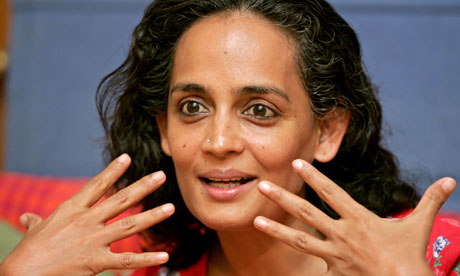
Isn't this what the Kashmir issue, too, has been for sixty-plus years?  The cease-fire and the "line of control" in place has merely perpetuated the war, instead of ushering in a sense of peace.

I am with Arundhati Roy (such agreement doesn't happen often!) when she says that Kashmir has never been an integral part of India and maybe Indians should just let go of that territory.  I, too, have expressed such sentiments in this blog.  I would extend the same logic to Nagaland, Mizoram, ...

The difference though is that as a nobody, and an American nobody, my words don't invite the Indian government's attention as do Roy's.  The latest news of a mob gathering outside her home doesn't bode well either.

Thursday, August 12, 2010

More on the Kashmiri Intifada

The NY Times hesitates to use the "torture" word when it comes some of the Cheney/Rove monsters.  But, "intifada" comes easy to the paper.  Not that it is an inappropriate word to describe the situation in Kashmir; hey, even I have been blogging along those lines! 

Anyway, peace in Kashmir looks so difficult from so far away.  The photo on the left is from the NY Times story: "Aabid Nabi, right, sat next to his brother Fida Nabi, who was shot in the head during a protest, in a hospital in Srinagar. Mr. Nabi later died from his injury."
“What we are seeing today is the complete rebound effect of 20 years of oppression,” said Mirwaiz Umer Farooq, the chief cleric at Srinagar’s main mosque and a moderate separatist leader. Kashmiris, he said, are “angry, humiliated and willing to face death.”
This summer there have been nearly 900 clashes between protesters and security forces, which have left more than 50 civilians dead, most of them from gunshot wounds. While more than 1,200 soldiers have been wounded by rock-throwing crowds, not one has been killed in the unrest, leading to questions about why Indian security forces are using deadly force against unarmed civilians — and why there is so little international outcry.
 This is certainly looking more and more like the Gaza situation where a generation has known nothing but internal unrest, and a sense of hopelessness.

Over at the BBC, Soutik Biswas echoes nearly identical sentiments:
Things are looking grimmer than ever before. It's a summer that could turn out to be another defining point in the valley's tortured history. A whole generation of children of the conflict - Kashmiri writer Basharat Peer evocatively calls it their "war of adolescence" - who grew up in the days of militancy and violence in the early 1990s are driving the protests today. (Seven out of 10 Kashmiris are below 25.) Growing up in the shadow of the gun and what they say is "perpetual humiliation" by the security forces, they are angry, alienated and distrustful of the state. As prominent opposition leader Mehbooba Mufti tells me when I visit her at her heavily secured home overlooking the stunning Dal lake: "If these young men are not given something to look forward to, God help Kashmir." The valley, most residents say, is in the early stages of an intifada.
 Biswas ends his report on a tough emotional note, which conveys the urgency of the Kashmir issue:
One mother emptied a cupboard and a suitcase full of of her 14 yr-old boy's belongings for me. Wamiq Farooq had gone to play in the neighbourhood when a tear gas shell fired by the troops exploded on his head. Doctors tried to revive him for an hour at the hospital before declaring him dead.

Now, sitting on a brown rug in a modest family home, his mother brings out Wamiq's red tie, red belt, white cap, fraying blue uniform, half a dozen school trophies, report cards, school certificates and then his pithy death certificate. "He is sure to be a face in the crowd," writes his school principal on one certificate praising Wamiq, the Tom and Jerry cartoons and science-loving teenaged son of a street vendor father. Then she slowly puts back Wamiq - his life and death - back into the suitcase and the cupboard and tells me, her eyes welling up: "I never understood why Kashmiri people demand freedom. After Wamiq's death, I do. I want freedom too. So that my children can return home unharmed and in peace."

Sunday, August 01, 2010

The intifada in Kashmir

I have blogged about the fresh series of violence in Kashmir, which is why I am all the more worried about the escalation in the confrontation there.

The caption for the photo on the left reads:
A man throws a policeman's bamboo shield on a burning government vehicle after protesters set it on fire in Pampore, near Srinagar on Sunday.

According to the same news report, At least eight people were killed in fresh round of violence in Kashmir, taking the death toll in the past 36 hours to 12.

A commentary from across the border, in Pakistan, naturally takes on a completely pro-Pakistani slant, along with anti-Indian and anti-American rhetoric:
India continues to treat the Kashmiri people as if they were not human beings and as if they have no rights. It refuses to acknowledge the uprising to be a home grown insurgency. Instead, it finds it easy to blame it all on groups that it says Pakistan sponsors.

There are even more fascinatingly rhetorical and inflammatory sentences in that commentary.  But then that is what most commentators do anyway--we have quite a few of such shrill ideological voices spouting rhetoric in the television and newspaper outlets here in America.  Stupid ideologues all over this planet!

If only India's Vallabhai Patel and Jawaharlal Nehru hadn't arm-twisted the Kashmiri maharajah, and quite a few other territories into joining the union.  I suppose this is the one of the rare situations when I agree with Arundhati Roy, who refers to these and other acts as India's acts of territory grabbing and imperialism. 
Meanwhile, there is the other serious internal violence that Roy details.

Friday, July 16, 2010

The dark clouds of war over India-Pakistan

It appears to be an intifada of sorts in Kashmir, and the situation there is one of the worst in recent years.
Against that background, the foreign ministers of India and Pakistan were to hold talks ...

Here a a few reports:
The day prior to the meeting, India's Home Secretary (a civil service position, not to be confused with the American "Secretary") flatly stated that Pakistan's ISI was directly behind the Bombay (Mumbai) terrorism:
"It was not just a peripheral role," the Indian Express newspaper quoted Pillai as saying. "They (ISI) were literally controlling and coordinating it from the beginning till the end."
Like that will go well with the Pakistani government, eh!  Not that this statement was the clincher, but the talks failed. Spectacularly.
The Pakistani minister was not pleased with the Indian contingent:
Pakistan from the start had been insisting on a sustained dialogue and picking up from where the composite dialogue was suspended by India, but New Delhi's contention was that since the process was called off because of the Mumbai terror attack, it cannot be restarted without some action in unravelling the conspiracy and bringing the culprits to book by Islamabad.
Commenting on the way the Indians conducted the negotiations, the Minister said the Indian side appeared ill-prepared with Mr. Krishna having to time and again consult New Delhi.
Pointing out that he had entered the dialogue well prepared and with the full mandate of the Pakistani leadership, Mr. Qureshi pondered aloud why his counterpart — who is supposed to preside over Indian diplomacy — needed to consult New Delhi ever so often. 
India's minister disagrees:
External Affairs Minister S.M. Krishna said here that India did not think it was prudent at this stage to accept the Pakistani offer of timelines because of the complexity of the issues involved. “We told them terrorism is the biggest problem in normalising relations. Unless this is met, everything else will be futile. In diplomatic parleys, we don't go by a timeline unless it is absolutely necessary. The question of timeline was not feasible.''
The Minister dismissed suggestions that the Indian delegation was not flexible and ill-prepared. “I am not going to score debating points. The fact of the matter is we did discuss many issues of concern…. The mandate was very clear. As External Affairs Minister, I confined myself to the mandate. I am quite satisfied,'' he observed.

Sensing a political opening, the out-of-power the crazy nutcase Hindu religious fundamentalist party, the BJP, calls for suspending talks altogether:
“The time has come for India to call off the dialogue,” she said. There was no need for India to keep putting up with insults heaped upon its representatives.
At the party headquarters here, spokesperson Ravi Shankar Prasad said Mr. Qureshi seemed to have lost his cool because Home Secretary G.K. Pillai mentioned about the Inter-Services Intelligence of Pakistan in a comment he had made. This showed the ISI was the “real boss” in Pakistan, he said.

At some point, the game of chicken could lead to one completely losing it.  I hope that dangerous day does not come. ever.
But, worry we should.