Showing posts sorted by relevance for query empathy. Sort by date Show all posts

Friday, April 26, 2019

Learning empathy takes effort

I have blogged in plenty about the need for empathy and, in a number of posts, have also written about a horrible human being seemingly with no sense of empathy being elected by 63 million as the President of the US.

To me, empathy has always been about the others. "Empathy is other-focused, not self-focused."  This is important to understand.  Because, sociopaths like tRump seem to easily zoom into what makes the "others" hurt:
Someone with sociopathic tendencies can ‘read’ other people well and understand their emotions. But a sociopathic person reads others in order to manipulate or take advantage of that person.
Empathy is not about merely understanding the emotions of others.  Empathy "is a tool or skill that provides people with information from which we are then free to take actions, or not. Empathy itself is neutral. What we choose to do with it is up to us."

It is up to us.  And up to us to invest the time and energy to understand the others.
The challenge with empathy is to be open to gaining knowledge about others. We tend to be biased when it comes to empathy. We are better at reading those who are like us than at reading people who are different.
tRump openly expresses his hate for, oh, Muslims and Haitians. But, his heart bleeds if a white person somewhere is attacked by a brown person.  It is not that he is empathetic to the white person in distress--the guy is simply biased. He is bigoted.

The "us-versus-them perception diminishes the ability to empathise. So, what can be done?"  The author distills the full array of empathy into seven behaviors; read them.

I will end this post with the final paragraph from that essay:
If we see ourselves in others, if we walk in their shoes, we have little to fear and can allow empathy to help us decide how to react and behave. It is a challenge to engage in empathy, it is not easy. Some days in some situations, empathy might come easily, other times it won’t. When people are scared, stressed or anxious, it can be difficult for them to step away from their own feelings and tune into those of another person. However, because of mirroring, empathy begets empathy. The more we use it, the more others around us will use it. Everyone wants to be heard and understood. Every group wants to be recognised. It can’t happen without empathy.


Source

Wednesday, March 23, 2016

On getting the head and the heart to work together

To observe important dates such as birthdays and death anniversaries, my parents make donations to charities, like goshalas, public feeding at temples, facilities for the disabled, etc. It is a good thing that my parents do not wonder if their donations will deliver the maximum possible benefits compared to giving to other causes.  If they did, then odds are that they will be disappointed.

In order to get to that point, let me start with the summer of 2014, when the social media fad was to challenge friends to a ice-bucket challenge.  Remember that?  It was to raise funds for the terrible Lou Gehrig's Disease (medically known as ALS).  I turned down a friend's challenge.  Because, as I wrote then:
 I am far from convinced that ALS ranks way high among the gazillion problems that humans experience on this planet and, therefore, it is more important for me to spend whatever that I can on issues that are of much higher priority.
It might have seemed like I am heartless.  A horrible monster.  But, I am not.  I am, in fact, worried about my sense of empathy that often emotionally drains me.  So, here I am with a high level of empathy but being cold-hearted?

The ice-bucket challenge was not any individual giving but was a public policy drive.  A public rally for allocating money for a specific issue.  Especially when it comes to public policies, the highly empathetic me wants to make sure that the money we spend will be on the highest priorities.  Such an approach is what the philosopher Peter Singer refers to as "effective altruism."

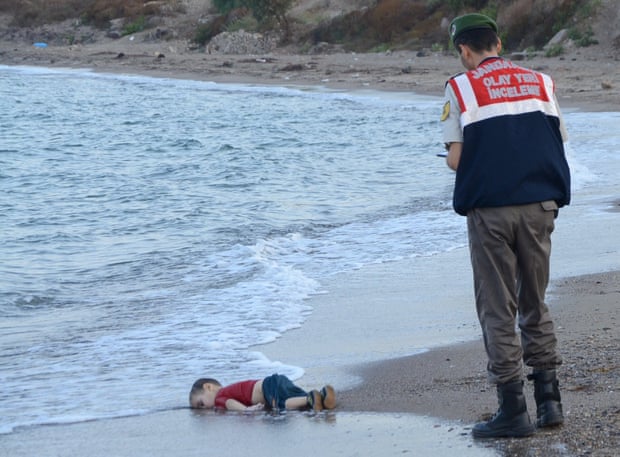
Purely guided by empathy means that we could individually and collectively make a whole bunch of wrong choices.  Take the Syrian refugee crisis, for instance.  We apparently couldn't care for about the humanitarian issues, despite being informed about it, until we saw the photograph of a toddler dead on the beach with his face down.  The momentary empathy is not what drives public policy nor should it.

Or, consider the latest extremism in Europe--the bombs in Brussels.  Our empathy is well warranted.  The people behind those bombings are evil, no doubt.  But, is that the greatest humanitarian crisis that should command all our attention and resources?  How about the chaos in Syria where the civil war has entered the sixth year?  Or, the crisis in Yemen?  Or, the Boko Haram-triggered violence and rape and everything else?  Or the incidents beyond our wildest imaginations that have been going on in South Sudan?   And, btw, why is the humanitarian crisis in South Sudan not even on the international radar?

Source

Those are geopolitical issues.  Will a focus on Brussels and the resultant public policy resource allocation decisions deliver more than some of the global health issues that we have continued to ignore for decades?  Like tuberculosis, malaria, Ebola, and now even Zika?  And given all the talk related to World Water Day, how about the benefits of clean water supply and sanitation?

There is a role for empathy, yes.  But, it is often "biased and parochial."
It favors vulnerable children and animals, and discriminates against unattractive people. You’re more likely to sympathize with someone in your social group rather than an outsider, especially one who looks different.
Empathy is also innumerate, Dr. [Paul] Bloom notes, which is why you may care more about one girl stuck in a well than thousands of war refugees or millions of people who will be affected by climate change.
Even that toddler who was face down on the beach, well, would that image have triggered the outcry if it were a black South Sudanese kid?  Or, did most of us in the advanced economies empathize because the kid did not look that different from one of our own?

Source

When my parents make those charitable contributions, is it the familiarity-triggered empathy? More important than any of the issues that I have listed here?  Should they think about it?   

There are even more problems with empathy:
In his current research, Dr. Bloom and a colleague are finding that the more empathic people feel toward victims of terrorism in the Middle East, the more they favor taking military action.
“If I want to do terrible things to a group, one tried-and-true way is to arouse empathy for victims of that group,” Dr. Bloom said in an interview. “Often the argument for war is rooted in empathy for victims of the enemy.”
So, driven by empathy, if you want to donate in order to make this world a better place for humans anywhere--not only those who are in your own social group--then what can you do?  Here is a place you can start.

Click here if you want to listen to a short three-minute video/talk by Bloom.
Monday, October 15, 2018

Trading places

Over the years, I have come to appreciate John Rawls's "veil of ignorance" a lot.  I mean, a lot.  (Click here if you need a ninety-second briefing.)

Unlike Rawls's theoretical structure of an original position, we have the real world to deal with.  It is this world, not a hypothetical scenario, that we have to work with.  Which means, we need to figure out how to understand what it might mean to be a person of the type that we are not.  The "other" could be a different gender from us.  A different religion.  Different skin color.  Different upbringing.  Different whatever.

If we begin to understand the circumstances in which the others might find themselves, then, well, we are beginning to have that wonderful aspect of what it means to be human: Empathy.

It is not the emotional empathy that I am referring to, like when we see the stereotypical photo of a fly buzzing around a poor kid with a runny nose.  Nope. As Roman Krznaric explains in the video that I have embedded in this post (or you can watch here) it is cognitive empathy.

We imagine what the people in Aleppo are going through.  We imagine what the homeless in the nation's capital experience when they are only a few blocks away from the President's palace.  We imagine what the hijab-wearing Muslim is worried about as a result of the elections.

Krznaric referred to Adam Smith, which, of course, intrigued me.  Smith, is often hailed by the free market and the pro-business people.  (Pro-business is not the same as being pro-market.)  However, that is cherry-picking from what Smith had to say.

Smith not only wrote about the invisible hand and the power of self-interest, but was a moral philosopher.  Krznaric quotes Smith about empathy.  The think-tanks and the business lobbies conveniently forget that Smith was quite a philosopher.  Either they forget, or they are not even informed about it--perhaps the latter!

Krznaric quotes from Smith's other book, A theory of moral sentiments: " ... by changing places in fancy with the sufferer, that we come either to conceive or to be affected by what he feels."

By changing places with the sufferer ... in our imagination, not literally.  We then imagine what it might mean to be that other person.

When the President says all the horrible things that he says on a daily hourly basis, it reflects an utter lack of an ability to "fancy with the sufferer"--a complete and total lack of empathy.

It is not any surprise when he makes even tragic situations only about himself. Or, talks about the most nonsensical things like how a boat ended up in some guy's yard.  A lack of empathy means that the asshole-in-chief can never behave like the comforter-in-chief that Presidents are expected to be in the face of tragedies. 

When he lacks empathy ... progress will stall.  Huge steps backward as we hopefully wait for the long arc of the moral universe to bend, again, towards justice.


Sunday, February 02, 2020

Empathy Through Enchiladas

The NY Times had an interesting report on the predictive power of food:
Voters who had been to Europe, Australia, Canada or Mexico or had eaten at an Indian restaurant were less likely to choose Mr. Trump by 10 to 12 percentage points beyond the differences explained by other factors like the ones mentioned above.
...
Of course, it’s not that eating Indian food leads a person to support one Democratic candidate over another — that’s silly. (And there are voters for whom Indian food is the taste of home.) But a voter’s orientation toward the world is related to candidate choice, and it turns out that eating in restaurants that celebrate less familiar cultures is one way to measure where people think they are more connected: to those around them locally or to people farther afield.
Indeed.  Food is a portal to understanding the world around us.

There's something remarkable about breaking bread together--even if that breaking bread happens at an "alien" restaurant.  That magic is powerful when we share food at home, as I quickly realized when I came to the US.

Siddiqqi, who was from Pakistan, or the Taiwanese girl whose name I have long forgotten, came over to my apartment to eat with me.  And then there were more. Greeks. Nigerians. Or my meals with Palestinians. A Guyanese-American with roots in India.  And, of course, white Americans too.

It was never really about the food.  What is it about then?
According to anthropologists and psychologists who have studied food in recent years, cuisines from international cultures can take us out of ourselves and help us better understand distinct people and cultures. The secret ingredient is empathy. And the process begins with stirring our emotions.
Food and emotions, and that wonderfully important ingredient to being human--empathy.

Empathy, about which I have blogged a lot because of the importance that I attach to it, means that we are placing ourselves in somebody else's shoes and understand their feelings.  When the others are from cultures that are alien to us, food is a phenomenal portal through which that "other" slowly becomes "us."
A culture may seem unfamiliar to a person, but after that person discovers the way people from an unfamiliar culture “prepare their food, the way they eat, somehow they understand it. There’s link between you and them, and that gives you insight.”
But, we need to keep in mind that it is not merely about food.  I have always stayed away from the international food fairs at college campuses because it seems to perpetuate the mistaken notion that it is all about food.  I want people to begin to understand the "other" through food.
Food alone, though, is often not enough to complete the trip to another culture. The journey needs other people.
Which is why white Americans eating Mexican and Indian foods can also be racists and xenophobes!  The "others" serving food is what the supremacists think is the norm--the equivalent of "shut up and dribble."  As if we are here only to keep the masters happy!

"Without the ingredient of human empathy, food from another land can only have a bland effect."  As I noted in this post a few months ago, I wish people would think about this:
“Have you or your family ever invited a person or a family of another race to your home for dinner?” ... When is the last time you or your family had dinner in your home with a person or family of another race?
Breaking bread at my home is about empathy and understanding. I have no place in my life for people who lack empathy.

Sunday, July 12, 2015

No empathy for Ivan Ilyich?

I have gotten to the halfway mark in The Death of Ivan Ilyich, and I am being simultaneously offered real world checks to go with the fictionalized world of Tolstoy's.

A couple of days ago, father informed me about a death in the extended family of a 67-year old.  "Sixty-seven is young for these days" he said.  I wonder how he feels to bear witness to younger people, including his son-n-law, dying.  I recalled my graduate school professor remarking once, in a rare genuinely revealing moment, about his emotional difficulty in delivering the eulogy for a colleague who was twenty years his junior.

Yesterday, another update from father about another death.  Maybe I should stop calling my parents!  This time, it was about the demise of a 94-year old.  "He lived a full life" father said as he recalled various events related to the departed.

If death after a "full life" is acceptable, then what do we mean by a full life?  When do we reach that "full life" status?

Tolstoy's Ivan Ilyich was having a wonderfully fulfilling life.  "And everything went on like that, without any change, and everything was very good."   Things started going bad after a fall that he didn't think mattered at all.  It started with a pain.  A mysterious pain.  And then, just like that, things changed.
And he had to live like that on the brink of the abyss, all alone, without a single person who could understand and take pity on him.
Tolstoy has set things up well, and from now on it will be Ivan Ilyich's introspective reflections on "Is there any meaning in my life that wouldn't be destroyed by the death that inevitably awaits me?"

When somebody else is suffering, moral questions arise in plenty.  What exactly am I supposed to about that other person?  What is the relationship between empathy and morality?
Not only does empathy seem to fail when it is needed most, but it also appears to play favorites.
If you have very good relationships with your family, you then feel their pain and suffering.  You might even cry because you can't bear to watch them in agony.  The neighbor across the hallway might be ill too, but we don't cry over their agony.  We play favorites?  Are we morally on solid grounds when we behave that way with different people?
Inspired by a competing body of recent research, we believe that empathy is a choice that we make whether to extend ourselves to others. The “limits” to our empathy are merely apparent, and can change, sometimes drastically, depending on what we want to feel.
Apparently research shows that we choose to empathize with others.  It is a choice that we make.  Ivan Ilyich is beginning to suffer from his illness and he is beginning to sense that his wife, daughter, and friends, do not seem to "understand and take pity on him."  Tolstoy's "humanities" and today's "science" seem to agree on human behavior.
Yes, there are many situations in which empathy appears to be limited in its scope, but this is not a deficiency in the emotion itself. In our view, empathy is only as limited as we choose it to be.
As I work my way towards the rest of The Death of Ivan Ilyich, I am sure I will understand a lot more about the human condition.  As you can imagine by now, understanding this existence is a part of my own "full life."


Thursday, March 19, 2020

Does empathy really have a downside to it?

We humans are strange that in our daily lives it takes a disaster to wake us up and draw us out of ourselves and our narrow perspective.  More on the empathy series in the time of Covid-19.

The following is an edited version of a post from December 2015.
********************

I did not stir out of my home in California for two days after the fateful events on September 11th, 2001.  I even skipped attending the back-to-school events, including the president's address in which he referred to a research project in which I was the lead researcher.  I was exhausted from thinking about the families whose loved ones had jumped to death out of the flaming buildings, the ones who were trapped inside, the ones in the planes, the fire and rescue personnel, ... the losses were acutely personal to me, even though I had not known even one of the dead or injured.

It was a replay of similar emotions after the Christmas tsunami. The Fukushima earthquake and the tsunami. The mass shooting in Oregon.  The recent rains and floods in Chennai. And a lot more.

I feel for the people at such events.  And then I worry that my empathy levels could become unhealthy--or worse, that it already is.

Compared to those events around the world, my troubles seem so trivial.  I have to remind myself my daughter's pragmatic suggestion years ago, of which she perhaps has no memory.  She matter-of-factly told me that a person's problems were important and huge to that person.  Whatever the problems might be.  End of story.

The psychotherapy column in the NY Times has that same bottom-line as well: "Got First-World Problems? Don’t Feel Guilty."
Focusing on your hurt feelings because a cousin didn’t invite you to her bridal shower can easily appear shallow if you place it in the context of African genocide or refugees drowning in the Aegean Sea.
The therapist advises not to feel guilty that your hurt feelings take priority over those catastrophic global issues.
If we allowed every mass tragedy to affect us deeply, we would soon suffer from empathy overload. Most of us would agree that having empathy for other people is a good thing, a core human capacity that supports morality and civilization. But it’s also possible to have too much of a good thing. Empathy has a downside when it makes you ashamed of what matters to you, or when it distracts you from other important emotions of your own.
If we didn't feel hurt and angry and frustrated in our daily lives that are peaceful and rich, then I suppose we would not be truly human experiencing the emotions that make us human.  But, of course, we do not want to live a selfish life that is shut off from all those problems either.  A fine balance between empathy and selfishness is what we need.

A similar issue pops up in a column about life after the catastrophic rains and floods in Chennai.  The author, a Chennai resident, writes:
There was a family celebration recently, a zero-number birthday, and we went out, had dinner at a nice place. The money I spent, I didn’t feel... guilty about it, exactly. After all, some of my money has found its way to relief organisations. And we can’t stop living, right? Life goes on, right? But when I handed over my credit card, I felt weird. I think I understood — rather, felt — for the first time what Siddhartha must have felt when he stepped out of the palace and saw people who did not have the privileges he did. Again, I’m trying not to make too big a deal about this — but these are big thoughts, big emotions. About, through some freakishly random accident, being born into a certain kind of family, having all kinds of opportunities, having the freedom to chuck a phenomenally well-paying job and pursue a maybe-it’ll-work career in another field, now living in a flat in a high-lying area that floodwaters couldn’t reach — all of which led to this evening where I’m taking a casual look at the bill and handing out my credit card.
All a part of the human condition on this pale blue dot.

Monday, May 04, 2020

I feel your pain!

Remember President tRump saying the following?
There are no national boundaries for climate protection or the global economy. No religious boundaries, either. The time has come to understand that we are the same human beings on this planet. Whether we want to or not, we must coexist.
Incredible, right?

It is incredible because tRump did not say that.

tRump is incapable of saying anything that conveys even a gazillionth of that meaning!  It is beyond the sociopath's ability to even imagine that "we are the same human beings on this planet" and that "we must coexist."

It was the Dalai Lama who wrote: "We must learn that humanity is one big family."

The sociopath has no sense of empathy.  63 million--including former commenters here--elected him because of that, and not despite that.

And they continue to support him despite because of the evidence over the four years!

The office of the presidency requires the President to be a consoler-in-chief during such crises.  But, the orange monster can only talk about himself.  How he has been treated worse than Abe Lincoln was.

Yep, the narcissist believes that he is greater than Lincoln--a man who paid a huge price of his own life because he wanted to unite the country!

There are many leaders who have been conducting themselves at the highest levels.
The leaders who exude empathy in the midst of the COVID-19 crisis are experiencing surges in popularity. The New York Times has called Gov. Andrew Cuomo of New York “the politician of the moment,” noting, among other things, his briefings, which now regularly reach national audiences and are “articulate, consistent and often tinged with empathy.”
Articulate. Consistent. Tinged with empathy.  None of those will ever apply to a description of this cheeto president!
Empathy has played a pivotal role in American history when presidents feel with, and act in response to, their constituents’ needs. Indeed, leaders who empathize, who relate to and feel with their people can ask them to do difficult things. ...
It is easier to trust an empathetic leader; their empathy is better assurance than the weak sympathy of a leader who grieves the loss of his own power over the loss of life.
But, don't ever forget that there are people, millions of them, who consider this unempathetic sociopath to be their hero!

Source

Tuesday, August 21, 2018

Do women dream of having sex with robots?

If only more women would get into computer science and robotics!

No, it is not because I think they will create better sex robots.  It is because of the exact opposite--I feel they will spend less time on how to dehumanize us humans that male scientists seem to want to do by merging us humans with robots.

In one of the paired opinion pieces in the NYT, Sherry Turkle, whom I have referred to a lot in this blog (like here) writes that there will never be an age of artificial intimacy.  Why?  For a simple and profound reason that I often write about: Empathy.

Robots can some day effectively fake empathy, yes.  But, it can never be the real thing.  And the loss of the real thing worries me, and worries Turkle too:
We diminish as the seeming empathy of the machine increases. It is technology forcing us to forget what we know about life.
In life, you are struck by the importance of presence, of the small moments of meaning, the miracle of your child’s breath, the feelings of deep human connection. When you are thinking about technology, your mind is not on all of that. We program machines to appear more empathic. Being human today is about the struggle to remain genuinely empathic ourselves. To remember why it matters, to remember what we cherish.
These days, to be human is to keep one’s mind on the glory that one is.
In the other commentary, Andy Clark argues that it is a good thing that we are merging with robots.  Guess what word never appears in his piece? Clark has nothing to say about empathy!

While I have no evidence to back me up here, I believe that Clark's commentary fits well with the stereotypical male approach to feelings and emotions.  Even sex, which he writes about, is apparently not about feelings and emotions and intimacy.

If indeed these male/female stereotypes do feed into robotics, then that is one more argument in favor of recruiting capable females into computer science and engineering.

In the meanwhile, all we can do is reflect on what it means to be human, especially if we are not going to promote the importance of empathy.  We have one clear example of what happens when we lose sight of empathy!


Tuesday, December 15, 2015

On this painful existence

I did not stir out of my home in California for two days after the fateful events on September 11th, 2001.  I even skipped attending the back-to-school events, including the president's address in which he referred to a research project in which I was the lead researcher.  I was exhausted from thinking about the families whose loved ones had jumped to death out of the flaming buildings, the ones who were trapped inside, the ones in the planes, the fire and rescue personnel, ... the losses were acutely personal to me, even though I had not known even one of the dead or injured.

It was a replay of similar emotions after the Christmas tsunami. The Fukushima earthquake and the tsunami. The mass shooting in Oregon.  The recent rains and floods in Chennai. And a lot more.

I feel for the people at such events.  And then I worry that my empathy levels could become unhealthy--or worse, that it already is.

Compared to those events around the world, my troubles seem so trivial.  I have to remind myself my daughter's pragmatic suggestion years ago, of which she perhaps has no memory.  She matter-of-factly told me that a person's problems were important and huge to that person.  Whatever the problems might be.  End of story.

The psychotherapy column in the NY Times has that same bottom-line as well: "Got First-World Problems? Don’t Feel Guilty."
Focusing on your hurt feelings because a cousin didn’t invite you to her bridal shower can easily appear shallow if you place it in the context of African genocide or refugees drowning in the Aegean Sea.
The therapist advises not to feel guilty that your hurt feelings take priority over those catastrophic global issues.
If we allowed every mass tragedy to affect us deeply, we would soon suffer from empathy overload. Most of us would agree that having empathy for other people is a good thing, a core human capacity that supports morality and civilization. But it’s also possible to have too much of a good thing. Empathy has a downside when it makes you ashamed of what matters to you, or when it distracts you from other important emotions of your own.
If we didn't feel hurt and angry and frustrated in our daily lives that are peaceful and rich, then I suppose we would not be truly human experiencing the emotions that make us human.  But, of course, we do not want to live a selfish life that is shut off from all those problems either.  A fine balance between empathy and selfishness is what we need.

A similar issue pops up in a column about life after the catastrophic rains and floods in Chennai.  The author, a Chennai resident, writes:
There was a family celebration recently, a zero-number birthday, and we went out, had dinner at a nice place. The money I spent, I didn’t feel... guilty about it, exactly. After all, some of my money has found its way to relief organisations. And we can’t stop living, right? Life goes on, right? But when I handed over my credit card, I felt weird. I think I understood — rather, felt — for the first time what Siddhartha must have felt when he stepped out of the palace and saw people who did not have the privileges he did. Again, I’m trying not to make too big a deal about this — but these are big thoughts, big emotions. About, through some freakishly random accident, being born into a certain kind of family, having all kinds of opportunities, having the freedom to chuck a phenomenally well-paying job and pursue a maybe-it’ll-work career in another field, now living in a flat in a high-lying area that floodwaters couldn’t reach — all of which led to this evening where I’m taking a casual look at the bill and handing out my credit card.
There is empathy, yes.  But, life goes on.  Babies are born. Wedding are celebrated. Funerals are conducted. Parties are held.

All a part of the human condition on this pale blue dot.

Tuesday, June 13, 2017

Do unto others ...

Over the years, I have read plenty of trashy, potboiler, fiction.  I have also read a number of serious works of literature. The past few summers even included syllabi that I carefully constructed (FYI: The 2016, and 2015 lists)

Over the years, the potboiler fiction and cheap movies have pretty much disappeared from my radar.  As I have often remarked in this blog, reading great works of literature, and watching movies that are about the human condition, help me with trying to understand the "other," which is pretty much everybody other than me.  In the process, I begin to understand myself too.

I have also blogged often that my intuitive, personal-observation-based, view is that despite the fact that we are more educated than ever before, we are reading less of literature. I routinely poll  students in my classes about a few classics that I expect to appeal to young readers in particular (like Fahrenheit 451) and the response is always discouraging.  For that matter, even my faculty colleagues seem to be unfamiliar and uninterested in some of the great works.  Yet,  these very faculty can be all high and mighty defending the value of the humanities.  WTF, right?
Many humanists have difficulty in presenting their case because they are used to speaking one way among themselves and another way to outsiders. To the public at large, they still make statements about the value of great books, of the noblest things said by the most brilliant minds and of the need to know the Western heritage. Among themselves, such talk is, at best, hopelessly dated. Perhaps one reason literary scholars make an unconvincing case to outsiders is that they do not believe it themselves.
Students often come to college without having any grasp of what reading great works entails. Their AP and other exams test knowledge of facts about literature, not actually understanding it. Classes teach them to hunt for symbols, to judge writers according to current values, or to treat masterpieces as mere documents of their times. The first method makes reading into a form of puzzle solving, the second allows us to compliment ourselves on our advanced views, and the third misses the point that great literature speaks outside the context of its origin. Tolstoy is not great because he tells us about czarist Russia or the Napoleonic wars.
How unfortunate!
Here’s an alternative approach: Why not approach great literature as a source of wisdom that cannot be obtained, or obtained so well, elsewhere?
Exactly!  This is exactly what I have been talking about, and practicing, for years now.
And great writers present ethical questions with a richness and depth that make other treatments look schematic and simplistic.Moreover, great literature, experienced and taught the right way, involves practice in empathy. When we read a great novel, we identify with the heroine. We put ourselves in her place, feel her difficulties from within, regret her bad choices. Momentarily, they become our bad choices. Even when we do not like her, we may wince, suffer, put the book down for a while. The process of identification, feeling and examination of feeling may happen not just once but, in the course of a long novel, thousands of times. No set of doctrines is as important for ethical behavior as this constant practice in ethical thought or that direct sensation, felt over and over again, of being in the other person’s place.
The most important lesson novels teach is not a fact or a message but the skill of empathy and of seeing the world from other points of view. Practiced often enough, that skill can become a habit.
Seriously, isn't it tragic that these are not self-evident, and that the president of Northwestern University and his faculty colleague there have to write a commentary to remind higher education professionals about these?

Empathy does not come easily to us.  We need to learn about it, and experience it over and over.  We learn and experience empathy through the profound works of literature.  I still remember feeling devastated after reading A farewell to arms.  As I noted in a post:
Felt so empty inside when it ended that I had to wait out a couple of days before blogging this.
Hemingway simply sucked everything out of me with the anti-war story where the American protagonist signs up to serve in the medical corps of the Italian army in order to fight the good war, ends up deserting that only to have the military come after him because of his AWOL status as an officer, flees to neutral Switzerland with his British "wife" who is pregnant ... and then Hemingway lets the wife die after a difficult birth of a stillborn child. That is simply too cruel!
Empathy, dear reader, for this fictional character leads to empathy for the real ones in the real world.
What could be more important, for ethical and social understanding, than the ability to grasp what it is like to be someone from a different culture, period, social class, gender, religion or personality type? And one learns why even those broad categories won’t do, because one senses what it is like to be a particular other person. And that, too, is an important lesson: no one experiences the world in quite the same way as anyone else.
If we could more easily put ourselves in the position of others and put on a set of glasses to see the world in their way, we might very well, when those glasses are off, still not share their beliefs. But we will at least understand people better, negotiate with them more effectively, or guess what measures are likely to work. Just as important, we will have enlarged our sense of what it is to be human. No longer imprisoned in our own culture and moment, or mistaking our local and current values for only possible ones, we will recognize our beliefs as one of many possibilities -- not as something inevitable, but as a choice.

Indeed.


Wednesday, November 08, 2017

A year of anger ...

I am with Katha Pollitt on this one:
I’m working on suppressing my rage.
Anger management; I have a long, long way to go.

The following is a re-post from a few months ago.
__________________________________________________________________

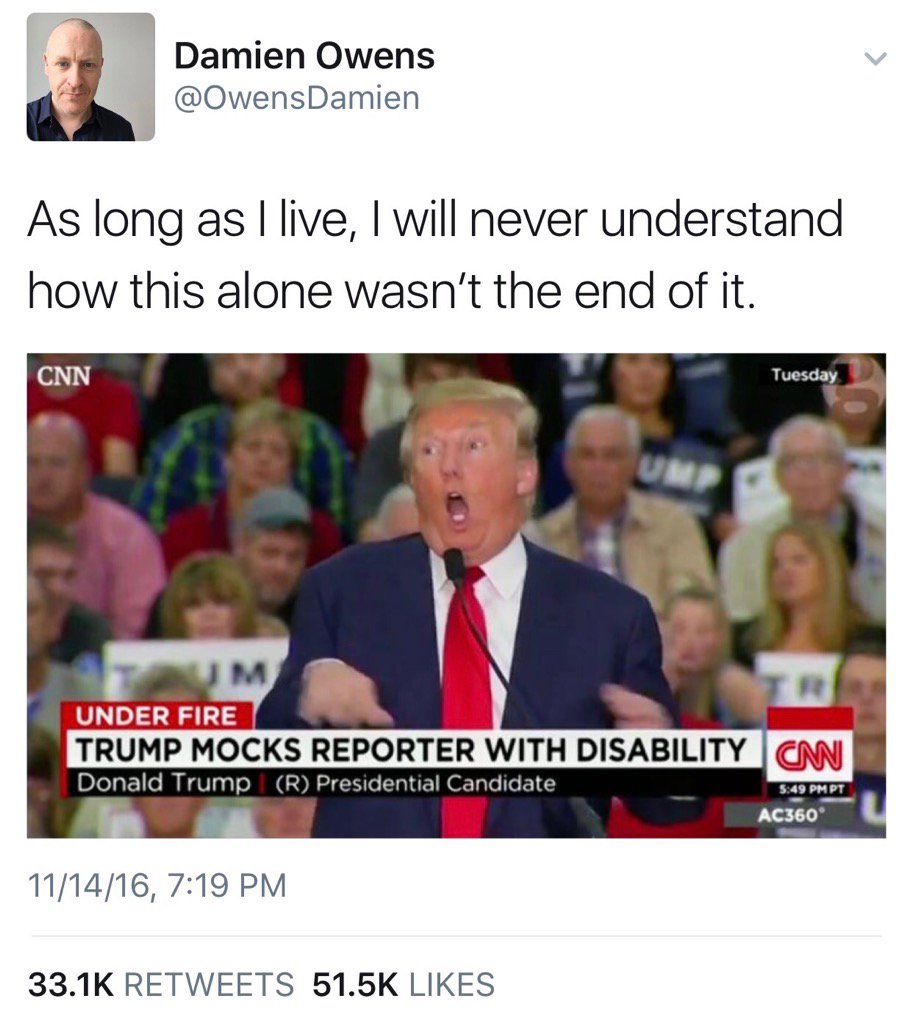
Even prior to this post, I have blogged 37 posts that I have tagged with a label that matters to me a lot: Empathy.  In her speech last night, Meryl Streep reminded us about that noble human quality.  By pointing out how empathy-deficient the pussy-grabbing president-elect is:
It was that moment when the person asking to sit in the most respected seat in our country imitated a disabled reporter—someone he outranked in privilege, power, and the capacity to fight back. It kind of broke my heart when I saw it, and I still can’t get it out of my head because it wasn’t in a movie; it was real life. And this instinct to humiliate, when it’s modeled by someone in the public platform, by someone powerful, filters down into everybody’s life, because it kind of gives permission for other people to do the same thing.
I still cannot believe he won despite such talk and action.  A horrible human being as the President!

It is even more depressing to think that he won because of such talk and action.

To quote the philosopher Adam Smith--yes, that same Smith who is canonized as the saint of capitalism--"by changing places in fancy with the sufferer, that we come either to conceive or to be affected by what he feels."  We imagine how it would be to be disabled. Or to be terminally ill. Or to live in Aleppo.  Normal human beings, therefore, do not mock the disabled, or the dying, or those being bombed in Aleppo.  Yet, if millions voted for that horrible human being to be the president, then I worry more about my fellow citizens than about the pussy-grabber himself!

Which is why right from election night I have been operating with a clear bottom-line: There is no such thing as a good trump voter:
Trump campaigned on state repression of disfavored minorities. He gives every sign that he plans to deliver that repression. This will mean disadvantage, immiseration, and violence for real people, people whose “inner pain and fear” were not reckoned worthy of many-thousand-word magazine feature stories. If you voted for Trump, you voted for this, regardless of what you believe about the groups in question. That you have black friends or Latino colleagues, that you think yourself to be tolerant and decent, doesn’t change the fact that you voted for racist policy that may affect, change, or harm their lives. And on that score, your frustration at being labeled a racist doesn’t justify or mitigate the moral weight of your political choice.
To empathize requires a fundamental starting point of recognizing and respecting the other--who does not look like me. Not with this demagogue and his voters!

Empathy is also what serious art conveys to us.  As Streep said, "An actor’s only job is to enter the lives of people who are different from us, and let you feel what that feels like."  Like even when a eleven-year old boy silently sheds tears because an animated character dies.

Unlike that eleven-year old boy, the demagogue has an utter lack of an ability to "fancy with the sufferer"--a complete and total lack of empathy.  There will be situations during his presidency when he will have to be the comforter-in-chief.  There will be situations when he will have to weigh whether or not to bomb a place or a country.  There will be situations when his policies might have drastic effects on people.  But, when he lacks empathy ... progress will stall.  We might even regress.  The trump voters will stand accused!

Source

Monday, January 09, 2017

J'accuse!

Even prior to this post, I have blogged 37 posts that I have tagged with a label that matters to me a lot: Empathy.  In her speech last night, Meryl Streep reminded us about that noble human quality.  By pointing out how empathy-deficient the pussy-grabbing president-elect is:
It was that moment when the person asking to sit in the most respected seat in our country imitated a disabled reporter—someone he outranked in privilege, power, and the capacity to fight back. It kind of broke my heart when I saw it, and I still can’t get it out of my head because it wasn’t in a movie; it was real life. And this instinct to humiliate, when it’s modeled by someone in the public platform, by someone powerful, filters down into everybody’s life, because it kind of gives permission for other people to do the same thing.
I still cannot believe he won despite such talk and action.  A horrible human being as the President!

Source

It is even more depressing to think that he won because of such talk and action.

To quote the philosopher Adam Smith--yes, that same Smith who is canonized as the saint of capitalism--"by changing places in fancy with the sufferer, that we come either to conceive or to be affected by what he feels."  We imagine how it would be to be disabled. Or to be terminally ill. Or to live in Aleppo.  Normal human beings, therefore, do not mock the disabled, or the dying, or those being bombed in Aleppo.  Yet, if 63 million voted for that horrible human being to be the president, then I worry more about my fellow citizens than about the pussy-grabber himself!

Which is why right from election night I have been operating with a clear bottom-line: There is no such thing as a good trump voter:
Trump campaigned on state repression of disfavored minorities. He gives every sign that he plans to deliver that repression. This will mean disadvantage, immiseration, and violence for real people, people whose “inner pain and fear” were not reckoned worthy of many-thousand-word magazine feature stories. If you voted for Trump, you voted for this, regardless of what you believe about the groups in question. That you have black friends or Latino colleagues, that you think yourself to be tolerant and decent, doesn’t change the fact that you voted for racist policy that may affect, change, or harm their lives. And on that score, your frustration at being labeled a racist doesn’t justify or mitigate the moral weight of your political choice.
To empathize requires a fundamental starting point of recognizing and respecting the other--who does not look like me. Not with this demagogue and his voters!

Empathy is also what serious art conveys to us.  As Streep said, "An actor’s only job is to enter the lives of people who are different from us, and let you feel what that feels like."  Like even when a eleven-year old boy silently sheds tears because an animated character dies.

Unlike that eleven-year old boy, the demagogue has an utter lack of an ability to "fancy with the sufferer"--a complete and total lack of empathy.  There will be situations during his presidency when he will have to be the comforter-in-chief.  There will be situations when he will have to weigh whether or not to bomb a place or a country.  There will be situations when his policies might have drastic effects on people.  But, when he lacks empathy ... progress will stall.  We might even regress.  The trump voters will stand accused!


Saturday, March 21, 2020

The un-empathetic sociopath

I will wrap up the empathy series by making it political.

As long as I live, I will never ever understand how tRump was elected President despite all his sociopath behavior that he made explicit.

It continues to shock me that his mocking of a disabled reporter alone did not send him into political wilderness but, instead, got him more support!  What a disgusting turn of events!

More than ever, it is during a crisis that we expect empathetic leadership.  We want leaders to feel our pain, our angst.  We want leaders to tell us that the problem is for real, and that all the machinery of the government is working overtime to get us through this.  However, the leader chosen by 63 million people "tests negative for empathy," as the satirical Andy Borowitz phrased it.

A reporter tosses him a softball question that any other President would have crushed to a towering home run.  Not this sociopath in the Oval Office.  He had a meltdown.  Instead of reassuring Americans, and the rest of the world too, he proved yet again that he "is simply incapable of offering the kind of emotional support the country needs at a time like this."
You may say that this is a less important part of the job of president than actually running the government and making good decisions. But every president is called upon to reflect and tend to the country’s psyche, sometimes over limited traumas and sometimes over larger ones. And when they do it well, we remember it for years, even decades.
We will remember this sociopath for decades, yes, but for all the horrible reasons!

There is no empathy from tRump and his godawful toadies.  Not "a word of sympathy or compassion for the thousands of Americans getting sick and dying on this president’s watch, as a result of this president’s neglect of his duties"
Trump and his party-line media do not do that. They cannot do that. That would take empathy—and empathy might dangerously remind Americans of the tragic cost of Trump’s mismanagement and absent leadership. Rage is all they feel, so rage is all they can express. Hatred fills their hearts, so hatred fills their mouths. The government and the government-line television network are, for the time being, in the charge of broken souls. Those broken souls are breaking a nation.
63 million Americans are guilty forever!

Source

Sunday, July 03, 2016

How do people come to know themselves?

One of the critical questions in Hindu philosophy is an existential question that people of any faith, or infidels like me, also worry about--or should worry about: Who am I?

I am sure that thinkers in cultures all around the world raised that very question.  The ancient Greeks, for instance, inscribed "Know Thyself" (well, not in English but in Greek, of course!) at the Temple of Apollo, and later Socrates declared that "the unexamined life is not worth living."

Source

My summer readings, on top of the different bits that I read and blog about, are essentially my attempts to keep after that question of "who am I?"  Instead of abstract philosophy, which I don't much care for, I ask that question in the contexts in which I find myself, in relation to the situations that surround me, especially because of my conviction that there is nothing after death, and it is all in the here and the now.  Thus, blogging about the Ebola crisis, or the Syrian refugees, or tweeting about the fascist, are all more than merely about Ebola or Syria or fascism--they are explorations into understanding who I am.

In an essay about James Baldwin, the author--Nathaniel Rich--quotes Baldwin:
The difficulty is to remain in touch with the private life. The private life, his own and that of others, is the writer’s subject—his key and ours to his achievement. Nothing, I submit, is more difficult than deciphering what the citizens of this time and place actually feel and think. They do not know themselves….
Rich follows that with his own observation:
How do people come to know themselves? One way is by reading fiction. The profound act of empathy demanded by a novel, forcing the reader to suspend disbelief and embody a stranger’s skin, prompts reflection and self-questioning. But most people don’t read novels.
The novel does not refer to the likes of Ian Fleming's James Bond series or the old Mills & Boon series or Fifty Shades of Grey ;)  I am reminded of a forum on campus, a little more than a year ago, when one faculty colleague referred to the "great books" approach at St. John's.  Another colleague, who is so convinced about his superiority that he never can even remotely understand how much of  an idiot he is, remarked that it is all relative on what "great books" mean and then went on to list some of the books that he has read, which made many of us gasp and wonder how such an idiot could possibly inhabit the world of higher education.  I suppose he doesn't know himself!  Hmmm ... where was I before this digression? ;)

In that same Baldwin essay, Rich notes:
Baldwin made the racial question personal, reducing a society-wide problem to a matter of one’s private conscience. He was not alone in this approach, but he was alone in bringing a novelist’s sensitivity to bear on it. In Baldwin’s writing racism is, among other things, a failure of empathy.
Indeed.  Racism, hate, or any systematic put down of "those people" is a failure of empathy.  Anybody who has any sense of empathy will not be able to generate the kind of rhetoric that foams from the mouth of the contemporary American fascist leader, and his ardent supporters equally suffer from a lack of empathy.  As this piece notes:
Trump deals in hates that dare not speak their names
This fascist leader:
enhances the force of a whole series of interlocking hates—black hate, Muslim hate, woman hate, and “Mexican” hate.
I would think that the fascist leader's short fingers have never ever touched the "great books" and the novels that compel the reader to reflect on "who am I?"

I wonder what James Baldwin would have said and written about this fascist leader!

Friday, March 20, 2020

If only we had more empathy

Not only is the COVID-19 a public health crisis, it is one awful economic crisis too.  This is the kind of a situation when people need the safety net.  But, here in the US, we have been systematically tearing apart the safety net ever since Reagan assumed the presidency.  My fellow citizens are finding out that the safety net has plenty of holes.  As if this is not horrible enough, Reagan's "heirs" want to tear up the safety net even more :(

I have blogged a lot about the safety net, and called for a new social contract.  The following is a post from October 2016, in which I worried that we don't have a good safety net because there is little empathy for the other.
*********************

First, read the following excerpt:
It is impossible to imagine Bill Gates’s wealth without Bill Gates’s ingenuity and effort. But it is far easier to imagine Bill Gates’s wealth being produced by someone other than Bill Gates within the institutions of modern American economic society than it is to imagine Bill Gates generating Bill Gates’s wealth in a different time and place – in France in the 1700s, or in the Central African Republic today – in which society was or is less tolerant of entrepreneurial capitalism and the accumulation of personal billions, and where the community of engineers that gave rise to and became America’s tech sector is absent. Indeed, at some point in Microsoft’s history it was Microsoft the information-processing organism that was more critical to Bill Gates’s wealth accumulation than Bill Gates himself. People, essentially, do not create their own fortunes. They inherit them, come to them through the occupation of some state-protected niche, or, if they are very brilliant and very lucky, through infusing a particular group of men and women with the germ of an idea, which, in time and with just the right environment, allows that group to evolve into an organism suited to the creation of economic value, a very large chunk of which the founder can then capture for himself.
That paragraph can easily be used as some kind of an ideological  Rorschach test.  Upon reading that, one can get pissed off and defend Gates's gazillions, or one might applaud in agreement that Gates has been unfairly hogging it all, or ... whatever.

To me, what makes that paragraph standout is this: The author, Ryan Avent, is senior editor and economics columnist at The Economist.  You might remember him from one of my earlier posts?  One of the many reasons why I have been a long-time reader of the Economist is this: It is not an ideological outfit.  It is not like the Nation or the Wall Street Journal.  There is a sensibility that reflects a much broader understanding, which Avent also displays in his essay.

In the essay from which I had excerpted that paragraph, Avent makes an argument that will certainly make one sit up:
The wealth of humans is societal. But the distribution of that wealth doesn’t rest on markets or on social perceptions of who deserves what but on the ability of the powerful to use their power to retain whatever of the value society generates that they can.
His follow-up sentence?  "That is not a radical statement."

After quoting Adam Smith and the wonderful advantages of trade and specialization, Avent writes:
Secure in the knowledge that societal growth would not reduce redistribution (and could indeed increase the value available for redistribution by increasing global output) the incentive to draw the borders of society tightly would be curtailed. The challenge, of course, is to create the broad social interest in an encompassing redistribution. How to do that?
Isn't that the challenge that I have been struggling with all my adult life!  How do we create the broad social interest in redistribution that is needed along with the open borders, trade, and specialization?  How do we develop a social contract that will include redistribution, which the ideologues from the right hate, while also allowing for free trade that the ideologues from the left hate?

Avent writes that Adam Smith the philosopher wrote about that too.  "The force of human empathy can be made to serve either openness or societal mercantilism."  Here again the problem is that we are far more empathetic to people like us, but not towards people completely unlike us.  We conveniently forget that deep down we are all humans, but only view each other through nationalistic or religious or ethnic, or whatever divisive lens we want to use.
There is a better answer available: that to be ‘like us’ is to be human. That to be human is to earn the right to share in the wealth generated by the productive social institutions that have evolved and the knowledge that has been generated, to which someone born in a slum in Dhaka is every bit the rightful heir as someone born to great wealth in Palo Alto or Belgravia. ...
Rich societies can find ways to justify their great wealth relative to others: their members can tell themselves stories about the great things they did that others could not have done that made them wealthy beyond imagination. Alternatively, they could recognize the wild contingency of their wealth, cultivate human empathy, and do what they can to extend the wealth of humans to everyone.
If only we had more empathy.  If only we spent at least as much time thinking about what it means to be human as we spend on entertaining ourselves.  If only ...

Wednesday, March 18, 2020

By changing places in fancy with the sufferer

Continuing with the empathy series in this Covid-19 context.  The following is an edited version of this post from October 2018.
***********************************

Over the years, I have come to appreciate John Rawls's "veil of ignorance" a lot.  I mean, a lot.  (Click here if you need a ninety-second briefing.)

Unlike Rawls's theoretical structure of an original position, we have the real world to deal with.  It is this world, not a hypothetical scenario, that we have to work with.  Which means, we need to figure out how to understand what it might mean to be a person of the type that we are not.  The "other" could be a different gender from us.  A different religion.  Different skin color.  Different upbringing.  Different whatever.

If we begin to understand the circumstances in which the others might find themselves, then, well, we are beginning to have that wonderful aspect of what it means to be human: Empathy.

As Roman Krznaric explains in the video that I have embedded in this post (or you can watch here) it is cognitive empathy.

We imagine what the people in Aleppo are going through.  We imagine what the homeless in the nation's capital experience when they are only a few blocks away from the President's palace.  We imagine what the hijab-wearing Muslim is worried about as a result of the elections.

Krznaric referred to Adam Smith, which, of course, intrigued me.  Smith, is often hailed by the free market and the pro-business people.  (Pro-business is not the same as being pro-market.)  However, that is cherry-picking from what Smith had to say.

Smith not only wrote about the invisible hand and the power of self-interest, but was a moral philosopher.  Krznaric quotes Smith about empathy.  The think-tanks and the business lobbies conveniently forget that Smith was quite a philosopher.  Either they forget, or they are not even informed about it--perhaps the latter!

Krznaric quotes from Smith's other book, A theory of moral sentiments: " ... by changing places in fancy with the sufferer, that we come either to conceive or to be affected by what he feels."

By changing places with the sufferer ... in our imagination, not literally.  We then imagine what it might mean to be that other person.


Thursday, February 09, 2017

That's life

In the movie 20th Century Women, the young teenage boy, who is raised by his divorced mother, asks his mother a simple question.  He asks her whether she was ever in love with his father (her ex-husband.)

There were many such moments in the movie, written and directed by Mike Mills.  Reading the reviews of the movie, I was reminded of his previous movie that I enjoyed: Beginners.  I remembered that one of the things that appealed to me the most about Beginners was that it seemed so real and genuinely plausible.  This movie, too, felt the same way--a mix of characters that is not out of the domain of real world happenings.

I re-read the New Yorker essay about Mills, and this stood out in a way that I can relate to both those movies:
“Mike is obsessed by exploring the connection between the dramatic and the real,” the director Lance Hammer, a neighbor of Mills’s, said. “I think it comes from the need to believe he’s actually here, that he’s not having a dream, not floating away.”
I have always felt that fiction that makes me think and feel for the characters does so because of how real it feels.  Which is also why I have difficulty connecting with fiction that deals with a future that is far, far away, or that is mythological like with the Hobbits.  That connection between the dramatic and the real helps me understand the world, the humanity around me, which is what I am looking for--it is not mere entertainment.

Anyway, back to the son's question.  The mother's reply to her son was, well, real.

She looks at the son with a matter-of-fact face and tells him that she didn't think so.  She got married to his father because she was getting old, and was concerned that she would end up alone and unloved.  And, sure enough, they were divorced real soon after, instead of the ever after.

Real life is way too complicated.

A short story in the New Yorker was also about life that is anything but simple.

Literature and the arts help me understand my fellow humans and, therefore, my own place among us.  The empathy that I did not understand till I got older.

Before he won the presidential contest, when he was a US Senator, Barack Obama spoke about the empathy deficit, in his commencement address at Northwestern. In that, Obama said:
The world doesn’t just revolve around you.
There’s a lot of talk in this country about the federal deficit. But I think we should talk more about our empathy deficit – the ability to put ourselves in someone else’s shoes; to see the world through those who are different from us – the child who’s hungry, the laid-off steelworker, the immigrant woman cleaning your dorm room.
As you go on in life, cultivating this quality of empathy will become harder, not easier.
If only this current president would read a few such short stories, or watch a few movies, or even listen to any one of Obama's commencement addresses, in order to truly understand the complicated lives that all of us lead and, therefore, to empathize.

Wednesday, October 05, 2016

Empathy and the social contract

First, read the following excerpt:
It is impossible to imagine Bill Gates’s wealth without Bill Gates’s ingenuity and effort. But it is far easier to imagine Bill Gates’s wealth being produced by someone other than Bill Gates within the institutions of modern American economic society than it is to imagine Bill Gates generating Bill Gates’s wealth in a different time and place – in France in the 1700s, or in the Central African Republic today – in which society was or is less tolerant of entrepreneurial capitalism and the accumulation of personal billions, and where the community of engineers that gave rise to and became America’s tech sector is absent. Indeed, at some point in Microsoft’s history it was Microsoft the information-processing organism that was more critical to Bill Gates’s wealth accumulation than Bill Gates himself. People, essentially, do not create their own fortunes. They inherit them, come to them through the occupation of some state-protected niche, or, if they are very brilliant and very lucky, through infusing a particular group of men and women with the germ of an idea, which, in time and with just the right environment, allows that group to evolve into an organism suited to the creation of economic value, a very large chunk of which the founder can then capture for himself.
That paragraph can easily be used as some kind of an ideological  Rorschach test.  Upon reading that, one can get pissed off and defend Gates's gazillions, or one might applaud in agreement that Gates has been unfairly hogging it all, or ... whatever.

To me, what makes that paragraph standout is this: The author, Ryan Avent, is senior editor and economics columnist at The Economist.  You might remember him from one of my earlier posts?  One of the many reasons why I have been a long-time reader of the Economist is this: It is not an ideological outfit.  It is not like the Nation or the Wall Street Journal.  There is a sensibility that reflects a much broader understanding, which Avent also displays in his essay.

In the essay from which I had excerpted that paragraph, Avent makes an argument that will certainly make one sit up:
The wealth of humans is societal. But the distribution of that wealth doesn’t rest on markets or on social perceptions of who deserves what but on the ability of the powerful to use their power to retain whatever of the value society generates that they can.
His follow-up sentence?  "That is not a radical statement."

After quoting Adam Smith and the wonderful advantages of trade and specialization, Avent writes:
Secure in the knowledge that societal growth would not reduce redistribution (and could indeed increase the value available for redistribution by increasing global output) the incentive to draw the borders of society tightly would be curtailed. The challenge, of course, is to create the broad social interest in an encompassing redistribution. How to do that?
Isn't that the challenge that I have been struggling with all my adult life!  How do we create the broad social interest in redistribution that is needed along with the open borders, trade, and specialization?  How do we develop a social contract that will include redistribution, which the ideologues from the right hate, while also allowing for free trade that the ideologues from the left hate?

Avent writes that Adam Smith the philosopher wrote about that too.  "The force of human empathy can be made to serve either openness or societal mercantilism."  Here again the problem is that we are far more empathetic to people like us, but not towards people completely unlike us.  We conveniently forget that deep down we are all humans, but only view each other through nationalistic or religious or ethnic, or whatever divisive lens we want to use.
There is a better answer available: that to be ‘like us’ is to be human. That to be human is to earn the right to share in the wealth generated by the productive social institutions that have evolved and the knowledge that has been generated, to which someone born in a slum in Dhaka is every bit the rightful heir as someone born to great wealth in Palo Alto or Belgravia. ...
Rich societies can find ways to justify their great wealth relative to others: their members can tell themselves stories about the great things they did that others could not have done that made them wealthy beyond imagination. Alternatively, they could recognize the wild contingency of their wealth, cultivate human empathy, and do what they can to extend the wealth of humans to everyone.
If only we had more empathy.  If only we spent at least as much time thinking about what it means to be human as we spend on entertaining ourselves.  If only ...

Friday, November 06, 2020

J'accuse! J'accuse! J'accuse!

The sociopath is on his way out.  We are only hours away from it becoming official.

But, the fact that he is defeated does not mean the country becomes a land of angels.  Nope.  Despite everything that he did, despite his impeachment, despite his awful handling of the pandemic, despite ... it is an endless list. Yet, even more people voted for him this time than in 2016!

Think about that.

Think about the fact that 70 million people voted for the sociopath! 

There are at least 70 million in this country who are ok with corruption, misuse of government machinery, separating mothers from children, ban on Muslims, tolerance of armed gangs of white supremacists, ... 

Did they vote for him because of these or despite these, and does it matter which category the 70 million belong to?

For now, yes, I am delighted that he will be gone.  After four years of being trapped in his vortex, I look forward to my normal, dull and boring, life.  But, I will be on the alert that even my now-former-friends and neighbors who are Republicans are the proverbial wolves in sheep's clothing.

Most of what follows is adapted from my post on January 9, 2017.  As I noted in my response to a supporter of the fascist in the old country: Let me repeat (and I will do this for many more years, I am sure): There is no such thing as a good trump voter

In her speech, Meryl Streep reminded us about that noble human quality.  By pointing out how empathy-deficient the pussy-grabbing president-elect is:

It was that moment when the person asking to sit in the most respected seat in our country imitated a disabled reporter—someone he outranked in privilege, power, and the capacity to fight back. It kind of broke my heart when I saw it, and I still can’t get it out of my head because it wasn’t in a movie; it was real life. And this instinct to humiliate, when it’s modeled by someone in the public platform, by someone powerful, filters down into everybody’s life, because it kind of gives permission for other people to do the same thing.
I still cannot believe he won despite such talk and action.  A horrible human being as the President!

Source

It is even more depressing to think that he won because of such talk and action.

To quote the philosopher Adam Smith, "by changing places in fancy with the sufferer, that we come either to conceive or to be affected by what he feels."  We imagine how it would be to be disabled. Or to be terminally ill. Or to live in Aleppo.  Normal human beings, therefore, do not mock the disabled, or the dying, or those being bombed in Aleppo. 

Yet, if 63 million voted for that horrible human being to be the president, then I worry more about my fellow citizens than about the pussy-grabber himself!

Which is why right from election night I have been operating with a clear bottom-line: There is no such thing as a good trump voter:
Trump campaigned on state repression of disfavored minorities. He gives every sign that he plans to deliver that repression. This will mean disadvantage, immiseration, and violence for real people, people whose “inner pain and fear” were not reckoned worthy of many-thousand-word magazine feature stories. If you voted for Trump, you voted for this, regardless of what you believe about the groups in question. That you have black friends or Latino colleagues, that you think yourself to be tolerant and decent, doesn’t change the fact that you voted for racist policy that may affect, change, or harm their lives. And on that score, your frustration at being labeled a racist doesn’t justify or mitigate the moral weight of your political choice.
To empathize requires a fundamental starting point of recognizing and respecting the other--who does not look like me. Not with this demagogue and his voters!

Empathy is also what serious art conveys to us.  As Streep said, "An actor’s only job is to enter the lives of people who are different from us, and let you feel what that feels like."  Like even when a eleven-year old boy silently sheds tears because an animated character dies.

Unlike that eleven-year old boy, the demagogue has an utter lack of an ability to "fancy with the sufferer"--a complete and total lack of empathy.  There will be situations during his presidency when he will have to be the comforter-in-chief.  There will be situations when he will have to weigh whether or not to bomb a place or a country.  There will be situations when his policies might have drastic effects on people.  But, when he lacks empathy ... progress will stall.  We might even regress. 

The trump voters will stand accused!


Wednesday, February 27, 2019

How much do the rich owe the poor?

First, read the following excerpt:
It is impossible to imagine Bill Gates’s wealth without Bill Gates’s ingenuity and effort. But it is far easier to imagine Bill Gates’s wealth being produced by someone other than Bill Gates within the institutions of modern American economic society than it is to imagine Bill Gates generating Bill Gates’s wealth in a different time and place – in France in the 1700s, or in the Central African Republic today – in which society was or is less tolerant of entrepreneurial capitalism and the accumulation of personal billions, and where the community of engineers that gave rise to and became America’s tech sector is absent. Indeed, at some point in Microsoft’s history it was Microsoft the information-processing organism that was more critical to Bill Gates’s wealth accumulation than Bill Gates himself. People, essentially, do not create their own fortunes. They inherit them, come to them through the occupation of some state-protected niche, or, if they are very brilliant and very lucky, through infusing a particular group of men and women with the germ of an idea, which, in time and with just the right environment, allows that group to evolve into an organism suited to the creation of economic value, a very large chunk of which the founder can then capture for himself.
That paragraph can easily be used as some kind of an ideological  Rorschach test.  Upon reading that, one can get pissed off and defend Gates's gazillions, or one might applaud in agreement that Gates has been unfairly hogging it all.

In the essay, by Ryan Avent, from which I had excerpted that paragraph, he makes an argument that will certainly make one sit up:
The wealth of humans is societal. But the distribution of that wealth doesn’t rest on markets or on social perceptions of who deserves what but on the ability of the powerful to use their power to retain whatever of the value society generates that they can.
His follow-up sentence?  "That is not a radical statement."

I want to get back to the example that Avent uses. Bill Gates has made gazillions.

Could Gates have amassed that wealth if he were in the Central African Republic? The answer is easy--he could not have.

Could Gates have made it that big back 200 years ago in France. He could not have.

Which means, there is something special about the very specific time period over which Gates was able to make his gazillions. The question then is how much Gates owes society for the special circumstances in which all these were possible.

Bill Gates, his wife, and Warren Buffett, have all made it abundantly clear--through their interviews and speeches over the years--that they fully recognize how lucky they were to have been in this special circumstances that made possible their gazillionaire status. Buffett refers to even being born in the USA as having won the "ovarian lottery." In addition to their humanitarian views, this is also a reason for them to turn almost all of their wealth over to the foundation that then spends it on various domestic and international projects.

After quoting Adam Smith and the wonderful advantages of trade and specialization, Avent writes:
Secure in the knowledge that societal growth would not reduce redistribution (and could indeed increase the value available for redistribution by increasing global output) the incentive to draw the borders of society tightly would be curtailed. The challenge, of course, is to create the broad social interest in an encompassing redistribution. How to do that?
Isn't that the challenge that I have been struggling with all my adult life!  How do we create the broad social interest in redistribution that is needed along with the open borders, trade, and specialization?  How do we develop a social contract that will include redistribution, which the ideologues from the right hate, while also allowing for free trade that the ideologues from the left hate?

Avent writes that Adam Smith the philosopher wrote about that too.  "The force of human empathy can be made to serve either openness or societal mercantilism."

Here again the problem is that we are far more empathetic to people like us, but not towards others who are completely unlike us.  We conveniently forget that deep down we are all humans, but only view each other through nationalistic or religious or ethnic, or whatever divisive lens we want to use.
There is a better answer available: that to be ‘like us’ is to be human. That to be human is to earn the right to share in the wealth generated by the productive social institutions that have evolved and the knowledge that has been generated, to which someone born in a slum in Dhaka is every bit the rightful heir as someone born to great wealth in Palo Alto or Belgravia. ...
Rich societies can find ways to justify their great wealth relative to others: their members can tell themselves stories about the great things they did that others could not have done that made them wealthy beyond imagination. Alternatively, they could recognize the wild contingency of their wealth, cultivate human empathy, and do what they can to extend the wealth of humans to everyone.
If only we had more empathy.  If only even a couple of million among the 63 million had even a little bit of a respect for the value of empathy!