Showing posts with label tax. Show all posts

Tuesday, December 10, 2019

Going stag

Emma Watson created some brouhaha by declaring herself to be self-partnered.  The rest of us refer to that existence as being single.  Maybe she was serious about that usage, or perhaps she was joking.  But, a brouhaha resulted.  And a few commentaries on her statement, like this one, in whcih the author writes:
The problem with declaring yourself self-partnered is that you’re ceding the argument, agreeing with the precept that some kind of monogamous partnership is a necessary component to a fulfilling life. Self-partnered also makes the same mistake that most depictions of romantic partnership do—assuming that one person can be all things for another. Even a person in a perfect romantic relationship still needs intimate platonic relationships. Self-partnering turns us even more into islands, suggesting that with the right mindset we can all be self-sufficient. A woman’s singleness is not a situation to be corrected, transcended, or rebranded. Be single, Emma, and be proud.
The language issues aside, it is high time that we the people reconsidered privileging the married people through the laws that we have created and the monetary benefits that we bestow on them.  "single people still don’t have access to the legal benefits and protections the government grants to those who get married."  Like what, you ask?
In the US, there are more than 1,100 laws benefiting married couples, and that’s just at the federal level; many states offer perks and protections as well.
Spouses in the US can pass on Medicare, as well as Social Security, disability, veterans and military benefits. They can get health insurance through a spouse’s employer; receive discounted rates for homeowners’, auto and other types of insurance; make medical decisions for each other as well as funeral arrangements; and take family leave to care for an ill spouse, or bereavement leave if a spouse dies.
Now, those are not bad things.  In fact, they are fantastic.  But, why privilege the spouse?  After all, it is not as if single people are mere isolated beings who dropped on earth from outer space, right?  If you prick them, do they not bleed like us?
After all, singles are rarely all alone. They have parents, siblings and other relatives, they have close friends and, often, lovers. Why should they be denied the right to pass on their Social Security benefits to them when they die, instead of having their money absorbed back into the system? Why should they be denied paid time off work to care for them?
Aha, you say now, eh!

I have never understood why a government should subsidize family and marriage.  Especially when we are no longer a "traditional" world in which the man works and the woman stays home barefoot and pregnant.
The law professor Martha Albertson Fineman argues in her book The Autonomy Myth (2004) that the government should stop privileging married couples, and offer the same perks and protections to anyone in a caregiving role. The law professor Vivian E Hamilton makes a similar argument in her paper ‘Mistaking Marriage for Social Policy’ (2004).
Notice that both those authors who are quoted are women?  It is not any accident.  After all, the current framework benefits the man as the primary income earner in a traditional family and they aren't going to be complaining.

Some day, we will wake up to the new reality that has been around us for a while.  But, I know better than to hold my breath for this to happen.

Sunday, March 11, 2018

Taking a dump in the commons

(I have sent the following to the editor)

Like many, I am disappointed that Oregon’s legislature did not pass a cap and trade bill in its short session that ended on March 3rd. It will be a while, therefore, before we Oregonians figure out how to stop pumping carbon dioxide (CO2) into the atmosphere.

In discussing emissions, politicians often try to sell the laws they propose as jobs, jobs, jobs. Here in Oregon, the cap and trade bill was floated as the “Clean Energy Jobs Bill.” Politicians take this approach for a good reason—public discussion on emissions is incorrectly framed by climate change deniers as job killers. Hence, the constant repackaging of legislation in this arena as an employment generator.

If a significant percentage of the public and their preferred leaders are not receptive to straight talk about the urgency to limit the emission of CO2 because of the role it plays in climate change, then there is another way to repackage it in a form that will appeal to many—as public health infrastructure.

In order to understand limiting CO2 emissions as an “infrastructure bill” we can learn from recent history. When England, and later the US, started industrializing, cities grew rapidly. People rushed to London, New York, and Philadelphia, in search of jobs and fortunes, and the growth of such population centers was unprecedented. The crowding of people and their close contact with each other made it easy for pathogens to wreak havoc, and life in the city became nasty, brutish, and short.

Two hundred years ago, Londoners were not only in close proximity with each other, they also lacked the piped water supply and sewer systems that we now take for granted. In the absence of protected systems, human feces found their way into fresh water supplies, like wells, and illnesses and death followed. A widely discussed example is the cholera epidemic in London in 1854 that was traced back to a single well where a mother had washed her child’s dirty diapers.

When American cities started growing as important economic centers, the population here, too, experienced health issues. Cities recognized the importance of public health and started investing in protected water supply services. As the Harvard economist Ed Glaeser points out, by the end of the 19th century, municipalities in the US were spending as much on water supply systems as the federal government was spending on everything except the military and postal services. It was a massive public infrastructure investment that wins applause from even contemporary anti-government crusaders.

These public investments in clean water supply and sewer systems separated the bad—the feces—from the good—potable water—and did wonders to decrease the incidence of water-borne diseases like cholera, and contributed to sharp increases in life expectancy. Thanks to our public sewer system, we now use the bathrooms at home and at the office, and don’t worry for a nanosecond about what happens after we flush.

This infrastructure is not for free. We pay monthly bills to our wonderful local utilities that collect all our refuse, process them at large sewage treatment plants, and make our cities livable and beautiful.

We do not want people to treat the banks of the Willamette River as their bathrooms—unlike, for instance, how the poor do in India by the side of lakes and rivers. Yet, we are the same people who have been merrily discharging filthy CO2 waste into the air that all of us breathe! We need an infrastructure plan to address this public dumping.

CO2 is a harmful byproduct of our activities that should not be dumped in the commons. Whether it is the smokestacks in factories, or the tailpipe in the car that I drive, the CO2 that comes out is casually and irresponsibly released into the air. All of us—yes, I, too—should be held accountable for this public dumping, and be required to pay for the needed infrastructure.

However, unlike with human feces, it is not easy to capture CO2 from the air and process it, though scientists and technologists are working on that approach. An easier and simpler approach is to limit our use of carbon in the first place. The less carbon we use, the less CO2 we will produce and, therefore, we will dump less in the commons.

Which is why I suggest that attempts to limit the use of carbon, through taxation, should be an important aspect of public health infrastructure investment for the future, similar to how generations past invested for the betterment of our lives. I hope that our elected officials will decisively act on this in 2019.

Monday, February 20, 2017

Automate or die

My class freaked out when we got to discussing the economic geography of the future that will be highly automated.  Well, these are the latest class to get all worried; I have been doing it to students for a few years now.  Because, it has been an open secret that automation has been replacing humans at various jobs here in the US. However much trump wants to tell his people that China, Mexico, and India are to be blamed for their job losses, automation is the real story.

And that story has barely begun.  You ain't seen nothin' yet!

Imagine if trump and his people were to even glance at the headlines that USA Today recently had:
Bill Gates: If a robot takes a human job, it should be taxed
Read that again.  It is Bill Gates.  Yes, that Bill Gates.  He is making an argument that robots taking jobs from humans should be taxed.

Not a human in China, Mexico, or India, but a robot right here in America!

Ah, but all these are nothing but fake news anyway, right Mr. President?

There is a reason that Bill Gates wants to talk about taxing robots.  Robots are not the real problem.

Well, automation is for real, and the robots--physical and software agents--are an unstoppable force.  But, we humans are the ones designing and using the robots, right?  Who benefits from the use of automation?

Answering that question, which is what Gates does, means that trump and the Republicans have to seriously engage with a topic that they would rather not: Redistribution.  Or, if you prefer the milder phrase that I have been blogging about for years: The Social Contract.

The NY Times gets to that in its editorial:
While breakthroughs could come at any time, the problem with automation isn’t robots; it’s politicians, who have failed for decades to support policies that let workers share the wealth from technology-led growth.
You think that the fabled white working class will not support this, if the logic is explained to them?  They will immediately embrace it.  They will demand a new social contract.  But, of course that is exactly what trump and his party do not want to do.  After all, the white nationalist party hates the very idea that some brown-skins might also benefit from this redistribution!

The editorial gives a quick lesson in economic history, and then concludes with:
Economic history shows that automation not only substitutes for human labor, it complements it. The disappearance of some jobs and industries gives rise to others. Nontechnology industries, from restaurants to personal fitness, benefit from the consumer demand that results from rising incomes in a growing economy. But only robust public policy can ensure that the benefits of growth are broadly shared.
If reforms are not enacted — as is likely with President Trump and congressional Republicans in charge — Americans should blame policy makers, not robots.
My guess is that such reforms will not even be discussed.  And trump and the GOP will continue to blame China, Mexico, and India, and the white voters will continue to vote for the white supremacists who promise to beat up on the non-whites.


Monday, January 23, 2017

Moving on up ...

The name of the new chairman of the Indian conglomerate, Tata Sons, sounded absolutely Tamil: Natarajan Chandrasekaran.  CEOs now are typically in my age cohort, and I wondered if he would be a contemporary of mine.

To me, even this is an example of critical thinking in daily life. Wearing that metaphorical thinking cap is a requirement not only when one is engaged in profitable ventures, or answering exam questions.  Every day life too presents plenty of opportunities to think critically about this world.  If only I can convince quite a few students about this!

So, I did a Google search for Natarajan Chandrasekaran.  Turns out that he earned his undergraduate degree from the same college that I attended much to my disappointment and disgust! ;)  Perhaps this is common knowledge to my college-mates, but news to me because I stayed away from the college.  In this case, I could have then avoided using my critical thinking skills because I would have already known ;)

It does feel good to know that even a podunk institution can produce a big shot, even if only occasionally.

Here in the US, it used to be the case that even small--especially public--colleges and universities provided upward mobility.  From the lower to middle and upper classes.  Like the fabled City College of New York.  It was in graduate school that I came to know about City College--when a professor chatted about European Jewish immigrants gathering in that college, and then moving on to influential roles in society.

It was in California that I also learnt about its tiered public higher education model.  By the time I started teaching, tuition and fees were not as low as they once were, but were still affordable.  Apparently that old  place where I taught for a couple of years is the third best in the country for upward mobility when colleges are ranked by percent of students from the bottom fifth of the income distribution who end up in the top three-fifths.
working-class colleges have become vastly larger engines of social mobility. The new data shows, for example, that the City University of New York system propelled almost six times as many low-income students into the middle class and beyond as all eight Ivy League campuses, plus Duke, M.I.T., Stanford and Chicago, combined.
How often do we get to read about the important and valuable work that podunk universities like mine do, right?
“[E]xpanding access to the high-mobility-rate colleges identified here may provide a more scalable model for increasing upward mobility for large numbers of children,” Chetty and his co-authors write. “The colleges with the highest mobility rates have annual instructional expenditures less than $6,500 per student on average, far lower than the $87,000 per student spent on instruction at elite private colleges.”
But, guess what?
The share of lower-income students at many public colleges has fallen somewhat over the last 15 years.
The reason is clear. State funding for higher education has plummeted. It’s down 18 percent per student, adjusted for inflation, since 2008, according to the Center on Budget and Policy Priorities.
I.e., college is getting too damn expensive for working class students. 
The question is how to enable more working-class students to do so. “It’s really the way democracy regenerates itself,” said Ted Mitchell, Obama’s under secretary of education.
Ah, yes, we know fully well how much the new president loves democracy and, therefore, what will happen to the public higher education system.  Elections have consequences!


Tuesday, September 20, 2016

What have the corporations ever done for us?

I am absolutely pro-labor union.  Yep.

I thought I should make that very clear to my rabid right-wing debaters, if they have not figured it out already ;)

At this point, you perhaps are thinking that this is a set up for something else.  Yep.

I am pro union, if the labor belongs to a category that truly can be screwed over by the short-term profit seeking greedy firms and bosses.  If, for instance, Walmart employees want to organize, I am all for it.  If Foxconn workers wants to join hands in solidarity, I say "go for it."  

But, any public sector employees forming a union, well, that's a different story.  I don't care if the employees are police officers or sanitation workers or university faculty.  The logic is this: Who is "the man" that the union wants to stick it to?  "The man" being considered the oppressor is the taxpayer.  Not some greedy capitalist.  So, the union wants to stick it to the taxpayer?

Of course, the public sector union's leaders will argue that they are really after the greedy capitalist who wants to hoard it all.

Consider this: Here in the dark blue state of Oregon, the public sector unions, "led by teachers," are enthusiastically pushing a ballot measure:
If approved by the voters here in November, Measure 97 would create the biggest tide of new tax revenue in any state in the nation this year as a percentage of the budget, economists said — and one of the biggest anywhere in recent history. Oregon’s general fund would grow by almost a third, or about $3 billion a year, through a 2.5 percent tax on corporate gross receipts.
How would that money be raised?
If the ballot measure passes, not every company will be affected. Out-of-state corporations and those with $25 million or more in revenue would pay the new tax. Smaller businesses would not. That disparity has cut like a knife through the business community.
If only it were that simple to make corporations pay taxes.  I wonder if the unions have heard of gazillion-dollar earning tax lawyers and accountants, like the ones Apple has on its side to keep the taxes far, far away.  The public sector unions create and live in their own alternate universe!

The editorial chief at the newspaper from the state's capital had some awesome lines:
What gets me is proponents’ assumption that corporations simply will accept lower profits in order to pay the tax. At the Salem City Club recently, one advocate went as far as saying companies would transfer their revenue from other states to pay their Oregon taxes.
That’s not the way corporations work, especially ones that are publicly traded on the stock market.
Meanwhile, the state's Legislative Revenue Office ran the numbers because, well, they have to.  It is their job.  What did they find?  Much to the displeasure of the Measure's backers, the office concluded that it would harm the state's economy:
among other effects, Measure 97 would slow private sector job growth and boost the average per-person tax bill by $600 via price increases, with the burden falling mostly on low- and middle-income Oregonians.
Really?  I was going to bet that businesses love paying taxes and will never pass the costs down to consumers.  Oh, how could I have been that stupid! I need to sign up with the comrades the first thing tomorrow ;)


Tuesday, October 06, 2015

Reduce, yes. Re-use, yes. Recycle? Hmmm...

Even though the garbage trucks come to our neighborhood every week, I have opted for trash pickup only every other week.  Not because there is a huge cost savings--the rate differential between weekly and biweekly service wouldn't even pay for a latte at the coffee place that seems to serve a blackish liquid that looks like it came from charcoal!  I consume very little, and throw the recyclables into the blue bin.  There is very little of trash for me to worry about.

Over the years, I have been convinced that even the recycling that I do is more for my own feel-good benefits than for anything else.  I blog often, like here, that I am a hypocrite for worrying about the environment.  I have joked often with students, and even noted once in an op-ed, that my annual flights to visit with the people in the old country contributes immensely more to pollution than I could ever pay for through the recycling.  Yet, the world too is way more impressed with my recycling, instead of being concerned that I take too many trips that are fueled by carbon-based energy sources.

All these are why I did not take any offense with this op-ed in the NY Times, in which the author writes:
To offset the greenhouse impact of one passenger’s round-trip flight between New York and London, you’d have to recycle roughly 40,000 plastic bottles, assuming you fly coach. If you sit in business- or first-class, where each passenger takes up more space, it could be more like 100,000.
Even those statistics might be misleading.
For the ease of argument, let us suppose that a round-trip flight between Eugene and Chennai will be about 60,000 plastic bottles.  (Of course, I don't fly business class. Not anymore!)  So, if I recycle about 500 plastic bottles a year (that's a stretch!) I have not achieved anything by recycling, have I?

But then you are thinking, "hey, lots of Americans don't fly that much."  My travel pattern is an outlier, I could claim.  For a regular John Doe, wouldn't recycling help?  And given that the John Doe numbers are far greater than the Srirams, surely recycling helps, right?  Well, it does not:
Despite decades of exhortations and mandates, it’s still typically more expensive for municipalities to recycle household waste than to send it to a landfill. Prices for recyclable materials have plummeted because of lower oil prices and reduced demand for them overseas. The slump has forced some recycling companies to shut plants and cancel plans for new technologies.
Recycling is a huge money loser.  Last week, one of the local trash hauling services announced an increase in the rate for curbside recycling!  The NY Times op-ed suggests that this is not the local company's fault:
The future for recycling looks even worse. As cities move beyond recycling paper and metals, and into glass, food scraps and assorted plastics, the costs rise sharply while the environmental benefits decline and sometimes vanish. “If you believe recycling is good for the planet and that we need to do more of it, then there’s a crisis to confront,” says David P. Steiner, the chief executive officer of Waste Management, the largest recycler of household trash in the United States. “Trying to turn garbage into gold costs a lot more than expected. We need to ask ourselves: What is the goal here?”
In a country like India, recycling can be a profitable venture, which is why the rag-pickers even search through the public trash piles.  But, as societies get more affluent, the relative cost of recycling climbs up rapidly.  
As a business, recycling is on the wrong side of two long-term global economic trends. For centuries, the real cost of labor has been increasing while the real cost of raw materials has been declining. That’s why we can afford to buy so much more stuff than our ancestors could. As a labor-intensive activity, recycling is an increasingly expensive way to produce materials that are less and less valuable.
I am especially drawn to issues like this because we are forced to think through the complications and question our own preferred ideas on how to make this world a better place for tomorrow.  A constant examination, a Socratic questioning, in which there is no sacred cow, so to speak.

But then we have this urge to do something.  Climate change is for real.  We know we have to reduce our carbon footprint.  Can we do anything at all?  We need to travel a different route for that:
It would be much simpler and more effective to impose the equivalent of a carbon tax on garbage, as Thomas C. Kinnaman has proposed after conducting what is probably the most thorough comparison of the social costs of recycling, landfilling and incineration. Dr. Kinnaman, an economist at Bucknell University, considered everything from environmental damage to the pleasure that some people take in recycling (the “warm glow” that makes them willing to pay extra to do it).
He concludes that the social good would be optimized by subsidizing the recycling of some metals, and by imposing a $15 tax on each ton of trash that goes to the landfill. That tax would offset the environmental costs, chiefly the greenhouse impact, and allow each municipality to make a guilt-free choice based on local economics and its citizens’ wishes. The result, Dr. Kinnaman predicts, would be a lot less recycling than there is today.
As you know very well, this is a road that politicians do not, and will not, take.  Whether it is in the context of trash, or the fossil-fuels that we burn, the incorrect price for carbon is the real problem.  Carbon tax, anyone?

Oh, btw, the op-ed's author, John Tierney, was following up on his own lengthy report for the NY Times from twenty years ago.  The title of that report?  Recycling is garbage.

Thursday, September 10, 2015

An apple a day ... will keep the profits away?

Mirror, mirror, mirror on the wall
Which is the evilest company of all?
It depends.

It depends on how one defines "evil."  You think it is easy?  Think again.

Seriously, you think you have defined "evil" in a way that everybody can agree with?  Let me give you a simpler task.  We eat sandwiches, right?  Go ahead, define a "sandwich."

If you think there is something tricky about me asking you to define a sandwich, yes, you are correct.  Click here to find out more about that problem.  If defining a sandwich will be that difficult, now do you agree with me that defining "evil" is not going to be easy?

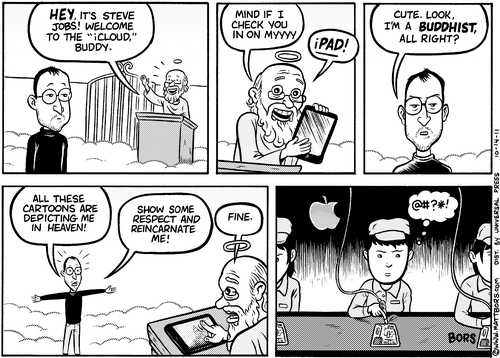
I find Apple to be a creepy and evil corporation.

Yes, for a few years I have had an iPhone.  But, that does not change my opinion that there is something creepy and evil about Apple. Its profits are the main reason why I think that way about Apple.

How profitable is Apple?  You want to know how much cash the company has sitting around?  You ready for this?  Are you seated?  Are you holding on to something so that you won't easily keel over?  Ok, here it is:
 As of last month, Apple had $203 billion in cash reserves.
Yes, it is two hundred and three billion dollars.  Of cash reserves.  BTW, a billion is a thousand million, right?  Which means the cash reserves are 203,000 million dollars.  Here, let me put it this way; it is $203,000,000,000.  And you thought zero has no value! ;)

Of course, this is not the first time (like here) that I am beating up on the company that liberals love; the same liberals who otherwise hate corporations!

It gets even more interesting:
keep in mind that $181 billion of that total (roughly 89%) is held outside the U.S.
Yep, Apple has enough lawyers and accountants who know every hole in the taxation Swiss cheese to keep the money far, far away from taxpayers in the country in which the corporation is headquartered.  If there aren't enough holes, then the corporation's hired hands create them, of course.

You still think Apple is a saintly entity?  Well then, how about this comment:
But one thing Apple absolutely shouldn't do is bring that cash back to the United States -- at least not yet. Because in doing so, Apple would incur a massive repatriation tax bill at a rate of 35%, or more than $63 billion.
Thankfully for Apple shareholders, management has promised that this isn't an option as long as America's repatriation tax remains at such a high rate.
I know, some of you readers are so pro-corporations and are finance wizards that you will want to interject here that America's tax policies are why Apple plays these offshore shell games.  Tell you what. it all depends on your definitions, like what Bill Clinton famously said!  Using my definition, Apple is one heck of an evil corporation.


Source