Showing posts with label france. Show all posts

Wednesday, June 17, 2020

The mask unveiled

In April 2010, which makes it more than ten years ago, I blogged about the French government fining a 31-year old French woman for wearing a niqab while driving.

Yep, that was her crime.

That seemed like a different era. I call that BC--Before Coronavirus.  Now, France requires everybody to wear masks in the public.  So, if masks are mandatory, then a niqab should work, right?  Keep in mind that there is a huge difference between a niqab and a burqa:

Source
A niqab and a face mask reveal the eyes comparably, right?  Here's a photo of the French president with a mask on:

Source

You put a baseball cap, er, beret, on Macron and the niqab equivalent will be complete.

But then in the age of the coronavirus, France reveals what the niqab ban is really about:
That one type of face covering is seen as withdrawing from society and another has become a sign of civic duty reflects the contradictory ways France defines community and solidarity, political analysts and historians say.
“It’s not a hypocrisy, it’s a schizophrenia at the end,” said Olivier Roy, a French scholar of secularism and Islam. “Which is to say that it’s about the problem of Islam. If you cover your face for Islam, it’s not the republic. If you cover your face for a reason not to do with Islam, it’s acceptable.”
So, if a woman ventures out wearing a niqab but not a face mask, "the result is a Catch-22. Those who do not wear a mask can be fined, as can those who violate the face-covering law."

Amnesty International notes that "the current recommendations on wearing face masks also lay bare the absurdity of the arguments that some European governments have used to prohibit the wearing of face coverings in the public space."  

When has politics not been a theatre of the absurd!

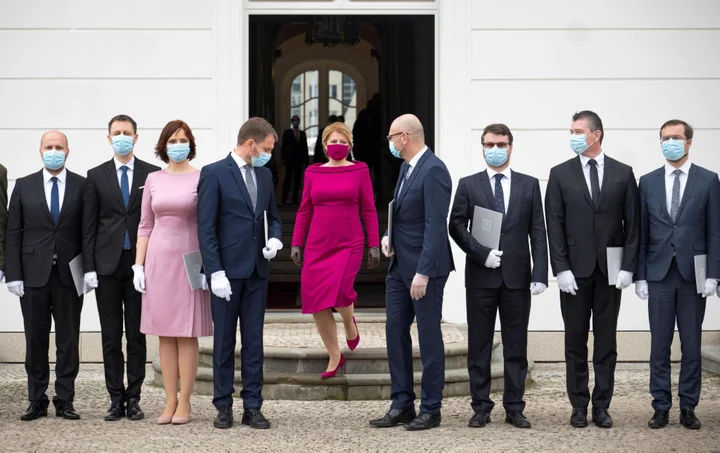
One politician has made a fashion statement out of masks.

Source
That person making a fashion statement is the president of Slovakia, Zuzana Čaputová.

Caputova was here in Eugene not too long ago.  When I met with her and chatted, I never imagined her as the president of her country!  Life --the coronavirus included--is beyond my imagination.

Saturday, January 19, 2019

The revolution in the "shithole"

This is the first long weekend of a new year; Monday is Martin Luther King Day.  Therefore, I will continue to focus on the slavery history of the United States in Jill Lepore's book.

I have written--many times--even in this blog, that I have no idea how African-Americans live without always being angry at the white folk who proudly claim their slave-owning history.  Or, when they openly talk about white supremacy.

Lepore gives me plenty to get angry about--despite that I am not an African-American, and was raised with Brahmin privilege in the old country.  I have no firsthand experience of being the underclass ever, and I am pissed off!

Consider this, for instance: The American Revolution of 1776 echoed across the waters with the French Revolution in 1789.  Liberty, Equality, Fraternity. Right?

It was the same France that had colonized Haiti, which was then known as Saint-Domnigue. It was "the largest colony in the Caribbean, and the richest."  Whites on the island were outnumbered by slaves, whose population was eleven times the population of whites.

A "democratic" revolution in the nearby United States, and another in the colonial power.  So, of course, Haiti's brown people rose up in 1791.

The leaders of the American revolution did not support the revolution in Haiti.  Instead, they attacked it.  Not just with words: "Between 1791 and 1793, the United States sold arms and ammunition and gave hundreds of thousands of dollars in aid to French planters on the island."  Yep, the young republic set a precedent way back then by sending money and materials to a war, not to help the downtrodden but to support the white and the wealthy!

American newspapers did not cheer the Haitian Revolution, but instead reported it "as a kind of madness, a killing frenzy."

America reinforced itself not as a land of liberty, but as a land of slavery.  How awful!

When George Washington called it quits and headed back home, some of their slaves fled.  Washington "sent a slave catcher" after one of them, who offered to return only if she would be granted freedom.  "Washington refused, on the ground that it would set a "dangerous precedent.""  When Washington died, blacks outnumbered whites in that room, Lepore writes.

Nearly 230 years after that revolution, the sitting President of the United States casually and callously referred to Haiti as a "shithole".

"For Brutus is an honourable man; So are they all, all honourable men."

Monday, July 16, 2018

Fun game, colonization!

These days, I wonder if what the white nationalistic folks are really afraid of is this: The "superiority" of the past three hundred years is rapidly ending because the browns no longer kowtow to the melanin-challenged.  And their globally aware white nationalist leaders are fully in the know that the vast brown world, with the exception of a few Anglophiles and Francophiles, truly knows and understands how Europeans royally screwed them up through their colonization.  The worry now is that "they" are coming to get "us."

The white colonizers did one hell of a job messing up the lives of brown people all over the world.  All over.  Not merely colonizing and taking over the lands.  That is the least of it.  They successfully upended every aspect of the human condition. Language, traditions, foods, and--the biggest one of all--Christianity.

In the process, they committed horrors after horrors.  Belgians, who are famous now for their chocolates despite the fact that cocoa cannot be cultivated in Belgium, killed humans by the thousands millions:
Under the reign of terror instituted by King Leopold II of Belgium (who ran the Congo Free State as his personal fief from 1885 to 1908), the population of the Congo was reduced by half -- as many as 8 million Africans (perhaps even 10 million, in Hochschild's opinion) lost their lives.
Some were beaten or whipped to death for failing to meet the rigid production quotas for ivory and rubber harvests, imposed by Leopold's agents. Some were worked to death, forced to labor in slavelike conditions as porters, rubber gatherers or miners for little or no pay. Some died of the diseases introduced to (and spread throughout) the Congo by Europeans. And still others died from the increasingly frequent famines that swept the Congo basin as Leopold's army rampaged through the countryside, appropriating food and crops for its own use while destroying villages and fields. 
As I often blogged, the bastard Raj even systematically and intentionally killed millions in the Subcontinent.  And through the decades, the fucking Raj de-industrialized the Subcontinent and reduced it to a land of beggars. Now, it is an island that has lost any relevance in the world, and if it were not for the browns there, well, the sun would have set forever on the "empire."

As Mohammed Mossadegh, prime minister of Iran in the early 1950s, said about Britain: "You do not know how crafty they are. You do not know how evil they are. You do not know how they sully everything they touch."  Of course, by expressing such truth, he invited trouble, which came in the form of  British-American supported coup that killed him and installed the Shah of Iran.  The British evil schemes continued even after colonialism had ended!

One could write for ever and ever about all the atrocities that Europeans committed in the non-white, non-Christian lands.  Some of that has been explored in this NYRB essay.  Compared to how many were killed by colonizers, and compared with for how long the colonized were in servitude, the Islamic terrorists of today are barely gnats.
A comment by a young Muslim man who had studied at an American university sets the tone for the impressively far-ranging Crusade and Jihad. “The bottom line,” he tells William Polk,
is that no Muslim ever tried to enslave or slaughter your people. You might think of the attack on the World Trade Center, 9/11, as a counterattack. It was terrible and most of us are ashamed of it, but just remember—it killed about 25 hundred people whereas imperialists killed at least 25 million of our relatives and tried to destroy our way of life and our religion. Do you care about that?  
Or, a more contemporary one, if you think those are irrelevant old stories:
under the sanctions that followed the invasion of Kuwait half a million Iraqi children are said to have died—“more than the number killed in the bombing of Hiroshima.” When asked about that figure, Secretary of State Madeleine Albright said, “I think this is a very hard choice, but the price—we think the price is worth it.” Polk comments:
Had such a remark been made about the deaths of children in Europe or America, it would have drawn universal condemnation; made about Iraqi children, it drew almost no attention in the American media. Nor would similar comments or similar actions against Afghan children draw condemnation. But such comments and such actions were widely reported and commented on throughout the Muslim world.
It is little wonder, then, that the deaths of Iraqi children featured prominently in the propaganda of Islamist ideologues such as al-Qaeda’s Abu Musab al-Suri and in Osama bin Laden’s recruitment videos, which showed Iraqi babies wasting away from malnutrition and lack of medicine.
All in a "mote of dust suspended in a sunbeam."  For what?


Sunday, July 05, 2015

Finally, we catch up with France! In technology?

Four summers ago, I was in the south of France for a week, thanks to the daughter bugging me to go with them.  "I am sure you will have a good time" she said.

I did.

Every morning, after having an espresso and a chocolate croissant, I was off for a walk in the quiet and scenic landscape of the Dordogne Valley just as the sun was barely beginning to light up that part of the world.

Morning at Carennac
I think it was a Sunday, which is why there was nobody at the gas station when we drove up to fill gas.  But, people were filling at the self-serve pumps.  We got to one.  There was no place to swipe the credit card.  The pump accepted only credit cards with embedded chips--the technology that American credit card issuers had resisted for the longest time because, well, they could.

We didn't have one of those cards.  It seemed like we were stuck.

A guy, about in his late twenties, was filling up at the adjacent pump.

"I am going to ask him whether he can pay for us on his card and I will pay him the cash" J whispered as she walked towards him.

I thought about the French stereotypes.  Won't speak in English even when they know the language. Will not want to help an American who can't speak French.  Will look down upon us.

"Oui, oui" I heard him say.  And then in English too, for a good measure, "no problems."

Stereotypes are horrendous caricatures.

After all those years, a couple of months ago, I got in the mail credit cards with chips in them.  Finally!  But, it has a magnetic stripe as well. So, I have been swiping the card everywhere as before.

A few days back, I was in the grocery store when I noticed that the machine had an option for the chip technology too.  Like a kid excited about the new toy, I eagerly placed it in that designated slot.  I wondered how the new technology will respond at the register.

"It doesn't work" the clerk said.

She smiled, and added, "I bet the day Whole Foods comes to town, they will update all these machines in a hurry.  Because Whole Foods will have it and we will have to keep up with the competition."

All those hardcore left of center people conveniently forget how the conveniences of the lives that we lead pretty much resulted from competition in the marketplace.  Everybody seems to be trying the hardest to build that metaphorical better mousetrap so that they can get rich--and, in the process, the rest of us have better television, smartphones, planes, cars, ... Without that competition to build a better mousetrap, well, the local grocery store has no incentive to upgrade their point-of-sale machines, right?

Of course, we could always argue whether we really need better television, smartphones, planes, cars, etc., when, for instance, there are hundreds of millions who are trapped in acute poverty, or when millions suffer from illnesses like malaria, or when India's millions have no place to shit but in the open. But, all those are different discussions from this one which is about competition delivering miracles in the form of various conveniences and gadgets, don't you think?

As far as I am concerned, my problem is this: I now have credit cards that will work in France, but don't have money to get there! It is tempting to charge the card and enjoy, if it were not for the unfortunate reality that people are not competing to pay my bills ;)


Thursday, March 27, 2014

People are hypocrites! Most of us.

I knew it was time for a second breakfast.  Yes, dear reader, I eat way too much!

I exited, and drove through the picturesque central part of the small town that was.  Nothing along the four blocks appealed to me.

I turned around to check the place one more time.  I suppose it is the gut instinct that comes with the experience of travelling.  Something told me that there was a place right along that street where the food was going to be tasty, and I was not ready to give up.

A sign said Bakery La Petite France.  That's it, I decided.

I parked, and walked in.  A young man, perhaps ready to crossover from the late teens to the twenty, greeted me with a French accent.  I scanned the menu and noticed that the choice of side dish for eggs included ratatouille.  Ever since I watched the movie, Ratatouille, I have not let go of any chance to order that dish if ever it is on a menu.

"How do you scramble the eggs?  Do you add anything?" I asked.  I hate eggs by themselves--they smell too eggy!  Which is why the eggs I make are always with vegetables and cheese.

"We make like an omelette and then piece up" the young man earnestly replied.

I struggled, successfully, to contain my laughter.  "I wonder if you add anything like onions or ..."

He shook his head to mean no.

I figured I would combine the ratatouille with the scrambled eggs.  And placed my order. With coffee, of course.

As I waited for the food while sitting outside by the street, I noticed that if I held my head a certain way, then the lights above looked like a halo around my head.  A selfie was born.


We men, or at least some of us, can be so easily amused.

I was about halfway through the tasty breakfast, and the tasty ratatouille in which the vegetables tasted delightfully fresh, when the chef walked up to me.

In an accent that makes women fall in love with the French instead of us with men with Indian accents, he asked me about the ratatouille after a bonjour.

"Bonjour" I said. "I love it."

"You seen the movie?"

"Of course."

"That mouse is in my pocket" he said with a laugh and pretended to yank the mouse out.

"Perhaps he is still back in the kitchen" I added with a big laugh.

We men folk, from India or from France, are born to make such jokes, which we think are hilarious.  I bet if he had tried that with a woman, she would have merely smiled a polite smile, thinking within that men are stupid!

We men can be so easily amused.

"Where are you from?"

"A long time ago from India. But been here for 27 years" I replied.  "How about you?"

"From Nice. In the south of France.  You been there?"

"Not there. But, a couple of years ago I was in the Dordogne ..."

"It is pretty. The river ..." he said while his hands acted out the meandering river.  He walked back into the kitchen.

I cleaned up my plate, and drank every drop of the coffee.  Life was, yet again, good.

The chef reappeared. "I want you to taste this" he said. "Freshly made tomato soup."


"Tell me the truth.  I can take it" he said pointing to his heart.  "You give people food, they say it is good. Even when they don't like. Damn hypocrites."

He could have cursed the worst curses ever, but his accent and pleasant demeanor will only make them sound like the best compliments ever. I, on the other hand, with my inability to smile, make even the best compliments come across like the worst insults.  I hate these people who can smile away at ease! ;)

As a small, small, small time cook, I could relate to his emotions. When I make anything that I share with others, I always look for honest feedback. Even if the feedback is that I have over-salted.

I took a sip.  It did taste fresh. And it tasted wonderful. I told him that. He walked back in with a smile.

I finished that soup. Sat for a while longer.

As I got up to leave, I looked into the eatery. Deep inside was the kitchen service window and I saw him looking towards the street.  I waved him a big time bye.  As if he was waiting for my action, he leaned out through the window as much as he could and waved back.

I walked towards the car thinking that I, too, hate hypocrites--not merely in food.

Saturday, January 11, 2014

The Roma get harassed in France. Again.

Something new every day.

Today's installment?  I had no idea that Inspector Javert--you remember him from Les Misérables, right??--"seems to have been born Roma."  Did you know that before?
The son of a fortune-teller, he spent his life "with an inexpressible hatred for that bohemian race, of which he was one."
No, I am not reading Les Misérables. That note on Javert's background was how this essay in the New Yorker ends. (Sub. reqd.)

No, the essay is not about the Victor Hugo classic.  It is about the Roma in contemporary France--a topic that I have blogged about before (here, and here.)

Of course, it is always a reflex response to think of my old high school friend, Srikumar, whenever I come across anything about the Roma.  For two decades now his work has been about improving the conditions for the Roma and for developing an understanding between the Roma and the rest, primarily in the Czech Republic where he lives.  Perhaps it should not surprise any that we people from India are drawn to the Roma; the New Yorker also notes the geographic origins:
The Roma do seem to have emigrated, as they have always claimed, in a distinct wave, perhaps a thousand years ago, from Northern India. 
Yep, the wandering Indians we are.

I wondered whether the essay would make any reference to Srikumar.  But, the story is tightly focused on France and, hence, no place for him, I suppose.

The essay is about the same old issues that have dogged the Roma forever.  They are viewed as thieves and pickpockets and abusers of the social welfare system.  From the manner in which one views the Roma "problem" one might think that they are immigrating in huge numbers from Romania.  Nope!  Leave it to an ailing French philosopher to put matters in perspective that it is a "racist and xenophobic obsession":
it is absurd for twenty thousand misérables to exasperate sixty-five million French.
If this obsession "is not about fear of the other," what might be the reason for this obsession with the 20,000?
It is the fear of the self--of what we might become.
And what are the French worried that they might become?  Misérables!
For the first time in thirty years, the standard of living in France is declining.
Victor Hugo's Misérables  meet Bill Clinton's "it's the economy, stupid!" equals beating up on the Roma, it seems.

The Economist also has a lengthy piece on the effect the economic conditions are having in countries like France, and notes the gains that the populist, nationalist, right parties are experiencing.
For the time being, however, a battered Europe is fertile terrain. There is little sign yet of a sustained drop in joblessness, nor decisive economic recovery.
It will be a while before the Roma's plights go away.

Friday, September 07, 2012

The French have some 'gaul' to expel the Roma!

A little more than an hour into the drive after landing in France, I spotted a marker along the road that said something about one of the important battles with the Romans having been fought there.

Romans fighting in a corner of France and not being able to win it over?  Could this be Asterix's and Obelix's territory, I wondered.  But, wasn't I in a different part of the country and not in in the Gaulish Village?  I didn't want to request "S" to backtrack so that I could take a photo of that road-sign. 

We reached home, and settled down to catch our breath.  In the morning, I wandered into the kitchen, while the rest of the household was asleep, and made myself an espresso to go with the delicious chocolate croissants that were calling me.

Which is when I spotted two figurines: Asterix and Obelix.  So, I hadn't misunderstood the sign by the road. Yay!  

 In the old, old days before India liberalized its economy, anything "foreign" was very rare among us kids, and Asterix comic books was a special rarity.  If ever any classmate managed to get a copy that seemed to materialize out of nowhere, every once in a while, then it quickly passed from one hand to another.  We read it even in class, during the breaks, and after school.  Sometimes we read the same comic book a second or third time.  


High school ended, and thirty years later I was in that fabled comic book geography?  Yay!

The familiarity with the comic book characters meant that the first thought I had when I spotted this editorial cartoon was, hey, they have drawn Obelix while calling it Asterix!


My second, and a more substantive, reaction was about the gypsies--the Roma.  One of the classmates with whom I have read and discussed the Asterix comics was Srikumar, who now works with/for the Roma people in the Czech Republic.  

I have noted earlier, too, France's casual treatment of the Roma.  Was there something in the news for this editorial cartoon to have popped up?  Yep:
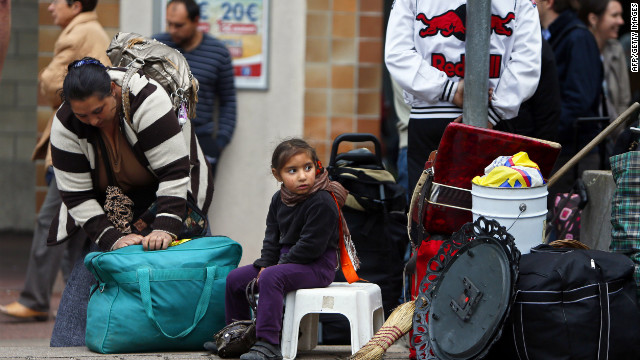
French Interior Minister Manuel Valls ordered police early Monday to dismantle a Roma camp set up along suburban railway tracks in Evry, south of Paris, and expel 72 inhabitants, including 19 children.
It is a controversial decision for President Francois Hollande's Socialist Party, which attacked former President Nicolas Sarkozy when his party dismantled Roma camps around France in 2010. Since the beginning of August, five camps have been dismantled under Valls' directive.
 An interesting coincidence it is that the CNN story carries a byline of Dheepthi Namasivayam, which reflects a Tamil heritage.

The Wall Street Journal adds:
Mr. Hollande's government has gone to great lengths to distinguish itself on social policy from Mr. Sarkozy, who served as interior minister before becoming president in 2007 and made law-and-order crackdowns a signature of his governing style. But breaking up Roma camps and offering financial incentives for repatriation appears to be a continuation of the initiatives of Mr. Sarkozy, whose mass expulsion of foreign Gypsies sparked an outcry in France and a row with the European Commission, the European Union's executive arm.
At the time, European Commissioner for Justice Viviane Reding called Mr. Sarkozy's policies and a government circular singling out Roma a disgrace and initiated legal proceedings against the country. Ms. Reding has weighed in on the latest evictions, though she has welcomed France's cooperation and the government's pledge not to target any particular group.
"The Commission will follow the developments in France very closely," she wrote in an op-ed published in Thursday's Libération. "There are 12 million Roma in Europe, who, like us, are at home in Europe. It is our responsibility to help them integrate."
To rework Obelix's favorite phrase "Ils sont fous ces romains," I suppose the French are simply insane!  Oh well, if only we could all get along ...

Monday, July 09, 2012

Why am I such a skirt-chaser?

The older I get, I seem to miss, even more than before, cultural practices that have practically become discontinued.  When I am in India, I miss seeing half-saris.  To quite an extent, I agree with Shashi Tharoor for his comments on women in India increasingly shunning the traditional sari in favor of other attires:
I have begun to notice fewer and fewer saris in our public places, and practically none in the workplace. The salwar kameez, the trouser and even the Western dress-suit have begun to supplant it everywhere.
Of course, it is crazy for me or Tharoor to wax nostalgia like this when we are so far removed from the traditional Indian outfits for men.  It is bizarre, as I noted in my Ecuador experiences, that we men quickly adopt clothes that are not traditional, while simultaneously missing a great deal of the tradition when women, too, quit wearing traditional clothes.  

Here in the US, as summer heat has picked up even in the Pacific Northwest, I miss the sight of women wearing summery skirts.  Young women and girls prefer to walk around in shorts, while the older ones seem to vote for full-length trousers and jeans, or capris.  Of course, capris always remind me of this wonderfully talented beauty!

I wonder why American females have abandoned skirts!

Earlier today, in the local mall, I saw a young woman in a summery pastel full-length dress skirt, arm in arm with, I suppose, her boyfriend, and they made a lovely couple.  

Women in skirts weren't rare in France or Italy or Germany.  I was in those countries in the summer months, and there were skirt-clad women of all ages.  Come to think of it, I would venture that more American girls walk around in shorty-shorts than did girls of comparable ages in those countries, when we would expect less display of naked legs in the supposedly puritanical society that the US is.

The travel guru, Rick Steves, suggests to women travelers:
Some women bring one or two skirts because they're as cool and breathable as shorts, but dressier. And skirts make life easier than pants when you're faced with a squat toilet! A lightweight skirt made with a blended fabric will pack compactly. Make sure it has a comfy waistband or drawstring. Tilley (listed above) makes expensive but great skirts (and other items) from blended fabric that feels like cotton. Skirts go with everything, and can easily be dressed up or down.
I wonder if the functionality of easily dressing up is why European women prefer skirts?  After all, my own experience is that most of us Americans--men and women--don't care enough to dress up, whether we are in the US or outside the country!

Too bad I am not a cross-dresser to keep alive the tradition of wearing skirts :)

Tuesday, April 24, 2012

Sarkozy in trouble because he didn't eat a sandwich alone?

Slate has a discussion on the typical American and French lunch breaks, which, for all purposes, is nothing but about the eating alone trait.  Interestingly enough, the Onion, too, has something to say about this, though about Obama eating alone :)


Obama's Approval Rating Down After Photos Surface Of Him Eating Big Sandwich All Alone

Thursday, January 27, 2011

In suddenly mighty India, America is fading

Posted to Web: Wednesday, Jan 26, 2011 05:37PM
Appeared in print: Thursday, Jan 27, 2011, page A9
 
The last couple of months have erased any doubt about how open India is for business with the rest of the world. One after another, the leaders of all five permanent members of the United Nations Security Council came calling on India’s political and business establishments.

British Prime Minister David Cameron was the first to visit. Then came President Obama, whose visit was right after the “shellacking” he and the Democratic Party suffered at the midterm elections. The Americans had barely left the country when French President Nicolas Sarkozy arrived with a huge delegation that included seven of his ministers and more than 60 business leaders. Finally, December ended with state visits by China’s Wen Jiabao and Russian President Dmitry Medvedev.

The visits were intended to strengthen economic ties, in contrast to the Cold War geopolitical calculations that shaped leading nations’ policies toward India in past decades. Prime Minister Wen made this clear when he publicly expressed his displeasure at the Indian media that constantly questioned him about the political differences between the two countries, when he was focused on the rapidly growing trade relationship.

By the way, China runs a trade surplus with India, as it does with America.

The impression is that the French were the big winners. The total of the Indo-French civilian and military deals is estimated to be more than double the value of agreements that America negotiated with India.

Russia and China have another mutual economic relationship with India, and also with Brazil. These countries are collectively referred to as BRIC, and their third summit meeting will be in China this year.

This could soon take on a plural form, BRICS, with the inclusion of South Africa, which has been invited as an observer. As one reporter phrased it, BRIC is “emerging as a symbol of gradual transfer of economic power from the West to emerging economies.”

While visiting India from America, I felt the urgency to stand up and paraphrase Mark Twain’s comment that reports of his death were greatly exaggerated. But there is no point in bemoaning the premature declarations of America’s and the West’s demise because of the enormous sense of economic confidence that is prevalent in India.

The rhetorical “yes, we can” that has become a faded memory in America is fully alive and well in a vibrant India. An analysis in the publication Business India noted that unlike the past when “Indians as a community were low on the confidence quotient,” now things are different — “the overall growth in this decade has increased the confidence of all Indians.”

Such attitudes are reflected even at casual conversations when I am the American representative. By chance I met a retired physician, who wasted no time to ask me “how come America is in so much trouble while India is flourishing.” Her husband, who is now retired after a career as an executive with an Indian multinational company, commented that perhaps only university teaching and the medical professions were safe in America. Even two years ago, I would certainly not have faced those kinds of questions and comments during a visit to India.

Economic collaborations are happening in unexpected areas. The headline of a newspaper item was one such shocker: “China gives green light to first ‘Made in China’ Bollywood film.” China’s official film production company is backing a $10 million movie that will be set in India and China, and will star a few of India’s leading actors.

While not intended as a statement on the current economic climate, the title of this Chinese-Indian Bollywood movie is absolutely appropriate — “Gold Struck.” With a combined population of nearly 2.5 billion, “Chindia” has a large and growing movie market. If “Gold Struck” succeeds and is followed by more, one can imagine the implications for one of America’s famous and valuable brands ever — Hollywood.

It is depressing that we in the United States. seem oblivious to such rapidly transforming economic realities in other parts of the world. Even more worrisome is the appearance that we are fixated on trivialities from “Jersey Shore” to the president’s birth certificate. I suppose I have a tougher job ahead in my classes when I discuss global issues with students!

Friday, August 20, 2010

In trouble in France ... after all the way from India

France, which loves to advice the rest of the world on anything and everything is deporting quite a few Roma:

"That's France for you," said one middle-aged woman, sitting dejectedly in pink flip-flops at the rue de Lyon squat. She, like all other Roma to whom the Guardian spoke, was unwilling to be identified. Intense media interest since the start of Nicolas Sarkozy's crackdown on crime and illegal immigration last month has made them uneasy in front of the cameras.
So, what happened?
In July, dozens of French Roma armed with hatchets and iron bars attacked a police station, hacked down trees and burned cars in the small Loire Valley town of Saint Aignan.
The riot erupted after a gendarme shot and killed a French Roma, 22-year-old Luigi Duquenet, who officials said had driven through a police checkpoint, knocking over a policeman. Media reports suggested he had been involved in a burglary earlier that day.
Duquenet's family dispute the police version of events, saying he was scared of being stopped because he did not have a valid driver's licence.
French President Nicolas Sarkozy called an emergency ministerial meeting, at which it was decided that some 300 illegal camps and squats would be dismantled within the coming three months.

Sakozy, who showed how brutally dogmatic he can be when it comes to dealing with minorities--remember how he dealt with the Algerian youth?--jumps into this harsh decision of deportation.  Romania, not that it has treated the Roma well within its own borders, cries xenophobia:
"We understand the position of the French government. At the same time, we support unconditionally the right of every Romanian citizen to travel without restrictions within the E.U.," Romanian President Traian Basescu said.
The rest of Europe is watching this closely:
The Council of Europe has expressed grave concerns at France's controversial deportation of Roma migrants.
“Recent developments in several European countries, most recently evictions of Roma camps in France and expulsions of Roma from France and Germany, are certainly not the right measures to improve the situation of this vulnerable minority. On the contrary, they are likely to lead to an increase in racist and xenophobic feelings in Europe,” Mevlüt Çavuşoğlu, President of the Parliamentary Assembly of the Council of Europe (PACE), declared on Friday.
Finally, why do the Roma wander anyway, right?
The Roma originated in India but left the subcontinent in the 11th century, perhaps following Muslim invasions. From there, they crossed into the Byzantine Empire, and then up to southeastern Europe by about 1300. Generally speaking, xenophobia made it difficult for them to stop in any one place for very long, let alone establish permanent settlements. (Since it's thought that the Roma adhered to strict purity codes, they may also have been reluctant to mix with outsiders, making assimilation unwanted on both sides.) When the Roma arrived in Western Europe in the 15th century, local populations worried they were part of an Ottoman invasion (because of their dark skin color) and the German Reichstag of Freiberg declared them outlaws. Barred from purchasing land or joining guilds, the Roma had no choice but to move about.
Another take on the Indian connection here.

But, the Roma have experienced worse things than Sarkozy.  Which is why I cheer when I read this:
many of the Romany families deported by France for outstaying their welcome were planning to head straight back.
“Of course we are thinking about going back,” 26-year-old Ionut Balasz told journalists as he arrived at the airport. “Life is better there than in Romania, even when you are illegal.”
Good luck to the Roma!

Tuesday, June 22, 2010

The nation's--world's--worst job ...

A couple of days ago, Fred Thompson (erstwhile senator and Republican presidential contender, and actor!) was on the Daily Show.  One of the questions Jon Stewart asked him was whether Thompson is relieved that he is not in the White House having to deal with all the issues.
Of course, The Onion beat everybody to the post when it declared soon after Obama won:
Black man given nation's worst job
It has gotten only worse for the president; the latest?
Yes, it is now Day 64 since the BP rig exploded, and continues to gush out oil at rates that only seem to increase every day--now at, or having exceeded, 100,000 barrels a day!
General McChrystal decides it is time to be a MacArthur, and is now looking at being removed from the job, which means a new chief for the country's longest war ever
Israel has gone complete bonkers with Gaza and occupied territories, and now even Ehud Barak is worried
The Euro is quite close to imploding, and the French-German relations are showing the stress
Unemployment continues to be high, and is a mere fractional points away from the psychological two-digit rate
WTF, eh!
And then internal issues:

The budget director, Orzsag, is leaving; A blogger at the SF Chronicle's notes the sex-issue:
Any dude who can snag ABC newscaster Bianna Golodryga while banging wealthy shipping heiress Claire Milonas, and running the country's budget is a man.
A man, yes, but not a thoughtful man.
One long summer ahead.  And then?  Midterm elections.  Odds seem to be in favor of the Republicans getting back the control of the House?

Sunday, April 25, 2010

Meanwhile, Sarkozy's France goes nuts

The woman in the photograph was fined.  This was in France.  What was the fine for?
Driving under the influence of drugs?
Prostitution?
Nah .... even worse, according to Sarkozy's government: for the veil!!!
Anne, an assumed name, a 31-year old French woman who has been fined for wearing a niqab while driving, speaks during a news conference in Nantes, western France, April 23, 2010. Anne told French media that police handed her a 22-euro ($29.6) fine, saying her veil posed a "safety risk" to her driving.

Wednesday, February 24, 2010

The "real" Asian Tiger ...

Consider this excerpt:
An economy that in the 1960s had a per capita income on a par with sub-Saharan Africa is now snapping at the heels of Britain and France.
Forty-plus years, and a poor country is now, for all purposes, a rich one.  And that country is ....
South Korea.
Its economy is practically as big as India’s even with a population less than one-twentieth the size. It exports more goods than the UK, a statistic admittedly more surprising to those who are aware that Britain still makes things. Samsung, not long ago considered a poor-man’s Sony, overhauled Hewlett-Packard last year to become the world’s biggest technology company by sales.
I had a whole bunch of classmates from South Korea when I was in grad school.  My dissertation guide, Harry, refers to them as the Korean mafia--no, they are not into illegal activities.  All those guys are doing really well as academics and policy wonks, and remain well networked.  Good for them, I say.  One guy took me to a Korean BBQ restaurant, which was quite an experience.  With another guy I remember going to the Chart House--this one was by Malibu.  One guy went to Vegas one weekend and came back about 3,000 dollars richer!!!  All those guys seemed to have quite some loose change in their pockets, while I was always scrambling for money :)

Tuesday, February 23, 2010

Monday, June 08, 2009

Guantanamo: a (US) state-sponsored madrassa!

I continue to have mixed feelings about Guantanamo, as I wrote earlier.
As always, I am simply impressed with how articulate Christopher Hitchens can be, and this time it is about Guantanamo. I mean, consider this sentence:
To the huge list of reasons to close down Guantanamo, add this: It's a state-sponsored madrassa.
Awesome. How powerful those few words strung together are! Hitchens' point is:
Suppose that you were a secular or unfanatical person caught in the net by mistake; you would still find yourself being compelled to pray five times a day (the guards are not permitted to interrupt), to have a Quran in your cell, and to eat food prepared to halal (or Sharia) standards. I suppose you could ask to abstain, but, in such a case, I wouldn't much fancy your chances. The officers in charge were so pleased by this ability to show off their extreme broad-mindedness in respect of Islam that they looked almost hurt when I asked how they justified the use of taxpayers' money to create an institution dedicated to the fervent practice of the most extreme version of just one religion.
And this is the same mentality that Hitchens says is the problem when it comes to Obama's big speech at Cairo--by "respecting" the traditions and practices of religions (in this case, Islam) what if we are accomplices?
Take the single case in which our president touched upon the best-known fact about the Islamic "world": its tendency to make women second-class citizens. He mentioned this only to say that "Western countries" were discriminating against Muslim women! And how is this discrimination imposed? By limiting the wearing of the head scarf or hijab (a word that Obama pronounced as hajib—imagine the uproar if George Bush had done that). The clear implication was an attack on the French law that prohibits the display of religious garb or symbols in state schools. Indeed, the following day in Paris, Obama made this point even more explicitly. I quote from an excellent commentary by an Algerian-American visiting professor at the University of Michigan Law School, Karima Bennoune, who says:

I have just published research conducted among the many people of Muslim, Arab and North African descent in France who support that country's 2004 law banning religious symbols in public schools which they see as a necessary deployment of the "law of the republic" to counter the "law of the Brothers," an informal rule imposed undemocratically on many women and girls in neighborhoods and at home and by fundamentalists.

(Click here for more of professor Bennoune's work.)

But to the women who are compelled to dress according to the requirements of others, Obama had nothing to say at all, as if the only "right" at stake were the right to obey an instruction that is, in fact—if it matters—not found in the Quran.
I am ok with Hitchens bringing these issues up because he beats up on any and all religions--so, it is not as if he has some agenda to promote one religion while critiquing another. I suppose Hitchens' only fault in this context was how much of a warmonger he was .... if only he had been less hawkish!

ps: in case you are wondering what the heck a madrassa is, well, click here. and here for hijab v. chador

Tuesday, May 12, 2009

So, the Middle East is going nuclear?

First, in order to counter Israel's nuclear bomb, the anti-Israel Arab world was keen on developing an "Islamic bomb". As India too got quite "explosive", Bhutto (Benazir's father) famously commented:"There's a Hindu bomb, a Jewish bomb and a Christian bomb," Bhutto once wrote. "There must be an Islamic bomb."

As Iraq got into that, Israel launched a brilliant attack that destroyed Iraq's key facilities. Much later, Pakistan detonated its nuclear devices to tell the world that it has arrived. A few months ago, something happened in Syria that nobody still talks about. But, speculation is that Israel wiped out some kind of a nuclear ambition that Syria had.

Yesterday (I think it was) as I was driving, I head on NPR that France was selling Saudi Arabia civilian nuclear power generating technology. Because, the Saudis want to prepare themselves for a world without petroleum--when they are sitting on the world's largest reserves that they can tap into for practically no cost at all.
I was not happy with all this talk about selling nuclear tech to the crazy guys in the Middle East. Because these are not democratic countries. We have no idea who the next ruler will be, and what kind of crazy things he will want to pursue.
And then I read this:
We are witnessing the beginning of a Middle East nuclear arms race. Iran's rivals do not want Tehran to gain the military, political, and diplomatic advantage that nuclear weapons convey. They are beginning the decades-long process of developing technologies to match Iran's capabilities. All of this is legal, by the way, under the Nuclear Non-Proliferation Treaty. In fact, nuclear weapon states are obliged to sell non-weapon states nuclear technology for peaceful purposes. It is one of the two grand bargains in the treaty. And it could spell our doom.

Not all Middle East powers may see civilian nuclear programs as a hedge against Iran. But recent history is instructive. The burgeoning interest in nuclear energy perfectly coincided with a set of events in the summer of 2006. At that time Western efforts to rein in Iran's enrichment program began to fail. The United States was becoming further mired in the wars in Iraq and Afghanistan and appeared unable to stop an Iran now freed of its main regional rivals. Iran's leaders expanded their military influence through aid to Hezbollah in the Israeli-Lebanese war. Referring to the changing atmosphere in 2006, Jordan's King Abdullah II observed, "The rules have changed on the nuclear subject throughout the whole region." My translation: "After this summer, everybody's going for nuclear programs." Given the context, the connection to Iran's growing strength and spinning centrifuges is clear.

Now, instead of persuading Jordan and others to refrain from setting off a proliferation cascade in the Middle East, the United States is joining the Chinese, French, and Russian salesmen eagerly peddling the tools to do it.

At its core, this is a deeply flawed method for preventing proliferation. It continues the Bush approach of dealing with problems state by state, dividing them into good guys and bad guys, rewarding friends with nuclear treats and trying to deny them to enemies.

It does not work.
Great! after we are done with the wars in Afghanistan and Iraq, next decade will be all about uncontrolled chain reactions in the Middle East. Thanks. Now I can sleep well! Dr. Strangelove, any pills for me? :-)

Saturday, October 25, 2008

From India to England to Japan: Curry

When I was a graduate student, a professor invited a few students--all of us foreigners--to his home for a meal. He himself was from Wales, and his wife was from Japan. One of the dishes there was a curry. Interesting, I thought, and reasoned it was because of the UK connection. Not so. The professor's wife explained to me that making the curry dish from scratch was a mark of expertise in Japan. In Japan!!!

It was about the same time that I discovered that a Japanese fast food joint in the LA area--I have forgotten that name--had on its menu a beef curry with white rice. I would never have guessed, way back in India, that curry would have such a vaulted status in Japan.

These memories have been stirred by a short piece in the NY Times magazine. It notes that:
katsu curry dates to the Meiji era of the late 19th century, soon after the opening of Japan’s borders. Japanese trade with the West led to a national fascination with foreign flavors and textures — a kind of reverse-twist culinary version of the Japonisme that gripped Europe around the same time. (There was until recently a curry museum located in Yokohama, one of Japan’s most prominent ports.)

I wonder if there was any equivalent import of Japanese food habit into the Indian kitchen?