Showing posts with label savings. Show all posts

Wednesday, June 13, 2018

Party like there's no tomorrow

The Queen of the United Kingdom and the other Commonwealth realms famously asked a bunch of eminent academics at the London School of Economics why nobody noticed the Great Recession before it arrived.

A simple question that all of us regular people have.  Of course, all the economists do was hem and haw and look the other way.  After all, as the joke goes, economists have correctly predicted 7 of the past 4 recessions!

Predicting the next recession is not easy.  It is impossible.  But, hey, I am not an economist; so, it is not like my reputation is on the line or anything ;)  But, I wonder if we are getting closer and closer to the next one.

Four years after the Queen asked that question, she got an answer:
Sujit Kapadia from the Bank's financial services committee gave the Queen three reasons why the crisis happened - one of which was that it was rare event which made it difficult to predict.
He added: "People thought markets were efficient, people thought regulation wasn't necessary. Because the economy was stable there was this growing complacency,"
"Thirdly, people didn't realise just how interconnected the system had become."
The Queen replied: "I suppose, in money terms, it is very difficult to foresee. But people had got a bit lax. Have they?"
The system is even more interconnected compared to a decade ago.  We have in power at the Oval Office, in the Senate, and in the House, maniacs who believe that regulation is unnecessary.  And, we the people have become a tad too complacent. They don't add up well, do they?
Rapid technological advances are propelling the U.S. economy into a new paradigm, unemployment is the lowest in decades, corporate debt is rising, inflation is dormant and the expansion is one of the longest on record, even if growth isn’t that hot.
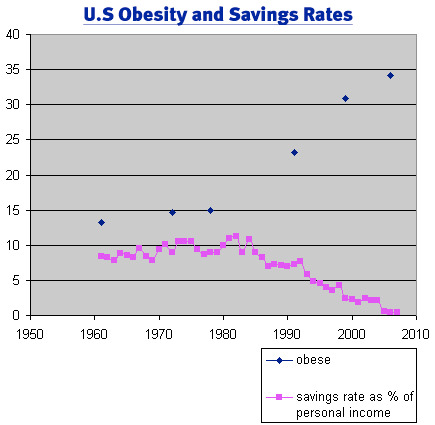
Much of that growth is being driven by consumer spending fueled not by rising income, but by borrowing more and running down savings, which have slumped to historically low levels.
Sound like the U.S. economy today? Yes, it does. It’s also the U.S. economy of July 2000
Yep, American consumers are at it again. Spending the money that we don't have, confident that the boom times will continue forever.

So, for how long can consumers can carry on spending, while saving practically nothing at all?
“The toxic mix of rising interest rates, falling savings, low or falling incomes and high levels of corporate debt is a train crash waiting to happen,” said Ann Pettifor, director at Policy Research in Macroeconomics in London. 
Any other perspectives?
The historically low household savings rate has caught the eye of Bernstein, which is now at least partially reconsidering its positive economic outlook for 2018.
 "A big financial shock — which is a plausible scenario for 2018 — not only would damage the consumption forecast but could end the expansion itself," Philipp Carlsson-Szlezak, an economist at Bernstein, wrote in a client note. "For 2018 it remains a core cyclical recession scenario in our coverage."
Always keep in mind that the day before the stock market crash of 1929, an eminent economist of the day, Irving Fisher, made the worst prediction ever:

Source

Saturday, July 17, 2010

Be responsible and ... go spend money?

So, given the economic conditions over the last two years, should we praise those saving money, or praise those who are fearlessly spending like there is no tomorrow?  (BTW, this might be a good time to read Somerset Maugham's take on the Ant and the Grasshopper ... I can't seem to find a free version online though!)

Roger Lowenstein writes that being an ant is ok, but sometime soon we better become grasshoppers:
Credit and inflation are really two sides of the same coin. When credit expands, people have more money to pay for goods, and prices go up. The Federal Reserve Board has kept short-term interest rates at nearly zero, effectively jamming the credit-creation pedal through the floor. But it hasn’t persuaded people to take out their wallets or their credit cards, stoking fears of a Japan-like deflation. Core inflation (which measures price increases of everything but energy and food) has fallen to its lowest level in 44 years. As people pay back loans rather than take out new ones, they exert a drag on business.
 Keep in mind that this a deflation threat along with high unemployment levels.  Anyway, when would Americans get back to being Americans and spend, spend, and spend, while taking on more debt in the process?
The Conference Board, which asks consumers every month whether they anticipate buying a home, a car or an appliance within the next six months, reported plummeting numbers in June. Consumers used to get their kicks from new Sub-Zero refrigerators; now they chip away at their balances. The turn is yet to come.
So, ok, that is Lowenstein.  Economics being economics, there has to be more than one interpretation, right?  Of course, yes.  Here is the libertarian Reason being sarcastic (so what's new, you ask?)
With inflation hawks questioning his every move and disloyal Fed underlings urging an interest rate hike, Bernanke finds himself unable to do the one thing he's spent his career preparing to do: save the world by throwing money at it.
Like many supergeniuses, Bernanke is in trouble because his plan is too brilliant. It really is possible to create inflation if you have the will. Just print another trillion or two, stop paying banks to keep that money in their vaults, and the country will be flooded with dollars. The problem is that the Fed keeps trying to micromanage the inflation, explode the monetary base without anybody noticing. But at some point you have to commit to devaluation of your currency. The moment to strike is now: Personal savings rates have been increasing for the last three months [all pdfs] measured. There are still millions of jobs to save or create. It's time to send a clear message: We're going to keep printing money until you stop saving it.

So, what do you say, Professor Krugman?
Like others, I’ve been warning that policy makers in the United States are defining normalcy down — accepting high unemployment and below-target inflation as just the way things are. It’s not just an obsession with inflation risks; it’s an abdication of responsibility for the economy, even if prices are falling rather than rising.
The passivity of the Bank of Japan offers an object lesson. The BOJ is now under political pressure? Why? Because it still sees no reason to act after fifteen years of deflation.
Is this a glimpse of the Fed’s future? That’s what I’m afraid of.

Friday, June 26, 2009

The Chinese save because? .... Read this!

I don't think the following explains it all; yet, an interesting point that the NY Times' Floyd Norris brings to our attenion:

In a working paper released by the National Bureau of Economic Research today, two economists, Shang-Jin Wei of Columbia University and Xiaobo Zhang of the International Food Policy Research Institute, note that “By 2005, men outnumbered women at age 25 or below by about 30 million.” In 2007 there were about five boys born for every four girls.

“Families with sons compete with each other to raise their savings rate in response to ever-rising pressure in the marriage market. Competitive saving by these families spills over to greater savings by other families, possibly through raising the prices of nontradable goods such as housing.”

“Across Chinese provinces, there is clear evidence that local savings rates tend to be higher in regions with more unbalanced sex ratios.”

In other words, parents want their sons to marry, and they figure that girls are more likely to want to marry rich boys.

The authors note that while they looked only at China, “other economies known to have a strong sex ratio imbalance include Korea, Taiwan, Hong Kong, Singapore and India. These countries also happen to have high savings rates.”
Maybe in the new academic year, I can bug a few Chinese students about this :-) and, BTW, ever wonder what happens to the money saved? Click here.

Monday, July 14, 2008

The wisdom (ha ha) of Greenspan

I guess the only credit he deserves is for cautioning against "irrational exuberance." That was during the go-go-internet years of the mid-1990s--they already seem like a few hundred years ago! If only he had smarts to think about the horrible ways in which mortgage and investment bankers were inflating assests and egos; on the contrary, he was an ardent supporter of sub-prime mortgages.
Over to Bill Fleckenstein: Alan Greenspan was recommending adjustable-rate mortgages in February 2004 -- just as short-term rates were making their lows. Then, in a speech on April 8, 2005, he extolled subprime lending:
"With these advances in technology, lenders have taken advantage of credit-scoring models and other techniques for efficiently extending credit to a broader spectrum of consumers. . . . As we reflect on the evolution of consumer credit in the United States, we must conclude that innovation and structural change in the financial services industry have been critical in providing expanded access to credit for the vast majority of consumers, including those of limited means. . . . This fact underscores the importance of our roles as policymakers, researchers, bankers and consumer advocates in fostering constructive innovation that is both responsive to market demand and beneficial to consumers."


His term ended, and Ben Bernanke took over. Bernanke was famous for his "savings glut" thesis--"the past decade a combination of diverse forces has created a significant increase in the global supply of saving--a global saving glut--which helps to explain both the increase in the U.S. current account deficit and the relatively low level of long-term real interest rates in the world today."

Even as Bernanke was touted as a potential replacement for Greenspan, this is what Daniel Gross wrote:
The savings-glut meme changes the terms of the conversation about global imbalances. It's not our fault that we rely on foreigners to fund our desire to spend in excess of our resources. Au contraire. Our extreme consumption and failure to save become something of a virtue. Somebody has to keep the world's factories humming and absorb all the products made in Japan, China, and elsewhere. And until the rest of the world becomes More Like Us in its consuming habits, the imbalances are likely to persist.
The savings glut may be an accurate and subtle take on the world's economic imbalances. But less subtly, it minimizes the impact of the potentially destructive monetary and fiscal policies pursued by the U.S. over the last five years. It also lays the responsibility for change squarely on the backs of foreigners and makes a virtue out of what appear to be our own failings. No wonder Bernanke is so popular at the White House.


And, ironically enough, it is Bernanke trying to manage a liquidity and credit crisis. So quickly we burnt up all those savings, eh? Well, as Bernanke, Paulson, and the Congress pour billions more down this sinkhole, let us turn to The Onion for the best report of all:
"What America needs right now is not more talk and long-term strategy, but a concrete way to create more imaginary wealth in the very immediate future," said Thomas Jenkins, CFO of the Boston-area Jenkins Financial Group, a bubble-based investment firm. "We are in a crisis, and that crisis demands an unviable short-term solution."