Showing posts with label Milanovic. Show all posts

Monday, July 22, 2019

Trend lines, headlines, and politics

One of the two brand new courses that I will teach in the coming academic year will be about how much the world has changed--for the better--and yet the news headlines will have us believe otherwise.  (Instead of working on the syllabus, here I am "wasting" away my time!)

Consider one of the many awesome things that we have accomplished--thanks to every government in the world advancing literacy and spending money on education, children from any background can now attend school. (Sadly, there are countries where girls are not educated.)


What a fantastic cause for celebration!.  It is phenomenal an achievement that of all the humans who are 15 years or older, only about 13% is illiterate..  We humans deserve credit for making such a world happen.

However, to look at that kind of progress and to merely engage in self-congratulations is, well, not what I do.  To begin with, that is not my job--I am a critic, by choice and by profession.

But, the change for the better does not mean that we can rest easy; after all, there are a gazillion ways in which we ought to work towards improving the state of the world, for humans and non-humans alike.  In this context, if we were to merely engage in rah-rah about literacy even for the disadvantaged, we begin to overlook the serious troubles there.

Does one imagine, for instance, that a government school in rural Uttar Pradesh is anywhere near the quality of the school that I (and the commenter) went to?  Why are the kids in rural Uttar Pradesh condemned to those godawful schools where teachers might not even come to class, leave alone being horrible teachers in the classroom, while kids in Neyveli get much better education?  Not the kids' fault that they were accidentally born to their parents who live in a certain area, right?

Now, think about how education is merely one out of the gazillion ways in which the accidental birth makes a huge difference in one's life.

Most of us in the political left-of-center always worry ourselves to death that such inequality that arises for no fault ought to be addressed via public policies.  Even while celebrating the fantastic reductions in extreme and absolute poverty, we worry about the uneven competition that exists only because of the accident of birth.

My go-to-expert on these topics, Branko Milanovic, has written in plenty about these issues.  One of his recent empirical analysis showed how "the entire world’s economy is lifted by the open exchange of goods, but this growth is unevenly distributed. The “global upper middle class” — that is, working class individuals in wealthy nations — take it on the chin as less skilled jobs move to poorer nations. Meanwhile, the global middle class and the very wealthy benefit tremendously."

Some of us--yes, I have conveniently inserted myself into an excellent company!--have argued for years that this calls for a new social contract in which we can appropriately compensate the people and communities who lose in this global win.  I yell about this at other places too ;)

"The sensible solution for a wealthy nation is to open its borders to as much trade as possible, but to tax the beneficiaries of free trade to lift up those who lose out."  It is so obvious.  But, apparently obvious only to a few of us who have no political power to make this happen :(


Source


Monday, October 09, 2017

Let's go, people!

I went to graduate school because I thought that I would find answers to the pressing questions of development.  Within a couple of years, I realized that plenty of highly capable thinkers had already thought up everything that I was worried about.  If everything had already been discussed, then what the hell?

I started understanding that addressing the human condition was not really about finding technical solutions.  Instead, it came down to the power of persuasion and, ultimately, politics.  I would no longer be fooled by fancy-shmancy data-driven models.

Which is also when I seriously started thinking about persuading others through easy to understand approaches.  One of the big topics then was free trade, and NAFTA in this part of the world.  I did not oppose free trade, especially after my experiences in the socialist India.  But, my logic told me that freely moving goods and capital alone merely provides advantages to those who are better-off.  I wanted free movement of people also. 

I went to talk about this with one of the professors.  He disagreed with me.  He gave me the same old textbook argument of how the movement of capital will counter and complement the controls on movement of labor.  I was not convinced.  I wrote an essay and sent that to Economic and Political Weekly.  Of course it was not published--I bet that it was one horribly written essay, stylistically and content-wise.

Over the years, I have been more convinced than ever that globalization ought to include freer, if not completely free, movement of labor.  Yes, I know that this exactly what the fascist thug campaigned against and for which he was rewarded with 63 million votes.  But, hey, the fascist can and will bullshit and lie.  But, the truth cannot be simply tweeted away.

One of the best contemporary thinkers on the distributional aspects of globalization, Branko Milanovic, whom I have quoted before, writes this:
income gaps are unlikely to be eliminated. Which, in turn, shows the importance of migration.  If a borderless cosmopolitan world is to be achieved (an objective with which I agree but see enormous political difficulties in reaching it), migration is absolutely essential. But as economic migration faces increasing obstacles in rich countries (and, it has to be added, not solely because of xenophobia but for economic reasons as well), the ideal of a world “without injustice of birth” recedes.
Yes, the injustice of birth.  Click here if you need a refresher on that.

Milanovic concludes:
I am very sympathetic to the borderless world but to believe that it can be achieved through trade alone, and without significant migration, is unrealistic. And once we say “migration”, we immediately open the Pandora’s box that the most recent elections in Europe and the United States have shown is a reality, not an imagination. Thus, our new “intellectual revolution” should be rather to address the issue of migration and citizenship than free trade. Free trade alone cannot solve world’s problems.
We need to think about migration and citizenship in new ways.  And we need to be able to think about that while dealing with the fascist thug's tweets and rants channeling his narrow and nativist takes on migration and citizenship.  Eventually, in the long run, truth will prevail.  But then, we need to also keep in mind that wonderful line: In the long run we are all dead.

Tuesday, May 13, 2014

Has income inequality increased or decreased? Yes!

When eminent economists at the world's elitist of elite universities disagree, then it all comes down to a simple question: who you gonna believe?

Income inequality is one heck of a hot topic now and even normally the dismal scientists would have had plenty to say about it.  And then came a French dude, with a name that I didn't really know how to pronounce and was going about butchering his last name as I butcher any word that I come across.  At least, thanks to the New Yorker, I know that even Nobel Laureates had some trouble with this:
The economist Paul Krugman burst into an office at the CUNY Graduate Center one recent evening with a pronunciation question. “Is it Pik-etty?” he asked, so that the name rhymed with “rickety.” “Or is it Pikit-tay? And are we going with Tho-mah, or Thom-as?” Three academics stood nearby, clutching wineglasses. They had assembled as part of a welcoming party, but no one knew how to pronounce the name of the guest of honor, the French economist Thomas Piketty. “How about Dr. P.?” Chase Robinson, the interim president of the Graduate Center, suggested.
So, really, how is it to be pronounced?  Tell us, Dr. P.:
Peek-et-tee,” he said.
That is the only easy thing about the storm that “Peek-et-tee,” has kicked up!

It turns out that there are long lines of reputed economists on either side of the issue.  I have no idea how to make sense of it all.  I am inclined to believe the pro-Piketty crowd, only because my emotions tend to sympathize with that.  After all, there is still that remnant of the commie spirits that flooded my teenage brain.

But, my rational mind wonders why there is that other line, also with economists of the highest calibre.  Take Kenneth Rogoff, for instance. A Harvard economics professor and a former chief economist with the IMF.  Enough cred for you?  Rogoff writes:
Reading Thomas Piketty’s influential new book Capital in the Twenty-First Century, one might conclude that the world has not been this unequal since the days of robber barons and kings. That is odd, because one might conclude from reading another excellent new book, Angus Deaton’s The Great Escape (which I recently reviewed), that the world is more equal than ever
Which view is right?
I say the answer is via another question: who you gonna believe?

If you believe Rogoff, well:
The answer depends on whether one looks only at countries individually or at the world as a whole
Why does that make any difference?
The same machine that has increased inequality in rich countries has leveled the playing field globally for billions. Looking from afar, and giving, say, an Indian the same weight as an American or a Frenchman, the last 30 years have been among the greatest in human history for improving the lot of the poor
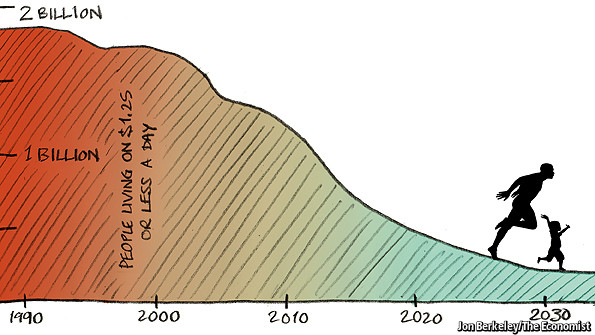
Indeed, over the last thirty years we have seen tremendous improvement in extreme poverty.
In 1990, 43% of the population of developing countries lived in extreme poverty (then defined as subsisting on $1 a day); the absolute number was 1.9 billion people. By 2000 the proportion was down to a third. By 2010 it was 21% (or 1.2 billion; the poverty line was then $1.25, the average of the 15 poorest countries’ own poverty lines in 2005 prices, adjusted for differences in purchasing power). The global poverty rate had been cut in half in 20 years.
The story of India and China now having a significant middle class also happened over the thirty years.  Which is why Rogoff says the answer depends, and concludes with this:
In accepting Piketty’s premise that inequality matters more than growth, one needs to remember that many developing-country citizens rely on rich-country growth to help them escape poverty. The first problem of the twenty-first century remains to help the dire poor in Africa and elsewhere. By all means, the elite 0.1% should pay much more in taxes, but let us not forget that when it comes to reducing global inequality, the capitalist system has had an impressive three decades.
So, who you gonna believe?

I turned to my favorite when it comes to income distribution issues: Branko Milanovic.  He writes:
When we look at the global population rather than at countries, however, there is a positive side. The unprecedented growth of China and, from the early 1990s, of India, as well as much of the rest of Asia has lifted millions out of poverty. For the first time since the industrial revolution, income inequality among world citizens has fallen.
See, again, from a global perspective, things have never been this good.

Milanovic concludes thus:
What is the role of national inequalities? On a purely arithmetic level, if real growth is given, greater inequality slows poverty reduction and probably the expansion of the middle class. But those who believe in trickle-down economics argue that without greater inequality there would not be strong growth. While this might have been true for China in the past 20 years, it is doubtful that further growth in inequality there will be so benign. China’s Gini – a measure of inequality – at about 44 is already greater than America’s. Can it rise further, deepening regional and urban-rural divides, without slowing the expansion of the middle? India’s inequality, long thought to be in the mid-30s Gini range, may if assessed in terms of income rather than consumption already be as high as 50, practically at the Latin American level.It is therefore growth with redistribution (a familiar development formula from the 1970s) that should be our objective in the years to come, if we want both global poverty and global inequality to continue their downward trend. 
So, who you gonna believe?

Friday, April 13, 2012

We are the global elite who could have done things differently

Doesn't the following chart tell one heck of a story:
[The] take of the very rich peaking in the late nineteen-twenties, at close to twenty per cent of total income, then falling sharply for forty years, only to turn back up in the late nineteen-seventies, and peak again in 2007.
Cassidy links to this paper, where the authors provide a similar looking chart for changes in the top income decile:


The question is always the same, right: why bother about income distribution?  Among other reasons, we want to understand how much of the national income goes to the top one and ten percent because of:
their impact on overall growth and resources, their impact on overall inequality, and their global significance.
At the same time, keep in mind that:
In the grand scheme of things, even the poorest 5% of Americans are better off financially than two thirds of the entire world
So, at the end of it all, could we have done things differently since the late 1970s, which is when we notice the sharp uptick in the graphs?
Yes, without thirty years of rising inequality, and with the same overall national income, income of the middle class would have been greater. People with middling incomes have many more priority needs to satisfy before they become preoccupied with the best investment opportunities for their excess money. Thus, the structure of consumption would have been different: probably more money would have been spent on home-cooked meals than on restaurants, on near-home vacations than on exotic destinations, on kids’ clothes than on designer apparel. More equitable development would have removed the need for the politicians to look around in order to find palliatives with which to assuage the anger of the middle-class constituents. In other words, there would have been more equitable and stable development which would have spared the United States, and increasingly the world, an unnecessary crisis.

Thursday, February 03, 2011

Quote of the day: on income inequality

The typical person in the top 5 percent of the Indian population, for example, makes the same as or less than the typical person in the bottom 5 percent of the American population. That’s right: America’s poorest are, on average, richer than India’s richest — extravagant Mumbai mansions notwithstanding.
Boggles my mind, you say?  Yep.  It is from Catherine Rampbell's review of Branko Milanovic's book The Haves and Have Nots: (ht)
And, for those of you wondering is this been adjusted for purchasing power parity, Rampbell notes:
The household income numbers are all converted into  international dollars adjusted for equal purchasing power, since the cost of goods varies from country to country. In other words, the chart adjusts for the cost of living in different countries, so we are looking at consistent living standards worldwide.

Remember the "ovarian lottery" that Warren Buffett talks about?  Well, more evidence supporting that:
As Milanovic notes, an astounding 60 percent of a person’s income is determined merely by where she was born (and an additional 20 percent is dictated by how rich her parents were).
Which is why immigration laws become so important--if the borders were open,
A recent World Bank survey suggested that “countries that have done economically poorly would, if free migration were allowed, remain perhaps without half or more of their populations.”
And that is the very scenario imagined in the crazy dystopian novel The Camp of the Saints