Showing posts sorted by relevance for query thinking. Sort by date Show all posts

Wednesday, September 12, 2012

I come to bury the liberal arts, not to praise it

Getting ready for a new academic year includes thinking about many issues not related to the course content themselves.  With every passing year, the level of difficulty seems to increase for at least one reason, among others: deep down, I am a traditionalist, and most of what higher education, including at the university where I teach, is far from traditional.

Because I use a whole lot of technological tools--way above the average faculty colleague, and way more than the typical student--students and faculty alike might not think of me as a die-hard traditionalist.  But, that is who I am.

In my traditionalist approach to higher education, it is actually not the content per se that I am interested in.  Instead, higher education, especially at the undergraduate level, is, to quote Andrew Delbanco, channeled via this essay by Joseph Epstein:
“show me how to think and how to choose”
Yes, I want students to demonstrate how they think and how they choose, and my hope is that through the readings, my observations, and class discussions, they will learn how to think.  I jokingly mention in most classes that all the courses I teach are the same--that I say the same things in all my classes.  I am not sure how many of them understand when I tell them the course itself is a front, a facade, because students might find it boring to register for courses called "Thinking 101," "Thinking 102," and so on.  We, therefore, package them in different flavors, from "Philosophy 101" to "Physics 101" to "Art History 101."

But, I suspect that I am in a tiny minority who believe that it is all about thinking.  I try as much as possible to stay away from describing it as "critical thinking" because I don't believe that there is any place for any un-critical thinking in a classroom.  When Descartes famously declared "Cogito, ergo sum" note that there is no "critical" used as a qualifier for the "thinking" that defined Descartes' existence.

Thus, I mean it when I tell students that a major itself does not matter, unless they are interested in a vocational education, where content is king.  Not that there is no thinking involved in vocational education; there is.  But, a major in electrical engineering is, after all, about the content of electrical engineering.

With every passing year, I am, therefore, increasingly appalled at how much faculty colleagues and other advisers routinely advise students to pick a major on which they plan to have a career, and to get all the other university requirements out of the way as soon as possible.  Getting everything else out of the way is often about whatever feeble form of the liberal arts that continues to exist in our curriculum.

It has been years since I gave students any kind of in-class, timed, closed-book exams.  Because, they are less about thinking and more about one's ability to recall from memory.  As Epstein writes:
[Quickness] of response —on which 95 percent of education is based—is beside the point, and is required only of politicians, emergency-room physicians, lawyers in courtrooms, and salesmen. Serious intellectual effort requires slow, usually painstaking thought, often with wrong roads taken along the way to the right destination, if one is lucky enough to arrive there. One of the hallmarks of the modern educational system, which is essentially an examination system, is that so much of it is based on quick response solely. Give 6 reasons for the decline of Athens, 8 for the emergence of the Renaissance, 12 for the importance of the French Revolution. You have 20 minutes in which to do so.
I routinely tell students that the worst of all these practices is the exam in which students have to bubble in their responses on scantron sheets.  "I feel like puking when I see a scantron sheet" is typically what I tell them. 

As I get older, the more I find bubbling in to be contrary to the goal of "thinking."  Even if students arrive at the correct answer, I would like them to show me how they thought that through.  When students arrive at an incorrect answer, it is all the more important to me that students show how they messed up so that we might begin to point out the errors in their ways.  It is all about the thinking, yes.

The result is that when students come in to my classes, and during discussions when I follow up on their observations with something like "you say that because ....?" I find that most are simply stumped.  It is not their fault, however, that they have never been questioned about the thinking.  They have only been through classes where they are expected to echo the words from the textbooks or the teachers' notes and lectures.

It is a crime that faculty (and universities) talk the liberal arts talk, but essentially do everything they can to kill the liberal arts because they themselves do not believe in it:
The profession of teaching, like that of clergyman and psychiatrist, calls for a higher sense of vocation and talent than poor humanity often seems capable of attaining. Yet there was a time when a liberal arts education held a much higher position in the world’s regard than it does today. One of the chief reasons for its slippage ... is that so many of its teachers themselves no longer believe in it
Thus, I begin yet another year in which I will witness Caesar being stabbed yet again by his own friends.

Tuesday, August 23, 2016

Meet General Malaise

The days away from the computer, the internet, Twitter, news, and even the New York Times, turned out to be a wonderful digital detox for Major Buzzkill.  However, rest and recreation does not mean that "thinking" is sidelined.

When "thinking" continues, well, Major Buzzkill always shows up for duty in full gear.

I am so much used to "thinking" that the reality that vast numbers do not engage in thinking amazes me.  I vaguely recall GBS (?) noting that thinking is so much absent in society that if one thinks for even five minutes every day then he is considered to be a philosopher.

Perhaps the fact that we humans have to learn to think is understandable.  After all, we are animals--whatever be the fantastic stories of creation that religions might offer, with stories contradicting each other; try reconciling the Vedic commentary on creation with the narrative from the Old Testament, for instance, and you, too, will begin to transition towards atheism! ;)

As animals, we are more used to reflex and doing what others in our species do, than to act after thinking for ourselves.   Imprinting is how we learn to survive:
Imprinting is a crucial stage of development in many young mammals and birds. Among avians, the process is particularly important for species that are precocial, a.k.a mobile and self-feeding soon after hatching, says Sunny Bettley, wildlife rehabilitation and outreach specialist at Sharon Audubon. Through observation, ducklings must learn to forage and swim in order to survive, Bettley explains. They need to know whom to follow, both in terms of imitating behavior and, more literally, to avoid getting lost. For this reason, wildlife rescuers must be careful about how they approach newborn ducks, she says. “Imprinted wildlife can’t be released into the wild as they won’t know how to properly or effectively find food, be aware of natural predators, or communicate with others of their species. They will not being able to reproduce.” 
Thinking requires us to go above and beyond the animal instincts.  In one of the essays that we were assigned in high school, Isaac Asimov reminded me that thinking and reasoning are new for us humans.  Maybe thirty years after reading that essay I am expecting way too much when I want my fellow humans to be thinking beings?

Over light-hearted discussions on some serious issues during the "time off," I did a full disclosure as a preface to my views: "My alter ego's name is Major Buzzkill, who brings to discussions a clear bottom-line of 'you are screwed.'"

Without even pausing, he chimed in a response.  "You have been promoted.  You are now General Malaise."

I imagine going to a meeting of Thinking Anonymous.  When it is my turn, I stand up.  "Hello, my name is General Malaise."  The others flee from the meeting ;)

BTW, given that thinking is my chosen profession, my work, if I think even when vacationing, does it mean that the past few days were a working vacation? ;)

Tuesday, August 13, 2019

Learn. Think. Repeat.

Engaged students in my intro class have often told me that my class almost always overturned many of the ideas that they had.  And they had believed many of those ideas to be established truths.  Some of my favorites include these:
  • Students came into class believing that human population growth would continue forever and lead to huge problems, and in my class they had to think through the fact that women are having fewer children than ever before and, therefore, population growth is slowing down.
  • Students would passionately defend the importance of buying locally, and then through the materials they had to think through the complex global interdependence and how we benefit from trade.
The second one--buying locally--is one that I had to even explicitly explain to, and argue with, a few Berniacs, who, like tRump supporters, parroted the rhetoric of how we in the US do not manufacture stuff anymore and how we, therefore, need to do something.

Both the examples clearly conveyed the link between content knowledge and critical thinking.  One has to know something in order to think through that content.  Critical thinking is not something as a standalone skill.  Critical thinking requires asking a lot of questions, which we cannot intelligently do unless we know about the content to even phrase a question or two.  I often tell students that in this age of access to information right from the small little device that fits into the palm of one's hands, we are only as smart as how smart we are in asking questions.  The ability to ask interesting and meaningful questions is, I believe, more important than before.

Typically, some time in the term, when a context comes up, I quickly slip in my advice to students that they need to seriously think about what they want from their four or five or six years of college.  I suggest to them that a broad introduction to as many ways of understanding the world will serve them well.  And, if they combined that with thinking and communication skills, they will be set for the rest of their lives.  Content plus skills.  Never about the skills alone.  And never about the content alone.

Johann Neem writes along these lines in his essay.
Cognitive science demonstrates that if we want critical thinkers, we need to ensure that they have knowledge. Thinking cannot be separated from knowledge. Instead, critical thinking is learning to use our knowledge.
Neem adds:
We can only think critically about things about which we have knowledge, and we can only make use of facts if we know how to think about them. As James Lang writes in Small Teaching: Everyday Lessons from the Science of Learning, “knowledge is foundational: we won’t have the structures in place to do deep thinking if we haven’t spent time mastering a body of knowledge related to that thinking.”
Indeed!

Neem echoes my thoughts here:
One has to know things to answer things. This is true even in the age of Google. If one looks up something online, one needs to know a lot of background information to make sense of the definition and explanation—and given how unreliable many online sources are, without that background knowledge, one might be led astray. But perhaps most surprising, those with more knowledge can learn more when they look something up on Google. That’s because if they already have background knowledge, they can add to it the new information and insights from what they are learning. This means that someone who understands political science and has some knowledge of how parties function will learn more from an online news story about elections than someone lacking that knowledge. Those who know more learn more than those who do not.
In other words, intellectual skills and knowledge are not two distinct things. They must work together to produce critical thinkers.
A mighty challenge it will be to get these ideas across when we live in an era of a President who prides himself on his gut instinct and with his party on an anti-intellectual crusade.  Think about that, too!


Tuesday, August 13, 2013

Trig plus bridge equals critical thinking

I have to consciously hold back my frustrations when I hear students remark that they hate math, especially trig.  If it were left to my instinct, I would slap the back of their heads for that remark.  But, I know I will lose my job and end up in prison if I were to do that.  Instead, I focus on the content.

"Trig is not merely about Sine and Cosine" I typically tell them.  "It is about developing your logical thinking.  It is about sequential reasoning, building up your argument in order to reach the conclusion.  That is the same skill we need in oral arguments. In writing papers."

But, of course, I don't think even one student has paid attention to that.  I never learn from these interactions; I am confident that the next time a student disses trig, I will say the same things all over again, and the student will roll his/her eyes way up!

Maybe people talk illogically, and have beliefs that are no logical at all, because they didn't take trig seriously.  Maybe the math teachers don't convey enough the idea to students that trig helps build important life skills.

I bet these students will also roll their eyes if I were to tell them that playing bridge will also help develop the thinking skills.

From the moment I landed in this country, I continue to be shocked at the prevailing misconception that bridge is played by single old ladies who are waiting for the Grim Reaper's knocks on their doors.  I have no idea why such an American interpretation exists.

I learnt trig in school, and my parents taught us to play bridge and chess.  Well, it was later in life that I realized that father had twisted the rules of the game a bit and I had to unlearn those bad habits. But, the unlearning was not difficult.

Unlike with poker, where a player needs to have a poker-face in order to bluff well, there is no need to bluff in bridge. In fact, bluffing can lead to losses and that is a sure way to end up with no partner at all!

The bidding in bridge and the execution of the contract require, once again, logical thinking.  If a player bids X, and another bids Y, it will soon become obvious whether or not they add up well.  The game is also a wonderful way to learn to construct a composite story based only on the smallest pieces of data that we can get.

Logical thinking, working with the data while making sure that the data is accurate, and leading to a conclusion is also what critical thinking is about.  There is no leap of faith in critical thinking.  No bluffing.  No arguments that cannot be supported with evidence.

Schools are not ready to adopt bridge:
Bridge is a challenging game even for adults, requiring strategy and the memorization of complex rules. Yet evidence of its academic benefits is still largely anecdotal. A 2005 study by Christopher C. Shaw, a retired business professor and bridge player, found that a group of bridge-playing fifth-grade students in Carlinville, Ill., made larger gains on standardized tests than their classmates, but academic scholars have called these findings limited and preliminary. Mr. Shaw is conducting a similar bridge study with students in Mount Pleasant, Iowa.
“My intuition says bridge is a really good tool to develop critical thinking and inferential reasoning, plus it gives them a lifetime recreational skill,” Dr. Shaw said.
Hey, even the richest bridge nuts--Bill Gates and Warren Buffett--couldn't get enough people and schools excited about this, despite them offering their own money to fund bridge in schools.  Students and teachers do see the benefits:
“It kind of teaches us math, but I like it better than math,” said Jack Schwerner, 10, who ranked bridge ahead of video games, but behind football.
Patricia McIlvenny, the principal, said the lessons in teamwork and cooperation learned around the bridge table were as important as the academic ones. “You can’t text your partner your strategy,” she said.
“You actually have to put down your cellphone and interact around a table. It’s reintroducing a lot of social skills that have been lost.”
No trig. No bridge. What is this world coming to!!!

Wednesday, April 02, 2014

I think I can. I think, I think, I think. Will I win though?

Perhaps the cosmos does pay attention to my grumblings. Sometimes.

"It is a curse, man. Nobody listens to me" I told a student yesterday.

That was yesterday.

As Miss O'Hara said, today was another day.  It was a sunny morning when I started driving to campus, became foggy midway, then overcast at the end.  An hour later, the fog and the clouds gave way to brilliant sunshine.  Like a kid in a classroom, I looked forward to play time in the sun after school ended.  Play time for me meant, of course, a walk by the river.

But, by the time I came home, the sun decided it had had enough with us Oregonians and partially hid behind a lonely but big grey cloud.  I knew I would not have the sun's warmth to keep me company. But, at least the river wasn't hiding behind anything else.  I was off to the races, as they say.

Walking by the river, I am often lost in my own thoughts.
Of ideas.
Of classes.
Of people.
Of the past.
Of plans.
And, most of all, I simply walk.

"Helooooo" said a voice that broke my thoughts of nothing.  It was a woman, perhaps a few years older than me, on a bicycle, and waving at me. Along with her a man about her age on another bike.  They both slowed and stopped.

I had no idea who they were.  Neighbors that I have forgotten?  Nope. Who could they be?

I waved out anyway.

"Are you the one who writes the editorials in the paper?"

Phew!  A relief.  I didn't know them after all. I relaxed.

"Yes."

"We have seen you often on the bikepath and I always told my husband that you are that writer.  I told him recently that if we saw you again, we would stop and say hello to you."

I thanked them.  They said more nice things before they resumed their biking.  I continued with my walking.

Yes, this is the latest of the evidence to negate my complaint that nobody listens to me.  I know there are people who do. Who read what I have written. Sometimes even implement what I suggest.

Yet, why do I have to complain that I suffer from a Cassandra Curse?  Or that I ail from a Rodney Dangerfield-like "I don't get no respect?"

Most of the rest of the walk was about nothing but this analysis of the self.  Before I knew it, I was back home. Five miles of thinking about ... I have no idea, though, on what exactly I thought!

I wish I could locate the switch in the brain and turn off the thinking. I imagine that my forehead will blink a sign "not for hire" after that switch is turned off.  The brain will simply stop thinking.  It will just be.  I wonder what that would be like--to not think.
To walk without thinking.
To cut tomatoes and not think.
To watch a sitcom and not think.
To shit without thinking.
To drive without thinking.

Nah. I think the cosmos will then stop listening to me!
Thinking
By Walter D. Wintle
If you think you are beaten, you are
If you think you dare not, you don't,
If you like to win, but you think you can't
It is almost certain you won't.

If you think you'll lose, you're lost
For out of the world we find,
Success begins with a fellow's will
It's all in the state of mind.

If you think you are outclassed, you are
You've got to think high to rise,
You've got to be sure of yourself before
You can ever win a prize.

Life's battles don't always go
To the stronger or faster man,
But soon or late the man who wins
Is the man WHO THINKS HE CAN!

Saturday, December 03, 2011

My hunch is that I suffer from "the illusion of validity" because "thinking is hard work"

As a kid, I was quite a serious student of math and the sciences, because of which I wanted to understand the world in a systematic manner.  The saffron-robe clothed people offering their judgments on the world was incompatible with what I was looking for. 

Now, in my professional life, when I ask for students' take on the readings, often my follow-up comment/question would be along the lines of "you say that because ..."  I want them to step beyond relying on their instinct--the "System One" in Daniel Kahneman's formulation, which Freeman Dyson reviews in the NYRB:
System One is amazingly fast, allowing us to recognize faces and understand speech in a fraction of a second. It must have evolved from the ancient little brains that allowed our agile mammalian ancestors to survive in a world of big reptilian predators. Survival in the jungle requires a brain that makes quick decisions based on limited information. Intuition is the name we give to judgments based on the quick action of System One. It makes judgments and takes action without waiting for our conscious awareness to catch up with it. The most remarkable fact about System One is that it has immediate access to a vast store of memories that it uses as a basis for judgment. The memories that are most accessible are those associated with strong emotions, with fear and pain and hatred. The resulting judgments are often wrong, but in the world of the jungle it is safer to be wrong and quick than to be right and slow.
It is not merely students, of course, who go with their instincts.  This one I blogged about is a classic example of how even faculty trained to think otherwise fall victims to "the illusion of validity."  Kahneman talked about this:
what you can get are people jumping to conclusions. I call this a "machine for jumping to conclusions".  And the jumping to conclusions is immediate, and very small samples, and furthermore from unreliable information. You can give details and say this information is probably not reliable, and unless it is rejected as a lie, people will draw full inferences from it. What you see is all there is. Now, that will very often create a flaw. It will create overconfidence. The confidence that people have in their beliefs is not a measure of the quality of evidence, it is not a judgment of the quality of the evidence but it is a judgment of the coherence of the story that the mind has managed to construct. Quite often you can construct very good stories out of very little evidence, when there is little evidence, no conflict, and the story is going to end up good. People tend to have great belief, great faith in stories that are based on very little evidence
Many students in my classes ought to be familiar, by now, that a comment that I often have when I review their essays is, "where is the supporting argument/evidence for this?"  I point that out with the hope that they would not start believing in stories that, sometimes, like with some of my division colleagues' lectures, are devoid of evidence. 

If we started thinking along these lines, an obvious question then is why we don't then ditch that System One, and rely on System Two instead?
Why do we not abandon the error-prone System One and let the more reliable System Two rule our lives? Kahneman gives a simple answer to this question: System Two is lazy. To activate System Two requires mental effort. Mental effort is costly in time and also in calories. Precise measurements of blood chemistry show that consumption of glucose increases when System Two is active. Thinking is hard work, and our daily lives are organized so as to economize on thinking.
I so much love that phrase there: "thinking is hard work."  It seems like we do everything possible to avoid thinking.  So much so that even a "thinking" idiot like me comes across to students as a philosopher!  If only students knew the real story that I am a fake :)

Sunday, July 31, 2016

Go to college and ... lose your thinking skills?

I justify playing bridge online with an argument that it helps my thinking skills!  Ahem, one needs to be able to think to even offer such arguments, right?  I have blogged in plenty, like here, on how my teaching is really all about helping students think.

One of the many problems that I had with the undergraduate program in India was that it was quite a bit about preparing for exams in ways that did not have to deal with thinking skills.  It was more about turning out technicians, it seemed like, than about graduating thinking professionals.  A recent study notes that contemporary China is no better:
A new study, though, suggests that China is producing students with some of the strongest critical thinking skills in the world.
...
But the new study, by researchers at Stanford University, also found that Chinese students lose their advantage in critical thinking in college. 
The system turns sharp thinking teenagers into boring exam-takers!
The findings are preliminary, but the weakness in China’s higher education system is especially striking because Chinese leaders are pressing universities to train a new generation of highly skilled workers and produce innovations in science and technology to serve as an antidote to slowing economic growth.
...
But many universities, mired in bureaucracy and lax academic standards, have struggled. Students say the energetic and demanding teaching they are accustomed to in primary and secondary schools all but disappears when they reach college.
All over the world, apparently universities favor research over teaching! In China too:
The Stanford researchers suspect the poor quality of teaching at many Chinese universities is one of the most important factors in the results. Chinese universities tend to reward professors for achievements in research, not their teaching abilities. In addition, almost all students graduate within four years, according to official statistics, reducing the incentive to work hard.
How terrible :(

An essay in the Chronicle of Higher Education (sub. req.) argues that such a sorry state of affairs is consistent with"the triumph of the graduate-school model of teaching and research."

Oh well ...

BTW, I looked up the bio of the author of the Stanford study. His name was the reason: Prashant Loyalka.  The first name is from India.  But then the stereotypical immigrant from India does not do research about education, and is a computer science faculty, right?  I wondered whether the author was born and raised here in the US--which then frees up the mind from the narrow prescribed paths in the old country.

Guess what?  His undergraduate degree is in economics, from Stanford, which is one solid piece of evidence that Loyalka was born here.  Even more fascinating is this in his CV:  He is fluent in English and Mandarin but only conversational in Hindi.

I tell ya, I think about everything--even an author's background ;)

Monday, December 01, 2014

If only the Tea Party activists ate rice every single day!

Margaret Thatcher famously commented that there is no such thing as society, in her articulation of a political economic thinking that promoted the individual and individual's rights.  Thatcher and Reagan set the world onto reexamining the role of the individual and the individual's contract with others.  As we look around, it is hard not to notice that we are yet to arrive at any definitive version of the contract--in fact, our disagreements appear to be getting more and more intense on the issue of individuals and society (think Obamacare, for instance.)

An anthropology professor notes in the NY Times forum, "The Stone":
modern evolutionary research, anthropology, cognitive psychology and neuroscience have come down on the side of the philosophers who have argued that the basic unit of human social life is not and never has been the selfish, self-serving individual. Contrary to libertarian and Tea Party rhetoric, evolution has made us a powerfully social species, so much so that the essential precondition of human survival is and always has been the individual plus his or her relationships with others.
"Plus" is the operative word there.
The sanctification of the rights of individuals and their liberties today by libertarians and Tea Party conservatives is contrary to our evolved human nature as social animals. There was never a time in history before civil society when we were each totally free to do whatever we elected to do. We have always been social and caring creatures. The thought that it is both rational and natural for each of us to care only for ourselves, our own preservation, and our own achievements is a treacherous fabrication. This is not how we got to be the kind of species we are today.
I don't imagine the patron saint of the Tea Party, Sarah Palin, reading that essay and thinking about the ideas discussed there.  It is a shame that from the intellectual weights of a Jefferson and Franklin and more we have now arrived at the likes of Palin as powerful leaders.  This surely cannot be evolution! ;)

So, why the rice, you ask?  There is a reason, dear reader.  Keep in mind that this blogger does not simply rant like how Palin does!

Here is what a report in the Scientific American notes:
research from the U.S. and China indicates that northern Chinese may have a mind-set closer to individualistic Americans than their southern compatriots. And the reason is rice.
Got your interest there?
Farmers north of the Yangtze predominantly grow wheat, and those to the south grow rice. Cultivating rice is very labor- and water-intensive, and it therefore requires sharing resources. Communities have to cooperate to plant and irrigate. Growing wheat requires half the labor and depends more on rainfall patterns, so it can be managed with much less reliance on one's neighbors.
Sets up well for the question, which is:
[University of Virginia doctoral candidate Thomas Talhelm] wondered if agricultural practices could help explain the more individualistic, or Western, mind-set he found in the north compared with the more holistic, or Eastern, way of thinking in the south.
Aren't you dying to know what Talhelm found?
As expected, the researchers found that holistic thought and loyalty were higher in provinces with rice cultivation and that individualism was more common in wheat-farming areas. To see if the rice theory applied beyond students, the researchers also looked at provincial divorce rates, another indicator of individualism. “Wheat regions had a 50 percent higher divorce rate than rice regions,” Talhelm says.
Aha!  There is more:
The rice theory jibes with other cultural research into how agriculture influences thinking, explains Richard Nisbett, a professor of psychology at the University of Michigan, who was not involved in the study. For example, Nisbett found that in Turkey, farmers (an interdependent occupation) were much more holistic than herders (an independent occupation).
If only Sarah Palin and the Tea Party nutcases would do some serious reading and thinking before they opened their mouths, and if only people across the political spectrum engaged in reading and thinking!

Yep, from the New Yorker ;)

Saturday, January 12, 2013

Creativity and original thinking. If only I could!

So, when I blogged about Narendra Modi's methodical quest to lead the country, I titled the post "India turns to Narendra Modi for gung-ho capitalism and national pride?"

The Economist, while commenting about Modi's ambitions, titles its report in a way that makes me so jealous: Finding NaMo.

What a wonderful play on Finding Nemo!  Now, why didn't I think of that!  Darn :(

So, how the heck can one become creative?  As John Cleese remarked:
Telling people how to be creative is easy - being creative is difficult.
Yes, creativity is so inexplicable.


Wednesday, June 14, 2017

I mean, think about this!

One of my big problems is this: I can't figure out how to shut the thinking off.  Even worse, because I think about things a lot, I am always shocked that most people don't think.  So much so that I cannot even imagine what not-thinking means!

I recall that when I was in high school, I read somewhere that if a person spent even ten minutes a day thinking, well, the world decided that the person was a philosopher.  That was back then.  Before the web, before Instagram, before trump.  Now, it has gotten worse;  "we live in a culture of thoughtlessness":
The American Time Use Survey found that although 95 per cent of respondents said that they did at least one leisure activity during the previous 24 hours, 84 per cent had spent no time at all relaxing or thinking.
If people are so thoughtless, I suppose we can retire the old saying, "a penny for your thoughts" ;)

So, what if we forced people to think?
A recent study by psychologists at the University of Virginia asked subjects to simply sit in a room and ‘just think’ for 6 to 15 minutes.
Sounds like a great idea to me.  Of course, students are forced to sit in my classrooms for much more than that.  I wonder now how the test subjects reacted.
In the room was a button allowing subjects to electrocute themselves if they wanted.
You can already see where this is going, right?   Will they prefer to sit quietly and think, or will they instead prefer to shock themselves?
The researchers found that the majority of subjects would rather electrocute themselves than just sit quietly and think. One person electrocuted himself 190 times during this short period.
Ouch!

These days, you rarely see humans pondering about something when they are in the public.  It is almost as if we have become afraid of being left to our own selves.
The vast army of electronic devices surrounding us has proven an able ally to our fear of thinking. Only a decade or two ago, everyday life held many small parcels of time in which we would be marooned with our thoughts: queuing, sitting on public transport, idling in a traffic jam, or even just waiting for a friend. Today, the first thing people do when faced with a moment of downtime is to reach for their smartphone. A study by the market research agency Harris Interactive in 2013 found that we use our smartphones when walking down the street, watching films, or while in places of religious worship; 12 per cent admitted to using their phone while taking a shower; 9 per cent had checked their smartphone during sex.
What are they checking their smartphones for when having sex?  Maybe checking the work email when having sex is a turn on for them, eh!

When stopped at traffic intersections, I rarely see drivers these days who are looking up and ahead.  Instead, it is all about the smartphone, as if in that 45 seconds some earth-shattering decision will have to be made by these drivers!

I, on the other hand, need to get out of my head, and live a little! ;)


Friday, August 22, 2014

We are all responsible for the drought in California?

Cogito, ergo sum is one that has been a wonderful guiding philosophy for me ever since I came across that.  (No, it was not in a Latin class, my friend!)  I often remark to students that education is all about thinking.  Thinking almost always challenges out gut instincts, which will not only make us a tad uncomfortable but force us to view the world in completely different ways.

But then thinking is hard work.  When students parrot statements condemning GMO food, or WalMart, or even the virtues of locavore as helping the local economy, it worries me very little.  They are, after all, in the process of figuring out how to think through.  I then prompt them with questions.  It is like the typical response we all received from our mothers throughout most of our childhood: "what were you thinking?" but without the judgmental tone.  Hmmm..., and then I wonder why enrollment in my classes has been on a decline! ;)

When I came across a Facebook comment, made perhaps in a lighter vein, that the ice-bucket-challenge was a waste of water, I was tempted to point out that the ice-bucket-challenge was a mere, ahem, drop in the ocean of wastage.  But, I did not, because Facebook is not really about serious discussions.  I have my blog for that! ;)

Vox.com provides a logical way to think through how we use water, and compares it with the gallon used in the ice-bucket-challenge:

source

The Slate piece that the chart is based on is not about the ice-bucket itself but a related water story--on how so much bottled water is exported out of California, which has been experiencing a terrible drought.
On Monday, Mother Jones produced this set of viral maps showing that most of the country’s bottled water comes from California, which just so happens to be in the midst of an epic, soul-crushing drought.
Barring a tropical storm or other variety of apocalypse, there is really no reason to ever buy bottled water. Bottled water is expensive, and it’s wasteful. But truthfully, exporting bottled water across state lines contributes an incredibly tiny amount to California’s annual water loss. You should never buy bottled water, but it’s because of the plastic, not because it’s making California’s drought worse.
Our gut instincts might tell us that exporting water from a state that has a serious water shortage is the worst thing Californians can do.  Which is where our gut instincts are wrong.  Not because exporting bottled water is wrong--it is wrong because of the plastic, as the article notes, and not because of the water itself.  What is the reality that challenges our gut instincts?
According to the bottled water industry, Americans consume about 30 gallons of bottled water per capita, each year. That may sound like a lot, but you’d do more to stem California’s drought by forgoing a single glass of Napa Valley wine or a single slice of Central Valley cheese. Skipping a single car wash would save more water than two people buy in bottles each year. But here’s the kicker: A single steak dinner uses as much water as almost a lifetime (61½ years’ worth, to be exact) of drinking bottled water. Animal products use so much water mostly because of the inherent inefficiencies of growing hay or grain first, and then feeding it to the animals. Animals raised industrially (not on pasture) are even worse: It takes a lot of water to wash away all the poop that would otherwise just recharge the soil.
Imagine a scene in California: a lovely middle-aged couple having a steak dinner with two glasses of wine and a tomato salad.  And their table also has bottled water.  A typical environmentalist will point only to that bottled water as a crime against nature, when the reality is far from that.

As long as you are checking your "gut" regarding thinking, you might also want to check your real gut:
Since California’s agriculture uses 80 percent of the state’s water anyway, small changes in your diet can go a long way. And since a good chunk of the entire country’s food comes from California, that means you don’t have to be a local to make a difference.
Even if you are a vegetarian--good for your health and for the global environment--and are eating almonds and cheese from California, you have contributed to worsening the state's drought way more than a schmuck does drinking water that was bottled in the Golden State ;)


Thursday, May 30, 2013

Can a man not working long hours get paid a lot? Yes, I can!

Consider this excerpt:
For upper-middle class men, notes sociologist Michèle Lamont, ambition and a strong work ethic are "doubly sacred. . . as signals of both moral and socioeconomic purity. Elite men's jobs revolve around the work devotion schema, which communicates that high-level professionals should "demonstrate commitment by making work the central focus of their lives" and "manifest singular 'devotion to work,' unencumbered with family responsibilities," to quote sociologist Mary Blair-Loy. ... How do the elite signal to each other how important they are? "I am slammed" is a socially acceptable way of saying "I am important." Fifty years ago, Americans signaled class by displaying their leisure: think banker's hours (9 to 3). Today, the elite — journalist Chrystia Freeland calls them "the working rich" — display their extreme schedules. 
Think about the professionals you know who are in that elite stratosphere.  (I know you, reader, are not one. Because, if you were, you would not have the time to read this post.  Elementary, my dear Watson!)  They are uber-busy, right?  Awfully packed schedules. Always on the go.  You will be lucky if you can get five minutes of their undivided attention.

We have turned the very idea of being rich upside down: we used to think that being rich meant that you had all the time in the world because you didn't have to work at all.  Now, it turns out that being rich means to boast that you have no time at all.

And, there is an unending rush, a long line, to join that elite club.

What's the deal?
It's not productivity. It's not innovation. It's identity. If you've lived a life where holidays are a nuisance, where you've missed your favorite uncle's funeral and your children's childhoods, in a culture that conflates manly heroism with long hours, it's going to take more than a few regressions to convince you it wasn't really necessary, after all, for your work to devour you.
It's identity.  I work, therefore I am.  I work incredibly long hours, therefore I am.  I am tempted to believe that it is not merely the money that motivates this extreme work schedule, but it is very much the identity.  Like the character that George Clooney played in Up in the Air.

I doubt that Max Weber would have ever imagined such an extreme version of the Protestant Ethic.  These rich are, ironically, not in the leisure class anymore!

I have a different version of identity: the good ol' I think, therefore I am.

In this identify, work is a 24x7 commitment.  Thinking is a lot of work.  Sometimes I wish I didn't think.  I worry that I overthink. I even wonder whether I am thinking in my sleep.


But, despite that intense 24x7 schedule, my calendar is always wide open.  Ask my neighbor who jokes all the time that he has never seen me at work.  You want to meet with me?  Say when, and pay for my plane ticket and I can be there.  It is not any BFD, to use Joe Biden's language!

I don't get paid for the 24x7 thinking work that I do.

Well, not in dollars.

I get paid a lot in so many other ways.  For one, I get to interact with you, dear reader.  Did you already know that you are a reward for my thinking?  Yes, without you, I will be infinitely poorer and I don't want to slide into that poverty.

There are plenty of payments that I receive, every single day.  Earlier today, on my way to the physical therapy appointment (now, that is an expense item, not a reward!) I flashed the hazard lights to warn the cars behind and came to a stop.

To collect a payment; this one:


Yes, it is an annual payment I receive for the long hours I work thinking.

And you thought I don't work long hours and that I earn pittance.  Now you know.

Tuesday, January 20, 2015

The big question of the year is on ... the machines that think

No, not my question.  Though, I have obsessed enough over it, even right here in this blog.

It is Edge's annual event--the big question for the year.  For 2015, it is: What do you think about machines that think?

As always, it is an impressive lineup of thinkers who respond to that question.  The ideas there are way more than my limited understanding capacity can handle.  So, I picked my way through that intellectual smorgasbord.

I decided that I would read contributions from non-white males.  Why?  This is a field that has been the domain of white males.  Slowly females and other males are cracking through it all and, thus, I figured it might be interesting to read their perspectives.

Even that was one too many people.  I figured I would develop another filter based on the names that I read: there were two Marias and one Mary.  So, hey, responses by three Marys.  There was one Indian name; so, of course, yes to that.  And then one of my all-time favorite polymaths ever: Freeman Dyson.

I had a game plan.  I went in.

First up, the Indian, Satyajit Das, a "former banker."
I read his piece, re-read it, and wondered why he was in the lineup.  A rambling, broad, blah response.

Will Mary save me?
Nope. More blah!

I bet that this Maria will have something profound; after all, I have often read her blog-posts and they have always been insightful.
Thinking is not mere computation—it is also cognition and contemplation, which inevitably lead to imagination. Imagination is how we elevate the real toward the ideal, and this requires a moral framework of what is ideal. Morality is predicated on consciousness and on having a self-conscious inner life rich enough to contemplate the question of what is ideal.
The famous aphorism often attributed to Einstein—"imagination is more important than knowledge"—is thus only interesting because it exposes the real question worth contemplating: not that of artificial intelligence but that of artificial imagination.
Of course, imagination is always "artificial" in the sense of being concerned with the un-real or trans-real—of transcending reality to envision alternatives to it—and this requires a capacity for holding uncertainty. But the algorithms that drive machine computation thrive on goal-oriented executions, in which there is no room for uncertainty—"if this, then that" is the antithesis of the imagination, which lives in the unanswered and often, vitally, unanswerable realm of "what if?" As Hannah Arendt once wrote, to lose our capacity for asking such unanswerable questions would be to "lose not only the ability to produce those thought-things that we call works of art but also the capacity to ask all the answerable questions upon which every civilization is founded." 

Score!

Off to the other Maria then.  What does the Caltech professor has to say?
I for one, am more concerned about humans who drop thinking or are brainwashed, than smart thinking machines taking over.
I, too, worry about humans who are ready and willing to be brainwashed and do not care to think for themselves.  Go on, professor.
 I foresee the emergence of hybrid human-machine chimeras: human-born beings augmented with new machine abilities that enhance all or most of their human capacities, pleasures and psychological needs. To the point that thinking might be rendered irrelevant and strictly speaking unnecessary. That might provide the ordinary thinking humans a better set of servants they have been looking for in machines. 
Oh, no!  This is the kind of a scenario that worries me.

Finally, Freeman Dyson.  I can always count on him to be clear and direct.  No blah. No unnecessary qualifiers.  No hedging.  A wonderful thinker.  Will he let me down?  I hope not.

Turns out that Dyson had the shortest response of all, which I provide you in its entirety:
I do not believe that machines that think exist, or that they are likely to exist in the foreseeable future. If I am wrong, as I often am, any thoughts I might have about the question are irrelevant.
If I am right, then the whole question is irrelevant.
Awesome!  I knew that they guy would be direct.  Maybe two generations from now, we will find out Dyson was way wrong.  I don't care.  I love the way he clearly articulates his thoughts based on a remarkable knowledge-base.

Here's to hoping that "nature cannot be fooled."

By now, you know where this is from, right?

Wednesday, September 12, 2018

72 ... and going weak!

Six years ago, I blogged about the falling Indian rupee, which had reached "an all-time low of 55.03 against the dollar."

I am not an economist nor a finance person.  Common sense and critical thinking is all I have; I wrote then that "buying a dollar for 55 rupees might even sound like a good deal" because I expected it to keep falling.

Common sense and critical thinking did not prepare me for this, however:
On Monday (Sept. 10), the rupee nose-dived to a new historic low, ending at Rs72.45 to the dollar. In this calendar year alone, its value has eroded 12% against the greenback, making it one of Asia’s-worst performing currencies.
Yep, "one of Asia’s-worst performing currencies."

In that post, I compared India with one other country that has always been a grand failure--Argentina.  I wrote there, "India is not that far behind Argentina in that respect."  Here too, in the case of the slide against the dollar, Indians can comfort themselves that the rupee hasn't fallen like the Argentine peso, which has lost half its value!

In that post in 2012, I wrote:
Indians, similarly, ought to figure out how to get their monies back from the crazy politicians at every level whose personal riches have been at the expense of the regular folks who work hard. For starters, they can get vote all the bums out. The problem though is this: throwing the bums out will mean new bums will get in!
There was one comment to the post from a stranger, who ranted:
India would have been better off with ordinary people with common sense at the helm, rather than there cronies with brain-washed ideas from the west, tamely speaking in a "Phoreen" accent trying to sound more intelligent than rest.
The foreign accent was directed at the party that was in power then--Congress.  In the elections after, the "real Indians" voted for "ordinary people with common sense at the helm."  I don't know about that commenter, but to my common sense and critical thinking, 55 rupees to the dollar sounds like a much better deal for Indians than 72 rupees to a dollar ;)

As I wrote then, "throwing the bums out will mean new bums will get in!"  The new bums are well entrenched, and the modi-toadies are hard at work to re-elect them, and to also elect more such bums at the state offices. 

But then I am not a political scientist either; common sense and critical thinking is all I have.

Friday, March 29, 2013

What you see is not what you get?

It was a gorgeous spring day in the valley. For now, I will conveniently ignore that precipitation this year has been significantly below average--well on our way to break the record since the systematic collection of data that began in 1892!  I will simply be Polyannaish and enjoy the phenomenal weather that nature is offering.

Stop to smell the roses, they say.  Despite the allergy risk, that is what I did when I came upon this tree blossoms:


The circle of life that spring time reminds us.  Regeneration. There is hope, even though only two months ago it was a grey landscape.  The burst of colors and the green shoots on trees and plants have only begun.

The bottom-line for humans that there is no second act in life doesn't seem to apply to nature, I thought to myself.  Trees and plants that looked so dead only a few weeks ago are so much alive now.  Perhaps that is what this bird was also contemplating about:


I wondered where all the kids were--it is spring break for them too, and they were not out on the bike path on such a day?  Were they watching TV and playing video games and missing out on all these?  Why were only the oldies, and me, walking about?

Sometimes, I wish that I didn't think about anything at all.  Why bother about such things, I ask myself.  Who cares if the kids are growing up messed up, or if there hasn't been enough rains, or whatever.  The fate of humans and this cosmos doesn't depend even one nano bit on what I think.  I might as well give up.

But, I don't listen to these inner voices.  I continue to think.  My neighbor might conclude that I am wasting my time.  Thinking is so internal. Watching paint dry might be more exciting than watching a person think.  Unless, that thinking is captioned with cartoonish pop-up bubbles.  Ah, but then Monty Python already explored the unsexiness of thinking in their soccer championship!

I spotted a couple seated on a bench and engrossed in a conversation.  They looked young. The woman seemed like she had a hijab on.  A colorful one.  Perhaps a scarf?  But, it wasn't worn like a scarf.  It was a hijab.

But, wait, is that smoke coming from her face?  A woman wearing a hijab and smoking a cigarette?  That is quite a sight. I decide to take a detour and check the couple out at closer quarters to verify that it was a hijab and she was smoking.

Indeed!  They were talking in some strange language and in low tones.

The man didn't look even moderately  handsome.  She was no beauty either.

But then very few among us are awesome looking.  Most of us are bland. Boring. Even ugly.  The cosmos couldn't care for how we look.

In our teens, most of us are worried most only about our looks. The pimple on my nose that wouldn't go away haunted me during my high school years. I worried that no girl would ever give me a second look. Especially that girl.

Now, I care very little about how I look. The advantage that age offers. Who cares a shit anymore!

What? I am already home?  Thinking makes five miles go by so easily!

Later in the evening, on my way back from the grocery store, the western horizon looked fantastic with the colors. As risky as it was, I snapped a photo even as I continued to drive. YOLO!


Tuesday, February 05, 2013

My teaching serves the public interest. Really.

I have absolutely no idea how it is to be a professional member of higher education in any country other than here in the United States.  In India, I have known the system only from my student days and my inferences on the teaching profession there might be incorrect and will also remarkably dated, given that nearly thirty years have passed since my graduation.

Here, in these United States?  I love being a faculty.  There is simply nothing else I would rather do in life.  As with many other aspects of my life--like how the generations past made it possible for me to even come to the US from a far away India--the previous generations of higher education professionals have made it possible for me to enjoy doing what I do.  For, the single most important aspect of my job is this: academic freedom.  I do not have to undergo any ideological litmus test (well, except when it comes to my ultra-left colleagues, which is another story) and as long as I behave professionally in the classroom and carryout my responsibilities, there is no constraint on what I can write and inquire about.  Fantastic!

This academic freedom wasn't always there, as this essay reminds me.

I know I would have never liked even a single moment, for instance, during those dark years of the Cold War, when the likes of McCarthy went after anybody suspected of being a commie.  Those were some brave souls who stood up and protested, even when it meant losing their jobs, and, as the essay points out, when even the Supreme Court got things all muddled because of the Cold War.  Yet, those pioneers of academic freedom fought on, thanks to which I can write opinion pieces critical of, say, higher education or even the university where I work. I can freely opine on my government's policies, without worrying about losing my job over it.  (Or, maybe one day I will be fired for all these, eh!)

A former student, with whom I had lunch last week, asked me why I don't let students in on my opinions when I am in the classroom.  "I am an old-fashioned traditionalist when it comes to it" I replied.  I stay focused on the topic for the day, and even if students try to engage me otherwise, I tell them to pursue that with me outside of class time.

I tell students that in the classroom my job is only to help them think through.  The content, yes, but ultimately it is about thinking.  Without thinking people, democracy will fail and will fail big time.

Therefore, I especially liked the concluding sentences of that essay:
[As] Justice Felix Frankfurter explained in a 1952 case that invalidated a test oath required of professors in Oklahoma, teachers are "the priests of our democracy" because it is their "special task ... to foster those habits of open-mindedness and critical inquiry which alone make for responsible citizens."
His point was that academic freedom is necessary not because teachers are smarter or better than everyone else, but because they serve the public interest by imparting the skills to think critically and participate meaningfully in the great, if often flawed, American experiment in democracy.
Now, I have yet another supporting argument to how my job is about helping students develop their thinking abilities: by thinking, the students and I are serving the public interest.

A few years ago, the editor of the Statesman Journal invited me to write a short piece on what motivates me to author newspaper op-eds.  I wrote there that I considered it a civic duty to use my abilities and think through public policy issues.  I thought my serving the public interest was explicit only via blogging and op-ed writing, and am delighted there is a much larger world outside that also believes in teaching serving the public interest!

Sunday, March 24, 2019

Learn to embrace uncertainty

In graduate school, it seemed like the faculty expected me to go the quantitative route, because of my background in electrical engineering. Statistical modeling and, more importantly, GIS, which was in its infancy back then.

I couldn't care about those data-based inquiries.

Because, I was convinced that the human condition that I was interested in learning and thinking about was beyond mere data.  Further, I even made fun of how the data were used in the publish-or-perish academic culture: Faculty and students were more often than not playing with data and seeing if anything would come out of it, instead of thinking through the issues and then using the data.

As with everything else, I chose the losing route.

Graduate students who specialized in data-based research techniques and GIS moved on to good jobs in academia and outside.  I struggled to find a job!

I did continue to criticize the publish-or-perish culture that encouraged fooling around with data and statistical software, which was getting to be more and more sophisticated.  All these were before "big data."

I now feel vindicated.  Phew!

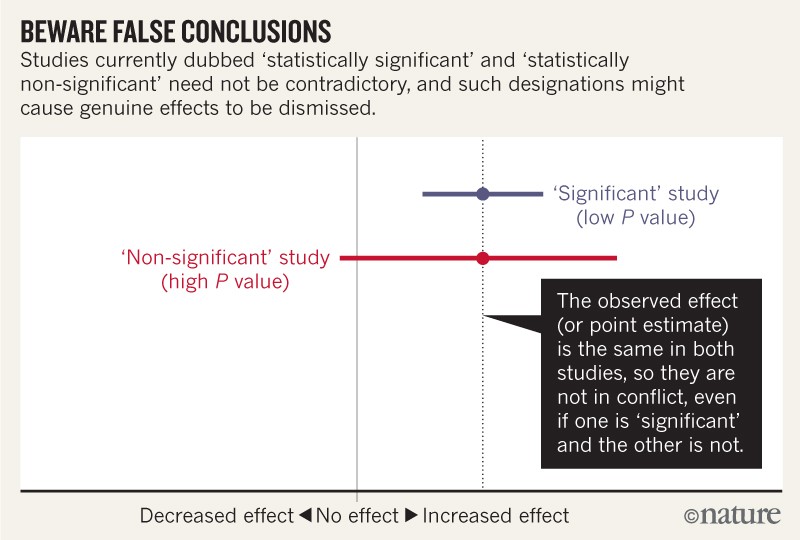
Pissed off scientists have risen up in their opposition to the abuse of statistical significance:

Source

The authors--"more than 800 signatories"--want researchers to quit categorizing:
The trouble is human and cognitive more than it is statistical: bucketing results into ‘statistically significant’ and ‘statistically non-significant’ makes people think that the items assigned in that way are categorically different ...
On top of this, the rigid focus on statistical significance encourages researchers to choose data and methods that yield statistical significance for some desired (or simply publishable) result, or that yield statistical non-significance for an undesired result, such as potential side effects of drugs — thereby invalidating conclusions.
Note how they phrased it? "encourages researchers to choose data and methods that yield statistical significance for some desired (or simply publishable) result" is exactly what I did not find appealing back in graduate school!

More from the authors:
The objection we hear most against retiring statistical significance is that it is needed to make yes-or-no decisions. But for the choices often required in regulatory, policy and business environments, decisions based on the costs, benefits and likelihoods of all potential consequences always beat those made based solely on statistical significance.
Exactly!

And even more important is this point from the authors on what will happen if we got rid of our focus on statistical significance:
Decisions to interpret or to publish results will not be based on statistical thresholds. People will spend less time with statistical software, and more time thinking.
More time thinking.  What a concept!

Saturday, April 18, 2015

Caveat emptor! All PhDs are not created equal

Back when I was in India and thinking about graduate school in the US, and given that those were the prehistoric days before the internet, I thought that most good universities were comparable and that it might not make that huge a difference on where I did my schooling.

It didn't take me long to know that I was wrong. Dead wrong.

Thus, I briefly flirted with applying to a couple of elite universities.  But, it was too much work all over again.  I ditched the plan, even as I watched two other students from India move on to Berkeley for their PhDs.  (One returned to India, primarily because he couldn't find an academic position here.  The other, I tracked down after all these years, thanks to thinking about this post.)

A PhD from USC sounds great to somebody in India. It might impress somebody in Peoria.  But, insiders know all too well that it ain't a PhD from Harvard.  All PhDs are not created equal.

Source

Now, when I attend conferences and watch the eager-beaver younger people whose identities are so wrapped up with their doctoral dissertations, I am tempted to ask them if they had thought whether or not their PhDs would really get them the academic positions that they are dreaming about?  When they have so much access to information that I never had when I was 22, did they not pay attention to how difficult it is to find a permanent job in academia?  Heck, when as undergrads they had the experience of teaching assistants with strange accents and adjunct faculty who were tired and poor, did they not worry about the post-doctorate phase of life in which they could be unemployed or underemployed?

I suppose to be youthful means to be optimistic and over-confident.  But, then they should not complain later, right?  To complain after seven years of graduate schooling will mean that they lack the very critical thinking that academe is about.

Dan Drezner, whose blog I followed a lot more before he moved on to WaPo, warns about the "cult of the PhD."  Though in the context of his fields of political science and international relations, his observations are equally valid to most, if not all, other disciplines as well:
if your goal is to become a professor and you are not accepted with a scholarship into a top-20 political science program, I would not in good conscience recommend that you get a PhD.
Indeed.
Most of the professoriate in international relations comes from the elite schools. Whether this is because these schools function as a prestige cartel or not is immaterial: the reason will not change the current realities. The academic job market is brutal; getting an academic job without a degree from a top-20 institution is even more brutal.
USC ain't in the top-20.  Well, its academic creds have vastly improved over the past decades.  But, if I were an undergrad in this country and thinking of a PhD program in order to have a career as an academic, USC would be more like my "safe school."

Drezner concludes with this:
If you really want to be a professor, then you need to get a PhD. If you want to advance your career as a wonk, then, all else equal, a PhD would probably help. But all else is not equal. If this is the kind of world you want to enter, then fine, you’ve been warned. But do not claim, seven years from now (if you’re lucky), that someone sold you a fake bill of goods.
Yep.  I have been saying the same thing for years.  And have also been blogging forever, it seems like, on why going to grad school is the worst move for most people.

The WSJ adds:
universities contribute to a glut of Ph.D.s by admitting students who take out loans (some 40% of the $1 trillion in student debt is for graduate school) even when they know few will ever work as full professors. By admitting them into graduate programs, the schools in effect are producing for themselves a low-paid work force.
“To put it crudely, they are hiring their own serfs,” says Richard Vedder, an Ohio University economist who runs the Center for College Affordability and Productivity. He says it’s “as much a moral issue as an economic one.” A university truly devoted to the well-being of its students would be more honest to grad students about the dismal job prospects for Ph.D.s—and more candid to undergrads about their actual instructors.
Caveat emptor!  Yes, that phrase too I learnt only in graduate school ;)


Monday, August 04, 2014

If teaching doesn't work, here is Plan B: Just shoot me ;)

One of my complaints about higher education (yes, I have many!) is that the curriculum that faculty put together and the way they present their courses is mostly to achieve only one goal--to replicate themselves.  As in the higher education process seems to be designed to make graduate students and then faculty out of students.  No wonder, therefore, at teaching universities like mine, faculty love to announce how their students are going on to graduate school.

Which is also why, like I noted in this post a couple of years ago, one of the questions I was asked by the chief academic officer was this:
"How about graduate school?  How many go on to professional schools?"
To quite an extent, all we seem to do right from the time kids enter the first grade is to try to brainwash them into thinking that there is no greater glory than to keep earning the As and do as much schooling as possible.  It does not take a PhD in rocket science (no grad school needed!) to figure out that not all students will go on to grad school, even if they are fully capable.  After all, there is more to life than grad school.  This is the situation that gets tricky for most faculty.  Why so?  Let me explain.

Assume that a student who is majoring in gender studies approaches a faculty and asks a simple question: "how do I go looking for a job?  And how do you think I can use gender studies as my selling point in getting a job?"

Most faculty won't have any answer, and we will begin to bullshit about critical thinking and writing and communication as being important to any job, even when most faculty couldn't care about critical thinking and writing.  And if you listened to faculty at meetings, you will be convinced that they know nothing about communication.

Which is why most students are smart enough not to ask faculty about jobs and careers anyway!
(So, what do I tell students?  Full disclosure is what I do--I use the "P" word, which I first used to describe higher education more than four years ago)

I am thinking about these issues because I have begun my serious work on re-creating the syllabi for the classes next term.  Beginning that work is always nothing but examining, again and again and again, this existential crisis of why I do what I do.  I have this enormous pressure within--and not because my faculty or my administrative colleagues care about what I do--to convince myself every summer that I am preparing myself to help students prepare for their long lives as productive members of the state, the country, and this world.  Productive not merely in economic terms--yes, I tell them all the time that there is more to life than money.

I had an encouraging start to that today, when a student wrote to me, "I got lucky and got a full time job, that may even turn into a career."

That was not because of any of the classes in which I got to interact with that student.  As I always tell any student, my class and five dollars will help them get a decent cup of coffee at Starbuck's.  But, I like to imagine that somewhere I added a little bit, and made that coffee at least one cent cheaper and the student had to shell out only $4.99

A couple more days to ease out of such existential dilemmas, and then off to real work.  I am glad, however, that I continue to have these crises--it assures me that I still care about what I do.

Shoot me like you will an injured racehorse when I don't seem to care about teaching and students.

Monday, August 19, 2013

A cosmic dance gave birth to Sanskrit. But, we have no sense, anymore!

One day, perhaps I should ask my father point-blank on whether he has ever paused to think about how much I am able to engage him in conversations about Hindu philosophy and mythology, even though I am a confirmed atheist.

Maybe he has, and he is practicing the old Hindu (Asian?) virtue of not praising the child (yes, I am a child!)

In my recent conversation with him, father noted that a traditional brahminical ritual would be observed on Tuesday.  (Be warned that this post might be too much of an inside-baseball for those not interested in such matters!)

He agreed with my comments that most people--even back then, and I bet more so now--simply go through the motions of the rituals without understanding what they mean.

"I always recall the sastrigal emphasizing that the day was to begin learning the sacred vedas .... "वेदाराम्बम  à¤•रिष्ये" " I told him.  (am hoping I haven't forgotten the Sanskrit script!)

"Yes, you are right" father replied.  "One is supposed to begin to learn the vedas, or re-read them all over again.  But, people simply rush through the ritual and go home to eat payasam"

There was nothing to disagree with there.

Even as a kid, I was usually pissed off at those putting on a show and behaving in ways that were contradictory to what they mouth off.  Actions, to me, have always spoken way, way louder than words.  And, unfortunately, whether it is in such rituals, or in professional lives, or every day living, it is awfully annoying, to the point of puking, when there is that Grand Canyon-like divide between the talk and the deed.

"And I remember that it was also the initiation to Sanskrit and its grammar ... the sounds 'a i un rlk e on ai auc  ..." I said.

"Yes, the sounds from the cosmic dance, which formed the basis for the sounds for the language of Sanskrit" father added.

Meanwhile, I was thinking to myself, "gimme some credit, man."  Hey, I am a mere mortal, who loves to hear compliments from teachers and parents :)

Image from Wikipedia

Sanskrit, which is a mother to so many languages, even has a story of how it was born.  How many languages can claim to have a birth story, right?  The Lord of all Dance, Nataraja, the mythology goes, danced holding a small drum in his hand, which produced those sounds 'a i un rlk e on ai auc  ...'  Those sounds became the basis for the vowels and consonants and, much later, the grammarian, Panini (not to be confused with the Italian sandwich!) worked out the complex syntax for the language. So goes the story.

Thus, the language was born. And with it, came thinking.  After all, can one think without a language?  Think about it! ;)

"I suppose all those were written for a time period when brahmins lived as brahmins.  Not as engineers and doctors" father--a retired engineer--said, while noting that even his father-in-law (my grandfather) was an engineer son of a a very traditional and orthodox vedas-reciting brahmin.

"But, people do not care to know about those things."   After a momentary pause, he added "maybe ignorance keeps people happy, when they don't have to think about things."

"Yes, ignorance is bliss" I chimed in.

Most of my stress in life comes from my thinking.  If I didn't think for myself, by now I would be a much richer man. A lot more professionally accomplished man.  I think, therefore I screw up!

After the phone call, I returned to my reading and ... thinking!

What a coincidence that a favorite site that I check in with every day had a link to an essay on the Indian-American poet/intellectual AK Ramanujan (not the math Ramanujan) which includes this poem, ‘Prayers to Lord Murugan’, which was, apparently, read out at his funeral:
Lord of the headlines,
help us read
the small print.
Lord of the sixth sense,
give us back
our five senses. 
Yes, please, give back us humans--brahmins and the rest alike--our five senses.
Immediately.
Or else!