Showing posts with label arabs. Show all posts

Wednesday, April 04, 2018

People, who don't need people?

Two years ago, the university where I work invited interested faculty members to self-nominate themselves to serve on the Strategic Planning Committee.  Given my interests in higher education, and given that the directions that the university sets through this committee will be in place until I retire or am fired, I nominated myself and provided evidence of my track record in thinking above and beyond mere courses and the small little bubbles in which most discussions are trapped.

Of course, I was not selected to be on that committee.  What do know about higher education, right? 

In a brief thank-you email after receiving the notification that also included the list of faculty named to serve on the committee, I added a sentence that I hoped would make them all think about the committee's composition:
BTW, it seems kind of odd that faculty membership does not include any "people of color" as they say ;)
It was not diversity for the sake of diversity that I pointing out, but was instead about the need to think of the demographic reality.  Strategic Planning is about consciously developing specific action items for the future.  The demographic future of the country is in beige, the 2042 that even comedians joke about.  Oregon is notorious for not knowing how to deal with diversity, whether based on the superficial skin or on religion.   Especially Islam.

Everybody is talking and writing about Islam and the Arab world and Muslims.  The more one delves into the news, the more we realize we don't know anything about Islam, the Arab world, and Muslims.   It is bizarre that we are madly against something about which we know nothing!

Edward Said covered all these and more in his Orientalism.  Naturally.  Said had plenty of profound observations on the distorted--and intentional at that--understanding that the "West" has about Islam and the Arabs.
The scholar Edward Said took this point further, writing in his book Orientalism in 1978 that Islam had defined Europe culturally, by showing Europe what it was against. Europe’s very identity, in other words, was built in significant measure on a sense of superiority to the Muslim Arab world on its periphery. Imperialism proved the ultimate expression of this evolution
In a lengthy essay after his book was published, Said wrote--keep in mind that this was in 1980:
 If you were to ask an average literate Westerner to name an Arab or Islamic writer, or a musician, or an intellectual, you might get a name like Kahlil Gibran in response, but nothing else. In other words, whole swatches of Islamic history, culture and society simply do not exist except in the truncated, tightly packaged forms made current by the media. As Herbert Schiller has said, TV’s images tend to present reality in too immediate and fragmentary a form for either historical or human continuity to appear. Islam therefore is equivalent to an undifferentiated mob of scimitar-waving oil suppliers, or it is reduced to the utterances of one or another Islamic leader who at the moment happens to be a convenient foreign scapegoat.        
If that is the case with the average literate Westerner then do we need to even wonder why there are plenty of Americans today who eagerly embrace the anti-Muslim and anti-Arab rhetoric from the likes of trump!

Even at the university, the numbers of students from Saudi Arabia and their families have not been strategically used as opportunities to truly understand "them."  Instead, it seems that my university, like many others, merely continues to treat the foreigners as revenue sources, which is not that different from the "scimitar-waving oil suppliers" caricature that Said was upset about. 


Monday, April 25, 2016

My university and Europe

The university where I work invited interested faculty members to self-nominate themselves to serve on the Strategic Planning Committee.  Given my interests in higher education, and given that the directions that the university sets through this committee will be in place until I retire or am fired, I nominated myself and provided evidence of my track record in thinking above and beyond mere courses and the small little bubbles in which most discussions are trapped.

Of course, I was not selected to be on that committee.  What do I know about higher education!

In a brief thank-you email after receiving the notification that also included the list of faculty named to serve on the committee, I added a sentence that I hoped would make them all think about the committee's composition:
BTW, it seems kind of odd that faculty membership does not include any "people of color" as they say ;)
It was not diversity for the sake of diversity that I pointing out, but was instead about the need to think of the demographic reality.  Strategic Planning is about consciously developing specific action items for the future.  The demographic future of the country is in beige, the 2042 that even comedians joke about.  Oregon is notorious for not knowing how to deal with diversity, whether based on the superficial skin or on religion.   Especially Islam.

Everybody is talking and writing about Islam and the Arab world and Muslims.  The more one delves into the news, the more we realize we don't know anything about Islam, the Arab world, and Muslims.  Robert Kaplan writes that "Europe was essentially defined by Islam. And Islam is redefining it now."
The cultural purity that Europe craves in the face of the Muslim-refugee influx is simply impossible in a world of increasing human interactions.
“The West,” if it does have a meaning beyond geography, manifests a spirit of ever more inclusive liberalism. Just as in the 19th century there was no going back to feudalism, there is no going back now to nationalism, not without courting disaster.
In his short essay, Kaplan makes extensive reference to Edward Said's Orientalism.  Naturally.  Said had plenty of profound observations on the distorted--and intentional at that--understanding that the "West" has about Islam and the Arabs.
The scholar Edward Said took this point further, writing in his book Orientalism in 1978 that Islam had defined Europe culturally, by showing Europe what it was against. Europe’s very identity, in other words, was built in significant measure on a sense of superiority to the Muslim Arab world on its periphery. Imperialism proved the ultimate expression of this evolution
In a lengthy essay after his book was published, Said wrote--keep in mind that this was in 1980:
 If you were to ask an average literate Westerner to name an Arab or Islamic writer, or a musician, or an intellectual, you might get a name like Kahlil Gibran in response, but nothing else. In other words, whole swatches of Islamic history, culture and society simply do not exist except in the truncated, tightly packaged forms made current by the media. As Herbert Schiller has said, TV’s images tend to present reality in too immediate and fragmentary a form for either historical or human continuity to appear. Islam therefore is equivalent to an undifferentiated mob of scimitar-waving oil suppliers, or it is reduced to the utterances of one or another Islamic leader who at the moment happens to be a convenient foreign scapegoat.        
If that is the case with the average literate Westerner then do we need to even wonder why there are plenty of Americans today who eagerly embrace the anti-Muslim and anti-Arab rhetoric from Donald Trump and Ted Cruz!

Even at the university, the numbers of students from Saudi Arabia and their families have not been strategically used as opportunities to truly understand "them."  Instead, it seems that my university, like many others, merely continues to treat the foreigners as revenue sources, which is not that different from the "scimitar-waving oil suppliers" caricature that Said was upset about.

At this rate, it seems like it will be a close race between my exit from the university and the ultimate exit itself ;)

Monday, November 16, 2015

If you prick us, do we not bleed?

It is easy to dish out philosophical advice and comfort to others upon whom the cosmos might have showered misfortunes.  When a death happens but in a different home, we trot out all the platitudes.  The believers might even say things like "your loved one is now with god" or "god's will hath no why."

In the old country, there is an expression: தனக்கு பட்டால் தான் தெரியும், which translates to something like "you will truly understand it only when it happens to you."  When, for instance, a death happens in our own home--even if it is the death of beloved dog--we cry and sob just like how the neighbor did and we forget all those philosophical platitudes that we dished out to the neighbor.

It is one thing when such events happen at a personal, individual level, but, another when an entire country is going through an upheaval that I cannot even begin to imagine in my wildest imaginations.  I am referring to Syria here.  When the war and the killings unfolded in Syria, all those over the past few years apparently mattered less to us compared to when the horrific killings happened in our own home, in Paris:
Monuments around the world lit up in the colors of the French flag; presidential speeches touted the need to defend “shared values;” Facebook offered users a one-click option to overlay their profile pictures with the French tricolor, a service not offered for the Lebanese flag. On Friday the social media giant even activated Safety Check, a feature usually reserved for natural disasters that lets people alert loved ones that they are unhurt; they had not activated it the day before for Beirut.
“When my people died, no country bothered to light up its landmarks in the colors of their flag,” Elie Fares, a Lebanese doctor, wrote on his blog. “When my people died, they did not send the world into mourning. Their death was but an irrelevant fleck along the international news cycle, something that happens in those parts of the world.”
The implication, numerous Lebanese commentators complained, was that Arab lives mattered less
That was after a double suicide attack in Beirut only a day before the Paris tragedy.  A city that was finally becoming calm and peaceful after years of unrest, and despite all the chaos next door in Syria that was pushing out refugees into Lebanon.
“Imagine if what happened in Paris last night would happen there on a daily basis for five years,” said Nour Kabbach, who fled the heavy bombardment of her home city of Aleppo, Syria, several years ago and now works in humanitarian aid in Beirut.
“Now imagine all that happening without global sympathy for innocent lost lives, with no special media updates by the minute, and without the support of every world leader condemning the violence,” she wrote on Facebook.
I want to be very clear here, before some troll thinks that I am minimizing the tragedy in Paris--I am not, and these two posts make that very clear.

"All of these tragedies are "an attack on all of humanity," writes this commentator, who points out how the media even reported the events very differently:
Although the terrorist group behind the attacks in Paris and Beirut was the same, the Western media narrative has been vastly different. In Paris, ISIS attacked the city's progressive youth, massacring dozens enjoying their night out at a concert, a soccer game and a restaurant. In Beirut, ISIS struck a "Hezbollah stronghold" in the "southern suburbs of Beirut," a poor, majority Shia area often characterized as a bastion of terrorism in the region. The attack was portrayed as little more than strategic punishment for Hezbollah's ongoing involvement in the Syrian civil war and support of Syrian President Bashar al-Assad's regime.
As much as we are shocked and sad about the Paris attacks, don't we need to think about other places too where the same ISIS has made daily life a hell on earth?  Shouldn't what we feel for Paris and France be the same as what we feel for Aleppo and Syria?  For Beirut and Lebanon?  For Baghdad and Iraq?  for ...

It seems like we have forgotten this part that Shakespeare wrote:
If you prick us, do we not bleed?
if you tickle us, do we not laugh?
if you poison us, do we not die? 
But want to remember only the lines that come after that:
and if you wrong us, shall we not revenge?
If we are like you in the rest, we will resemble you in that.

Caption at the source:
The relatives of one of the victims of the twin suicide attacks in Beirut mourned
during a funeral procession in the city's Burj al-Barajneh neighborhood.

Friday, February 18, 2011

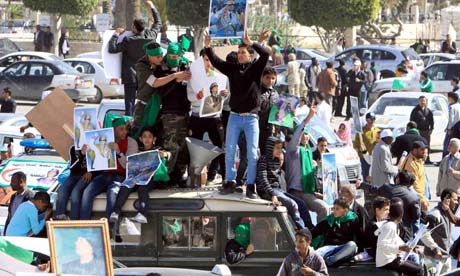
No Ukrainian nurse can help Libya's Gaddafi. Cheering the protesters

So, it appears that the Arab youth are mad as hell. 

And, Libya's Gaddafi is now at the receiving end of the  raging emotions that have been bottled up for 41 long years.  Yes, it was in 1969, almost 42 years ago, this maniac took over the country

But, Gaddafi will clearly not go away without putting up a fight, and he has quickly resorted to dirty tricks:

The mainstay of the unrest is in regional towns and cities, where many people live in poverty.
Foreign journalists operate under restrictions in Libya, so it has been impossible to independently verify much of the information coming out of the country.
But the BBC has confirmed that several websites - including Facebook and al-Jazeera Arabic - have been blocked.
And the airport in Benghazi, the country's second largest city, has been closed, amid reports that protesters have taken it over.
Residents in Benghazi told the BBC that electricity has been cut off, and tanks are posted outside the court building.
Benghazi protesters have told international media they have learnt from Tunisia and Egypt, and are determined to depose Col Gaddafi.
Media outlets loyal to Col Gaddafi had earlier conceded that security forces had killed 14 protesters in Benghazi on Thursday, though other accounts put the death toll much higher.
 The news channel that US cable corporations refuse to carry, Al Jazeera, also has a similar report:

Marchers mourning dead protesters in Libya's second-largest city have reportedly come under fire from security forces, as protests in the oil-exporting North African nation entered their fifth day.
Mohamed el-Berqawy, an engineer in Benghazi, told Al Jazeera that the city was the scene of a "massacre," and that four demonstrators had been killed on Friday.
"Where is the United Nations ... where is (US president Barack) Obama, where is the rest of the world, people are dying on the streets," he said. "We are ready to die for our country."
I hope my intro class students are tuned in--one of the two short stories that I have assigned for their final projects is Hisham Matar's "Naima."  Matar writes in the Guardian:
I appeal to Colonel Gaddafi and his security forces: for the sake of the mothers, for the sake of those who died, for the sake of Libya, please don't shoot and torture your people.
I blogged before that Matar knows well about this dictator and his cronies ...

So, why the Ukrainian nurse in the heading you ask?  Thank WikiLeaks for that