Showing posts with label salaries. Show all posts

Sunday, January 19, 2020

Selling graduate degrees

History/news repeating itself means that I can easily copy/paste from my old posts. It is as simple as that.

Consider this Washington Monthly piece, for instance, which argues that "Teachers across the country earn grad degrees to get raises. Turns out those degrees don’t improve student learning—they just fatten universities’ bottom lines."

Ah, yes, an old issue here at this blog!

Back in September 2011, I warned readers: "Two words to keep in mind: graduate degrees."  I wrote there:
Look at yourself at the mirror and ask this question: "Does one really need a master's degree to teach at the elementary school level?
And then, follow it up with this: "Do instructors at community colleges need doctorates to teach the classes?"
There is a good possibility that your instinct says that a master's degree is not needed for elementary school teachers, and that community college faculty don't need to have the "PhD" tag either.
It is also highly probable that you think it might be a good idea if teachers have those respective advanced degrees.
Now, ask yourself, this: will student learning be increased just because it is an elementary school teacher with a master's degree, or a community college instructor with a PhD?
That was in 2011.

Here is the Washington Monthly in its January/February 2020 issue:
“Most of the research is that there’s either no statistically significant difference, or small significant differences, in teachers with master’s degrees,” said Thomas Kane, an economist and professor of education at Harvard. Matthew Chingos, an education-policy expert at the Urban Institute, has described it as “one of the most consistent findings in education research.” Kate Walsh, president of the National Council on Teacher Quality, put it more bluntly: “It’s as conclusive as research that finds smoking causes lung cancer. It’s as conclusive as the research on climate change.”
Compare with what I wrote here in 2011:
There is nothing in the literature that shows that student learning is enhanced merely because the teachers have those higher credentials.  In fact, the higher credentials by themselves do not make good teachers.  The advanced degrees are neither necessary, nor sufficient, conditions for improved student learning.  These are simply distractions!
So, why then the push for graduate degrees?  I will quote from my own post first:
The problem comes up because teachers, their unions, and the schools have set up a system in which teachers get a salary bump if they have advanced degrees. ...
Now, think about higher education as an industry.  If you are a higher education professional, you realize that there is an economic incentive for second grade teachers also to get master's degrees.  You then expand into offering those programs
And what does the Washington Monthly say?
Nixing the automatic master’s pay bump, which many experts advocate, would likely face intense resistance from teachers’ unions. It would also draw quiet resistance from a less obvious source: the universities awarding degrees. Data from the Department of Education shows that education master’s degrees are the second most commonly awarded master’s degrees in the country, after MBAs. That makes them an important and reliable source of tuition revenue—as long as teachers feel the need to get them.
Seriously, what the hell is wrong with us?!

My bottom-line was:
Taxpayers subsidize the public universities that offer those graduate degree programs.  That is right: we pay for the generation of most of those advanced degrees.  These graduates then earn more because of the very degrees, when those degrees are not even required!
That is no different from this argument that teachers ought to be paid more:
 This money should still go to teachers—it just shouldn’t be tied to an expensive, time-consuming degree with no tangible benefit. Simply giving all teachers higher salaries, says Roza, would be better than having teachers go into debt to get degrees.
Make teaching great again, dammit, instead of wasting money on unnecessary diplomas!

Saturday, July 11, 2015

If only WalMart can sell teachers!

A few years ago, I explained to my father that I don't get the summers off.  "We get paid only for nine months by our contract" I told him.  I gave him an idea of how much I earn, which pretty much depressed him; until then, his understanding was that college teachers in America get paid really well.  I then had to add that most of us who get into teaching are like me--we are not in it for the money.  If earnings are all we were interested in, we would have gone into other professions and we certainly have the smarts for that.

I have always been puzzled at how poorly societies pay teachers.  Back in the old country, there is a verse in the Upanishad, in which is included the directive to treat teachers like god: "acharya devo bhava."  But, of course, it is all talk and no shit!  In the industrial township where I spent all my formative years, I once went inside the home of one of the teachers.  I was shocked at how poor the conditions were.  My old Sanskrit teacher did not even have to say anything about his poor existence--it was clear that the man and his family could not afford to have even one paisa lying on the floor at home.  A few years ago, an old school mate passed along a request for financial help from the teacher who slapped me silly.  I felt bad for the guy--even though he was in a pickle largely as a result of his own follies.  I sent money to a friend and asked him to give it to the slapper, but without including my name.

Ask people with kids and they will loudly proclaim that their children are the most precious things in their lives.   If that were truly the case, and if one put the money where the mouth is, then teachers, who play perhaps as equal a role as the parents do in shaping the kids' lives, will get paid a lot and get treated well.  Yet, almost always the same parents complain about teachers' salaries.  They almost hate paying for the schooling of their own kids.  Most parents seem all too keen to nickel and dime, as we say in this country, and want to get teachers for the lowest possible price, er, salary.

As I have pointed out in many posts, I couldn't care about earning more than what I get paid now.  My daughter has remarked in the years past, quite a few times, that my decisions have always been about searching for lower paying jobs!  My personal decisions aside, I have enormous sympathies for teachers working in kindergarten through high school, who have stressful working lives dealing with kids while not getting paid a whole lot.  So much so that many school teachers take up summer jobs like painting homes and working on farms.
Because of the low starting salary, teaching is considered a poorly paid profession compared to other careers involving similar background and education requirements, such as registered nurses or accountants. Arne Duncan, the U.S. education secretary, has said that public-school teachers are “desperately underpaid,” and has advocated for doubling their starting pay.
“Most teachers do need the extra money and they do work in the summer,” says Richard Ingersoll, a professor at the University of Pennsylvania’s graduate education school whose research focuses on the teaching force; he cites data suggesting the majority of them even get actual summer jobs. According to Ingersoll, the average teacher’s earnings (including any money earned through summer work) are still lower than that of other professionals even when accounting for time off. And several studies have shown that low salaries are a top reason teachers leave the profession.
The nickel and dime approach and the disrespecting of teachers are having their effects.  In Arizona and Kansas, for example, teachers are fleeing from the profession and from the states too!

If children are their most precious things ever in their lives, would parents want financially and emotionally stressed out teachers molding the kids' minds?  Am not kidding about the stress:
 Indeed, burnout is a widespread concern in the teaching industry, and a common reason why teachers leave the classroom.
Without the summer months of furlough--remember it is not a break but a furlough--it will be extremely difficult for most teachers to recharge themselves for another academic year.

I tell ya, most parents have no idea how lucky they are that it is not the flashing dollar signs that motivates many (most?) teachers who choose to be in the profession.  


Friday, November 19, 2010

Do elementary school teachers need master’s degrees

From the Chronicle of Higher Education:
In a speech at an American Enterprise Institute forum on Wednesday, the secretary of education, Arne Duncan, said state and local governments should rethink their policies of giving pay raises to teachers who have master’s degrees because evidence suggests that the degree alone does not improve student achievement.
This is a familiar territory in this blog; back in September 2009, I blogged, citing Matt Yglesias, questioning the logic behind paying teachers more if they have graduate degrees.  It adds on a huge cost to taxpayers, with no returns on this premium.

Monday, March 29, 2010

Quote of the day

Faculty evaluations are:
Freud's notion of the narcissism of small differences—our need to exaggerate the minimal distinctions between ourselves and people very much like ourselves.
Fantastic phrasing.  Read the entire essay here.  Yes, the author cares not for them.  But, as I read it, I was more impressed with the dollar figures quoted there ... no mashed potatoes there :)

Saturday, September 12, 2009

More on the monetary worth of college


Adding my growing list!

Via Richard Florida

My only hassle with this chart is how it refers to "college costs" when it is strictly about private colleges.

My hypothesis is that the gap exists, and is widening, for graduates of public universities also. But, the gap will not be this wide.

Friday, September 11, 2009

Why a Master's degree for 5th grade teaching?

I have always found it difficult to understand why elementary school teachers with graduate degrees are paid more--degrees whether in the subject area or in the art of teaching. My instinct has been that this unnecessary credential ends up adding cost to the system, inflates educational qualifications by setting precedents, while not delivering additional benefits to student learning. But, this has been only my conjecture and, hence, never voiced my thoughts on it. Until now.

I was reading a post somewhere that referred to a comment from Matt Yglesias about compensation for teachers. Yglesias is not any ideological nutcase, and the Center for American Progress, while certainly to the left of the political center, is more like Clinton's New Democrats. So, later when I had some time, I followed up on what the CAP had to say on teachers and degrees, and it is pretty darn interesting:
Teacher salaries increase each year with longevity and graduate credits, making them destined to escalate, and yet they have little link to student achievement.

Decoupling salary from experience is a tall order, but forward progress on school reform requires school districts to revamp their spending habits somehow. One habit related to experienced-based salary is the practice of paying a teacher with a master’s degree more than an otherwise identical teacher with only a bachelor’s degree. The long-cherished “master’s bump” makes little sense from a strategic point of view.

On average, master’s degrees in education bear no relation to student achievement. Master’s degrees in math and science have been linked to improved student achievement in those subjects, but 90 percent of teachers’ master’s degrees are in education programs—a notoriously unfocused and process-dominated course of study. Because of the financial rewards associated with getting this degree, the education master’s experienced the highest growth rate of all master’s degrees between 1997 and 2007.

Now, I have data to work with, and my instinct-based hypothesis has some backing. (Note: the university I work for has a pretty busy master's in teaching program. My comments do not imply in any way that they are directed at that program. I have walked around with this hypothesis ever since I started thinking about public policy issues, back when I was in Southern California.)

So, how much is the cost escalation because of the additional compensation for graduate degree holders?
A 2007 study estimated that 2.1 percent of all current expenditures can be attributed to teacher compensation related to master’s degrees. Seen another way, the master’s bump costs the average school district $174 per pupil.
... A Nebraska lawmaker, for example, should probably be aware that, on a yearly basis, roughly $81 million dollars—$279 per pupil—are tied up in master’s degrees and thus unavailable for other purposes. During this time of fiscal stringency, it should raise eyebrows when a state automatically allocates over 3 percent of the average per pupil expenditure in a manner that is not even suspected of promoting higher levels of student achievement.
Hmmm .... here in Oregon, according to this study, the extra cost as a result of this master's bump is $109,520,560. That is, $109 million? Wow!!!

Wednesday, October 22, 2008

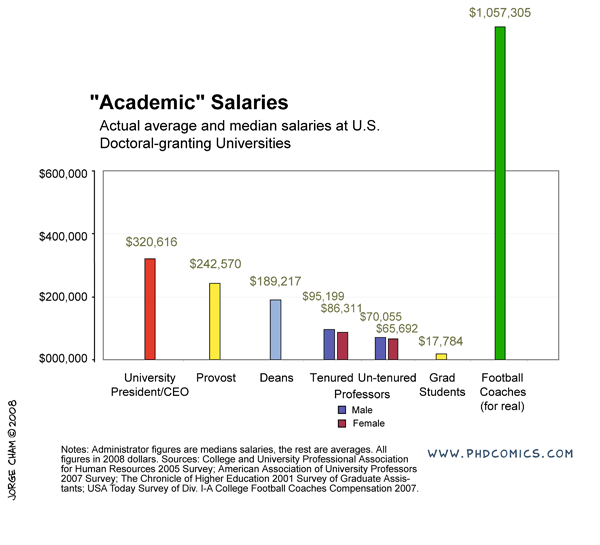
Salaries: academic versus football

I have blogged a lot about the horrible minor league football that college football really is. But, I suppose a picture is worth a thousand words: