Since 2001 ........... Remade in June 2008 ........... Latest version since January 2022
Monday, March 14, 2016
How far away is India from Indonesia?
It was published in the Bakersfield Califiornian--by then I had transitioned to life in Bakersfield. Soon, it was a second opinion piece in that same paper, after I had managed to find gainful employment in the city. A day after that second opinion essay, when the phone rang at work, it turned out to be the beginning of a productive association and friendship.
The caller was a professor at the local university. He was pleased that the opinion author was from India and wanted to contact me right away. He was also from India, and chose to go with a short version of his multi-syllable Indian name. At the end of the brief phone conversation, he invited me and my family over to his home for dinner with him and his wife.
A few days later, we met in the real world. That was the first of the many dinners with Kris and Kirsten. He was only a few years younger than my father. Kirsten was from Denmark--they had met when he was a graduate student in Copenhagen.
Not too long after that, Kris invited us to join them at the local Danish association's potluck gathering. In his uniquely funny manner, Kris added that he was the president of the Danish Association. Only in America can an Indian be the president of a Danish association!
It was but a small gathering. Most of them were even older than Kris. They were all familiar with India as well. One of them, a much older woman, quizzed me about the Danish connection with India. She asked me if I knew about the Danish colonies there. I was so thankful that I knew about Tranquebar--it was not far from where we lived in India. The old woman was pleased that I knew. She then talked about how in their schooling they had learnt about the Danish East India Company, and the Nicobar Islands. She regretted not having been to India.
All the way from tiny Denmark a colony in the Nicobar Islands. Imagine that!
I was reminded of those old stories when I read this lengthy report in the New York Times, about the ethical and legal issues relating to a dead baby among one of India’s last intact Paleolithic tribes in the Andamans. Reading that will be well worth your time, I assure you.
So, why Indonesia in the title of this post? It is easy to forget that the Andaman and Nicobar Islands are way, way out there from the Indian mainland. So much out there that the southern end of this archipelago is less than a hundred miles away from the northern tip of Indonesia's Aceh Province.
It is a small world after all.
As for Kris, one evening he poured wine in two glasses for Kirtsen and for himself while she was making a pizza for dinner. Kris told his wife that he was going to lie down for a few minutes. He never woke up again--a massive heart attack ended his life.
Thursday, September 04, 2014
I was born in a small town ... and I live in a small town
One research topic that I briefly explored for my dissertation topic, which my adviser was eager about, was one that I could not personally resonate with--megacities. Back in the late 1980s, it was clear that the cities in China and India, and later in other countries too, would grow to sizes that could be beyond our imaginations and that extensive planning had to be done, and done quickly. As much I understood the urgency of the problem and the need to investigate the dynamics, I did not pursue that topic.
I love visiting the big cities, but don't ever want to live in one of them. Some day, I hope I will get to experience the masses in Sao Paulo and Chongqing, with the reassurance that I will return to my hermitage.
There is a certain spatial match that we don't usually think about. Not all of us are wired to enjoy the big city, nor are we all at ease in the remote hamlets. Life is that much more enjoyable when we find that fit.
The author of this essay writes about "giving up my small town fantasy"--a move from San Francisco to upstate New York that didn't work out all that well:
For the first time since college, I became depressed. Listless, I spent long hours lying in bed. Taking showers for warmth seemed like a legitimate hobby. Walking in the snow to and from the office was the only time I was outdoors and also the only time that I was alone. And when I walked, I walked in the middle of the street. There were rarely any cars with which to share the road. It felt like living in a snow globe.I can imagine it getting depressing--it can happen even in a charming setting if one can't quite feel at home there.
Patrick and I became lonely together. He was experiencing creative growth, but it came at the expense of social contact. Even the house became fraught, as our home was now Patrick’s office.
Maybe things would have been different if we had done a better job of integrating into the community. But while meeting people happened easily enough, making friends — laying down roots — proved difficult. I had taken for granted the networks running beneath my life in San Francisco and New York, the former co-workers and college friends and ex-paramours, and now, in Hudson, my connection to the community seemed only geographical. Often, it just wasn’t enough to cement relationships.
By early this year, I had had enough. It was time to move to the city. Patrick felt torn about leaving such a cheap setup for writing, but as the snows continued into March, he saw the wisdom of a more connected life. In August, I began a job in Manhattan and we set about dismantling the home we had made. We can’t let go completely — I love Hudson, I have started whining to friends — so we’ll become those annoying weekenders, the kind who keep the stores buzzing in the summer but shuttered in the winter.
“People are waiting for civilization to catch up with this wild thing that’s been happening here.”
Wednesday, February 26, 2014
The world is not your oyster. It is your life.
That was yesterday, and here I am reminded about him yet again because of the story in the NY Times about Merle Haggard and the old boxcar that was home to the young Haggard.
Towards the end of my graduate school existence, my life was transitioning from Los Angeles to Bakersfield. Harry, who rarely ever talked anything personal with me--I am not sure if that was his nature or whether he kept me at length--talked about how much he loved the Bakersfield Sound.
If it felt odd, there was a logical reason--Harry was from the UK. I am from India, and was moving to a town called Bakersfield. And the Brit tells me he about his fondness for the country music of Bakersfield.
Merle Haggard was a big name, of course, along with Buck Owens, in this genre of Bakersfield Sound. I could never get really into it; different strokes for different folks! But, the intellectual part in the stories of the Dust Bowl migration, the migrants, the condescension towards the "Okies," the very different lifestyle in Oildale--with the zipcode of 93308--fascinated me. From the bluffs where our street ended, across at a distance, beyond the oil pumping jacks, was Oildale.
Merle Haggard grew up there.
Like much of the music associated with the Bakersfield sound, an unvarnished form of country that thrived in honky-tonks here in the 1950s and ‘60s, Mr. Haggard’s is rooted in the making-do values of the Dust Bowl. His parents migrated from Oklahoma in 1935 and, like thousands of Okies, they sought refuge in Oildale, a ragtag collection of camps and settlements on the outskirts of Bakersfield.One of the advantages in migrating and travelling is this: we develop attachments to places that otherwise are mere factoids. Had I not lived in Bakersfield, I might have even skipped the NY Times story, unless I was into country music and the Bakersfield Sound. Having been to Tanzania means that any news story about the country makes me pause and read that. No wonder then that Mark Twain noted this about travel:
Travel is fatal to prejudice, bigotry, and narrow-mindedness, and many of our people need it sorely on these accounts. Broad, wholesome, charitable views of men and things cannot be acquired by vegetating in one little corner of the earth all one's lifetime.Thus, reading about Merle Haggard's old home stirs a feeling of familiarity. I get it. I can also understand why there is the feeling of urgency to preserve his old boxcar home:
Though occupied, the house today is nearly ruined, sagging under a tangle of vines. The campaign to “Save Hag’s Boxcar” is a recognition of the role of the house and the railroad in Mr. Haggard’s career, as well as a nod to the collective ingenuity of Depression-era craftsmen like his father.Yes, it is about Haggard. But it is also about the migrants. Of the conditions they faced. Of their fierce determination.
Boxcar houses were not uncommon during the Depression, as chronicled by Works Project Administration photographers like Arthur Rothstein. The story of how the Haggards acquired the car offers a glimpse of the era’s widespread prejudice toward Okies, though the singer’s own pride in his origins would later inspire his 1969 hit, “Okie from Muskogee.”I suppose life is about collecting such stories and relating them all. Like how an Indian and a Brit can be connected by a thread that also ties in with Bakersfield and Merle Haggard. Life is simply fascinating!
The family learned of the boxcar from a fellow church member, who asked James Haggard if he thought he could turn a surplus refrigerated train car she owned into a home, Mrs. Rea recalled. “She asked my daddy where he was from, and when he said ‘Oklahoma,’ she said, ‘I hear Oklahomans don’t work.’ Well, his blue eyes met her blue eyes and he said, ‘I’ve never heard of one who didn’t.'”
Sunday, April 07, 2013
"Do you have a life?"
I nodded my head as he continued with a smile, "even about your haircut." Ah, yes, about that $9.99 haircut.
"I was thinking that the professor has lots of time."
I gave him my usual spiel of how my work is also my hobby and how, therefore, I don't find blogging to be any time consuming work at all as much as I don't find my work to be time consuming either.
"But, you have a life, like family and a life, right?"
That is a difficult question for me to answer. Because, "life" includes blogging and doing everything else that I do now.
Except during my undergraduate days, when I did very little reading because of the crappy library that my college had, I have always spent (wasted?) time reading and thinking. Before college, during my school days, I was keen on reading anything other than the regular textbooks, which always made my mother wonder when I ever prepared for exams. She is right; I rarely did anything that would qualify as serious exam prep work.
In graduate school, I thought I had died and gone to heaven with the awesome libraries on campus. Yes, in the plural. Multiple libraries. I had a tough time choosing my favorites. There was my favorite spot in the reading room at Doheny:
![]() |
| USC Doheny Library, summer 2009 |
Life is what we make of it. How I enjoy life might not appeal to the next person. When my cousin was visiting with me a few weeks ago, she felt that my life was too regimented with what I eat and don't eat, and with the walking that I do, and the relatively mess-free home that I maintain. "Get a life" she said. "It is ok to be messy, you know."
Reading and thinking and writing naturally led me to write opinion pieces. Back in Bakersfield, as the newspaper started publishing my pieces, I felt encouraged and perhaps even started flooding the editor's mailbox with my writings. Blogging would have helped, a lot! There were a few in the community who even asked me if I worked for the newspaper!
After moving to Oregon, it took me a while to get oriented to the new environs. Though neighbors, California and Oregon are very different. Bakersfield's San Joaquin Valley is a world away from the Willamette Valley where I now live. Once I got a sense of the rhythm of this place, I was off to the races, as they say.
Even in my first year in Oregon, I invited a couple of my faculty colleagues to contribute to my blog. I was convinced that the more contributors I had, the more we could influence discussions. But, in retrospect, their decision not to blog--neither with me nor anywhere else--is a telling example of how differently my thoughts are compared with theirs as has been in pretty much everything else at work.
So, when the student asked whether I have a life, all I could do was smile and nod. There is no way I could have provided such a lengthy explanation, and there is no way in hell that he would have patiently listened to all these either; let us see if he read this ;)
Saturday, July 07, 2012
So, why haven't bald men gone extinct?
Her reply didn't satisfy my curiosity. Or, perhaps, I was too stupid to understand her answer?
A few months after that thought, I was shocked at a more personal revelation--I was beginning to develop the typical male bald patches.
A course that I taught had students in the same classroom and students at another off-campus site. The class was held at a television studio-classroom, and images and sounds from the studio were sent in real time to the off campus, and the video and audio from there were beamed back as well. The off-campus room had only one camera, while the classroom where I was had a camera turned towards the instructor (me) and another from behind me to capture the students.
There was a monitor in my view where I could see the images from the cameras. And that is when I caught the image from the camera that was behind my back--it showed the back of my head with the (then) thinning hair where the scalp was beginning to shine through.
It was so much a shock that I remember commenting right there something along the lines of "wow, I am going bald!"
Since then, the hairline in front has receded a lot. The back has become a lot smoother. When raindrops fall, as they do for nine months of the year here in Oregon, there is very little hair on top to act as shock-absorbers, and I can feel every drop falling like a pebble.
Over the years, the question about hair, in terms of colors, has, therefore, and understandably so, morphed into why there is baldness at all. Does it serve any evolutionary purpose? If it does not, and if baldness is a disadvantage, then can we expect bald people to become extinct?
Robb Dunn comments on the question of "why haven't bald men gone extinct?" in the New Scientist.
The hair on our heads may protect us from the noonday sun, maintain body heat when it is cold, and even attract a mate. If so, men who lose their hair are at a disadvantage, and you would expect natural and sexual selection to have weeded them out. So why haven't bald men like me, or at least our versions of genes, gone extinct?Turns out that it is a teaser essay, without any real explanations; the mystery continues :(
It seems like the rate at which I am balding is far from steady but increases every single day.
A couple of weeks ago, I wondered how I might look like if (when?) I become fully bald. So, in a typically scientific approach, I headed (pun intended!) to the barbershop, and came out looking like this:
A few more steps to satisfy my curiosity, and I became:
I don't know about all the bald people, but I am well on my way to extinction :)
Wednesday, June 22, 2011
From the Neyveli "hill" to Cotopaxi. The mountain man, I am
Saturday, July 17, 2010
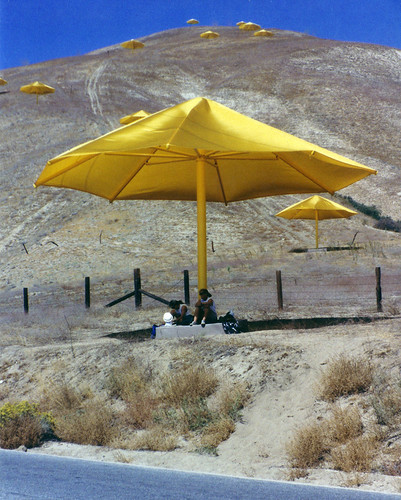
Christo, art, and his umbrellas
But, I tell people that I appreciate art in my own way, which is nothing but yet another version of Justice Potter Stewart's comment "I know it when I see it." Well, that itself is nothing but an iteration of the old adage that beauty is in the eye of the beholder.
Anyway, I know it when I see the beauty in art! And I did see one unique piece of art--Christo's umbrellas. I lived in Bakersfield, and remember going up to Gorman to look at one of the umbrellas up, close, and personal. And to stand under it because of the bright and hot Sun :) ... I should note that the photo here is not mine, but one I found on Flickr--this too is from Gorman.
The neatest thing about Christo's umbrellas was that the art was an experience. Because, unlike a painting that might hang in a museum for centuries, Christo's umbrellas were temporary. I liked that Buddhist sand mandala approach of his to remind ourselves of the temporary lease we have on this planet. I would like to think that it was more than mere art.
(Why the note on Christo? All because of this!)
Say, all that talk about umbrellas remind me of Rihanna's hit number :)
Friday, July 09, 2010
Photo of the day: in the nude
"CALIFORNIA—Near Bakersfield, 1983"
The Bakersfield I know--from 1991 on--was one conservative place. A couple of years ago, it was rated the most conservative city in California, and the eight most in the country!!! And this was only eight years before I first got to visit Bakersfield? Did the transition happen that fast? Is the caption incorrect? Hey, anybody from Bakersfield reading this? Any stories to tell?
BTW, that was not the only photo from "near Bakersfield" ... there are more. As always, only the best photos from Magnum (via Slate)
Wednesday, March 10, 2010
Another anti-gay Republican .... is gay
One of the local politicians was Roy Ashburn, who systematically contested and won election after election. At one time there was even speculation that he might head to the Congress. The guy was typical of the local pols who were highly successful--ultra conservative Republican talk. (Not "Conservative" but Republican.) Ashburn was also, as one can then imagine, anti-gay.
So, there I was checking with the newspaper from Bakersfield and I almost fell off the chair when I read a series of reports on Ashburn and his homosexuality:
“I am gay. Those are the words that have been difficult for me for so long,” a sometimes emotional Ashburn told local talk radio show host Inga BarksSo, why was he vehemently anti-gay, and why did he support anti-gay policies?
Ashburn has taken heat in the last week for having been both closeted and a consistent voter against gay-rights related legislation. In the interview, Ashburn repeatedly argued he voted the will of his constituents in his conservative 18th Senate District, which includes much of Bakersfield.
“I took a position based on what I believed was the will of my constituents, not mine, necessarily,” Ashburn said. “We have a representative form of government ... where citizens select people to cast votes on their behalf.”Bah! It was strictly a game he played in order to win re-elections? How awful! The Fresno Bee editorial has the best line on this:
For Ashburn, being part of the club of elected officials apparently was more important than voting his conscience. That's disturbing. It's also extremely hypocritical, no matter how Ashburn tries to spin it.
But times are changing. Most younger voters don't care about sexual orientation. Ashburn could have shown leadership by trying to change the minds of others. He never gave his constituents the chance.I wish Ashburn well .... but, I also hope he will understand how much his anti-gay politics caused pain and hardship to gays. I look forward to reading his apology in a future issue of the Bakersfield Californian.
Saturday, August 22, 2009
More on the (bad) high speed rail idea
I am glad I got an opportunity to exit this agency and return to academia where I did not have to hide my analyses and ideas behind facades--thanks the intellectual freedom we have. (Or so I thought until I found out otherwise; but, who cares for my sob stories, right?)
Anyway, one reason why I was convinced that high speed rail will never be economically feasible without extensive--I mean extensive--public subsidies was a simple back of the envelope calculation. The calculation was about the out of pocket expenses that a family of three would incur if they drove from their home, say in Bakersfield, to the destination in Los Angeles, compared to the expenses involved with completing the same journey on a high speed train.
To take the train, there are the following explicit cost factors in addition to the fare for each passenger:
transport to the station of origin
transport from the destination station
and then the transport costs to move around in the destination city.
You add these expenses to the fares for the family of three, and it turns out to be way, way, more than the out of pocket expenses if that family had simply gotten into their car and driven. And then, add to this the need to stick to the train schedule as opposed to leaving from home, well, whenever.
Anyway, that is all water under the bridge. That is what I thought, until the recent rah-rah for high speed rail in the US. I suppose such policy ideas are like mythical monsters that never die!
It was not a surprise to me that my graduate school professor, Peter Gordon, has blogged about it--he has a long track record voicing his opposition. It was, however, interesting to note that the UK too is planning on big time expansion of high speed rail. As Johnny Carson would say, "I did not know that!"I liked this comment about the the UK discussions:
Yes, sir!Obsessing about high-speed rail also misses the point that every form of transport has its strengths and weaknesses. There are all sorts of factors that people take into account when choosing if and how to travel, like cost, convenience, speed, comfort and flexibility. If you want to travel from city centre to city centre, trains are great for journeys of up to three hours. No check-in, no driving, just turn up and let the ‘train take the strain’. For longer journeys, the hassle of air travel is off-set by the speed (and, given the stupendous prices charged on Britain’s railways, flying is usually cheaper, too). For trips to less popular destinations, or where you need transport at the other end, the car is often the best choice.
So, to make Britain a truly mobile society, we need trains, planes and cars, and the best possible infrastructure for all three. And we need a government that is committed to the idea that mobility is a good thing rather than one that puts the brakes on our transport future.
Sunday, July 19, 2009
California's Detroit: farmlands in the Central Valley
The real question is what emerges after the almonds, tomatoes and cantaloupes disappear. What happens as ever more Central Valley farmland is retired, as is inevitable? What does the future look like for the northwest corner of Fresno County? Will the usual solution -- building a new prison -- be all that's conceived? Or can the sun-baked San Joaquin Valley become a hub of solar power and alternative energy, as some have suggested? If so, who will prepare workers for this new field?Rick Wartzman in the LA Times
... "We are part of a multibillion-dollar agricultural juggernaut that feeds the nation," Riofrio said. "But we've gotten chewed up and spit out."
Wednesday, May 06, 2009
Geography matters. In unemployment, and otherwise.
To begin with, issues such as rocketing home price was not country-wide at all. I don't think speculators were "flipping" homes in North Dakota as they were even in Bakersfield. Which also means that foreclosures are not a country-wide problem at all. To a large extent, the physical aspect of the housing crisis is highly geographic in nature. That is the physical, real, stock.
Similarly, the real, tangible, manufacturing was also geographically concentrated. If I remember correctly, the relative importance of manufacturing in Oregon--in terms of percentage of jobs--was higher in our state than in the Northeast.
Money on the other hand was flowing in from everywhere, including the unfortunate and greedy investors from Iceland.
Economists almost always aggregate all these issues, and space does not matter to them. Thus, if at all, Glaesar is a tad late to the game. Richard Florida provided an interesting analysis in the March issue of the Atlantic, with a provocative title: How the crash will reshape America. in that piece, Florida noted that:
Financial positions account for only about 8 percent of the New York area’s jobs, not too far off the national average of 5.5 percent. By contrast, they make up 28 percent of all jobs in Bloomington-Normal, Illinois; 18 percent in Des Moines; 13 percent in Hartford; 10 percent in both Sioux Falls, South Dakota, and Charlotte, North Carolina.
Anyway, I agree with Glaesar's thoughts there. California is in a mess, and will get worse before it can remotely get better. This crisis, I think, is worse than the impacts of the aerospace/defense contraction of the 1990s. Because, that one helped the skilled folks apply their talents to other fields, including IT. Now, there is nothing to be gained from empty and sprawling McMansions.
The politics and the government there is not helping either. If it were not for immigrants, California would have tanked a long time ago--almost half the new tech firms were founded or co-founded by immigrants!
CA, AZ, NV are in the same housing crisis .... Again, from Florida's essay:
To an uncommon degree, the economic boom in these cities was propelled by housing appreciation: as prices rose, more people moved in, seeking inexpensive lifestyles and the opportunity to get in on the real-estate market where it was rising, but still affordable. Local homeowners pumped more and more capital out of their houses as well, taking out home-equity loans and injecting money into the local economy in the form of home improvements and demand for retail goods and low-level services. Cities grew, tax coffers filled, spending continued, more people arrived. Yet the boom itself neither followed nor resulted in the development of sustainable, scalable, highly productive industries or services. It was fueled and funded by housing, and housing was its primary product. Whole cities and metro regions became giant Ponzi schemes.
I simply resonate with his description that the entire economy essentially became one massive ponzi scheme. Sickeningly true. This is a HUGE difference between the post-IT boom and now--then, we were at least left with miles and miles of fiber optics, for instance, which then helped as the economy recovered. I don;t see anything productive out of the mansions that are now sitting empty, and turning into slums.
Oregon is in deep shit as well--perhaps not as bad as California is. Earlier today I was speculating at a semi-serious conversation that our unemployment might top out at 14 or 14.5 percent before things begin to improve. This is going to be brutal. I don't see an emerging economic activity that can suddenly provide an upward momentum .... Kulongoski seems to be betting on electric cars. I am not sure if that is a winning bet. It is still a car with a lipstick, to paraphrase the election-season nastiness about lipstick on a pig -)
Unfortunately, to a large extent, Americans are not as geographically mobile as we think we are. I.e., not many unemployed Oregonians are going to move to New Hampshire where the probability of employment is higher. One of the main reasons as it turns out--housing. Owning a home drastically makes us immobile! It is easier for a renter to pack up and move. So, while economists assume that the probability of jobs might be a huge incentive for migration, apparently we have firmly established disincentives that discourage the move. To quote from that same essay by Florida,
“If you no longer can sell your property, how can you move elsewhere?” said Robin Boyle, an urban-planning professor at Wayne State University, in a December Associated Press article. But then he answered his own question: “Some people just switch out the lights and leave—property values have gone so low, walking away is no longer such a difficult option.”
The next forecast by the state economist will be on May 15th. We will all be yelling "mayday, mayday, mayday" then :-(
Tuesday, October 07, 2008
PTSD claims a two-tour Iraq veteran
U.S. Marine Cpl. Contreras, a 2003 graduate of South High, died two weeks ago after surviving two tours in Iraq.
He took his own life after suffering, it appears, from post-traumatic stress disorder. ....
Being in battle wasn’t supposed to be part of his job, but on one occasion he and some fellow Marines left the base and ended up in the middle of a gunfight.
“He had to use his weapon,” Esther said. “Five guys were shooting in a crowd of women and children. He knows he shot a woman. He didn’t know if he shot any children.”
At one point, he had a nervous breakdown during a Disneyland fireworks show, his family said. Light flashing in the air had been a signal for help in Iraq.
The episode was one of the few moments his family and friends noticed something out of the ordinary with Leonardo.
Read the entire report, with photographs, here.
Monday, September 15, 2008
Bakersfield, too, contributed to Lehman Bros' demise
We lived in Bakersfield, CA, before moving to Oregon. We sold our home just before the real estate mania set in. Bigger and bigger homes were being built, and speculators (flippers) were buying from all over. McAlister Ranch was one such mega project, which is one of the reasons that Lehman Brothers is now in a mess (watch the following YouTube clip)
I tell you, we are the United States of Gordon Gekkos :-(
Update: the Bakersfield Californian lists the investments in Bakersfield and Kern County with the Lehman connection.
Wednesday, August 06, 2008
I was right on the (gas) money :-)
Gas pricemarks pushing $2-a-gallon ; local drivers 'don't mind,' expert says
Filed: 09/14/2000
By CHIP POWER Californian staff writer e-mail: ppower@bakersfield.com
Statewide gasoline prices are kissing the $2-a-gallon level, with Bakersfield motorists near the head of the line.
Local prices now are $1.97 a gallon for self-serve regular, according to a AAA Motor Club survey, nearly 12 percent higher than a month ago. The statewide average in California, which has the highest gas costs among the continental states, was $1.86. San Francisco prices are at $2.05
Fuel industry analysts have dismissed the effects of the increase in crude oil production promised by the Organization of Petroleum Exporting Countries as being too little, too late to affect U.S. retail petroleum prices this winter.
Some analysts are speculating about possible energy shortages if the United States encounters a colder than normal winter. The accuracy of these predictions is difficult to verify.
As long as the U.S. economy hums along with little threat of inflation or a recession, most confident motorists are shrugging off the current high prices with little changes in their driving or purchasing behavior, said Sriram Krishnamurthy, a Cal State Bakersfield economist specializing in environmental resources.
"People don't mind spending a few extra bucks here and there if they feel like the economy is humming along," said Krishnamurthy.
However, there does come a point when people may cut back their driving and avoid the popular, gas-guzzling sport utility vehicles, he said.
When that adjustment comes is hard to say, but Krishnamurthy said it would likely be well past $2 a gallon and would also need to be accompanied by a big change in the larger economic picture, such as higher interest rates, shrinking job growth or run-amok inflation.
"If you had those sort of changes, vehicles such as the Jeep Cherokee would sell at a discount instead of a premium," the economist added. But that hasn't happened yet.
I was right: it took a few things to come together for people to run away from SUVs.
And, yes, Krishnamurthy was my last name before I legally changed it.
Wednesday, July 09, 2008
The real estate downward spiral
Meanwhile, here is a news item from a different part of the US--Muskegon, MI:
A man, allegedly upset over a real estate transaction, shot a realtor in the head at the realtor's office Tuesday morning.
Robert Johnson, 73, walked into Nexes Realty at 880 Broadway in Muskegon and asked for the realtor, Troy VanderStelt, by name. He went into a conference room and waited.
"It appears this was essentially an execution-style murder in the conference room," Muskegon County Prosecutor Tony Tague said. "He went over there with a handgun, asked specifically for this real estate agent, went into a conference room and within minutes fired a shot at point blank range into the side of the victim's head."