Showing posts with label hemingway. Show all posts

Wednesday, May 01, 2013

Bombs and missiles are ok in Syria, but gas is not ok? WTF!

Last night, even as my eyes were half-closing, and with my right arm tiring quickly holding the New Yorker thanks to the tennis-elbow issue that I am dealing with, I simply had to, had to, finish reading the absolutely depressing narrative on the people in Aleppo burying their dead.

If it was depressing to read, I cannot imagine how awful it was for the reporter to be there.  And even more awful for the Syrians who live in Aleppo.  And way more awful for those whose friends and family are dead. What a terrible situation there!

The entire essay is bloody depressing.  Within that insanity, one of the most insane was this: there is a bridge that divides the rebel area from the regime's.  People use it even as there is fighting all around because, well, they have to keep going with their lives.  And then this happens:
In several places, to evade government snipers, you must run.  Nearly every day, the snipers kill people--but, if you reach the bridge, chances are that the soldiers on the other side will let you in.
The snipers shoot commuters in order to bait rebel fighters and would-be rescuers.  Often, it is women and children who are shot. 
Even Catch-22 didn't include such levels of insanity.

It is now more than two years of fighting.  The UN has registered and processed more than 1.2 million refugees.  As one can imagine, a lot more are internally displaced.

So, when all these are happening, why should the use of gases be some kind of a red line that Assad's government cannot cross?  The 1.2 million refugees don't matter? The 75,000 dead is within our tolerance limits?  The regime's use of aircraft and missiles against its own people is normal?

This artificial notion of gas used against Syrians as some kind of a barometer on whether or not we should act is just bizarre.  Stupid, actually!

It is a long corridor of geopolitical instability from Kashmir all the way to the Mediterranean.  We need to draw a red line around the thousands of miles of this corridor.  And there isn't enough red ink for that!

All I can do in such contexts is rely on the old masters; here is Hemingway in A Farewell to Arms
"There is nothing as bad as war. ... When people realize how bad it is they cannot do anything to stop it because they go crazy.  There are some people who never realize. There are people who are afraid of their officers. It is with them the war is made"

"I know it is bad but we must finish it."

"It doesn't finish.  There is no finish to a war."

"Yes there is."

Passini shook his head.

"War is not won by victory. ... We think. We read. We are not peasants.  We are mechanics.  But even the peasants know better than to believe in a war.  Everybody hates this war."

Sunday, February 17, 2013

Why do beauty contestants wish for world peace?

As a kid, who had no idea about what wars meant, I remember being confused when we were told that we might have to turn out the lights and go dark during the 1971 war with Pakistan.  Yes, even though we lived in a town that was far, far away from Pakistan!

The following summer, or was it a year after that, when we were in Pattamadai to spend our school vacation time with the grandmothers, we kids were thrilled to listen to stories from the battlefront, narrated under the stars--the narrator was practically a family member, who was an army "javaan."

Of course, it was only later in life did I come to know that he was not anywhere near the front itself!  The older we get, the more we learn about the un-truths; turns out we live in a world of truthiness!

But, other than during those childhood years, I have never been a fan of war and violence.  I was a graduate student at USC when Bush, Sr., decided to liberate Kuwait from Saddam's invasion, and I joined the anti-war rallies at the campus square by Tommy Trojan.  War was not the answer, as far as I was concerned.

Into my adulthood, I have become more and more of a pacifist, and even people yelling and screaming is a huge turnoff anymore.  There are certainly plenty of ways in which we can express disagreements without resorting to violence in words and, definitely, in action.

Reading Hemingway's A Farewell to Arms and re-reading Catch-22 further convinced me that war is hell. War supporters are almost always, in Joseph Heller's words, the scum of the earth.

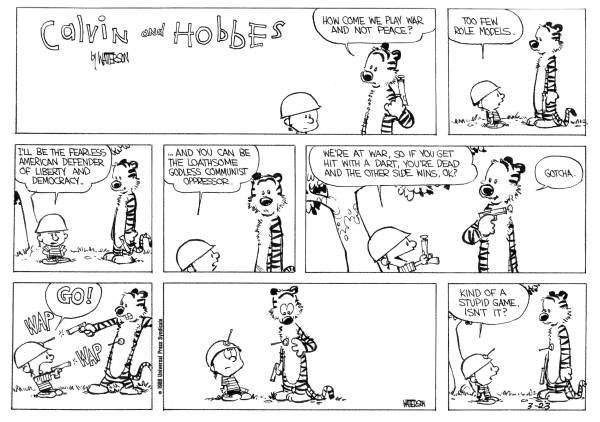
But, for all those who are pressed for minutes and seconds in these modern times, there is no one better to succinctly explain the idiocy of war than Calvin himself.

No, not John Calvin, but the one who walks around with Hobbes.  No, not that Hobbes either :)
If only Watterson hadn't retired!  Oh well ....
So, why war all the time?
Yep, stupid!  Hellishly stupid!

Monday, January 23, 2012

Comment of the day: On Hemingway, Franco, and war

If ever I need evidence for how the world is full of crazies, I need not go very far.  I have to merely look at myself in the mirror :)

No, seriously, the following is a comment that somebody had left, in response to my post a while ago about Hemingway's A farewell to Arms:
Hemingway:
BORRACHO PAYASO.
OUR LAST CIVIL WAR NEVER WAS OF YOUR FUCKING BUSSINESS, AS NEITHER FOR AT LEAST ALL OF THOSE NUNS AND PRIESTS KILLERS CALLED BRIGADAS INTERNACIONALE AND ALSO THE JEWISH LINCONL BRIGADE.

VIVA FRANCO FOREVER.
Ahem, it is absolutely my f*g business!  And will continue to be my f*g business :)

Ps: Google helped me out with translating BORRACHO PAYASO.  The translator is quite funny as well.  Because I had copied and pasted into the translator the comments, which are in uppercase, the translation in English was also in uppercase: DRUNK CLOWN :)

Wednesday, August 10, 2011

Quote of the day: on the scum of the earth. Who? Read on!

A phrase that really gets to me, for instance, would be one of those neoconservative references to Vietnam as a national tragedy, but only because we lost. That thought fills me with ire. To begin with, the person who says it is typically untouched by tragedy; like me, he has not lost a son or a job. In addition, the implication is that if we had won, the war would have been somehow less tragic. People with that mentality, I have to admit, impress me as being the scum of the earth.

 That is Joseph Heller, author of Catch-22 (ht)

Catch-22 is now fifty years old.  I have read a few essays in this context.  The best one of them all is this one by Ron Rosenbaum

In a way, it was a coincidence that those essays came up as I was wrapping up reading and blogging about A farewell to arms

"War is not won by victory. ... We think. We read. We are not peasants.  We are mechanics.  But even the peasants know better than to believe in a war.  Everybody hates this war."

"There is a class that controls a country that is stupid and does not realize anything and never can. That is why we have this war."

"Also they make money out of it."

Saturday, August 06, 2011

Photo of the day: remembering Hiroshima and the A-Bomb

Caption at the source:
Doves fly by the gutted Atomic Bomb Dome, (seen in the background), preserved as a landmark for the tribute to the A-Bomb attack, following a speech delivered by Prime Minister Naoto Kan, marking the 66th anniversary of the world's first atomic bombing in Hiroshima on Saturday.
 The photo below shows the remnants of the building (Industrial Promotion Hall) which was capped by this dome:


More photos of the post-bomb Hiroshima here.

So many wars over the thousands of years humans have been on this planet  The Japanese included. So unfortunate.  Even more tragic is the reality that we haven't gotten rid of our instinct to bomb the shit out of life anywhere on earth :(

As Hemingway wrote:
There is nothing as bad as war. ... When people realize how bad it is they cannot do anything to stop it because they go crazy. 

Saturday, July 23, 2011

"That was what you did. You died." Tenente lives. War goes on.

A few days back, I read the final words of A Farewell to Arms. (prior posts here and here.)

Felt so empty inside when it ended that I had to wait out a couple of days before blogging this. 

Hemingway simply sucked everything out of me with the anti-war story where the American protagonist signs up to serve in the medical corps of the Italian army in order to fight the good war, ends up deserting that only to have the military come after him because of his AWOL status as an officer, flees to neutral Switzerland with his British "wife" who is pregnant ... and then Hemingway lets the wife die after a difficult birth of a stillborn child. That is simply too cruel!

... So, that was it. The baby was dead. That was why the doctor looked so tired. But why had they acted the way they did in the room with him? They supposed he would come around and start breathing probably. I had no religion but I knew he ought to have been baptized. But what if he never breathed at all. He hadn't. He had never been alive. Except in Catherine. I'd felt him kick there often enough. But I hadn't for a week. Maybe he was choked all the time. Poor little kid. I wished the hell I'd been choked like that. No I didn't. Sill there would not be all this dying to go through. Now Catherine would die. That was what you did. You died. You did not know what it was about. You never had time to learn. They threw you in and told you the rules and the first time they caught you off base they kileld you. Or they killed you gratuitously like Aymo. Or gave you the syphilis like Rinaldi. But they killed you in the end. You could count on that. Stay around and they would kill you.

It was like how I used to feel after watching one of those older Malayalam movies back in India.  Those days, one could expect nothing but tragedies in those movies, and the cynical joke was that not only the hero and the heroine but the dog also died!

I suppose the consolation is that Tenente survives it all.
After a while I went out and left the hospital and walked back to the hotel in the rain.

 
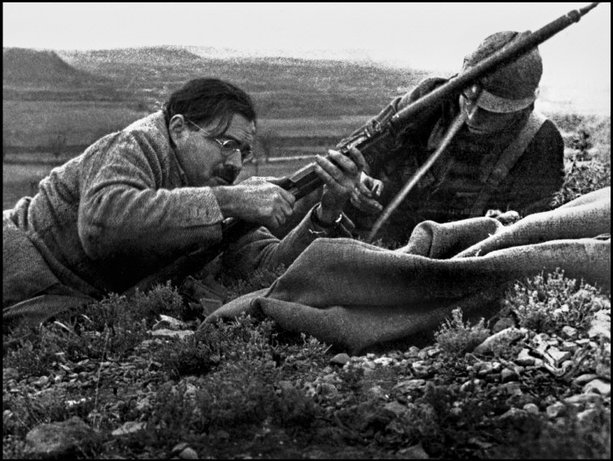
Caption at the source:
MORA DE EBRO, Spain—Hemingway on the front lines with members of Gen. Enrique Lister’s Loyalist 5th Regiment who were holding out against Gen. Franco's offensive, Nov. 5, 1937.

Tuesday, July 05, 2011

Have they ever been able to stop the war?

"... I feel very low."

"You have the war disgust."

"No. But I hate the war."

"I don't enjoy it," I said. He shook his head and looked out of the window.

"You do not mind it. You do not see it. You must forgive me. I know you are wounded."

"That's an accident."

"Still even wounded you do not see it. I can tell. I do not see it myself but feel a little."

"When I was wounded we were talking about it. Passini was talking." ...

"The officers don't see anything."

"Some of them do. Some are very delicate and feel worse than any of us."

"They are mostly different."

"It is not education or money. It is something else. Even if they had education or money men like Passini would not wish to be officers. I would not be an officer."

"... You are nearer the officers than you are to the men."

"What is the difference?"

"I cannot say it easily. There are people who would make war. In this country there are many like that. There are other people who would not make war."

"But the first ones make them do it."

"Yes." ...

"And the ones who would not make war? Can they stop it?"

"I do not know."

He looked out of the window again. I watched his face.

"Have they ever been able to stop it?"

"They are not organized to stop things and when they get organized their leaders sell them out."

"Then it's hopeless?"

"It is never hopeless. But sometimes I cannot hope. I try always to hope but sometimes I cannot."

"Maybe the war will be over."

"I hope so."
As I noted in an earlier post,
It is from Ernest Hemingway's A Farewell to Arms.

First published in 1929.
Eighty-two years have gone by and, yet, echoes today's world.

Tuesday, June 28, 2011

There is nothing as bad as war. Everybody hates this war.

"There is nothing as bad as war. ... When people realize how bad it is they cannot do anything to stop it because they go crazy.  There are some people who never realize. There are people who are afraid of their officers. It is with them the war is made"

"I know it is bad but we must finish it."

"It doesn't finish.  There is no finish to a war."

"Yes there is."

Passini shook his head.

"War is not won by victory. ... We think. We read. We are not peasants.  We are mechanics.  But even the peasants know better than to believe in a war.  Everybody hates this war."
"There is a class that controls a country that is stupid and does not realize anything and never can. That is why we have this war."

"Also they make money out of it."

Sounds very contemporary, doesn't it?

It is from Ernest Hemingway's A Farewell to Arms.

First published in 1929.
Eighty-two years have gone by and, yet, echoes today's world.

Perhaps another piece of evidence that the more things change, the more they look the same :(

PS: A couple of pages after this, Passini is killed in a mortar attack when they are eating cheese and macaroni in the trenches :(

Monday, September 20, 2010

The Sun Also Rises

No, this is not a blog to cheer myself up about the soon-to-disappear Sun here in the western part of Oregon :)  And, yes, it is about Ernest Hemingway's novel.

It was simply wonderful.  It was so refreshing a writing style to encounter after getting flooded by the emotion-laden long paragraphs in Invisible Man.  The short sentences, particularly to describe the intensity of emotions felt by the characters, must have been quite revolutionary in literature for the time period that this was written. But then, I am biased--I have always preferred short stories to novels, and short sentences over the multi-line sentences in Charles Dickens' works!

However, one issue bothered me.  Hemingway seemed to have been intent on making sure that the reader knew fully well that the character Robert Cohn is Jewish. Well, Hemingway doesn't use "Jewish" but always writes "Jew."  After a while, and particularly when something negative was said about Cohn, I wasn't sure why it had to pointed out so many times.  Was this something consistent with the way Jewish characters were written about in that time period?  But, even if so, given that Hemingway was writing in his "Heminway" style, he could have avoided that repeated characterization.  Similarly, there is something about the way he refers to a "nigger" boxer that didn't seem quite right.  The "Jew" and then the "nigger" together ... as much as I loved the novel, I am curious now about Hemingway's feelings about the world other than White Christians ...

I did like the protagonist--Jake Barnes.  There is a sense of idealism underneath his very realistic approach, and that gives life and color to the character.  An enormous sense of optimism comes through in that character, which is not to be seen in the others--definitely not in Robert Cohn, nor in the main female character, Lady Brett Ashley.  To quite an extent, Barnes personifies the idea of America itself, particularly given the contexts of the story of American and British expats in France and Spain.  There is America the ideal--freedom and happiness and all that, and the America that is so pragmatic that is all about taking care of your own yard and to heck with everything and everybody else.  Barnes has this in him.

It was neat, therefore, to end the summer readings with a piece of American literature that conveys a sense of pragmatic idealism, how much ever of an oxymoron that is.  Am glad I didn't end with Invisible Man, which left me down and depressed, and angry and furious too.

BTW, a few years ago, Wired ran an interesting contest for short stories--along the lines of the shortest story that Hemingway wrote:
For sale: baby shoes, never worn.
Hemingway apparently called it his best work. 

Thursday, September 17, 2009

Tweet your story?

For sale: baby shoes, never worn
That was the shortest story that Hemingway ever wrote. Clever and profound.

But then Hemingway was also not the gazillion-line-sentence writer that Dickens was anyway :-)

There is the prolific cell phone novelist in Japan. There is fiction writing within the 140-character constraint of Twitter.

Anyway, while walking by the river yesterday, I was imagining the sight of a peacock flashing his colors, which is when I came up with the following short story.
Virgin peahen commits suicide. Autopsy reveals color blindness.

I tried!