Showing posts with label twitter. Show all posts

Monday, August 27, 2018

If you call, who will come running?

Of the gazillion social media that one can now spend time on, the only one that I use is Twitter.  The best part of twitter is this--I don't have to be friends with anybody. I don't have to follow anybody. I can be my own, and yet keep track of whatever it is that interests me.

I used to be on Facebook.  Throughout the years that I used Facebook, I had a difficult love-hate relationship with that medium.  Not only because I was worried about the technology snooping into our lives and making money out of it, but also because I couldn't relate to the artificial "friendship" there with "friends" commenting about every damn thing, even though I knew very little about them in the real world.  Almost all of them were not really anywhere close to being my "friend."

Even back in high school, I didn't have many friends--according to the way I defined what friendship was.  If I didn't share anything close to my innermost feelings, they weren't friends but were merely classmates.  There were a couple of them who were friends.  Like this guy, when we were really young. And later this friend.

I have always firmly believed that it is impossible to be friends with many.  Again, a reminder that I am not using a loose definition of friendship.  We now have more and more scientific evidence to back me up:
Study after study confirms that most people have about five intimate friends, 15 close friends, 50 general friends and 150 acquaintances (green bars).
To me, a friend is what that previous sentence refers to as "intimate friend."  The rest are acquaintances.

Yes, we humans are social animals.  But, that social behavior is not the same as friendship.  Why?
This threshold is imposed by brain size and chemistry, as well as the time it takes to maintain meaningful relationships, Dunbar says. “The time you spend,” he adds, “is crucial.”
We have limited time, and there is only so much that we can spend on anything including friendship.

Which means, you, too, have an easy metric that you can honestly use in the privacy of your home.  Ask yourself how much time you have spent over the last year or two with people who are not related to you.  And rank them by the time you have spent with them. Right?


Tuesday, February 28, 2017

Not well-versed in Twitter ;)

Verse as in ...

The term is coming to an end ... this is when my problems begin ... because, I have just about gotten to know students, and we have to start wrapping things up.  And then, as if I never learn from past experiences, I once again start all over when a new term begins, and ... it is like the Buddhist monks and their mandalas--they painstakingly create those awesome colorful patterns, only to erase them when done.  And to erase it as a ritual as well.

Academic life too, is, thus about the cycle of beginnings and endings, and beginnings and endings, and ...

Here are a few tweet-verses in which I expressed some of those mandalas that were created ...


Wednesday, August 27, 2014

Maybe students would prefer me tweeting my course syllabus?

This is a post with two objectives:
  • to discuss one of the madness in higher education, which is about the course syllabus, especially because I am trying hard to get them done (yeah, right!)
  • to convince some of you readers about how we put Twitter to wonderful use, and we don't merely tweet about what we ate 
Speaking of what I ate, should I tell you about the awesome beet-salad that I made for myself the other day?  Why not; it is my blog, after all!

Sliced boiled beet in olive oil, balsamic vinegar, finely chopped garlic, and fresh ground pepper
topped with shredded cheese

Anyway, back to the objectives.  As always, Rebecca Schuman had a wonderful column at Slate.  It is all about the "Syllabus bloat" at American colleges and universities.  Excerpting from there will not do any justice. Read it in full.

I tweeted about it
Within minutes, there was a response from Schuman; I guess some of us academics never go to sleep! ;)
And then quite a few other responses.  More than that, the retweets:


A simple addition means that my tweet about Schuman's article was retweeted to 10,561 Twitter users thus far.   Of course, some might be in more than one of these loops.  Let us assume that it was 9,000 separate individuals whom the retweets pinged.   From there, it would have been retweeted more.  Just like that, with the click of a mouse button Rebecca Schuman's article gets distributed!

I cannot even begin to imagine the logistical hassles of sharing ideas and news in the old days, even twenty years ago!  For people like me who love to live in the world of ideas, there has never been a better time in history than now.

It is such an awesomely different world that the youth are beginning to explore.  Which is why the Mindset folks at Beloit College include in their latest compilation of "reminder to faculty to be wary of dated references"
"Press pound" on the phone is now translated as "hit hashtag."
Should I add that to the course syllabi and tweet about it?

Wait, I already did--about the Mindset ;)

PS: A note to the reader who thinks he is funny--don't even dream of "tl;dr" as your comment ;)

Monday, May 27, 2013

Facebook is not a panacea for the world's problems. It is causing more!

I am no Luddite.  But, there is not a day that goes by without me wondering and worrying that this latest version of the Industrial Revolution might really be the job killer that Luddites have always feared.

Reading George Packer's essay in the New Yorker and this piece on Jaron Lanier in Salon add to my worries.  Here is what Packer writes in his blog, in a follow-up to his original piece:
life inside Silicon Valley can be a paradise (for its winners) of opportunity and reward. Meanwhile, life outside falls further and further behind. All those highly paid engineers, with their generous stock options and unheard-of buying power, aren’t making the Valley more equal—they’re making it less so. 
As one who grew up in the Valley, and as one who attended high school there, Packer is an insider as much as he is an outsider now.  He writes in his essay about the economic reality of the Silicon Valley, which is home to more than fifty billionaires and thousands of millionaires:
There are also record numbers of poor people, and the past two years have seen a twenty-per-cent rise in homelessness, largely because of the soaring cost of housing.  After decades in which the country has become less and less equal, Silicon Valley is one of the most unequal places in America.
This new and improved Digitial Economy, version 2.0, as opposed to the internet boom of the 1990s, is changing the economic and geographic landscape that doesn't seem to be getting the attention it deserves.  

Lanier arrives at this with an example:
“Here’s a current example of the challenge we face,” he writes in the book’s prelude: “At the height of its power, the photography company Kodak employed more than 140,000 people and was worth $28 billion. They even invented the first digital camera. But today Kodak is bankrupt, and the new face of digital photography has become Instagram. When Instagram was sold to Facebook for a billion dollars in 2012, it employed only 13 people. Where did all those jobs disappear? And what happened to the wealth that all those middle-class jobs created?”
Of course, this is not the first time I am blogging about such worries.  In a recent one, I referred to Twitter, which, Packer writes, threatened to move its headquarters away from San Francisco, and I wrote then:
At $10 billion, the company might still be quite a bargain.  For that kind of a valuation, Twitter employs only about 1,600 people.  And even that draws a remark as to whether that many are really needed!
@bill_gross What are 800 developers doing all day at a product that hardly changes? 800? That's like 80 Instagram-like Start-Ups. #wondering— Michael Hirschbrich (@MicHirschbrich) March 8, 2013
Jobs aren't being created directly, nor as multipliers, as they were in the past revolutions.  The result shows up geographically, as Packer notes:
San Francisco is becoming a city without a middle class.  Pockets of intense poverty, in districts like the Fillmore and the Tenderloin, are increasingly isolated within the general rise of exorbitantly priced housing.  
Lanier adds:
We kind of made a bargain, a social contract, in the 20th century that even if jobs were pleasant people could still get paid for them. Because otherwise we would have had a massive unemployment. And so to my mind, the right question to ask is, why are we abandoning that bargain that worked so well?
At Ramesh's post on Apple's tax avoidance, even when disagreeing, we both agreed on the need to rewrite the social contract.  A contract with the people on so many different levels.

Packer asks:
Why has a revolution that is supposed to be as historically important as the industrial revolution coincided with a period of broader economic decline?  I posed the question in one form or another to every one I talked to in the Bay Area. ... Few of them had given the topic much consideration.
Evgeny Morozov wants us to rethink technology:
a) What problems are worth tackling, and what problems look like problems only because we have technologies for solving them? 
b) Which of the “real” problems should be solved by governments and which ones by technology companies—given that it's technology companies that run much of this new infrastructure? What do we lose or gain once it's private technology companies that are tackling problems like climate change or obesity? 
c) If we do decide that, at least for some problems, technological fixes are OK and that private companies can be allowed to help with solving them, what should be the principles and values guiding problem-solving? Tech companies, like all companies, have a bias toward efficiency, but efficiency may not be the value to optimize in attempts to solve important public problems.
Yes, it is not merely about efficiency.  There is a lot more to humanity and life than efficiency alone.  How do we rethink technology in terms of the problems of the day and those we can anticipate in the future?  Why aren't we doing technology along those lines?  Packer's response is this:
It suddenly occurred to me that the hottest start-ups are solving all the problems of being twenty years old, with cash on hand, because that's who thinks them up.
That might be a tad too harsh, and exaggerated, yes.  But, there is also a great deal of truth in it.  Packer quotes a young entrepreneur on his colleagues:
"They actually think that Facebook is going to be the panacea for many of the world's problems.  It isn't cynicism--it's arrogance and ignorance."
If there is any student or one younger than me reading all these: you have been warned.
(Full disclosure: I use Facebook and Twitter, and use them a lot.)

Sunday, March 03, 2013

The ethnic cleansing of Shia in Pakistan is escalating

I looked at the trending topics in Twitter.  The first one, below the promoted topic, was #Karachi.
It couldn't be anything but bad news, I decided.  Why else would Karachi trend way up!  The only question I had was about the number left dead. And injured.

Tuesday, May 03, 2011

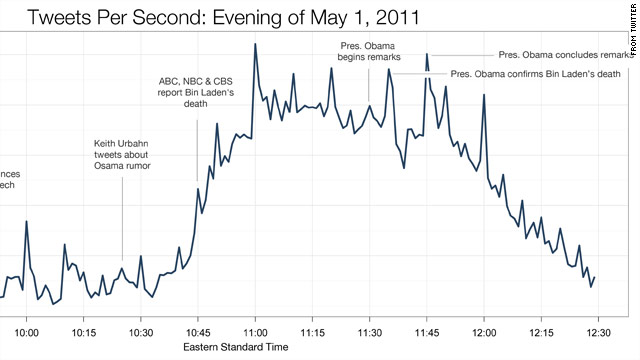
Chart of the day: Twitter and bin Laden's death

I can relate to this chart--from the moment the media started their speculation that the major address by Obama was related to OBL's death, and for a couple hours after that, I was watching for updates on Twitter ... My first tweet on this was at 8:12 pm PDT, and my final one was at 11:15 pm.  It was simply crazy to follow the news, and to kind of vicariously participate in real-time conversations, on Twitter. Who woulda thunk that!


I feel sorry for all those rebels and protesters in Libya, Yemen, ...their protests have been drowned out in the OBL news.

Friday, March 04, 2011

Twitter followers are ok, but stalkers?

Hey, my first ever Twitter warning ... Somebody thinks I am significant enough to tweet a warning to me :)


Hey, thanks for letting me know.  I will watch out for that earthquake.

Saturday, February 26, 2011

CIA orders Facebook shut down Feb 29th to 31st

Made you think twice, eh :)

Pundits are all over the map on how much the Arab revolutions were facilitated by Facebook and Twitter and ....   I like the cartoon here the best
ps: in case you are still wondering about the title of this post, ahem, check the calendar!

Thursday, October 28, 2010

Image of the day: on Juan Williams and NPR

I was one of the many who had opined that Juan "I fear Muslims" Williams ought to be fired from NPR as soon as I watched that video.  And, was glad that NPR did, though the "psychiatrist" remark ought to have been avoided.

Well, I came across this tweet today:
(on Twitter, I am "congoboy," which is how I sometimes called my dog, Congo, who died almost five years ago!!!)
I suppose Ceeb2 will be happy to know that my faculty and administrative colleagues decided that I am not qualified to be a "Professor" and I am only an Associate Professor :)

Thursday, March 18, 2010

Why India (Indians) love Facebook

I wonder what my "Indian friends" on Facebook will have to say about this column by Tunku Varadarajan: (BTW, the one good thing that came out of Rupert Murdoch taking over the Wall Street Journal? Varadarajan fled from that publication!)
Social media was invented for Indians, says Sree Sreenivasan, a digital media professor at Columbia and co-founder of SAJA, the South Asian Journalists Association. "They take to it naturally and with great passion. It allows them to do two things they love: Tell everyone what they are doing; and stick their noses into other people's business." (The gregarious Prof. Sreenivasan, when last I checked, had 4,995 Facebook friends; he, his wife, and his father—a retired Indian ambassador to the U.N.—are all my Facebook friends. My wife and brother are the professor's friends, too. Q.E.D.)
First, let me get this.  Varadarajan has Tamil Nadu connections.  Sreenivasan could easily be a name from Tamil Nadu, and definitely from southern India.  And me, well, .... :)  aaah, too many opportunities for sidebar comments! 

Anyway, that is an interesting way to look at FB and Indians--how FB fits well into an Indian way of life.  More from Varadarajan:
Prof. Sreenivasan of Columbia, no slouch on Twitter himself, says "I tell folks in the U.S. that you ain't seen nothing yet. Wait till Indians really combine their love of the cellphone with social media. Then, Facebook, Twitter, etc, will really explode.
"Take the Mumbai terrorist attacks in November 2008, for example, when so much fuss was made about how Twitter had 'truly arrived' with the way it was used during the attacks. Back then, Twitter worked in India only via smartphones and Web browsers, of which there was only a small number. Today, there are hundreds of millions of cell \phones. Imagine if they could all easily Facebook and Twitter via text message!"
Is it any wonder, then, that Facebook has gone to India—gone, I'd say again, to the place where it belongs?
For whatever it is worth: Yes, I use Twitter. I blog. I am on Facebook with 38 friends :) ht

Thursday, September 17, 2009

Tweet your story?

For sale: baby shoes, never worn
That was the shortest story that Hemingway ever wrote. Clever and profound.

But then Hemingway was also not the gazillion-line-sentence writer that Dickens was anyway :-)

There is the prolific cell phone novelist in Japan. There is fiction writing within the 140-character constraint of Twitter.

Anyway, while walking by the river yesterday, I was imagining the sight of a peacock flashing his colors, which is when I came up with the following short story.
Virgin peahen commits suicide. Autopsy reveals color blindness.

I tried!

Saturday, August 29, 2009

The end of Facebook?

Is Facebook doomed to someday become an online ghost town, run by zombie users who never update their pages and packs of marketers picking at the corpses of social circles they once hoped to exploit? Sad, if so. Though maybe fated, like the demise of a college clique.
Thus concludes Virginia Heffernan in the Sunday magazine of the NY Times.

To paraphrase Mark Twain, the death of Facebook is greatly exaggerated by commentators. But, I do wonder though what the next cool thing will be because, let us "face" it, Facebook is not cool anymore to the young crowds when even grandma and grandpa are out there. I don't know how Twitter will morph into anything other than how it currently is--I hate the idea of geocoding the twitterer's location.

I just can't wait for that next (r)evolution :)