Showing posts with label teachers. Show all posts

Sunday, January 19, 2020

Selling graduate degrees

History/news repeating itself means that I can easily copy/paste from my old posts. It is as simple as that.

Consider this Washington Monthly piece, for instance, which argues that "Teachers across the country earn grad degrees to get raises. Turns out those degrees don’t improve student learning—they just fatten universities’ bottom lines."

Ah, yes, an old issue here at this blog!

Back in September 2011, I warned readers: "Two words to keep in mind: graduate degrees."  I wrote there:
Look at yourself at the mirror and ask this question: "Does one really need a master's degree to teach at the elementary school level?
And then, follow it up with this: "Do instructors at community colleges need doctorates to teach the classes?"
There is a good possibility that your instinct says that a master's degree is not needed for elementary school teachers, and that community college faculty don't need to have the "PhD" tag either.
It is also highly probable that you think it might be a good idea if teachers have those respective advanced degrees.
Now, ask yourself, this: will student learning be increased just because it is an elementary school teacher with a master's degree, or a community college instructor with a PhD?
That was in 2011.

Here is the Washington Monthly in its January/February 2020 issue:
“Most of the research is that there’s either no statistically significant difference, or small significant differences, in teachers with master’s degrees,” said Thomas Kane, an economist and professor of education at Harvard. Matthew Chingos, an education-policy expert at the Urban Institute, has described it as “one of the most consistent findings in education research.” Kate Walsh, president of the National Council on Teacher Quality, put it more bluntly: “It’s as conclusive as research that finds smoking causes lung cancer. It’s as conclusive as the research on climate change.”
Compare with what I wrote here in 2011:
There is nothing in the literature that shows that student learning is enhanced merely because the teachers have those higher credentials.  In fact, the higher credentials by themselves do not make good teachers.  The advanced degrees are neither necessary, nor sufficient, conditions for improved student learning.  These are simply distractions!
So, why then the push for graduate degrees?  I will quote from my own post first:
The problem comes up because teachers, their unions, and the schools have set up a system in which teachers get a salary bump if they have advanced degrees. ...
Now, think about higher education as an industry.  If you are a higher education professional, you realize that there is an economic incentive for second grade teachers also to get master's degrees.  You then expand into offering those programs
And what does the Washington Monthly say?
Nixing the automatic master’s pay bump, which many experts advocate, would likely face intense resistance from teachers’ unions. It would also draw quiet resistance from a less obvious source: the universities awarding degrees. Data from the Department of Education shows that education master’s degrees are the second most commonly awarded master’s degrees in the country, after MBAs. That makes them an important and reliable source of tuition revenue—as long as teachers feel the need to get them.
Seriously, what the hell is wrong with us?!

My bottom-line was:
Taxpayers subsidize the public universities that offer those graduate degree programs.  That is right: we pay for the generation of most of those advanced degrees.  These graduates then earn more because of the very degrees, when those degrees are not even required!
That is no different from this argument that teachers ought to be paid more:
 This money should still go to teachers—it just shouldn’t be tied to an expensive, time-consuming degree with no tangible benefit. Simply giving all teachers higher salaries, says Roza, would be better than having teachers go into debt to get degrees.
Make teaching great again, dammit, instead of wasting money on unnecessary diplomas!

Monday, December 21, 2015

Our own felicity we make or find

"Have you ever read my school's Golden Jubilee book?" asked my father.

I know that the school that he attended in the village is an old one, founded many decades ago.  Yet, I had forgotten that the school dates back to the late 19th century and the book that he was referring to is from 1941-42.

The down-the-memory-lane essays by two distinguished alumni were a treat for this pretentious intellectual and writer.  One of them was certainly a classy essay that was about the school days, which were from 1900.  It vividly brought to life the personalities--the headmasters and the teachers--and the few students who were mentioned.  A piece of writing of the highest caliber, in which wonderfully woven was the quote from Oliver Goldsmith, "Honour sinks where commerce long prevails."

I had never come across that quote.  Yet again, I am humbled by how little I know.

Google gave me the source of that quote,  It is from Goldsmiith's poem, The Traveller.  It turns out that the poem is about one of my favorite topics--the pursuit of happiness.  Wikipedia offers this:
The dedication to The Traveller sets out Goldsmith's purpose:
I have attempted to show, that there may be equal happiness in states, that are differently governed from our own; that every state has a particular principle of happiness, and that this principle in each may be carried to a mischievous excess.
He begins the poem by extolling the happiness of his brother Henry's simple family life. Then, from a vantage-point in the Alps, he surveys the condition of the world. Every nation, he says, considers itself the happiest, but this is only because each nation judges by its own standards. In fact, happiness is probably equally spread, though in different forms which tend to be mutually exclusive.
The poem is from 1764, when "nations" meant different from how we think of nations now.  We could, therefore, even think of cultures, and the sentence reads very well: "Every culture, he says, considers itself the happiest, but this is only because each culture judges by its own standards."  We could also bring that down to the individual level, and it still  makes sense that we would judge happiness by our own respective standards.

I located a site that had the entire poem.  As tempting it was to note "tl; dr" I gave it a quick read.  The poem, certainly philosophical, is loaded with thoughts, place names, and events, all of which require careful reading.  I can easily imagine the essayist remembering the impressive headmaster reciting the poem and interpreting it for the class.  I wish I had that kind of a teacher even now who would  provide me with the kind of a thrilling and memorable learning experience that the essayist had as a school-boy in the classroom more than a century ago.

Wikipedia further notes that Goldsmith concluded the poem with the philosophical notion that wherever we might be--England or America or France or Italy--happiness comes from within:
How small, of all that human hearts endure,
That part which laws or kings can cause or cure.
Still to ourselves in every place consign'd,
Our own felicity we make or find
May you also find or make your own felicity.

Thursday, September 24, 2015

Those damn teachers and their stratospheric salaries!

When it comes to school teachers, over the years, society has managed to make sure that the probability of the smart students choosing that career will be ultra-low.  As I noted in this post more than three years ago, we faculty might whisper about this behind closed doors but never openly and honestly discuss it.  We do not have to wonder where the smart ones are headed.

Society, whether it is here or in the old country, "respects" only those who earn high incomes, which teaching does not offer.  The smart and hardworking students make the rational choice to then head towards Wall Street, the Silicon Valley, and other geographic areas where the roads are paved with the metaphorical gold.

On top of that is the prevailing wisdom that teachers are overpaid anyway.   That always shocks me.  I have always been puzzled at how poorly societies pay teachers. Nonetheless, my fellow citizens have clearly stated that they would rather pay for, say, entertainment than for teachers; the very ones who are shaping the lives of their most valuables ever--their children.

So, over the decades, we nickel-and-dimed teachers.  And we also made sure we made so many negative remarks that there is very little of a feeling of respect and being wanted.  Which is why, as I noted in this post a couple of months ago, teachers were fleeing from Arizona and Kansas, among other places.

Teacher shortage is now a serious problem in many states, and I am not surprised at all.  Those who have never taught have no idea how challenging and stressful the profession is, and how the burnout drives teachers away.
Clark County [Nevada,] like a growing number of school districts across the country—including Providence, Rhode Island; San Francisco; and Los Angeles—does indeed have a severe teacher shortage. Even with the marketing campaign, which recruited slightly more than 1,700 teachers to Clark County, the school district still started the school year short about 800 teachers.
Yawn!  No surprise here.
“Well-paying jobs with good conditions don’t have to have gimmicks to attract quality people,” says Richard Ingersoll, a professor of education at the University of Pennsylvania who studies teacher demographics and retention. “You have to put your money where your mouth is ..."
Of course, more money does not automatically mean better teachers.  But, guess what? Less money means no teachers.  Less money means we begin to scrape from that proverbial bottom of the barrel.  If that's what people want, hey, I have no problems with that, especially when I don't have a kid in the education pipeline!
It’s not just the salaries. It’s also the conditions in Clark County classrooms that drive teachers to leave.
Samantha Jones left Clark County in June after teaching there for eight years. She says she no longer felt respected as a professional.
Yawn!  No surprise here.

My neighbor's granddaughter is an elementary school teacher, into the third year of her young career.  Her class apparently has 45 students.  That is like how it was when I was a student back in the old country.  I am always shocked that society's priorities in this richest country on the planet are so screwed up that the class size here has grown to what we expect to see in resource-constrained developing countries.  And then there is this report:
Teachers always come and go, but in recent years there are some new reasons for the turnover. Polls show that public school teachers today are more disillusioned about their jobs than they have been in many years. One 2013 poll found that teacher satisfaction had declined 23 percentage points since 2008, from 62 percent to 39 percent very satisfied, the lowest level in 25 years. Fifty-one percent of teachers reported feeling under great stress several days a week, an increase of 15 percentage points reporting that level in 1985.
Good job by the ideologues!  But then, hey, when did ideology ever bother with the facts on the ground, right?

Tuesday, September 08, 2015

On the making of teachers ...

Until I joined graduate school, I had never thought about where school teachers came from.  All I knew about school teachers, especially the awesome ones, and the awful ones too, was from the experience as a "lifer" in that wonderful school, and from two relatives from my father's generation who were high school teachers.  I had never spent even a minute into thinking about the making of a teacher, and questions like: Who trained them?  What makes people wanting to teach?

In graduate school, depending on my mood, I would wander into any one of the libraries on campus and either do my own work or read something from the collections there.  Others perhaps call this as "wasting time" but I enjoyed such intellectual wanderings.

USC Doheny Library, summer 2009

One of the libraries was at the School of Education, which is also where I got into the habit of reading The Chronicle of Higher Education.  It fascinated me that there was a School of Education.  There were even undergraduate students who were on a teacher preparatory path.  All through my years in India, I had never known of any young person who was studying to be a school teacher.  This was all getting to be really interesting.

When I started teaching in California, it turned out that quite a few students who were in my economic geography class were there because it was required for their teacher-prep majors.  Now, I started getting some insights into the making of a teacher.  I was impressed with a few of them.  And was disappointed with most of them--if their attitude towards learning was this awful, how would would they ever inspire their students to learn!

Here in Oregon, a math colleague, who a few years ago moved across the continent to be closer to her family, once remarked at a faculty senate meeting about the immense responsibility that we faculty have.  "We blame high schools for the bad quality students they send us; the high schools blame the middle schools; the middle schools point their fingers at elementary schools.  We forget that we are the ones preparing teachers for all those schools."  I was the only one who was impressed with her plea--the rest couldn't care; I suppose they could not wait to get back to writing their journal articles and books and here she was wasting their precious time!

The interest in making sure we have good teachers is huge outside the academic walls.  Everybody, from the President to the kid on a skateboard has firm beliefs on what is wrong about teaching and teachers.  Some opinion writers even claim that a high school diploma is all one needs to teach kids.  How can we make sure that we have wonderful teachers for kids?
Policy makers have debated the best way to evaluate teacher effectiveness, but have shown little interest in the training that is supposed to make them effective in the first place. That’s changing, but it’s not obvious where and how to intervene. Tougher entry requirements for teacher training? A more challenging certification test? New accreditation standards for teacher training programs? The problem is that many different organizations influence various aspects of the teacher training process. 
It is cacophony out there!

Meanwhile, I am now left thinking about yet another issue: how come in the vast extended family we have engineers and doctors and MBAs and college professors and whatever else, but no school teachers?  Is it because it is not considered worthy enough a profession?  Nothing makes sense the older I get!

Saturday, July 11, 2015

If only WalMart can sell teachers!

A few years ago, I explained to my father that I don't get the summers off.  "We get paid only for nine months by our contract" I told him.  I gave him an idea of how much I earn, which pretty much depressed him; until then, his understanding was that college teachers in America get paid really well.  I then had to add that most of us who get into teaching are like me--we are not in it for the money.  If earnings are all we were interested in, we would have gone into other professions and we certainly have the smarts for that.

I have always been puzzled at how poorly societies pay teachers.  Back in the old country, there is a verse in the Upanishad, in which is included the directive to treat teachers like god: "acharya devo bhava."  But, of course, it is all talk and no shit!  In the industrial township where I spent all my formative years, I once went inside the home of one of the teachers.  I was shocked at how poor the conditions were.  My old Sanskrit teacher did not even have to say anything about his poor existence--it was clear that the man and his family could not afford to have even one paisa lying on the floor at home.  A few years ago, an old school mate passed along a request for financial help from the teacher who slapped me silly.  I felt bad for the guy--even though he was in a pickle largely as a result of his own follies.  I sent money to a friend and asked him to give it to the slapper, but without including my name.

Ask people with kids and they will loudly proclaim that their children are the most precious things in their lives.   If that were truly the case, and if one put the money where the mouth is, then teachers, who play perhaps as equal a role as the parents do in shaping the kids' lives, will get paid a lot and get treated well.  Yet, almost always the same parents complain about teachers' salaries.  They almost hate paying for the schooling of their own kids.  Most parents seem all too keen to nickel and dime, as we say in this country, and want to get teachers for the lowest possible price, er, salary.

As I have pointed out in many posts, I couldn't care about earning more than what I get paid now.  My daughter has remarked in the years past, quite a few times, that my decisions have always been about searching for lower paying jobs!  My personal decisions aside, I have enormous sympathies for teachers working in kindergarten through high school, who have stressful working lives dealing with kids while not getting paid a whole lot.  So much so that many school teachers take up summer jobs like painting homes and working on farms.
Because of the low starting salary, teaching is considered a poorly paid profession compared to other careers involving similar background and education requirements, such as registered nurses or accountants. Arne Duncan, the U.S. education secretary, has said that public-school teachers are “desperately underpaid,” and has advocated for doubling their starting pay.
“Most teachers do need the extra money and they do work in the summer,” says Richard Ingersoll, a professor at the University of Pennsylvania’s graduate education school whose research focuses on the teaching force; he cites data suggesting the majority of them even get actual summer jobs. According to Ingersoll, the average teacher’s earnings (including any money earned through summer work) are still lower than that of other professionals even when accounting for time off. And several studies have shown that low salaries are a top reason teachers leave the profession.
The nickel and dime approach and the disrespecting of teachers are having their effects.  In Arizona and Kansas, for example, teachers are fleeing from the profession and from the states too!

If children are their most precious things ever in their lives, would parents want financially and emotionally stressed out teachers molding the kids' minds?  Am not kidding about the stress:
 Indeed, burnout is a widespread concern in the teaching industry, and a common reason why teachers leave the classroom.
Without the summer months of furlough--remember it is not a break but a furlough--it will be extremely difficult for most teachers to recharge themselves for another academic year.

I tell ya, most parents have no idea how lucky they are that it is not the flashing dollar signs that motivates many (most?) teachers who choose to be in the profession.  


Monday, January 26, 2015

Even Democrats are taking on teachers and their unions? Good for them!

Reading this in the Economist reminded me of the election-time strike in Chicago by members of the teachers union there and had lost track of whatever happened after the strike; now, I know at least this much:
Some of the toughest decisions Mr Emanuel had to make in his first term concerned schools. He demanded merit pay for teachers and a longer school day (Chicago’s was only 5 hours 45 minutes) and earmarked for closure 50 half-empty schools in poor districts. Teachers went on strike for the first time in 25 years, but Mr Emanuel got the longer day and the closures went ahead in 2013. The teachers kept their seniority-based pay system.
Mr Emanuel ploughed some of the money saved by closures into charter schools, which made him even more unpopular with the teachers’ unions. But charter schools have worked well in Chicago.
 Emanuel was, if you recall, the aggressive White House Chief of Staff in the first couple of years of Obama's presidency.  Chicago pols are some tough people, I suppose.

But taking on that safe Democratic votes of teachers and unions?

It turns out that Emanuel is not the lone Democrat on this issue.  Consider the following that was directed at "a teacher union member who said he represents the students":
“You represent the teachers. Teacher salaries, teacher pensions, teacher tenure, teacher vacation rights. I respect that. But don’t say you represent the students.”
Ouch!  And that was not from Wisconsin's Scott Walker, but from, get this, Andrew Cuomo!  Yep, from that blue state of New York.   The son of Mario Cuomo.

And, he said more:
Cuomo referred to the teacher unions and the entrenched education establishment as an “industry” that is more interested in protecting the rights of its members than improving the system for the kids it is supposed to be serving.
“Somewhere along the way, I believe we flipped the purpose of this,” Cuomo said. “This was never a teacher employment program and this was never an industry to hire superintendents and teachers.
“This was a program to educate kids.” ...
Ouch!

You think that maybe, perhaps, even the Democrats are beginning to wonder if the teachers' unions have drifted far from their mission?  Even if you had doubts, all you had to do was read the opening lines in a powerful essay in the New Yorker a few years ago, in 2009:
In a windowless room in a shabby office building at Seventh Avenue and Twenty-eighth Street, in Manhattan, a poster is taped to a wall, whose message could easily be the mission statement for a day-care center: “Children are fragile. Handle with care.” It’s a June morning, and there are fifteen people in the room, four of them fast asleep, their heads lying on a card table. Three are playing a board game. Most of the others stand around chatting. Two are arguing over one of the folding chairs. But there are no children here. The inhabitants are all New York City schoolteachers who have been sent to what is officially called a Temporary Reassignment Center but which everyone calls the Rubber Room.
These fifteen teachers, along with about six hundred others, in six larger Rubber Rooms in the city’s five boroughs, have been accused of misconduct, such as hitting or molesting a student, or, in some cases, of incompetence, in a system that rarely calls anyone incompetent. The teachers have been in the Rubber Room for an average of about three years, doing the same thing every day—which is pretty much nothing at all. Watched over by two private security guards and two city Department of Education supervisors, they punch a time clock for the same hours that they would have kept at school—typically, eight-fifteen to three-fifteen. Like all teachers, they have the summer off. The city’s contract with their union, the United Federation of Teachers, requires that charges against them be heard by an arbitrator, and until the charges are resolved—the process is often endless—they will continue to draw their salaries and accrue pensions and other benefits.
“You can never appreciate how irrational the system is until you’ve lived with it,” says Joel Klein, the city’s schools chancellor, who was appointed by Mayor Michael Bloomberg seven years ago.
Yep, that was the Rubber Room!

That same essay noted:
Leading Democrats often talk about the need to reform public education, but they almost never openly criticize the teachers’ unions, which are perhaps the Party’s most powerful support group.
And now it is happening. In Chicago. In the state of New York. And more.

As Reason observes:
The fact that this fiery anti-union tirade passed the lips of a blue state Democrat tells you everything you need to know about just how thoroughly teaches union have alienated many of their natural political allies. And this isn't merely some quirk of New York politics, as the same thing has happened on a local scale in numerous cities such as Chicago, Detroit, and Los Angeles. Democratic politicians everywhere are more willing to take on teachers unions than ever before.
I bet this will be some interesting political theatre. Get ready.

Friday, September 05, 2014

If only more people viewed teaching as artisanal

Today is Teachers Day in India.  An old country with plenty of great teachers--real and mythical--but where in everyday life teachers are treated like dirt.  Ah, the bundles of contradictions in the old country!

If I refer to myself as a teacher, I would be misappropriating that title from those who are usually referred to when people think of teachers--in the kindergarten through high school system.
  • Teachers like the awesome one who taught math--maths, as we called that subject back then: Vimala Sitaraman.
  • Teachers like the awesome one who taught English--Mrs. Manson--who, when I talked with a few years ago, could recall a whole bunch of my classmates but told me point-blank, "I don't remember a Sriram at all."
They were teachers.  I think of people like them when I imagine a "teacher."  I owe them thanks by the trainloads.

I am not a teacher. I am a guide.

That is how I approach my responsibilities.  At best, I can perhaps claim to teaching students how to think.

One of the many topics that I force students to think about, and I wished they thought more about, is, well, their own lives and how education fits into it.  Education as being a lot more than merely to earn a diploma that can launch them into careers, including teaching.

As always, I will provide them with contexts to think about the rapidly evolving technological world and will invite them to think about their own futures.  I will remind them that the most important learning they can do is to learn how to learn, because learning will be an important aspect of their professional and personal lives.

The world in which they find themselves to be middle-aged will be profoundly different from the one in which I am a middle-aged crank.
That’s the key: can you complement the new computer technology and use it to provide a better experience rather than just be someone who does a routine thing that anyone could replace you in doing? There’s enough human ingenuity out there and enough demand for new experiences that people will be able to take advantage.
But to get there, we need to rethink education – not just to produce people who can do well on standardized tests, but who can also work in collaborative ways with interpersonal skills.
There are no standardized tests in my classes.  No Scantron sheets. No multiple-choice questions. I force them to think and articulate their interpretations of the vast grey areas.  If we can learn and think, then we are ready for the changes that are coming, and are coming at speeds that we have never ever experienced in history.
I think any young person is going to want a strong liberal arts education to give you the basis to move in a lot of different directions. I actually think it may be that a really strong liberal arts education is going to be more valuable in the future as opposed to a very specific thing by itself. A traditional business program may be less valuable in the future than someone who may have been a humanities major but learned a bunch of science and analytics as well. It’s going to be your ability to deal with what can’t be turned into an algorithm; how well do you deal with unstructured problems and how well do you deal with new situations; that’s really key.
It is simple: if you cannot think and learn, a robot will easily replace you.  Even in "teaching."


Tuesday, June 10, 2014

Yes, Virginia, earthquakes happen in California, too

Oh boy, for a news junkie like me, what a day!  I mean, what a day!

From the West Coast, which is known for literal and metaphorical earthshaking:
A shallow magnitude 3.0 earthquake was reported Tuesday evening eight miles from Ridgemark, Calif., according to the U.S. Geological Survey.
Ok, that is not the one, but this:
Judge Rolf M. Treu ruled, in effect, that it was too easy for teachers to gain strong job protections and too difficult to dismiss those who performed poorly in the classroom. If the ruling stands, California will have to craft new rules for hiring and firing teachers.
Gee, I am shocked, shocked that (awful) teachers with tenure are a major part of the education mess.  I had no idea!  (Yes, I am being gleefully sarcastic!)

Could this ruling get us out of the Jurassic Age of the education system?
The lawsuit, brought on behalf of nine schoolchildren, concentrated on three areas: teacher tenure, dismissal procedures and the seniority rules. The plaintiffs had argued that the rules resulted in grossly ineffective teachers obtaining and retaining permanent employment, and these teachers were disproportionately in schools serving low-income and minority students. The judge said this violated fundamental rights to equal education. "There is also no dispute that there are a significant number of grossly ineffective teachers currently active in California classrooms," he said, adding that “the evidence is compelling. Indeed it shocks the conscience.” 
Indeed.  Remember that lengthy New Yorker piece on the awful teachers who cannot be fired?  The Rubber Room?

Meanwhile, on the other coast, a huge political earthquake:
 In one of the most stunning primary election upsets in congressional history, the House majority leader, Eric Cantor, was soundly defeated on Tuesday by a Tea Party-backed economics professor who had hammered him for being insufficiently conservative.
I can't decide which earth-shattering news excites me more; damn, couldn't they have happened on two separate days so that I could have enjoyed them, savored them, both!

Compared with Cantor, Speaker Boehner was a "moderate."  And how does Cantor compare with the guy who beat him in the primary?  And what does it mean for the next two years of Obama's lamest of lame duck presidency?
“How do you get that or anything done now? Eric is too liberal? This was the guy holding Boehner back.”
Muahahaha.  Eric Cantor is a liberal as far as the Tea Party is concerned.  On that scale, Nancy Pelosi is more of a communist than all the communists of the world put together.

The good ol' US of A, where the political theatre can be even more exciting than the one in the old country!

Yes, I am sufficiently entertained! ;)

Tuesday, January 24, 2012

How smart is your elementary school teacher?

One taboo subject on campus, perhaps on any university campus: anything to do with comparing intellectual abilities of students across majors.  We are expected to pretend that all students are equally capable.  (Plus, of course, pretentious faculty, even at teaching universities like mine, walking around as if they are geniuses!) 

And then comes the GPA issue.  We are suddenly faced with a situation where we find plenty of students with perfect or near-perfect GPAs in some majors, and far-from-perfect GPAs in others.  But, of course, academia being nothing but politics anymore where honest discussions are not allowed, we never openly engage in discussions.

So, we whisper in hallways, and might complain to colleagues we trust.  In my case, not having a colleague to trust makes it all the easier to blog about all these :)

In my second year as a graduate student, when I was a teaching assistant, one undergraduate student, who was in my discussion section, referred to the very course that I was TAing for as a "mickey mouse" course and that she had no problems earning high grades in many similar university courses.  I was amazed at such an honest and open admission from a student. (BTW, she was a contender, that year, to be in the "Royal Court" at the Rose Parade.)

What a terrible contrast it has been since I became a faculty, only to discover that most faculty, unlike that student, do not want to engage in honest and open discussions.

Worse, they are ready to throw out idiots like me who cling on to seemingly antiquated notions that education and university are about honest pursuits of truths!

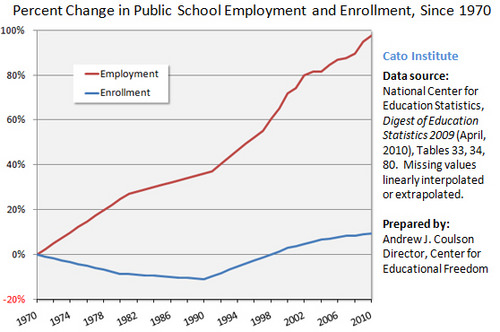
It will be awesome if, for instance, a faculty meeting were devoted to the following graph (ht):


Fat chance!

Sunday, December 18, 2011

Is any learning taking place in schools?

So, here I am half way around the world from my home, and it is fascinating to read two pieces on the same question, one in the US and the other in India.

They both tell us that there is something seriously wrong with education.

The paper here has a piece on education, in which the author--Suman Bhattacharjea--summarizes a recent study completed by her and two others:
Over 96 per cent of all children are now enrolled in school. Yet very often, we forget that children go to school in order to learn. Increasingly, empirical evidence suggests that enrolment in school does not automatically ensure learning....
This study indicates that neither higher educational qualifications nor more teacher training are associated with better student learning. What does matter is a teachers' ability to teach.
Aha, doesn't that sound familiar?  Like this argument of mine that in the US, we over-invest and overpay teachers with graduate degrees when there is no strong evidence that those graduate degrees contribute to higher student learning outcomes!

Meanwhile, from the US is this report:
Nearly half of America's public schools didn't meet federal achievement standards this year, marking the largest failure rate since the much-criticized No Child Left Behind Law took effect a decade ago, according to a national report released Thursday.
 Now, I am no fan of the NCLB Act. and for the manner in which tests become the focus.  But, we do need to constantly ask ourselves whether our students are learning, right? 

Saturday, September 24, 2011

Quotes of the day: on teachers and education in India

Where have all these teachers gone today?
Real teachers simply do not exist. We as a nation erased the framework and the climate to create good teachers. In our hurry to become a superpower, we forgot the elementary. We started first with creating engineers, followed by doctors. Then we created ‘tech coolies' and ‘nurses'. Then we created an army of generalists who claim to be educated, have paper degrees and could easily take up any of the service sector jobs — ranging from being an ‘officer' in a corporate to the ‘fast moving' retail sector to the financial services sector.
Teachers, along with other nation-building professionals, fell by the wayside. 

The entire opinion piece here.

As for the drive to generate engineers, well, to use Dr. Phil's language, "how's that workin' for you?"  Here is one about Kerala, and from what I have read and heard, this is not unique to one state, but is a country-wide issue:

[Nearly] one-third of the students enrolled in many of these private self-financing engineering colleges end up never taking the university degree — they remain Bachelor divorced from Technology (for life). Those without even the basic mathematical sense succeed in sneaking into some of the private self-financing engineering institutions, only to fail all the way accumulating back papers semester after semester. Certainly, the money their parents dish out, by way of loans, nay mortgage, contribute to the overall liquidity and provides employment and business opportunities to many. Beyond that social function, what becomes of the family from which the forlorn student hails is the moot question. 

Simply awful :(
All the more the reasons why increasingly Indians are frustrated with the current situation, and are even tempted to turn to the likes of the fascist Narendra Modi for leadership and a government that can deliver, even if that potentially means infringements on freedoms.

Because, as China, Singapore, South Korea, and the likes have demonstrated, those countries have surged way ahead of India, whose only claim seems to be its "democracy." 

How I wish I could somehow force these opinion essays down the throat (metaphorically speaking, of course!) of the author of that one hell of a stupid op-ed on the "better" education system in India!

Monday, August 08, 2011

Stupidest op-ed of the day: Lessons from India: Blame students, not teachers

It was one of those mornings when I wondered if my life will be more, or less, exciting if my vocation and my hobby alike were not as focused as they are on various public policy issues, which make a news junkie of me.

No, I am not referring to the stock market free fall.

My news addiction means that I catch up with a few local papers, including the Oregonian, which is where I came across this op-ed on the lessons to learn about schooling--from India.

Naturally, I had to read it.

And then got so pissed off with the op-ed--I was reminded of an earlier post on my displeasure at politicians hyping up the "competition" from India.

I have emailed the following to the editor, and am hoping it will be published.

While I appreciate Tracy Groom’s overall objective in her op-ed (August 8th) to improve the learning conditions in schools here in Oregon, there is very little for me to agree with her observations on India’s education system.

In the first place, comparisons of the US with India conveniently overlook the fundamental point—most of India is poor.  America’s poorest are, on average, richer than India’s upper-middle class.

Wealth is concentrated in major metropolitan areas.  Thus, cities like New Delhi, where Ms. Groom spent a semester as a Fulbright exchange teacher, often have some of the best schools also.  Typically, schools in such cities have English as the medium of instruction and the students also come from literate families—often highly educated too.  Thus, Ms. Groom’s observations about India’s educational system are highly skewed, at best. 

Even in schools in urban areas, students are often forced to become experts at rote memorization because most of the education in India is less about fostering the ability to think and is more about teaching to the tests.  But then these are the better schools, so to say. 

As one ventures out to the rural areas, conditions deteriorate rapidly.  Many rural schools lack even proper buildings. Students rarely have textbooks and rely on whatever the teachers might ask them to do in the classrooms. Most teachers are horribly ill-qualified and, according to news reports, quite a few of them collect their paychecks even without reporting to work!

If all these fail to dampen the natural curiosities of children, then there is always the possibility of punishment—from forcing students to stand outside under the blistering tropical sun, to beatings.  This is no trivial matter even in India, which is why the Indian government has addressed "corporal punishment" in the “Right to Education Act” that was recently passed. 

There are many more problems that plague India’s education system.  Even a relatively minor observation that Ms. Groom makes about students not needing tutoring services is atrociously incorrect—most parents in India have no choice but to spend a lot of money on private tutors for their children because of the lack of quality teaching at schools, and because of the intense pressure to score well in the all important tests. 

While I could point out a lot more that is incorrect in Ms. Groom’s op-ed, I would instead conclude on the note that many of the elite schools in India’s cities systematically work to introduce American-style education that encourages students to discover their strengths and weaknesses through discussions and learning by doing. 

We need to ensure that Oregon’s schools provide the best environment for the children to be all they can be. But, let us not slide down to towards the lowest common denominator, and that too based on highly uninformed and incorrect judgments on a more “successful” system in a remarkably poor India.  Tracy Groom’s op-ed does a great disservice to India and the US by projecting incorrect impressions about  teachers, students, and parents on the other side of the planet.

Sunday, April 17, 2011

Teaching credentials. One heck of a ponzi scheme?

A week ago, I had invited over for dinner at home four students who will soon graduate, and one with a graduate degree in teaching.  I asked "L" whether that grad degree is really needed when teaching in the third grade classroom, which is the career goal here.  Turns out that a mere grad degree is not that much of an employment credential anymore--additional certifications and licenses are also needed to land that job!

Unless all the four soon-to-be-graduates (all four in different fields of study) were faking it because I was the host (!), they were unanimous that the entire higher education came across to them as one "huge corporation."

This expensive credential inflation bankrupts the youth who are spending the money they don't have.  It, of course, makes colleges and universities rich and they can then build multimillion dollar gyms with climbing walls and student union buildings with wine bars.

The system is also rigged that teachers with graduate degrees get paid more too.  I have noted before--almost two years ago--the cost escalation to the system because of the additional compensation for teachers with graduate degrees:
A 2007 study estimated that 2.1 percent of all current expenditures can be attributed to teacher compensation related to master’s degrees. Seen another way, the master’s bump costs the average school district $174 per pupil.
... A Nebraska lawmaker, for example, should probably be aware that, on a yearly basis, roughly $81 million dollars—$279 per pupil—are tied up in master’s degrees and thus unavailable for other purposes. During this time of fiscal stringency, it should raise eyebrows when a state automatically allocates over 3 percent of the average per pupil expenditure in a manner that is not even suspected of promoting higher levels of student achievement.
Here in Oregon, according to this study, the extra cost as a result of this master's bump is $109,520,560.

Forget everything else, and merely use logical and rational thinking here.  How is a graduate degree holder better than an undergraduate degree holder when explaining anything to students in the third grade?  What do we Oregonians, for example, get for this additional 109 million dollar investment?  Nothing!  We spend all that money for nothing.
On average, master’s degrees in education bear no relation to student achievement. Master’s degrees in math and science have been linked to improved student achievement in those subjects, but 90 percent of teachers’ master’s degrees are in education programs—a notoriously unfocused and process-dominated course of study.
And, hey, if you want it from the proverbial horse's mouth, well, I blogged about that too a few months ago:
In a speech at an American Enterprise Institute forum on Wednesday, the secretary of education, Arne Duncan, said state and local governments should rethink their policies of giving pay raises to teachers who have master’s degrees because evidence suggests that the degree alone does not improve student achievement.
Coming soon to the third grade classroom in your neighborhood school: teachers with doctorates!

Tuesday, March 08, 2011

Teacher pay, and public outrage ... images of the day

Says a lot, doesn't it?  Discussions here ht

Bill Gates says that "state budgets are riddled with accounting tricks that disguise the true cost of health care and pensions and weighted with worsening deficits -- with the financing of education at the losing end."


But, in the public, all these are reduced to ... this?

Thursday, March 03, 2011

How do you get rid of an incompetent teacher? Like so :(

No, this is is not about me! (editor: do you have a death-wish or something? Awshutup! It is not about them)

Remember the special room that New York has for its incompetent teachers who have tenure?  No? The "Rubber Room" remember?
The Rubber Rooms house only a fraction of the 1.8 per cent who have been rated unsatisfactory. The rest still teach. There are fifty Rubber Roomers—a twentieth of one per cent of all New York City teachers*—awaiting removal proceedings because of alleged incompetence, as opposed to those who have been accused of misconduct.
What goes on this Rubber Room? Ahem ...
[There] are fifteen people in the room, four of them fast asleep, their heads lying on a card table. Three are playing a board game. Most of the others stand around chatting. Two are arguing over one of the folding chairs. But there are no children here. The inhabitants are all New York City schoolteachers who have been sent to what is officially called a Temporary Reassignment Center but which everyone calls the Rubber Room.
These fifteen teachers, along with about six hundred others, in six larger Rubber Rooms in the city’s five boroughs, have been accused of misconduct, such as hitting or molesting a student, or, in some cases, of incompetence, in a system that rarely calls anyone incompetent.
The teachers have been in the Rubber Room for an average of about three years, doing the same thing every day—which is pretty much nothing at all. Watched over by two private security guards and two city Department of Education supervisors, they punch a time clock for the same hours that they would have kept at school—typically, eight-fifteen to three-fifteen. Like all teachers, they have the summer off. The city’s contract with their union, the United Federation of Teachers, requires that charges against them be heard by an arbitrator, and until the charges are resolved—the process is often endless—they will continue to draw their salaries and accrue pensions and other benefits.
Well, looks like the Windy City can put up a good competition (ht)--click on the image for larger and clearer text/graphic

Friday, January 14, 2011

How important are "good teachers" for a "good education?"

How true is it that "no education system is better than the quality of individual teachers?"

The opening paragraph in The Economist makes it clear what that newspaper thinks:
BUDGET, curriculum, class size—none has a greater effect on a student than his or her teacher. Given this, politicians might be expected to do all in their power to ensure that America’s teachers are good ones. For decades, they have done the opposite. The trouble begins long before a teacher enters the classroom. In Singapore, which recently came second in an international ranking of 15-year-olds’ skill in maths (America was 31st), the teacher-training programme accepts only students in the top 30% of their academic cohort. In America, most teachers were mediocre students. Only 23% of new teachers were in the top third of college graduates.
So, having quality teachers is the key, right?
I am not so sure.  (editor: could it be because you feel threatened that it will soon be revealed that you are a lousy teacher?  Awshutup!)

I am a lot more inclined to agree with the writer at Spiked who argues that education systems are increasingly messed up because of "the denigration of the idea of knowledge as an end in itself." There has been a systematic erosion of this notion that education is all about knowledge as an end to itself.  (One can immediately see how, therefore, a testing-centered No-Child-Left_Behind is messed up!)
When I was at school, academic knowledge was more valued than it is today; there was a far stronger belief in the value of education for its own sake. This was the principal central organising principle for educationalists, and it brought parents, teachers and educational elites together in a common endeavour.
In this climate, teachers could actually get on with teaching their specific subjects. There was undoubtedly a wide disparity in the amount of enthusiasm, talent, skill and success with which any individual teacher went about his or her work. And, like most people, I can remember teachers who were inspirational and others who were deathly dull. But the net effect was that school felt like a collective effort where pupils and teachers pursued a common goal. The sum was greater than its parts. So the education system was, and can still be, better than ‘the quality of its individual teachers’.
To look upon teachers as being solely responsible for the quality of education is both incorrect and unhelpful.
Yep, my story as well.  It seems like I had as many awful teachers as there were fantastic teachers.  But, even the awful ones made it abundantly clear that we were in school to learn and appreciate the wonders of knowing.  But, that does not seem to be the case anymore.  Why so?
the most disastrous has been the loss of faith in the pursuit of Truth, without which education starts to lack a point. 
Indeed!  I tell students that we pursue the truth--not there there is a magical book that reveals the truth. But, I am not sure even if university faculty convey and practice this message anymore.  Most of us merely Bullshit.  But, I digress.
I liked the following paragraphs even better than the first few:
We do need to accept that not all pupils will understand all subjects at school. While the government’s aim to help children ‘achieve much more than they may ever have imagined’ is laudable, this outlook is often mixed up with the idea that every child should achieve the same results. The idea that education should somehow create wider social equality is erroneous. Social equality is a complex political issue that can only be solved in adult society, not in schools.
The idea that education determines all later life chances is now widespread. Within the education system it has encouraged a focus on the assessment of common skills in order to allow for the most superficial kind of equality of outcomes.
However sincere the wish, education cannot, and should not, be thought of as ‘an engine for social mobility’. Past attempts to burden education with this task have failed and it has led to a degraded view of the value of knowledge, the consequences of which the Lib-Con coalition seems to underestimate.
Having a good education does not guarantee a comfortable adult life, with a nice house and an interesting, well-paid job. Social and material inequalities are neither entirely created, nor remediable, in the sphere of education. In fact, the paradox of education is that it is likely to be of greatest benefit when we afford it the greatest autonomy and insulation from the concerns of wider society.

Friday, November 19, 2010

Do elementary school teachers need master’s degrees

From the Chronicle of Higher Education:
In a speech at an American Enterprise Institute forum on Wednesday, the secretary of education, Arne Duncan, said state and local governments should rethink their policies of giving pay raises to teachers who have master’s degrees because evidence suggests that the degree alone does not improve student achievement.
This is a familiar territory in this blog; back in September 2009, I blogged, citing Matt Yglesias, questioning the logic behind paying teachers more if they have graduate degrees.  It adds on a huge cost to taxpayers, with no returns on this premium.

Friday, November 12, 2010

Party like there is no deficit!

The topic is pensions as one hell of a liability issue is not new to this blog.  So, the following serves as an addition to the collection:

Today there is an almost $500 billion shortfall for funding teacher pensions, and that gap is growing. Why should you care? Because ultimately taxpayers are on the hook for that money. But the problem doesn't just end there.
One would think that these and the other kind of future obligations will force us to worry, and do something, about the growing deficit and debt issues.  The preliminary thoughts from the "bipartisan" commission has already been declared dead on arrival.  It is kind of an irony in that the opposition is absolutely bipartisan--commentators of every stripe seem to be opposed to it.