Showing posts with label hinduism. Show all posts

Monday, June 15, 2020

Corona Amman

Four years ago, a "kumbabhishekam" was organized for a temple in grandmother's village.  That Mariamman Kovil is dedicated to the goddess who, according to the believers, protected them from the dreaded small pox.

Praying to the gods in order to ward off the horrible small pox was not a Hindu thing.  Cultures all over the world did that.  The small pox is the only disease for which there are specific deities because people had such fears about it--and rightfully so.

A few weeks ago, I clarified to my mother that the coronavirus is less like a flu but more like small pox and tuberculosis that they worried about when she was young.  My mother knows well about those old diseases, having survived a TB infection in her chest that nearly killed her.  If not for the modern treatments that had become available, she might have had a short life like her favorite uncle and aunt who died from TB, and I would not be blogging!

Elders had stories about blood sacrifice at the Mariamman Kovil.  Chicken or goats were killed in front of the deity.  One aunt recalled her father taking her to the annual feast at the temple when she was a kid, and described how a guy took a knife to his elbow and then proceeded to "serve" a couple of drops of blood on every banana-leaf.  I wish I had asked her if people consumed that blood too!  Such stories terrorized me as a kid, instead of making me view the goddess as a savior.

But then, as anthropologists note, this was the standard operating procedure of those days.
Contagion goddesses are not angelic and gentle, as one might expect caregivers to be. They are hot-tempered, demanding and fiery. They are deemed wilderness goddesses – highly local and traditionally worshiped primarily by lower caste, Dalit, tribal and rural folk. Some are associated with tantric practices and dark magic.
Placating the goddesses through blood sacrifice, decorative offerings and self mortification, was – and in some places, still is – a way of preparing for a pandemic in parts of India.
And, yes, the Mariamman temples seem to be in the outskirts of the village and far away from the "high caste" neighborhoods.  (Click here for an old post on the caste/religious spatial organization in grandma's village.) 
High caste Hindus and those who mirror high-caste practices often ignored and shunned the contagion goddesses, fearful of the blood rites, possession and the tantric rituals, which they associated with low caste worship.
But, the higher caste folk in grandma's village also donated to the temple--with the hope that the goddess would protect them from small pox.

The Hindu faith is fluid and dynamic, and adapts to changing conditions.
With the widespread use of modern antibiotics, retrovirals and vaccines in the mid 20th century, traditional Hindu healing rituals became less relevant. Contagion goddesses were beginning to be forgotten and ignored. But a handful of them developed rich post-pox lives, reinventing themselves for modern afflictions. Some goddesses moved on from focusing on disease alone.
The gods must be crazy for unleashing such viruses on us humans!

Monday, November 19, 2018

Hare Krishna!

I had no idea about Leonard Bernstein until I came to the US for graduate school.  I watched West Side Story on a rickety old television set, and was hooked.

Bernstein, whose centenary was this year, was a music giant, and a public intellectual and a social activist, who spoke up on important issues of the day.   A deep thinker he was, as much as he was a musician.  When artists like him, with their broad and deep knowledge, speak, society listens.  Even when they point out to the uncomfortable truths.

Back in the old country, TM Krishna continues with such a tradition of the public-intellectual-musician.  He is not new to this blog, of course.

As a musician, Krishna is one of the best; even my father, who after listening to the jambhavans of old the days rarely ever elevates any of the contemporary young artistes to the stratosphere, has a favorite story about how Krishna moved him to tears at a homage to Musiri.

As a public intellectual, Krishna is turning out to be equally accomplished.  From the other side of the world, it seems to me that Krishna's activism are about injustice, of which there is plenty in India.  The latest incident was no exception; he has pumped up his activism:
"Krishna sings, Krishna is heard", reports The Indian Express.  "A soiree on the art of politics," reports another outlet.
The political overtones of this musical soiree are surely difficult to miss. Ranged on one side are dogged opponents of the values and politics Krishna and AAP stand for. This fusion of politics and music – Carnatic music and north Indian politics – sends out a signal of the political direction that could take place in the days and months ahead. ...
The 2019 Lok Sabha elections are just five months away. If the routine silence of the ruling BJP is a way of endorsing the intimidation and threats made by right-wing social media trolls, swift retaliatory tactics by its opponents are also a way of getting back at the party.
Critics telling Krishna to shut up and simply focus on his music are no different from the right-wing nutcases here in the US who tell football players to shut up and simply play ball.  Krishna is ballsy; a lesser man would have quit being an activist a long time ago.

Again, one can learn from Bernstein's life:
Bernstein was named in Red Channels, a publication from 1950 that targeted people in the entertainment industry who were suspected of having Communist affiliations. Since he was prominent, and a lot of people around him had leftist affiliations, the FBI paid attention to him. He kind of slid past the McCarthy hearings. Copland and Robbins were called to testify, but he was not. He lost his passport for a time in the 1950s, but that was it.
I am thankful that there have been, and are, people fighting these good fights.


Monday, February 15, 2016

God hates menstruating women?

This recent post was about the pathological relationship that some have with women, and most of that pathology having to deal with religion.  Another post from three weeks ago was on a public policy issue relating to women--taxing tampons.  Put them together as a Venn diagram of sorts and you can see the possibility of religious institutions having practices that restrict menstruating women, right?

I have been trying to understand this issue for a long time.  It is a strange world that I had to understand as a young boy when my mother could not attend a wedding in the family.  She traveled with us all the way and then had to exclude herself from mixing with people.  It was the introduction to women's issues that were never talked about but were always there.  If not for the biology class that described the ovary, Fallopian tubes, and the uterus, and why bleeding happens, the whole thing would have been a bloody mystery to me.  (Yes, the horrible pun intended; hehehe!)  It is darn stupid to exclude girls and women from regular life just because they menstruate.

Now consider a temple setting.  A Hindu temple, like any place of religious worship, is not a place for reason.  It is about faith, and like all religious faiths, well, it is irrational.  In such a faith context, bleeding women are typically not allowed to go anywhere near the pooja (worship) room at homes and, of course, the temples too.

I have no quarrels over how people want to practice their faiths.  It is up to the believers to think about how awful their faith-based everyday life can be, like with banning menstruating believing women from the zone.

So, if some of the faithful think it is not kosher to ban the menstruating women from temples, what options do they have to correct the injustice as they perceive it?

In India, that's what apparently led a few to approach the court--in the context of the Sabarimala temple ban on females between 10 and 50 years of age.  Why the court, you might wonder.  Because,  unlike here in the US, India's temples have government oversight.
The ban was enforced under Rule 3 (b) of the Kerala Hindu Places of Public Worship (Authorisation of Entry) Rules, 1965 (women at such time during which they are not by custom and usage allowed to enter a place of public worship).
So, if the government oversees the functioning of temples, then, of course, the judicial arm of the government has a say in whether menstruating women should be barred from entering temples.
A Special Bench led by Justice Dipak Misra, which is hearing the Sabarimala temple entry issue, will consider the intervention application. The students want the apex court to address and decide on whether modern society should continue to bear with “menstrual discrimination” when the Indian Constitution mandates right to equality and health of women to achieve gender justice.
As you read this, perhaps you think, "wait a second, this is bizarre."  But, bizarre is in the eye of the faithful.  Barring menstruating women from temples is not bizarre to many believers (including women), just as wrapping up women in burqas is not bizarre to another group of the faithful.  Many churches in old Europe do not allow female tourists in skirts or without a scarf over their heads--bizarre faith-based practice.  What is bizarre to one is apparently holy to another!

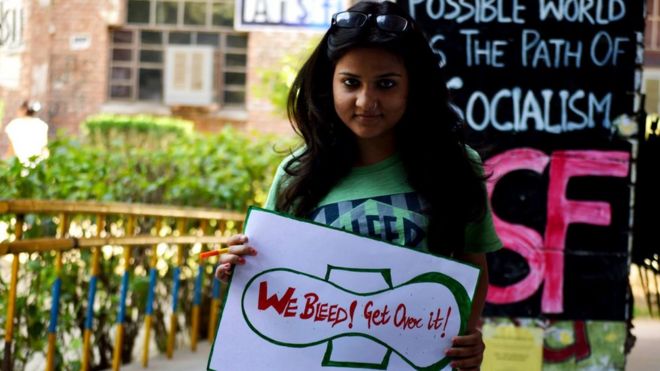
Why only the Sabarimala temple?  The "Happy to Bleed" campaign began after this:
"A time will come when people will ask if all women should be disallowed from entering the temple throughout the year," Prayar Gopalakrishnan, who recently took charge of the hilltop temple dedicated to Lord Ayyappa, told reporters earlier this month.
"These days there are machines that can scan bodies and check for weapons. There will be a day when a machine is invented to scan if it is the 'right time' for a woman to enter the temple. When that machine is invented, we will talk about letting women inside," he added. 
Ah yes, surely science and technology can deliver such a gadget--there are plenty of smart Indians, women too, who can work on it ;)

Back to the high court in India:
At a preliminary hearing on Friday, Justice Misra had asked whether the Vedas, Upanishads and scriptures discriminate between men and women. “Is spirituality solely within the domain of men? Are you saying that women are incapable of attaining spirituality within the domain of religion? Can you deprive a mother?” Justice Misra had asked.
Now, it doesn't take a rocket scientist to, therefore, conjecture that women cannot be priests at temples, right?  That controversy will be for another day! All this atheist can do is observe such happenings and comment on this mad, mad, mad religious world ;)

Source

Friday, May 02, 2014

The (Chinese) gods must be crazy!


As a graduate student, I never said no to any fellow Indian student asking me whether I wanted to go to the Hindu temple.  Not because I was a faithful believer, but because it was at a scenic spot, and the drive was scenic as well.  And, of course, there was good food.

Not only the temple priest, but the sculptors were also imported from India.  Of course, it was not new.  That's how these things are done.  But, if Hindus could cross the seas, which was traditionally prohibited, and could thus settle down in lands far, far away, then how much are traditions, well, traditions?

In the tradition, worshiping god is not in the abstract manner but by praying to idols and paintings.  One needs to only look at abandoned temples in order to theorize that a worshiped god no longer exists in that very idol that was worshiped for years, even centuries.  The same idol when under the care of the government's archaeology department becomes a mere artful sculpture that attracts mostly only foreign tourists.


Non-believing foreigners go to visit the god-less idols in abandoned temples.  What if non-believing foreigners created images of gods for the believers to worship?

Sounds intriguing?  The Hindu reports:
Mr. Zhao’s shop, the Zhejiang Yiwu Yijie Crafts company, displays from its walls images one would not expect to find in officially atheist China: on one corner is a collection of beautifully rendered images of the god Krishna as a child. There are, on the shop’s walls, framed photographs of half a dozen gods and goddesses from the Hindu pantheon: images of Ganesha, Hanuman and Saraswathi on a lotus.
From this small shop in Yiwu, these images will find their way to homes and offices – and possibly even places of worship – across India.
More than a hundred Indian companies buy Mr. Zhao’s products, supplying and distributing them across India – often without making their customers aware of the fact that the images that adorn their prayer rooms were all put together by Chinese workers in a factory in Zhejiang province.
"Without making their customers aware."  Caveat emptor, indeed!

If the customer is informed about this, will the god become any less a god to the faithful who worships the image?  

A few years ago, Thomas "master manipulator of metaphors" Friedman noted that practically every statue of Virgin of Gualalupe that was sold in Mexico was manufactured in China.  Maybe I ought to watch out for his pointless pontificating on Ganesha from Guangzhou.

Anyway, The Hindu adds:
There are at least three other companies that have factories producing images and statues of gods and goddesses for the Indian market. Most of the factories are located in Cangnan, a county close to Wenzhou – a thriving port city in Zhejiang that is famous for being a centre of entrepreneurship. Some of the companies have listed annual sales of 10 million Yuan (Rs. 10 crore); they also render a range of Christian images for export.
Zhang Daofeng, who runs a factory in Cangnan, said his company’s “Indian gods series”, which included posters, three-dimensional images and statues, were being sold across India.
Mr. Zhang was one of the earliest producers of images of Hindu gods. Today, he estimates, there are between 30 and 40 companies in China doing the same, even as they struggle to stay competitive as wages across China rise year after year. “Many of the new factories offer poor quality, but the Indian customers are very price sensitive so business is down,” he said.
Of course, the faithful shall also be bargain-hunters!  The god-crazy India combined with the price-shopping behavior means:
“It’s still easier to order from China,” one trader said. “Everything is produced in bulk, and the trade is very organised. Where am I going to find such factories in India?”
How interesting that a country with 800 million Hindus have outsourced a good chunk of their god production to godless China!

The gods must be crazy!

Monday, March 03, 2014

Blogging about reading Wendy Doniger's "The Hindus": #4

It looks like blogging on other topics might have to be put on hold for a while.

Doniger writes,
"Much of what we now call Hinduism may have had roots in cultures that thrived in South Asia long before the creation of textual evidence that we can decipher with any confidence. Remarkable cave paintings have been preserved from Mesolithic sites dating from c. 30,000 BCE in Bhimbetka, near present-day Bhopal, in the Vindhya Mountains in the province of Madhya Pradesh.
My first reaction was: did I sleep though the Indian history class in high school when they might have discussed this?  30,000 year old cave paintings that I hadn't even heard before?  This being in India, are those paintings well protected?  Have by now people already scribbled on them the equivalent of "sriram wuz here?"

India is filled with all kinds of mysteries!  One of them is the unresolved question of where and how did the Hinduism as we refer to originate:
There were other early settlements in India, notably the culture of Baluchistan, in the westernmost part of what is now Pakistan, dating to before 6000 BCE. But from about 2300 BCE the first urbanization took place, as great cities arose in the valley of the Indus River, 150 miles south of Baluchistan, also in Pakistan. The material remains of this culture, which we call the Indus Valley Civilization or the Harappan Civilization (named after Harappa, one of two great cities on the Indus, the other being Mohenjo-Daro), present a tantalizing treasure chest of often enigmatic images that hover just beyond our reach, taunting us with what might well be the keys to the roots of Hinduism.
Damn those people for not leaving behind clear records for us--maybe we need to outsource decoding this to Martians ;)
For the resemblances between some aspects of the IVC [Indus Valley Civilization] and later Hinduism are simply too stunning to ignore. As the Late Harappan culture declined, its survivors must have carried some of it into the Ganges-Yamuna basin. ... [The] process of urbanization moved gradually south from the Indus cities to the site of Kaushambi, near modern Allahabad in the Gangetic plain, and to the surrounding villages. ... The Indus Civilization may not have simply gone out like the flame of a candle or, at least, not before lighting another candle.
...
We can see the possible survival, in transformation, of a number of images. ... These patterns, and the rough outlines of other images that we have considered, perhaps even the stone lingas and the voluptuous women, may have gradually merged with the culture of the people of the Veda.
Which then leads us to the question of where these Vedic people came from. Who were they?  How did they relate to the IVC people? To the Dravidians?

Frustrating because the Vedic people left behind the sounds of knowledge (Vedas) but otherwise they cleaned up before they turned the house over. Not a scrap remains of their existence.

But, before that, what triggered the collapse of the Indus Valley Civilization?  Interestingly enough, Scientific American has this today:
The decline of Bronze-Age civilizations in Egypt, Greece and Mesopotamia has been attributed to a long-term drought that began around 2000 BC. Now paleoclimatologists propose that a similar fate was followed by the enigmatic Indus Valley Civilization, at about the same time. Based on isotope data from the sediment of an ancient lake, the researchers suggest that the monsoon cycle, which is vital to the livelihood of all of South Asia, essentially stopped there for as long as two centuries.
The monsoon did not fail for merely a season or two: " the regular summer monsoons stopped for some 200 years."

Ouch!
If a lack of monsoons did spell the end of the Indus Valley civilization, says Hodell, “it is an example — and there are other examples of this — of how ancient societies have had to contend with climate. There are some lessons for us and our future, in which we will have to deal with anthropogenic climate change”.
Hmmm ...  Jared Diamond now gets another piece of evidence that adds to the thesis of Collapse.

Source

Sunday, March 02, 2014

Blogging about reading Wendy Doniger's "The Hindus": #3

Three years ago, India's Supreme Court noted that India, too, is a land of immigrants and that about 92 percent of the population descended from immigrants from the northwest and the northeast.  India has been at interesting crossroads throughout--people and ideas came in from over the mountains and across the seas. Doniger writes that "India functioned, throughout history, less like Shangri-la than like Heathrow or O'Hare."

She builds on that imagery, and draws a parallel with that icon for immigrants to the US:
The proliferation of polythetic polytheisms may pose problems for the definition of Hinduism, but they are its glory as a cultural phenomenon. Pluralism and diversity are deeply ingrained in polylithic Hinduism, the Ellis Island of religions; the lines between different beliefs and practices and permeable membranes.  Not only can we see the Hindu traditions a divided among themselves on many central issues throughout history, but we can see what the arguments were on each point, often far more than two views on major questions. The texts wrestle with competing truths, rather than offer pat answers.
Not only are new people and new ideas coming in to stir things up, the Hindu traditions are divided amongst themselves with competing truths. Thus, when a new layer is added:.
The Parsis ("Persians"--i.e., Zorastrians) in several communities in India tell a positive story about social hybridity. They say that when the Parsis landed in India, the local Hindu raja sent them a full glass of milk, suggesting that the land was full. The Parsi leader added sugar and returned the glass, indicating that his people could mix among the Arabs and Hindus like sugar in milk, sweetening it but not overrunning it. The metaphor of sugar in milk suggests the extreme ideal of communal integration, in which individuals change the community by melting into it, flavoring it as a whole with their qualities (Zorastrianism, or sweetness).  The Parsis did not in fact dissolve into Islam and Hinduism; they remained Parsis and indeed were often caught in the crossfire during the riots that followed the Partition of India and Pakistan in 1947. This seems to me the more accurate way to view such cultural mixes: as a suspension of discrete particles rather than a melting pot.
Which is all the more why I find it so un-Indian like to protest against Wendy Doniger's book, and to compel the publisher to withdraw all the copies and pulp them.  To borrow from an Indian sport that was accidentally invented in England, this battle cry against a foreigner and her ideas is simply not cricket.

Doniger wraps up the first of the twenty-five chapters with this:
I would therefore argue for the recognition of the simultaneous presence of a number of pairs of opposites, throughout the history of the Hindus, the both/and view of community. The historiographic pendulum of reconciliation, never resting at the swing either to one side or the other, forces us to acknowledge the existence, perhaps even the authenticity, of the two extremes of various ideas, and also their falseness, as well as the fact that there is no pure moment at either end of the swing, and leave it at that
Perhaps such an interpretation reminds one of Amartya Sen's The Argumentative Indian.  I wonder if I picked up on the multiplicity of truths, even without my knowing, right from my young days and, to this day, am hell bent on ticking people off because I rarely ever subscribe to anything as the truth!  The earliest I remember when I felt my views on Hinduism challenged and, thereby, my view of the world itself, was during my preteen years and father had brought home from his magazine club the tabloid Blitz.  In that was an article about the Shiva Lingam being a phallic symbol.  A phallic symbol!  I talked about that with my cousin, who seemed to be aware of that interpretation but was not at all bothered by it.  Doniger does write about that, which is not really news anymore, but can easily upset the true believers who worship the lingam.  I am sure she will have more on these in the later chapters.

The Gudimallam Lingam, aka Lingodhbhava
Source

Blogging about reading Wendy Doniger's "The Hindus": #2

Where does one begin the narrative on the Hindus, right?  Will be quite a challenge.  No wonder the book is as long as it is, and I am yet to move past the introductory chapter!

Meanwhile, a friend informs me that the saga continues:
Another book on Hinduism by American indologist Wendy Doniger has come under attack from the same Delhi-based group which had compelled the publishers of an earlier work by her to withdraw the title. 
Shiksha Bachao Andolan Samiti (SBAS) demanded on Saturday that the Aleph Book Company stop sales and pulp all remaining copies of Doniger's book "On Hinduism", published in 2013. 
Which is why negotiating with terrorists is a bad idea--they get emboldened the moment you yield. 

Anyway, continuing on with "The Hindus" by Wendy #Doniger (the immediately previous post here):
The textbook of legal code (dharma) attributed to Manu (first century CE) does not use the word "Hindu" but does offer a geographical definition of the people to whom his dharma applies (a definition that, it is worth noting, uses animals to define humans):
From the eastern sea to the western sea [the Indian Ocean and the Bay of Bengal], the area in between the two mountains [the Himalayas and the Vindhyas] is what wise men call the Land of the Aryas. Where the black antelope ranges by nature, that should be known as the country fir for sacrifices; and beyond it is the country of the barbarians. The twice-born [the upper classes and particularly the Brahmins] should make every effort to settle in these countries.
At first blush,, it might seem like Manu was the biggest ignoramus that ever lived. But, in jumping into that conclusion, we forget to contextualize his observations.  It was 2,000 years ago, when humans had very little idea of the planet, and its physical and human geography.  It is, therefore, quite an impressive achievement that Manu was familiar with the geography that he describes.  If we laugh at his idiocy now, imagine how generations two centuries from now will find our own idiocy to be a tragic farce!

However, those few sentences also underscore the rising importance of the upper classes, and the Brahmins in particular. A social dynamic that has immensely messed up India forever.

The narratives about India and Hinduism often completely ignore the non-Sanskrit stories. I grew up in a Tamil language environment--the oldest living language with a rich literature past.  A language that is not derived from Sanskrit, and which uses a script that is not god's own, Devanagiri, that Sanskrit uses.  Thus, the world outside rarely has any clue about the Tamil and Dravidian stories--of Hinduism and otherwise.  How did that happen?
Sanskrit is the model for most North Indian languages (and the source of much of their grammar and some of their vocabulary), , as Tamil is for the Dravidian languages of the south (such as Telugu, Kannada, and Malayalam.) ... Not only did southern ideas go north, and vice versa, and not only did Tamil flow into Sanskrit and Sanskrit into Tamil, but Tamil went north and Sanskrit south.
...
The British used texts as a way of disregarding actual Hindu practices and justifying their own imperial project with textual citations. And the Orientalist orientation to texts is the orientation toward Brahmins (and Sanskrit, and writing.) More recently, scholars have begun to pay more attention to ritual, archaeology, art history, epigraphy, the records of foreign visitors, and, in the modern period, ethnography, revealing new aspects of a lived religion that is very differently represented in texts.
There was a great deal of non-Sanskrit, non-Vedic, Hinduism that I was familiar with right from when I was a kid.  At grandmothers' villages, there were village deities that had nothing to do with the Vedic gods.  There was the "maadan"--spirits. The "god" who protected the population from the dreaded smallpox was non-Vedic. The favorite god of many Tamils, "Murugan," is almost exclusively worshipped in the Dravidian south.

The "kodai" festival at Pattamadai was a village celebration in non-Vedic ways. My father's cousin sister has a favorite story about this.  Girls could go to those celebrations up until they hit puberty.  But, rarely were kids--boys and girls--taken to those because of the "strange" practices there.  This aunt of mine nagged her father enough--she was the youngest of four--that he took her to the festival. One strange thing after another. And finally they sit down for the feast. A guy proceeds to cut himself on his elbow and blood gushes out.  He then moves from one plantain-leaf-plate to another and places a drop of his blood on each.  The aunt said she almost fainted.  This was less than fifty years ago!

I have always considered it a tragedy that the old country did not spend time and energy understanding such old faiths, which were also part of Hinduism.  Instead, it all became a Brahminical, Sanskrit, version of a very complex and diverse religion.  I am sure Doniger will get to such discussions as well.

At the temple out in the wilderness where our "family temple" is located

Tuesday, February 11, 2014

If no incoming fire, you are bombing the wrong place

It all started with a tweet. A short one in my Twitter feed.

I haven't read that book, but remembered that it created a controversy in India and that there was pushback from nationalistic and Hindutva groups.

So, I then did a quick search to see if the author might have said anything about it.  There was nothing, but I came across a recent interview with her, which I watched. I then tweeted a response:

Apparently this was not a case of a tree falling in the forest and nobody hearing the sound it did, or did not, make:
It always amazes me that those who want to deny the freedom of expression and inquiry often do that with discourteous language too.  Not that I care for their courtesy while shutting me up!

Some random Twitter user is not going to scare me.  As a first step, I let "Teja" know that this "Stupidest fuck" read the tweet by ... well, I retweeted it!

The WSJ reports on this decision by Penguin:
One of India’s largest publishing houses has agreed to withdraw and pulp all copies of a 2009 book written by a leading scholar of Hinduism that reinterprets the history of the ancient religion. Penguin Books India Pvt. Ltd complied with an agreement drawn up by a court in Delhi on Monday to recall and withdraw all copies of “The Hindus: An Alternative History” by Wendy Doniger, a professor of the history of religions at the University of Chicago, and cease to publish or sell it in India. 
In that same report, the WSJ reminds us that this is not the first instance of a book being banned in India. What a shame!

The paper also notes this:
A review of the book, published in the Journal in 2009 said that Ms. Doniger had succeeded in “making modern sense of the texts and tales of Hindu society, as well as of the rituals and symbols of the Hindu people.” 
At the end of it all, I figured that the best thing I can do is to buy a copy of this banned book, and read it over the next couple of months. "Teja" and his buddies will be delighted that their work has catalyzed me into buying the very book they have successfully banned in India.


As for the title of this post, I heard something along those very words in an NPR segment--I wish I remembered when it was for me to zoom into it and attribute the source.

Update: I should have known that some of the commentators I pay attention to will have something to say ... here is Shikha Dalmia:
[Her] aim in writing the book was to save Hinduism from misinterpretations of both hostile alien interlocutors and nativist Hindutva boosters.
Here is a flavor of the book from a review by Daily Beast columnist Tunku Vardarajan, former Newsweek international editor:
A religion without a central church or pontiff — and with no predominant sacred place (a la Mecca) -- Hinduism has spawned hundreds of competing devotional sects and theological strains. Ms. Doniger does a deft job of tracing their few unifying tenets — those of karma (actions) and dharma (righteousness) and a merit-based afterlife and of holding these beliefs up to critical examination against the obvious injustices of the caste system. Her most beguiling chapters, though, are the ones in which she examines the impact on the Hindus of India's numerous foreign invaders -- from the earliest "Aryans" in the second millennium B.C. to the imperial British, the last and perhaps greatest external shapers of Hindu society.
Am all the happier that I purchased the book. The paperback. I prefer the old style, when it comes to books.  As Dalmia notes:
The silver lining in all this, as Doniger told England-based Salil Tripathi last night, is that in the age of Internet, Penguin can’t actually ban the book. “Anyone with a computer can get the Kindle edition from Penguin, NY, and it’s probably cheaper, too.”
So go for it dear readers. It’s for a good cause.
Yes, buy it.

Sunday, July 21, 2013

How do you say Quanzhou in Tamil?

Every day there is more evidence on how much of a false idea it is when we think that globalization is something new.  We humans have always been curious about the world outside our respective villages, but were constrained by the technological limitations of the times, as much as our deep space explorations are limited now because we simply do not have the abilities to go where no man has ever gone before.

In addition to the curiosity, we humans have an economics gene in us.  Way back, when humans figured out that we do not have to live the way other animals do, and that we can divvy up the workload and then trade for goods and services, that gene started playing an increasingly important role.

Today's evidence on such a commerce-led globalization comes from India.
No, from China.
Ok, from both these countries.
Caption at the source:
A panel of inscriptions of the God Narasimha adorns the entrance to the main shrine of the temple,
believed to have been installed by Tamil traders who lived in Quanzhou in the 13th century. 
 The Chedian shrine is just one of what historians believe may have been a network of more than a dozen Hindu temples or shrines, including two grand big temples, built in Quanzhou and surrounding villages by a community of Tamil traders who lived here during the Song (960-1279) and Yuan (1279-1368) dynasties.
At the time, this port city was among the busiest in the world and was a thriving centre of regional maritime commerce. 
By now, are you thinking what I am thinking?  Where the hell is Quanzhou?


View Larger Map

Across the waters from Taiwan!

And these traders from Tamil Nadu got to Quanzhou a thousand years ago?  Cool!

Wait a second; there's more:
Ms. Wang says the earliest record of an Indian residing in Quanzhou dates back to the 6th century. An inscription found on the Yanfu temple from the Song Dynasty describes how the monk Gunaratna, known in China as Liang Putong, translated sutras from Sanskrit. Trade particularly flourished in the 13th century Yuan Dynasty. In 1271, a visiting Italian merchant recorded that the Indian traders “were recognised easily.”
Sixth century?

The distance between South India and Quanzhou 1,400 years ago might have felt like the distance between Earth and Mars now!
The most striking legacy of this period of history is still on public display in a hidden corner of the 7th century Kaiyuan Buddhist Temple, which is today Quanzhou’s biggest temple and is located in the centre of the old town. A popular attraction for Chinese Buddhists, the temple receives a few thousand visitors every day. In a corner behind the temple, there are at least half a dozen pillars displaying an extraordinary variety of inscriptions from Hindu mythology. A panel of inscriptions depicting the god Narasimha also adorns the steps leading up to the main shrine, which houses a Buddha statue. ...
A few kilometres from the Kaiyuan temple stands a striking several metre-high Shiva lingam in the centre of the popular Bamboo Stone Park. To the city’s residents, however, the lingam is merely known as a rather unusually shaped “bamboo stone,” another symbol of history that still stays hidden in plain sight. 
Something new every day.

I wonder if my fellow-explorer of all things under the sun, Ramesh, who spent a few years in China, has been to these places.  Or Indu, with her China experience, who seems to occasionally swing by this blog.

If even "cockles" can get my curiosity, then it is not difficult to imagine me getting all excited about this topic, right?  Google directed me to this, where the author notes:
A Chinese source states that in 720 the Pallava king Narasimhavarman II "constructed a temple [in Tamil Nadu] on account of the empire [i.e. China]", and another text cites the existence of three Hindu temples in southern China where "Brahmans" resided during the eight century.   
Pallava King.  Ah, yes, my mind rewound my clock to my sabbatical year, when I was able to travel around a lot more in India than I normally would have been able to.  I spent an entire day at a few temples in Kanchipuram--the capital city of the Pallava Empire.  At one of those temples, the guide directed my attention to a 1,300-year old stone-carved panel depicting a Chinese guy:


Was this that temple that Narasimhavarman II built?  Curiosity means the exploration never ends and, dammit, all the stories are so inter-connected too!

I suppose between this Chinese guy and a South Indian in Quanzhou, we somehow ended up with the சீனா சட்டி ("cheena chatti"--a wok); ah, recalling the taste of dosai made in that chatti makes me drool!

I wonder if the Quanzhou connection was also how came to enjoy the dish of சேவை (sevai)?  Hmmm ... More drool!


Saturday, June 01, 2013

Life is not about the grammar issues

Before you get any incorrect ideas and leap to conclusions, let me make it clear: spellings matter; watch out for the comma, which can kill a person; and, yes, make the writing look sophisticated by using semicolons!

However, let us not get carried away.  There is more to life than grammar. A lot more.  Way more.

When I was a kid, one relative who never failed to impress me was my father's uncle.  In conversations we always referred to him as RM.  Like all of us, he was also a mixed bag of the good, the bad, and the ugly.  RM was sharp. Quick witted. And well read.  He didn't keep up with the modern science and literature, yes.  But, he knew what he had studied during his younger days.

A rather argumentative and cantankerous man he was.  (Now you know there might be a biological reason, too, for my fascination for The Argumentative Indian!)  Mostly irreligious, and definitely irreverent too.  The religious rarely dared to pick an argument with him not merely because he was good at arguing but, and more importantly, because he would recite from memory verses from any number of religious texts and proceed on to interpreting them.

One that made an early impression on me was the way he presented to the young me how Bhjaja Govindam came about.  Now, thanks to the information technology, I am able to simply link to that Wikipedia entry.  The Wikipedia note says the same that RM told me a long time ago.  That devotional, philosophical, and poetic work, the story goes, was Sankara's reaction when he came across a Sanskrit professor teaching the finer points of grammar to his students.  Sankara observed:
Bhajagovindam bhajagovindam
Govindam bhaja muudhamate
Sampraapte sannihite kaale
Nahi nahi rakshati dukrijnkarane. 
         Translation:
Worship Govinda, Worship Govinda,
Worship Govinda. Oh fool!
Rules of Grammar will not save you
At the time of your death.
RM was often annoyed that those reciting this didn't even pause to understand what it meant and, thus, I have often heard him talk about dukrijnkarane. The audience would get nervous, while I sat there enjoying the show.

We draw our own lessons from what we experience in life.  In my case, I fell in love with the idea that there is a lot more to life than the small stuff that we are so fascinated with.  That there are much larger issues that we needed to understand.  I didn't care for the religious "Govindam" bottom line that Sankara preached, but I appreciated that dukrijnkarane as a metaphor for the ultimately trivial stuff that don't matter at all.

Graduate school and the research activities that professors and students engaged in often reminded me of this dukrijnkarane approach.  Instead of grammar, it was about some minutiae.  I didn't refer to such research as dukrijnkarane; after all, I was an in alien culture.  So, I made fun of research in the field of economic development as nothing but a fixation on "the productivity of left-handed female labor in the cotton textile mills of who-cares-where."

I felt convinced that modern day academic research was nothing but a variation of that Sanskrit professor being monomaniacal about dukrijnkarane.

Whether in intellectual pursuits, or in life, I understand that there is a lot more to it than the fine details we worry about.  Yes, those details matter, like how the comma does.  But, it is not about the comma, right?  And that we forget.

It was always easy to get RM going on such issues.  He loved them.  He seemed to draw energy from making life miserable for others by bringing up such topics.

He was also the first one I really knew who grew a beard.  Well, sometimes he grew one, and at other times he was clean-shaven.  Once, in his bearded phase, while assisting somebody else at a food charity event of sorts, he was asked to be in-charge when the other person left.  RM being RM, he decided to play a practical joke; he sat there like a holy man--he had the beard, the looks, and the erudition after all.  When people came, he made the appropriate comments and soon had collected donations from the passers by by offering his profound words of wisdom!

Now, I am at an age that probably RM was when I began to interact with him as a kid.  My beard, unlike his, is always well-trimmed.  I suspect that my beard is why people pay attention to me even the little bit they do.  Ask yourself: if you were a student in my classes, or a newspaper reader scanning through my op-ed, would you think I had any gravitas if I looked like this?:

yes, me, in summer 2012.
http://sriramkhe.blogspot.com/2012/07/so-why-havent-bald-men-gone-extinct.html
With all the pontification that I do, I can easily imagine that I, too, can sit at a place, make appropriate comments and, in the process, earn more money than I currently do now.  I am not that far away from the place where something like that actually happened, after all.

There is a demand for a false prophet like RM, even if only for those few minutes, or a lot more such RMs because innately we humans are always driven to understanding the mystery that life is.  We intuitively feel that there is a lot more to life than whatever dukrijnkarane we pursue.  We want to make sense of that larger issues.  We then seek people who, we think and believe, might have the answer.  Or, at least, show us the path towards that.

But, the search for that master is futile.  Nobody knows.  It is up to us individually to understand that life is not about the fine points of grammar.  In a way, that is what I tell students, without going into all this philosophy talk.  When I tell them that a course they take with me is not really about the course alone, and that education is not merely about the letter-grade and diploma alone, I know that I am implicitly hoping that they would engage in a self-driven inquiry into what they understand the big picture to be.

Perhaps it was six years ago that I went to Sengottai to say hi to RM.  It was our last interaction.  He was anything but that person he was when younger when he made a serious impression on me. RM spoke so softly that I had to strain to catch his words.  In my Americanized way, I tried telling RM how much I appreciated him.  I held his bony arms with the skin that was dry and wrinkled.  I am not sure whether my expressions crossed across the cultures.

I like to imagine that as RM neared his last few breaths, he knew really, really well that life is not about dukrijnkarane.

A few months ago, when my mother saw a recent photo of mine, she couldn't stop commenting on how much I look like RM.  Am not sure whether it is a case of we see what we want to see, or whether there is more of a resemblance.  The beard helps, for sure :)

Friday, May 11, 2012

Kali Ma, Beer De, er, Shakti De :)

From an email, yes, an email I received:
Portland (Oregon) based Burnside Brewing Company, which earlier announced to release its “Kali-Ma” beer on May 15; has apologized, postponed the release and would rename it.

In an announcement published on their Facebook page today, the Company wrote: In response to pleas from the Hindu community we have decided to postpone the limited release of "Kali-ma" our imperial wheat ale flavored with Indian spices and Scotch-Bonnet peppers. It is NEVER our intention at Burnside to offend or alienate any race, creed, religion or sexual orientation. The inspiration for the beer label simply came from a favorite childhood movie in the "Indiana Jones" series and we were unaware that it could be offensive to anyone. We are currently scrambling to re-name the beer and intend to release it soon afterwards…to anyone we have offended we sincerely apologize.

Hindu statesman Rajan Zed, who spearheaded the protest, calling identifying of the beer with Goddess Kali as “inappropriate”, has thanked and commended the Company for showing responsibility, respect and maturity by taking quick action and for having an understanding for the hurt feelings of Hindu community. It was a step in the right direction, he added in a statement in Nevada today.
I am not sure if the hassle was all worth it though ...


Update on May 15th:
The Hindu reports:
Strongly objecting to a US company launching a beer brand named after Goddess Kali, a demand was made in Rajya Sabha today that US Ambassador to India should be summoned and asked to apologise for it. 
Doesn't India's Parliament have other important things to worry about? Like whether sixty-year old political cartoons are harmful to kids and adults alike? :)

Thursday, November 10, 2011

Photos of the day: religious observances

Caption at the source:
A devotee takes the ritual bath at the water tank of the illuminated Bangla Sahib Sikh temple on the birth anniversary of Guru Nanak in New Delhi. Photo: AP
 
 Caption at the source:
Devotees perform 'Anushthan' in Yagya Shala at Shanti Kunj in Haridwar.
 
Caption at the source:
Muslims offer prayers during Eid al-Adha, or the Feast of the Sacrifice, at the Taj Mahal monument, in Agra.
Of three different religions, spaced within a couple of days, and all from the same country ... one of the unique aspects of India.

Tuesday, September 20, 2011

Ganesh v. Hitler. Fight canceled, already?

Have we forgotten how to have a good laugh? (ht)

Ganesh Versus the Third Reich is yet to open at the Melbourne Festival, but news of its storyline has caused consternation among the Indian community.
In the play, which has been described by its producers as rambunctious fable brimming with humour, the elephant-headed Hindu god rampages through Germany on a quest to reclaim the ancient Hindu symbol of goodwill from the Nazis.

What is the big deal?  Laugh it off, folks.

BTW, there is a difference between the Hindu and Nazi swastikas:

Saturday, October 16, 2010

Why is there something instead of nothing?

How did the universe come about?  Why is there something instead of nothing?  While offering ten testable explanations, Michael Shermer articulates the argument that I have offered in my own less sophisticated ways for a number of years:
in answer to the question Why is there something instead of nothing?, it is okay to say “I don’t know” and keep searching. There is no need to turn to supernatural answers just to fulfill an emotional need for certainty and comfort. Science’s uncertainty is its greatest strength. We should embrace it.
I have always felt people have been drawn to religions because of the sense of security those narratives offer.  Which is also why most of the people who feel "secure" within their religious explanations of how all these came about and where we will end either make fun at the obvious holes in other religious narratives, or even feel threatened by them.

My only problem with some of the science-based explainers is that their preference to mask this uncertainty of science and, instead, project that as the absolute truth.  Now, I understand that a great majority of the non-science population might not appreciate the nuance when we talk about science's uncertainty.  But, then neither am I happy with beating the life out of them by telling them that the scientific knowledge we have is definitive.

A few years ago, my parents were describing to me how my dead grandmother spoke through my cousin.  In a respectful tone I told them that this was not possible, and perhaps it was nothing but some psychological aspect of my cousin's that needed to be understood.  My mother asked me a few questions and at the end of it all I told her something like this: a long time ago, the Hindu religious narrative explained the eclipse as a war between the good and evil forces.  Scientific thinking--even in the old India--explained that there were no gods and demons involved here, and that one could even predict when eclipses would occur.  Slowly, in many aspects of life, we have been able to drive out the old incorrect explanations, and offer rational ones that withstand scrutiny.  We have a long way to go, but it does not mean that we will have to fill the gaps with "faith."

Come to think of it, that might have been the last time we discussed our respective approaches to understanding this universe. 

Monday, October 04, 2010

The land of overlapping multiple narratives. Not the US!

In the New York Times, Pankaj Mishra notes this about India:
India not only lives, as the cliché goes, in several centuries at once; it is also a land of multiple narratives, which continuously and often painfully overlap.

If I needed a photo to convey this point, here it is from The Hindu, where the caption reads:
"Super Star Rajinikanth’s fans ceremonially bathe the Enthiran banner with milk in Gandhiji Road in Thanjavur."

As Slate noted a few days ago, Rajnikanth is a movie superstar that most Americans (and a good chunk of the world) haven't heard about.  His latest movie, Enthiran, had a worldwide release ... and it is this movie opening that his fans are celebrating by pouring milk down this huge banner.


Pouring milk down the image relates to the centuries-old religious tradition.  And it has spilled over (ha, pun!) to a cinematic idol worship ....!


I have noted this many times before, and will write again: I have come to terms with India by not trying to deconstruct and understand what goes on there ... life there has its own momentum in all possible directions all at once.  The overlapping multiple narratives that Mishra writes of ...

For those of you who have never visited India, pack up and head there. Now!

Tuesday, July 27, 2010

Images, and story, of the day


Don't these two images by themselves tell some fantastic stories about India?

The sadhu on the left is one hysterical combination: all the paraphernalia of a holy man, including the "kamandala" in his left hand.  But, also in his left hand is a cigarette.  Or is that good ol' weed rolled up?  And, to make it even more exciting a juxtaposition, he is talking on the cellphone! 

Now, the image on the right might come across as perhaps a meeting of all the holy people discussing some profound theological issues, right? 
Want to guess again?
The caption for the photo on the right is: "PRIESTS FOR MORE PAY: Village priests stage a demonstration in Coimbatore pressing for various demands including pension hikes."  


India is one complicated place where I have run into way more surreal images than I can ever imagine.  Salvador Dali's creation of the dream sequence for Hitchcock's "Spellbound," ahem, pales next to such everyday images in India!  Even neater is the fact that unlike me, a visitor these days, the "locals" don't even pause to consider these as surreal juxtapositions.  A German colleague with whom dad worked in Orissa apparently had a frequent remark that I find absolutely marvelous in situations like this one: "That is India for you" :)


Anyway, I grabbed the photo of the kamandala-holding, cigarette-smoking, sadhu on the cellphone from this note on almost fiive billion cellphones on the planet now:
This month may not actually see the 5 billionth mobile phone subscription, but earlier this year a Singapore research firm estimated that that happy threshold would be passed sometime before the advent of 2011. Keep in mind that total world population is just 6.8 billion. The first commercial cell phone network began operation in Japan in 1979 and the Federal Communications Commission finally authorized the operation of the first cell phone system in the U.S. in 1982. Motorola's first phone weighed two pounds and cost $3,995 ($8,800 in today's dollars).
What a remarkable rate of technological diffusion across the planet! 

An interesting parallel between mobile phones and the personal computer: the two electronic devices date back to pretty much the same time period.  The world has never been the same since then.  Good for us all :)

Tuesday, June 08, 2010

When temples outnumber schools and hospitals ...

The constant presence of religion--mostly Hinduism--kind of freaks me out when I visit India.  But, because I do not want to stir serious debates on such a sensitive issue for a short duration that I am typically there ....
"mum is the word" as Jack Tripper once put in Three's Company!

I am not sure whether the rapidly growing India's middle class ever pauses to think about this, for instance:
India now has 2.5 million places of worship, but only 1.5 million schools and barely seventy-five thousand hospitals. Pilgrimages now account for more than 50 percent of all package tours, while the bigger pilgrimage sites now vie with the Taj Mahal for the title of most visited in the country: the Balaji Temple in Tirupati had 23 million visitors last year, while 17.25 million trekked to the mountain shrine of the goddess Vaishno Devi, one of India’s holiest sites. Such is the appetite for rituals by this newly religious middle class that there has recently been a severe shortfall in English- and Sanskrit-speaking priests with the qualifications to perform Vedic rituals. When it comes to religion in the new India, demand has completely outstripped supply.
More about religion in India, and in Pakistan too, here in an essay by William Dalrymple, who is the author of Nine Lives: In Search of the Sacred in Modern India 

Sunday, March 21, 2010

Religion .... blogging on a topic, against my better judgment?

Secular Right had three interesting posts, and I am blogging all the three here ... (BTW, Secular Right is a contrast to the "Religious Right" and one of the people at Secular Right is one heck of a sharp mind, Heather Mac Donald.  She is way too much a libertarian/conservative for my preferences, but that does not stop me from her reading her essays!)

So, the first one is about how rationalists in India seized on the opportunity when "a famous tantric guru boasted on television that he could kill another man using only his mystical powers"

At first the holy man, Pandit Surender Sharma, was reluctant, but eventually he agreed to perform a series of rituals designed to kill Mr Edamaruku live on television. Millions tuned in as the channel cancelled scheduled programming to continue broadcasting the showdown, which can still be viewed on YouTube.
First, the master chanted mantras, then he sprinkled water on his intended victim. He brandished a knife, ruffled the sceptic’s hair and pressed his temples. But after several hours of similar antics, Mr Edamaruku was still very much alive — smiling for the cameras and taunting the furious holy man.

The second one is about the continuing saga of the Danish cartoons on Islam and the Prophet:

UP TO 95,000 descendants of the prophet Muhammad are planning to bring a libel action in Britain over “blasphemous” cartoons of the founder of Islam, even though they were published in the Danish press.
The defamation case is being prepared by Faisal Yamani, a Saudi lawyer acting for the descendants, who live in the Middle East, north Africa and as far afield as Australia.
Mark Stephens, a British lawyer who has seen a “pre-action” letter sent by Yamani to 10 Danish newspapers, said it “specifically says” he will launch proceedings in London.
Yamani is expected to justify the action by claiming that the cartoons, including one of Muhammad wearing a bomb-shaped turban, were accessible in Britain on the internet.

The third one?
some American Christians are fostering religious strife abroad. They mean well, but the damage they’re doing can be seen all the way from Nigeria, where Christians and Muslims are killing each other, to Malaysia ...
The Times story is about an outreach technique that some Baptist missionaries use with Muslims. It involves stressing commonalities between the Koran and the Bible and affirming that the Allah of the Koran and the God of the Bible are one and the same.
I suppose we non-believers are all the more convinced!

Friday, October 16, 2009

A Diwali greeting from President Obama

U.S. President Barack Obama celebrated Deepavali by lighting the ceremonial lamp at the White House amidst chanting of Vedic mantras seeking world peace, becoming the first U.S. President to personally grace the occasion.
“I think it’s fitting that we begin this work in the week leading up to the holiday of Diwali -- the festival of lights -- when members of some of the world’s greatest faiths celebrate the triumph of good over evil,” Mr. Obama said in his remarks on the occasion at a White House function held at its historic East Room on Wednesday.
This is for the first time that a U.S. President attended and celebrated Deepavali at the White House -- thus giving an official recognition to the festival of lights celebrated across the world by millions of Hindus, Sikhs and Jains.
 That was from The Hindu.  And here is a cool YouTube video of Obama wishing a happy Diwali. Cool!